A wolf and a lamb are separated by a stream. They are also surround by plants, trees, and cattail. The wolf is staring at the lamb and appears angry as the lamb is drinking from the stream.
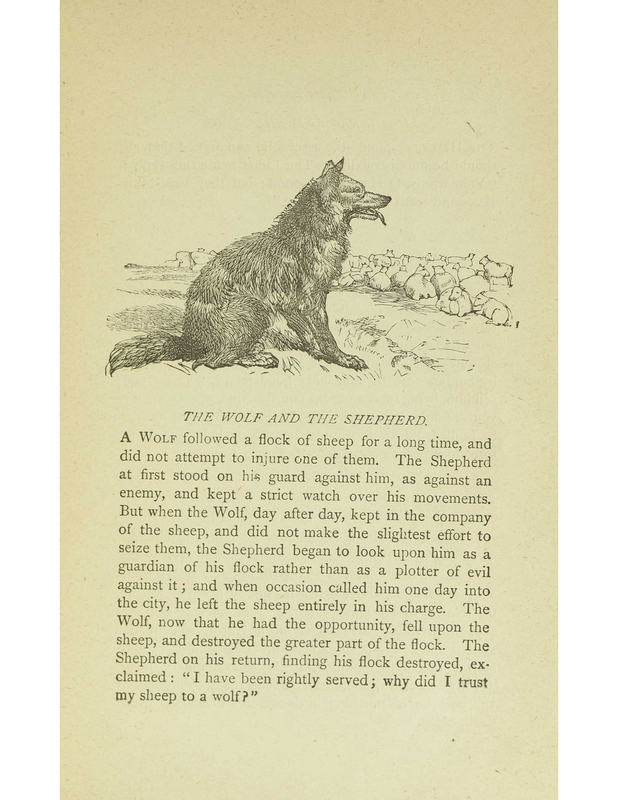
On the left side of the image, a wolf is sitting down looking straight ahead. The wolf’s tongue is sticking out. In the background near the wolf is a large flock of sheep, oblivious to the wolf’s presence.
This image is illustrated in a chapter that discusses and criticizes the government and society in Spanish conquered Peru. This image depicts two Spanish government officials hanging a cacique [native lord]. The cicaques would protect and defend their indigenous peoples from Spanish government abuse, and the encomenderos would hang them for it. The encomendero on the right side of the image is holding a card in his hand which reads, ‘petición contra don Juan’ [petition against Don Juan]. Don Juan is the native lord that is depicted hanging on the left side of the image.
Amelia Osborne holds Georgy Osborne tight to her chest, her body turned away from her mother but head facing her with a displeased expression. Mrs. Sedley stands next to her, in shock, holding the teaspoon from which she had just been secretly feeding her grandson medicine.
This engraving illustrates Minerva, also known as Pallas, standing on the right side of the engraving suited in armor, holding a lance in her left hand and a shield (with a depiction of Medusa on the front) in her right. We know this is Minerva as the name Pallas is engraved directly beside her. This engraving represents the importance of Minerva and what she brought to the world. Boccaccio explains that Minerva had discovered wool work and weaving. There is a woman on the left-hand bottom corner of the engraving shearing a sheep to signify this discovery. The woman standing behind her has fabric in her hand to signify the art of weaving that Minerva had given to the world. The man in the centre of the engraving is depicted with a millstone in his hand, pressing down into a bucket of olives. Boccaccio explains that Minerva had taught the world of men to do this so that they can extract and use oil from the olives. An olive tree stands in the background to further the significance. There is an owl resting on a tree stump next to Minerva, which Boccaccio explains, represents her wisdom.
Here we see a child who is immortal. There is a small population of immortal people on Luggnag. These people are identified by a spot on their forehead, which is red when the child is born and changes colour throughout their lives. The same image appears in the 1839 Krabbe edition.
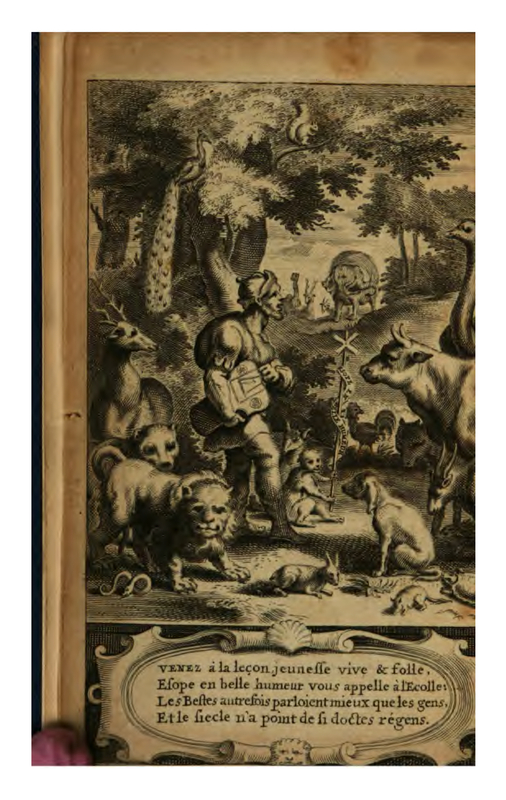
The image is in sepia tone with a man walking through a jungle carrying a bag in his hand. Around the man there is a lion, deer, dog, chicken, bull, calf, rabbit, snake, rat, tortoise and a reindeer. In front of the man, there is a monkey holding a pole with a flag that says Escope en belle humeur. In the far distance around the trees there is an elephant and two more reindeers. The image has a text written in it which reads VENEZ a la lecon jeunelle vive et folle, Elope en belle humeur vous appelle a l'Ecolle: Les Beftes autrefois parloient mieux que les gens, Et le fiecle n'a point de fidoetes regens and the text is framed in a scroll with curved edges.
Rebecca Sharp is seated on the arm of a chair in the great hall at Queen’s Crawley, looking at a large painting of a woman. It is hung on the wall between paintings of other Crawley ancestors. To the left is a cabinet, and to the right is a high-backed armless chair.
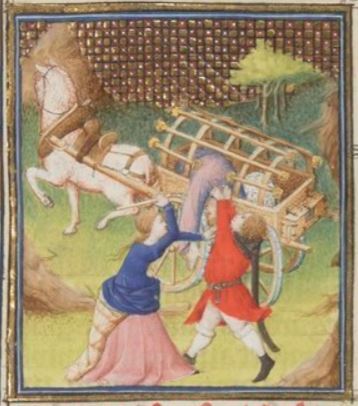
This illumination depicts a woman named Claudia, who was a vestal virgin in Rome. She is depicted grabbing onto a man wearing a red shirt and hitting him. Her father was a noble man who, under the order of the senate, rode through a populous area of Rome on a chariot as he showed off his triumph. A man had run up to Claudia’s father in a rage and was about to attack him, but not before Claudia put herself in front of the man to protect her father. The man in the red shirt is illustrated grabbing on to Claudia’s father and attempting to drag him out of the chariot while Claudia hits the plebeian. Boccaccio explains Claudia is praiseworthy due to her devotion to her father and for her actions of risking her life for him.
In this image we see a procession of diplomats from Blefuscu arriving on Lilliput to make peace. The Emperor of Blefuscu is in the centre of the image riding a white horse and wearing a long cape which is being held up by his attendants. The Blefuscudian Emperor is also wearing a different shaped hat than the others in the party. In the front of the procession is a heralder riding a black horse and announcing their arrival by trumpeting on an instrument. Behind the Emperor is a procession of other diplomats and nobles, one of whom is carrying the banner of Blefuscu. Gulliver is looking on from behind a tower within the walls of Lilliput. The same image appears in the 1839 Krabbe edition.
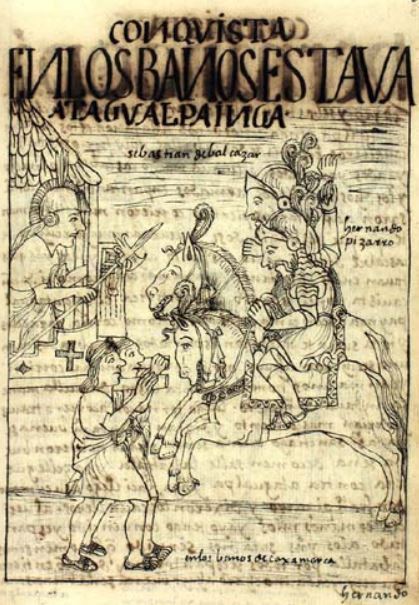
This chapter focuses on discussing the arrival of Spaniards and the Spanish conquest of Peru. This image depicts two conquistadors on the right side of the image, labeled as Sebastian de Benalcazar and Hernando Pizarro. They are illustrated galloping on their horses towards the Inca Emperor, Atawalpa Inca, who is depicted sitting on his royal litter on the left side of the image. The Spaniards and their horses are suited in their armour prepared to fight the emperor to begin their conquest of the empire. Atawalpa Inca and the two men carrying the litter have frightened expressions as they had never seen horses being ridden before. The caption at the bottom of the image identifies the location of this scene. The caption reads, en los banos de caxamarca [at the baths of Cajamarca].
This illumination depicts the goddess Venus standing in the centre of the image, wearing a blue dress and holding her right hand up. Venus was renowned for her beauty, as well as for her discovery of brothels. There are people depicted surrounding Venus as they admire her incomparable beauty.
Elicia goes to Areusa’s house to inform her about the deaths of Celestina, Sempronio, and Pármeno. As she approaches the door, she overhears Areusa in a fit of rage. She realizes that Areusa is yelling at someone (Centurio) and waits for him to leave before entering. Areusa sees that Elicia is in mourning and asks her to explain why, and Elicia tells her about the deaths. With a desire to avenge the deaths that were caused as a result of Calisto's love for Melibea, they decide to ask Centurio to kill Calisto.In this illustration, we see Centurio reaching out toward Areusa, who appears to be pulling away from him. She is wearing a robe and a veil, while he is wearing a hat. In his left hand he is holding a sword, the tip of which is resting on the ground. To the right we see Elicia awaiting the departure of Centurio (in the narrative she waits outside the house). She is wearing a robe and a veil, and her posture and expression convey an air of sadness.The entire image is identical to those found on pages 200 and 246 of the text.
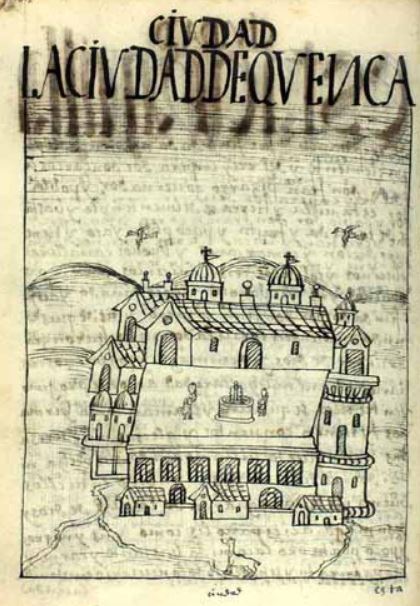
This image is depicted in the author’s chapter where he discusses cities, towns, villages, and provinces in colonial South America. This image depicts the city of Cuenca in Ecuador. The city is depicted as a cluster of buildings that form a square in the centre. There are two people standing in the square approaching the fountain that is situated in the middle. There is a llama outside the city walls and birds flying above the city. The author explains that this city was founded by the conquistador Francisco Pizarro and that it had many good Christians living in the city. The caption at the bottom of the image reads ciudad [city].
Four artists watch Rebecca Sharp performing a caricature with her two dolls, Miss Pinkerton and Miss Jemmy. Rebecca is seated upon a large cushion and leaning back against a table upon which there is a statue. One of the artists is seated backwards on a chair next to her with another standing behind him; the other two stand across from her, one leaning on a table with a bottle upon it, the other beneath a bust on the wall.
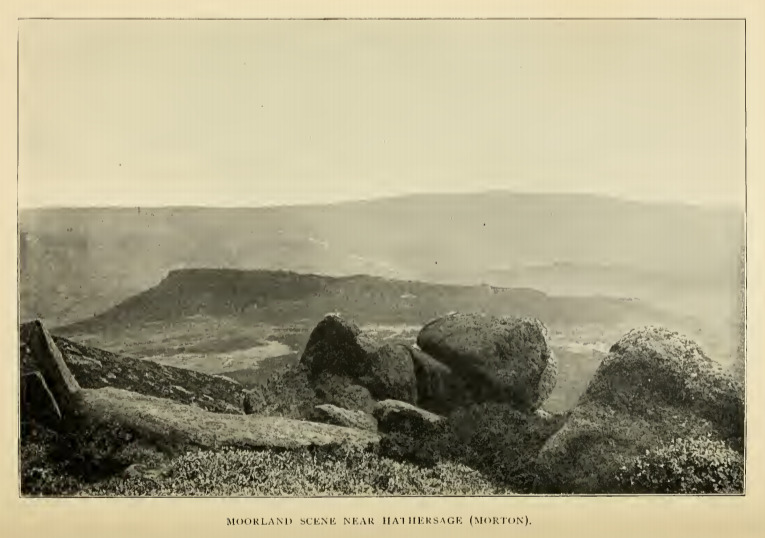
Here we see the moorlands near the village of Hathersage, a village in Derbyshire. After running away from Thornfield after ending her engagement to Mr. Rochester Jane ended up in Morton, which was based on the real village of Hathersage. She arrived at Moor house with Mr. Rivers and his sisters, Diana and Mary. She lived with them for several months and taught at the village school before returning to Mr. Rochester. Before arriving at Moorhouse Jane spent two days and nights walking around the moorlands. The same image appears in the 1899 Bigelow, Brown, and Co edition of Jane Eyre.
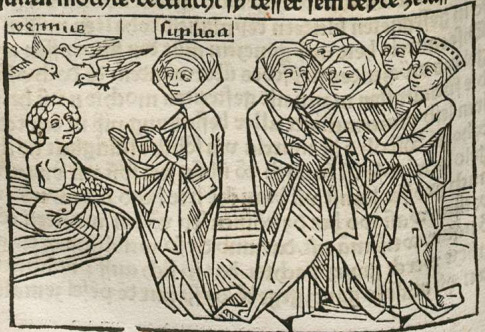
This engraving depicts Sulpicia, a woman renown for her chastity, consecrating a statue of Venus. Sulpicia is depicted on the left side of the engraving with her hands reaching out towards the nude statue of Venus. We know that these figures are Sulpicia and Venus as their names are engraved above their heads. There are doves flying above the statue of Venus as dove’s are known to be one of many symbols of the goddess. There is a group of women depicted behind Sulpicia as they were all chosen as some of the most chaste women of their time, and they all voted for Sulpicia to be the one to consecrate the statue.
Two larger European ships are shown near the coast, as well as seven smaller rowboats filled with colonists. At the tip of the bay there is a large cross. Near the shore is an Indigenous village labelled ‘Acutia’, with several long structures, a fence, and several mounded structures. One Indigenous person stands in the village. Four colonists armed with spears and rifles approach the village from the left.
Elicia and Areusa go to Centurio’s house to request that he avenge the deaths of Celestina, Sempronio, and Pármeno. When Centurio acts arrogantly toward her, Areusa fakes an unwillingness to cooperate with him, and Elicia tries to calm her down. This causes him to become submissive again. He eventually agrees to kill Calisto, but immediately begins planning ways to avoid fulfilling the task himself. He decides to send some of his men in his place. In this illustration, we see Centurio reaching out toward Areusa, who appears to be pulling away from him. She is wearing a robe and a veil, whereas he is wearing a hat. Further, in his left hand he is holding a sword, the tip of which is resting on the ground. To the right we see Elicia trying to convince Areusa to work with Centurio. The entire image is identical to those found on pages 200 and 222 of the text.
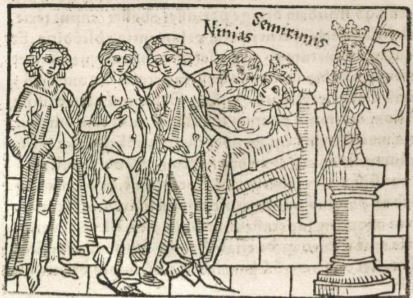
This engraving illustrates Queen Semiramis of the Assyrians lying in bed while having sexual relations with her son, Ninyas. We know that these figures are indeed Semiramis and her son, as the creator engraved their names above the bed to identify them. There is a statue sitting on a platform on the right side of the engraving which appears to be a king. The statue is in fact Semiramis, who had a substantial military career and took part in many battles. The three almost naked women that are illustrated in front of the bed represent the women who Semiramis was afraid of. She was afraid that they would desire her son and take her away from him. Semiramis is said to have invented the chastity belt to avoid anyone having sexual relations with her son. The women are illustrated with undergarments on, which is suggested to be the chastity belts.
In this image we see Gulliver sitting among several large leaves. He is crouched down, contemplating his experiences in the past days on Brobdingnag. The image comes at the end of the first chapter of the second part of the story, after Gulliver described how much more difficult basic things were on Brobdingnag because of his size – specifically moving around and going to the bathroom. The same image appears in the 1839 Krabbe edition.


![[Wolf and Lamb]](https://collections.cemvc.ca/files/large/5248b1609f5c9b2d4624c8e30d3d7d2d92d6cbc4.jpg)
![Q[ve] El Comendero Le Haze Ahorcar Al Cacique Prencipal don Juan Cayan Chire y por Dalle Contento al Encomendero le Cuelga el Corregidor](https://collections.cemvc.ca/files/large/d53f6b9f3ed7b7ac736159b0339d2182e5d89a19.jpg)
![[Amelia and her Mother and Baby]](https://collections.cemvc.ca/files/large/238c31e14ff99e16517ea8f3554d1268c0ef98b8.jpg)

![[an immortal child born on Luggnag]](https://collections.cemvc.ca/files/large/d92b58c56d729a97730b79910af5599279ae97b6.jpg)
![[Rebecca Sharp in the Great Hall at Queen’s Crawley]](https://collections.cemvc.ca/files/large/5f0ea0afd5126ba29f913a2dec6454f667214845.jpg)

![[A procession of diplomats]](https://collections.cemvc.ca/files/large/05fcf4fc950c1c9ffd92440950ba9d0d79d98566.jpg)


![[Act XV – Areusa Recoils from Centurio While Elicia Waits for Centurio to Depart]](https://collections.cemvc.ca/files/large/3fa5e04ad5c1aed3c4926b6b87b2aa6e46bf1497.jpg)
![[Rebecca puts on a Puppet Show]](https://collections.cemvc.ca/files/large/de0bbca514d2e983628c288eb141ea0dda911cff.jpg)
![[Europeans go ashore in rowboats near an Indigenous village]](https://collections.cemvc.ca/files/large/46b8fddc32b5b0bba1063f87780ee0932af7e297.jpg)
![[Act XVIII] Elicia spreect eerst.](https://collections.cemvc.ca/files/large/b7d4484e7ff0b064d155394d8c0088232f8458fb.jpg)
![[Gulliver sits on giant leaves on Brobdingnag]](https://collections.cemvc.ca/files/large/b23437b6e46b2eebb5d174f33cccb76f757fc791.jpg)