In this image Sir William Lucas leaves Charlotte and Mr. Collins in Hunsford. Sir William went to visit his daughter and son-in-law after their marriage. He only stayed a week and after being convinced that Charlotte was settled comfortably, he returned to Meryton. This scene occurs in chapter 30. The characters are shown in the traditional regency style. Sir William and the driver wear waistcoats and tailcoats. The regency period dated to the early nineteenth century (1811-1820) when George, Prince of Wales, later George IV (r. 1820-1830), reigned as regent for his mentally ill father, King George III (r. 1760-1820). The regency period is associated with the rise of neoclassicism in art and fashion.
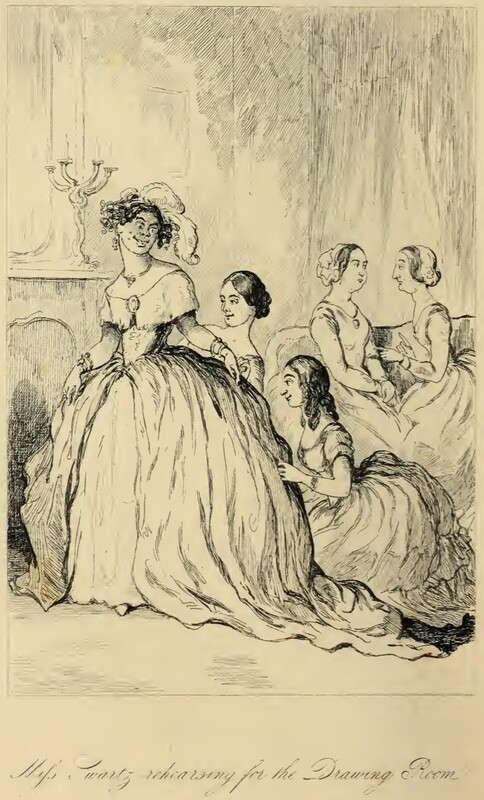
Miss Rhoda Swartz stands in front of Jane and Maria Osborne, dressed in a large gown with many pieces of jewelry and feathers in her hair. In the background, Miss Wirt and Miss Swartz’s chaperone Miss Haggistoun are seated on a sofa, talking to each other. Below the illustration is printed in cursive its title, Miss Swartz rehearsing for the Drawing-Room.
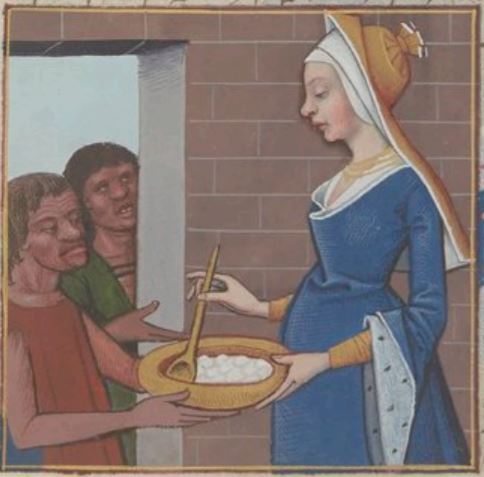
This illumination depicts a woman named Busa holding a bowl of food and presenting it so a group of men at her door. Boccaccio explains that after a city called Cannae was attacked by Hannibal the Carthaginian, the people fled to Canusium. Busa opened her home graciously to the people who fled the danger of war and provided them with hospitality and food. These are the people who are depicted at Busa’s door receiving her hospitality.
Sempronio (rightmost figure) is shown arriving at Celestina’s house to request her aid on behalf of Calisto, and he encounters Celestina (central figure) in the street. In this illustration, she is shown opening her door. Inside, we see Crito (leftmost figure) descending the staircase. Celestina and Elicia attempt to hide him from Sempronio.The entire illustration is identical to the one found on page 95 of the text (folio f1r): [Act V – Pármeno Opening the Door for Celestina and Sempronio].
In this image we see Gulliver pulling Blefuscudian ships back to the port in Blefuscu. Gulliver threw ropes and hooked the ships. Gulliver then used the ropes to pull the ships back to their home port, resulting in damage to the ships. In the image we see Gulliver stepping out of the water onto land with his left arm stretched above his head. In his right hand he holds fifteen ropes attached to ships – not all of which are visible. On the right hand side several Blefuscudians are visible, looking onto the scene. The same image appears in the 1839 Krabbe edition.
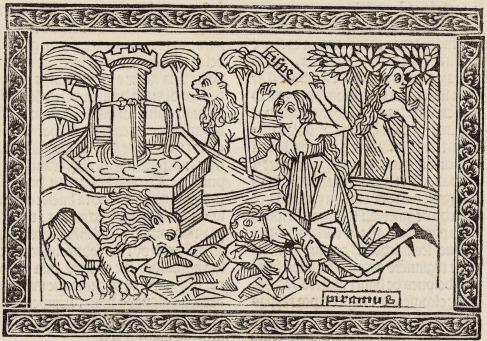
This engraving depicts Thisbe, a young virgin from Babylon killing herself after finding her lover, Pyramus, already dead. Boccaccio explains that the two lovers were forbidden from being together, so they devised a plan to run away. Thisbe waited for Pyramus by the fountain depicted on the left-hand side of the engraving, when a lioness appeared. Thisbe ran into the woods, as depicted in the background on the right side of the image. The lioness, with a bloodied mouth, chewed on the cloak that Thisbe left behind after running. This is illustrated in the foreground of the engraving. Pyramus had then arrived at the meeting point, only to find the bloody cloak of Thisbe. Believing her to be dead, Pyramus killed himself with his sword. Pyramus is depicted in the foreground of the engraving, lying on the ground with his sword impaled into his chest. The creator engraved his name beside his leg to identify him. Thisbe found Pyramus as he was dying and impaled herself with the same sword in order to be with her lover. Her name is engraved just below her left arm.
Two weeks after Gulliver’s arrival in Luggnag the King invited him to court. Gulliver was required to lie on his stomach and lick the dust off the floor (which had been swept because he was a stranger) as he moved towards the King. This task was only allowed for those of the highest ranks at the court when they wanted to be admitted into the court. Anyone who does this is not permitted to wipe their mouth in the presence of the King. When a high-ranking criminal was sentenced to death, they would be executed by spreading a poisonous powder on the floor and having the criminal lick the floor in the same manner. In this image we see Gulliver licking the ground in front of the King’s footstool. In the background we see courtiers who are watching this ceremony. Two courtiers hold brooms, indicating that the floor had been swept before Gulliver began because he was a guest. If someone was an enemy of other courtiers, then extra dust would be spread before they licked the floor. The King sits on his throne with his dog sitting on his footstool, and a large cat behind him. The same image appears in the 1839 Krabbe edition.
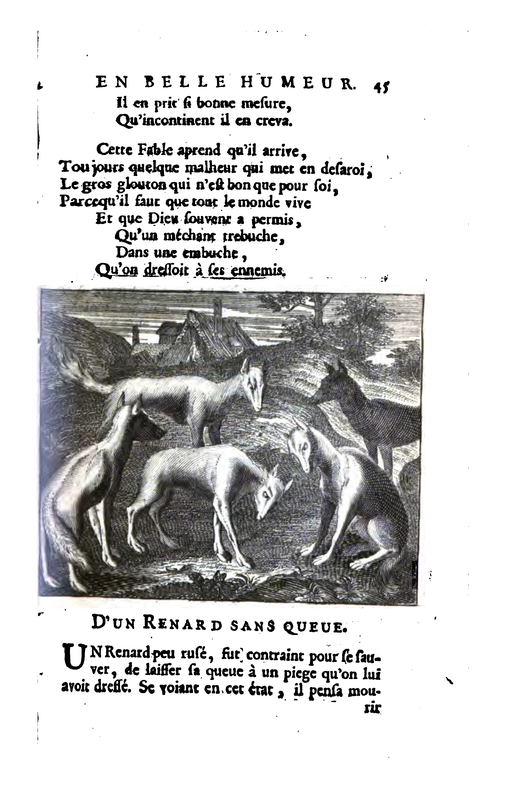
There are five foxes in this image with a central fox without a tail. The fox without a tail is expressing a sad face while the other foxes who all have a tail are just looking at him. There are all standing in a field of grass. There are house with chimney and trees in the background.
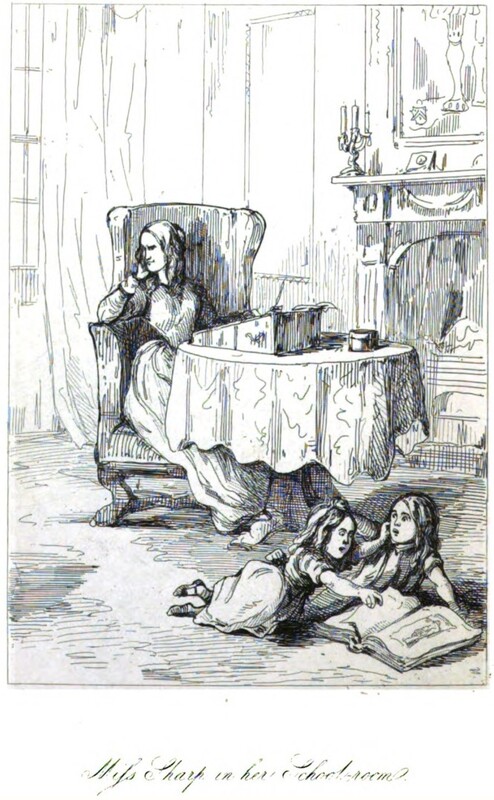
Rebecca Sharp sits in an armchair at a round table with her back to the window, looking irritated. Her table holds a writing desk and round dish. It is next to an ornate fireplace, on the mantle of which are a candelabra and clock, and above which hangs a painting. On the far side of the table Rosalind and Violet Crawley are on the floor, fighting over a very large open book. Violet is pulling on a page from the book and pushing her sister away, while Rose has grabbed her sister by the hair and looks somewhat shocked. Below the illustration is printed in cursive its title, Miss Sharp in her School-room.
In this image a Lilliputian sticks his sword into Gulliver’s nose while Gulliver was asleep. This tickled Gulliver’s nose, causing him to sneeze, throwing the Lilliputian off of his chest. The same image appears in both the 1839 and 1843 Krabbe editions.
In this image the king Fernando is talking with some monks. On the left side of the image there are three monks all in their habits speaking with the king who is on the right. The king is wearing his jewelled crown and he is wearing a cloak over his robes. In the background there is a stained window.
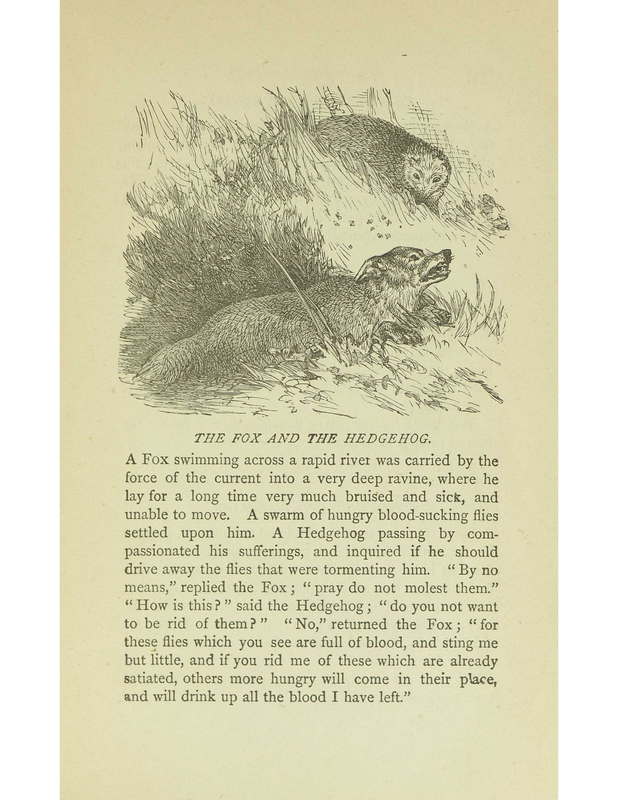
A fox is lying on the ground, looking wet, tired and in pain. Its ears are pushed backwards, and its facial expression shows that it is in pain. Many small flies are flying around and resting on the fox. A hedgehog peaks from behind the tall grass and looks down at the fox. The fox meats his gaze.
A pair of young children stand by the seaside. The girl is wearing a bonnet and has her fingers gripped behind her back, while the boy is holding onto the string of a kite. The kite is shaped like a cone with a rounded top, and flies next to the letter I.
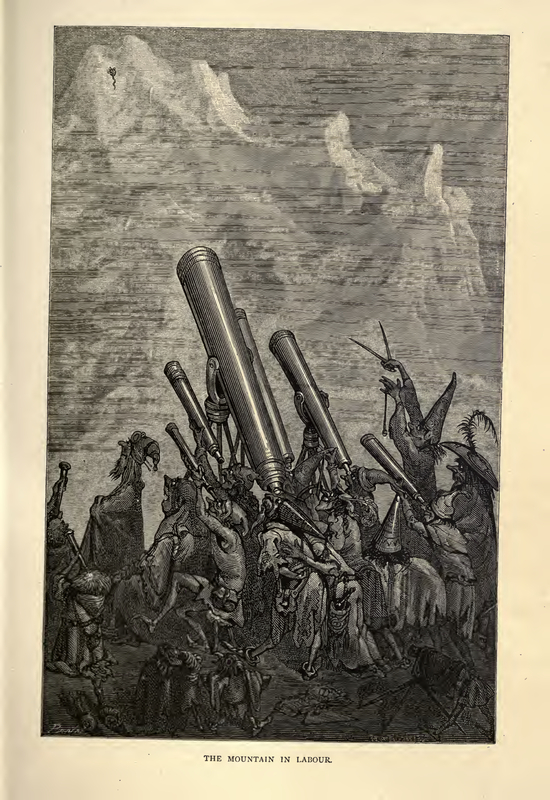
A group of people are gathered around; all wear pointy hats of hats decorated with feathers atop their heads. Many are holding telescopes. Some holding them by themselves, while others look through the telescope as a group of people hold it in place on their backs. All are looking up at the top of a mountain where a small ball with a little tail is flowing up.
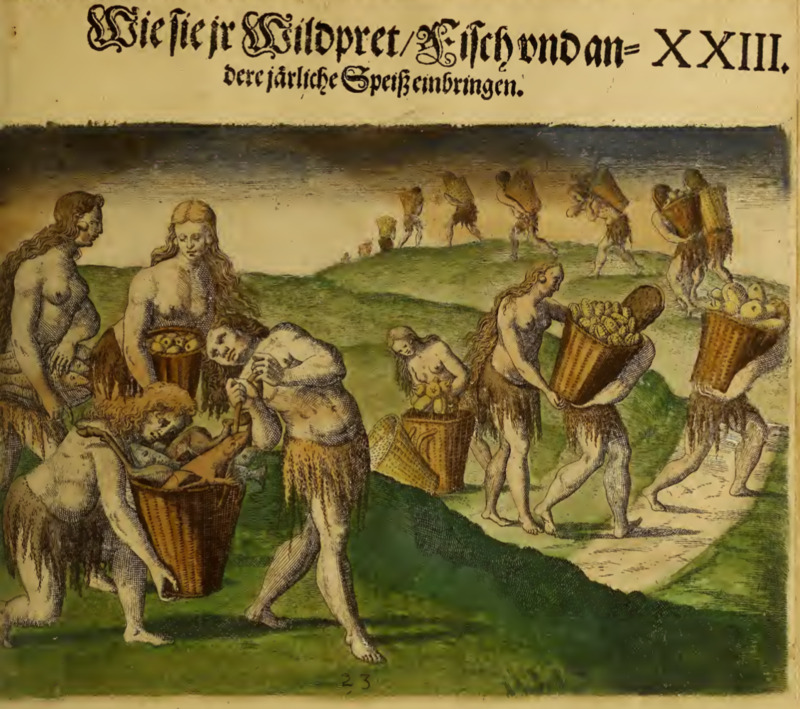
A group of Indigenous people carry large baskets of fish, small wild animals, and produce. This illustration is identical to the one found on page 81 of Frankfurt 1591, but colored.
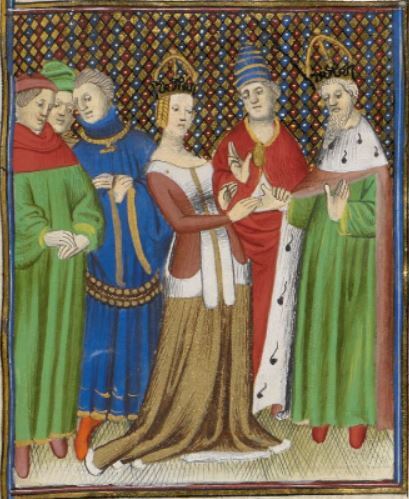
This image depicts Constance, the daughter of King William of Sicily, marrying Henry, the emperor of Rome. Constance was forced to be a nun at a young age due to a prophecy which foretold Constance would somehow cause the destruction of Sicily. Her father, William, put her in a convent to prevent the prophecy from happening. At an older age, Constance was married to Emperor Henry and bore a son at the age of fifty-five (despite being fifty-five, Constance is depicted young in this image). There are three men on the left side of the image witnessing the marriage between Constance and Henry.
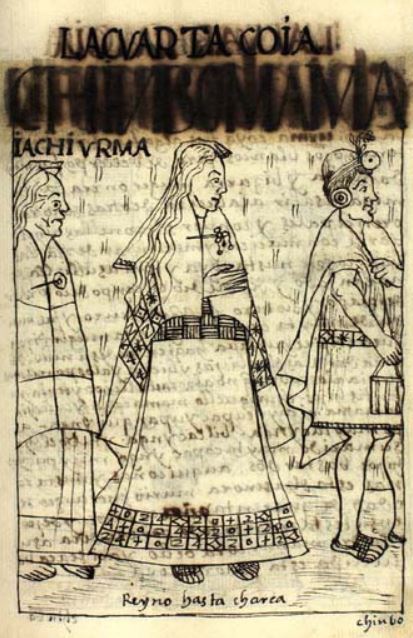
This illustration depicts Mama Yachiy Urma, the fourth Coya [Queen] of the Inca Empire. She was married to the king, Mayta Capac Inca. She is depicted in the centre of the image walking with two other women. The author explains that she enjoyed going out to converse and walk with other women. The words Reyno hasta Charca is written at the bottom of the image, which translates to He reigned to Charca. This is referring to her husband, who reigned the regions up to the region of Charca.
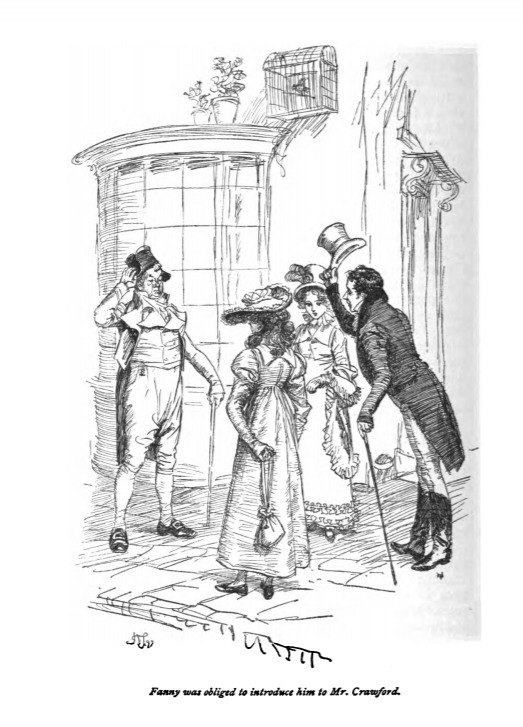
In this image Fanny and her sister Susan were out on a walk with Mr. Crawford, who came to Portsmouth to visit her. They went into town and ran into their father, Mr. Price, and Fanny was obliged to introduce them. Fanny was concerned about her father’s conduct because he had a short temper, but he behaved very gentlemanly. This scene occurs in chapter 41. The characters are shown in the traditional regency style. Fanny and Susan wear regency style dresses with empire waistlines. Mr. Crawford and Mr. Price wear waistcoats and tailcoats with breeches. Mr. Crawford carries a walking stick and raises his top hat. Mr. Price raises his bicorn hat. The regency period dated to the early nineteenth century (1811-1820) when George, Prince of Wales, later George IV (r. 1820-1830), reigned as regent for his mentally ill father, King George III (r. 1760-1820). The regency period is associated with the rise of neoclassicism in art and fashion.
El Cid is riding on a horse while holding a bird. He is looking at Jimena as she also looks back at him. Jimena is wearing black robes with her head covered by them. She is walking in what appears to be a courtyard with trees and shrubbery in the background. There are two columns separating two different entrances. On the other side of the wall dividing the courtyard and the road, El Cid is sitting on his brown horse. He is wearing a tunic, pants and a hat. His hat has a feather on it. He is wearing gloves with a sheath; on this sheath is a dagger. A white cloth covers the horse.

![[Sir William Lucas leaves Hunsford]](https://collections.cemvc.ca/files/large/adb7da5d235da1cacbdfc23510e9195120fe731a.jpg)

![[Act I (Third Illustration) – Celestina and Sempronio Talking as Crito Descends the Staircase]](https://collections.cemvc.ca/files/large/1947a5c0efd75b4e8f26d7b14c017e0faec605cc.jpg)
![[Gulliver pulls Blefuscu’s warships back to land]](https://collections.cemvc.ca/files/large/9d003fed97bbb46735c5b460ff12295187473c46.jpg)
![[Gulliver licks the dust in front of the King of Luggnag]](https://collections.cemvc.ca/files/large/b054911bcf4ff31189deb3c4e9371c5a0ffd025c.jpg)
![[a Lilliputian tickles Gulliver’s nose with his sword]](https://collections.cemvc.ca/files/large/1ddd147eb71424da155ca9fffefac3c7e5e2965e.jpg)
![[Monks speaking to the king Fernando]](https://collections.cemvc.ca/files/large/1426c5c56182cff8217e6d7bd1951edba6daf31c.jpg)
![[Vanity Fair Vol. II Chapter XXXVI Inhabited Initial]](https://collections.cemvc.ca/files/large/47fb52267d9d5adf7746b0cfdbde868403be6f84.jpg)
![[The Cid courting Jimena]](https://collections.cemvc.ca/files/large/4e578810d518a51149a7e9d079ad6f4aa9421e88.jpg)