Mr. Pitt Crawley introduces Miss Briggs, his aunt’s companion, to Lady Jane Sheepshanks, his betrothed, with a smug look on his face. Miss Briggs, on her way home from the library, is holding one of her books and has dropped two others. Lady Jane is half hidden behind Mr. Crawley, looking shy.
This image is illustrated in a section where the author discusses and calls for literacy and better bilingualism amongst Andean nobles in the colonial Spanish government. He desires native officials to be bilingual in Spanish and Quechua in order to better navigate the colonial system and be better equipped to help the native people of Peru. The local official depicted in this image is a municipal mayor. He is illustrated standing in the centre of the image dressed in Spanish trousers and holding a rosary in his left hand and a long staff in his right hand. The author explains that this official came from a pichkapachaka,’s town [an administrator who oversees towns of 500 natives]. The author also explains the mayors should be good Christians and speak Spanish. The caption at the bottom of the image reads, en este rreyno [in this kingdom].
Captain Rawdon Crawley and Rebecca Sharp are in the center of the image, hand-in-hand as they perform a country dance. Mrs. Martha Crawley, Reverend Bute Crawley’s wife, is playing the piano in the background. Through the opening to the next room, a portrait hanging on the wall and a man playing cards can be seen.
As midnight approaches, Calisto (central figure), Sempronio (leftmost figure), and Pármeno (left-central figure) leave for Melibea’s house. Calisto asks Pármeno to knock on her door, but Pármeno replies that it would be best if his was the first voice she heard. When Calisto knocks, he is first greeted by Lucrecia (rightmost figure?), who confirms his identity. Calisto and Melibea (right-central figure; only her shoulder and headpiece are showing) talk for some time through the door, but soon Pármeno and Sempronio hear a commotion in the distance and flee. They realize the noise is coming from the alguacil’s (justice’s) men patrolling another street, and they head back toward Melibea’s house. However, the alguacil’s men soon enter upon the street where Melibea’s house lies, causing Calisto and his servants to flee to Calisto’s house. While Calisto takes his rest, Sempronio and Pármeno decide to pay Celestina a visit.
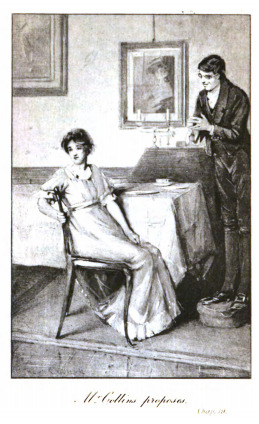
Here we see Mr. Collins proposing to Elizabeth Bennet. Mr. Collins is Mr. Bennet's cousin, and the one who will inherit Longbourn after Mr. Bennet’s death. Mr. Collins paid the Bennet’s a visit and proposed to Elizabeth. She found Mr. Collins insufferable and refused his proposal. Mr. Collins was offended, but ultimately ended up marrying Elizabeth’s friend, Charlotte Lucas. In this image, Mr. Collins holds a ring box, leaning forward to ask Elizabeth for her hand in marriage. She is seated and looks away in disgust. This scene occurs in chapter 20 as noted beneath the title of the image. The characters are shown in the traditional regency style, with Mr. Collins wearing waistcoats, tailcoats, and knickers that stopped at the knee. Elizabeth wears the regency style dress with an empire waist. Her hair is worn tied up, as was tradition for women after their coming out before the queen, signaling her entrance into society. The regency period dated to the early nineteenth century (1811-1820) when George, Prince of Wales, later George IV (r. 1820-1830), reigned as regent for his mentally ill father, King George III (r. 1760-1820). The regency period is associated with the rise of neoclassicism in art and fashion. The same image appears as an insert between pages 106 and 107 for the Dent 1893, 1894, 1895, 1896, and 1897 editions of Pride and Prejudice.
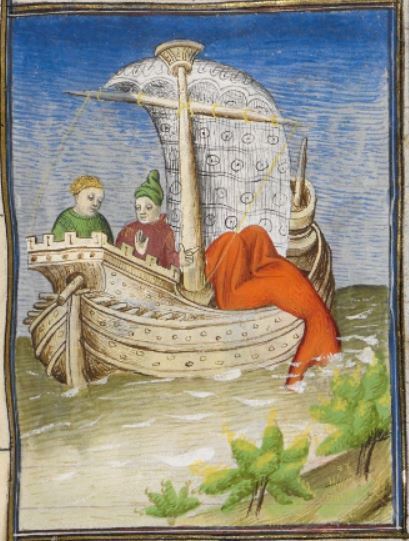
A Greek woman named Hippo is depicted on the ship in the centre of the image as she plunges herself headfirst into the ocean. Hippo had been captured by enemies, and when she heard the men discussing a plan to defile her chastity, she decided that an early death was far better than having her honour destroyed. She drowned and successfully saved her honour.
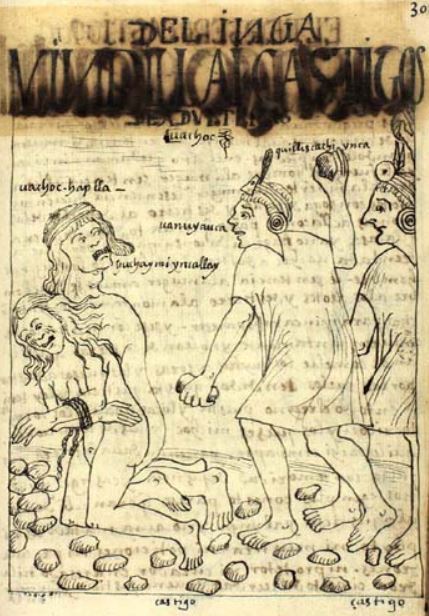
This chapter is dedicated to discussing the justice and punishment systems of the Inca Empire. The author discusses five methods of punishment in detail, and this image represents the third punishment. This image depicts the punishment for adultery in the Inca Empire: death by stoning. The author explains that the capital punishment would be received by both the man and the woman participating in the adulterous act, and their bodies would not be buried, but rather given to wild animals. If a woman or a man was raped, the rapist would receive the capital punishment and the person who was raped would receive a non-lethal punishment. This image depicts a naked man and woman on the left side of the image being stoned to death by the two officials on the right. The word huacoc [adulterer] is written at the top of the image to describe the events. The word huacoc haplla [violent adulterer] is written above the naked man’s head and the words huchaymi yncallay [it is my fault my Inca] are being spoken by the naked man. The words uanuy auca [die enemy] are being spoken by the man holding the stones. There are words written above the stone that the man is holding which reads quillis chachi ynca [a tribe in the valley of Anta].
This image serves as a satire on the relationship between the Houyhnhnms and the yahoos. The Houyhnhnms are shown with the body of a horse and the head of a human, representing their intelligence. The yahoo is shown with the head of a donkey and the body of a human. The image represents how their society was flipped from what Europeans were accustomed to. The yahoo sits on a globe, with various scientific and artistic instruments surrounding him. The same image appears in the 1839 Krabbe edition.
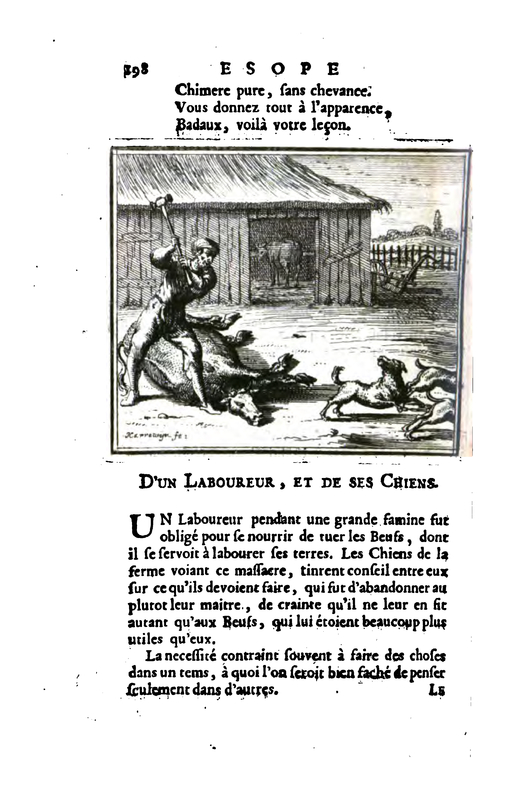
A man is holding a hammer above his head with both hands while a large cow lay at his feet. A group of dogs can be seen running away from him looking back. In the distance there is a barn with another cow inside.
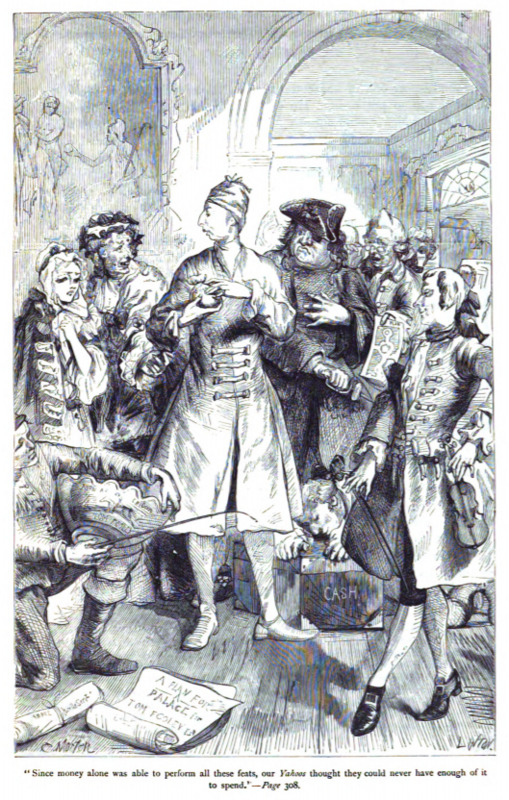
Here we see Europeans and their views on money, as Gulliver explained to the Houyhnhnms. The Europeans grasp onto their bags of money. In the background we one man kissing a cash box. The Houyhnhnms were shocked when they learned about the conduct of Europeans.
Here we see Gulliver as an old man. He imagines how he would spend his life if he were born immortal like some individuals on Luggnag. He begins by saying that he would make himself rich by all arts and other methods. By proper management of his money, he estimates within two hundred years he would become the richest man in the kingdom. The second thing Gulliver says he would do would be to apply himself to learning all the arts and scientists. Finally, he says he would record every consequential event and their outcomes, specifically changes to customs, language, dress, and diet. He would do this to become a living treasury of knowledge, thus making himself the Oracle of the Nation. The same image appears in the 1839 Krabbe edition.
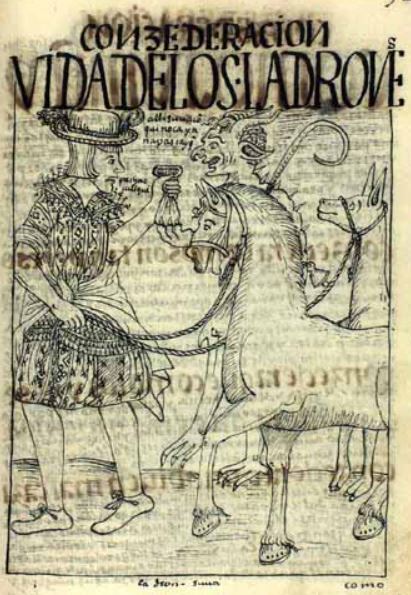
This image depicts an indigenous thief dressed up as a nobleman. The author criticizes indigenous peoples who would steal, lie, and gamble, and believed them to be worse than Spaniards and black people. The indigenous man is depicted holding a bag of money in his left hand and the reigns to the horse and llama in his right hand. There is a devil depicted standing behind the horse speaking with the indigenous man. The devil is illustrated with horns, long ears, and talons for feet. The devil has dialogue written by his head which reads, Alli suuaconqui. Noca yanapascayqui [You’ll be a good thief. I’ll help you]. The indigenous man replies, Pachac Cullqui [Here’s a hundred pesos]. The caption at the bottom of the image reads. ladrón, suwa [thief].
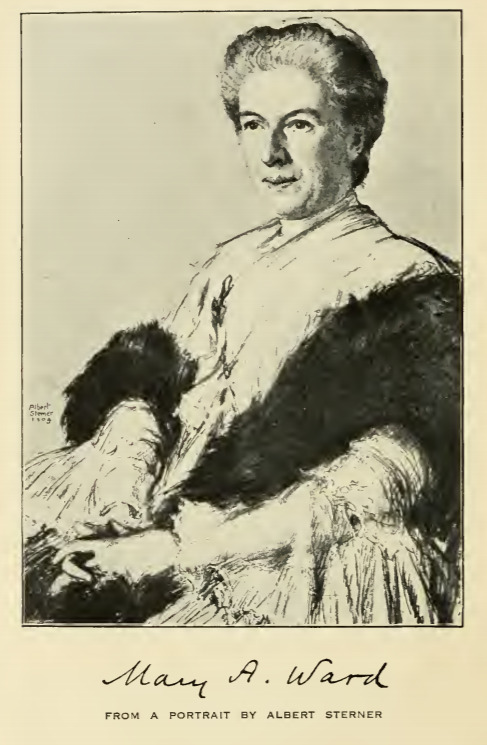
Here we see a portrait of Mary A. Ward, a British novelist who wrote an introduction to Jane Eyre. The image is a reproduction of a drawing by Albert Sterner. Mary Ward often wrote under her married name, Mrs. Humphrey Ward. She was also the founding president of the Woman’s National Anti-Suffrage League.
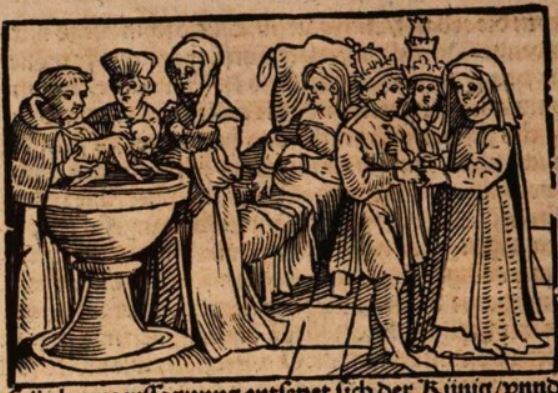
The right side of this engraving depicts Constance, the daughter of King William of Sicily, marrying Henry, the emperor of Rome. Constance was forced to be a nun at a young age due to a prophecy which foretold Constance would somehow cause the destruction of Sicily. Her father, William, put her in a convent to prevent the prophecy from happening. At an older age, Constance was married to Emperor Henry and bore a son at the age of 55. Constance is depicted in the centre of the engraving lying in a bed after giving birth to her son, Frederick. Frederick is depicted getting baptized on the left side of the image. The baby grows up to be the one to fulfill the prophecy that King William was fearful of.
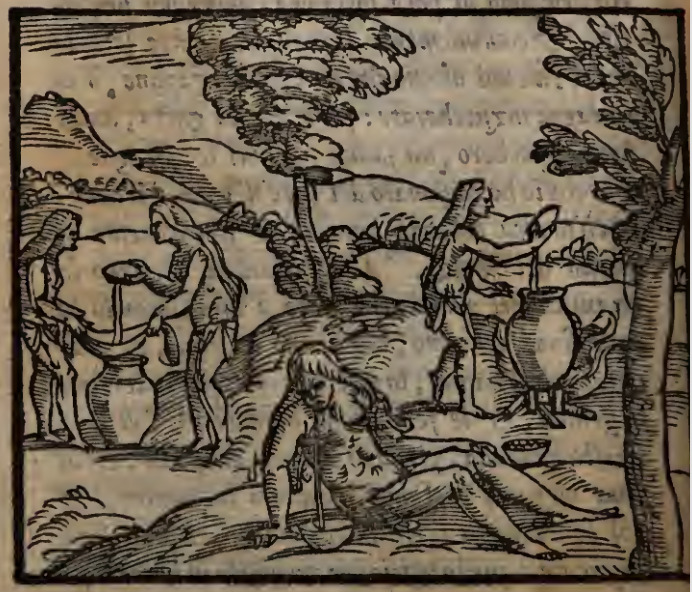
Four Indigenous women prepare an alcoholic beverage. The woman in the middle sits on the ground while she chews on the corn or grain used to make the alcohol and spits it into a bowl beside her. Two women on the left strain the saliva mixture into a large pot using a cloth. On the right, another woman pours the strained liquid into a pot over a fire to boil.
There are two men in this image. The one kneeling down is Alvar Fañez and the one standing up is the king Alfonso. Alvar Fañez is wearing a tunic that covers his head. He has a moustache. He is pointing at the ground at some jewels and coins. The pile consists of money, hats with jewels on them, and little treasure chests. The king is wearing his crown with a tunic with a pattern at the end of it and a cloak. He has a long beard.
After Areusa gets information from Sosia about the encounters between Calisto and Melibea, she and Elicia pay Centurio a visit. He acts arrogantly at first, but Areusa pretends that she is still upset with him, causing him to become submissive. She then asks him to avenge the deaths of Pármeno, Sempronio, and Celestina by murdering Calisto. He agrees, but he immediately tries to find some way of escaping his duty. He decides to send Thraso and his companions to fulfill this promise.
Here we see a flock of Lilliputian cattle walking towards the town. The cattle is attended by a Lilliputian man. Gulliver’s head and shoulders are visible over the hill where he watches the cattle. The image comes when the Emperor gives Gulliver his own household and staff, with the cattle making up a part of Gulliver’s household farm. The same image appears in the 1843 Krabbe edition.
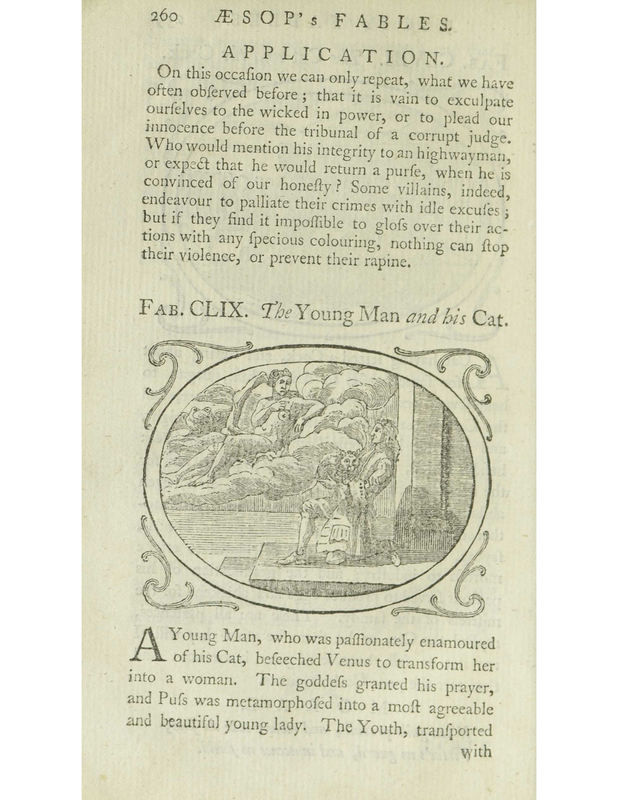
A young man kneels to presents his Cat to a nude women. The nude women is meant to represent the goddess Venus. She sits on top of clouds with doves and looks down to the man.

![[Jane is Introduced to Miss Briggs]](https://collections.cemvc.ca/files/large/f60a20226d2a147c694eb5c21d2308a154e45ab0.jpg)
![Capi[tv]lo Pri[me]ro de las Ivst[ici]as I Cabildo: Alcalde Maior, Tocricoc](https://collections.cemvc.ca/files/large/35af44275b8340a6ea72f11806cca921d82f0134.jpg)
![[Rawdon and Rebecca]](https://collections.cemvc.ca/files/large/3c360481c79b15902d6d3567a111bafbdef1033a.jpg)
![[Act XII (First Illustration) – Calisto Talks to Melibea and Lucrecia Through Melibea’s Door While Sempronio and Pármeno Stand Guard]](https://collections.cemvc.ca/files/large/68e30899b376f934da7fe5931a4b958379d3e2a6.jpg)

![[Vanity Fair Chapter XIV Inhabited Initial]](https://collections.cemvc.ca/files/large/9fda398e7d3c02ec0b62611faece5e717b25ca8f.jpg)
![[a satire on the Houyhnhnms and the yahoos]](https://collections.cemvc.ca/files/large/c0d9e8bec4102fe517cb296df822d9a05ea9e302.jpg)
![[Gulliver imagines his life as an immortal from Luggnag]](https://collections.cemvc.ca/files/large/35cd1b0a4b9eca7a333085a97fb670e05e7cf380.jpg)
![[Alvar Fañez bringing treasure to the king Alfonso]](https://collections.cemvc.ca/files/large/b2e7eb970f2533ccab33b016d7d0c0780bef2bf6.jpg)
![[Vanity Fair Vol. II Chapter XXXIX Inhabited Initial]](https://collections.cemvc.ca/files/large/6129fd2438f442c1853ae9ac0e8d35198eab9d22.jpg)
![[Act XVIII – Elicia and Areusa Talking to Centurio]](https://collections.cemvc.ca/files/large/7a048072dde6a54857979ab38d3c086d96029672.jpg)
![[Flock of cattle overlooked by Gulliver]](https://collections.cemvc.ca/files/large/81c6333e5197d06393c9d76988644e00591dc45f.jpg)
![[The Cid kneels before a bishop]](https://collections.cemvc.ca/files/large/34a8795354e0dc6bb0baab4eb22eaf18376552cb.jpg)