Sancho Panza sits at a clothed table with courtly attire, a fork in his left hand which he uses to feed himself and a knife in his right. Laid out before him on plates are somecow-beef hashed with onions, and calves' feet and a glass of water in the foreground.
Don Quixote, clad in armor, spreads his arms up and orates aloud what he claims to have seen in the Cave of Montesinos at Sancho Panza (left) and the scholar (right). Sancho Panza sits cross-legged, looking towards Quixote, his head resting on his left hand. The scholar sits cross-legged with good posture and waits patiently to hear Quixote's story.
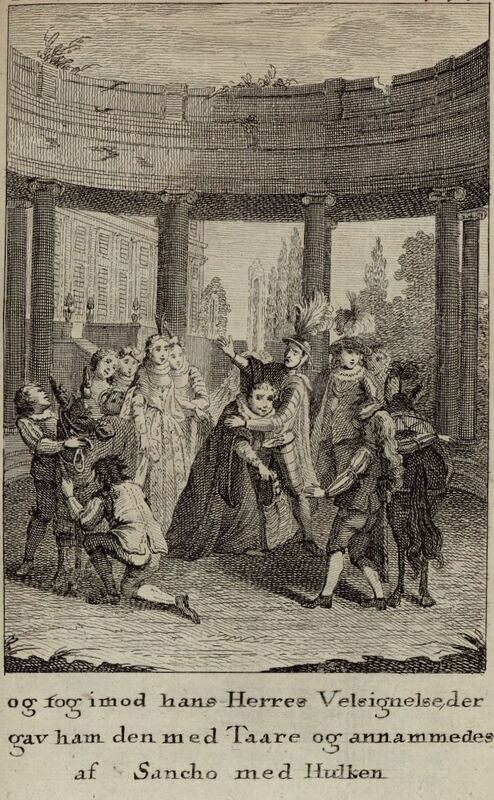
Sancho Panza bids farewell to Don Quixote, the duke, and the duchess before leaving to take up the governorship of Barataria Island. In the centre of the composition, Don Quixote embraces Sancho. The duke (right), the duchess (left), and the servants look on. The illustration is richly detailed (clothes, gallery with ionic columns, architecture, fountains, gardens). Unsigned. Part 2, ch. 44.
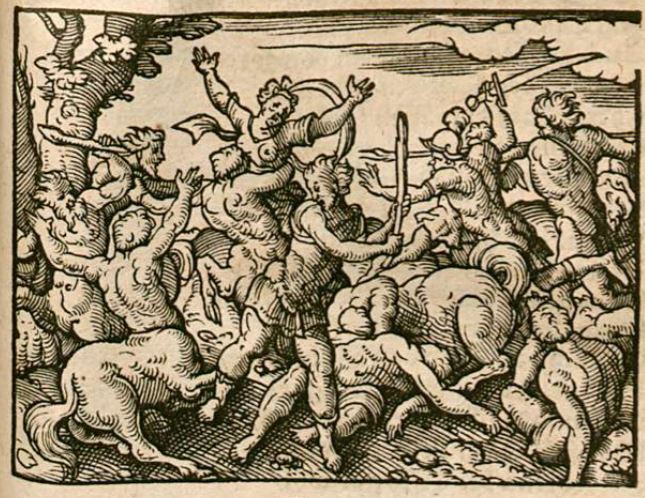
This engraving depicts a chaotic battle between centaurs and the Lapiths. The battle broke out due to one of the centaurs, Eurytus, stealing the bride of Pirithous, the king of the Lapiths. The centaurs were invited to the wedding ceremony, but Eurytus betrayed Pirithous by being overtaken by Hippodame’s beauty and dragging her off. Eurytus is illustrated almost in the center of the engraving with Hippodame in his arms as he carries her away. Her arms are in the air as she pleads for help. Pirithous’ friend, Theseus, is illustrated to the right of Eurytus with a helmet on and his sword behind his head ready to swing at the centaur and save Hippodame.
Having accepted penance of a thousand lashes to disenchant Dulcinea, Sancho Panza (left), with sword equipped by his waist, leans forward. His master DonQuixote (right), clad in armor, leans forward and clings his hands to his squire's neck, kissing his squire on the forehead and cheeks. In the background, the duke and duchess look upon the grateful act very pleased with the happy outcome.
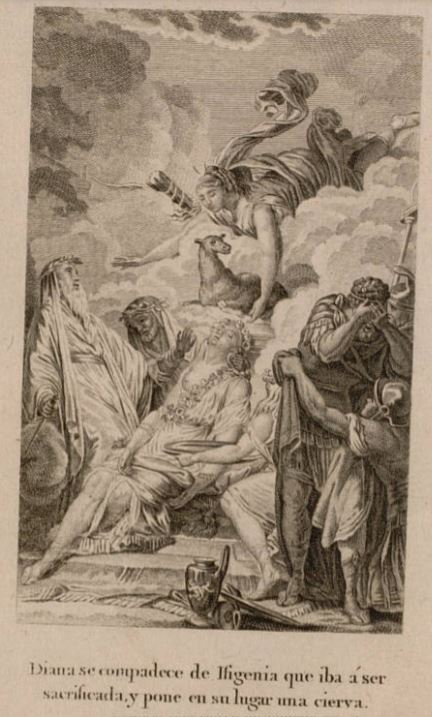
This image depicts the sacrifice of Iphigenia. Iphigenia was the daughter of King Agamemnon and he wanted to sacrifice his daughter to the god Neptune in exchange for a safe passage to Troy. Iphigenia is depicted in the centre of the engraving with the seer Calchas to the left about to sacrifice her with a knife. Her father Agamemnon is on the right side of the image shielding his eyes from watching his daughter get killed. At the last second, Diana substituted Iphigenia for a deer and saved her life. Diana is depicted floating on a bed of clouds at the top of the image holding the doe that she substitutes Iphigenia for.
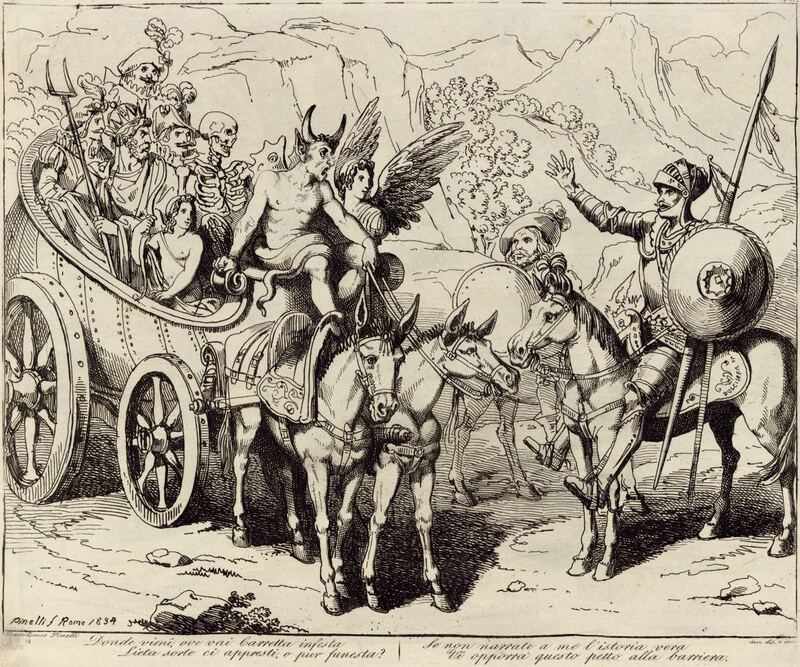
Don Quixote and Sancho Panza encounter a cart carrying the actors of Angulo el Malo’s company for the mystery play ‘The Assembly of Death.’ The latter are dressed as Devil, Cupid, Death, Angel, Emperor, Queen, and Soldier. The knight orders them to stop and tell him who they are. Signed by Bartolomeo Pinelli (engraver and illustrator) and dated Rome, 1833. Plate 42. Part 2, ch. 11.
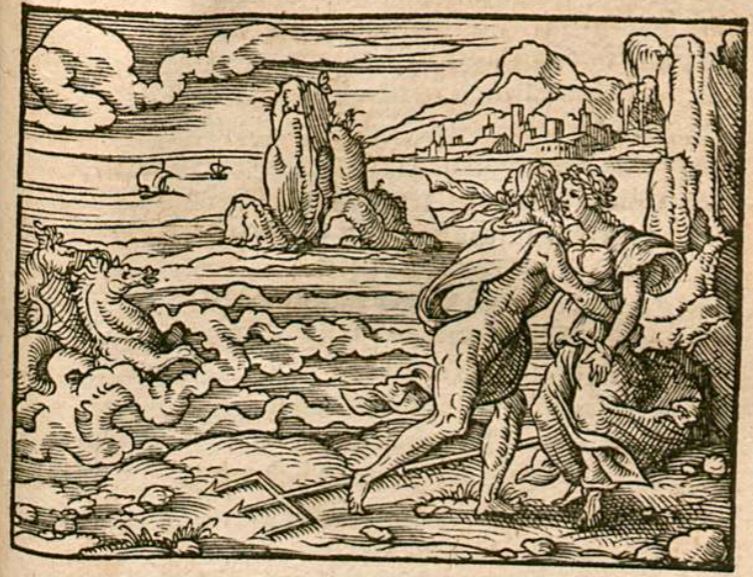
The woman depicted in this engraving is Caenis, a young virgin from Thessaly who had been the prize of many suitors. She was walking along the beach when the sea-god Neptune noticed her beauty and took Caenis by force. Neptune’s trident is illustrated by his feet and his seahorse drawn chariot is visible on the left side of the engraving in the water. After raping Caenis, Neptune grants her one wish. She asked to never be harmed or suffer any pain like that again, so Neptune transformed her into a man named Caeneus who would be protected from all wounds.
A waggons arrives in the forest, drawn by four oxen, all covered with black palls, and a large lighted torch of wax fastened to each horn. The drivers were two ugly devils,similarly habited in buckram, located on both sides of the oxen, each of whom grab the lighted torch from the oxen's horn. At the top of the waggon is fixed a seat, on which a venerable old man sits, with a white beard so long that it reaches below his girdle. He wears a long gown of black buckram. This is the sage Lirgandeo.
Having caught up with his master, Sancho Panza (middle) fell from his donkey at the feet of Don Quixote (left), wounded, bruised, and out of breath, his body limp and his arms by his side. Don Quixote, clad in armor, reaches down to examine his wounds. To the right, Dapple bends down to get closer to Sancho.
A sharp, bright, poniard lying on the ground. Occasioned by Don Quixote saying "It all was true, excepting as to the dagger, for it was neither a dagger, nor little, but a bright poniard, sharper than an awl."
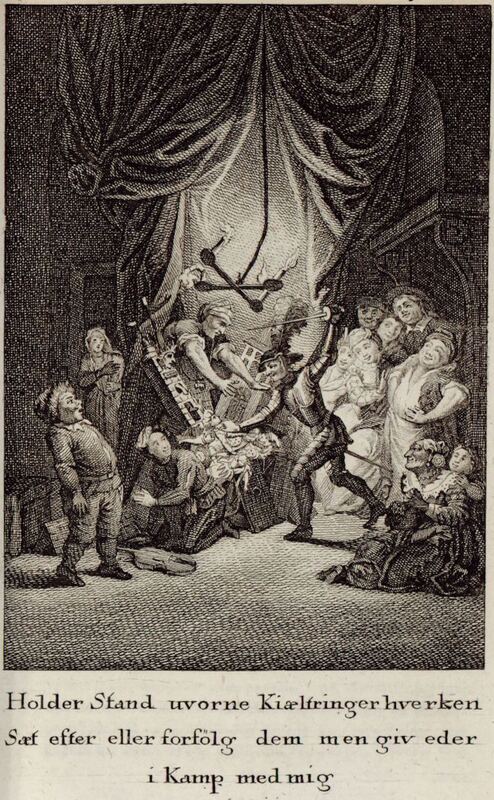
Don Quixote attacks Maese Pedro’s theatre and puppets, while the innkeeper and other astonished theatregoers watch. In the background, a chandelier swings dramatically from the ceiling and a large curtain serves as a backdrop. Unsigned. Part 2, ch. 26.
A naked nymph with long black hair stands in the midst of a river with a forest on the right. The image is occasioned by Don Quixote saying " not the greatest beauty upon earth shall prevail on me to cease adoring her, who is engraven and imprinted in the bottom of my heart and in the inmost recesses of my entrails. Whether, my dearest lady, you be now transformed into a garlic-eating country-wench, or into a nymph of the golden Tagus, weaving tissue-webs with gold and silken twist".
This image appears at the beginning of the thirteenth book. It depicts the hero Achilles lying dead in a burning funeral pyre after just having been slain by Paris. His limbs are visible beneath the wooden logs. A goddess of an unidentified name is depicted flying over the burning Achilles. The armour of Achilles is resting just outside of the fire as it will go to Ulysses.
Don Quixote attacks Maese Pedro’s theatre and puppets, while the innkeeper and other astonished theatregoers watch. In the background, a chandelier swings dramatically from the ceiling and a large curtain serves as a backdrop. Signed by Bonard (illustrator), no given name, and L. Cars (engraver). Part 2, ch. 26.
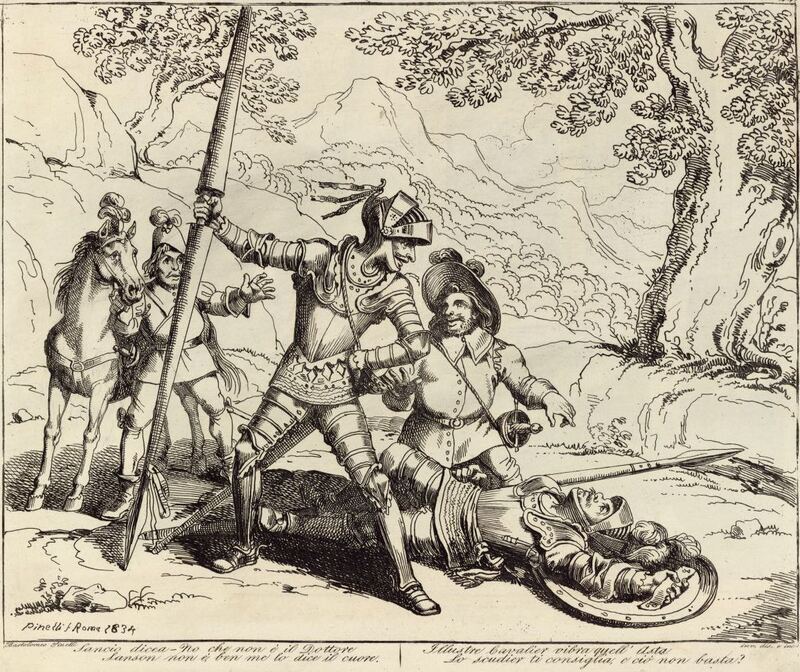
Don Quixote and Sancho Panza discover that the Knight of the Mirrors, lying defeated on the ground, is Sansón Carrasco. Tomé Cecial is pictured in the background, but the illustration is not accurate to the text: he should have a fake big nose. Signed by Bartolomeo Pinelli (engraver and illustrator) and dated Rome, 1833. Plate 44. Part 2, ch. 14.
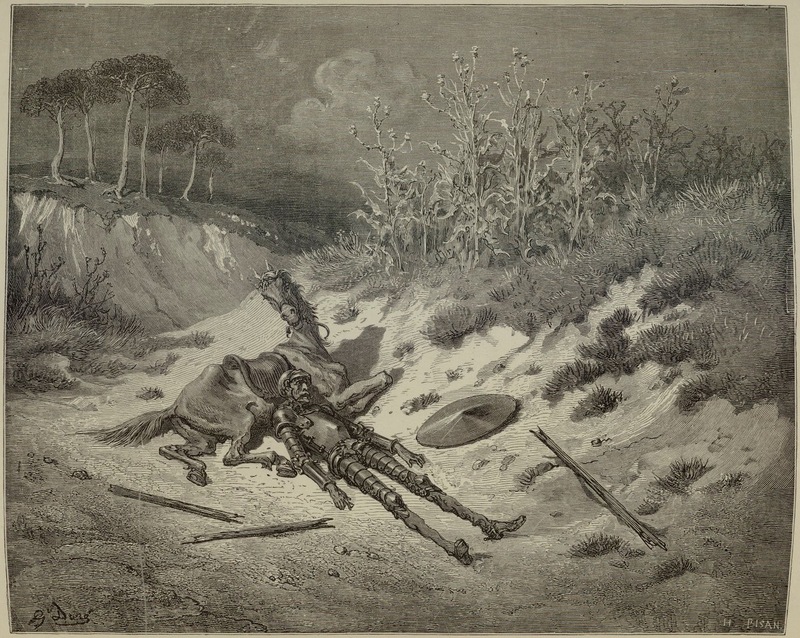
After his encounter with the group of silk merchants from Toledo, Don Quixote is so bruised and beaten that he cannot move. His madness makes him recall the story of Valdovinos and the Marquis of Mantua, who was left wounded by Carloto in the highlands. He recites a ballad about these characters that ends with the lines: ‘O noble Marquis of Mantua / mine uncle and natural lord.’ Signed by G. Doré (illustrator) and H.-J. Pisan (engraver). Part 1, ch. 5.
In the aftermath of their battle, Don Quixote, with a gesture of clemency, orders the Knight of the Mirrors (Sansón Carrasco) to present himself to Dulcinea in El Toboso on his behalf. Sansón’s squire, Tomé Cecial (left) takes off his fake big nose, revealing himself to Don Quixote and Sancho Panza. Sancho Panza has climbed into a tree, and observes the scene from above. Signed by F. Hayman (illustrator) and L. G. Scotin (engraver). Part 2, ch. 14.
In the centre of the illustration, the first barber declares to the second that the basin is Mambrino’s helmet. To the left, Don Quixote grabs Sancho Panza’s arm, who wants to retrieve the stolen packsaddle. Several other characters, among them Don Fernando, observe the scene. Signed by F. Hayman (illustrator) and C. Grignion I (engraver). Part 1, ch. 45.
A procession of musicians marches forward, among them there are two drummers visible (middle and right) with a stick in both hands and their drums tied to their waist. On the left, a hooded man dressed all in black robes plays a fife. Amidst the procession a man much larger than the rest with a long white beard holds a large scimitar in his right hand.
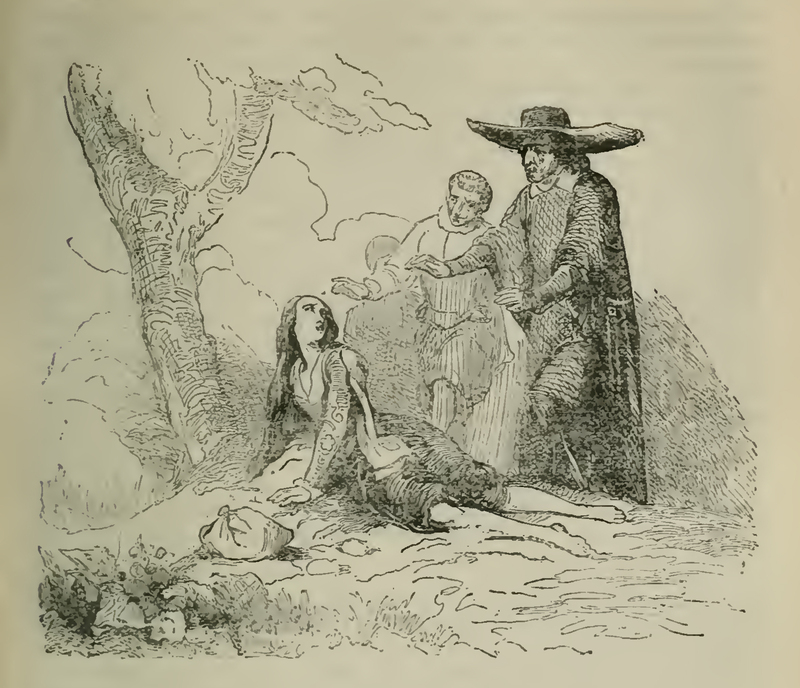
The priest (right), Cardenio (left), and the barber (middle) chance upon Dorotea in the Sierra Morena mountains, sitting behind the fragment of a rock at the foot of an Ash tree. Dorotea is wearing a double skirted grey jacket, girt about the middle with a piece of white linen; with breeches and grey hose cloth. Her hose aredrawn up to the middle of her legs, as she washes her feet in the rivulet. On the ground to Dorotea's left lies a grey huntsman's cap with which she hides her hair.
Don Quixote, his face bandaged and marked by the cat’s claws, lies sleepless in bed. Doña Rodríguez, duenna to the duchess, visits him in his room. She wears long and intricate white veils. Altisidora and the duchess’ other maidens watch from the door, holding their shoes. Signed by Bonard (illustrator), no given name, and L. Cars (engraver). Part 2, ch. 48.
An older woman dressed in black robes (countess Trifaldi) faints away into the arms of two of her pages who catch her before she hits the ground. Meanwhile, on the right, Sancho Panza see's her faint away and lifting his arms denounces the punishment of the enchanter Malumbruno.
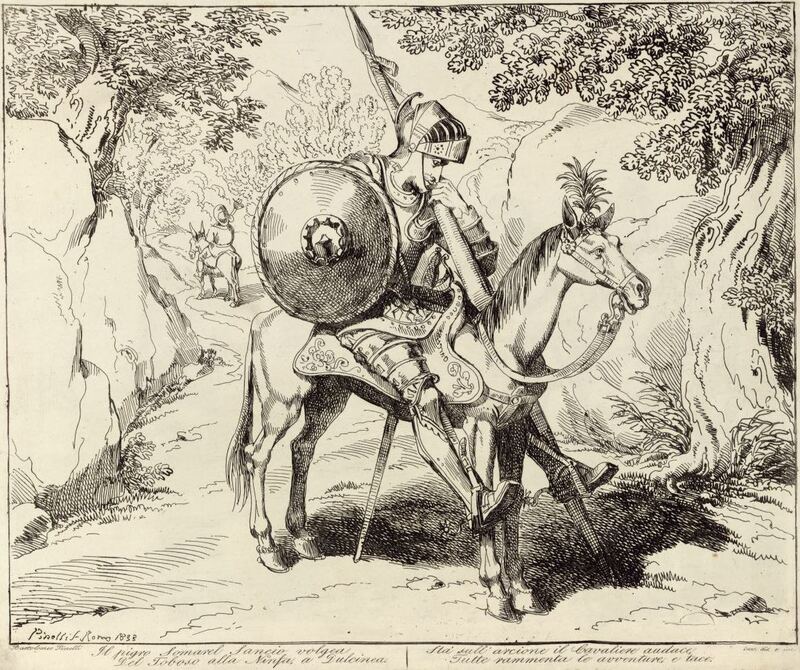
Don Quixote waits in a clearing, mounted on Rocinante and leaning on his lance, while Sancho Panza returns to Toboso. He orders his squire to ask Dulcinea to allow herself to be seen and deign to give Don Quixote her blessing. Signed by Bartolomeo Pinelli (engraver and illustrator) and dated Rome, 1833. Plate 40. Part 2, ch. 10.
Sancho Panza, with receding hair, sits and writes a letter upon parchment on his lap. He turns to his right alighting to speak, a smile plastered on his face.

![[Sancho Panza Eats Supper in the Hall of Barataria]](https://collections.cemvc.ca/files/large/f39e885be5696fafb60f456f1266ea1c565fbca7.jpg)
![[Don Quixote Relates what he had Seen in the Cavern of Montesinos]](https://collections.cemvc.ca/files/large/7e471eb767ed0785a819bc8b79e9c035a6fd6f11.jpg)
![[Don Quixote Kisses Sancho Panza for Accepting his Lashes]](https://collections.cemvc.ca/files/large/ff062e34a6658e54722827eeb0b72cfdc30df9e6.jpg)
![[The Sage Lirgandeo Pulled by Oxen]](https://collections.cemvc.ca/files/large/7b4ccdb2f00c79fe70d307eaecbb3261d10be10d.jpg)
![[Sancho Lies Bruised at Quixote's Feet]](https://collections.cemvc.ca/files/large/f530c5d7b7b99d6e02fde2cfdaef1a06902a117a.jpg)
![[Montesinos' Blade]](https://collections.cemvc.ca/files/large/5a685afe30287e70ac1a71516ab2b6520ad56dad.jpg)
![[A Nymph of the Golden Tagus]](https://collections.cemvc.ca/files/large/767b566fc1dcd51e6c6973e63badc2d3db3d9ec8.jpg)
![[The Death of Achilles]](https://collections.cemvc.ca/files/large/24a4368db449e52d3468d8084aeddfa8639ea321.jpg)
![[Don Quixote attacks the puppets]](https://collections.cemvc.ca/files/large/be7981be11fe1982f4df63de64fa5f352a0a3c6e.jpg)
![[Don Quixote defeats the Knight of the Mirrors]](https://collections.cemvc.ca/files/large/6c7216b11fdac1ed51ac44672ea2a758b8ed8476.jpg)
![[Dispute at the inn over Mambrino's helmet and the packsaddle]](https://collections.cemvc.ca/files/large/ad7d35d1b5d3a66638a80fe98a3c9cd65deb04f3.jpg)
![[A Procession of Drums and Fife for the Squire of Countess Trifaldi]](https://collections.cemvc.ca/files/large/c0814e564cbca981d9a3f3e2c674433808b04b64.jpg)
![[Doña Rodríguez visits Don Quixote at night]](https://collections.cemvc.ca/files/large/20cf4e80852a2430949394c1adac934948d7f727.jpg)
![[The Countess Trifaldi Faints Having Instructed Her Duennas to Lift their Veils]](https://collections.cemvc.ca/files/large/4392f8dadf01e1b68aa044b324c98e1e3f87c4bb.jpg)
![[Sancho Panza Excited at the Prospect of Governance]](https://collections.cemvc.ca/files/large/334e1ff140a2522d6f3cb22bdd221405f47f2ec5.jpg)