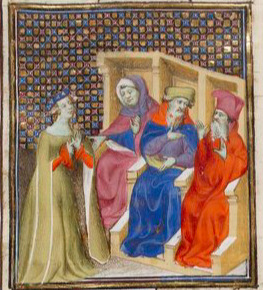
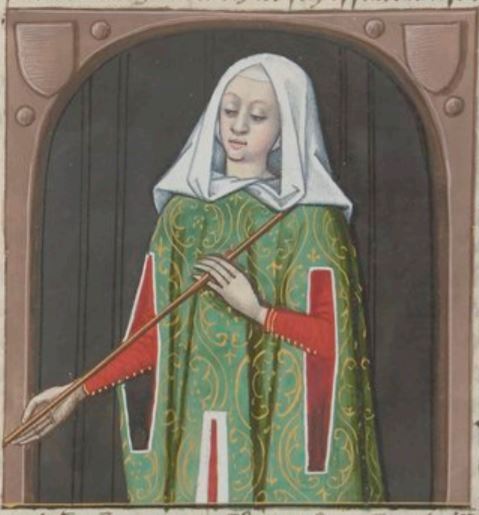
Hortensia bravely fought for the Roman women in front of the Triumvirate. She wanted to relieve them of their heavy taxes that men did not need to pay. She is seen in the green gown, standing before the Triumvirate who are seated in chairs.
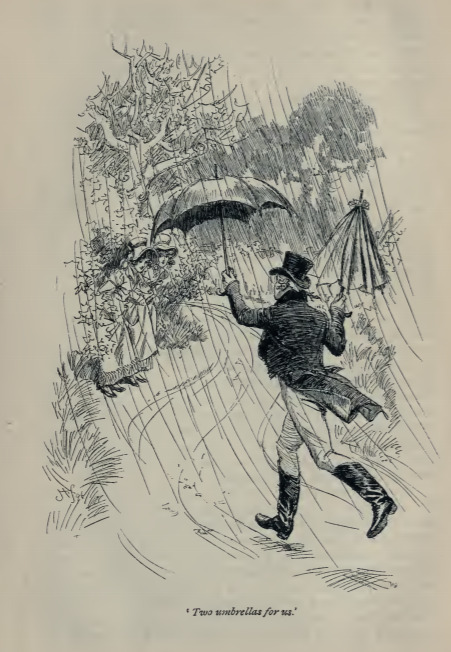
Here we see Mr. Weston bringing out two umbrellas for Emma and her governess, Miss Taylor after they got caught in the rain while out for a walk. The novel opens with the wedding of Miss Taylor and Mr. Weston. This was Mr. Weston and Miss Taylor’s first meeting. Emma recounts this story as a means of consoling her father who was sad that Miss Taylor, now Mrs. Weston, had left Hartfield. This scene occurs in chapter 1. The characters are shown in the traditional regency style, with Emma and Miss Taylor wearing the regency style dress with an empire waist. Their hair is worn tied up, as was tradition for women after their coming out before the queen, signaling her entrance into society. They wear bonnets to protect her face from the sun. Bonnets were a popular accessory at this time because going for walks was a common pastime, and pale skin was believed to be the most fashionable as a means of indicating a woman’s status in the upper class, who did not have to perform outdoor labour. Mr. Weston wears a waistcoat and tailcoat, and a top hat and carries two umbrellas. The regency period dated to the early nineteenth century (1811-1820) when George, Prince of Wales, later George IV (r. 1820-1830), reigned as regent for his mentally ill father, King George III (r. 1760-1820). The regency period is associated with the rise of neoclassicism in art and fashion.
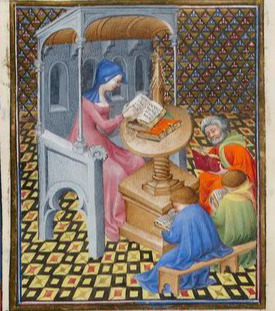
Sappho is seated as her desk, wearing a pink gown. She was known for being able to write incredible poetry, and is probably reading or writing poetry at her desk. Around her are her disciples, who are also reading or writing. Her style of poetry was named Sapphic, and is still known today. It is believed that her mournful poetry is influenced by the muses.
A jester in a checkered suit with a large ruff, holding his hat in his hand, bows deeply to a man in military uniform. A window, through which the heads of two soldiers can be seen, forms the letter O from Our.
This illumination depicts a portrait of Tertia Aemilia, the wife of Scipio Africanus. Her husband had fallen in love with a young servant girl and began having an affair with her. To avoid this secret going public and ruining her noble reputation, Tertia Aemilia set the servant girl free married her off to a freedman. Boccaccio explains that she is praiseworthy as any other woman would have let the infidelity affect their emotions, make the affair public and cause her husband’s fame to be ruined.
A man stands in front of a door of brick-walled house. A dog greets him from the inside of the house, looking up at him with its tongue out and its front legs in the air. The man holds two things in his hands. In his left hand he holds something that looks like some sort of tool, while in his right hand his holds a thick circular object, possibly food for the dog. There are decorative pillars in the background where the man is standing.
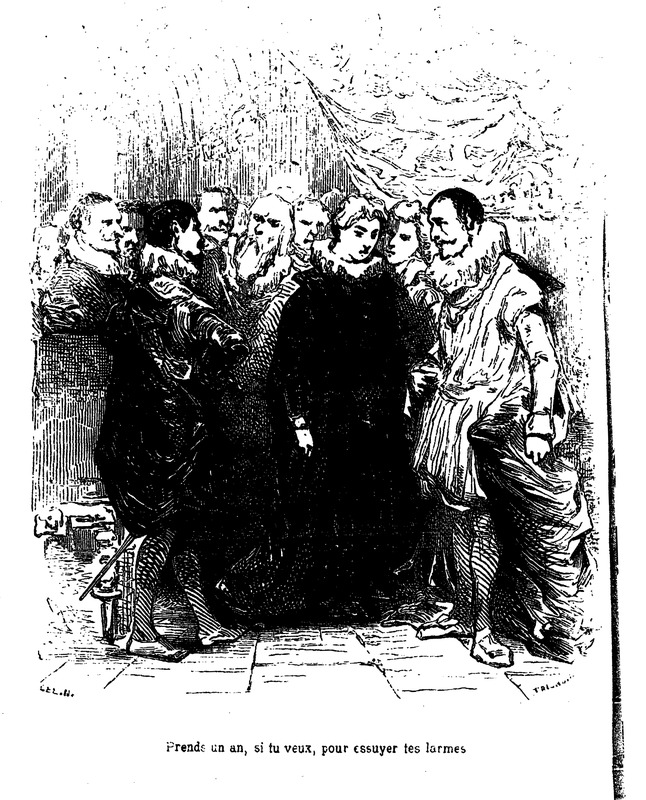
Rodrigue, on the far right, meets with Chimène after she thought he had been killed in a duel by Don Sanche. Don Fernand, the king, recommends that the two marry, as Chimène has done enough to mourn and avenge her father, but as she says that she is not yet ready for that he decides that the marriage should be put off for a year while Rodrigue campaigns in the south.
Two groups of Indigenous people are shown in conflict, one group attacking the village of the others. The attacking group surrounds the village, aiming their bows at the people within the fence. Inside the fence the people are mostly standing around the inside of the fence and shooting their bows and arrows outwards at the attackers. A few women and children are in the center of the village, appearing distressed. At the top end of the village fence there are four poles with skulls mounted on them. In the bottom right corner, six canoes are anchored along the shore.
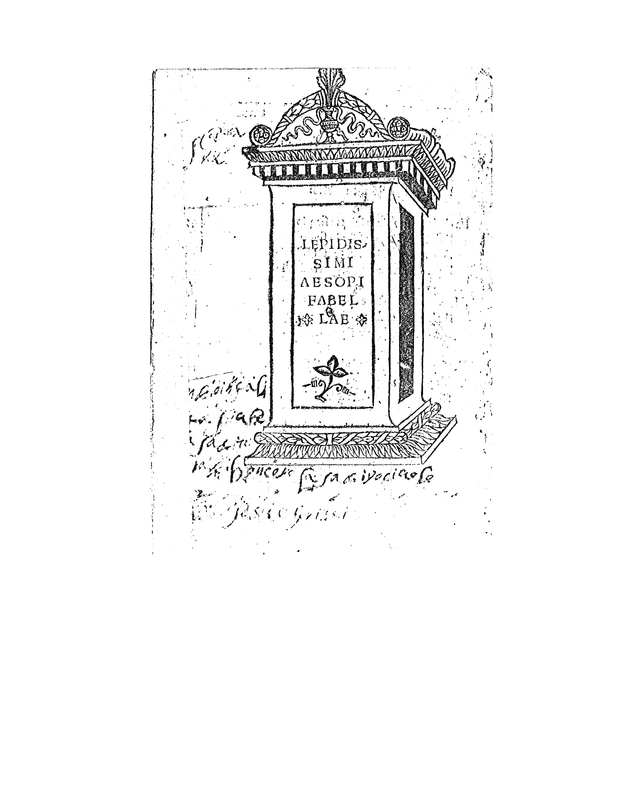
A monument with decorative encravings at the top and the bottom. There is also an engraving in the middle of the momument that reads Lepidis-simi Aesopi Fabel Lae. There is illegible writing in the bottom left of the image.
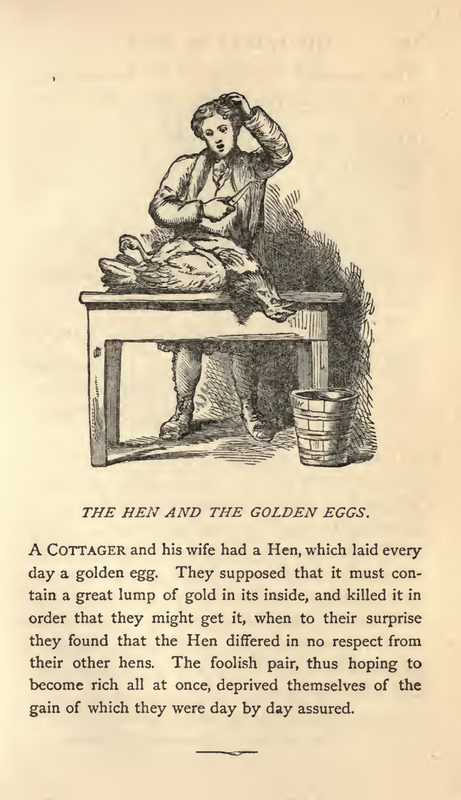
A woman is standing behind a table, holding a knife in her right hand. Her left hand is on her head, and her mouth is agape in sock as she looks down at the lifeless hen on the table. The hen is lying belly up and its stomach seems to have been cut open. There's a bucket in front of the table that seems to be empty.
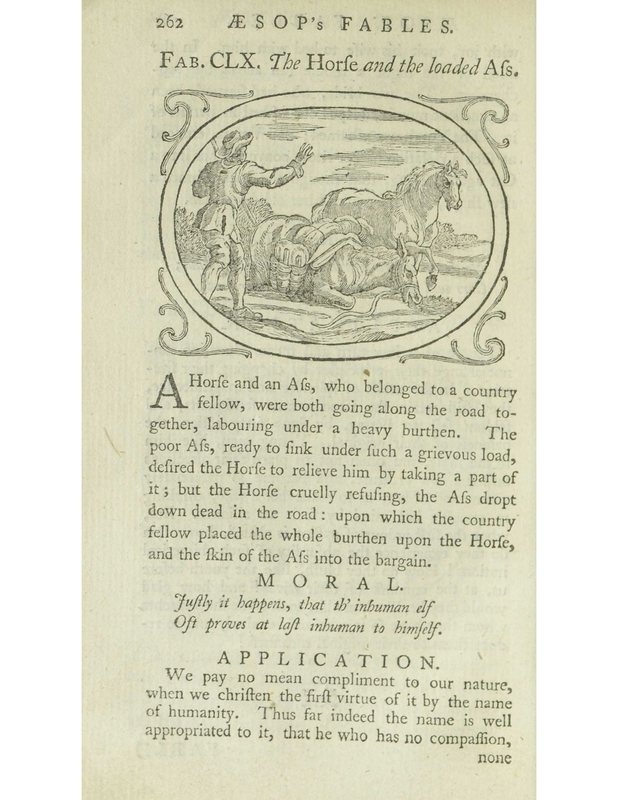
A man stands to the right of a dead donkey, he is holding a large stick. The dead donkey has collapsed under the weight if the cargo they were carrying, their tongue is sticking out. Behind the donkey there is a horse in good condition. The man is calling to the horse.
In this image, we see Gulliver standing next to a door of the castle smoking a pipe while talking to a Lilliputian. Gulliver’s size is shown by the height difference between the door and Gulliver. Gulliver holds a pipe in his right hand, and a Lilliputian in his left hand. The same image appears in the 1843 Krabbe edition.
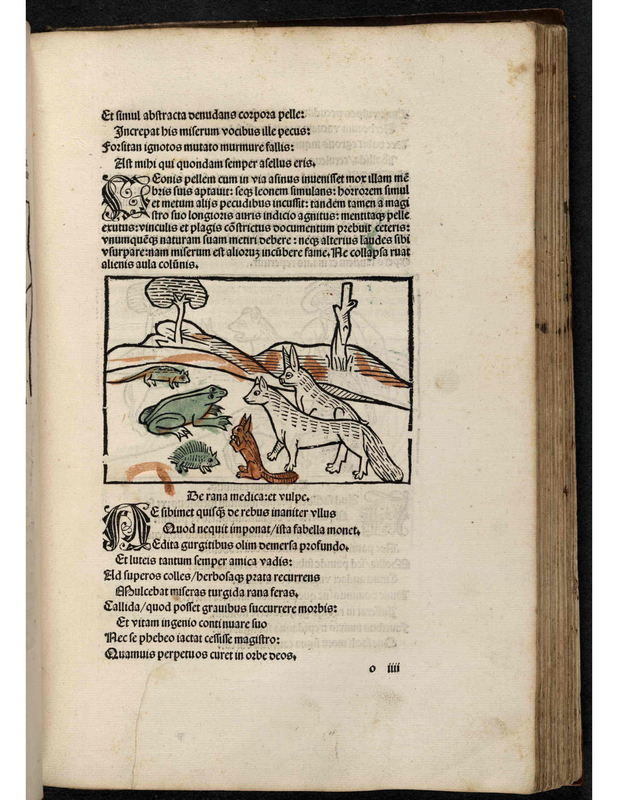
A group of animals have assembled on a hill. A lizard, a frog, and a hedgehog are facing a rabbit, a fox, and a squirrel. On the top left corner of the image, there is a tree with leaves, and on the top right corner of the image, there is a tree without leaves and branches.
A maiden named Joan had disguised herself as a man in order to follow her lover to England while he attended school. Joan had excelled in academics and became incredibly knowledgeable while attending school. Continuing to dress as a man, Joan went to Rome and was elected to succeed as Pope, known as Pope John. No one had known she was a woman, however, she ended up having a love affair which resulted in pregnancy. This engraving depicts Joan, dressed as Pope John laying on the ground with her legs open as she gives birth to a child. The birth happened during a public procession which revealed her identity as a woman. According to Boccaccio, Pope John (Joan), was thrown into a dungeon to die as punishment for posing as a male while holding the title of Pope.
Here we see Gulliver after he was stranded in the Country of the Houyhnhnms. On his fourth voyage Gulliver was the captain of the ship, and his crew mutinied, leaving him abandoned on the beach. In this image we see Gulliver walking alone on the beach, with his ship sailing away. On a rock we see the letter J, which is the first letter of the chapter. The same image appears in the 1843 Krabbe edition.
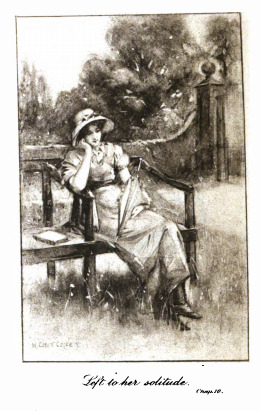
Here we see Fanny sitting alone on a bench in the park outside Sotherton, the house of Mr. Rushworth, Maria’s fiancé. Fanny went on a walk with Edmund and Mary Crawford. She got tired, and the three of them sat down on a bench. Miss Crawford quickly became restless, and she and Edmund continued on their walk, leaving Fanny alone. The rest of the party walked past her and spoke with her, but eventually Fanny went to look for Edmund and Miss Crawford, fearing they had forgotten about her. This scene occurs in chapter 10 as noted underneath the title of this image. The characters are shown in the traditional regency style, with Fanny wearing the regency style dress with an empire waist. Her hair is worn tied up, as was tradition for women after their coming out before the queen, signaling her entrance into society. She also wears a bonnet, used to protect a woman’s face from the sun. These bonnets were a popular style in this era as going for walks were common pastimes. She holds a parasol, a form of umbrella used to shade herself from the sun. The regency period dated to the early nineteenth century (1811-1820) when George, Prince of Wales, later George IV (r. 1820-1830), reigned as regent for his mentally ill father, King George III (r. 1760-1820). The regency period is associated with the rise of neoclassicism in art and fashion. The same image appears as an insert between pages 106 and 107 for the Dent 1893, 1894, 1895, 1896, and 1897 editions of Mansfield Park.
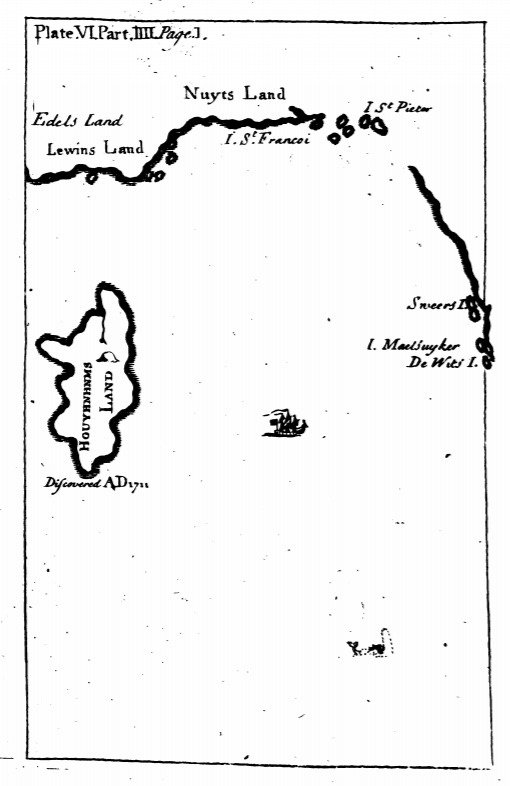
Here we see a map of the Country of the Houyhnhnms. Written under the land is Discovered AD. 1711. The Houyhnhnms’ Land is shown near Nuyts Land and Eidels Land. A man-of-war style ship is shown in the water.
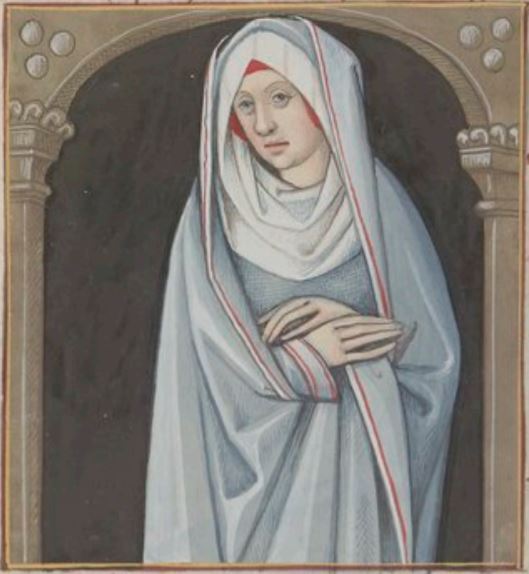
This illumination depicts a portrait of a woman named Sulpicia. Sulpicia is renowned for having been a devoutly chaste woman. Boccaccio explains that Sulpicia was chosen out of one hundred women to consecrate a statue to Venus in the city of Rome. She was chosen for being considered the most chaste out of all the other women.
The decision to include Celestina in this illustration is odd, seeing as neither she (nor any other female character) is included in the second act. However, the illustration likely represents the end of the first act, in which Calisto gives her 100 gold crowns as pre-payment for her services. We see that Calisto (central figure) is holding a small bag, and Celestina (leftmost figure) has something in her hands. Behind Calisto, we see another male figure (either Sempronio or Pármeno), who appears to be yawning.
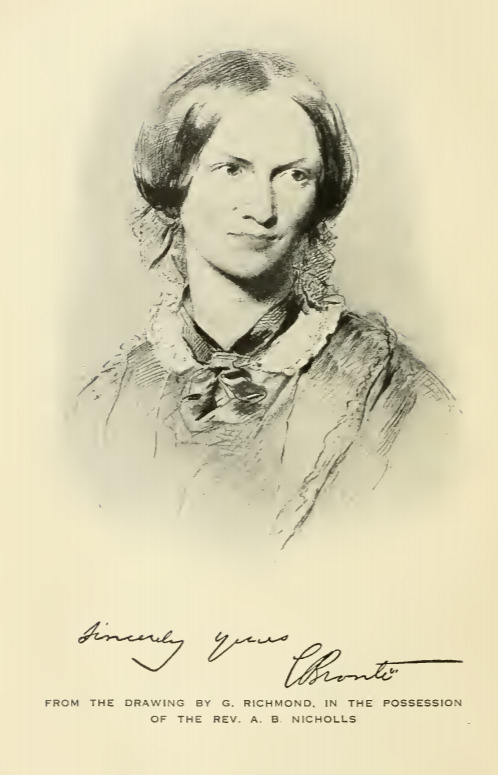
Here we see a portrait of Charlotte Bronte, with her signature underneath. The image is a reproduction of a drawing by G. Richmond. The original is in the possession of the Rev. A. B. Nicholls. The same image appears in the 1899 edition of Jane Eyre published by Bigelow, Brown, and Co.

![[Vanity Fair Vol. I Chapter XVIII Inhabited Initial]](https://collections.cemvc.ca/files/large/d9d20a4fa9e88717f580662002f470e447147aff.jpg)
![[The Man and the Dog]](https://collections.cemvc.ca/files/large/a6b9efcb5c9d02bb439b874fad968efed059dda8.jpg)
![[Two Brazilian Indigenous groups in conflict]](https://collections.cemvc.ca/files/large/52693897cced5c0b627db5e6ac2061059d516cb8.jpg)
![[Gulliver smokes a pipe while talking to a Lilliputian]](https://collections.cemvc.ca/files/large/06d43d5f87894bdee4d1ed3fc4f1df32857ef4e1.jpg)

![[Gulliver is stranded on his fourth and final voyage]](https://collections.cemvc.ca/files/large/f728d259e920f113d91f1b3e4047dcc3b38ea62a.jpg)
![[Act II (First Illustration) – Calisto Paying Celestina While Another Figure (Either Sempronio or Pármeno) Yawns]](https://collections.cemvc.ca/files/large/e1332ddf8ec5439adb1e7527cf74ed661b089f2a.jpg)