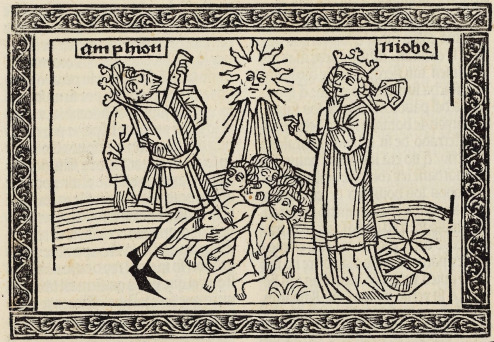
This engraving depicts Niobe, the daughter of King Tantalus of Phrygia, on the right-hand side of the engraving wearing a crown. We know that this is Niobe as the creator engraved her name beside her head to identify her. Niobe had become proud of the fact that she had more children than Latona, mother to Diana and Apollo. As punishment for her hubris against the goddess, all of Niobe’s children, as told by Boccaccio, had been killed by the plague. Her children are illustrated in the centre of the engraving, being killed by the rays of the sun which signify the plague. Grieved by the loss of all their children, Niobe’s husband, King Amphion of Thebes, killed himself with a knife. Amphion is depicted on the left side of the engraving as he pierces his body with the knife. His name is engraved just above his head.
This image depicts the Virgin Mary kneeling before her son, Jesus Christ. Behind Mary is a group of the Church’s Saints. Saint Peter, who is commonly depicted holding keys, is depicted directly behind Mary. Mary has a halo drawn over her head. They are all praying to the risen Christ on the left side of the image. Jesus is depicted sitting above the kneeling Saints, holding a large cross with a halo over his head. He has nail marks on his hands and feet. The author urges his Christian readers to devote themselves to God and Mary. The caption at the top of the image reads, rruega a su hijo Señor Jesucristo y los santos y santas, ángeles del cielo por el mundo y por los pecadores. Aués de conzederar, cristiano, y tener deboción de Santa María de Peña de Francia [pray to her son, Jesus Christ, and the saints and angels of heaven and the world and for sinners. Consider, Christian, having devotion to the Virgin Mary].
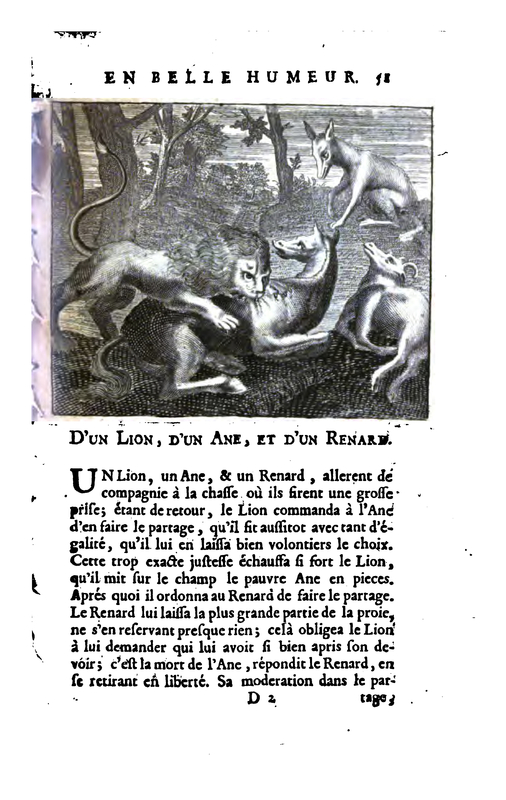
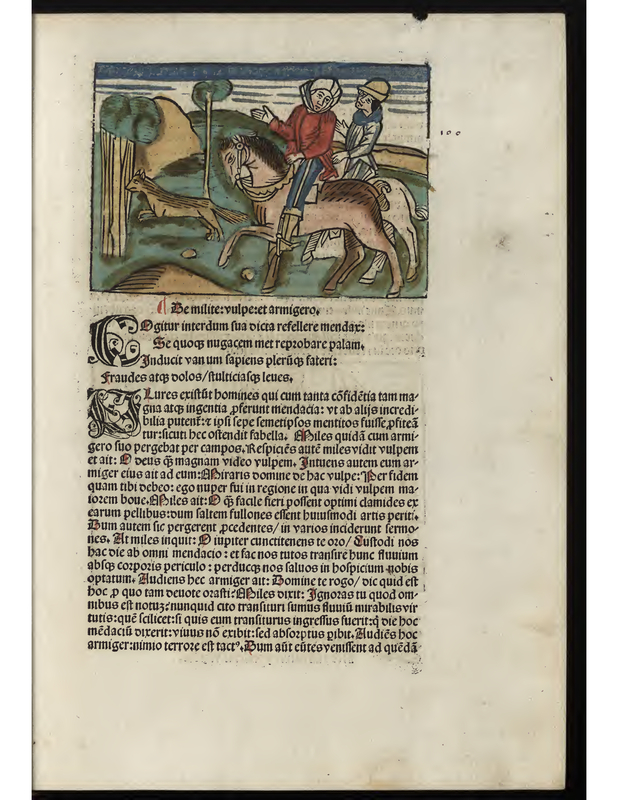
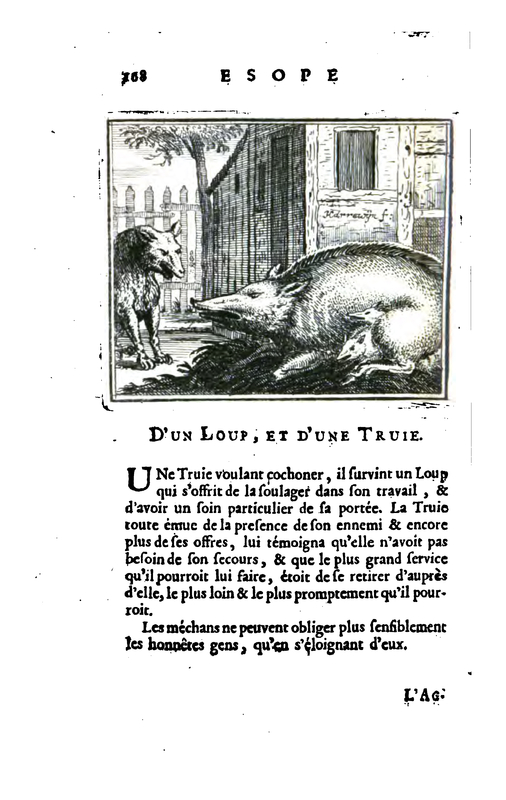
There is a lion in front of the image tearing through the flesh of a donkey. The donkey expresses sadness and terror. There is another donkey next to this scene, possibily already dead but he seems to be just laying down with his eyes open. Behind them there is a fox looking down on his paw. There are trees behind them and houses.
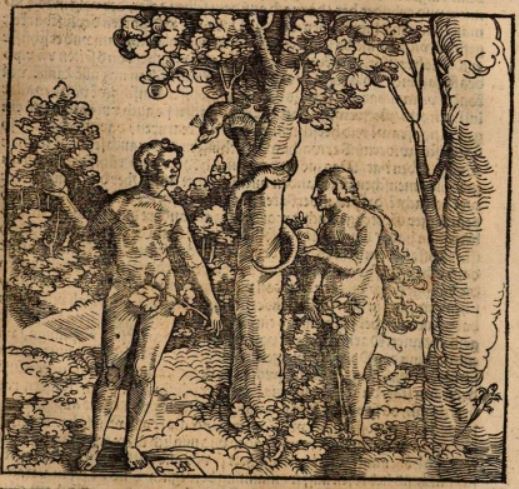
This engraving depicts Adam and Eve in the Garden of Eden. Eve is illustrated on the right side of the image holding an apple from the Tree of Good and Evil in her left hand. Adam is on the left side of the tree, holding an apple in his right hand. The snake that encourages Eve to eat the forbidden fruit is depicted coiled around the tree. Boccaccio explains that he wrote on Eve as the first chapter in his book as she is the first mother of us all.
A scene depicting the simple and happy country life. A shepherdess is depicted sitting on a small hummock, a ribboned staff leaned against her shoulder. A man in uniform kneels before her, clasping her hand in his. Both are looking contentedly at the other. Her crook lies on the ground beside the hummock, and behind it is one of her sheep. In the background are a farmhouse and clocktower, and the top right of the image is the letter B from “Besides”.
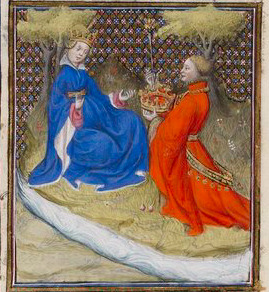
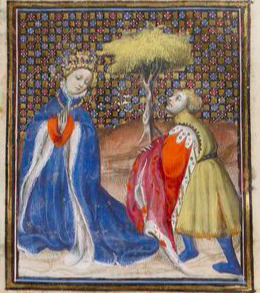
Lavinia, wearing a blue gown and a crown, receives a gift from her husband, Aeneas, who is wearing a red robe. The gift symbolizes his kingdom – Aeneas offered his kingdom before his death.
George Osborne and Amelia Sedley sit together on a chaise lounge, talking. Amelia is working on a bit of sewing, while George is leaning against her with his hat placed upside-down on the floor.
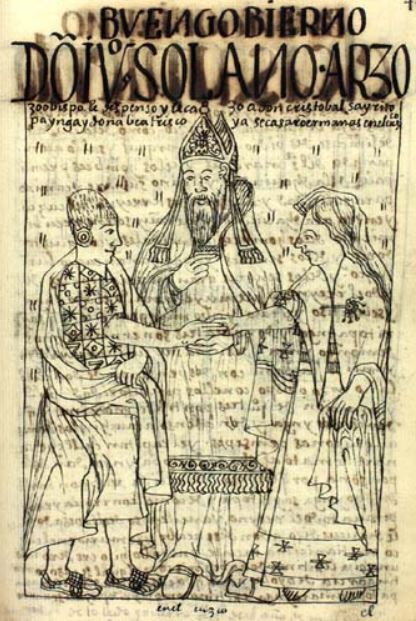
This image depicts a marriage between Sayri Topa Inca and his sister, Doña Beatriz. Sayri Topa Inca is illustrated standing on the left side of the image as he holds the hand of his bride. They are both wearing traditional Incan clothing. They are being married by the Archbishop Don Juan Solano, who is standing behind them and dressed in European clerical clothing. The caption at the bottom of the image identifies the location as it reads, “en el cuzco” [in Cusco].
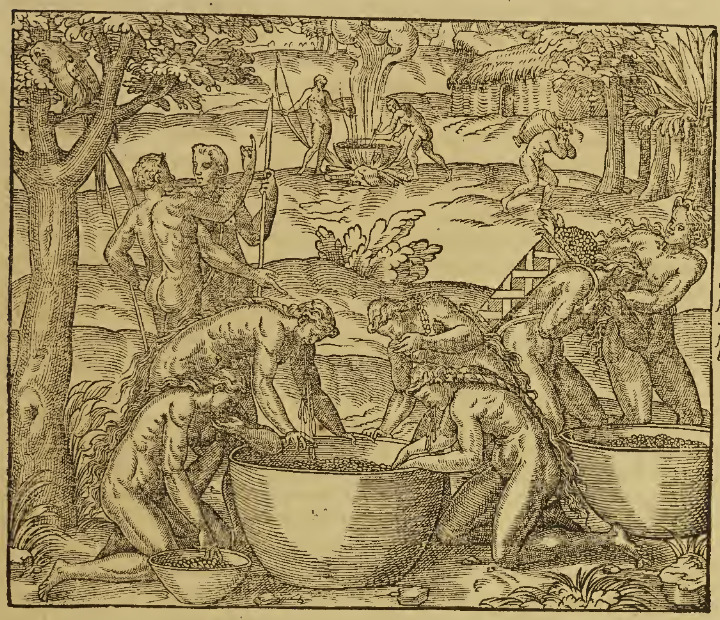
A group of Indigenous women crouch around large pots on the ground. They chew roots (manioc/cassava) and then spit them into the vats, after which the concoction is boiled and strained. A woman by the pot on the right carries a large basket on her back full of more roots. Two men, one holding a bow and the other a spear, stand talking just behind the women. In the background, two people tend a large pot over the fire where the beverage is being boiled. Another individual walks by carrying a large container on their back. One structure is also visible in the background. This image is identical to one found on page 917 of Paris 1575 (Chaudière).
While performing a sacrifice to a bloodied and thrashing animal, Pompey was covered in the animal’s blood. He sent his bloodied clothes home so he could put on clean clothes, but nobody told his wife Julia that the blood was not his. When she saw his bloodied clothes, she assumed he had died. She is depicted in a blue gown on the left of the image, looking at Pompey’s bloodied clothes which are carried by a servant.
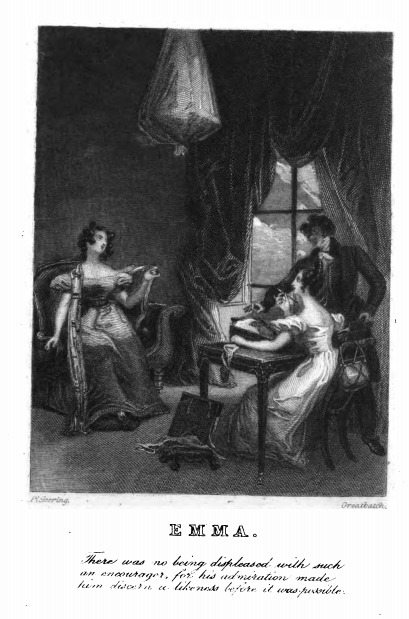
Here we see Emma drawing Harriet’s portrait. Emma sits at a desk with a writing desk sitting on top. A writing desk was portable and sloped to make writing or drawing easier. The top of the desk would open and supplies could be kept inside. Mr. Elton stands over Emma’s shoulder pointing at the drawing in admiration. Harriet sits in a chair posing with a shawl around her shoulders. Emma was being a matchmaker, trying to set up Harriet and Mr. Elton. He encouraged Emma to do Harriet’s portrait and was very flattering of the portrait and Harriet’s beauty. Emma took this as a sign of his romantic interest in Harriet, but in reality, he was interested in Emma. He offered to take the portrait to London to have it framed. With Emma’s encouragement, Harriet fell in love with Mr. Elton, but he proposed to Emma and she refused. This scene occurs in chapter 6. The characters are shown in the traditional regency style, with Mr. Elton wearing waistcoat, tailcoat, and knickers that stopped at the knee. Emma and Harriet wear the regency style dress with an empire waist. Their hair is worn tied up, as was tradition for women after their “coming out” before the queen, signaling her entrance into society. The regency period dated to the early nineteenth century (1811-1820) when George, Prince of Wales, later George IV (r. 1820-1830), reigned as regent for his mentally ill father, King George III (r. 1760-1820). The Prince of Wales was a fan of Austen’s work, and she dedicates the novel to him. The regency period is associated with the rise of neoclassicism in art and fashion.
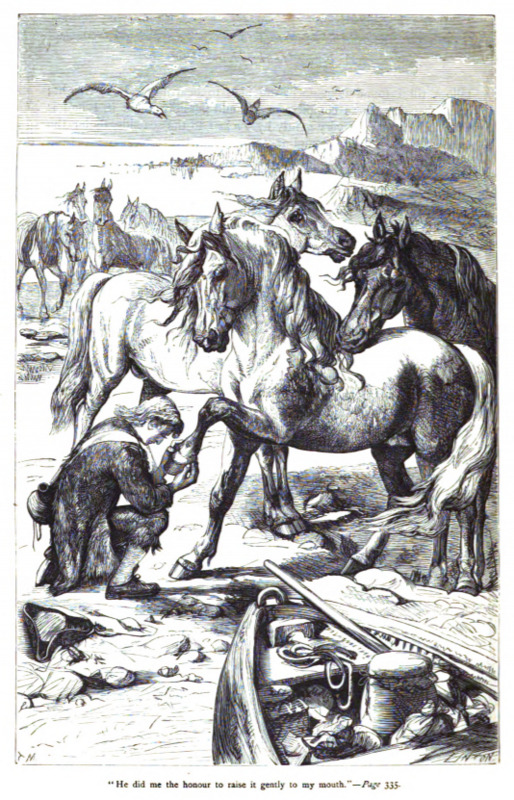
Here Gulliver says goodbye to his master on the Country of the Houyhnhnms. Gulliver kneels down to kiss his master’s hoof, and his master lifted his hoof so Gulliver would not have to bend all the way down. The Houyhnhnms Gulliver lived with gathered on the shore to see Gulliver off.
In this image we see the farmer’s baby trying to put Gulliver in its mouth. The baby holds Gulliver by the waist and tries to put Gulliver’s head into its mouth. Gulliver’s legs and arms flail in concern. A woman holds the baby and watches what is happening before stopping the baby from killing Gulliver. The baby wears a bonnet and a shirt with a vest. The same image appears in the 1839 Krabbe edition.
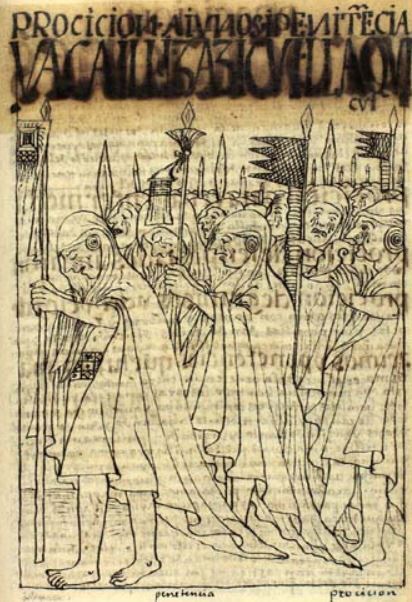
This image depicts the month that the people in the kingdom of the Inca Empire were lawfully required to fast and mourn. They would walk together in processions with long spears that had flags on them, as illustrated in the image, and they would cry to appease their idols. They would scream out and ask for rain and food in return for their fasting and mourning. The people in the image are depicted with tears running down their face, with many looking down to the ground.
Captain Rawdon Crawley and Rebecca Sharp are in the center of the image, hand-in-hand as they perform a country dance. Mrs. Martha Crawley, Reverend Bute Crawley’s wife, is playing the piano in the background. Through the opening to the next room, a man seated at the table playing cards and a portrait hanging on the wall can be seen.
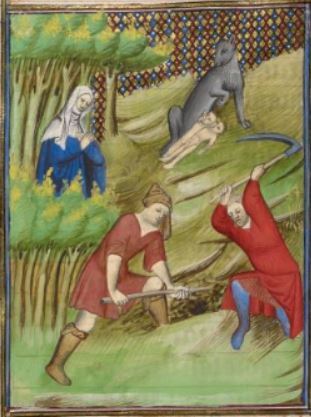
This illumination depicts Rhea Ilia (also known as Rhea Silvia) on the left side of the image dressed in a blue dress. There are two men in the foreground of the illustration digging a grave for Rhea Ilia. As a vestal virgin, Rhea Ilia was forbidden from having relationships with men. She gave birth to twin boys, and as her punishment for having sexual relations with someone, she was buried alive. Therefore, the two men are digging a grave. The twin boys were named Remus and Romulus, and they were the eventual founders of Rome. They were raised by a mother wolf after being exposed in the wilderness. There is a wolf in the background of the image with the twin boys drinking her milk.
The image depicts the backside of a carriage, over the top of which the coachman’s hat can be seen. Sambo is standing on the base of the back of the carriage, holding on to two straps, as it drives away from Miss Pinkerton’s academy in a cloud of dust.
One of the men who appeared before Gulliver was the commander of a ship who fought at the Battle of Actium in 31 BCE when Octavian (later Augustus) defeated Marc Antony and Cleopatra. The commander was quite successful at the battle, however, he was overlooked by Augustus when it came time to appoint a commander of a greater ship. This position went to a young man who waited on one of the Emperor’s mistresses, showing the corruption of Augustus’ court, like many other courts throughout history. The commander was charged with neglect of duty after he asked to be promoted, and he retired to a poor farm outside Rome. His ship was then given to a favourite page of the Vice-Admiral. The commander’s son who was killed at the battle appears with the commander. Intrigued by the story of this commander, Gulliver called upon Agrippa, a friend of Octavian and the admiral at the Battle of Actium, who confirmed this story. Agrippa’s version of the story paints Octavian in a much more favourable light, however. The same image appears in the 1839 Krabbe edition.
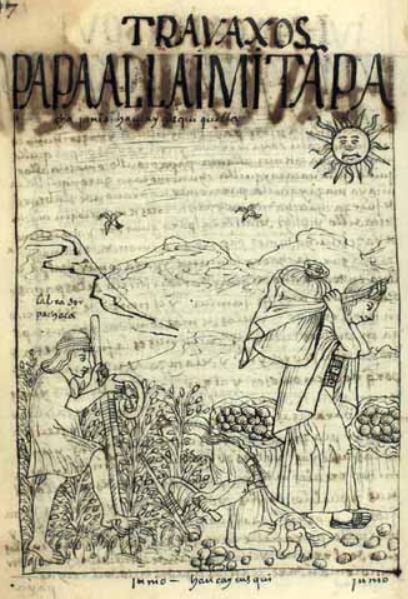
This image is reflected in the final chapter of Ayala’s chronicle where he provides a description of labours and festivals that occur in the rural areas of the Spanish colonial Andes during each month of the Inca calendar year. This image depicts the month of June, which was a time of rest after harvesting all the corn. While June was a month of rest, they also spent time harvesting potatoes. The sun is shining in the top right corner of the image while an indigenous man and two indigenous women are depicted harvesting the potatoes. The man on the left side of the image is standing with one foot pressing down onto his shovel to dig out the potatoes. The woman next to him is kneeling and using a digging device with her hands to also dig out the potatoes. The woman on the right side of the image is walking away carrying a large sack of harvested potatoes on her back. There are other full bags of potatoes beside her. The mountainous Andean landscape is illustrated in the background of the image with birds flying over top. There are words written above the native man which reads “labrador, pachaca” [labourer]. The caption at the bottom of the image reads, “junio, haucay cusqui” [June, seventh month].

![S[an]ta M[ari]a Peña de Francia](https://collections.cemvc.ca/files/large/246164065c149cc130de152bb476f3e42b482109.jpg)
![[Vanity Fair Volume I. Chapter XI Inhabited Initial, B]](https://collections.cemvc.ca/files/large/eee5b710eada8fe2ae1dc7f78757daed07c841af.jpg)
![[George with Amelia]](https://collections.cemvc.ca/files/large/b11716a950144d9d328729bed565e6e5d5ffb543.jpg)
![[A giant baby tries to eat Gulliver on Brobdingnag]](https://collections.cemvc.ca/files/large/abd4555770212594fbf879d86fc19b654090d9b9.jpg)
![[Rawdon and Rebecca Dance]](https://collections.cemvc.ca/files/large/f92887871b04a6093283a36d64d5d6f15fbd859d.jpg)
![[Sambo Behind the Carriage]](https://collections.cemvc.ca/files/large/0e87577e1d630eb30b59bf49c8f54b2cb2a6d856.jpg)
![[Gulliver speaks with the Commander of a ship who fought at the Battle of Actium]](https://collections.cemvc.ca/files/large/bc7d0bda05c07d92f26b0adac9e9ac49e8fd50d9.jpg)