Here the Lilliputian Emperor walks through a crowd of kneeling Lilliputians. The Emperor is identified by his elaborate headpiece which has a long train coming out of the top. The Emperor walks towards the gates to the palace, with the crowd lining the walkway towards the gate. The same image appears in the 1839 Krabbe edition.
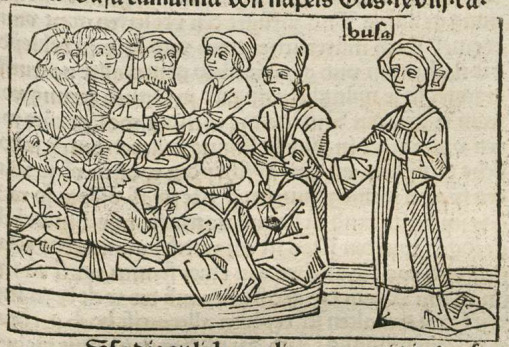
This engraving depicts a woman named Busa on the right side of the image looking at the group of people in front of her. We know that this figure is Busa as the creator engraved her name above her head. Boccaccio explains that after a city called Cannae was attacked by Hannibal the Carthaginian, the people fled to Canusium. Busa opened her home graciously to the people who fled the danger of war and provided them with hospitality and food. These are the people who are depicted sitting around Busa’s table.
This image is presented on the first page of the introduction before the first chapter of the book. The author, Jonathan Swift, is depicted sitting in what appears to be his study as he holds a quill to his mouth and looks out the window as he holds a book in his left hand. There is a horse standing in the window looking into the study. The title of the book “Gulliver’s Travels Into Several Remote Nations of the World” is written on the left side of the engraving.
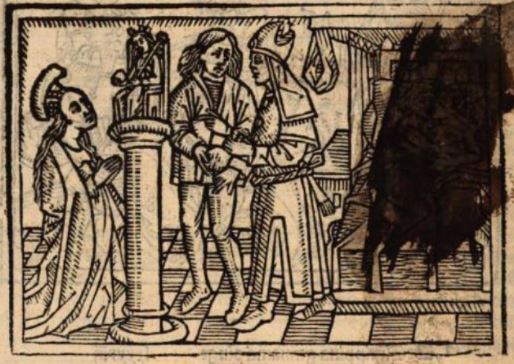
The Roman woman Paulina is depicted on the left side of the engraving as she kneels in prayer. She is looking up at the statue of the Egyptian god Anubis. The statue of Anubis is sitting on a tall platform, with the name “Anubis” engraved on the platform. Paulina was an incredibly devout and chaste woman and was faithful to her husband. A man named Mundus had fallen in love with Paulina due to her overwhelming beauty, and when she continuously rejected his advances, he devised a plan to have her as his own. Mundus is depicted in the centre of the engraving speaking to a priest. Mundus bribed the priest of the temple to invite Paulina to sleep at the temple to have an encounter with the god Anubis in her sleep. Paulina stayed at the temple, expecting to have an experience with Anubis, however, Mundus came to Paulina in her sleep and pretended to be the god and convinced her to have intercourse with him. This is depicted on the right side of the engraving (someone appears to have damaged the engraving with a black spot to hide the depiction of the sexual acts). Paulina is famous for having been tricked into losing her virtue and chastity. Mundus ended up being exiled, and the priest was tortured for his involvement in the deception.
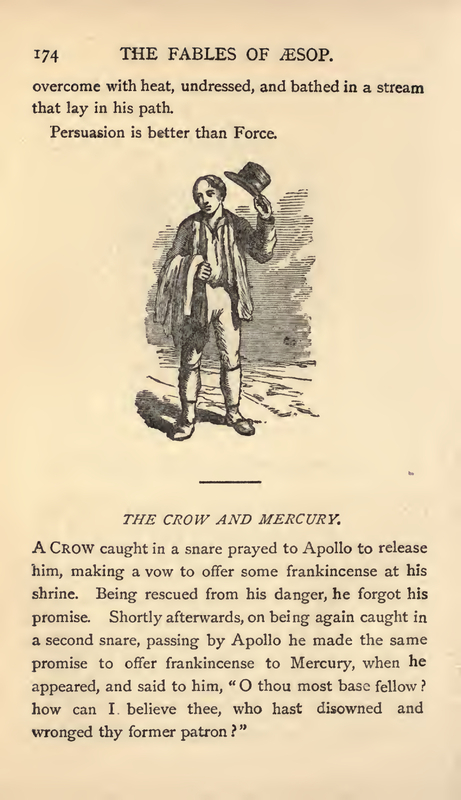
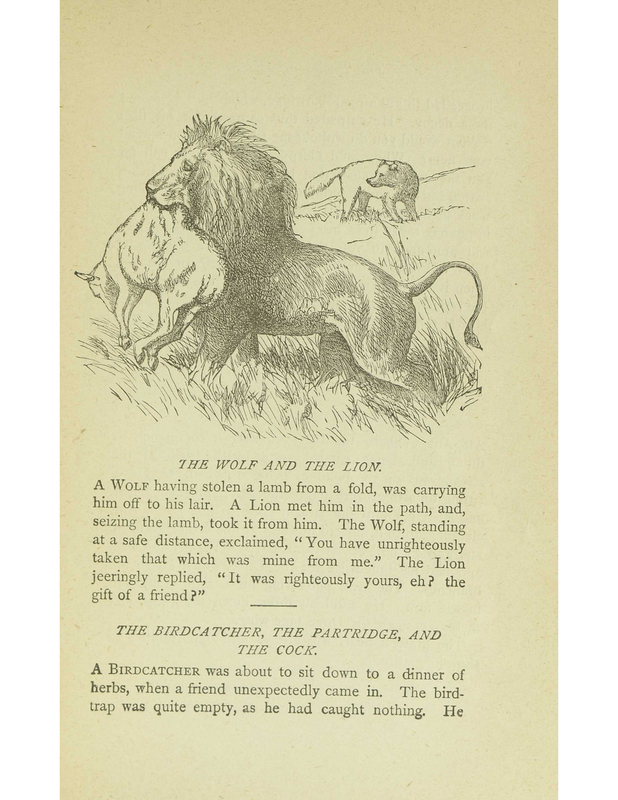
A large lion is running up a small hill, holding a lamb by the skin of its back in its large mouth. In the background, a wolf is looking around as though something was taken from him.
Three Indigenous Brazilians, a man, woman, and child, are shown under a tall tree with large fruit. The woman sits on a tree stump holding one of the fruits from the tree while the child stands nearby, also holding a large fruit. The man has placed one of the fruits on a nearby stump and stands bent over it. This image is identical to one found in Frankfurt, 1557.
Here we see the Lilliputians taking an inventory of Gulliver’s belongings. In the foreground we see Gulliver’s sword and pistol. A Lilliputian is standing on a stack of paper counting bullets in the foreground. Two Lilliputians examine Gulliver’s comb, while others look at his telescope. In the background we see Lilliputians using sticks to carry Gulliver’s small box and pocket watch. In the distance we see other Lilliputians carry some other things on their heads and shoulders. The same image appears in both the 1839 and 1843 Krabbe editions.
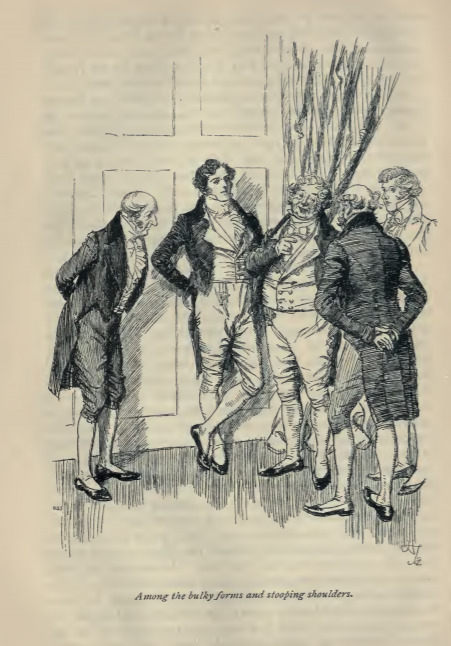
In this image we see Mr. Knightley standing among the married men at the ball. Emma thought it improper for him to be standing to the side of the ball with the married men, rather than dancing with the women. Balls were one of the ways in which men and women could flirt and form engagements, and because he was not married, Emma thought that Mr. Knightley should be dancing and trying to find a woman to marry. This scene occurs in chapter 38. The characters are shown in the traditional regency style. The men wear waistcoats and tailcoats with breeches and cravats. The regency period dated to the early nineteenth century (1811-1820) when George, Prince of Wales, later George IV (r. 1820-1830), reigned as regent for his mentally ill father, King George III (r. 1760-1820). The regency period is associated with the rise of neoclassicism in art and fashion.
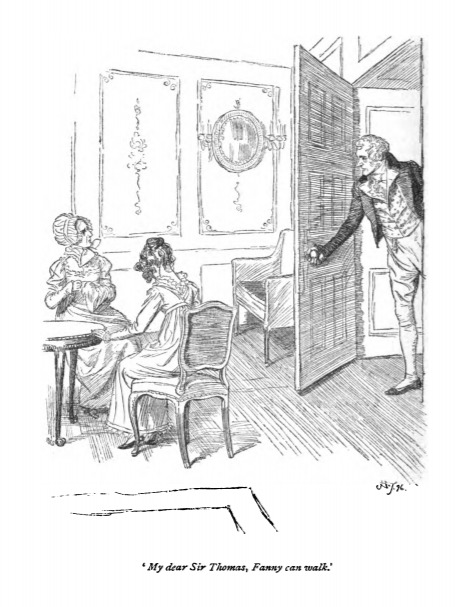
Here we see Fanny sitting with her aunt Norris and Sir Thomas coming into the room. After Mr. Crawford, Maria, and Julia, had all left Mansfield, Miss Crawford invited Fanny to come to dinner at the parsonage. In this scene, Mrs. Norris tells Fanny not to expect Sir Thomas to bring out the carriage to take her to and from the parsonage because no one else would be going out. Much to her surprise, at that moment, Sir Thomas came into the room to ask Fanny what time she would like the carriage to come to the door. Mrs. Norris tried to convince Sir Thomas that Fanny could walk, but Sir Thomas insisted that she take the carriage. This scene occurs in chapter 23. The characters are shown in the traditional regency style. Fanny and Mrs. Norris wear the regency style dress with an empire waist. Mrs. Norris wears a mop cap to cover her hair. Sir Thomas wears a waistcoat and tailcoat, and knickers that stop at the knee. The regency period dated to the early nineteenth century (1811-1820) when George, Prince of Wales, later George IV (r. 1820-1830), reigned as regent for his mentally ill father, King George III (r. 1760-1820). The regency period is associated with the rise of neoclassicism in art and fashion.
Paulina greatly worshipped the god Anubis. When the priest named Mundus found out about this, he used this to his advantage. He dressed up as Anubis and convinced Paulina to have sex with him, saying that it was allowed. In the image, a bed is made inside the temple of Anubis for Paulina to sleep in that night. Beside it, Paulina is courted by “Anubis,” who is actually Mundus. Mundus is wearing a black cloak, part of Anubis’ regalia.
An Indigenous man, called an enchanter by the author, is shown standing on the bank of a river. He wears a black bird in his short hair as a symbol of his position. His only clothing is a hide tied around his waist, and a satchel hangs at his side. Behind him, other Indigenous people are seen in a canoe, hunting water birds with a bow and arrow.
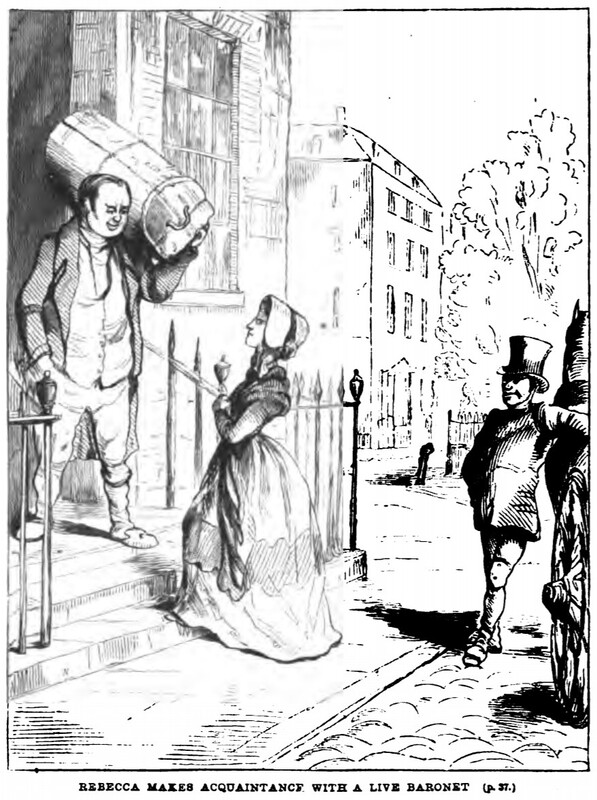
Rebecca Sharp stands in the center of the picture at the base of the staircase to Crawley mansion, scowling up at the man on the stairs. He is holding her trunk on her shoulder with his other hand in his pocket, and, though assumed by the others to be a porter, is Sir Pitt Crawley. To the right of the image, John, the Sedley’s groom, is leaning against his carriage with a smirk on his face. In the background the corner of the Crawley mansion and a neighboring house are lightly sketched. Below the illustration is printed its title and location in the story, “REBECCA MAKES ACQUAINTANCE WITH A LIVE BARONET (p. 37.)”.
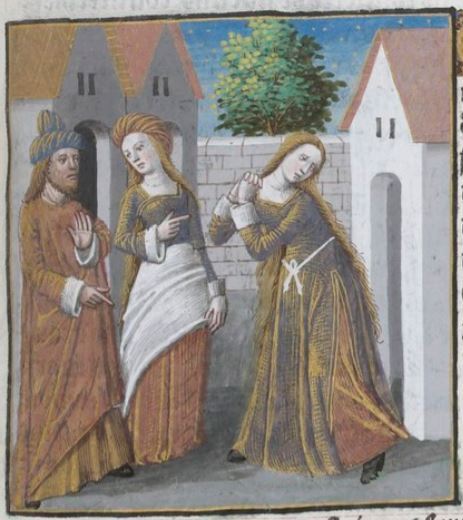
This illumination depicts Turia, a Roman woman and wife of Quintus Lucretius, on the right side of the image with her hands together as she expresses a look of despair. After her husband had gotten proscribed, Turia kept her husband safe within their house so that he would not have to go to war. She took care of him and even went so far as to go out in public and pretended to have lost her husband, so that no one would suspect that he was home. This image depicts Turia out in public pretending to be upset while looking for her 'lost' husband. There are other citizens in the image pointing at Turia and appear to be talking about her to one another. Boccaccio explains that he wrote on Turia to highlight her devotion to her husband.
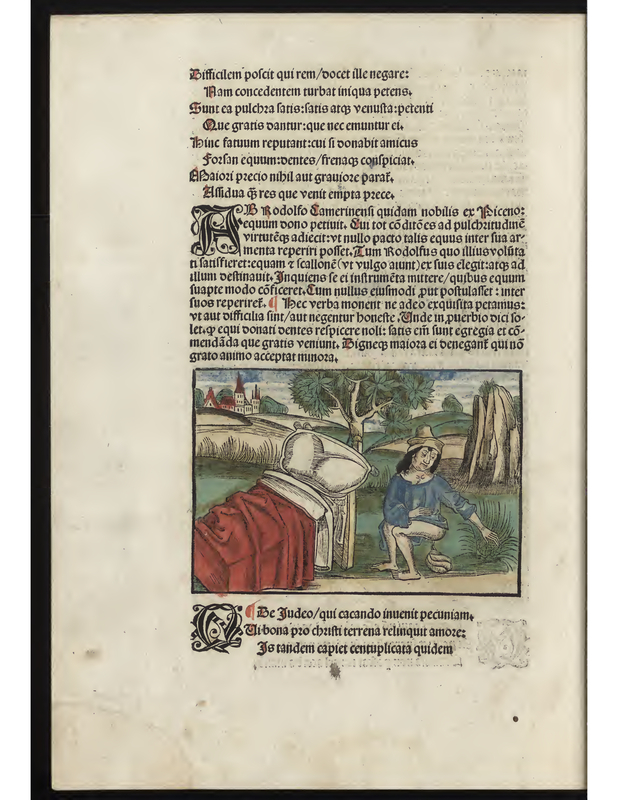
Man is seen relieving himself in a field, while reaching into bush where coins are seen. A town is in the background with a bed in the foreground with the man.
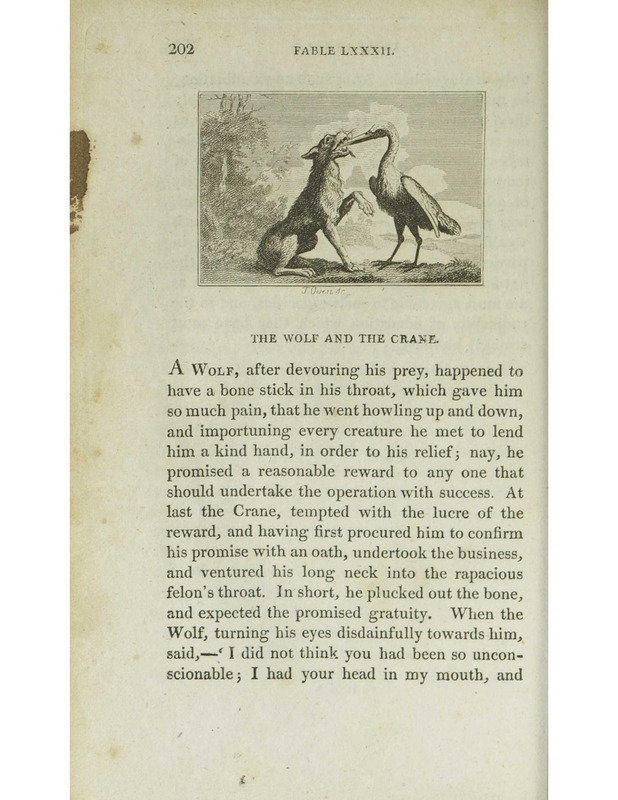
A horse is kicking a lion in the face with his back feet. There are trees and mountains in the background of the illustration. The sun is out just above one of the mountains. The horse is facing its head frontwards. The lion's mouth is open.
Here we see the Empress and two of her maids looking out of a large palace window after the fire. The Empress is in the centre and can be distinguished from her maid and lady-in-waiting by her headpiece and clothing. The maid is on the left and the lady-in-waiting is on the right. Although the fire was in the Empress’s apartments, she chose not to return to those apartments after they had been refurbished given the manner in which Gulliver extinguished the fire (through urination). The same image appears in the 1843 Krabbe edition.
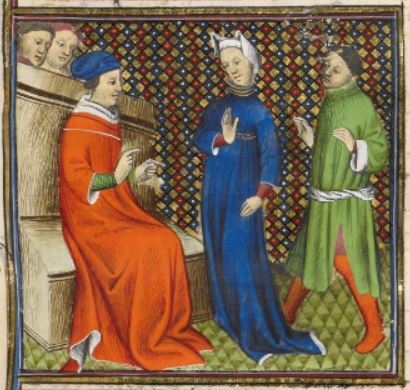
This illumination depicts a woman named Sempronia in the centre of the image wearing a blue dress. Sempronia was the daughter of the famous Tiberius Gracchus. Boccaccio explains that after her brothers were murdered, Sempronia was brought to trial by a tribune of plebeians. This image depicts that trial. The person on the left side of the image told her to let herself be kissed by a man named Equitius (who is standing behind Sempronia) and accept him as a member of the Sempronian family, however, Sempronia rejects this to protect her family’s honour and nobility.
A group of Tupinambá men have set up a camp near the shore. Their four canoes have been pulled up along the shoreline, and the men sit and stand in relaxed groups. One man has been hunting and return to the group with a deer over their shoulder, and there are fish set on a wooden frame over a fire. In the background several hammocks have been hung between trees and are used for napping. Most of the men wear feathered headdresses and adornments around their waists and carry bows and arrow quivers. A bearded European man stands amongst the group to the left.
Tom Stubble sits at one of the coffee-room tables at the Slaughter’s, writing a letter to his parents before his regiment leaves for Belgium. He is holding a pen against the piece of paper on which he has written only a couple of lines, and has his head drooped sadly into his other hand. On the table in front of him is an inkwell with another pen in it.
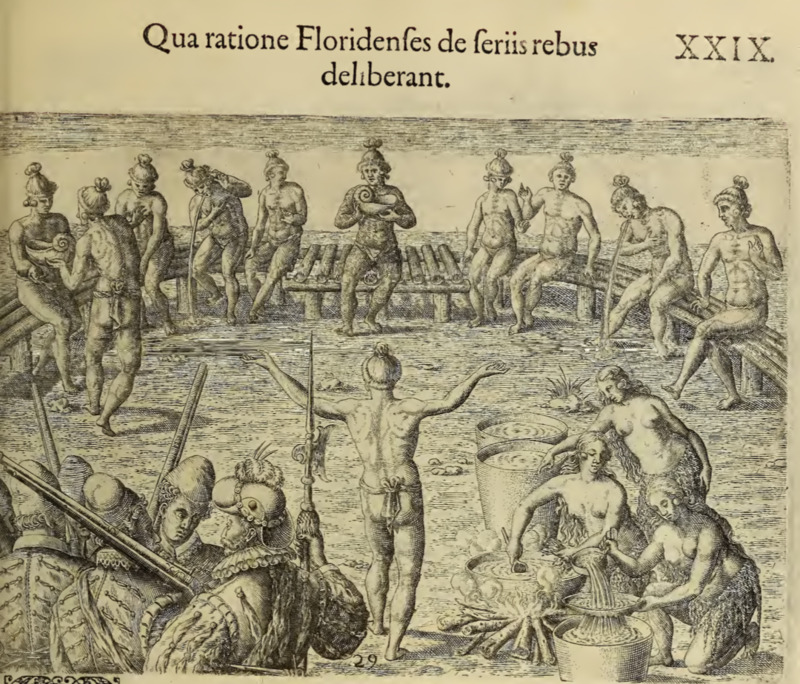
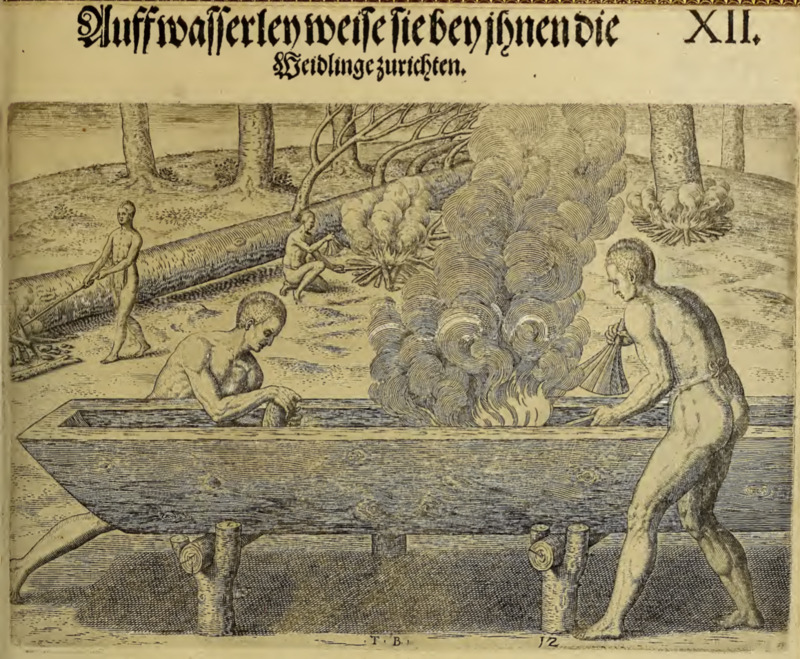
A group of Indigenous people is shown. Several men sit on wooden benches that are arranged in a semi-circle. Two men hold large shells, and two appear to be vomiting onto the ground. Three women tend to large pots on the right. To the left of the women, and individual stands with their arms outstretched. In the foreground, a group of colonists stand holding rifles.

![[Procession with the Lilliputian Emperor]](https://collections.cemvc.ca/files/large/4211f686e4c48fb12255c75839da1e00592c0013.jpg)
![[Jonathan Swift Sitting in his Study]](https://collections.cemvc.ca/files/large/063c736286c1c8a7c67a70450715b10dc9238e4e.jpg)

![[Indigenous Brazilian man, woman, and child under a tree]](https://collections.cemvc.ca/files/large/a90108b2446b21de4f8422c6b6c00e23316c2258.jpg)
![[Lilliputians take inventory of Gulliver’s person effects]](https://collections.cemvc.ca/files/large/7b26c19f25d846786b0872317a7b9c9e384b4f99.jpg)



![[The Horse and the Lion]](https://collections.cemvc.ca/files/large/d83bb6fffb17e50f2c852e76f60acd0e984e9a7a.jpg)
![[The Lilliputian Empress and her maids looking out the window after the fire]](https://collections.cemvc.ca/files/large/51f771c65ffcfdc0db1b938ffb78d7c6e73928cd.jpg)
![[Tupinambá warriors make camp near the shore]](https://collections.cemvc.ca/files/large/bd4fafbde3e15238fa9e6a56637963c2bc927893.jpg)
![[Ensign Stubble Writing to his Mother]](https://collections.cemvc.ca/files/large/223483fd89813e4d64c2a082cdea8bc2f2bc9244.jpg)