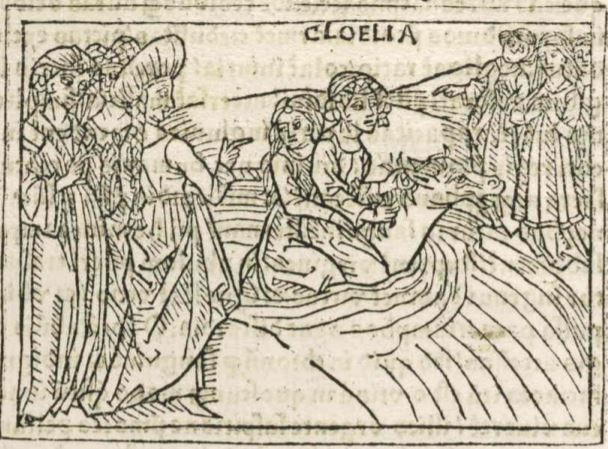
This engraving depicts Cloelia, a young Roman woman, riding a horse through a deep river with many women looking at her. Boccaccio explains that Cloelia was given to a foreign king as a hostage, and when she escaped, she took many other hostages with her. While escaping, she came across a river that was too treacherous to pass. She found a horse, and despite never having ridden one, she got herself and the other women across safely by means of this horse. This image depicts her taking the other women across the river one by one as there is only one other female on the horse with Cloelia. We know that this figure on the horse is Cloelia as her name is engraved above her head.
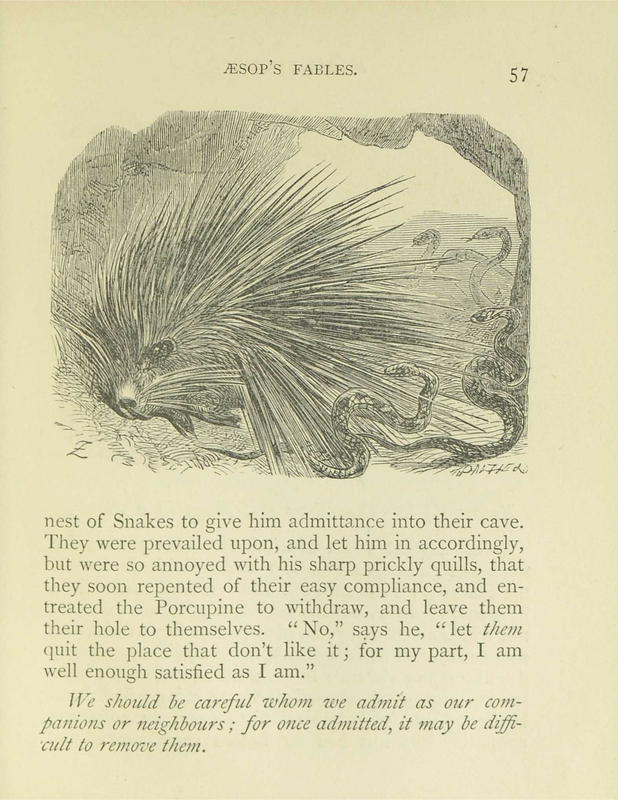
Most of the image is taken over by a large porcupine in the foreground. The porcupine appears to be tucked away in a shallow cave. Surrounding the porcupine are five snakes all trying to hurt it but cannot reach it due to its quills.
This image tells the story of a man’s death, dismemberment, and eventual cannibalization by the Tupinambá group. In the background of the image, the man lays in a hammock and is awoken by several Tupinambá people. On the left, the man kneels on the ground with two Tupinambá men at his sides holding each of his arms, while a third man standing in front of him holds a club above his head poised to fall. In the foreground, the man’s body is dismembered. Each of his limbs and his head have been removed, one arm lays on the ground and a child washes the head in a nearby pool of water. A bearded European man stands beside the men doing the dismembering and gestures towards them, perhaps in protest. In the center of the image, the man’s limbs lay on a wooden rack over a fire to grill while a woman watches.
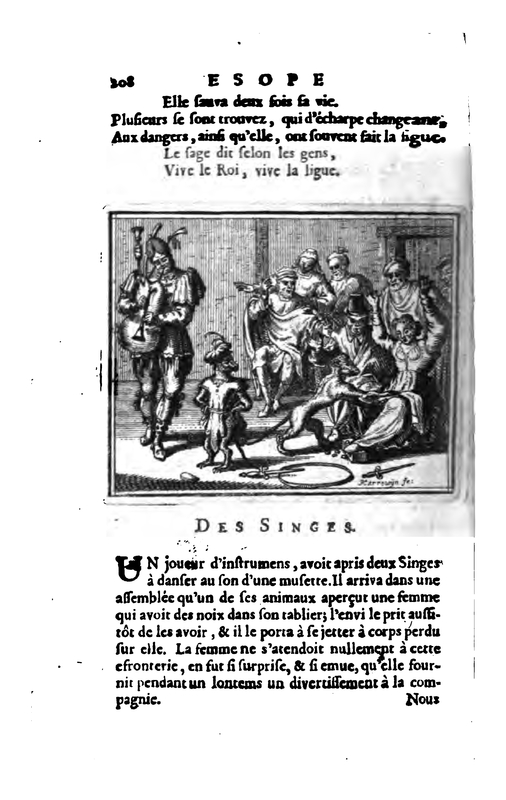
On the right side of the illustration, monkeys are grabbing the apron of a woman sitting down. On the left-hand side, a man is playing an instrument. There appear to be men in the background. The woman has her hands in the air. The illustration has the signature of Harrewijn in the bottom right corner.
Here we see the Lilliputians taking an inventory of Gulliver’s belongings. In the foreground we see Gulliver’s sword and pistol. A Lilliputian is standing on a stack of paper counting bullets in the foreground. Two Lilliputians examine Gulliver’s comb, while others look at his telescope. In the background we see Lilliputians using sticks to carry Gulliver’s small box and pocket watch. In the distance we see other Lilliputians carry some other things on their heads and shoulders. The city skyline is visible in the background. The same image appears in the 1839 Krabbe edition.
Here we see Jane’s cousins, Eliza and Georgiana Reed. This scene happens when Jane returns to Gateshead Hall at her aunt’s request. Jane’s aunt Reed asked to see Jane and one of her servants came to Thornfield to bring her back to Gateshead. Georgiana stands on the left and Eliza on the right.
Here we see a professor from the Grand Academy on Balnibarbi holding a stack of papers that had details about a conspiracy against the government. The professor advises that those named in the papers be closely monitored at all times, naming specifically while they were using the bathroom, as this is when men were most thoughtful. This conspiracy is thought to be an allusion to the trial of Francis Atterbury, the bishop of Rochester for allegedly plotting with the Jacobites. Atterbury was charged with treason in 1722 and was exiled to France. The evidence used against him were papers found in his close-stool. Many believe this evidence to have been fabricated. The same image appears in the 1839 Krabbe edition.
Rawdon Crawley is at the saddler’s where he, under the pseudonym Eliza Styles, is receiving letters from Rebecca Sharp. He is seated on the counter, reading his newest letter while twirling his moustache. To his side is a saddle displayed over a beam, and the boy behind the counter is smiling up at him.
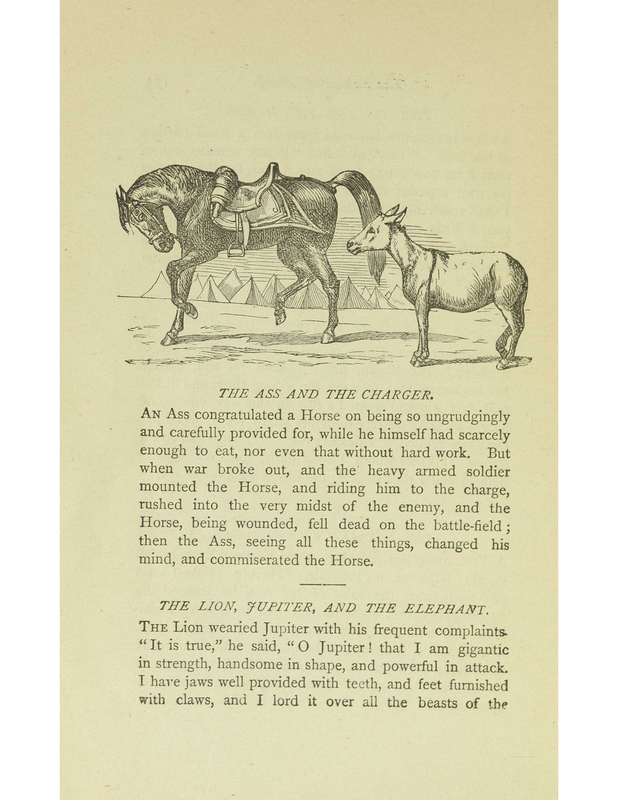
A horse is strutting to the left of the image, its head bent lower towards the ground. The horse has its front left leg and its back right leg in the air while the other two remain on the ground. Next to the horse on the right side of the image, an ass stands there looking at the horse. Behind them, mountains can be seen in the distance.
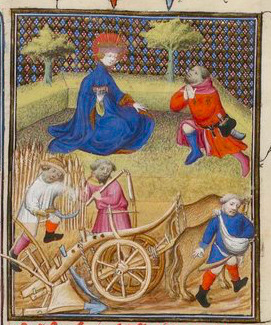
Ceres, queen of Sicily and goddess of the harvest, is pictured at the top of the image in a blue gown, sitting in a field. Farm workers surround her. They are praying and yoking oxen to plow the fields. Queen Ceres is responsible for being the first to tame and train oxen to pull plows.
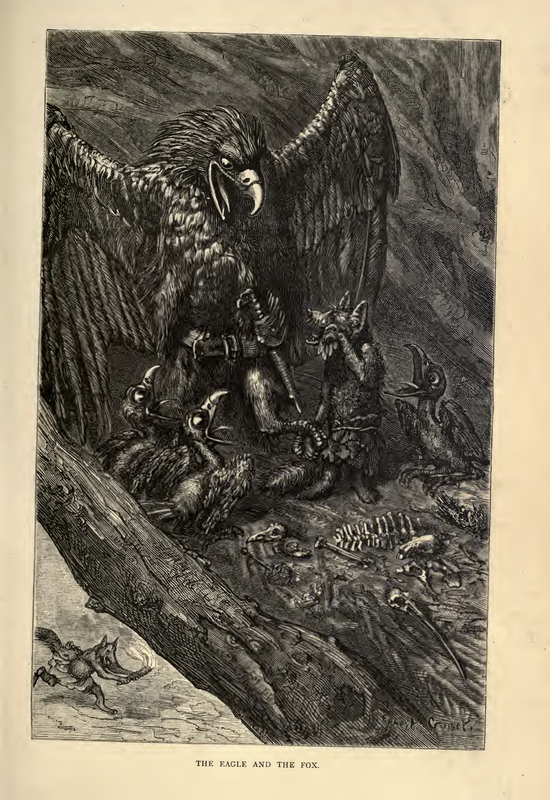
An eagle stands tall with both its wings spread out behind itself. It is looking down at its feet with its beak wide open. At the eagle’s feet, its three babies are looking up at their mother with their beaks open, looking at her with large oogly eyes. The eagle wears a belt around its waist with a small sword seethed to its left hip. On the ground, various carcasses decorate the dark muddy ground of the nest. Next to the eagle, on the right side of the image, a wolf stands up walking like a human. It’s mouth is open as it wipes at its face with a piece of cloth while looking up at the eagle. The eagle seems to be holding onto the fox’s right paw using its left claw. The fox wears a few pieces of cloth held together by a string around its waist. On the lower left corner, another small fox wearing the same kind of cloth bottoms is running with a torch in its hands. That fox is running on land right above the next.
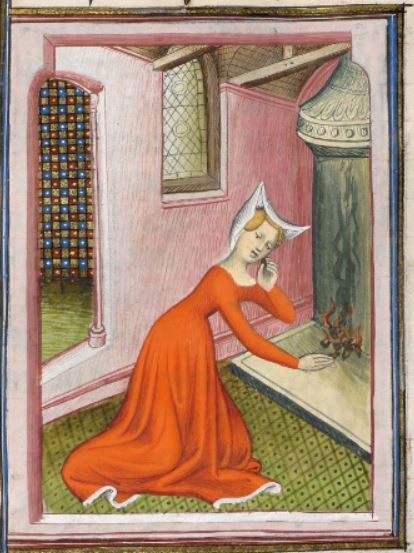
This illumination depicts Portia, the daughter of Marcus Cato and the wife of Brutus, swallowing a hot piece of coal to kill herself. Brutus was one of the people involved in the conspiracy to assassinate Julius Caesar. When Brutus told Portia of the conspiracy, she took a barber’s knife and stabbed her foot with it. She does this to prepare herself in case she has to kill herself should the conspiracy not work out in Brutus’ favour. Brutus eventually dies, and all Portia had to kill herself with was hot coal which is why she is depicted swallowing this in the image.
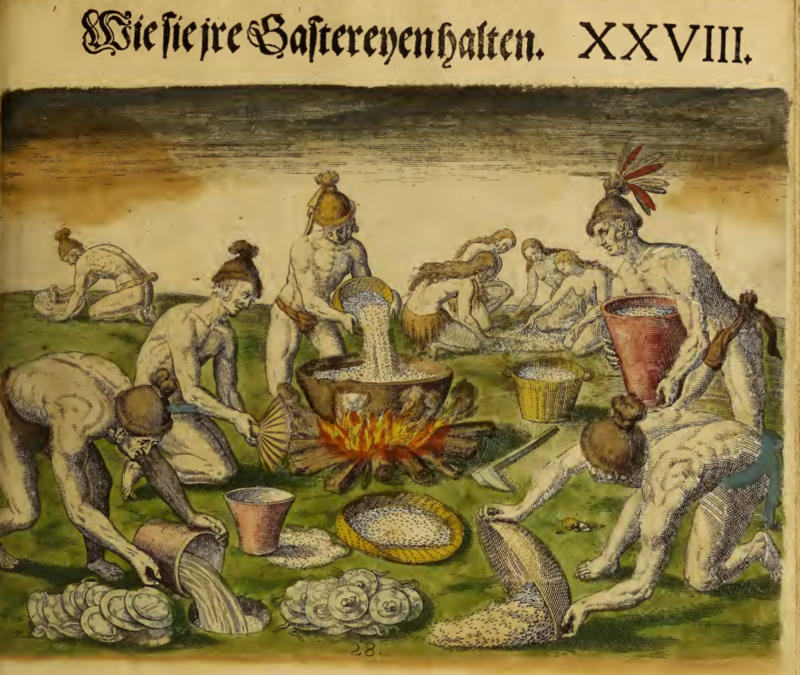
Several Indigenous people are shown preparing food for a feast. A large pot sits on a fire in the middle of the group, one man pours a substance into the pot and another man kneels beside the pot and fans the flames. This illustration is identical to the one found on page 97 of Frankfurt 1591, but colored.
Miss Matilda Crawley sits in her wheelchair, bundled up in a bonnet and muff. The chair is being pushed by a thin man in a coat and tall hat. In the top right of the image is the letter T from “The”.
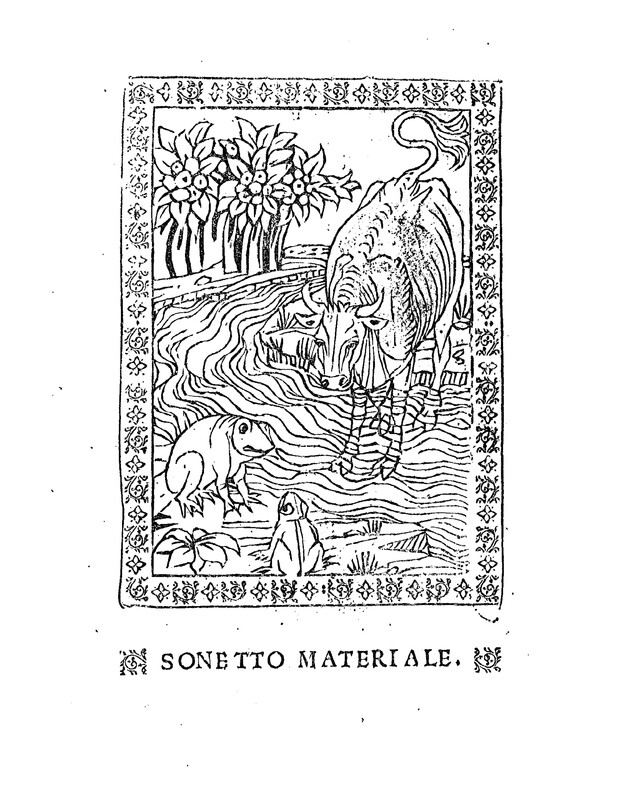
Submerged in what looks like a river is a Bull, on the other side on dry land are two Frogs looking curious. Trees in the background. The image is bordered by a vine design
A donkey and a horse dressed up in fancy accessories stand near a tree while in the bankround there is a man riding a horse that is pulling a cart and another horse in the distance next to a building.
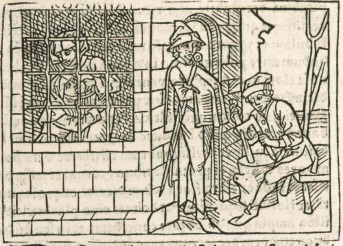
This engraving depicts a story of a young Roman woman who saved her mother from starving to death. Boccaccio explains that this unknown young woman’s mother had been sentenced to death, and when she was locked away to die of starvation, her daughter saved her with her own breast milk. The girl and her mother are depicted behind the window as the mother drinks the milk of her daughter’s breast. The men that are depicted standing guard outside the prison cell seem unconcerned and relaxed. They are unsuspecting of the young woman, as they searched her every time she visited her mother and she never carried food with her. The young woman saved her mother’s life through her breast milk, and Boccaccio explains that he wrote on this unknown young woman due to her filial devotion.
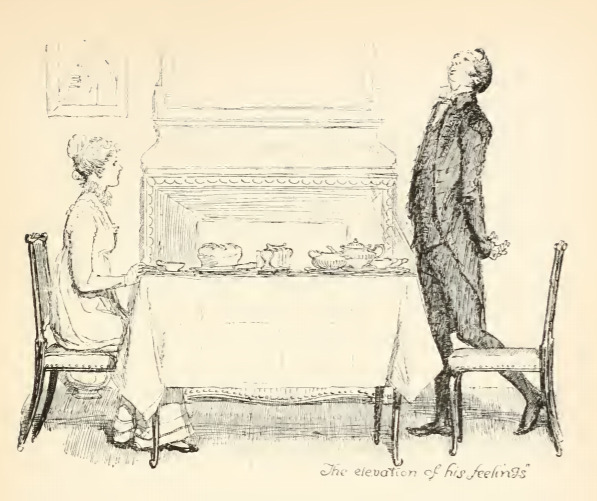
In this image Mr. Collins bid farewell to Elizabeth as she leaves to go to London with the Gardiners and then home to Longbourn. This scene occurs over breakfast on the day she was set to leave. Mr. Collins thanks Elizabeth for coming to visit and tells her he hopes she can find the same kind of happiness that he and Charlotte found in each other. This scene occurs in chapter 38. The characters are shown in the traditional regency style. Elizabeth wears the regency style with a dress with an empire waist. Mr. Collins wears a waistcoat and tailcoat. The regency period dated to the early nineteenth century (1811-1820) when George, Prince of Wales, later George IV (r. 1820-1830), reigned as regent for his mentally ill father, King George III (r. 1760-1820). The regency period is associated with the rise of neoclassicism in art and fashion.
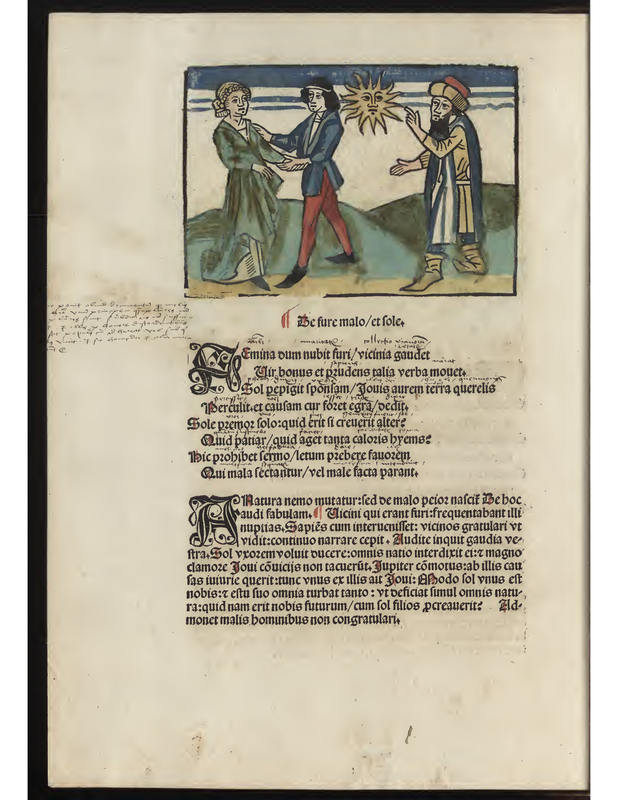
In the middle of the image, a sun with a face can be found in the sky. On the left-hand-side of the image a man is seen holding a woman in a green dress. Beside the pair stands a man – pointing towards the sun.
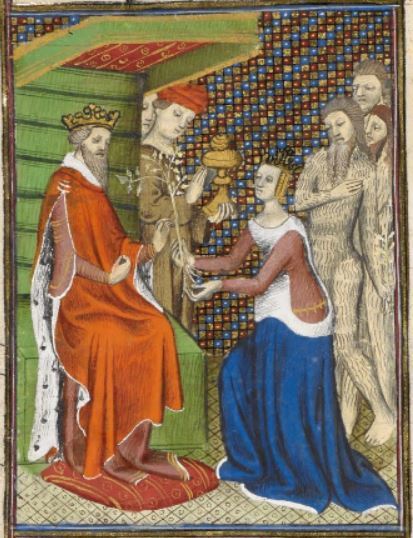
This illumination depicts Nicaula, the queen of Ethiopia, on the right side of the image meeting King Solomon of Jerusalem. King Solomon is illustrated wearing a red robe and a crown. Nicaula, as Boccaccio explains, was incredibly wise and wanted to hear and listen to the wisdom and intellect of Solomon. She had traveled from Ethiopia to Jerusalem to meet him. Nicaula is depicted kneeling and presenting King Solomon with a balsam tree. She has servants behind her carrying more gifts that she brought for the king.

![[A man is killed, dismembered, and cooked by the Tupinambá]](https://collections.cemvc.ca/files/large/03920d82923eb7b3170dbd2e86f2b9c1b2fd3be0.jpg)

![[An inventory of Gulliver’s personal belongings]](https://collections.cemvc.ca/files/large/ce13de201708d35e4df10f4e9f5e66aa8cefd6dd.jpg)

![[A professor from the Grand Academy presents evidence of a conspiracy]](https://collections.cemvc.ca/files/large/f2cd848b7ef7eb9c901e604b86f5b938cde39372.jpg)
![[Rawdon Receives his Mail]](https://collections.cemvc.ca/files/large/d86f78689eb6f24e40f40f078cf3b055decce205.jpg)



![[Vanity Fair Volume I. Chapter XXXIII Historiated Initial, T]](https://collections.cemvc.ca/files/large/411aadb7136c38f99206084cc520ea24a06c28e5.jpg)