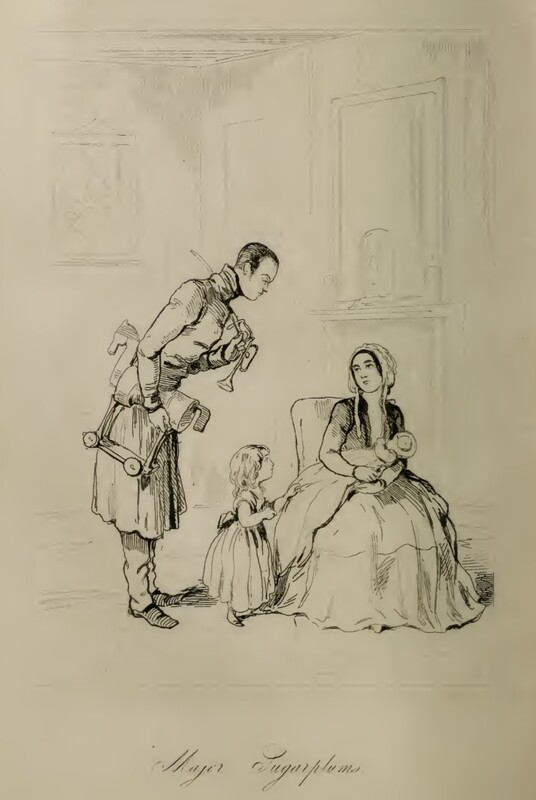
William Dobbin, carrying a toy sword, trumpet, and wooden horse on wheels, bows to Amelia Osborne. She is seated on a chair, holding her son Georgy, who is asleep. At her side is Mary Clapp, the landlord’s daughter, acting as the mistress of ceremonies to announce Dobbin. Below the illustration is printed in cursive its title, “Major Sugarplums”.
Here we see Gulliver saying goodbye to his family as he leaves for another voyage only two months after returning from Lilliput and Blefuscu. Everyone here is crying. Gulliver’s wife is on his left while his daughter and son hug him. In the background we see the docks and the ship that Gulliver was leaving on. The same image appears in the 1843 Krabbe edition.
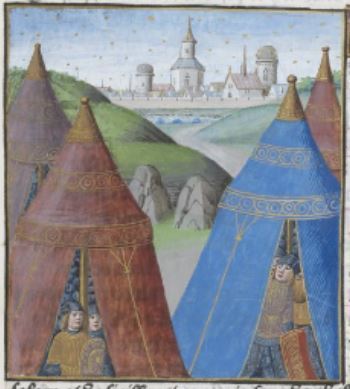
This image appears in the chapter that treats Queen Joanna of Sicily and Jerusalem. Boccaccio praises Joanna on her fierce ability to rule which was not common for women to do during her time. He explains that Joanna would attack cities until men would flee in fear of her and her forces and she would then siege the cities. This image depicts one of Joanna’s military camps which is outside of the city that is depicted in the background.
There is a woman sitting in a doorway. There is a child sitting on the ground in front of the woman. Across from them there is a wolf staring at the child with his teeth showing. The woman has her hand up in front of the wolf.
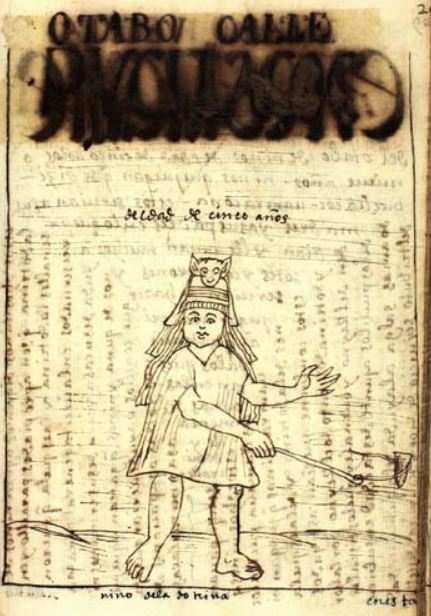
The author explains that there were ten paths for men to follow in the Inca Empire based on age division. This eighth group is called pucllacoc [playful]. This group refers to children aged five to nine years old and their duties include helping their mothers and fathers as best as possible with younger siblings. The child in the image is depicted playing with a sling and a stone and wearing a head garb that appears to have a bat skin on it. The caption at the bottom of the image reads “de edad de cinco años niño de la dotrina” which translates to “five years old, child of school age.”
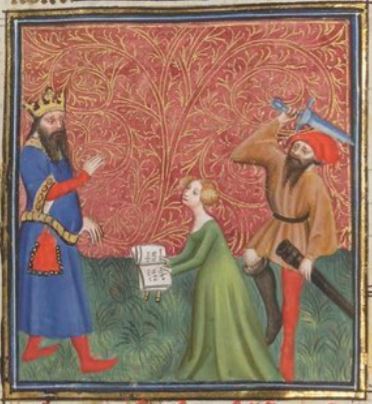
This illumination depicts Cassandra, the daughter of King Priam of Troy, standing in the centre of the image holding a book. She is showing this book to King Agamemnon, who is standing on the left side of the image. Cassandra had the gift of foresight and predicted the events of the Trojan War and the downfall of her city. She predicted the death of Agamemnon, as well as her own. Boccaccio explains that the god Apollo had given Cassandra the gift of foresight in exchange for her love, and when she denied him what she had promised, he made it so that no one would believe any prediction she made. Cassandra appears to be desperate in this illustration as she tries to tell Agamemnon her predictions, however he does not understand her prophecies. There is a man with a sword behind Cassandra which foreshadows her death.
An Indigenous man is in the process of chopping down a palm tree with a hatchet. Another man sits nearby sharpening a stick for an arrow or spear with a knife. A woman also sits nearby with a child on her lap. There are two structures in the background. This illustration is a simplified and mirrored version of the one found on page 72 verso of Paris, 1557.
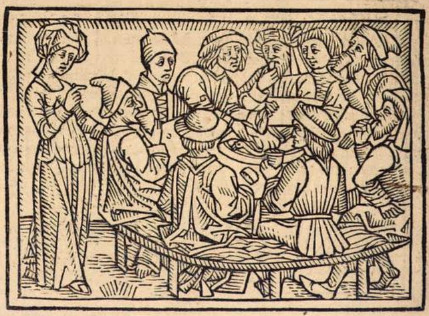
This engraving depicts a woman named Busa on the left side of the image looking at the group of people in front of her. Boccaccio explains that after a city called Cannae was attacked by Hannibal the Carthaginian, the people fled to Canusium. Busa opened her home graciously to the people who fled the danger of war and provided them with hospitality and food. These are the people who are depicted sitting around Busa’s table.
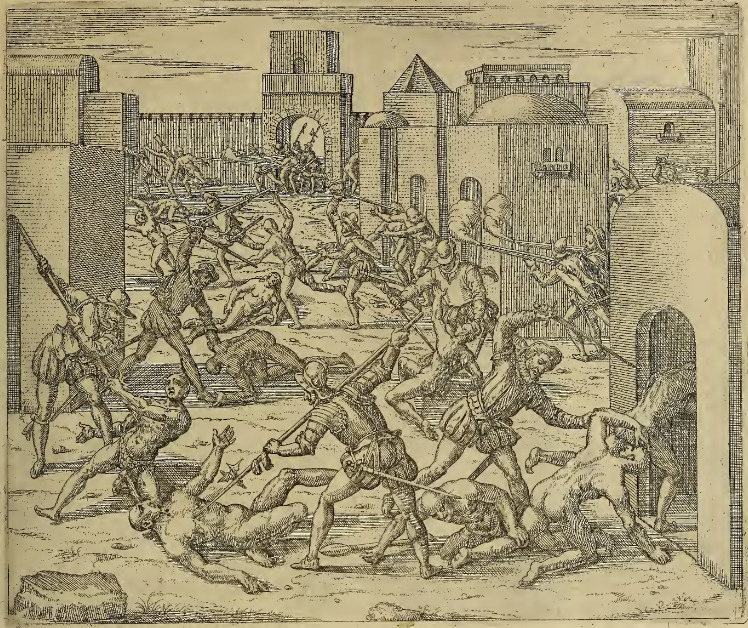
After the execution of the Inca Emperor Atahualpa, the Spaniards embarked on the long voyage to Cuzco in search of the gold Pizarro had been told was kept there. Within the walls of Cuzco, Spanish soldiers kill unarmed Inca men and women with pikes or spear, swords, and muskets. Some of the Inca people flee the Spaniards. This image is identical to one found on page 12 (133) of Frankfurt, 1596.
An Tupinambá Indigenous village is shown, comprised of four long structures arranged in a circle and surrounded by a fence. Inside the village two Indigenous women cut the hair of a European man while several other women watch. The village is on the coast of Brazil, the shoreline is visible in the background and five canoes are anchored there. Several long poles with skulls mounted on the ends have been planted in the ground around the fence.
Ulysses is depicted on the right side of the illustration holding up his shield with his left hand and wielding his sword with his right. His ship can be seen floating in the water in the background of the image. He is in a fighting position as he threatens the woman in front of him. The woman’s name is Circe. She was known for her magic and skills with herbs and incantations. Circe is illustrated standing in a calm but fierce way, as she guards the animals behind her. Boccaccio explains that these animals are in fact the companions of Ulysses, and that Circe is known to transform those who land on her shores into animals. Ulysses is threatening Circe to save his companions from their transformed state.
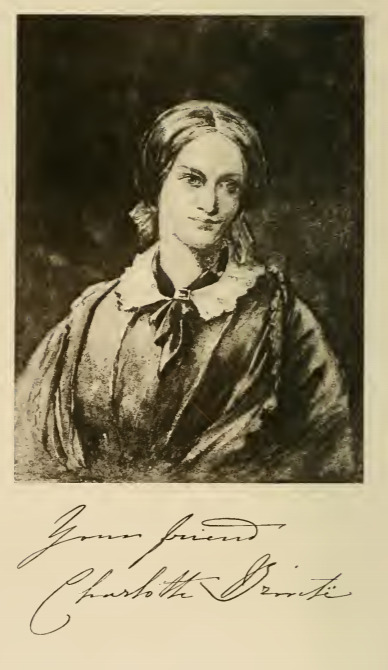
Here we see a portrait of the author, Charlotte Bronte. The illustration is a reproduction of a photograph. Underneath the image is the handwritten phrase “Your friend, Charlotte Bronte”, possibly in the author’s hand, however it is not certain.
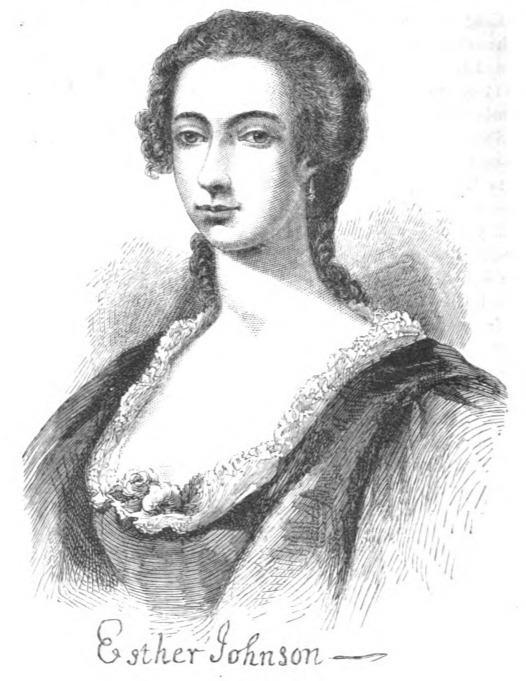
Here we see the bust of Esther Johnson, nicknamed ‘Vanessa’. Esther was romantically involved with Swift, however she is often cast in a negative light, as Swift was already engaged with Jane Waring. Swift was Esther’s tutor, and a relationship evolved, similar to that of Stella Johnson. This image appears as part of the biography of Jonathan Swift.
Here we see Gulliver standing next to a yahoo. “Yahoo” is the word the Houyhnhnms use to describe the humans of their country. Gulliver looks disgusted by the yahoo because of the yahoo’s differences from Gulliver. Gulliver’s opinions are a reflection of European prejudice against Native Americans. The same image appears in the 1843 Krabbe edition.
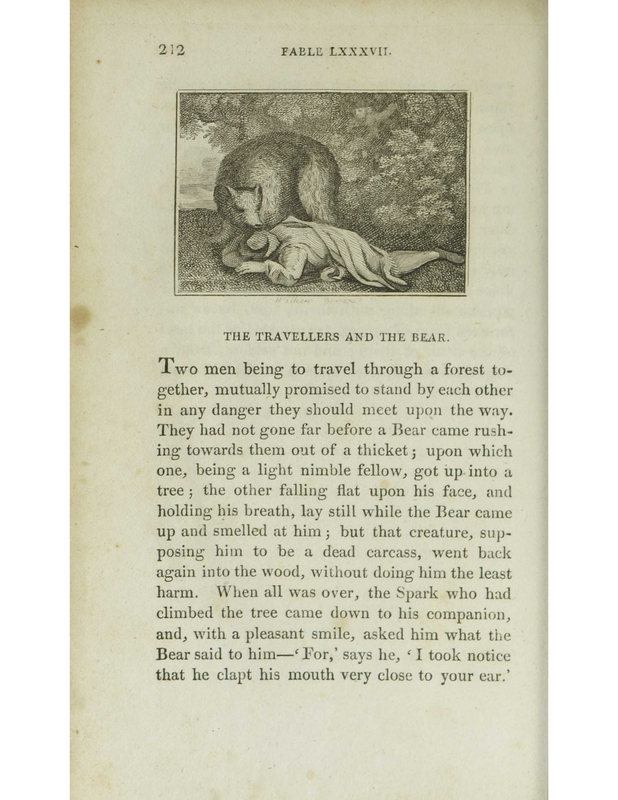
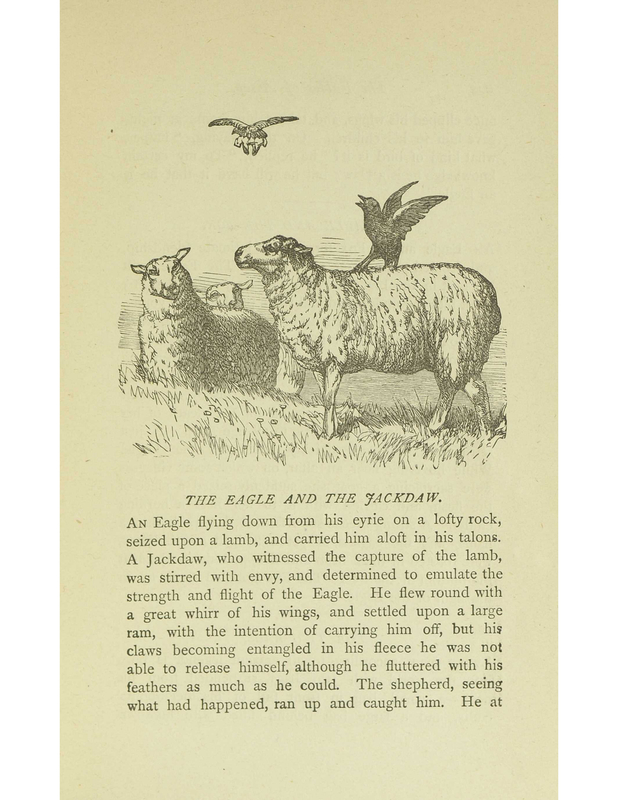
Three sheep are in a field. The two in the back of the image are looking towards the sheep to the right which has a jackdaw on its back, its wings are widely open. The jackdaw is looking up in the sky to the left. In the upper left corner, an eagle is flying away, looking back at the sheep and the jackdaw.
At the political school at the Grand Academy on Balnibarbi a medical doctor was attempting to use his knowledge of disease to heal the political system. One of his hypotheses was when conflict broke out between two parties, then he would take one member from each party with similar sized heads and then cut into each of their heads, and cut each of their brains in half, and swap half of their brains. By doing this, the doctor thought the two brains would debate within the skull, and come to a compromise, resulting in moderation and regularity of thinking which was desirable for the leaders of the country. The same image appears in the 1839 Krabbe edition.

![[Gulliver leaves his family once again]](https://collections.cemvc.ca/files/large/d0a0fbc12a443b9f3f921f73db986dd6dd06de5f.jpg)
![[Woman Protects Child]](https://collections.cemvc.ca/files/large/096b77d72d250326a47f7d3a2b396bdedd3fd007.jpg)
![[An Indigenous Brazilian man chops down a tree]](https://collections.cemvc.ca/files/large/c7afcc07f3cdefd95dbcdd8fdde8a1b3d61dba6e.jpg)
![[Tupinambá women cut the hair of a European man]](https://collections.cemvc.ca/files/large/bbe22e595bf9ddac7de93575571359c575329ff7.jpg)
![[Ulysses Threatens Circe with his Sword]](https://collections.cemvc.ca/files/large/59a80c966435e2e506ef9b89a25c58eba55ff488.jpg)

![[Gulliver and a yahoo on the Country of the Houyhnhnms]](https://collections.cemvc.ca/files/large/da3cce294b80b3571a46cc357c38bf158d9bcd53.jpg)
![[A hypothesis for resolving political conflict]](https://collections.cemvc.ca/files/large/c1a0cf42008eb40fdb14cce0996aec8b2e062f7d.jpg)