Two figures are climbing over a wall using a ladder placed next to a tree. The man, representing Captain Rawdon Crawley, is at the bottom of the ladder, holding the hand of the woman. She represents Rebecca Sharp, looking backwards as she climbs over the wall and onto the ladder. The ladder forms the letter H from “How”.
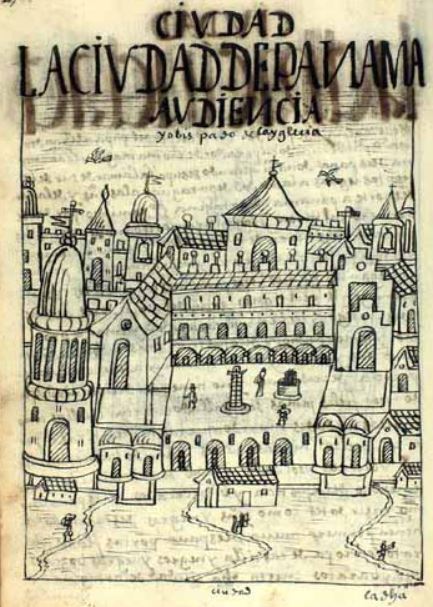
This image is depicted in the author’s chapter where he discusses cities, towns, villages, and provinces in colonial South America. This image depicts Panama City in Panama. It is arranged in a cluster of buildings which forms a large square with two fountains in the centre. There are three people illustrated walking in the square. There are three winding pathways outside of the city walls that lead in and out of the city. There is one person walking on each of the pathways. The caption at the bottom of the image reads “ciudad” [city].
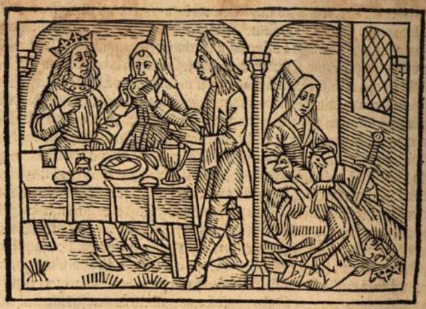
This engraving depicts two separate scenes. The left side of the engraving depicts Queen Cleopatra of Egypt sitting at a dinner table with her husband Antony beside her. Cleopatra had very expensive tastes and demanded a feast which would cost an outrageous amount of money. When Antony did not provide the entire feast Cleopatra demanded, she took out one of her pearl earrings and dissolved it in her drink and drank it to get the luxuriousness she desired. Cleopatra is depicted drinking the pearl in this image. There is a third figure in this scene, which is a man named Lucius Plautus who was called to be a judge of the feast. The right side of the engraving depicts the suicide of Antony. After realizing the forces of Octavian were on their way to destroy them, Antony plunged his sword into his chest, as depicted in the engraving. Cleopatra is depicted kneeling over his body before she kills herself as well.
In this image, we see Gulliver standing next to a door of the castle smoking a pipe while talking to a Lilliputian. Gulliver’s size is shown by the height difference between the door and Gulliver. Gulliver holds a pipe in his right hand, and a Lilliputian in his left hand. The same image appears in the 1839 Krabbe edition.
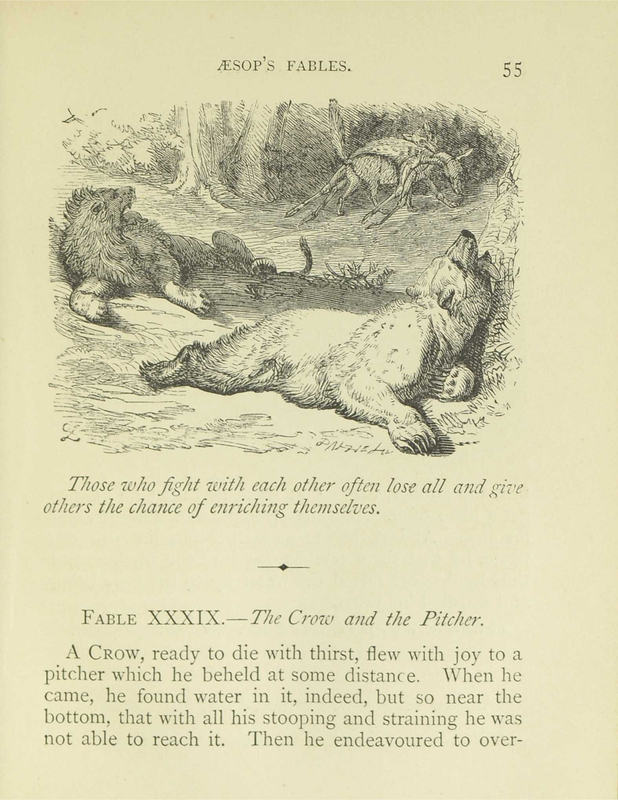
In the foreground on the right lies a bear with its head leaning up against a tree with its tongue hanging out in exhaustion. Behind the bear on the left side is the lion laying on the ground also seemingly in exhaustion. In the back of the image a small fox can be seen carrying a limp deer in its mouth through the forest dragging it across the ground.
This image is illustrated in a chapter that discusses and criticizes the government and society in Spanish conquered Peru. The two men depicted in the image are a Corregidor [Magistrate] and an Encomendero [Trustee] who appear to be arguing over a large sum of money on the table in front of them. They are dressed in traditional European clothing. The author criticizes these government officials by saying they lack respect for the indigenous peoples of Peru and exploit their labour.
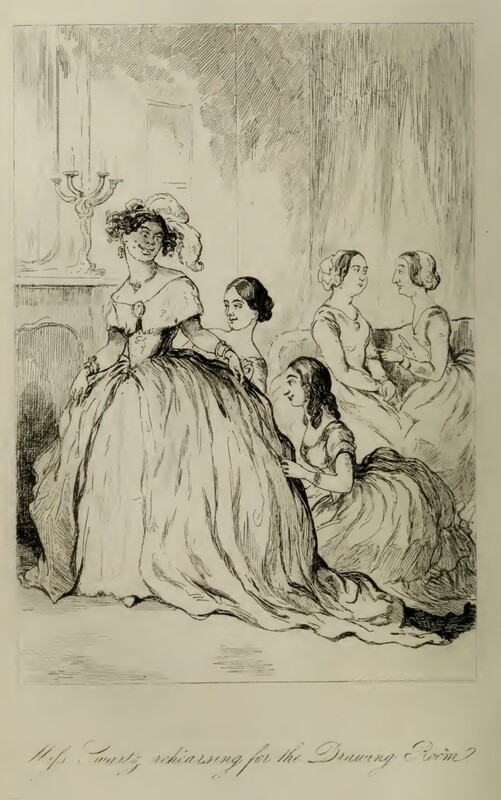
Miss Rhoda Swartz stands in front of Jane and Maria Osborne, dressed in a large gown with many pieces of jewelry and feathers in her hair. In the background, Miss Swartz’s chaperone and Miss Wirt are seated on a sofa, talking to each other. Below the illustration is printed in cursive its title, “Miss Swartz rehearsing for the Drawing-Room.
A fox is sitting on the ground below a tree. A crow is perched on one of the tree's branches. A house is behind them, and a fence is around the land. There are mountains in the far distance.
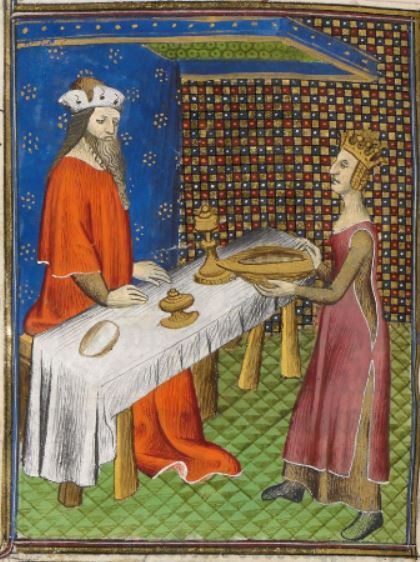
This illumination depicts a Dripetrua at a dinner table with her father, King Mithridates of Pontus. They are both depicted wearing crowns. Boccaccio explains that Dripetrua was born with two sets of teeth and was incredibly hideous, however, she was also very devoted to her father, which deserved praise.
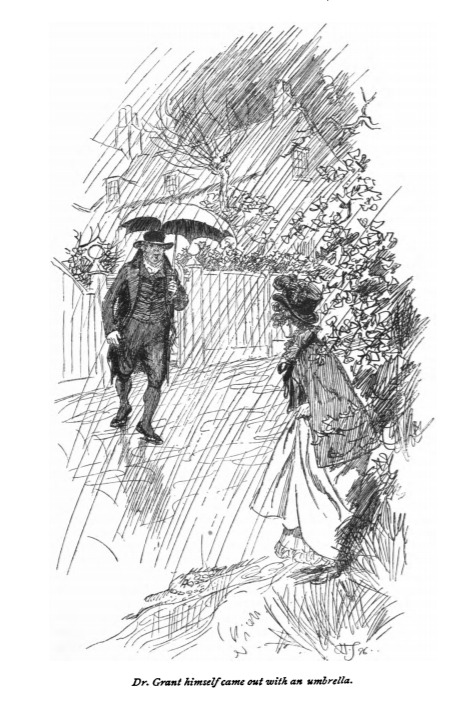
Here we see Mr. Grant going out in the rain with an umbrella to compel Fanny to come into the Parsonage. Fanny went into town on an errand for her aunts and got caught in the rain. She took shelter underneath a tree by the Parsonage. Mrs. Grant and Miss Crawford tried to convince her to come in and visit with them while she waited for the rain to pass, but she refused, not wanting to visit with them and be an inconvenience. Mr. Grant finally came outside and convinced her to come in. She waited with Miss Crawford until the rain passed. Fanny spent most of the visit watching the window for the rain to pass, wanting to leave as soon as the sky cleared. Miss Crawford entertained them by playing her harp for Fanny, who had never heard her play. This scene occurs in chapter 22. The characters are shown in the traditional regency style. Fanny wears the regency style dress with an empire waist and a cloak. Her hair is worn tied up and wears a bonnet. Mr. Grant wears a waistcoat and tailcoat, and knickers that stop at the knee. The regency period dated to the early nineteenth century (1811-1820) when George, Prince of Wales, later George IV (r. 1820-1830), reigned as regent for his mentally ill father, King George III (r. 1760-1820). The regency period is associated with the rise of neoclassicism in art and fashion.
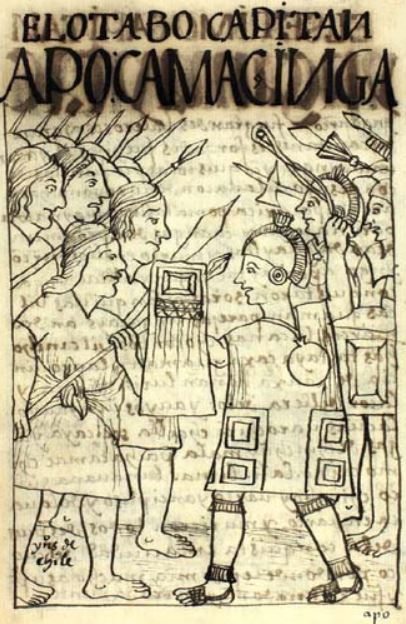
This illustration depicts the eighth captain, Apo Camac Inca. These captains were a level of Inca authority who helped lead the conquest of the Andes. This captain was the son of Pachacuti Inca Yupanqui, the king of the Inca Empire. This captain is depicted leading an army on the right side of the image as they face their enemies. The author explains that Apo Camac Inca lead 50,000 soldiers to conquer Chile. The words “yndios de chile” is written below the soldiers on the left-hand side of the image to identify them as the “Indians of Chile.” The author explains that the captain and his soldiers killed over 150,000 Chileans and starved them out for ten years in order to conquer the entire country.
In this image we see Gulliver and Glumdalclitch – the daughter of the farmer, who became Gulliver’s nurse. Gulliver kneels on a cushion, and hands Glumdalclitch his sword. A small sleigh bed that Glumdalclitch made for Gulliver is in the foreground, with Gulliver’s clothes lying on the ground. Glumdalclitch wears a dress with laces in the front, and a cap with her hair coming out from the bottom. The same image appears in both the 1839 and 1843 Krabbe editions.
This illustration depicts Julia, daughter of Julius Caesar, kneeling in despair after seeing the blood-stained cloak in front of her which is being held by a servant. The blood-stained cloak belongs to her husband, Pompey the Great. After seeing the blood on the cloak, Julia believed her husband must have been violently murdered. Pompey was sacrificing an animal, and when his clothes got stained by the animal's blood, a servant took his dirty clothes away to get new ones. The servant happened to pass by Julia while holding the cloak stained with animal blood. Before the servant can explain that it is not her husband’s blood, Julia falls to the ground and dies.
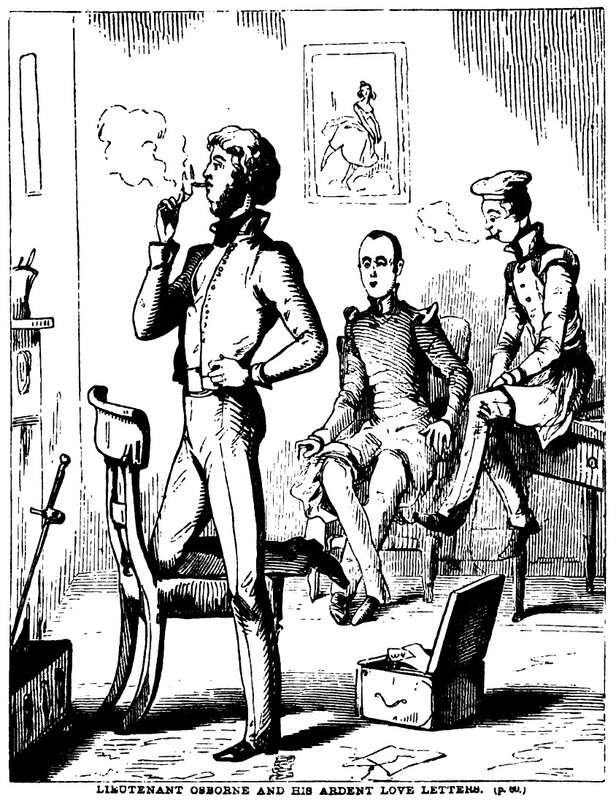
George Osborne stands facing the fireplace with one leg resting on a wooden chair, smoking a cigar which he has lit using a love letter from Amelia Sedley. At the base of the chair is an open chest, filled with more of her letters. Two other officers are seated in the background. One is sitting on the edge of the desk, also smoking. The other is Dobbin, seated in an armchair over which a portrait of a woman hangs, looking shocked. Below the illustration is printed its title and location in the story, “LIEUTENANT OSBORNE AND HIS ARDENT LOVE LETTERS. (p. 60.)”.
There are two men and two women. One man is leaning over a table. The other man is sitting on the floor. One woman is sitting behind the man on the floor as she sews fabric onto the man’s head piece. The other woman is standing above the man over the desk as she sews fabric onto the man’s head piece.
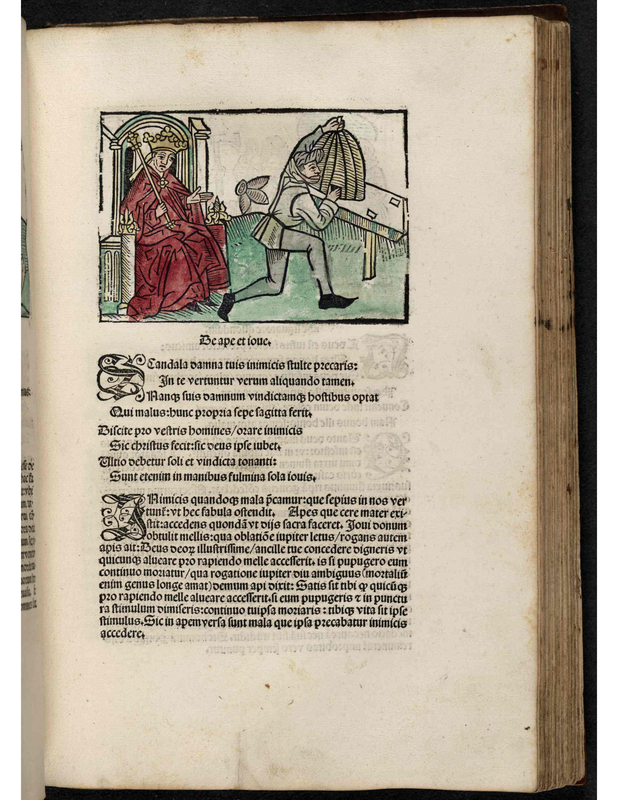
A man carries a beehive while a bee flies nearby. There is a king wearing a lavish crown sitting in a throne, with his palm facing out in a manner of explanation.
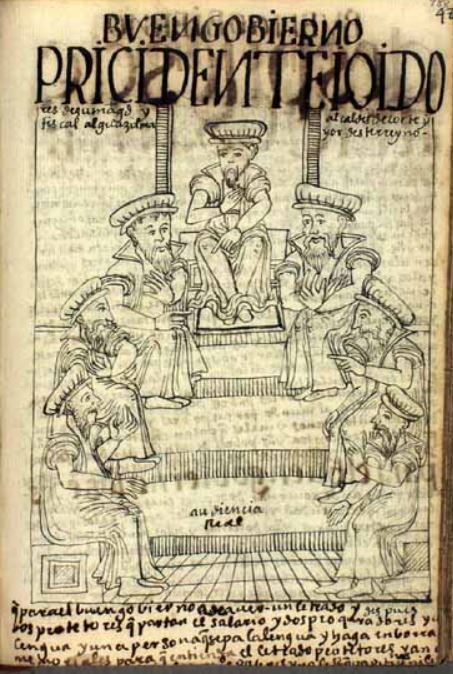
This image depicts the royal audience of Lima, the ruling body of Spanish colonial Peru. There are three men sitting on each side of a staircase with one man sitting at the top. They are all dressed in traditional European/Spanish clothing. The author explains that the governors rarely favour or care for the indigenous peoples of Peru. The large caption written at the bottom of the image reads, “que para el buen govierno a de auer un letrado y dos protetores que partan el salario y dos proquradores y u[n] lengua y u[na] persona que sepa la lengua y haga en borra[dor] memoriales para que entienda el letrado protetores y an[...] y no le [...] pitici[o]nas ni le [...]” [for good government there should be a learned advocate, two defenders who shall share a salary, two attorneys, an interpreter, and another person fluent in the [Quechua] language who can draw up memoranda for the use of the advocate, the defenders, and […] petitions, nor […]].
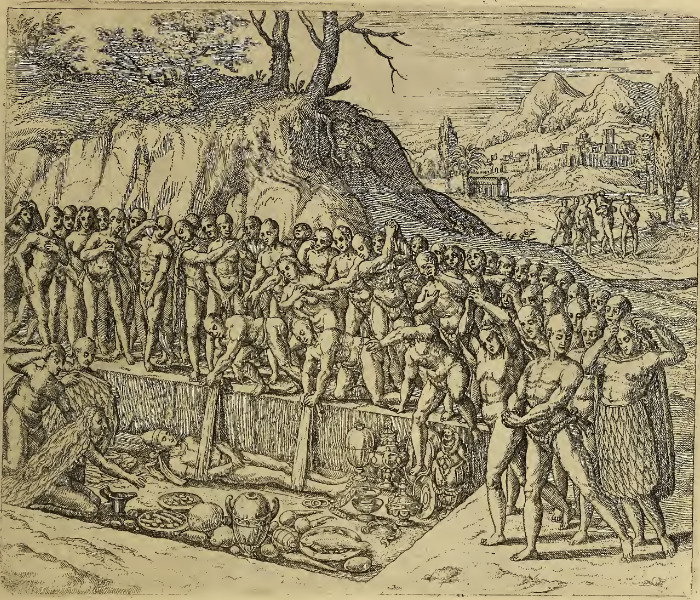
A group of Inca people in Peru bury one of their Emperors. They have dug a large, rectangular hole in the ground for the burial. The body of the Emperor has been laid out along one side of the grave, and the rest of the space is filled with food, jewelry, and gold and silver ornaments and vessels. A man kneeling in the grave lays down a feathered cloak or blanket. A large group of mourners gather along one side of the burial, many holding their hands clasped together. Several individuals wear feathered cloaks or skirts, including a woman kneeling in the grave. In the distance, a walled city is visible. This image is identical to one found on page 26 (161) of Frankfurt, 1596.
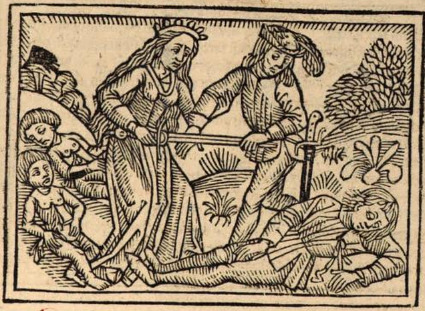
This engraving depicts Berenice, the queen of Cappadocia, stabbing a servant in his abdominal area to avenge her sons’ deaths. After her sons had died at the hand of her brother, Mithridates, Berenice sought vengeance against him. The slave that Berenice is stabbing in this engraving is Caenus, a man who was involved in the murder of her sons. Although she is depicted stabbing him with a sword in this engraving, Boccaccio explains in his story that she actually chased Caenus down in a chariot, and after hitting him in the head with a rock, she drove over his body with the chariot until he died. The dead figures in the engraving who are lying on the ground are assumed to be Berenice’s children.

![[Vanity Fair Volume I. Chapter XVI Historiated Initial, H]](https://collections.cemvc.ca/files/large/89985aecc64601b5c4bf55d1a8c5c4ea4150d06f.jpg)


![[Gulliver speaking with a Lilliputian]](https://collections.cemvc.ca/files/large/d57488bbf2e3a2bd48595aac79ef08143fe80e37.jpg)
![Coreg[id]or I Comendero Tienen Pendencia Sobre los Rreales Quien a de Lleuar Mas](https://collections.cemvc.ca/files/large/f374ed799c32ba83a801cb8f26519c3051899211.jpg)

![[The Fox and the Crow]](https://collections.cemvc.ca/files/large/4ce54ae15e4d0d0defc9822da3df5a6d2cf2d7f1.jpg)
![[Gulliver and Glumdalclitch]](https://collections.cemvc.ca/files/large/7e60a838c34c85be4e5a811709e1a58376dde6ea.jpg)
![[Julia Seeing Pompey’s Blood-Stained Cloak]](https://collections.cemvc.ca/files/large/cfaddada84bca64d95f8629b7598400ee98b950f.jpg)
![[Women Sew For Men]](https://collections.cemvc.ca/files/large/056c658a5230c55cfe8d13c1ab16f7b4c3157a1e.jpg)