A large group of Tupinambá Indigenous people canoe near the coast of Brazil. Fourteen canoes are shown, all full of three to five individuals. In the distance, a settlement can be seen on land close to the shore.
This illustration depicts two different scenes. In the background on the left side, there is a man illustrated on his hands and knees in the Numicius River, looking down as if he is in pain. This man is Aeneas, a Trojan hero. He had been taking part in a war which resulted in injuries that caused his death near this river. Before dying, his wife Lavinia gave birth to their son, Postumus. Lavinia is illustrated in the foreground of the image hiding in the woods as she gives birth. She is holding onto a tree for support as her new born child emerges from under her dress.
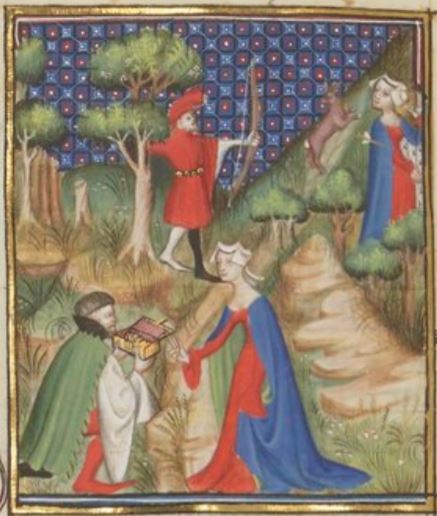
When Cephalus was told that his wife (Procris) would abandon him in exchange for money and treasures, Cephalus began testing his wife. Cephalus would disguise himself and offer her gold and treasures in exchange for her love. This is depicted in the foreground of the image, with Cephalus kneeling and presenting a box of treasures to Procris. Procris rejected the disguised Cephalus multiple times, however, she eventually accepted his treasures. Procris regretted what she had done to her husband. To punish herself, Procris went to live in the woods. Cephalus had been hunting one day and had mistaken his wife for an animal and shot her. Cephalus is illustrated in the background of the illustration holding a bow in his hands. Procris is on the right side of the image with an arrow protruding from her chest after being mistakenly shot by Cephalus. There is a deer beside Procris as this was the animal Cephalus mistook her for.
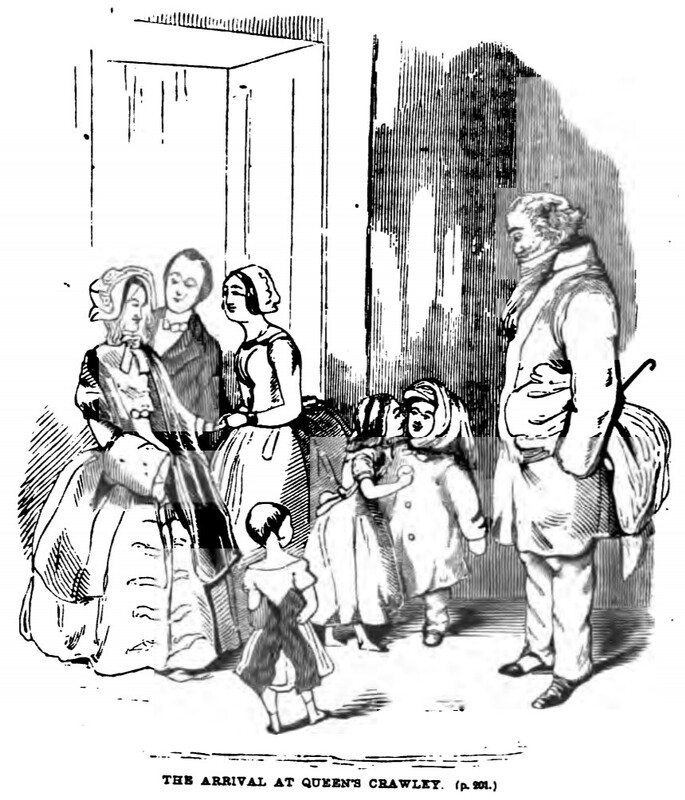
Matilda Crawley greets her cousin, the younger Rawdon Crawley, while her brother Pitt Binky hangs back and watches. To their side is Mr. Rawdon Crawley, watching his son. In the background, Sir Pitt and Lady Jane are greeting Rebecca Crawley, who has just arrived at Queen’s Crawley with her husband and son. Below the illustration is printed its title and location in the story, “THE ARRIVAL AT QUEEN’S CRAWLEY. (p. 201.)”.
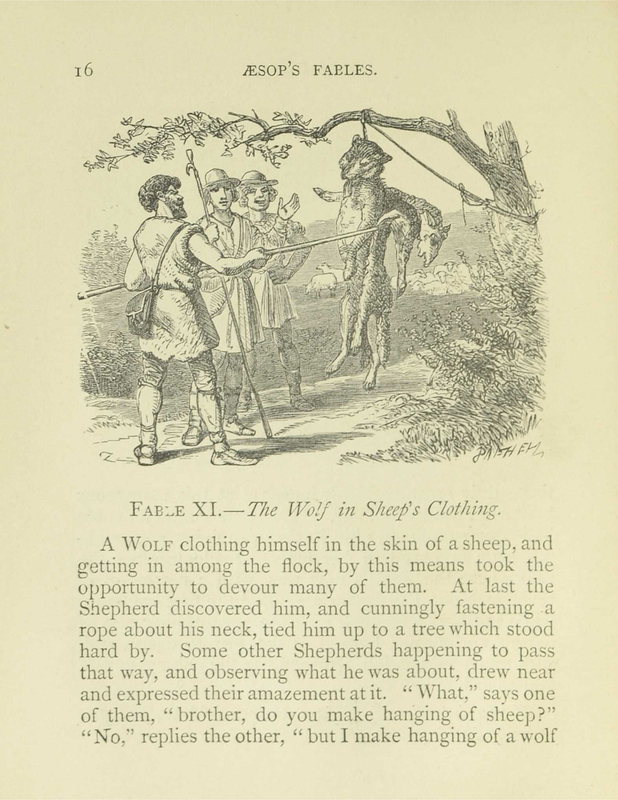
A wolf clothing himself in the skin of a sheep and getting in among the flock, by this means took the opportunity to devour many of them. At last the Shepherd discovered him, and cunningly fastening a rope about his neck, tied him up to a tree which stood hard by.
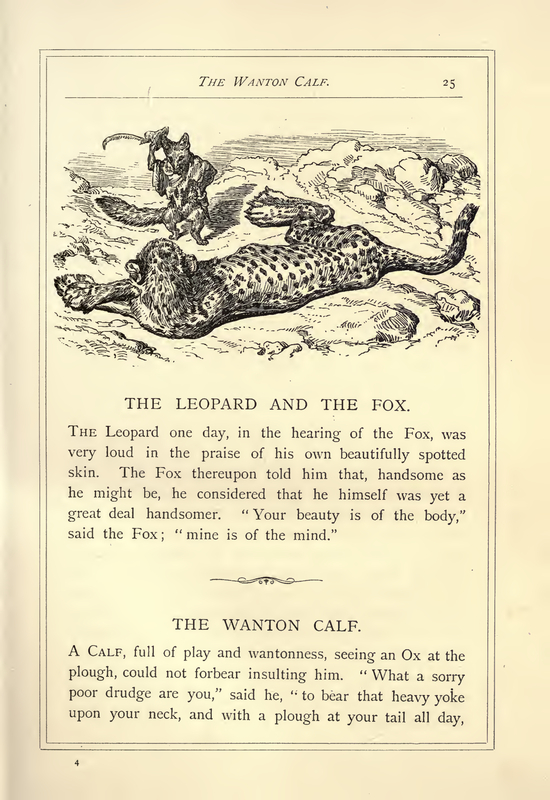
A leopard lies on the ground on all his length. Its back is towards the reader, as it looks straight ahead. In front of the leopard, a fox is walking like a human. The fox looks down at the leopard, and takes off his hat, gently inclining towards the leopard.
Only a fraction of the image is visible, as the rest has worn off with time. From what is visible, there is a combination of animals on the ground, all looking skywards. There is a lion, a cow, a wolf, and a horse. The horse is on its front legs, kicking back rocks towards the sky with its hind legs. All the animals on the ground have an angry expression to the sky. In the sky, there is a bat taking flight on the right side. In the upper right corner, a goose is looking down at the ground animals. The other sky animals are hard to determine, but from the claws visible at the left upper corner, it could either be an eagle or a dragon.
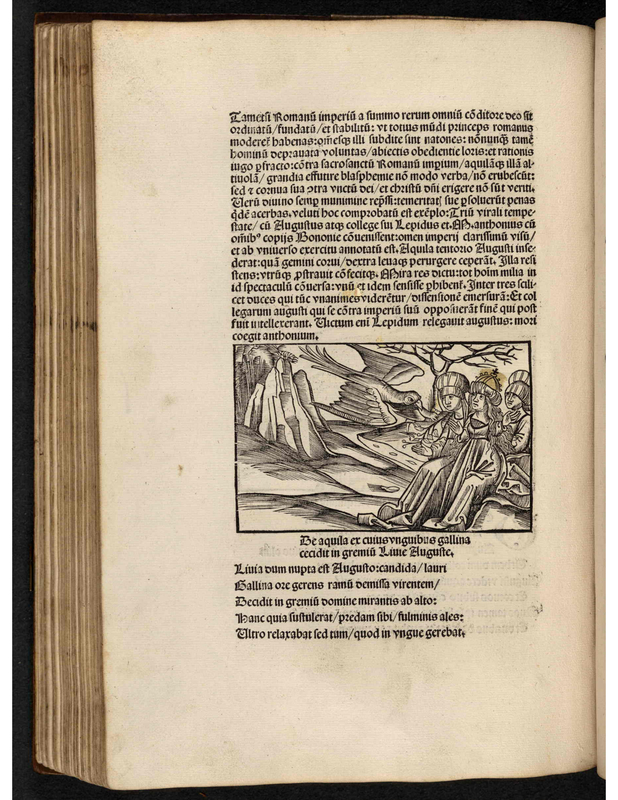
Three women with unique headdresses sit in a group. There are mountains and a tree in the background. A bird is flying toward them with something in its beak.
A group of Tupinambá Indigenous people capture a European man on an island called Saint Maro in Brazil. The European man stands on the shore near the left side of the image, with two Indigenous people holding on to him and brandishing weapons. Several of the Indigenous people on shore hold either a bow, a spear, or both. Some members of the group are departing the island in canoes, while others in canoes row near the shore. Several settlements can be seen in the background, including one labelled “Brikioka”.
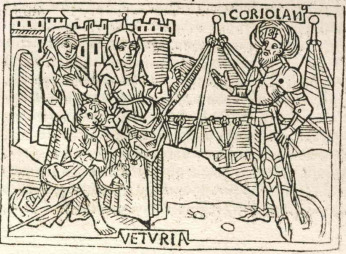
An old noble Roman woman named Veturia is depicted on the left-hand side of the engraving with her daughter-in law and grandchild beside her. We know this figure is Veturia as her name is engraved below her feet. She is illustrated pointing at the man on the right-side of the engraving. This man is her son, Coriolanus (his name is engraved above his head). Boccaccio explains that after Coriolanus had been exiled from Rome for neglecting the plebian class, he planned an attack on Rome. Veturia, with the help of her daughter-in-law (Volumnia) and grandchild, went to speak with Coriolanus at his camp and convinced him to not go through with the attack. Boccaccio explains that he decided to write on Veturia for her honour as a mother and a woman.
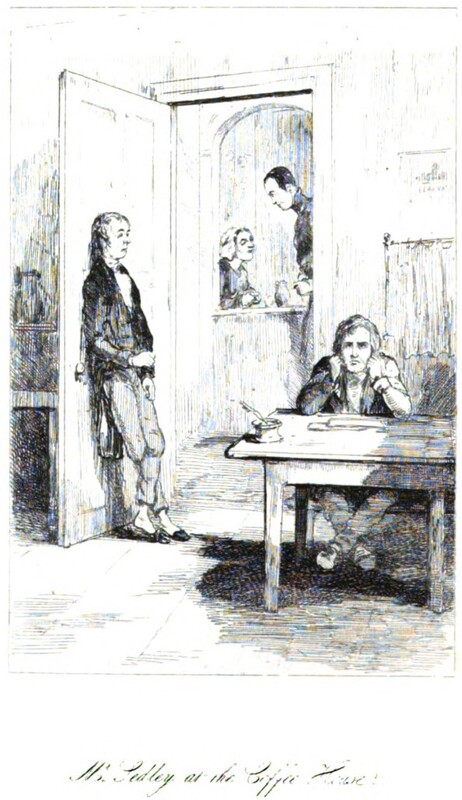
John Sedley is seated at a table at the Tapioca Coffee-house, slouching over with his elbows resting on the table and his scowling face between his fists. On the table in front of him are several pieces of paper and an inkwell with a quill. The door to the room is held open by a bored-looking man who leans against it. Through the doorway, William Dobbin can be seen talking to the woman at the desk. Below the illustration is printed in cursive its title, “Mr. Sedley at the Coffee-House.
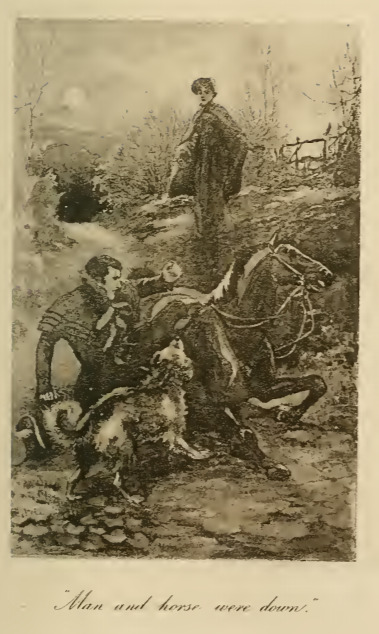
Here Jane meets Mr. Rochester for the first time. Jane was going into town when Mr. Rochester rode past her on horseback. His horse slipped on ice and threw Mr. Rochester off. He hurt his ankle and needed Jane’s help. She helped him back onto his horse, not knowing who he was, nor did he know her.
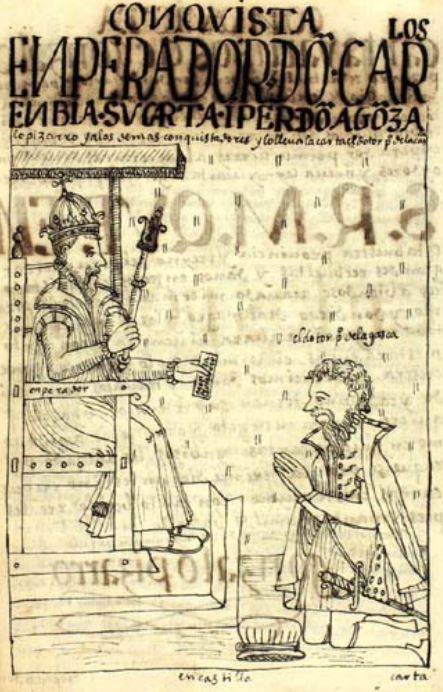
This chapter focuses on discussing the arrival of Spaniards and the Spanish conquest of Peru. This image depicts Charles V, the Holy Roman Emperor and king of Spain and Germany, sitting on a throne on the left side of the image holding a scepter in his right hand and a letter in his left. A man named Pedro de la Gasca, a priest and diplomat, is depicted on the right side of the image kneeling before the emperor. King Charles V appointed Pedro de la Gasca with the task of bringing a letter of pardon to Gonzalo Pizarro, with the hopes of bringing peace to Peru. The word “enperador” [emperor] is written on the arm rest of the throne to identify the emperor. There is a caption written above de la Gasca which reads, “el dotor Pedro de la Gasca” [the gifter Pedro de la Gasca]. The caption at the bottom of the image reads, “en Castilla” [in Castile].
A mixed group of Indigenous people and Europeans stand on an island labelled ‘S. Maro’ and a group of Indigenous people in canoes are arranged along the shore facing the group on the island. The two groups are engaged in conflict, with the Europeans firing guns and the Indigenous people shooting arrows. At least two Indigenous people in one canoe (second from left) and one person in another (far right) have been killed or wounded. There appears to be a European captive in the prow of the canoe in the middle – the man is nude and has a rope tied around his neck, and he fires a gun at the group on the island. There are two fortifications on the island, as well as one on the mainland labelled ‘Brikioka’, from which several cannons are firing.
Intrigued by the European’s technology, Gulliver explained how he arrived on the island. He explained how ships work and used his handkerchief to explain the ship’s sails, seen here. In this image Gulliver uses his breath to simulate wind, using a handkerchief to simulate the sails to his master. Gulliver did this to explain how ships were built and how they worked and how he arrived in the Country of the Houyhnhnms. The same image appears in the 1843 Krabbe edition.
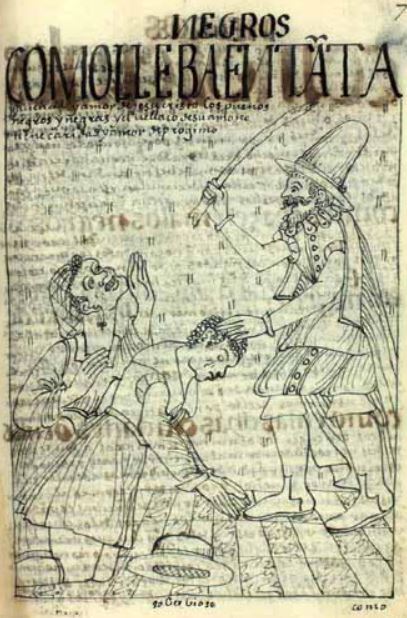
This image depicts the mistreatment of the black population in colonial Spanish society of Peru. There is a Spanish master standing on the right side of the image holding a long stick in his right hand as he beats the black slaves kneeling before him. The author explains that, despite the black people of Peru being slaves, they were good, devout Christians who had patience when being mistreated by their masters. The kneeling woman is looking at her master with tears running down her face as she holds her hand in the air. The kneeling man has his head pointed towards the ground as he also has tears running down their face.
Circe is sitting in the centre of the image wearing a pink dress and a crown. She was known for her magic and skills with herbs and incantations. There are figures standing beside Circe whose bodies are in the form of a human while their heads are transformed into animals. Boccaccio explains that these animals are the companions of Ulysses, and that Circe was known to transform those who landed on her shores into animals. Ulysses is the only one depicted in his human form.
Two Indigenous men and a child stand around a tree. The man on the right threads the items harvested from the tree (dried fruit or nuts) onto a string to make a leg rattle, like those worn by the man on the right. The man on the left dances with one hand on his hip, wearing leg rattles and holding a maraca or religious item in the other hand. Both men wear feathered headdresses. This illustration is a simplified and mirrored version of the one found on page 66 verso of Paris, 1557.
![[Tupinambá people canoe off the coast of Brazil]](https://collections.cemvc.ca/files/large/908e8742d23265f9ba7c0a6d9c2732d478906e5f.jpg)
![[Lavinia Gives Birth in the Forrest While Aeneas Dies in a River]](https://collections.cemvc.ca/files/large/03226962eababc1440c11918d4fb1830ecfe4ebb.jpg)

![[The Ground Animals Against the Sky Animals]](https://collections.cemvc.ca/files/large/fa7d1988a5d2f0f0479bfc90381e4c3554a030a3.jpg)
![[A European man is captured by a group of Indigenous people]](https://collections.cemvc.ca/files/large/eec46af038edddd373a8cd3e345a01c183b5564f.jpg)
![[Combat between European and Indigenous men on an island and Indigenous people in canoes]](https://collections.cemvc.ca/files/large/b4983930ff2591d58ed3ea84cf5357e50a8b6a56.jpg)

![[Gulliver explains how he arrived at the Country of the Houyhnhnms by sailing ship]](https://collections.cemvc.ca/files/large/3ddb69ffe7435679bab2df560d3a356aacbb43e7.jpg)

![[Indigenous Brazilians harvest fruit or nuts for leg rattles]](https://collections.cemvc.ca/files/large/8dd6b761881f97bb2c120c54a0ad71c9914b9524.jpg)