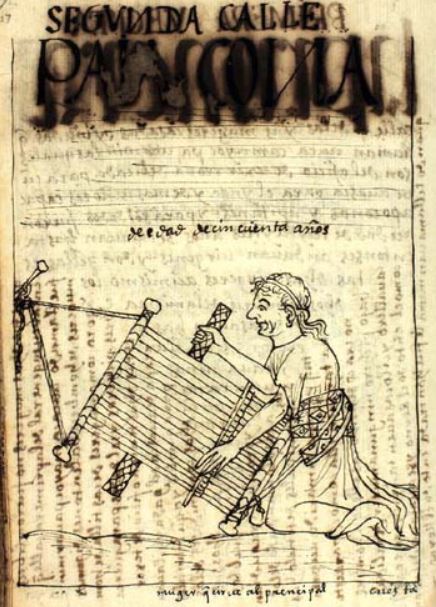
The author explains that there were ten paths for women to follow in the Inca Empire based on age division. This second group was called the payacona [old women]. These were women who were fifty years old who weaved clothing for the common people. The woman in the image is depicted kneeling as she weaves at a loom which is strapped around her back. The caption written on the image reads “de edad de cincuenta años muger que cirue al prencipal,” which translates to “fifty-years old, woman who serves the nobles.”
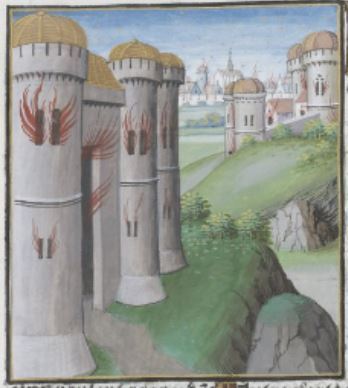
This image appears in the chapter that treats Constance, the empress of Rome and the queen of Sicily. The image depicts many towers that are on fire with flames emerging from all of the windows. This is to represent the chaos that ensues after Constance’s father, King William of Sicily, had died and there was conflict regarding who should take the throne. Wars broke out and cities burned, which is why there are burning buildings in this image. The wars subsided when Constance left her position as a nun at a cloister and took the throne.
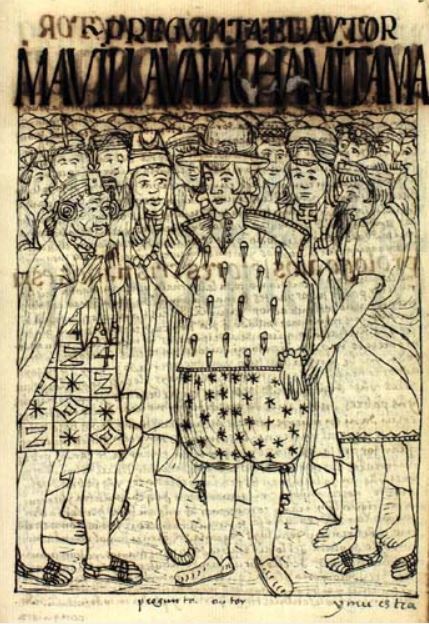
This image depicts the author of the book standing in the centre of the image wearing western attire as he is surrounded by a traditionally dressed crowd. The author, Felipe Guaman Poma de Ayala is depicted speaking with the people surrounding him as he asks for information regarding the history of the indigenous people of the Inca Empire and Peru. He is seeking out this information in order to write this book on the history and governance of Peru. The caption at the bottom of the image reads “pregunta autor” [the author asks questions].
Here we see a horseshoe. The Houyhnhnms asks about the horses in Europe and how they live. Gulliver explains that humans or yahoos govern the country and care for the horses or Houyhnhnms, and how humans use their horses. Gulliver explained how horseshoes were made of iron and were put on the bottom of the horses’ feet to protect them from the rough roads. The same image appears in the 1843 Krabbe edition.
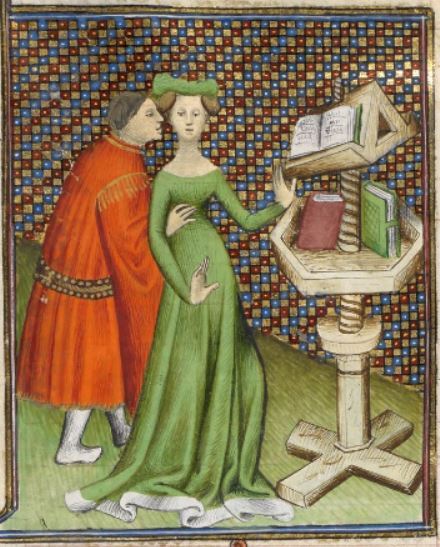
This illumination depicts a Greek woman named Leontium. Boccaccio explains that Leontium was an intellectual scholar and philosopher and became renowned for criticizing and speaking against certain philosophers of her time. Leontium is depicted standing in the centre of the image with books sitting on a podium beside her. These books are representative of her intellectual life. There is also a man holding Leontium as he stands behind her. This is depicted due to her becoming a prostitute later in her life. Boccaccio believes her fame was hindered by becoming a prostitute.
This engraving depicts three separate events. The far right of the engraving depicts a man named Brutus having a discussion with his wife Portia. We know that these figures are Brutus and Portia as Portia’s name is engraved beside her body and Brutus’ name is engraved above his head. Brutus is telling his wife the conspiracy plan to kill Julius Caesar. After hearing the conspiracy plans, Portia took a barber’s razor and cut herself with it. The engraving depicts the barber’s razor sticking out of her foot. She does this to prepare herself in case she has to kill herself should the conspiracy not work out in Brutus’ favour. The centre of the engraving depicts the assassination of Julius Caesar. Brutus is on the left side of Caesar, stabbing him in the chest. A man named Cassius is behind Caesar as he stabs his abdominal area. Their names are engraved above their heads. The far left of the engraving depicts Portia eating burning hot coals from the fire directly beside her after hearing of her husband’s death.
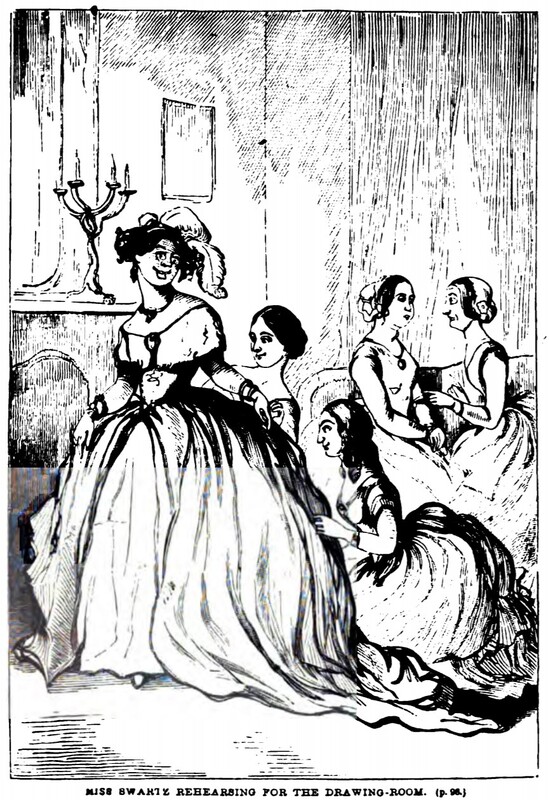
Miss Rhoda Swartz stands in front of Jane and Maria Osborne, dressed in a large gown with many pieces of jewelry and feathers in her hair. In the background, Miss Wirt and Miss Swartz’s chaperone Miss Haggistoun are seated on a sofa, talking to each other. Below the illustration is printed its title and location in the story, “MISS SWARTZ REHEARSING FOR THE DRAWING-ROOM. (p. 98.)”.
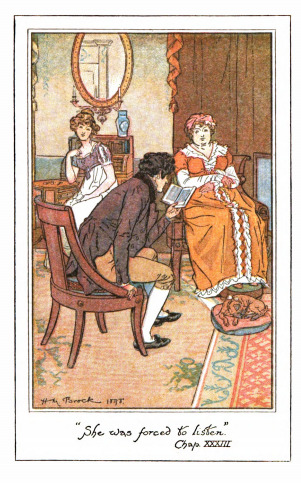
Here we see Mr. Crawford reading a passage of Shakespeare to Lady Bertram and Fanny. Fanny was reading to Lady Bertram when Mr. Crawford walked into the drawing room. She stopped reading when Mr. Crawford walked in. He tried to convince her to continue reading, but she refused. Mr. Crawford then picked up the book and continued reading the passage where Fanny left off. Fanny did not want to listen but found his reading captivating. It was at this point that Mr. Crawford had decided he wanted to make Fanny love him. This scene occurs in chapter 33 as noted underneath the title of this image. The characters are shown in the traditional regency style. Fanny and Lady Bertram wear the regency style dress with an empire waist. Fanny’s hair is worn tied up and Lady Bertram wears a mop cap. Mr. Crawford wears a waistcoat and tailcoat, and knickers that stop at the knee. The regency period dated to the early nineteenth century (1811-1820) when George, Prince of Wales, later George IV (r. 1820-1830), reigned as regent for his mentally ill father, King George III (r. 1760-1820). The regency period is associated with the rise of neoclassicism in art and fashion.
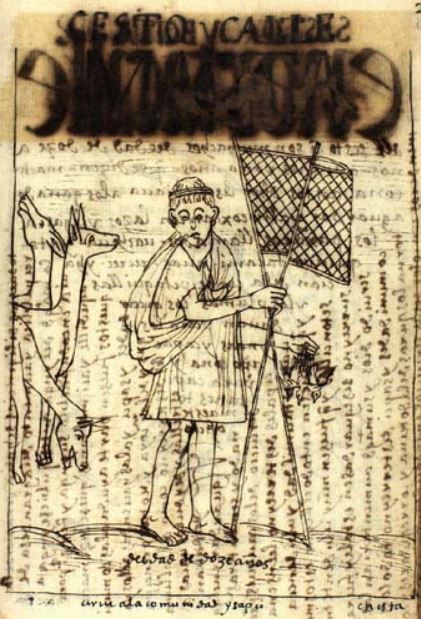
The author explains that there were ten paths for pmen to follow in the Inca Empire based on age division. This sixth group was called macta [young boy]. This group was young boys aged twelve to eighteen years old who had the duties of watching over farmer’s herds and to catch birds that would be used for meat. The young boy depicted in the image is illustrated holding a net in his right hand and three dead birds in his left. There is a herd of llamas depicted standing behind him. The caption at the bottom of the image reads “de edad de doze años cirue a la comunidad y sapci” which translates to “twelve years old, he serves the community and their sapsi [property].”
Joseph Sedley, seated in a chair in his bed-chamber, gestures at his face to tell Isidor to shave off his moustaches. Jos is afraid of being mistaken for a military man and killed by the victorious French army. He has tried ordering a shave, but his French is not good enough to be understood, and Isidor at first thought he had lost his mind and was asking to be killed.
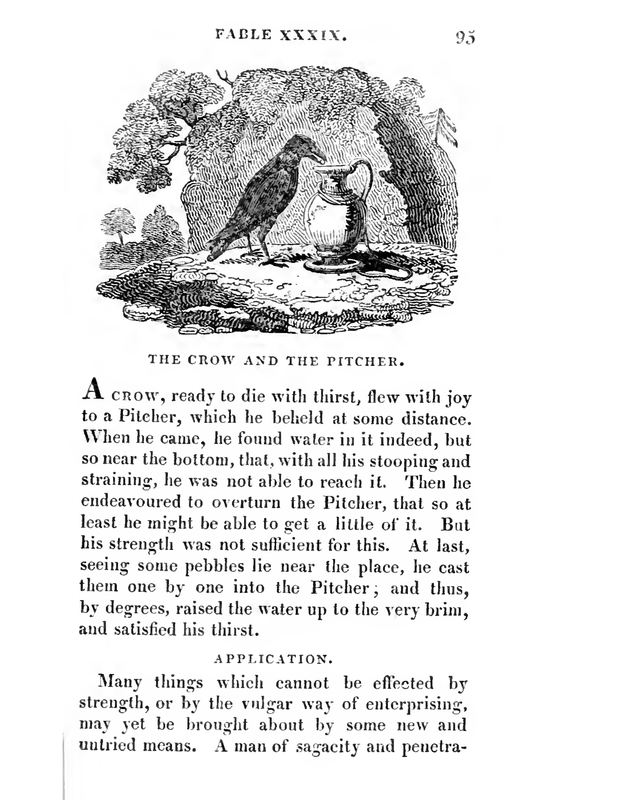
On a mound of dirt in the centre of the image is a crow facing right holding a small round object (likely a berry) in its beak. The crow is about to drop the item into a pitcher to its right. The pitcher handle is on the right, and it has a rope around the neck that falls to the ground. A tree is behind the mound and arches over the top of the image. Many other trees fill the background.
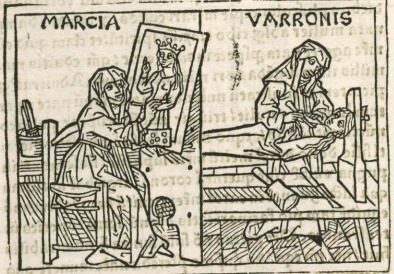
Marcia, a Roman woman who remained a virgin her entire life, is depicted on the left side of the engraving painting a portrait. Boccaccio explains that Marcia is worthy of renown for her chastity and for her painting and sculpting abilities. She is known to have mostly painted and sculpted figures of women, which is why there is a portrait of a woman wearing a crown in her painting. The right side of the engraving depicts Marcia sculpting a figure of a woman. Her sculpting tools are illustrated on the table in front of her. Marcia’s name is engraved at the top of the engraving near the left-hand corner in order to identify her. The name “Varronis” is engraved at the top on the right side of the engraving, which refers to her father, Varro.
Mr. Bowls sits in a chair at the kitchen table, reading aloud to his assistant, who sits opposite him, holding onto a jug. Through the door in the background, Mrs. Firkin is entering, holding a candle in front of her.
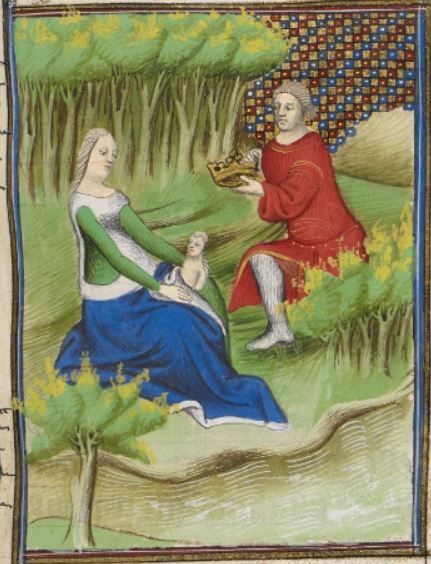
This illumination depicts Lavinia, the wife of Aeneas and queen of Laurentum, hiding in the forest. Boccaccio explains that after her husband Aeneas died, Lavinia fled to the forest as she was afraid that her stepson would kill her and her newborn son, Silvius. Lavinia was wrong, and Ascanius voluntarily gave the kingdom of Laurentum back to her and helped raise Silvius. Ascanius is depicted holding a crown, presenting it to Lavinia as he offers her kingdom back. Lavinia is depicted holding her newborn son in her arms.
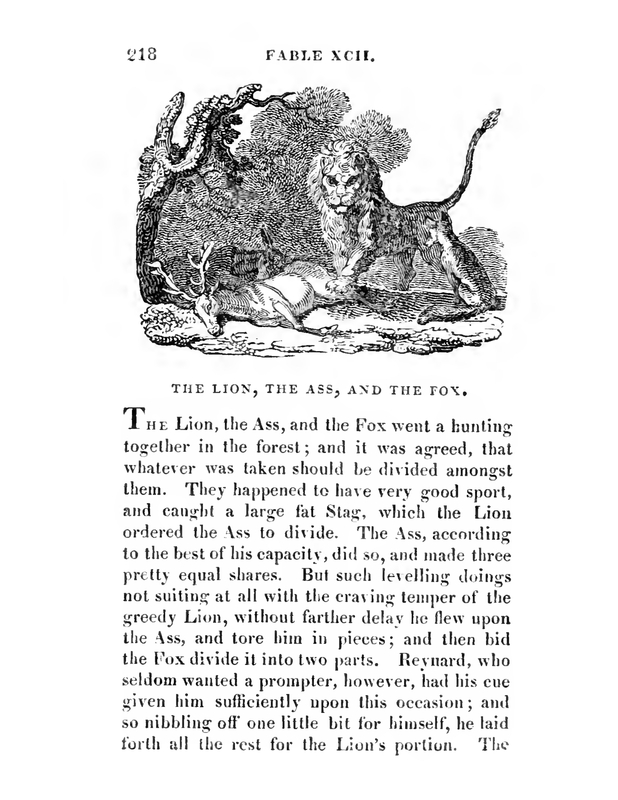
This image depicts a lion standing over an ass with its tail up in the air, and its paw on top of the ass. There is a fox sitting on the right side of the lion looking down at the ass. Surrounding the lion, ass, and fox are many trees, and bushes.
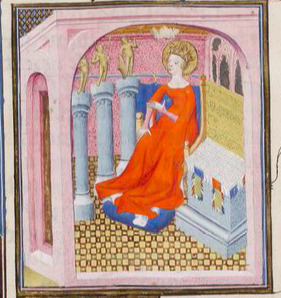
Opis, also called Ops or Rhea, is seated in a throne in the center of the image. She was mistakenly considered not only a queen, but also a deity by mortals. This resulted in temples and sacrifices being accorded to her. In the image she is located inside one of the temples that was built in her honor.
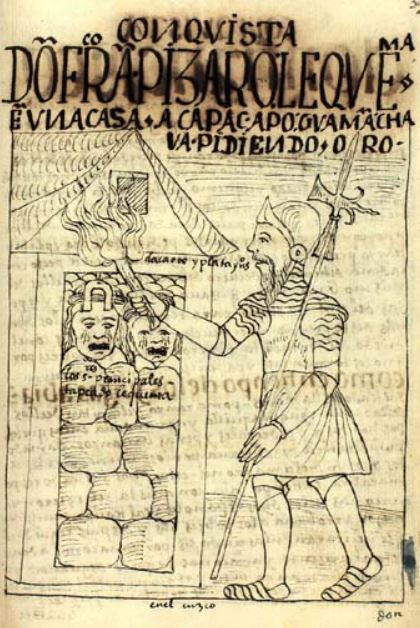
This chapter focuses on discussing the arrival of Spaniards and the Spanish conquest of Peru. This image depicts Don Francisco Pizarro, one of the leading conquistadors in the conquest of Peru, on the right side of the image suited in his armour. He is illustrated holding a torch and placing it on a house. He is setting a house on fire that contains Capac Apo Guaman Chaua, a noble lord second in command to the emperor, as well as other noble lords. The lords inside the house have tears running down their faces as they are walled in the house and unable to escape. The conquistadors locked these lords in the house to demand gold from them. When the lords did not comply, Pizarro set the house afire and killed the lords. The caption written to the left of Pizarro’s face reads, “daca oro y plata, yndios” [give me gold and siler, Indians]. The caption written below the faces of the noble lords reads, “los senores principales tapeado le quema” [the noble lords, walled in to be burnt]. The caption at the bottom of the image identifies the location as it reads, “en el Cuzco” [in Cusco].
![[a horseshoe]](https://collections.cemvc.ca/files/large/b35e164bf27064a8467126e8b95adffc6cce1680.jpg)

![[Joesph Demands a Shave]](https://collections.cemvc.ca/files/large/17ea52ef8993eb8e6854e7d99c6a61e9ef9cd924.jpg)
![[Mr. Bowls Reading]](https://collections.cemvc.ca/files/large/a21a529863c6c2c33087d21b575bf58b5d43152e.jpg)