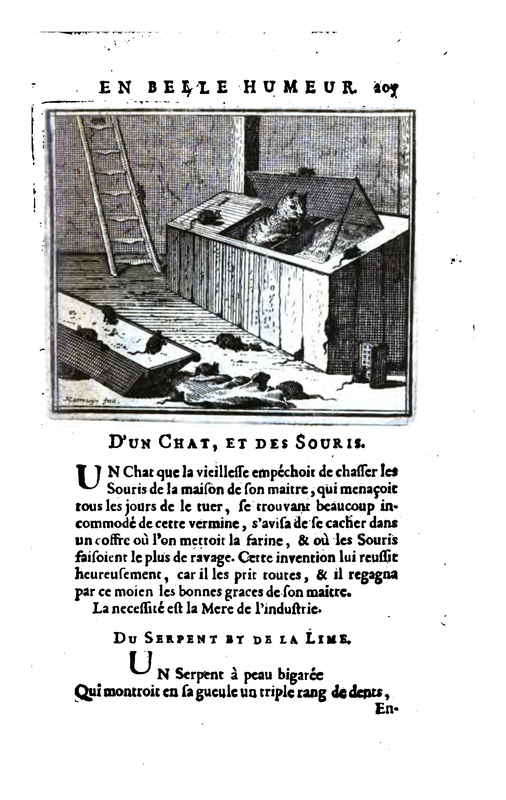
A cat appears to be in a wooden box in a room with many mice climbing around. There are things on the floor which the mice appear to have soiled. A ladder is up against a wall on the left side of the illustration. The illustration has the signature of Harrewijn in the bottom left corner.
This illumination depicts a portrait of a woman named Sappho from the Greek island of Lesbos. She is illustrated playing a lyre with a solemn expression on her face. Sappho is renowned for being a skilled poetess. Boccaccio explains that her verses were often melancholy, due to being broken hearted by a man who did not share a mutual feeling of love for Sappho.
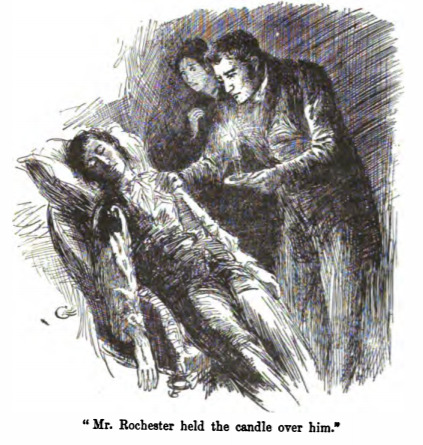
One of the unexpected guests at Thornfield during the party was Mr. Mason, Mr. Rochester’s bother in law. In the night, Mr. Mason snuck upstairs to see his sister who attacked him with a knife. Mr. Rochester then went out to get the surgeon, while Jane watched over Mr. Mason. Jane was unaware who Mr. Mason was, nor did she know about Mrs. Rochester.
In this image we see the Lilliputians performing for Gulliver. Three are walking on a tightrope, with one doing a handstand, another juggling, and the third walking with a long pole. A fourth man is lying on the ground, as though he fell off the tightrope. A crowd watches the performance from above, with Gulliver sitting in the back. This performance was used for participants to earn their place in high favour at the royal court. Pillows are on the floor to help break the fall of anyone who might slip. This image comes when Gulliver is being accepted into Lilliputian society. The same image appears in the 1839 Krabbe edition.
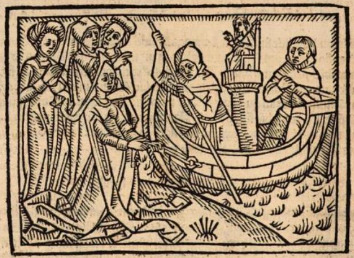
This engraving depicts Claudia Quinta, a Roman woman, standing on land as she pulls a ship to shore. Boccaccio explains that after Claudia Quinta was accused by other matrons of not being chaste, she prayed to the goddess Ceres to help prove her virtue. After a ship that contained a statue of Ceres had gotten stuck on a sandbar, Ceres gave Claudia Quinta the power to pull the ship to shore as proof of her chastity. The women who accused Claudia Quinta of being unchaste are standing behind her in the engraving as they watch her pull the ship to shore. The statue of the goddess is illustrated on top of a platform on the ship.
Rebecca Crawley learns against the back of George Osborne’s chair, flattering him. He is turned slightly to look at her, while Rawdon Crawley sits opposite him, smoking. The men are each holding two cards in their game of écarté.
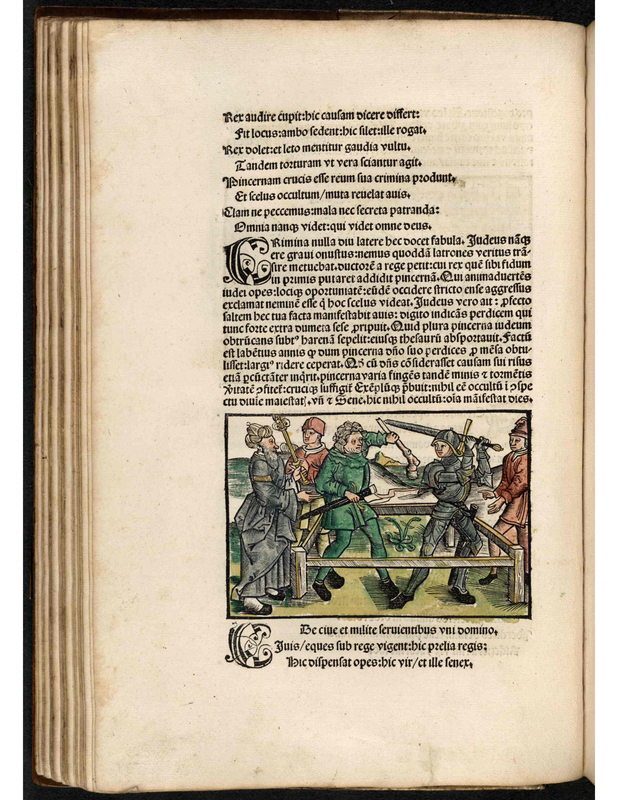
In a ring outlined by wooden planks a man in commoner clothing with a sheathed sword in one hand and a club in the other, is fighting a man in night armour who is holding a sword. Outside the ring a man in grey robes holding a staff watches the fight, opposite him another man watches as well. Behind the man in the grey robes another man stands, facing away from the fight.
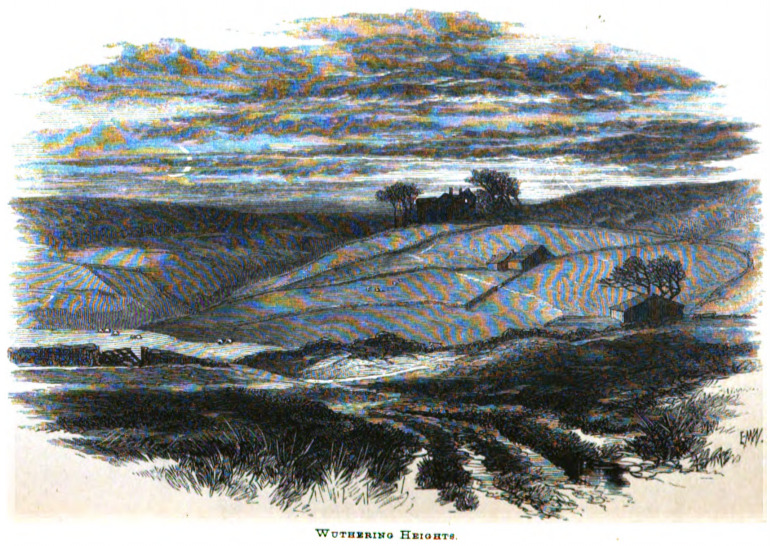
Here we see Wuthering Heights overlooking Gimmerton Valley. The Estate of Wuthering Heights is seen in the distance, with two smaller houses also in the Valley. A pasture with sheep is visible in the left foreground. The viewer is likely standing outside Thrushcross Grange, the other main location of the story.
The head of a man is on the ground, from the top of his head to his shoulders. It is hard to identify whether this is the head of a real human, or if it is a statue. Next to it is a fox, intrigued at the head. It had its right paw raised, looking down and concentrated at the head. Weeds and grass surround them.
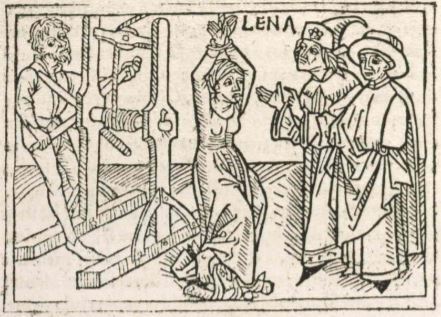
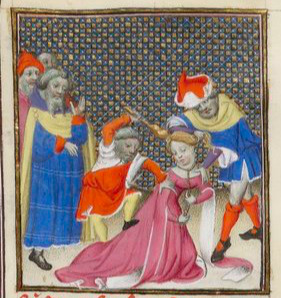
This engraving depicts the prostitute Leaena being tortured for information regarding a conspiracy. We know that the woman being tortured in this image is Leaena as her name, spelled as “Lena”, is engraved above her head. She is depicted with her hands bound by rope, which is attached to some sort of torturing device that a man is controlling. She is also depicted standing in a fire as another torturing method. Boccaccio explains that she is being tortured for being involved in a conspiracy to overthrow a tyrant. In order to avoid revealing information to those torturing her, she bites off her own tongue. Her tongue is depicted sticking out of her mouth in this engraving. The two figures on the right-hand side are unknown by name, however, they are significant as they are the ones attempting to get information regarding the conspiracy from Leaena.
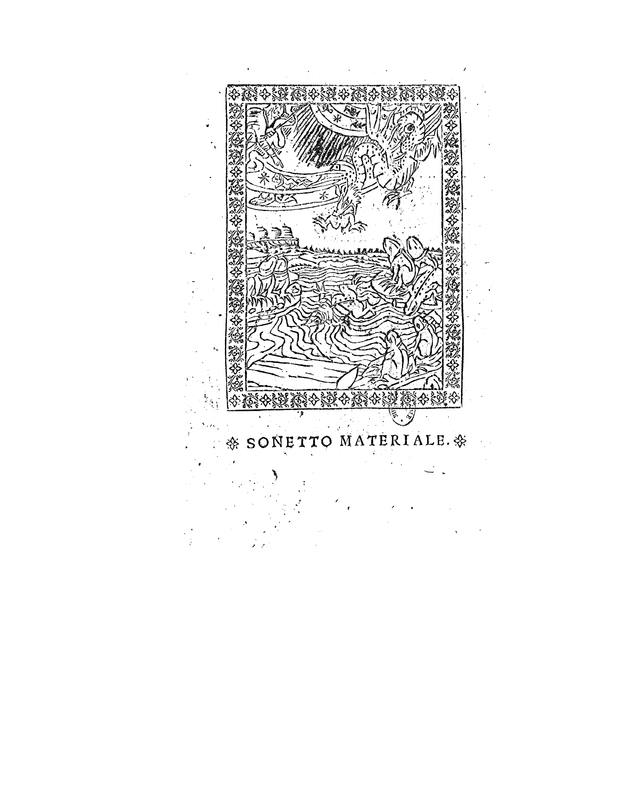
There are several frogs sitting around a pond looking up. They are looking at a dragon-like creature in the sky who is devouring a frog. There is a god-like figure it the top left corner of the image who seems to be commanding the dragon-like creature. Both the god-like figure and dragon-like creature are in the sky and surrounded by symbols and desings that imply supernatural status.
Two Tupinambá people are shown lighting fires. They do so by twirling a pointed stick against another stick on the ground until the friction creates a hot ember to start a fire.
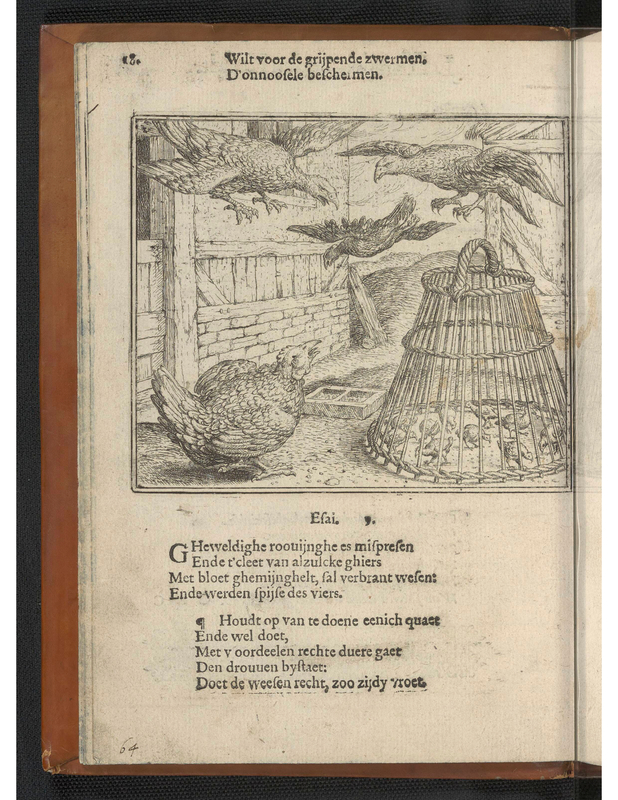
Two large birds attack a smaller bird in the air. The small bird dives as the other two reach for it with their talons. A third bird watches from the ground of a barn. Ten chicks on the right of the page are confined in a woven cage, safe from the altercation.
When Epicharis was held captive and tortured in attempt to have her reveal information, she found herself growing too weak to bear the torture. She decided to commit suicide in order to escape a third round of torture. She tied a noose and hung herself. In the image, she is found dead holding her noose, while the men who were questioning her find her body. These men surround her in the image, examining the situation.
The Lion aforesaid, touched with the grateful procedure of the Mouse, and resolving not to be outdone in generosity by any wild beast whatsoever, desired his little deliverer to name his own terms, for that he might depend upon his complying with any proposal he should make.
This image depicts Joanna, the queen of Jerusalem and Sicily, sitting on a throne while holding a scepter. She is wearing a crown to symbolize her status of queen. There is a man looking at the queen through a window on the right side of the illustration. Boccaccio praises Joanna for her lineage and the extent of her power and rule.
Here we see a Lilliputian Knight standing over the body of a knight from Blefuscu. He holds a banner with the letter “T” which is the first letter of Chapter Five, where the image appears. With Gulliver’s help, Lilliput won the war against Blefuscu.
In this image we see a procession of Diplomats from Blefuscu arriving on Lilliput to make peace. The Emperor of Blefuscu is in the centre of the image riding a white horse and wearing a long cape which is being held up by his attendants. The Blefuscudian Emperor is also wearing a different shaped hat than the others in the party. In the front of the procession is a heralder riding a black horse and announcing their arrival by trumpeting on an instrument. Behind the Emperor is a procession of other diplomats and nobles, one of whom is carrying the banner of Blefuscu. Gulliver is looking on from behind a tower within the walls of Lilliput. The same image appears in the 1843 Krabbe edition.
Joseph Sedley, seated in a chair in his bed-chamber, gestures at his face to tell Isidor to shave off his moustaches as his French is not good enough to be understood. Jos is afraid of being mistaken for a military man and killed by the victorious French army.
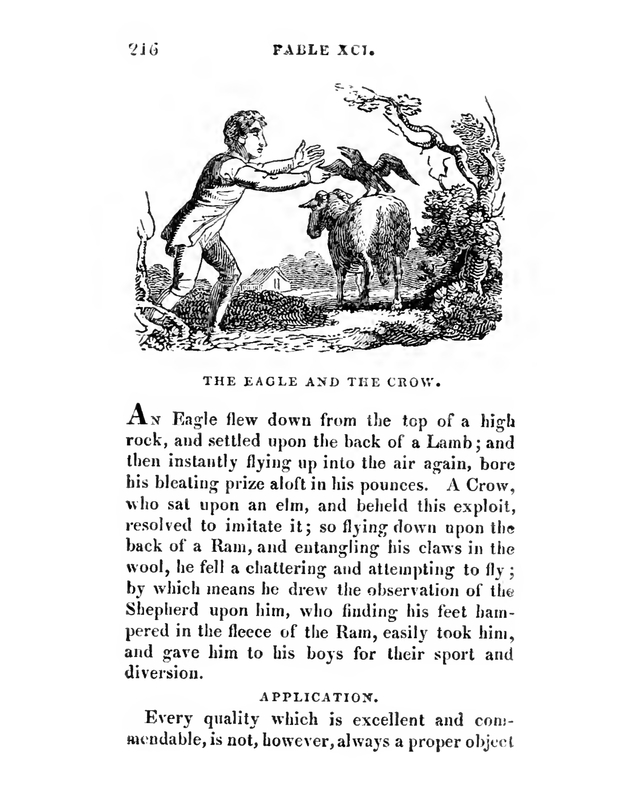
The image depicts a man who is holding his arms out towards a crow. Underneath the crow is a ram’s backside, and a house in which the ram is facing. Surrounding the man, crow, and ram are various trees, branches, and bushes.
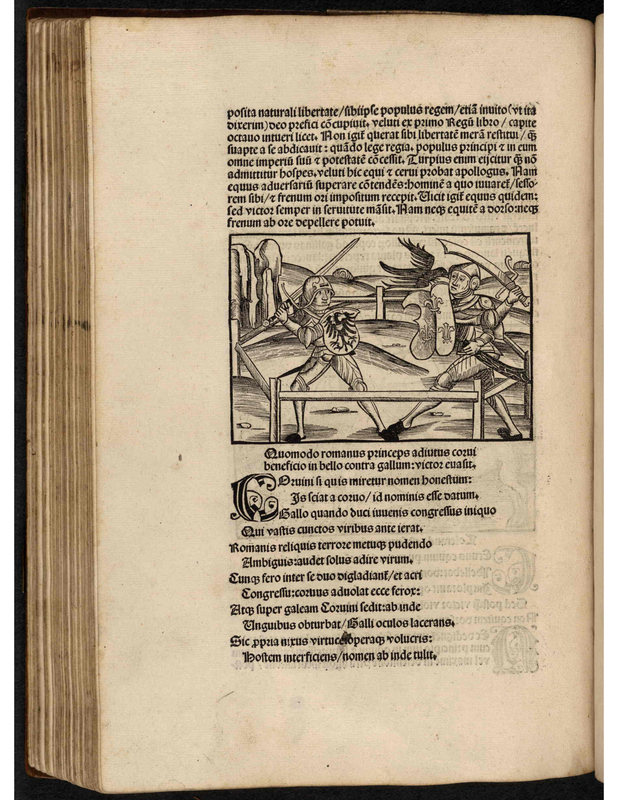
Two men are in combat with swords and metal armour in a wooden fence ring; one man holds a shield with a bird on it, the other holds a shield with three fleurs-de-lis on it. A bird attacks the face of the man holding the fleur-de-lis shield.

![[Sappho Playing the Lyre]](https://collections.cemvc.ca/files/large/e1d22fad9a50c71f54ebfe9dcafbf45304b57e23.jpg)
![[Lilliputians perform while Gulliver watches]](https://collections.cemvc.ca/files/large/d104a4399588c3851919c117b34b3083a74e45b6.jpg)
![[George Osborne at the Crawley’s]](https://collections.cemvc.ca/files/large/c37094043bfbca694ff80fd18e9c08ba6d677840.jpg)
![[The Head and the Fox]](https://collections.cemvc.ca/files/large/5e7ce33edd7a4d6ca130feb03ea844e34157945b.jpg)



![[Knights fighting in the battle between Lilliput and Blefuscu]](https://collections.cemvc.ca/files/large/aec21bed7c13b18cc771c430ef36b727ac46487a.jpg)
![[Diplomats from Blefuscu come to Lilliput]](https://collections.cemvc.ca/files/large/cb174c846b438ec24d893eccfa5a640c94adf69f.jpg)
![[Jos Requests a Shave]](https://collections.cemvc.ca/files/large/bc3a33a129b69b701c960a5e603bc4e5b4da5fc7.jpg)