Rebecca Crawley sleeping alone in her bed after waving goodbye to her husband. She has a sleeping cap on and looks peaceful and content, not at all concerned about the regiment’s departure to the battlefront.
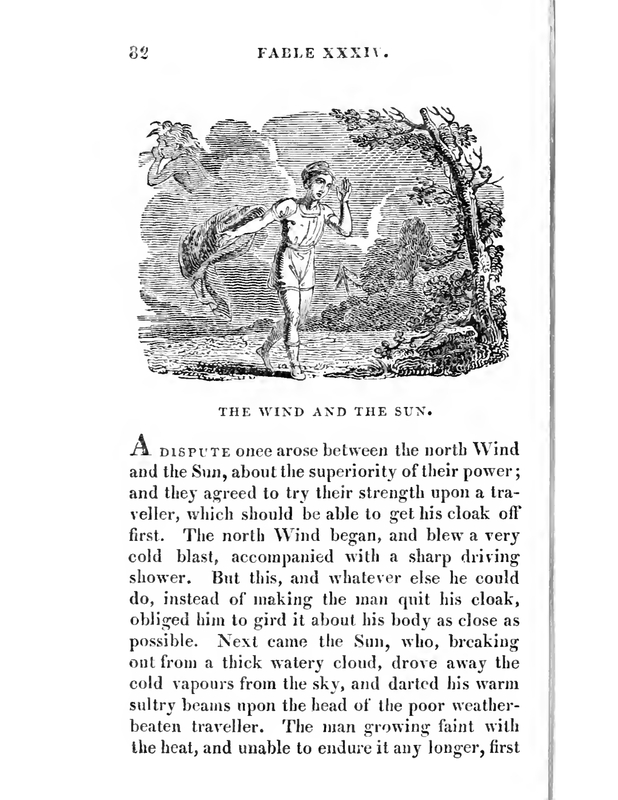
A woman is in the centre of the image, walking with her right leg forward. Her left hand is up, blocking the sun from her face, while her right arm trails behind her while she holds a piece of fabric. Light rays shine through the top right of the image. There is the upper torso and head of a person in the upper left in the clouds blowing wind. A tree is in the foreground on the right of the image.
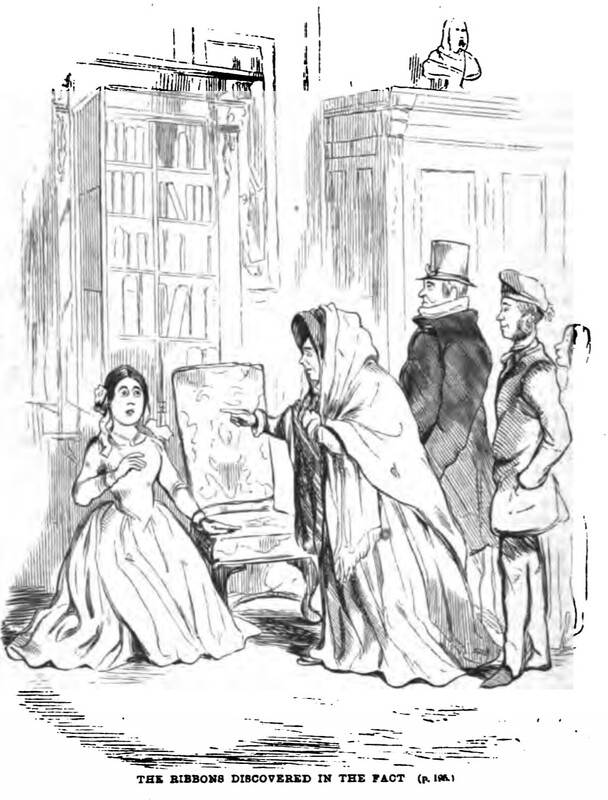
Miss Betsy Horrocks, with large ribbons in her hair, kneels in shock next to a chair in Sir Pitt Crawley’s study. Mrs. Martha Crawley, who has just caught Miss Horrocks trying a stolen set of keys on the locked drawers in the room, points an accusing finger at her. Behind her are Reverend Bute Crawley, her husband, and James Crawley, their son, who have both also witness the robbery. Below the illustration is printed its title and location in the story, “THE RIBBONS DISCOVERED IN THE FACT (p. 195.)”.
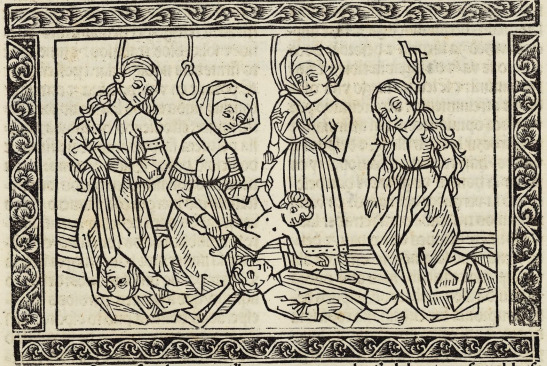
This engraving depicts the wives of the Cimbrians (a northern tribe) killing their children and hanging themselves. After their husbands were defeated in war against the Romans, the wives pleaded to their enemies for mercy and to let them become vestal virgins. When the Romans denied their request, they decided to kill their own children and hang themselves to save their virtue and to not die at the hands of their enemies. Some women in the image are depicted with the nooses around their necks, and one woman is depicted killing her child before killing herself.
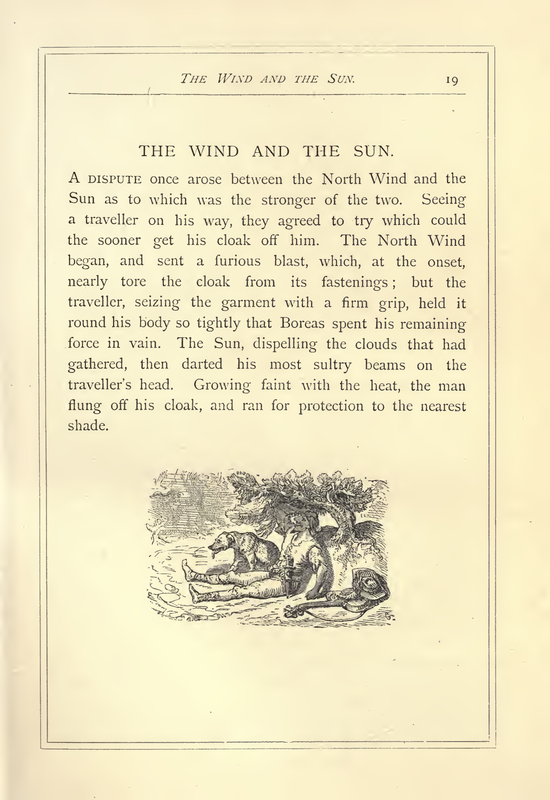
A man is sitting down on the ground with his back resting against a tree. Next to the man, on his right, a dog is sitting down. The dog is slightly bent forward and has its tongue out, as though it was tired. To the left of the man, his bag and other belongings lay on the ground.
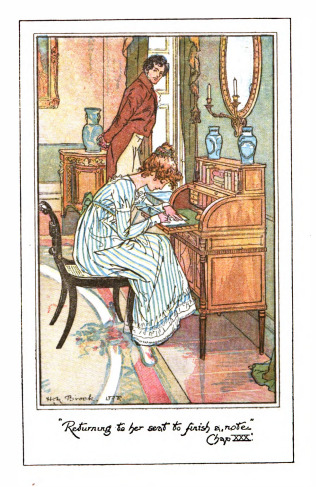
Here we see Henry Crawford and Fanny. After returning from London, Henry Crawford announced to his sister that he was going to make Fanny like him. He had dined with Fanny after Maria and Julia were absent from Mansfield. He was quite taken by Fanny. He spent the remainder of his time at Mansfield wooing Fanny but was unsuccessful. Before he left Mansfield he proposed to Fanny, but she refused. He was not discouraged by this rejection and continued to try and impress her, even coming to visit her at Portsmouth. In this image, Fanny is sitting at a desk copying down a letter for Lady Bertram. Mr. Crawford stands at the door admiring Fanny as she writes as he prepares to leave from a visit with the Bertrams. This scene occurs in chapter 30 as noted underneath the title of this image. The characters are shown in the traditional regency style. Mary Crawford wears the regency style dress with an empire waist. And her hair is worn tied up. Mr. Crawford wears a waistcoat and tailcoat, and knickers that stop at the knee. The regency period dated to the early nineteenth century (1811-1820) when George, Prince of Wales, later George IV (r. 1820-1830), reigned as regent for his mentally ill father, King George III (r. 1760-1820). The regency period is associated with the rise of neoclassicism in art and fashion.
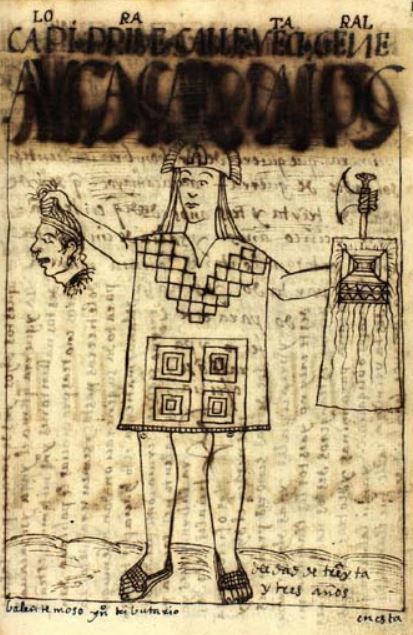
The author explains that there were ten paths for men to follow in the Inca Empire based on age division. The first path is of the auca camayoc [master of war], brave warriors who entered their service at twenty-five years old and ended at fifty years old and fought for the emperor. The man depicted in the image is labelled as auca camayoc. There are words written at the bottom right side of the image which reads “de edad de treynta y tres anos” which translates to “thirty-three years old.” The words written in the bottom left corner of the image reads “balente moso yndio tributario” which translates to “brave young Indian tributary.” The young man depicted in the image is illustrated holding a decapitated head of an enemy in his right hand and a shield in his left.
Here we see a common horse pulling a cart and getting whipped. The Houyhnhnms asks about the horses in Europe and how they live. Gulliver explains that humans or yahoos govern the country and care for the horses or Houyhnhnms. In opposition to the well-kept horses used to pull carriages that Gulliver explained earlier, Gulliver goes on to say that common horses were often treated poorly, as they were whipped and forced to do labour and were fed low quality foods. The same image appears in the 1843 Krabbe edition.
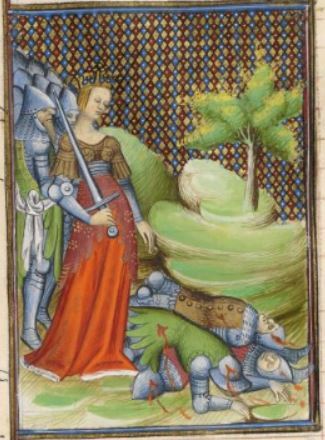
This illumination depicts Artemisia, the queen of Caria, standing on the left side of the image holding a sword as she looks down at dead bodies on the ground. She has soldiers dressed in armour standing behind her. Artemisia was renowned for her military leadership as she had taken up arms against her enemies multiple times.
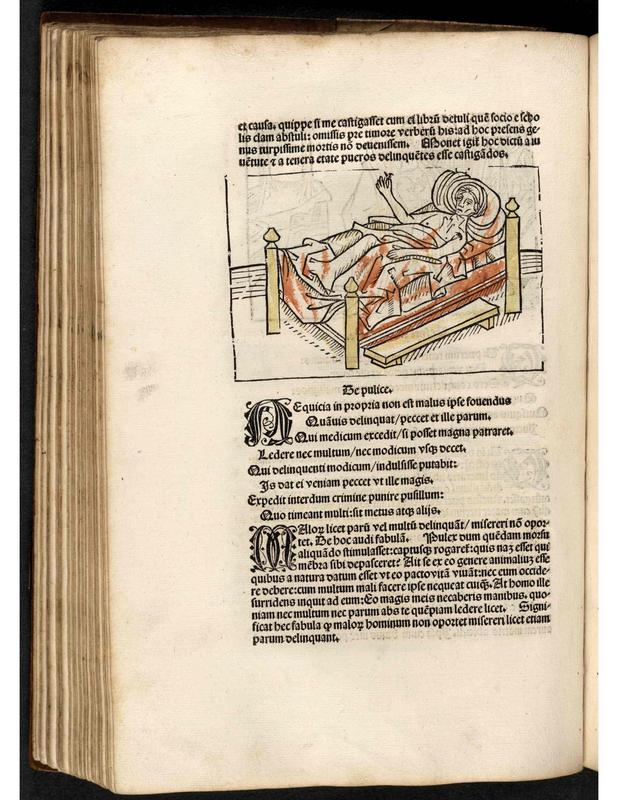
There is an illustration at the top of the page, and below this illustration is a body of text. In the illustration, 4 men are talking to 3 holy people wearing robes. The four men are interacting with the holy people, and one of the holy people is pointing towards the men.
A group of Indigenous Brazilians engage in cannibalism. A man on the right uses a hatchet to dismember a human body. Several limbs and torsos lie scattered on the ground around the group. A wooden frame has been erected over a fire, and an arm sits on the frame to roast over the fire. There is a structure on the right, and a dismembered head mounted on a long pole sticks out the window.
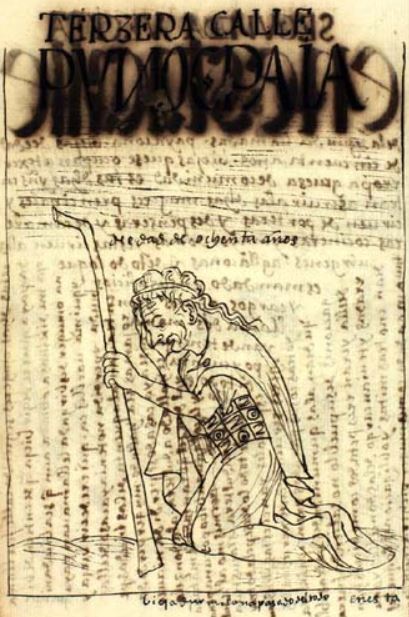
The author explains that there were ten paths for women to follow in the Inca Empire based on age division. This group was called the punoc paya [sleepy old women]. These were women who were eighty years old and their duties included serving, weaving, spinning, watching over animals or helping to raise children. They did whatever they were capable of doing given their old age. The old woman depicted in the image is illustrated kneeling with her left hand holding on to a walking stick and her right hand holding her head. The caption on the image reads “de edad de ochenta años, bieja durmilona pasada del todo,” which translates to “eighty years old, sleepy woman who does no work.”
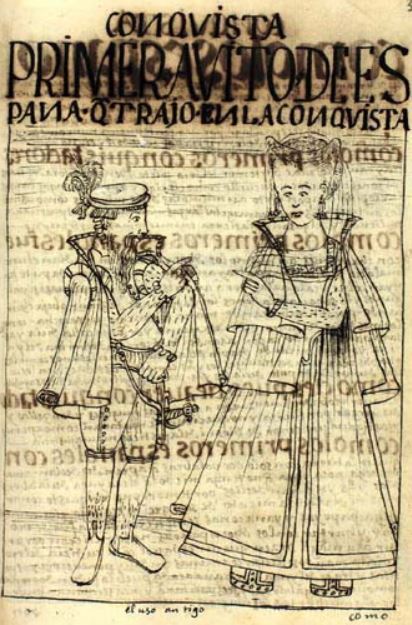
This chapter focuses on discussing the arrival of Spaniards and the Spanish conquest of Peru. This image depicts the first style of clothing that the European conquerors would wear when they arrived in Peru. They are both illustrated wearing heavy layers as they were afraid it might be cold in the New World. The woman is dressed in a long gown with a cape over her shoulders that has a high collar. The man is wearing long pants, a high collared cape and a hat. The caption at the bottom of the image reads, “el uso antigo” [the old style].
This image serves as a satire on the relationship between the Houyhnhnms and the yahoos. The Houyhnhnms are shown with the body of a horse and the head of a human, representing their intelligence. The yahoo is shown with the head of a donkey and the body of a human. The image represents how their society was flipped from what Europeans were accustomed to. The yahoo sits on a globe, with various scientific and artistic instruments surrounding him. The same image appears in the 1843 Krabbe edition.
This is the first image in the chapter that discusses black people’s involvement and lives in the colonial Spanish society of Peru. This image depicts two devout black Christians from “Guinea” which is what West Africa was known as during the author’s time. They are wearing Spanish clothing as they kneel before an image of the Virgin Mary while holding rosaries. There is a caption at the bottom of the image that was intended to be addressed to the king of Spain. It reads, “s[acra] m[agestad] que el rrey de guinea negro son gente rrecia que uenzera al gran turco y sugetara para el seruicio de dios y de buesa corona rreal, ayudandole con armas y comida” [Sacred Majesty, the king of Guinea, the blacks are strong people and can defeat the Great Turk and subjugate him, in the service of God and your royal crown, helping you with arms and food].
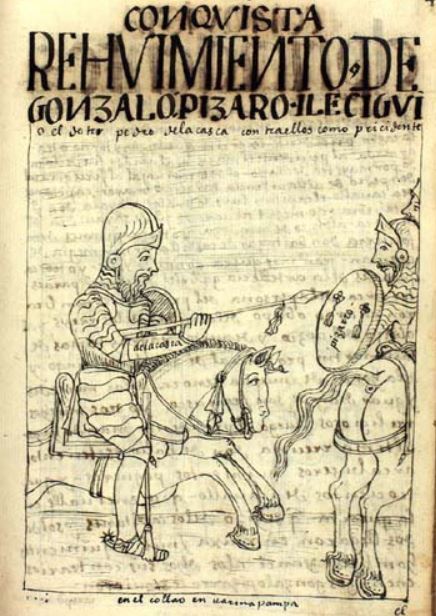
This chapter focuses on discussing the arrival of Spaniards and the Spanish conquest of Peru. This image depicts the forced surrender of Gonzalo Pizarro, who is illustrated riding a horse on the far right of the image. Pedro de la Gasca is illustrated riding a horse on the left side of the image and pointing a spear at Pizarro. Pizarro’s name is written on his shield to identify him, and Pedro de la Gasca has his name written on his right gauntlet. They are both illustrated suited in European armour.
Inside the village, two Tupinambá men lower the body of a third man into a grave. The deceased man has been wrapped in cloth. Around the burial site, women crouch with their hands over the faces in mourning, and two women hold each other by the shoulders in comfort. There is a sick man lying in a hammock near the grave site, being tended to by a man who holds a ceremonial/decorative staff.
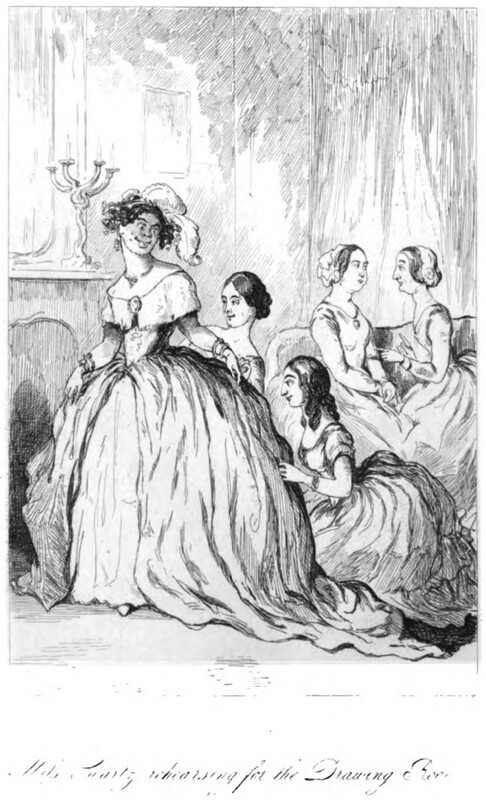
Miss Rhoda Swartz stands in front of Jane and Maria Osborne, dressed in a large gown with many pieces of jewelry and feathers in her hair. In the background, Miss Wirt and Miss Swartz’s chaperone Miss Haggistoun are seated on a sofa, talking to each other. Below the illustration is printed in cursive its title, “Miss Swartz rehearsing for the Drawing-Room.
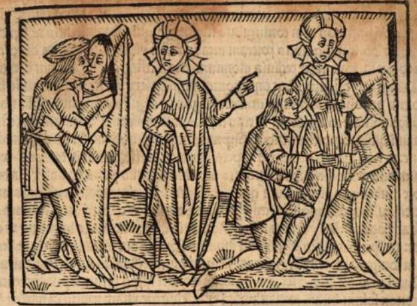
This engraving depicts Scipio Africanus, a Roman general, committing adultery with a young servant girl on the left side of the image. The woman in the centre of the engraving is his wife, Tertia Aemilia. She is depicted looking at her husband and his mistress as they commit adultery. Instead of confronting her husband about the affair, she devises a plan to get rid of the mistress. The right side of the engraving depicts Tertia Aemilia marrying the young servant girl off to a freedman. She does this so that no one finds out about the affair so that it does not ruin her reputation. Boccaccio explains that he chose to write on Tertia Aemilia because the way she handled the affair and how she used her cunning was admirable.
![[Rebecca Crawley Asleep]](https://collections.cemvc.ca/files/large/e5b7ddb3862c148d03c3d60161da5b90aaa7100c.jpg)
![[common horses working pulling a cart]](https://collections.cemvc.ca/files/large/82ef154f377aba38abfa72519117363750c15238.jpg)
![Vita et Fabulae [Four men are talking to three people who are in Holy attire]](https://collections.cemvc.ca/files/large/765a0c21b1ef371e8a0f23e88b96c5d5ab98127a.jpg)
![[Cannibalism amongst Indigenous Brazilians]](https://collections.cemvc.ca/files/large/4e538d63d886ec568481811d81804ee48966c4ba.jpg)
![[a satire on the Houyhnhnms and the yahoos]](https://collections.cemvc.ca/files/large/9c5f82d27bfc3ad74034ddc563354a4a57a1e3a4.jpg)
![Primer Historia [...] Cristiano Neg[ro, Ne]gra que Salen de Negros Bozales de Guinea [...]. Destos Salio el Bienauenturado San Juan Buen[auentura]](https://collections.cemvc.ca/files/large/924df602966b5c0e490372d9417efd6a12a76a97.jpg)
![[Tupinambá people tend to their sick, bury their dead, and mourn]](https://collections.cemvc.ca/files/large/a1d9dfb5e962bb456fd0cd95214acb4f005101cc.jpg)