Don Quixote (far right) speaks with the Duke (facing the reader) and Duchess (seated and facing the doorway) about the squire Sancho Panza. As Quixote praises Sancho Panza for his good intentions and ability to govern Sancho comes dashing into the room, looking around disheveled with a cloth bib around his neck. Behind Sancho follow kitchen boys and other servants, one of whom came with a basin of dirty dishwater. The fellow with the dishwater tries to apply it to Sancho's beard. The Duchess asks what the trouble is, and the servants respond that Sancho refuses to have his beard washed. Sancho is incensed by this accusation, as he is every bit willing to have his beard washed, but also knows that he is being made the butt of the joke by being washed with dirty water.
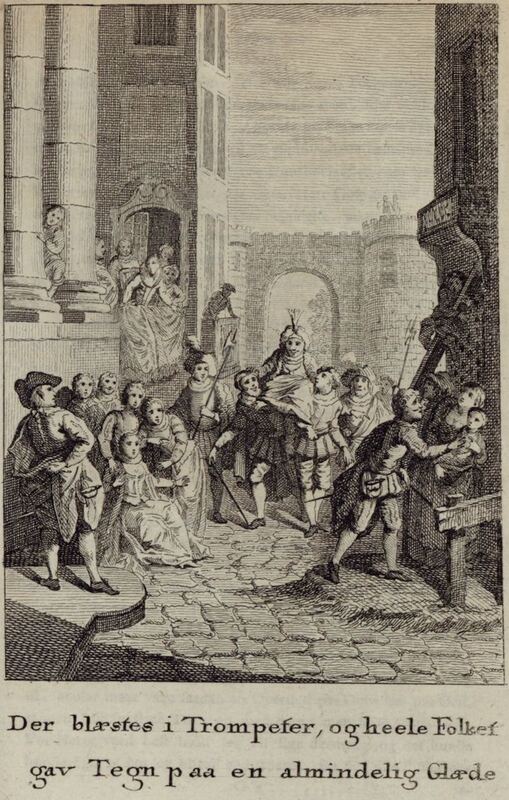
Sancho Panza, dressed as governor, is taken through the streets of Barataria Island on the shoulders of two men. People observe him from windows, stairs, towers, and balconies. Unsigned. Part 2, ch. 45.
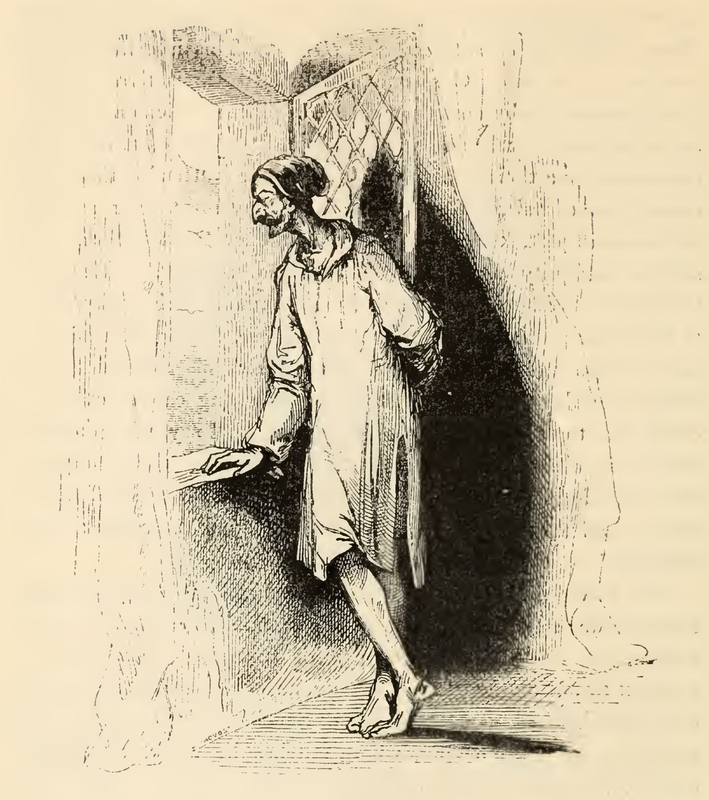
Having gotten up from his bed, Don Quixote, dressed in a loose long sleeved shirt that fell down to his knees and a greasy cap, opened the casement of a grated-window, and looked out into the night. Quixote leans against the window sill with his right hand, his left hand behind his back.
Cardenio recounts his story to Don Quixote, Sancho Panza, and the goatherd. He asks them not to interrupt him because he would like to pass quickly through the tale of his misfortunes. Signed by A J.-J.-M. Devéria (illustrator) and P. J. A. Vallot (engraver). Part 1, ch. 24.
In the middle of a street in the city of Barataria, two men with their swords drawn stand on the left, one with a moustach pointing accusingly at the other. In the foreground on the left a hat and a pile of clothes have been strewn on the ground. In the middle, Sancho Panza intervenes with his rod of office in his right hand, arms extended to intervene in the matter, wearing a cape and other courtly attire fit for a governor. On the right stands a guard with a halberd at the ready and a large group of people who have gathered to see their governor resolve the issue.
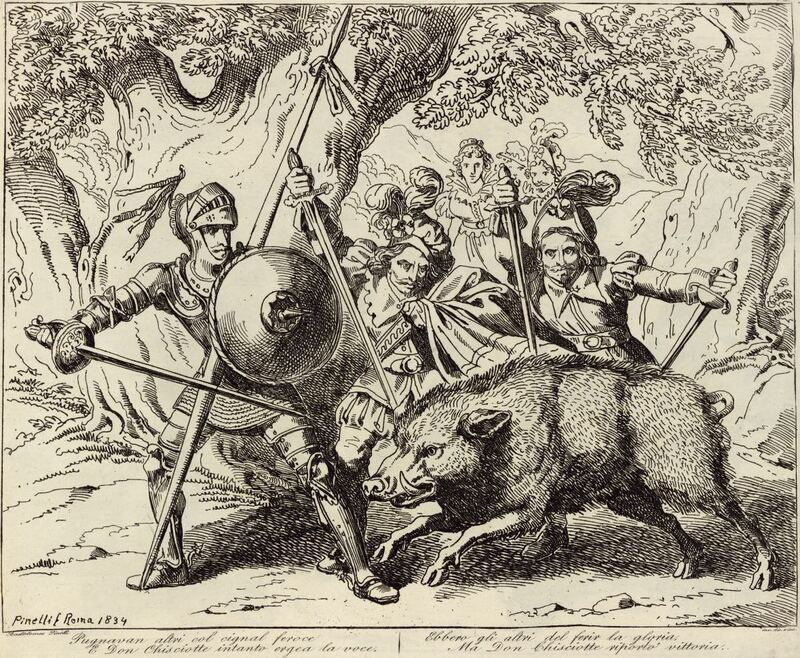
Don Quixote and the hunting party accompanying the duke and the duchess corner a wild boar in the foreground. In the background, the duke and the duchess watch. Signed by Bartolomeo Pinelli (engraver and illustrator) and dated Rome, 1833. Plate 53. Part 2, ch. 34.
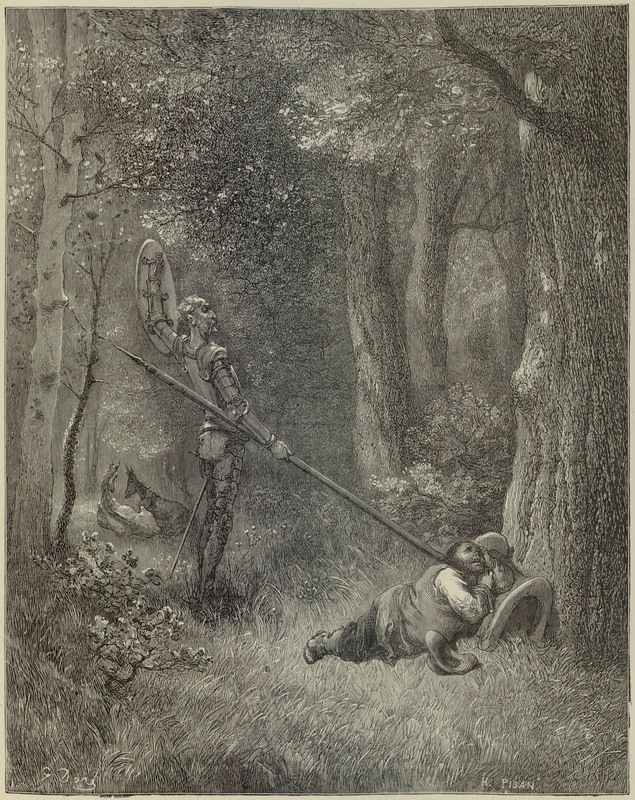
Don Quixote challenges the Knight of Mirrors to a duel which is to take place at dawn. Once all is set, the Knight of Mirrors charges at Quixote while he is distracted by helping Sancho Panza into a nearby cork tree. Although the Knight of Mirrors stopped upon seeing that Quixote was preoccupied, Don Quixote, who saw not these perplexities, assailed him with perfect security, and with such force that he soon brought the Knight of Mirrors to the ground, leaving him motionless and without any signs of life. Upon seeing his master's victory slid down from the cork-tree, and ran to his master, who dismounted from Rocinante, and went up to the vanquished knight. When, unlacing his helmet to see whether he was dead beheld the bachelor Samson Carrasco. Lying upon the ground before Quixote is the Knight of Mirros, a strong-made man, not very tall, who wore over his armor a loose coat of the finest gold cloth, besprinkled with little moons of polished glass. A large plume of feathers, green, yellow, and white, waved above his helmet which had fallen onto the ground beside him. In the background, the squire of the wood rushes to the retake the side of his master.
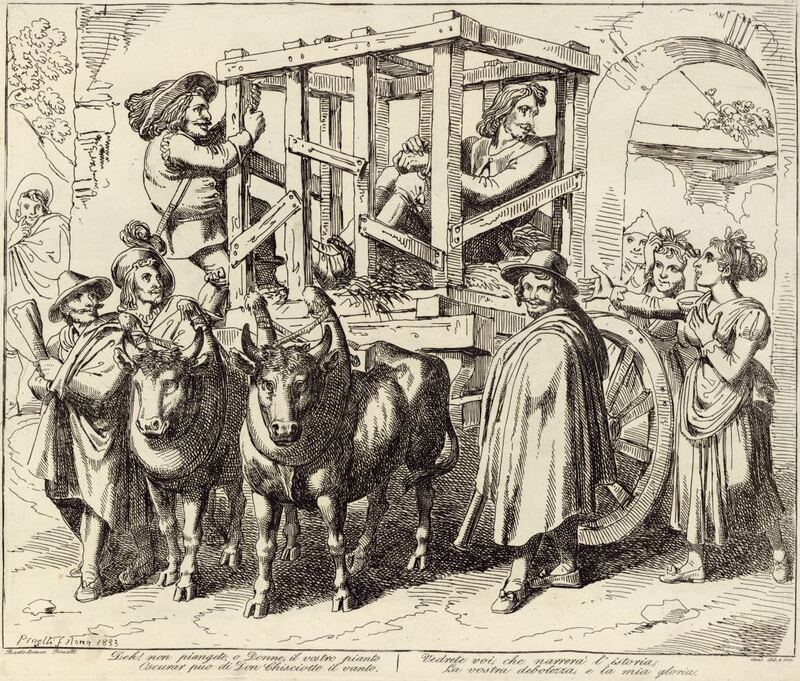
Don Quixote is enchanted and trapped in a cage on a cart. The innkeeper’s wife, her daughter, and Maritornes take their leave of Don Quixote, pretending to weep with sorrow at his misfortune. Sancho Panza, the officers of justice, and others are also pictured. Signed by Bartolomeo Pinelli (engraver and illustrator) and dated Rome, 1833. Plate 35. Part 1, ch. 47.
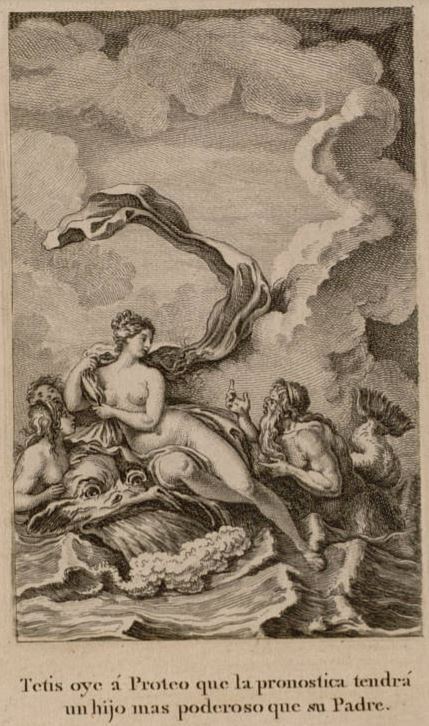
This image depicts the shape-shifter Thetis speaking to the sea-God Proteus. Proteus is on the right side of the image with the upper-half of his body resembling a man and the lower-half resembling a fish. Proteus is telling Thetis that she is destined to have a son that will be more powerful than his father. Jupiter was infatuated with Thetis, but when he heard of this prophecy, he knew that he had to back away so that he did not produce a son that would be more powerful than himself.
Sancho Panza is taken from the courtroom to a sumptuous palace, where, in a large hall, a royal table is set. Plates of food are placed before Sancho, but at the request of the physician Pedro Recio (right, holding a rod), they are taken away. Signed by Bonard (illustrator), no given name, and L. Cars (engraver). Part 2, ch. 47.
A knight dressed in black armor rides a flying wooden horse governed by a peg in its forehead, which serves for a bridle. Behind the knight sits a woman, Magalona, adorned in a white dress with long black hair that blows behind her by the pace of the steed. Below them, the outline of a distant city can be seen. The image is occasioned by the countess Trifaldi saying "This same horse, according to ancient tradition, was the workmanship of the sage Merlin, who lent him to Count Peter, who was his friend, and who took great journeys on the wooden steed's back, and stole, as has been said, the fair Magalona, carrying her behind him through the air, and leaving all who beheld him from the earth staring and astonished." (Page 425).
Don Quixote and Sancho Panza kneel before three peasant girls mounted on mules. Sancho introduces one of them as the enchanted Dulcinea. Don Quixote is dressed in his armour and wears Mambrino’s helmet (the barber’s basin). The trees in the landscape and gestures of the figures are well detailed. Signed by F. Hayman (illustrator) and L. G. Scotin (engraver). Part 2, ch. 10.
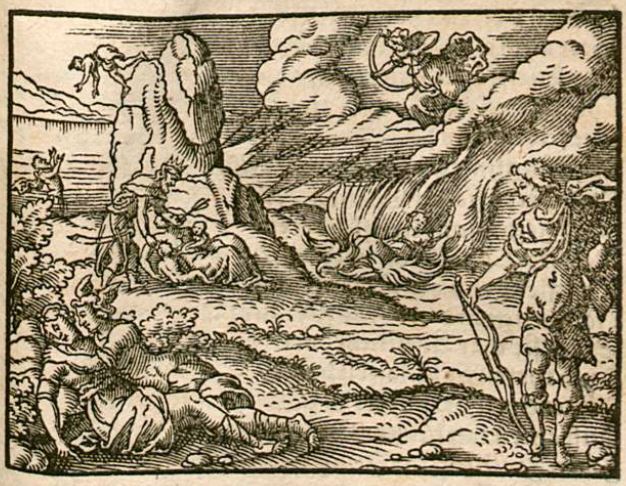
This engraving illustrates the story of Daedalion and his daughter Chione. Daedalion, the son of Lucifer, had a daughter whose beauty captivated thousands of suitors, including the gods Mercury and Apollo. The two gods had their way with Chione and both gods impregnated her. The bottom left corner of the engraving illustrates the god Mercury forcing himself upon Chione as she sleeps. After having two children born of Apollo and Mercury, Chione begins exclaiming that she is more beautiful than the goddess Diana. Diana is angered by these claims and punishes Chione. She shoots Chione through her tongue, which ends up killing her. This is illustrated in the engraving with Chione laying down as the arrow sticks out of her face with her father holding her up and two children holding on to her. Daedalion is depicted with a crown on his head. Diana is illustrated in the foreground of the engraving with the bow in her hand, as well as in the background of the engraving floating on a cloud. Daedalion was so upset by his daughter’s death that he plunged himself off Mount Parnassus. Before he hit the ground, Apollo transformed him into a hawk out of pity. Daedalion is illustrated in the top left corner of the engraving plummeting off the mountain with Apollo standing at the bottom.
The ink penned scribbled signature of Sancho Panza with a cross drawn in the bottom right. The image is occasioned by Sancho sending a letter to his wife Teresa and signing his name at the end of it.
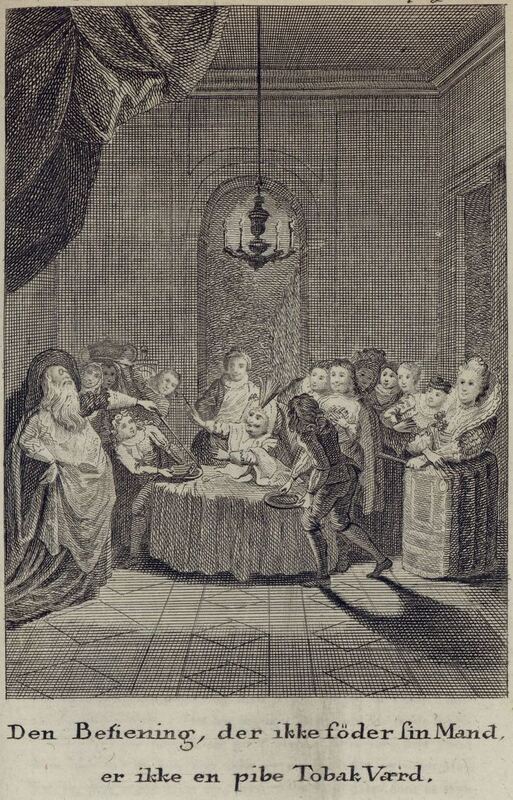
Sancho Panza is taken from the courtroom to a sumptuous palace, where, in a large hall, a royal table is set. Plates of food are placed before Sancho, but at the request of the physician Pedro Recio (left, holding a rod), they are taken away. Several servants and onlookers are pictured. Unsigned. Part 2, ch. 47.
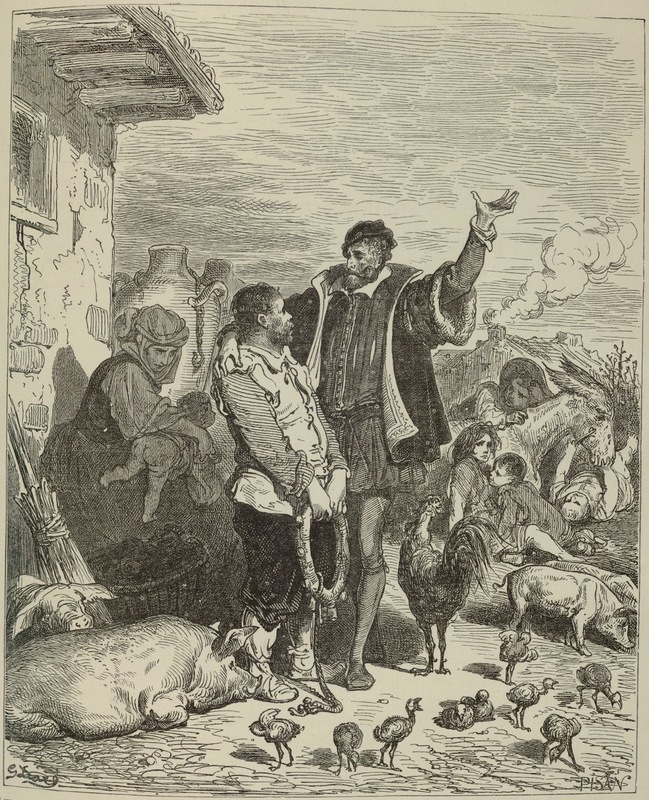
After recovering from his wounds, Don Quixote approaches his neighbour, the farmer Sancho Panza, and asks him to be his squire and undertake his second sally with him. He promises to make Sancho governor of an ínsula. Signed by G. Doré (illustrator) and H.-J. Pisan (engraver). Part 1, ch. 7.
A winding river bends off into the distance, a tree on the left and some rocks on the right. In the background, some hills cascade and clouds hang in the sky. The image is occasioned by Sancho Panza (not pictured) and Don Quixote (not pictured) pursuing their way towards the banks of the famous river Ebro.
Dorotea washes her feet in the stream. The barber, the priest, and Cardenio are not pictured but their arrival on the scene is indicated by Dorotea’s glance. Signed by A J.-J.-M. Devéria (illustrator) and P. J. A. Vallot (engraver). Part 1, ch. 28.
A young woman in a braided headdress and white dress lifts her skirt to avoid getting caught in the thorns. In her left hand she holds a fan of peacock feathers close to her face. She is surrounded by many flowers, though roses are most numerous amongst them. The Knight of the Mirrors tell Quixote that this woman is Casildea de Vandalia who has employed him as Hercules was by his step-mother, and that he had needed to succeed in many perils, and was promised, at the end of each of them, that the next should crown his hopes of loving her.
From his bed, Don Quixote dictates his last will to a notary (foreground). Also pictured are Sancho Panza, Sansón Carrasco, the housekeeper, the priest, and the niece. Don Quixote’s armour hangs over the bed. Signed by T. Stothard (illustrator) and W. Blake (engraver). Plate XV. Part 2, ch. 74.
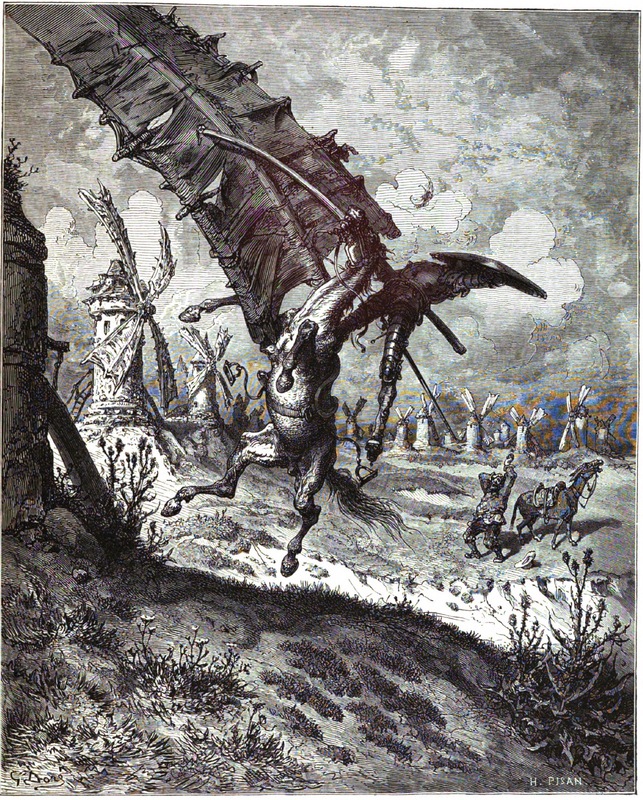
Don Quixote charges at the windmills he believes are giants. He spears their sails with his lance but the force of the turning windmill breaks the lance and knocks over both Don Quixote and Rocinante. Sancho Panza watches in horror from a distance. Scene found in Part I, Book 1, Chapter 8.
A doctor (left) with a black cape and feathered cap places his right hand on his hip and extends his left hand outwards to make some point with his index finger. Sancho Panza (right) bows before the man, lowering his hat and looking down at the ground. The doctor is directing him to break his fast with four draughts of water, making him believe that light meals quicken the judgment.
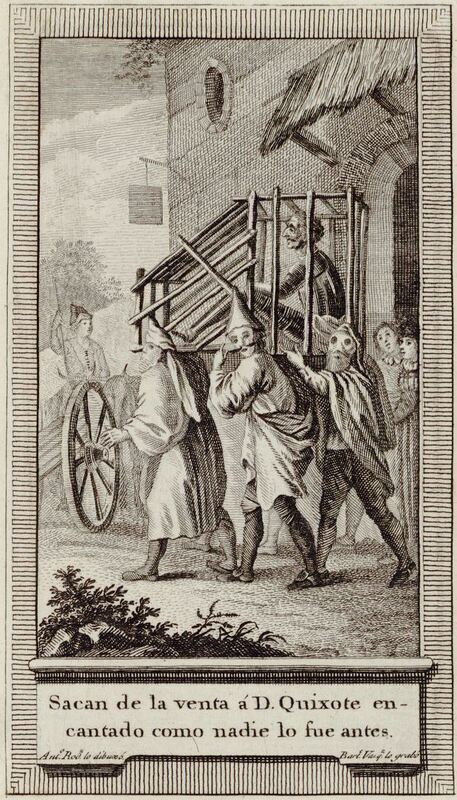
Don Quixote ‘enchanted’ into a cage and surrounded by ‘phantoms,’ in reality Don Fernando, his companions, Don Luis’ servants, the officers of the Brotherhood, the innkeeper, and the priest. They are masked and disguised in a variety of ways so that the errant knight will not recognise them. He tells Sancho Panza that in all the histories of knights errant he has read, he has never heard of knights being carried on an oxcart. Signed by A. Rodríguez (illustrator) and B. Vázquez (engraver). Part 1, ch. 46.
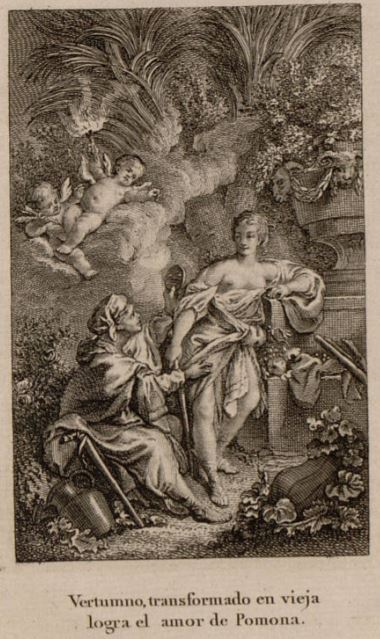
This engraving depicts the nymph Pomona engaging in a conversation with what seems to be an elderly woman. The elderly woman is in fact the god of seasons Vertumnus in disguise. Pomona is a nymph who has a passion for gardening. Ovid explains that she allows no men to enter her garden, which is why Vertumnus disguises himself as an old woman. Taken by her beauty, Vertumnus does whatever it takes to spend time with Pomona, even putting on disguises. There are small, winged cherubs in the top left corner of the image watching over the scene.

![[Sancho Panza Came Dashing Into the Room]](https://collections.cemvc.ca/files/large/429617f3826d6de783462cf577714e52710d64a6.jpg)
![[Don Quixote and Sancho Panza hear Cardenio's story]](https://collections.cemvc.ca/files/large/160bc79a7fb15df4bd1df65f2db7eb0c56ac8085.jpg)
![[The Governor Sancho Panza Delivers Justice in the Streets of Barataria]](https://collections.cemvc.ca/files/large/dcfeb5f3f84c71b837a50bb09690c38a168d6235.jpg)
![[Don Quixote Defeats the Knight of the Mirrors]](https://collections.cemvc.ca/files/large/ddd5c71232eeeb8fcb9c320c6cf543927282897f.jpg)
![[Dinner at Barataria Island]](https://collections.cemvc.ca/files/large/5100e4792d47af24cd9c5a1484d09b394c697c6b.jpg)
![[Count Peter Flies Across the Sky Upon a Pegged Wooden Horse]](https://collections.cemvc.ca/files/large/96e0f749cd07e5a252b4026f77248f6ce7a431f9.jpg)
![[Don Quixote meets the enchanted Dulcinea]](https://collections.cemvc.ca/files/large/750e1483555af27726e7721ba99ccbac84493d9a.jpg)
![[Sancho's Signature]](https://collections.cemvc.ca/files/large/2c8a6c3512ee5a436ae34e90f1936e0467c004d7.jpg)
![[The Banks of the Famous River Ebro]](https://collections.cemvc.ca/files/large/16afda9b71e18a5cf7756e5d49391d79df4a362f.jpg)
![[The priest, the barber, and Cardenio encounter Dorotea]](https://collections.cemvc.ca/files/large/88651c223ea4bc47a2ba4545afa2c0a5d8cb45c4.jpg)
![[The Peerless Casildea de Vandalia Fans Herself]](https://collections.cemvc.ca/files/large/b276773babdfcfbc354692558e0990d5ecfd981e.jpg)
![[Don Quixote makes his will]](https://collections.cemvc.ca/files/large/3c904d4abb3672389e42ec3ee2339be99e39c4b0.jpg)
![Doctor Pedro Recio Directs Sancho Panza to Break HIs Fast With Four Draughts of Water]](https://collections.cemvc.ca/files/large/cd702bd0016d1244d08013e4cd8d0ab6c9b4f5c9.jpg)