Here we see a battle scene during the war between Lilliput and Blefuscu. The two countries were divided over the correct way to crack an egg. This served as a metaphor for the religious wars in Europe during and after the Reformation.
In this image we see an old man with a long beard wearing fancy robes. He appears to have tablets in each hand. The image comes when Gulliver discusses the differences in religious beliefs between Lilliput and Blefuscu which led to war. The man represents the former Emperor of Lilliput who outlawed the religious beliefs of Blefuscu. This is a thinly veiled reference to the religious wars of the sixteenth and seventeenth centuries. The same image appears in the 1843 Krabbe edition.
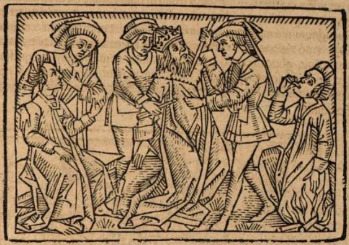
There is a group of men, they are holding onto a man who has his hands tied up behind his back. They are walking this man towards the guillotine that is a few feet in front of them .
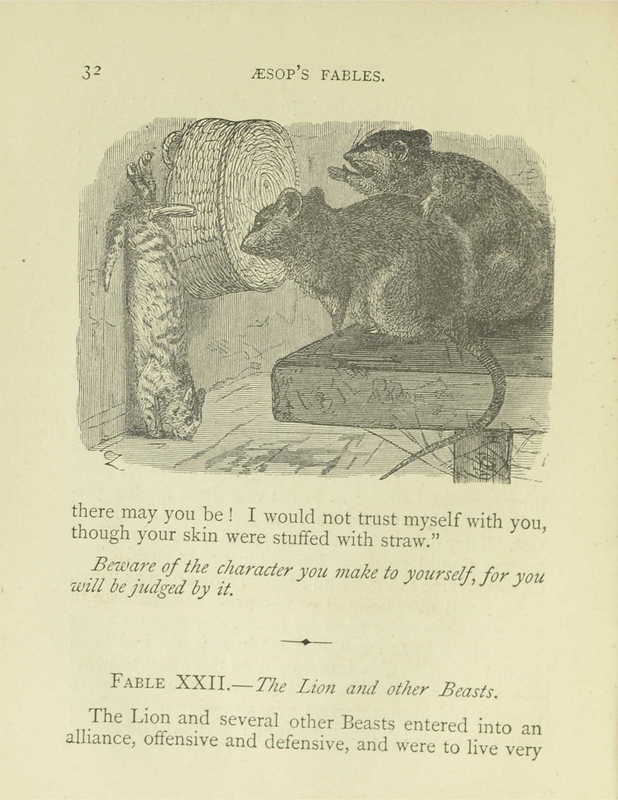
A certain house was much infested with Mice; but at last they got a Cat, who catched and ate every day some of them. The Mice, finding their numbers grow thin, consulted what was best to be done for the preservation of the public from the jaws of the devouring Cat. They debated, and came to this resolution, That no one should go down below the upper shelf.
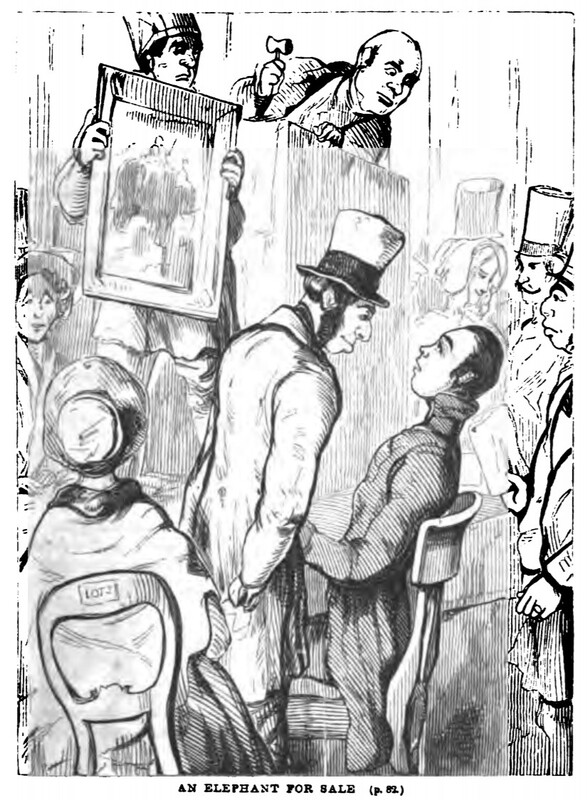
At the auction of the Sedley estate, Mr. Blowman holds up a picture to show the buyers. William Dobbin is seated directly in front of the painting, looking up with a startled expression at the bearded man looming over him. Mr. Hammerdown is peering down at the two men from the auction block, holding his mallet up. Among the figures in the background, on the right side of the picture, are Rawdon and Rebecca Crawley. Below the illustration is printed its title and location in the story, “AN ELEPHANT FOR SALE (p. 82.)”.
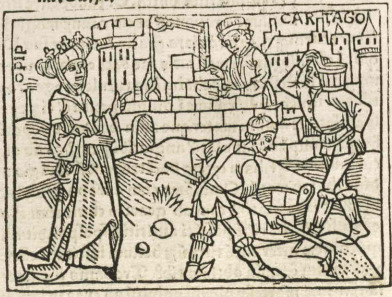
This engraving depicts Elissa, who was later called Dido, standing at the foreground of the engraving watching people build the city of Carthage. We know that the female figure in this engraving is Dido as her name is engraved beside her head. She is illustrated with her hands pointing towards the city as she watches it being built. The word “Cartago” is engraved above the city which translates to “Carthage”. Boccaccio explains that Dido had stolen her brother’s treasure in retaliation of him murdering her husband. After fleeing with her brother’s treasure, she made her way to Africa where she established and became queen of the city of Carthage.
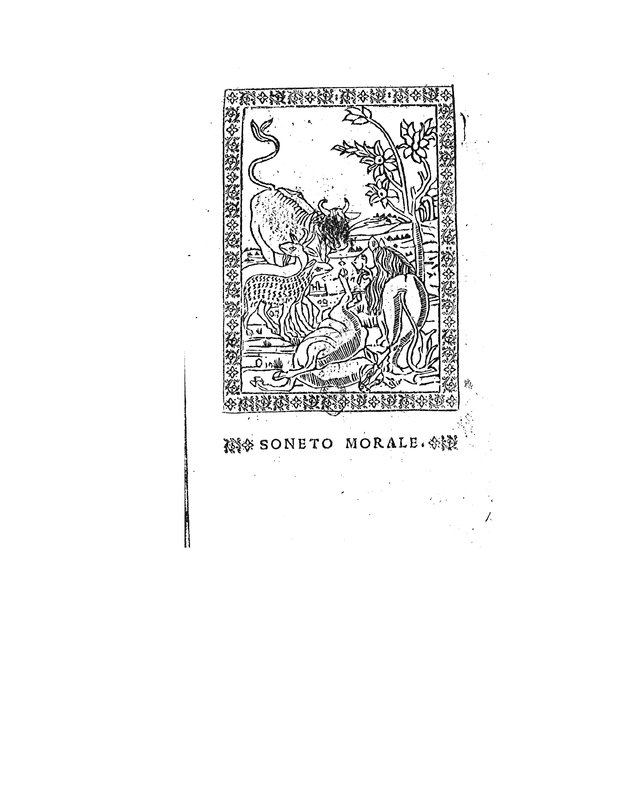
In this image we see a lion who has just killed a stag and is guarding it. There are threee other animals in proximity of the stag a sheep, a goat, and a heifer. The lion is looking at them in a threatening manner.
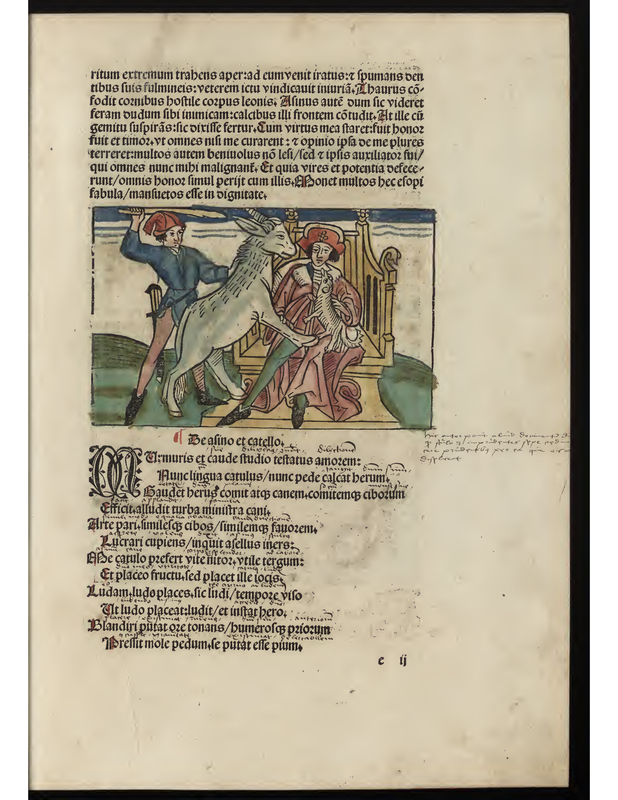
A goat and another small animal are seen climbing atop a man seated in a throne. On the left-hand-side of the image another man is preparing to strike the goat.
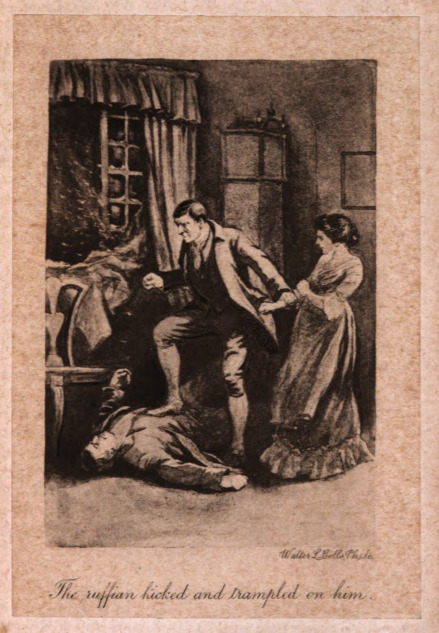
Here we see a fight between Heathcliff and Earnshaw. Heathcliff attacked Earnshaw, threatening him with a knife. In this image Earnshaw is lying on the ground with Heathcliff standing over him, grasping Ellen’s wrist to prevent her from calling Joseph – another servant. The two were fighting about Catherine, Earnshaw’s sister, and the woman whom Heathcliff loved.
On the lower left side of the image, a man is sitting down and bent forward. In front of him is a lion with its tail between its legs. The man is holding the lion's mane with his right hand and is trying to feed a circular object to the lion with his left hand. Behind the man, on the left-hand of the image, are two animals with long necks, small spots, and little ears. Possibly giraffes. One animal has its eyes closed, while the other has its neck curved in a way to look at the other animal in the eyes with an angry expression. On the right-hand side, behind the lion, are three fruit trees that stretch out into a thick forest.
This engraving depicts three separate events. The far left of the engraving depicts a man named Brutus having a discussion with his wife Portia. Brutus is telling his wife the conspiracy plan to kill Julius Caesar. After hearing the conspiracy plans, Portia took a barber’s razor and cut herself with it. The engraving depicts the barber’s razor sticking out of her foot. She does this to prepare herself in case she has to kill herself should the conspiracy not work out in Brutus’ favour. The centre of the engraving depicts the assassination of Julius Caesar. Brutus is on the right side of Caesar, stabbing him in the chest. A man named Cassius is behind Caesar as he stabs his abdominal area. The far right of the engraving depicts Portia eating burning hot coals from the fire beside her after hearing of her husband’s death.
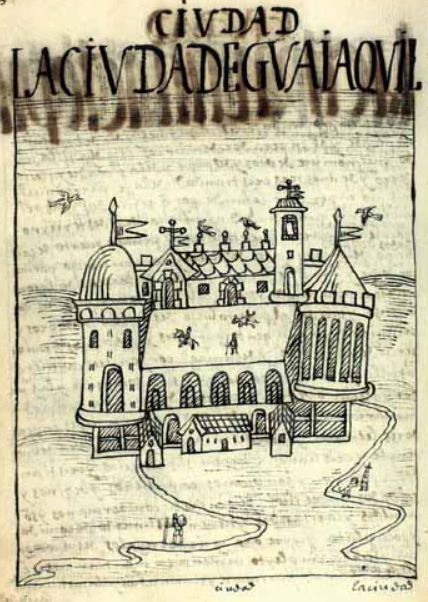
This image is depicted in the author’s chapter where he discusses cities, towns, villages, and provinces in colonial South America. This image depicts the city of Guayaquil in Ecuador. It is arranged as a cluster of buildings which forms a square in the centre. There are two soldiers riding horses in the square and another soldier walking with a spear in his hand. There are two winding pathways that lead into the city, there is one soldier holding a spear and shield on the path on the left side and there are two people on the path on the right. The author explains that the city had good horsemen, soldiers, and Christians who were known to be charitable. The caption at the bottom of the image reads “ciudad” [city].
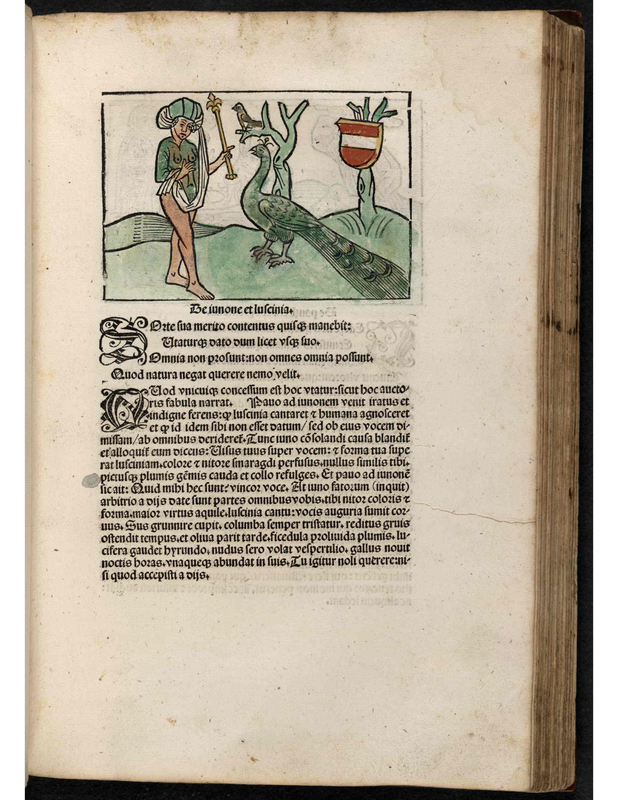
A woman who is partially naked gestures towards a peacock, the woman holds a sceptre. In the distance are two trees, both without leaves, on one tree a bird rests on a branch and on the other a shield hangs from a branch.
A group of Tupinambá women prepare for the ceremonial execution of a captive man. In the foreground, a woman kneels on the ground and paints or carves the end of a club while other women dance around her. In the background, another group of women dances around the captive man. He sits on the ground on a raised mound while a woman paints his head. He is restrained by a rope around his neck. Several of the women carry small children in baskets or slings tied to their backs.
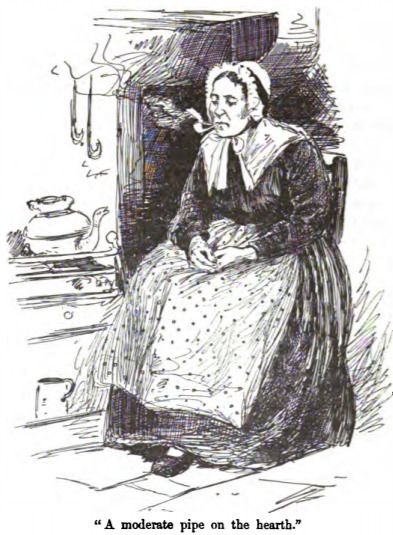
Here we see Grace Poole sitting by the hearth in her third-floor apartment in Thornfield. She was responsible for caring for Mr. Rochester’s mentally ill wife. Jane was unaware of this and was very suspicious of Grace Poole, blaming her for the suspicious activity going on in Thornfield, specifically the fire in Mr. Rochester’s room.
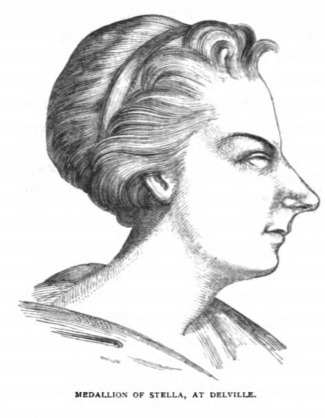
Here we see a profile of Stella Johnson, that appears on a medallion. Swift met Stella while working at Moor Park. Swift and Johnson were romantically involved, however, Swift was already engaged to Jane Waring. Nevertheless, Swift and Johnson remained in contact throughout their lives. This image appears as part of the biography of Jonathan Swift.
On the left side of this illustration, we see a male figure and a female figure off by themselves, the latter of which is wearing a robe. These two figures likely represent the scene in which Melibea’s parents, Pleberio and Alisa, discuss the possibility of finding a husband for Melibea. To the right, we see a female figure wearing a robe and a veil. She is interacting with a group of four male figures. This scene has no apparent relation to the events portrayed in Act XVI.[This illustration is identical to those found in Acts I (folio 9r), VII (folio 52v), IX (folio 67r), XI (folio 80r), XII (folio 83v), XIV (folio 96v), and XIX (folio 115v).]
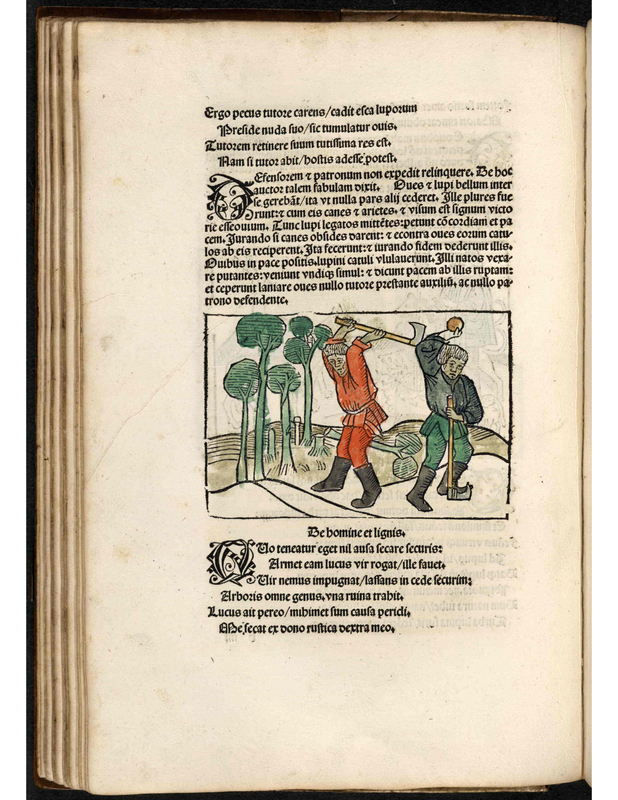
Two men hold axes in front of a forest, some of the trees are chopped down. One man is swinging his axe while the other holds the axe with the bladed end on the ground and holds an orange ball, which appears to be some kind of fruit, above his head with his other hand.
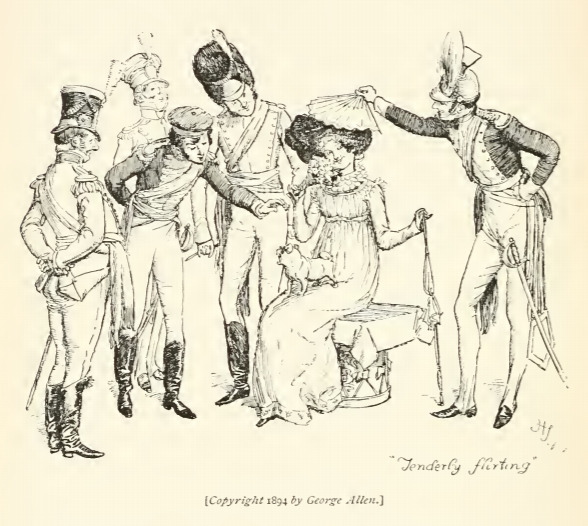
In this image Lydia flirts with the regiment in Brighton. The regiment was previously stationed in Meryton, under the command of Colonel Miller. When the regiment left, Colonel Forester’s wife, invited Lydia to accompany them to Brighton. Elizabeth privately asked Mr. Bennet to prevent Lydia from going, but Lydia begged to be allowed to go, and Mr. Bennet conceded. Here Lydia flirts with several of the soldiers, including Mr. Wentworth. One fans her from the heat, while another pets the dog on her lap. This scene occurs in chapter 41. The characters are shown in the traditional regency style. Lydia wears a dress with an empire waist and a bonnet. She holds a parasol in her hand. The regiment wears the regency military uniform with leather belts, and double-breasted jackets. They wear a variety of helmets, indicating their different positions. The regency period dated to the early nineteenth century (1811-1820) when George, Prince of Wales, later George IV (r. 1820-1830), reigned as regent for his mentally ill father, King George III (r. 1760-1820). The regency period is associated with the rise of neoclassicism in art and fashion.
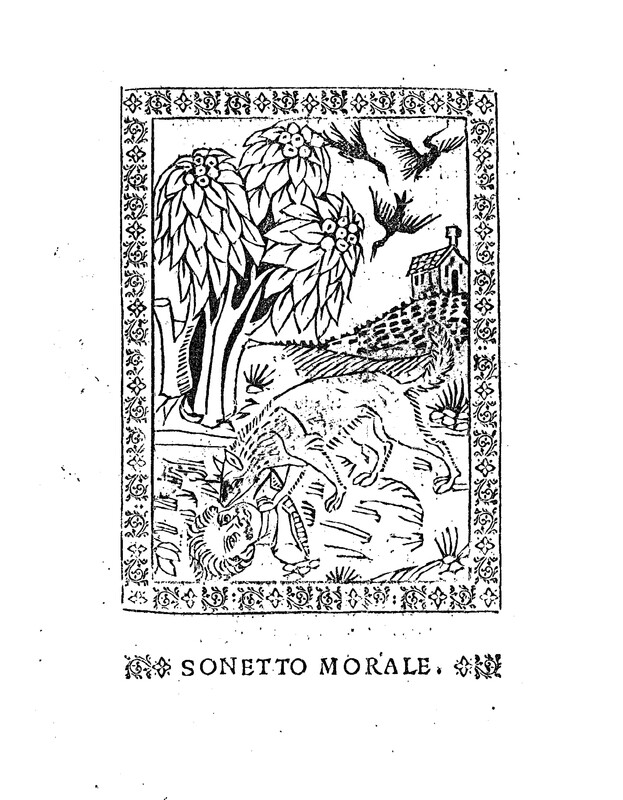
At the front of the image, a wolf Is ontop of a man that looks dead. 3 large black birds are flying overhead. A large tree is to the left of the image. A house lies in the distance to the right. The image is bordered by a vine design

![[The Wanton Calf]](https://collections.cemvc.ca/files/large/32654db9d4ba505dd7e3a4d9fc2310940b4cdfd9.jpg)
![[The war between Lilliput and Blefuscu]](https://collections.cemvc.ca/files/large/05845ce0e8f9e11fdb0c88434ed0eb015777d74d.jpg)
![[Old man weighs the correct interpretation of religion]](https://collections.cemvc.ca/files/large/81f8e93d00f719b659f16ec25decac5f914ceaf0.jpg)
![[Man Faces Death]](https://collections.cemvc.ca/files/large/44c551a398a469afaa27602effe6a1cc7659b5d5.jpg)

![[The Man Feeding the Lion]](https://collections.cemvc.ca/files/large/9e401e800b4ca9a6842006cb54c36fe7848f69c1.jpg)
![[Tupinambá women prepare a captive man to be executed]](https://collections.cemvc.ca/files/large/862ff79594dab39543a323abe86025e74ce03aaf.jpg)

![[Act XVI]](https://collections.cemvc.ca/files/large/f4e69fb7eefee6b45e810f0f9ecde9574ce5c3d5.jpg)