Elicia tells Sosia that Areusa wants to speak with him. Some time later, Elicia goes to Areusa’s house to see if he has visited her yet. Soon after she arrives, Sosia knocks at the door, and Elicia finds a place to hide. Areusa manages to manipulate Sosia into divulging where, when, and how Calisto enters Melibea’s garden, and he discovers to her that Calisto will be paying Melibea a visit that night. Areusa tells him that she has other matters to deal with, and Sosia departs.To the left of the image, we can see Elicia in hiding. She is wearing a robe and a veil. In the foreground we see Sosia walking toward Elicia with his hat in his right hand. He also has a sword mounted on his belt (seen above his right leg). Areusa is wearing a robe and a veil. She appears angry in her expression, and her arms are outstretched toward Sosia.
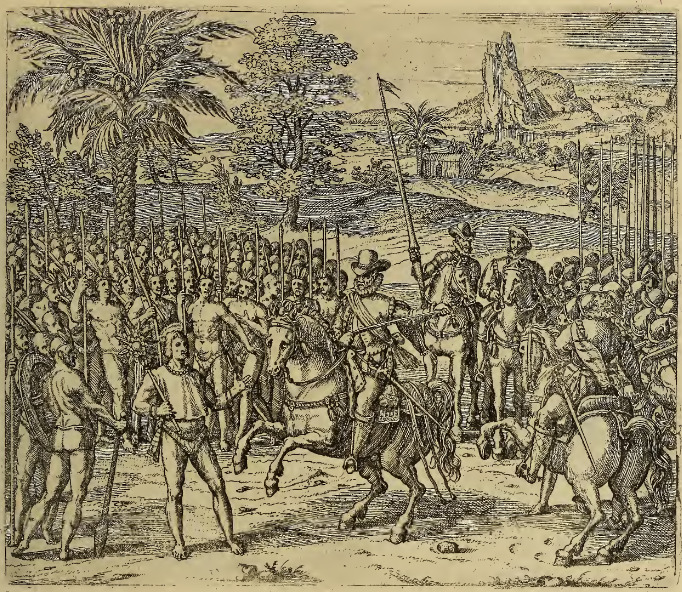
Spanish commander Hernando de Soto and Inca Emperor Atahualpa (Atabalipa) meet in Peru. Hernando de Soto is on horseback, as are a few of the Spanish soldiers who accompany him, while most of the group is on foot. The Spaniards are armed with pikes/spears, swords, and muskets. Atahualpa stands in front of de Soto’s horse. He wears a short-sleeved tunic, loincloth, and beaded necklace, and carries a scepter fashioned to look like the sun. A large group of Inca warriors stand behind him, mostly armed with spears and bows, with a few individuals carrying shields. Most of the Inca men wear loincloths, and some wear feathered headdresses. This image is identical to one found on page 5 (119) of Frankfurt, 1596.
A group of Tupinambá people fish near their coastal village. Three people in canoes fish using bows and arrows. Another two people stand in the shallow water, one of them also uses a bow and arrow while the other holds a fish in their hands. Two people on land fish using a large net thrown into the shallow water. On land in the background, two people tend to plants. There is a long structure and a cross on the right, and one person kneels in prayer before the cross.
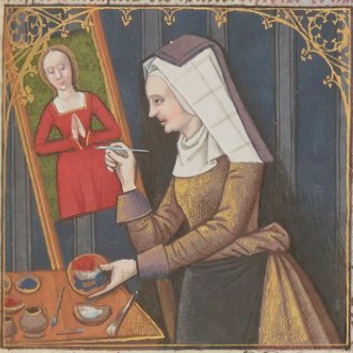
This illumination depicts a young woman named Thamyris sitting in front of an easel as she holds a brush with her right hand and a pallet in her left as she paints a portrait of woman in prayer. Boccaccio explains that Thamyris was renowned for her exceptional painting skills and was the daughter of a famous painter (Micon).
Here Jane Eyre is leaving Gatehead Hall in the winter. She stands apart from her aunt Reed and her cousins who are walking through the gates at Gatehead Hall. This separation shows Jane’s separation and neglect from the Reeds. Jane lived with her aunt until she was ten years old, when she was sent away to Lowood school.
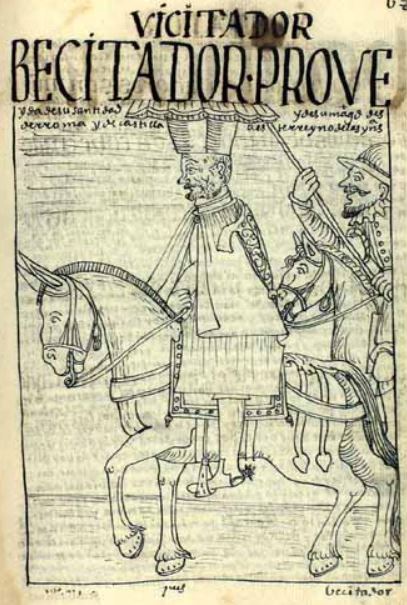
This image depicts a general inspector of colonial Peru riding a horse in the centre of the page. He is elegantly dressed and is adorned in a cloak and hat. He has an assistant riding behind him while holding an umbrella over his head to protect him from the sun. This general inspector was sent to the Indies by the Pope to inspect each bishopric office. The author explains that this man was chosen to be an inspector for twelve years and was required to be a good, charitable, honourable, Christian man.
There is an illustration at the center of the page; above and below this illustration are bodies of text. In the illustration, a man can be observed to have fallen over face first into the ground. In the background of this illustration is a large tower like structure and some trees.
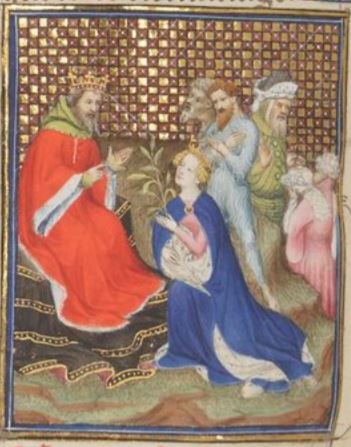
This illumination depicts Nicaula, the queen of Ethiopia, on the right side of the image meeting King Solomon of Jerusalem. King Solomon is illustrated wearing a red robe and a crown. Nicaula, as Boccaccio explains, was incredibly wise and wanted to hear and listen to the wisdom and intellect of Solomon. She had traveled from Ethiopia to Jerusalem to meet him. Nicaula is depicted kneeling and presenting King Solomon with a balsam tree. She has servants behind her carrying more gifts that she brought for the king.
In this image we see Gulliver’s ship sailing into Brobdingnag. The ship appears quite small compared to the landscape of Brobdingnag. Large cliffs and hills surround the bay into which the ship sails. The same image appears in the 1843 Krabbe edition.
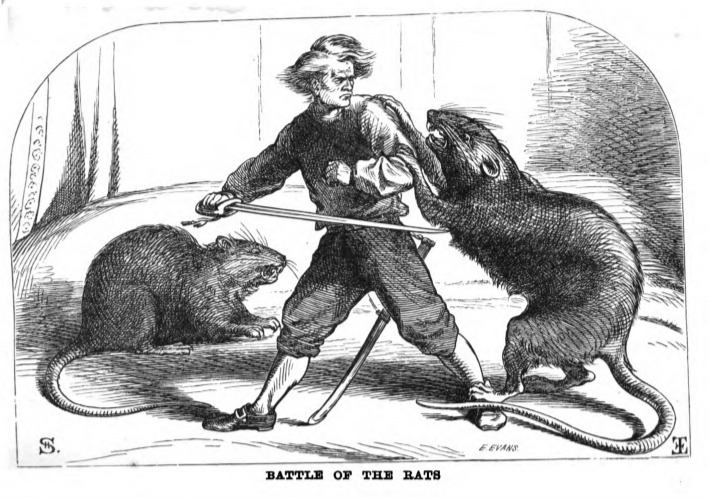
Here we see Gulliver defending himself against the giant rats on Brobdingnag. He uses his sword to defend himself from the rats that were almost as large as he is. The larger rat on the right-side steps on Gulliver’s foot and puts its paws on Gulliver’s shoulder.
In this image we see a group of seven Lilliputian court officials and the Emperor at a table discussing Gulliver’s fate. Some argue that Gulliver should be pardoned or given a less severe charge than treason because of his work in defeating the Blefuscudian fleet during the war between Lilliput and Blefuscu. The Grand Admiral, however, insisted that Gulliver should be put to death because of his actions, specifically urinating on the Imperial Palace. The Grand Admiral is the second figure from the left in this image. He is wearing part of a suit of armour and does not wear a hat. The Emperor sits in the middle of the table, and can be identified by his headpiece with several large feathers coming out of the top. The men are seated in a large hall in the Imperial Palace. The throne can be seen in the distance behind the Emperor as can a row of columns on the right side and a large curtain on the left. The same image appears in the 1843 Krabbe edition.
Berenice, the queen of Cappadocia, is illustrated in the centre of the image sitting in a chariot. She is depicted swinging an axe towards the man to the left of her. The man running away from Berenice is Caeneus, a servant who killed Berenice’s children under the order of Mithridates (her brother). Berenice kills this servant to avenge her children’s deaths. There is a chariot driver on the right side of the image who is depicted riding the horse.
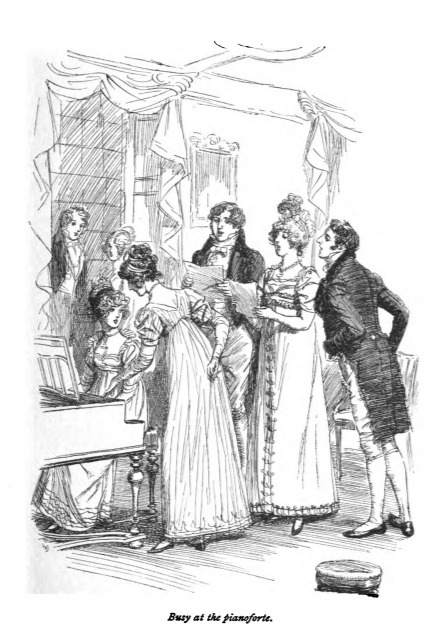
Here we see Julia and Maria Bertram, Miss, Crawford, Mr. Crawford, and Mr. Rushworth standing next to the piano, as Fanny looks on. Mr. And Miss Crawford formed a habit of coming up to Mansfield Park after tea each evening. In this scene, Sir Thomas had just written to announce his return to Mansfield in November. In the evenings they would enjoy music and card games, events which became less frequent with Sir Thomas’ return. As such, Maria and Julia were not looking forward to their father’s return. This scene occurs in chapter 11. The characters are shown in the traditional regency style. The women are wearing regency style dresses and coats with empire waists. The men wear a waistcoat and a tailcoat with breeches. The regency period dated to the early nineteenth century (1811-1820) when George, Prince of Wales, later George IV (r. 1820-1830), reigned as regent for his mentally ill father, King George III (r. 1760-1820). The regency period is associated with the rise of neoclassicism in art and fashion.
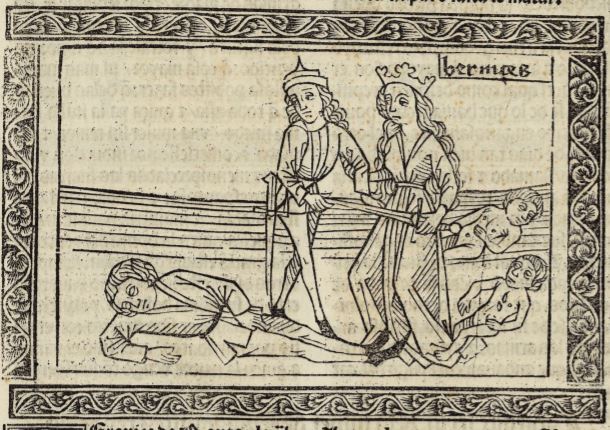
This engraving depicts Berenice, the queen of Cappadocia, stabbing a servant in his abdominal area to avenge her sons’ deaths. Berenice’s name, written as “Bernices” is engraved above her head to identify her. After her sons had died at the hand of her brother, Mithridates, Berenice sought vengeance against him. The slave that Berenice is stabbing in this engraving is Caenus, a man who was involved in the murder of her sons. Although she is depicted stabbing him with a sword in this engraving, Boccaccio explains in his story that she actually chased Caenus down in a chariot, and after hitting him in the head with a rock, she drove over his body with the chariot until he died. The dead figures in the engraving who are lying on the ground are assumed to be Berenice’s children.
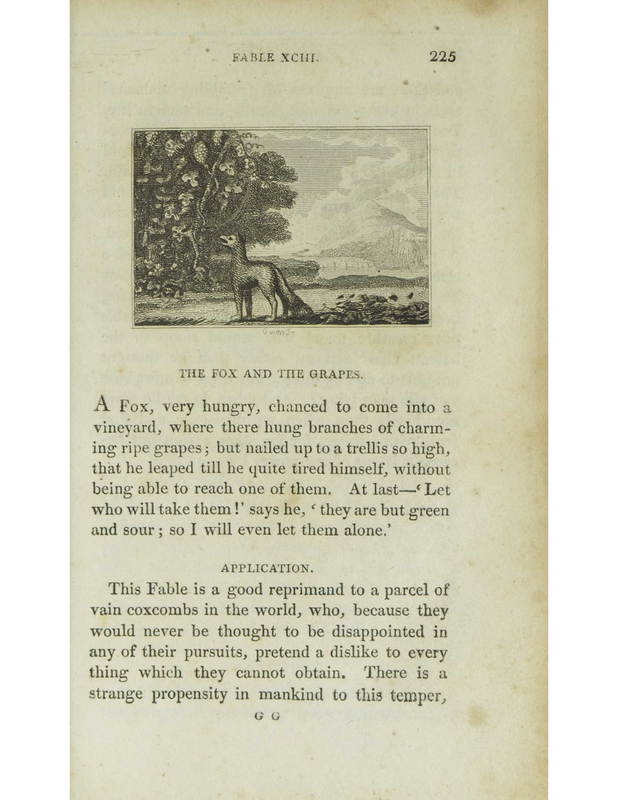
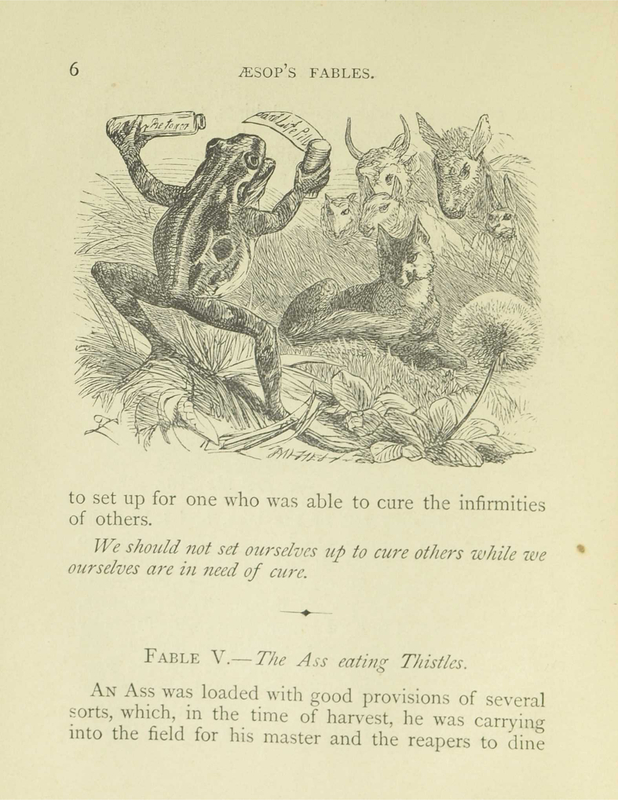
A frog, leaping out of the lake, and taking the advantage of a rising ground, made proclamation to all the beasts of the forest, that he was an able physician, and, for curing all manner of distempers, would turn his back to no person living.
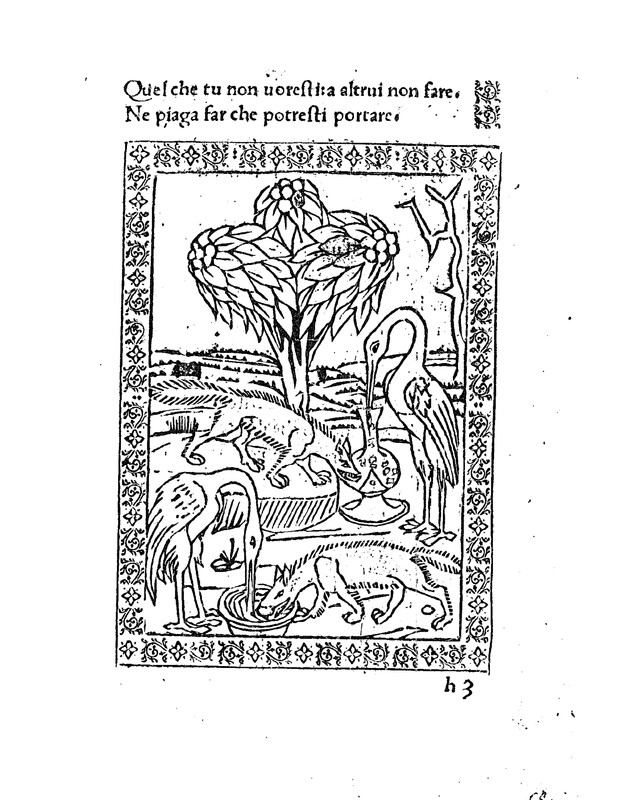
In the front of the image, a fox and a stork are drinking out of the same bowl. Behind them, another fox and stork are Eating from the same plate. And behind them there is a Large tree with many leaves. The image is bordered by a vine design
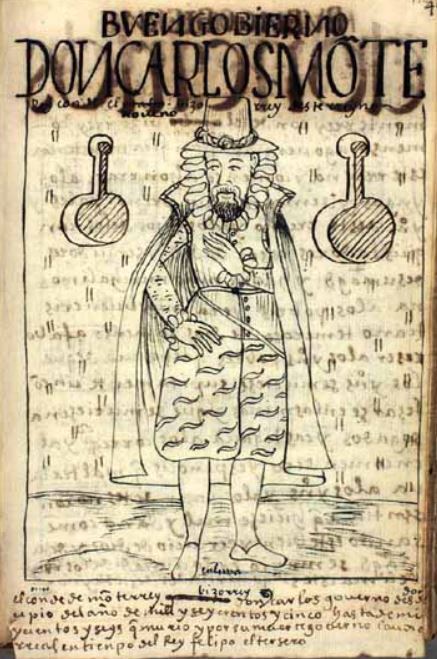
This image depicts a standing portrait of the ninth Spanish viceroy of Peru, Don Carlos, Count of Monterrey (his real name is Gaspar de Zúñiga). He is depicted wearing traditional European/Spanish clothing. The caption written by his feet identifies the location as it reads, “en lima” [in Lima]. The large caption at the bottom of the image reads, “el conde de monterrey don carlos gouverno desd[e] [el prin]cipio del ano de mill y seycientos y cinco hasta de mi[ll y se]ycientos y seys que murio y por su muerte gouerno l[a] audie[ncia] rreal en tienpo del rrey felipo el tersero” [the Count of Monterrey Don Carlos governed from the beginning of the year 1605 until 1606, until his death he governed the royal audience in the time of King Philip III].
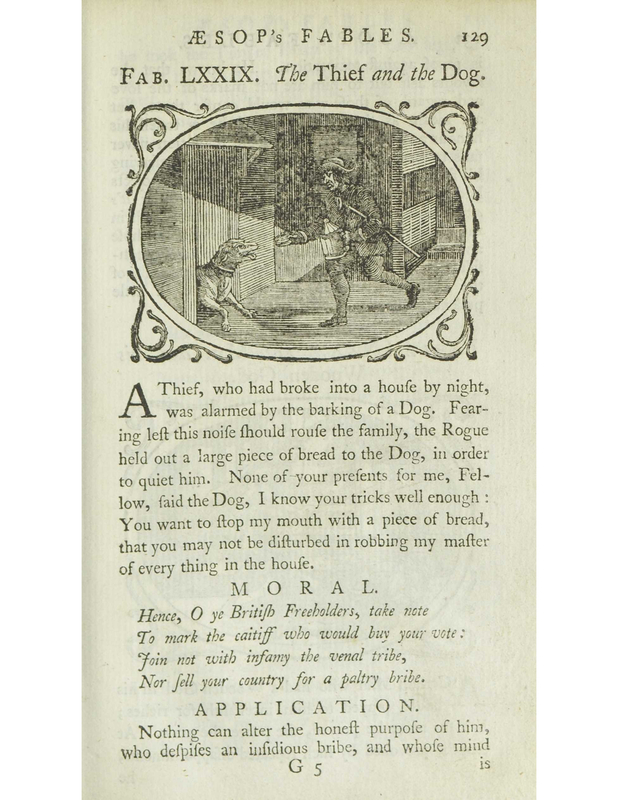
A thief with a lantern approaches a barking dog and is attempting to give it a piece of bread. The surroundings are very dark, and the dog stands halfway through the door, blocking the thief's entrance.
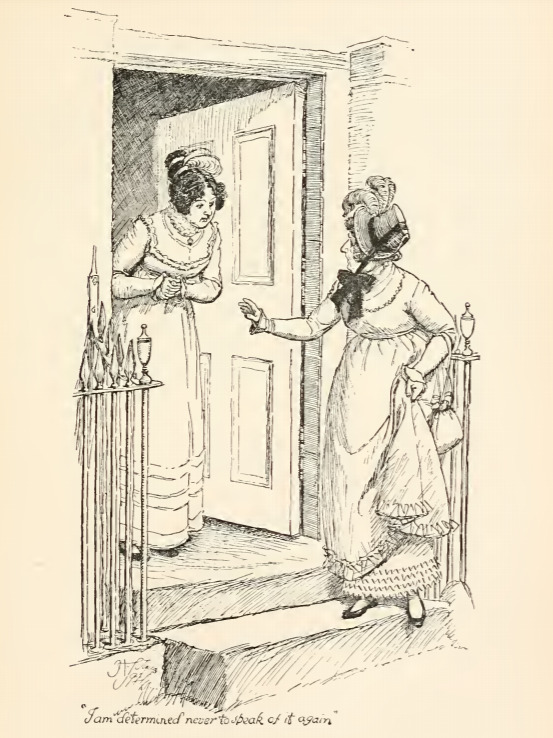
In this image Mrs. Bennet leaves her sister, Mrs. Philip’s, house. Mrs. Bennet had called on her sister and told her about Jane’s situation. After she left, she told her sister that she had resolved never to speak of it again. This scene occurs in chapter 40. The characters are shown in the traditional regency style. Mrs. Bennet and Mrs. Philip wear the regency style with dresses with empire waistlines. Mrs. Bennet wears a bonnet and carries a purse. The regency period dated to the early nineteenth century (1811-1820) when George, Prince of Wales, later George IV (r. 1820-1830), reigned as regent for his mentally ill father, King George III (r. 1760-1820). The regency period is associated with the rise of neoclassicism in art and fashion.
A group of Indigenous Brazilian woman, called ‘Amazons’ by the author, fight against a group of Indigenous Brazilian men who attack from the water. The women fight with bows and arrows, spears and shields, while the men in canoes use bows and arrows and clubs. The women are unadorned with their hair worn unbound. Some of the men wear feathered headdresses. This illustration is a simplified and mirrored version of the one found on page 124 verso of Paris, 1557.
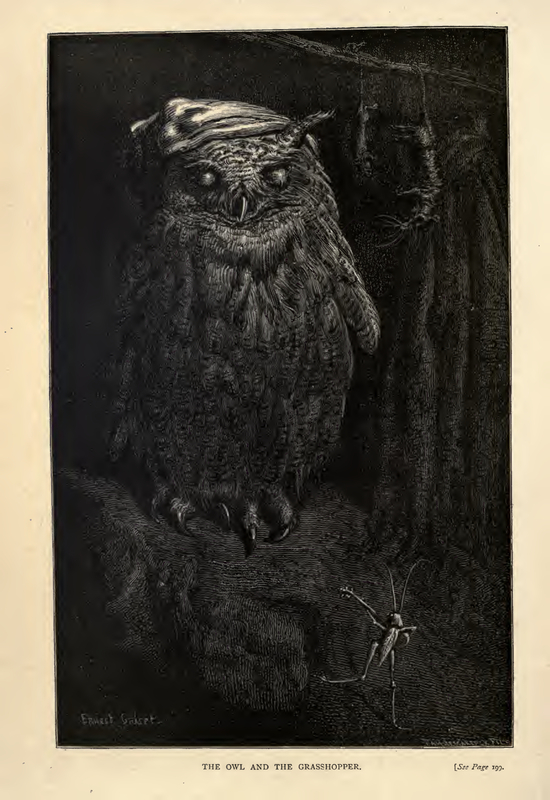
A large owl is standing on a tree trunk. The owl's eyes are glazed over, almost as though it was blind. The owl wears an old-fashioned sleep hat. Next to the owl, on the right side, a branch crosses over its head and two insect-looking creatures hang from a small piece of rope. In front of the owl, at the foot of the tree trunk, a grasshopper stands wide stance, holding what seems to be a very small guitar.

![[Act XVII] Elicia spreect teghen haer zelven.](https://collections.cemvc.ca/files/large/f46adfb587b9f78716bc76528f3b8860493b4b06.jpg)
![[Tupinambá people fish along the coast]](https://collections.cemvc.ca/files/large/77dee7ccfa88e6f733b4315167deb0c7606b9068.jpg)
![[a young Jane Eyre looks back at the viewer in the yard of Gatehead Hall]](https://collections.cemvc.ca/files/large/d205219b48315bb68952cd098d189f0d85ffff34.jpg)
![Vita et Fabulae [A person has fallen down amidst the background containing tower like structures]](https://collections.cemvc.ca/files/large/797c9e1a11219e019c7699f9e5799c7b32ab1ad1.jpg)
![[Gulliver’s ship sails into Brobdingnag]](https://collections.cemvc.ca/files/large/2ca45b68b062ae71a6be5134eb104839ed3b6a9f.jpg)

![[a meeting of Lilliputian officials discussing Gulliver’s fate]](https://collections.cemvc.ca/files/large/74c19142e733110f6487e68b5f7387101e9f3dc9.jpg)

![[Indigenous Brazilian women on land in conflict with Indigenous Brazilian men in canoes]](https://collections.cemvc.ca/files/large/7c8829c8ecf94802941fdeb42d1f3c13a50d8830.jpg)