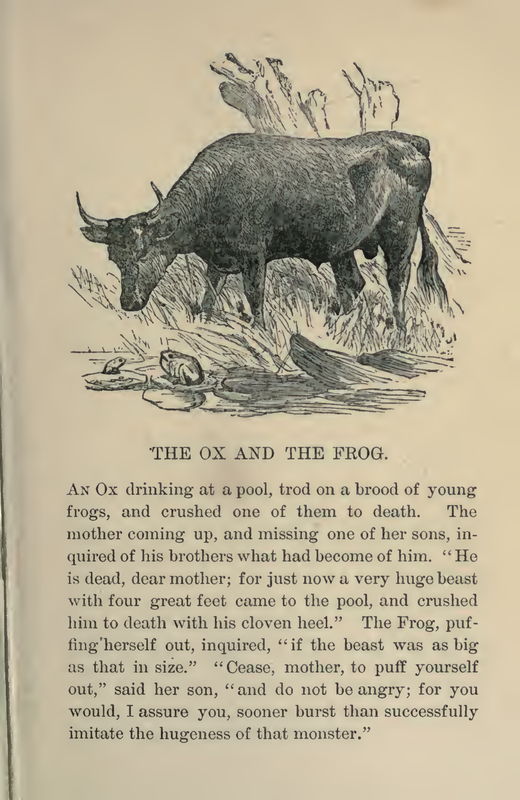
An ox is in the middle of the image, walking amongst the grass. In front of the ox, two frogs are sitting on water lily pads in the lake next to a log of wood.
Here we see a Lilliputian burial ceremony. The deceased is buried head down because the Lilliputians believe that the world will eventually turn upside down and the dead will be resurrected, thus when this happens, they will be right side up. The burial is attended by a crowd of mourners. This image appears when Gulliver discusses the various traditions and practices of the Lilliputians. The same image appears in both the 1839 and 1843 Krabbe editions.
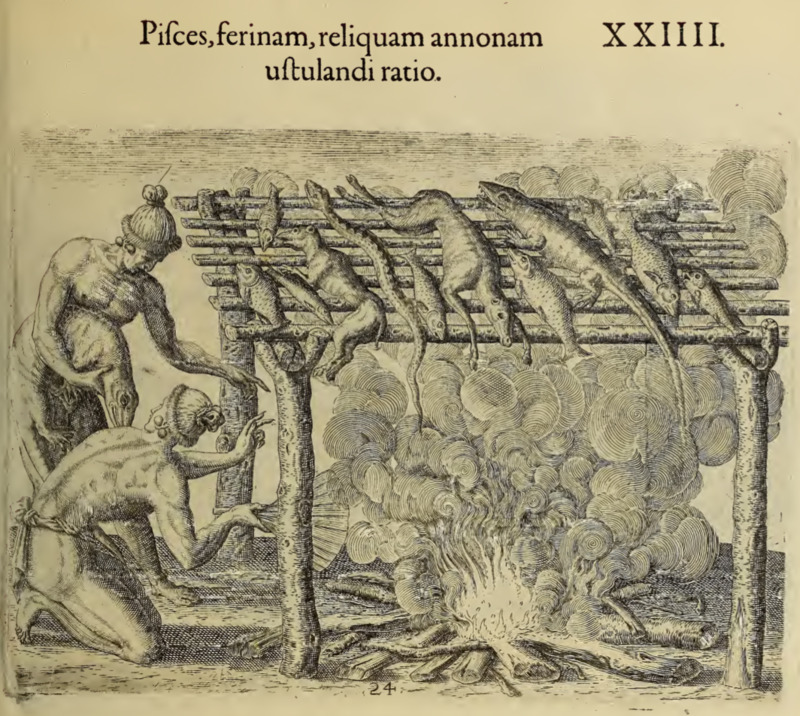
A tall rack is shown built over a large fire. The rack is composed of four upright logs with forks in the top ends. Two smaller logs are stretched between each pair of upright logs, and multiple small logs are stretched across those, forming a grill. Fish and small game, including a lizard, snake, and small deer are laid on top of the grill. Beside the rack are two Indigenous men. One kneels and fans the flams under the rack while the other holds a small animal. This illustration is identical to the one found on page 87 of Frankfurt 1591, but colored.
This image depicts a grievance council being held to hear the complaint of an indigenous woman who is illustrated kneeling on the right side of the image. The indigenous woman set forth a complaint against a parish priest who had beaten her and punished her. It was not uncommon for Spanish priests to poorly mistreat and abuse the indigenous peoples of Peru, and the author spends a large portion of the book criticizing them for it. The indigenous woman, who has a small child wrapped on her back, appears to be using her hands to list the things the parish priest had done to her. She is speaking to a group of native councilmen on the left side of the image. The native magistrate is depicted presenting the woman with a justice card that says, “a mi senor cacique” [to my lord chieftain]. This card will go to the priest about whom the complaint is about.
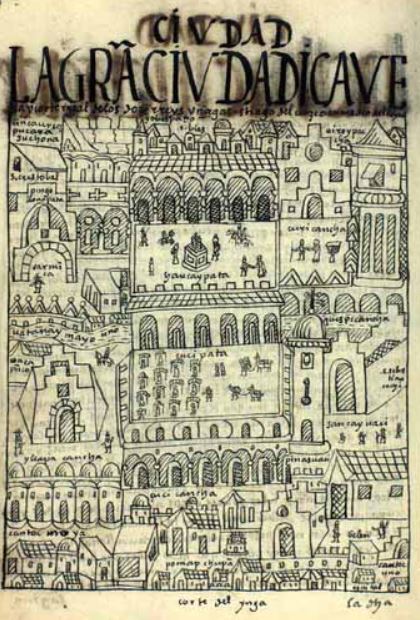
This image is depicted in the author’s chapter where he discusses cities, towns, villages, and provinces in colonial South America. This image depicts the city of Cusco, which was the capital city of Peru during the Inca Empire. The author discusses the importance of the city of Cusco as it was founded by the creator deity Viracocha in Incan mythology. The city is depicted as a large cluster of buildings that forms two main squares in the centre of the city. The author has labelled many of the buildings and churches throughout the city. Starting from the top left corner and moving from left to right until the bottom right corner, the author has identified, Cinco Urco, Pucara, Suchona, Pingolona Pata, San Cristóbal, San Blas, Uiroy Paccha, Carmica, Haucay Pata, Curi Cancha, Uatanay Mayo, Cuci Pata, Quispi Cancha, Uaca Punco, San Sebastián Cachi, Yllapa Cancha, Pinas Uaci, Cuci Cancha, Cantoc Moya, Sancay Uaci, Pomap Chupan, Belén, and Cantoc Uno. People are illustrated walking around the town squares and through the streets. The caption at the bottom of the image reads “corte del ynga” [court of the Inca].
Here we see a Lilliputian who is about to stick his sword into Gulliver’s nose, thus tickling Gulliver, causing him to sneeze, throwing the Lilliputian off of Gulliver. The same image appears in the 1839 Krabbe edition.
A human torso with both arms, head and one leg removed lies face down on the ground. One Tupinambá man removes the innards from an incision along the spine and sets them on a plate held by a woman while another man prepares to remove the final leg using a small axe or hatchet. Around the body three women hold the two arms and one leg, and a child holds the head. To the right there is a large pot set over a fire, and two women add innards and a head to the pot while another brings more firewood. A bearded European man stands behind the fire with his arms crossed over his chest, observing the group.
Captain Rawdon Crawley and Rebecca Sharp are in the center of the image, hand-in-hand as they perform a country dance. Mrs. Martha Crawley, Reverend Bute Crawley’s wife, is playing the piano in the background with a smirk on her face. Through the opening to the next room, a portrait hanging on the wall and a man playing cards can be seen.
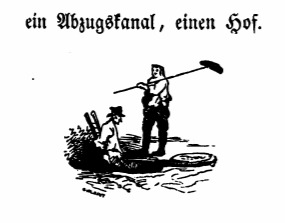
This image shows a man coming out of the sewer, while another, stands nearby. The sewer is the code word for the Court. This image comes in a description of a conspiracy found by a professor from the Grand Academy on Balnibarbi. This idea is representing code word for terms in the conspiracy that Swift is satirizing. The professor advises that those named in the conspiracy papers be closely monitored at all times, naming specifically while they were using the bathroom, as this is when men were most thoughtful. This conspiracy is thought to be an allusion to the trial of Francis Atterbury, the bishop of Rochester for allegedly plotting with the Jacobites. Atterbury was charged with treason in 1722 and was exiled to France. The same image appears in the 1839 Krabbe edition.
A tall rack is shown built over a large fire. The rack is composed of four upright logs with forks in the top ends. Two smaller logs are stretched between each pair of upright logs, and multiple small logs are stretched across those, forming a grill. Fish and small game, including a lizard, snake, and small deer are laid on top of the grill. Beside the rack are two Indigenous men. One kneels and fans the flams under the rack while the other holds a small animal.
A group of Tupinambá women dance in a circle around a European man, who wears a feathered headdress and ratels around his calves. Two of the dancing women have infants strapped to their backs. The village, labelled ‘Uwattibi’, is comprised of five long structures arranged in a pentagram and surrounded by a fence.
Amelia Osborne sits in the chair in her bedroom from before she was married, looking melancholy. Behind her, Miss Flannigan, the maid, is leaning over the chair with one hand on her hip. On a smaller, wooden chair and the floor in front of Amelia there are scattered papers.
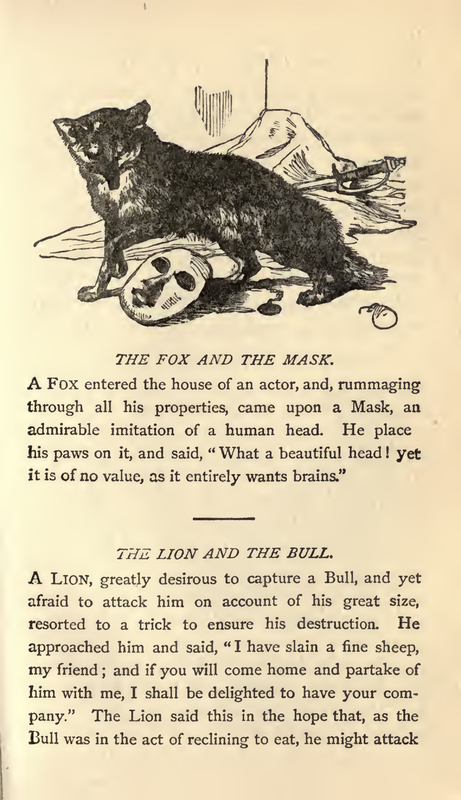
There is a wolf which walk around and look at the mask. While the mask is lied down on the ground and near the sword which belongs to the mask, lied on the rock behind the fox
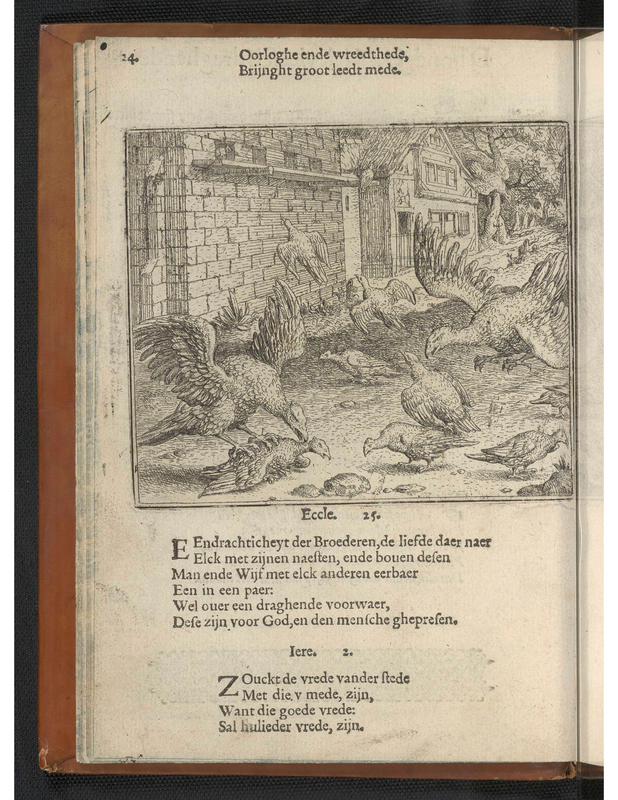
Birds feeding on the outskirts of a town. Two large birds attack the smaller birds who are eating food from the ground. Some of the smaller birds fly away and escape. A bird perched on a nearby house watches the attack.
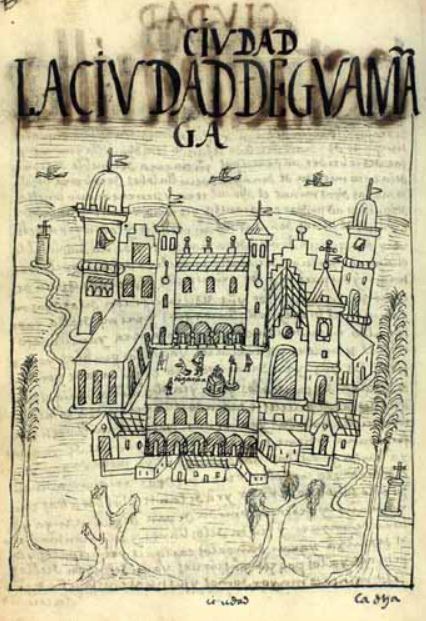
This image is depicted in the author’s chapter where he discusses cities, towns, villages, and provinces in colonial South America. This image depicts Huamanga, Peru. The city is arranged in a cluster of buildings that forms a square in the centre of the town. There is a fountain illustrated in the square with people walking around. There are birds flying over the city and four trees illustrated in the foreground of the image. There is a pathway on the bottom right side of the image and one on the left side of the image, both leading into the city. The author claims that his father was the founder of this city. The caption at the bottom of the image reads “ciudad” [city].
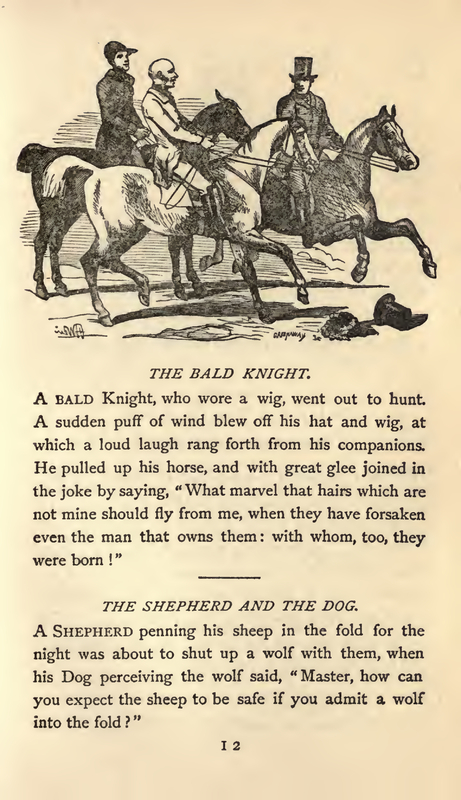
Three men are each on horses. Two of the men have hats on and are both looking at the third man. The third man doesn't have a hat and is bald. Lying down on the floor in front of the men and closest to the bald man are a hat and a wig.
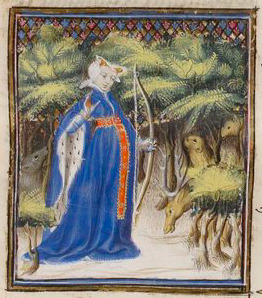
Zenobia was highly respected for her generosity and intelligence. While she spent the majority of her time hunting, she also made sure to learn many languages, both written and spoken. Her skill at hunting and bearing arms is seen in the image, where she stands in the forest with a bow and arrow. She wears a blue gown, and around her are many wild animals that she will hunt.
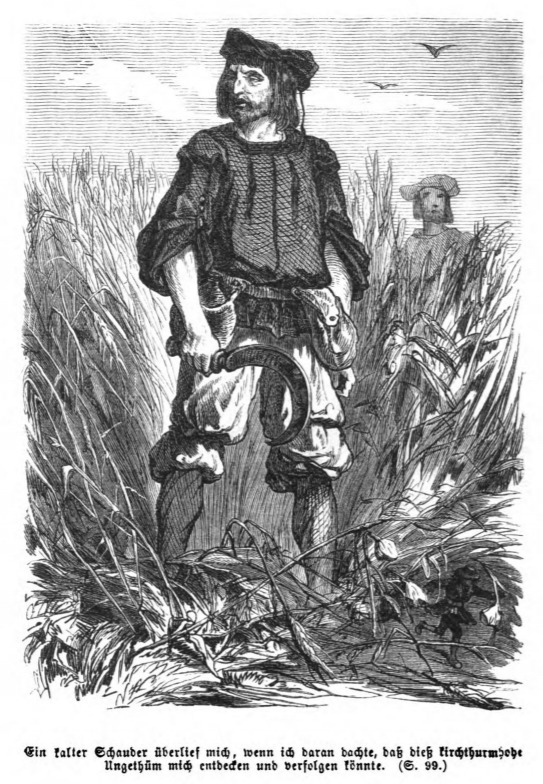
Here we see Gulliver running away from the giant farmer from Brobdingnag. The farmer holds a scythe and stands in a field of wheat. This is where the Giant discovered Gulliver and took him home.
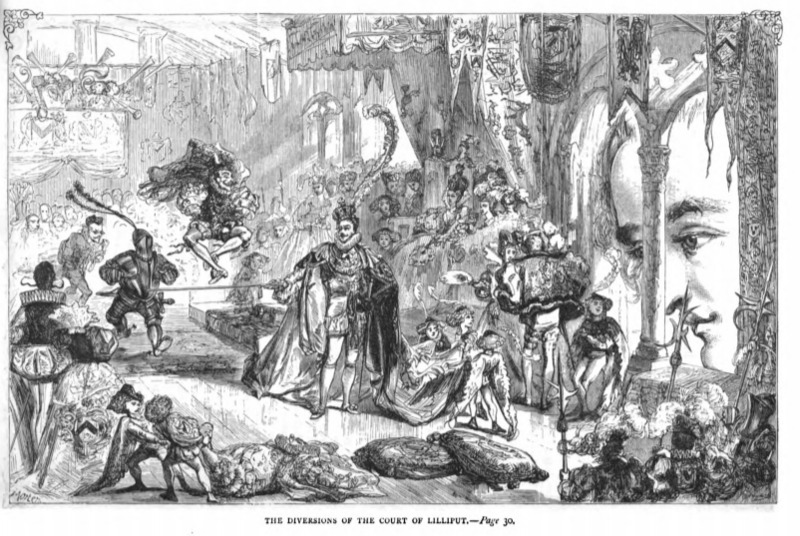
In this scene we see a variety of performers in Lilliput. The performers entertain the emperor, who stands in the centre, while an audience looks on. Gulliver looks in the window of the castle.
This image depicts the Roman woman Portia (also commonly spelled as Porcia) filing the toenails of the man sitting on the stool in front of her. This man is most likely her husband, Decius Brutus, a conspirator of the assassination of Julius Caesar. Brutus had told Portia that the Senate was going to assassinate Caesar, and after hearing the conspiracy plans, Portia took a barber’s razor and cut herself with it. She does this to prepare herself in case she has to kill herself should the conspiracy not work out in Brutus’ favour. The tool in her hand in the image is representative of the barber’s razor that she uses in the story. After her husband dies, she eats burning coal to kill herself.


![[Lilliputian burial ceremony]](https://collections.cemvc.ca/files/large/046988a8a740da9f300d2c3d9314d5377e667ab9.jpg)


![Cavildo de la Q[ve]xa Q[ve] Pedio la Pobre Yndia Contra el Padre y Pide Justicia. Dize la Yndia que, Deciendole amansebada, le a Hecho Hilar, Texer y Castigado Muy Mucho a la Pobre Yndia. El Dicho Alcalde le de Carta de Justicia, Para que el Senor Bicario le Oyga y le Haga Justicia y lo Abise a su Senoria Obispo Para que Sea Castigado el Padre y a Otros Exenplo en Este Rreyno](https://collections.cemvc.ca/files/large/269046d876f861d45ba9169b7eac6f2ef34e61dc.jpg)
![[A Lilliputian guard sticks his sword in Gulliver’s nose]](https://collections.cemvc.ca/files/large/9ae68f0ca6175f52cc0edca63df226cf522fea7e.jpg)
![[The Tupinambá dismember a body for ceremonial cannibalism]](https://collections.cemvc.ca/files/large/5d2d03012f882239f629ebce1ffaf6d9a81425a7.jpg)

![[Rawdon Dances with Rebecca]](https://collections.cemvc.ca/files/large/da82e6d83335b9117b46fb9eb2395c2f7cd57e3d.jpg)
![[Inside a village, Tupinambá women dance around a European man]](https://collections.cemvc.ca/files/large/70fa688f4936faa5f76c3cb0317c36aef4853aaa.jpg)
![[Amelia in her Chair]](https://collections.cemvc.ca/files/large/a28bf5fafdafa42dc35ae73b71191eca623444c5.jpg)
![[Portia the Daughter of Marcus Cato]](https://collections.cemvc.ca/files/large/e1b1c825c12cff56f254ba7b22055c2d08434e43.jpg)