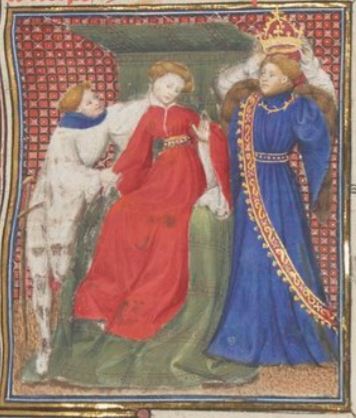
This illumination depicts Irene sitting on a throne with her son, Constantine, standing beside her while wearing a blue robe and holding a crown over his head. Irene and Constantine compete for the throne multiple times throughout their lives. Constantine is depicted taking the crown and throne from Irene in this image, with a servant grabbing her arm to escort her away. Irene eventually blinds her son, and after he fell ill and died, she took the throne back. Irene famous for her reign as empress of Constantinople.
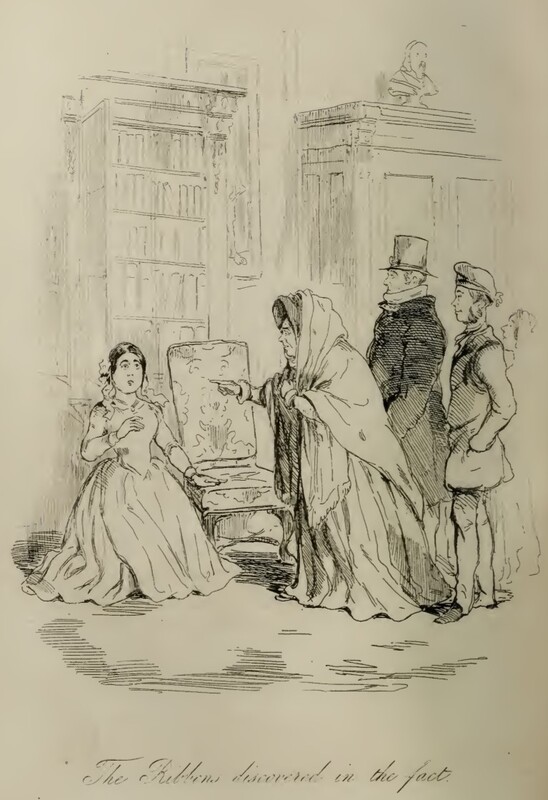
Miss Betsy Horrocks, with large ribbons in her hair, kneels in shock next to a chair in Sir Pitt Crawley’s study. Mrs. Martha Crawley, who has just caught Miss Horrocks trying a stolen set of keys on the locked drawers in the room, points an accusing finger at her. Behind her are Reverend Bute Crawley, her husband, and James Crawley, their son, who have both also witness the robbery. Below the illustration is printed in cursive its title, “The Ribbons discovered in the fact”.
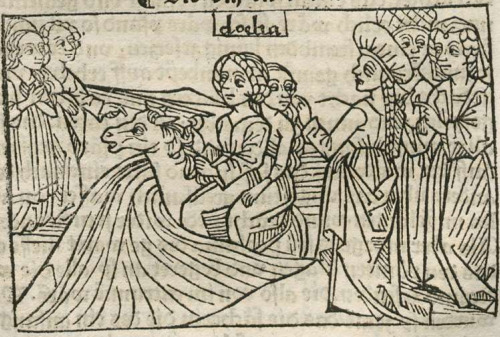
This engraving depicts Cloelia, a young Roman woman, riding a horse through a deep river with many women looking at her. Boccaccio explains that Cloelia was given to a foreign king as a hostage, and when she escaped, she took many other hostages with her to get back to Rome. While escaping, she came across a river that was too treacherous to pass. She found a horse, and despite never having ridden one, she got herself and the other women across safely by means of this horse. This image depicts her taking the other women across the river one by one as there is only one other female on the horse with Cloelia. We know that this figure on the horse is Cloelia as her name is engraved above her head.
This illustration depicts Medusa on the left side of the image, standing tall and pointing towards the men who approach her. Boccaccio explains that Medusa was known for her incredible beauty, and it would at times render men motionless, as if it stunned them. The reputation of her beauty had become so widely known that the hero Perseus had traveled to see her. The man approaching Medusa is presumably Perseus, as he is the only man Boccaccio refers to by name in this chapter.
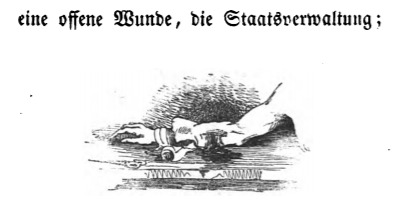
Here we see a wound that it is seeping. This is the code word for the state administration. This image comes in a description of a conspiracy found by a professor from the Grand Academy on Balnibarbi. This idea is representing code word for terms in the conspiracy that Swift is satirizing. The professor advises that those named in the conspiracy papers be closely monitored at all times, naming specifically while they were using the bathroom, as this is when men were most thoughtful. This conspiracy is thought to be an allusion to the trial of Francis Atterbury, the bishop of Rochester for allegedly plotting with the Jacobites. Atterbury was charged with treason in 1722 and was exiled to France. The same image appears in the 1839 Krabbe edition.
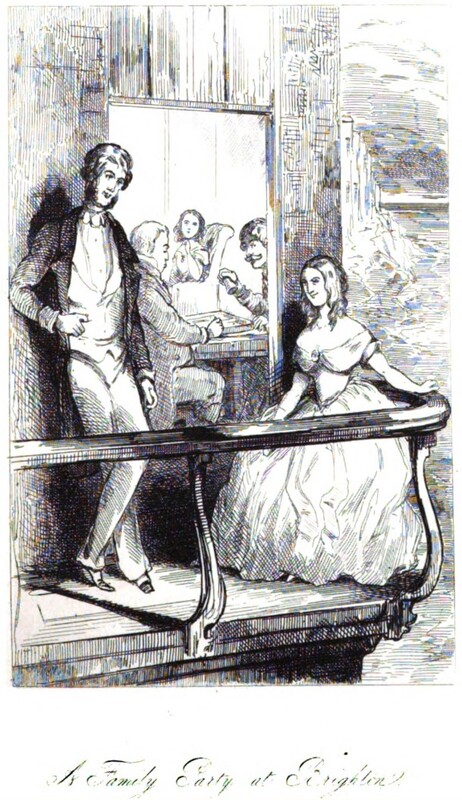
George Osborne and Rebecca Crawley are on the balcony of the inn at Brighton, looking at the ocean. He is leaning against the building, facing out, while she is seated by the railing, facing him. Through the doorway, Joseph Sedley and Rawdon Crawley can be seen inside at the table, playing backgammon. In the far background, Amelia Osborne is sitting alone in an armchair, looking forlornly at the others. Below the illustration is printed in cursive its title, “A Family Party at Brighton”.
In this image we see the two types of eggs at war with each other. Those on the left are cracked on the top, while those on the right have been cracked in the middle. This difference as to the correct way to crack an egg was the reason for the tensions between Lilliput and Blefuscu. This is a thinly veiled reference to the religious wars of the sixteenth and seventeenth centuries, where Swift insinuates that the “correct” religious beliefs – like the correct way to crack an egg – is a personal decision, and not one worth going to war over. The same image appears in both the 1839 and 1843 Krabbe editions.
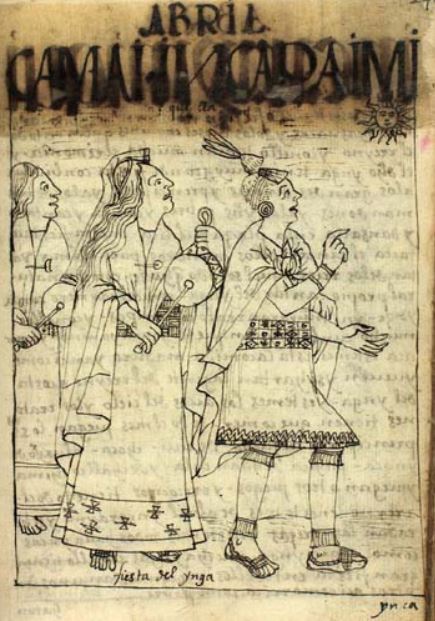
This chapter is dedicated to discussing the traditions and rituals of each month during the Inca Empire. The Incas tracked the months and years through the stars and their months consisted of thirty days. This image depicts the month of April, which was dedicated to the festival of the Inca. The month of April provided ripe crops which allowed them to have a great feast. The author explains that the Inca Emperor would invite lords, chiefs and the common people to the festival, where they would play games, sing and enjoy entertainment. This image depicts the festivities as the Inca Emperor is looking up to the sun as he sings while two women stand behind him playing musical instruments. The caption at the bottom of the image reads “fiesta del ynga” which translates to “festival of the Inca.”
A group of Indigenous Brazilians engage in cannibalism. A man on the left uses a hatchet to dismember a human body. Several limbs and torsos lie scattered on the ground around the group. A wooden frame has been erected over a fire, and an arm sits on the frame to roast over the fire. There is a structure on the left, and a dismembered head mounted on a long pole sticks out the window. This illustration is a simplified and mirrored version of the one found on page 77 of Paris, 1557.
This image depicts the choirmasters of rural parishes in colonial Peru. There are five indigenous men standing in front of a tall music stand that has lyrics written on it. The singer at the front of the group is illustrated holding a baton in his right hand as he points to the music sheet, and a musical instrument in his left hand. The men standing behind him are illustrated playing their musical instruments. The author explains that these choirmasters were paid a salary for their services, which was twelve pesos, six corns, and six potatoes for the year.
There is an illustration at the top of the page; below this illustration is a body of text. In the illustration, towards the left of the illustration a person is lying in a bed. To the right of this person is a table full of utensils and towards the right of this table are two men. These two men dressed in holy attire are pointing towards the man lying down and conversing. At the foot of the table in between is a dog observing the man lying on the bed.
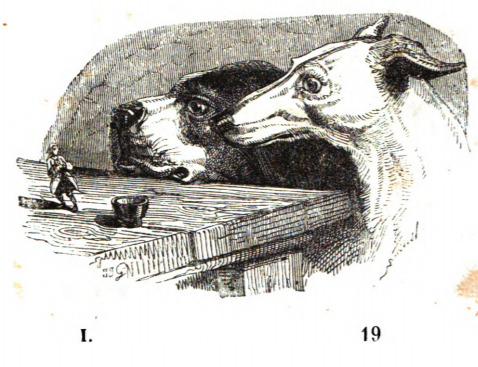
Here we see Gulliver encountering the farmer giant’s dogs. Two dogs stand at the edge of the table looking at Gulliver. The two dogs resemble a St Bernard and a greyhound. The St Bernard’s head is resting on the table. Gulliver stands on the table with his small bowl of food next to him. He leans back away from the dogs. This image highlights the difference in scale between the giant’s world and reality. The same image appears in the 1843 Krabbe edition.
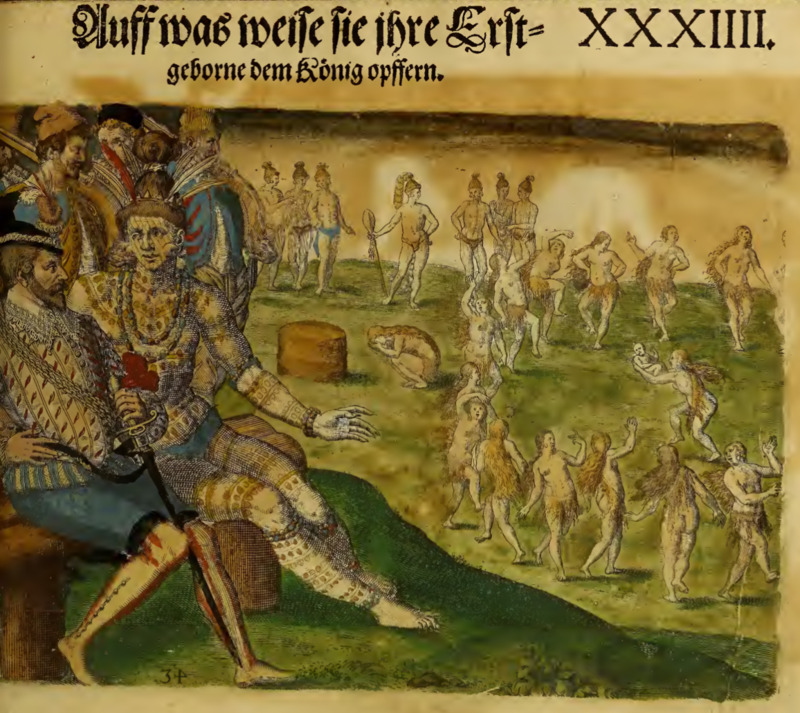
In the foreground, an Indigenous man sits on a wooden bench with a colonist. The Indigenous man wears feathers in his hair, strands of beads around his neck, elbows, wrists, knees, and ankles. His body is covered in tattooed or painted designs. In the background, a large circle of women dances. One woman holds a child aloft in the center of the circle. Another woman kneels on the ground beside a large block with her hands over her head. Several Indigenous men watch the women dance. This illustration is identical to the one found on page 111 of Frankfurt 1591, but colored.
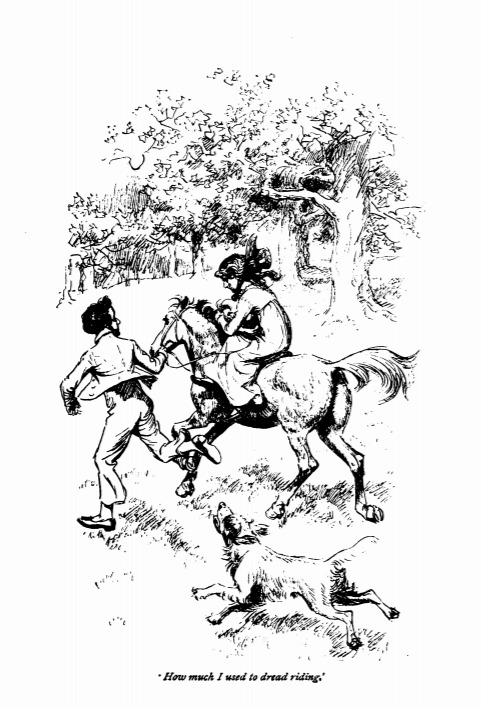
Here we see Edmund teaching Fanny to ride a horse. Fanny was very timid when she first arrived at Mansfield Park. Edmund was kind and gentle with her and the two became close friends. Fanny was scared to ride at first, but Edmund took her out on the old grey pony, seen in this image, and she quickly came to love riding. This scene occurs in chapter 3. The characters are shown in the traditional regency style. Fanny wears the regency style dress with an empire waist. Her hair is loose, and her bonnet is tied under her chin and has flown off her head behind her. Edmund runs next to the pony and wears a short coat. The regency period dated to the early nineteenth century (1811-1820) when George, Prince of Wales, later George IV (r. 1820-1830), reigned as regent for his mentally ill father, King George III (r. 1760-1820). The regency period is associated with the rise of neoclassicism in art and fashion.
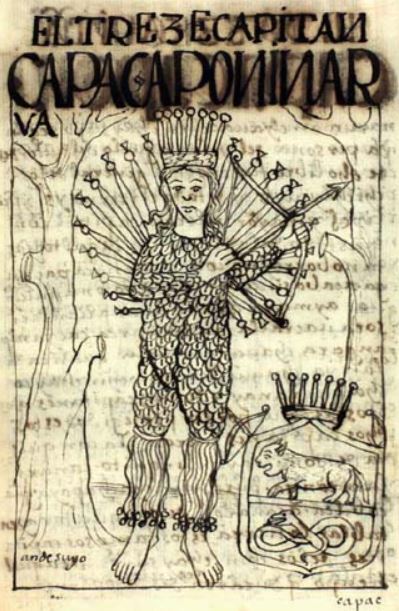
This illustration depicts the thirteenth captain, Capac Apo Ninarua. These captains were a level of Inca authority who helped lead the conquest of the Andes. He is depicted holding a bow in his left hand and drawing an arrow with his right hand and depicted wearing a unique outfit. His shield is illustrated resting on the ground by his feet. The author explains that this captain aided the emperor Huayna Capac in conquering Quito.
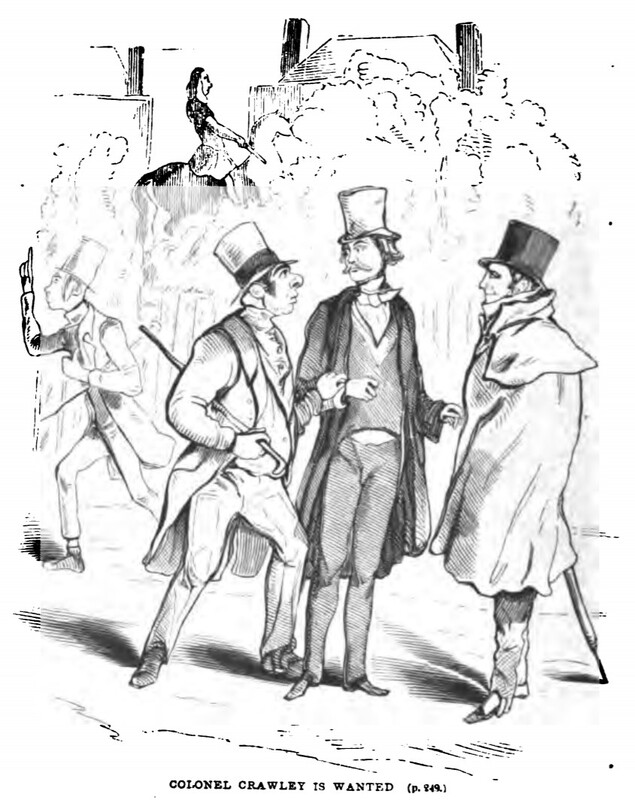
Rawdon Crawley stands with Mr. Moss and his assistant each holding one of his hands. They have come to collect his debt to Mr. Nathan. In the background Mr. Wenham, who has no money to lend him, is leaving with his hand raised and his cane tucked under his arm. Behind the men, amongst the trees, is a statue of a horse and rider. Below the illustration is printed its title and location in the story, “COLONEL CRAWLEY IS WANTED (p. 249.)”.
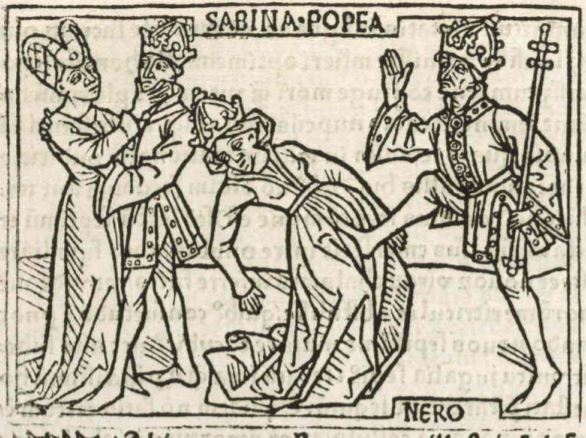
This engraving depicts two separate events. The scene on the left side of the engraving depicts a woman named Sabina Poppaea, a woman of noble birth, seducing emperor Nero. She was incredibly beautiful, as well as cunning. She sought power and found it by marrying emperor Nero, although she did not hold her power for long. The right side of the engraving depicts her tragic fate, as emperor Nero kicks a pregnant Sabina Poppaea, which ends up killing her. Sabina Poppaea’s name, written as “Sabina Popea”, is engraved above her head, and Nero’s name is engraved by his feet.
A mouse is sitting down with its back facing us. It is sitting atop of a circular image with mice sitting around a candle, they seem to be talking as the bigger mouse in the middle is making some hand gestures. There is a small bell hanging above them. In the lower right corner, the letters R. H are written, representing Richard Heighway.
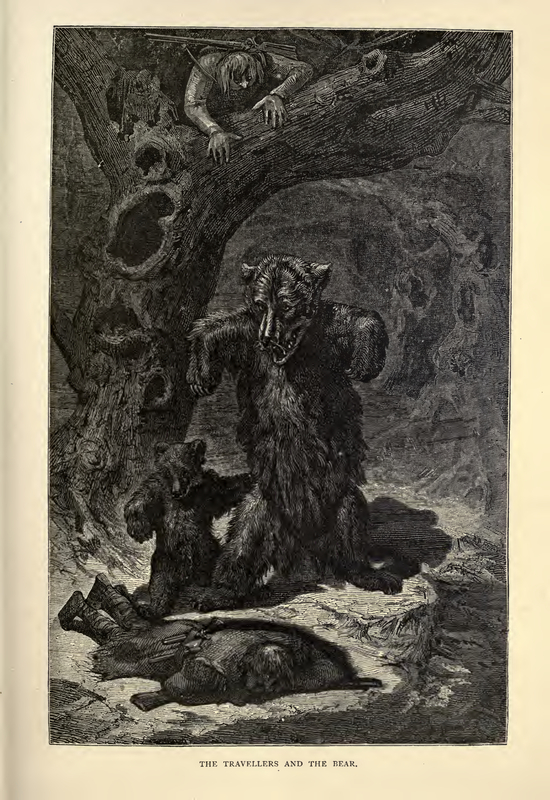
A man lies lifeless on the ground, face down. Behind the man, a mother bear and her cub on standing on their hind legs with their front paws on either side of their head. The mother bear has her mouth open and is looking down at the lifeless man. The cub is looking down too, with his left paw resting on his mother’s leg. Next to the bears is a tree, and the other traveler is hiding atop it, looking down at the scene below him.
There is an illustration at the center of the page, above and below this illustration are bodies of text. In the illustration, a short man is bringing a plate full of food towards a group of three men sitting at a table. The third man from the group of three sitting at the table is drinking something from a glass. The table is full of utensils.
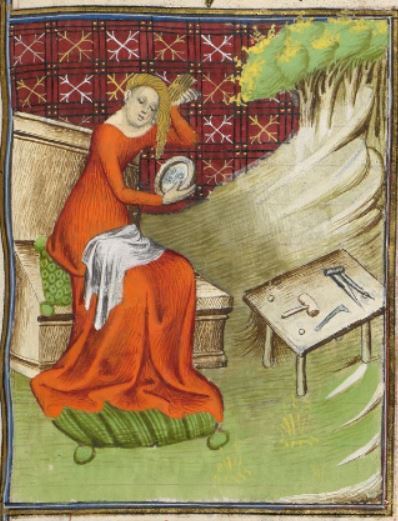
This illumination depicts the young Roman virgin Marcia holding a mirror in her right hand while she combs her hair with her left. There is a table with painting and sculpting supplies in front of Marcia as she was a painter and is preparing to paint a self-portrait in this image. Boccaccio explains that Marcia is worthy of renown for her chastity and for her sculpting and painting abilities. She is known to have mostly painted and sculpted figures of women.


![[Medusa Being Approached by Perseus]](https://collections.cemvc.ca/files/large/9d913751ea9cc2a720e554388177a53e05a3b85b.jpg)
![[Cracked eggs depicting wars of religion]](https://collections.cemvc.ca/files/large/43d5dbdfd6b13defe0058b43b549eef6fcbec0b5.jpg)
![[Cannibalism amongst Indigenous Brazilians]](https://collections.cemvc.ca/files/large/b7bdd564d6ea254e91c8d0be0a81072fdaefc123.jpg)
![Cantor: Los Cantores de la S[an]ta Yglecia Enpedidos de Taza](https://collections.cemvc.ca/files/large/ac628942ae869dfcf3ee951cfb62adec7c0c5a2c.jpg)
![Vita et Fabulae [A person is sleeping while a dog observes and while two people in Holy attire converse]](https://collections.cemvc.ca/files/large/958dd3d9913f591e9d8a4cf0e3f261b9ef462803.jpg)
![[Rodents Standing Around a Lit Candle]](https://collections.cemvc.ca/files/large/fe81f17729a8297d8bb93350df4f5e9cfbe925d2.jpg)
![Vita et Fabulae [A man carries a plate of food towards three men sitting at a dining table]](https://collections.cemvc.ca/files/large/ec3c0cfdbf4ffc428e0b80d5fdf18e562f25cfc6.jpg)