There is a pillar in the middle of the image, with two rats scurrying on the floor nearby. There are stairs on the right, with a person walking down carrying a light and carrying what appears to be a kind of jug. The illustration has the signature of Harrewijn in the bottom left corner.
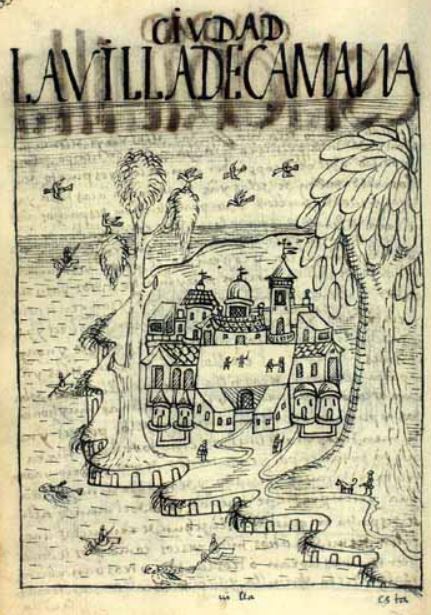
This image is depicted in the author’s chapter where he discusses cities, towns, villages, and provinces in colonial South America. This image depicts the coastal town of Camaná in Peru. The town is depicted close to the shoreline and has two large trees in front of it. There are four boats in the water and two seals swimming close to the shore. The town is arranged in a cluster of buildings that forms a square in the centre. There are two people standing in the square and another two people who appear to be sword-fighting. There are two winding paths that lead to the city. There is one person walking towards the city on the left path and two people walking on the path on the right, with one of those people walking behind a dog. The author explains that this town, because it was close to the water, was used as a port. The caption at the bottom of the image reads ”uilla” [town].
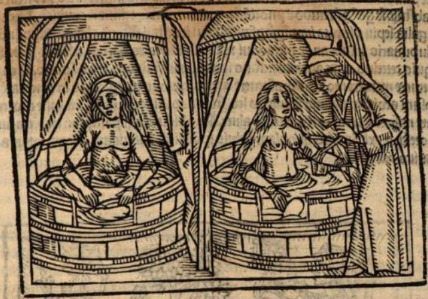
This engraving depicts Seneca and his wife Pompeia Paulina committing suicide in bathtubs. Seneca is depicted on the left side of the image with Pompeia Paulina in the tub beside him. After emperor Nero found out that his tutor, Seneca, was involved in the conspiracy to assassinate him, he ordered a centurion to command Seneca to commit suicide. Not wanting to live without her husband, Pompeia Paulina got into the tub next to Seneca and slit her arm to die with him. Seneca is depicted dead in the engraving; however, a servant is illustrated saving Paulina by tying a rope around her arm to stop the flow of the blood. Emperor Nero did not want Pompeia Paulina to die as he had nothing against her, which is why the servant saved her life.
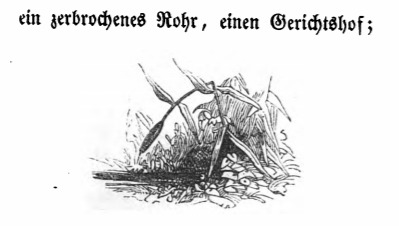
Here we see the broken stems of a reed plant. This is the code word for the Court of Justice. This image comes in a description of a conspiracy found by a professor from the Grand Academy on Balnibarbi. This idea is representing code word for terms in the conspiracy that Swift is satirizing. The professor advises that those named in the conspiracy papers be closely monitored at all times, naming specifically while they were using the bathroom, as this is when men were most thoughtful. This conspiracy is thought to be an allusion to the trial of Francis Atterbury, the bishop of Rochester for allegedly plotting with the Jacobites. Atterbury was charged with treason in 1722 and was exiled to France. The same image appears in the 1839 Krabbe edition.
A group of random animals gather around a lion that is wearing round glasses and is reading a book. The animals are the following: Rhino, Camel, Crane, Alligator, Monkey, Ass, Fox, Mice, Tortoise, Hare, ect. Basically, these are all the animals of Aesop’s fables gathered around the reading lion.
In the centre of the illustration, we see a female figure wearing a robe and a veil. There are two male figures to the left and one to the right. Because there are four female characters in Act X, we can say that this illustration does not relate to the events contained within the act.[This illustration is identical to those found in Acts IV (folio 32r), V (folio 42r), VI (folio 45r), VIII (folio 62r), XIII (folio 93v), XV (folio 102r), and XVII (folio 109r).]
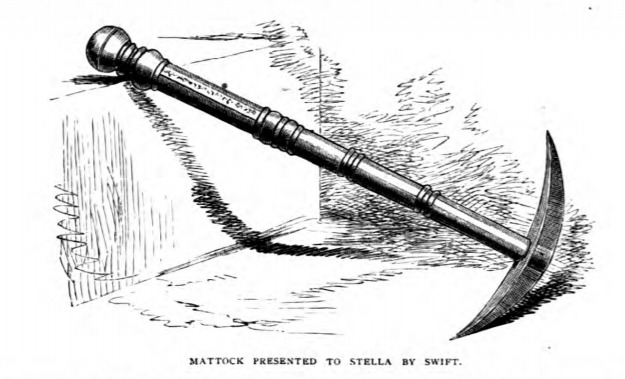
Here we see the mattock Swift gifted to Stella Johnson. A mattock is a pickaxe-like tool. This image appears as part of the biography of Jonathan Swift.
This image depicts three indigenous lay officials. These men oversaw rural parishes on a day-to-day basis. The man in the centre of the image is a prosecutor. He is tall and standing only on one foot and supporting himself with a tall staff, which infers he might have a deformity or disability concerning his left leg. The prosecutors fulfilled their religious duties. The man on the left side of the image is the choirmaster. He is depicted looking up at the prosecutor as he plays a flute instrument. The man on the right side of the image is the sacristan, who is depicted holding a set of keys. The sacristans were responsible for carrying the keys to the sacristies.
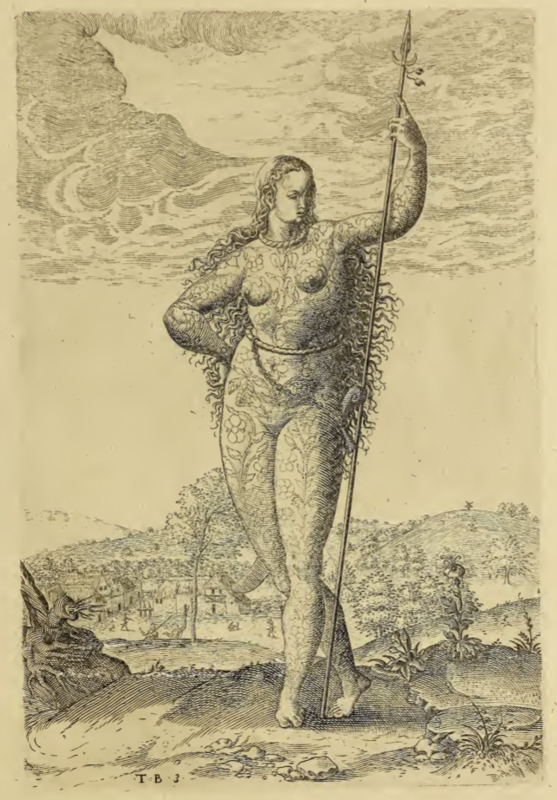
A young Indigenous woman is shown from the front. She carries a spear in her left hand. Her hair is long, she wears a twisted cord around her neck, and a sword with a curved blade hangs another cord around her waist. She is nude, and her body is covered in painted designs. The Picts were an Indigenous group who lived in Britain long before the author’s time. Images of Picts were included in this book so that readers could compare their customs to those of the Indigenous people living in Virginia.
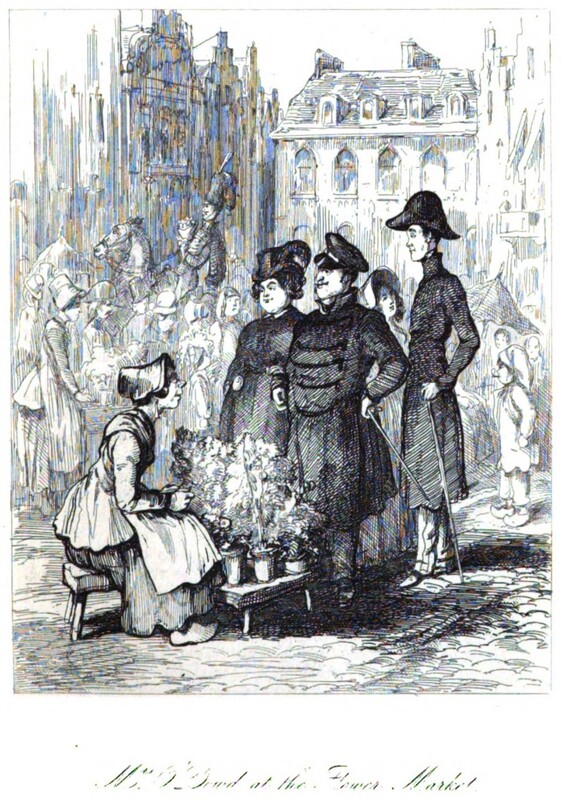
Peggy O’Dowd, in a feathered hat, stands in front of a flower seller at the market in Brussels. She is holding onto the arm of her husband, Major Mick O’Dowd, who has on a cap and is wearing his sword at his hip. Behind the pair are William Dobbin, also with his sword, and Amelia Osborne, who is in a bonnet and looking up at Dobbin. The flower seller is in a bonnet and clogs, seated on a low stool behind the table which holds her rows of potted plants. In the background of the image are the crowds of shoppers, another flower seller standing at her table of plants, a mounted officer holding a bouquet, and the tall, ornate buildings that surround the market square. Below the illustration is printed in cursive its title, “Mrs. O’Dowd at the Flower Market”.
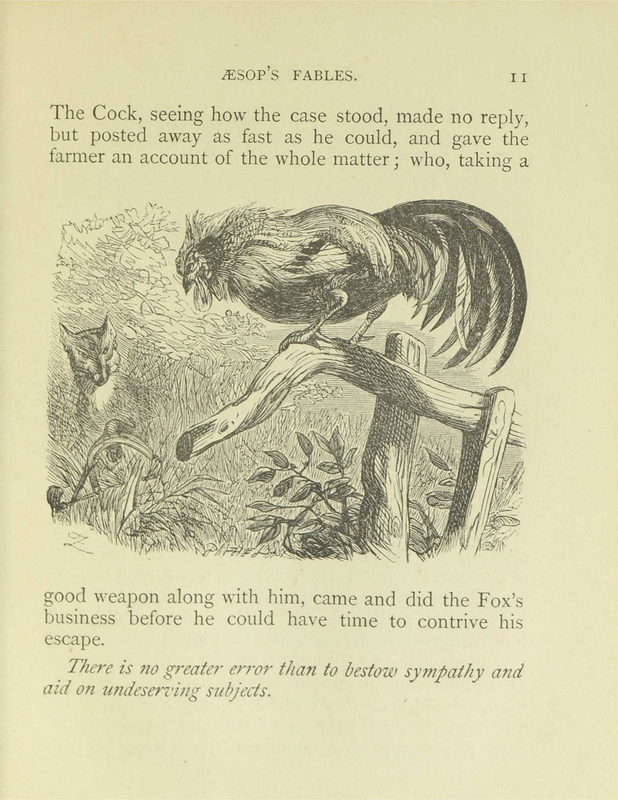
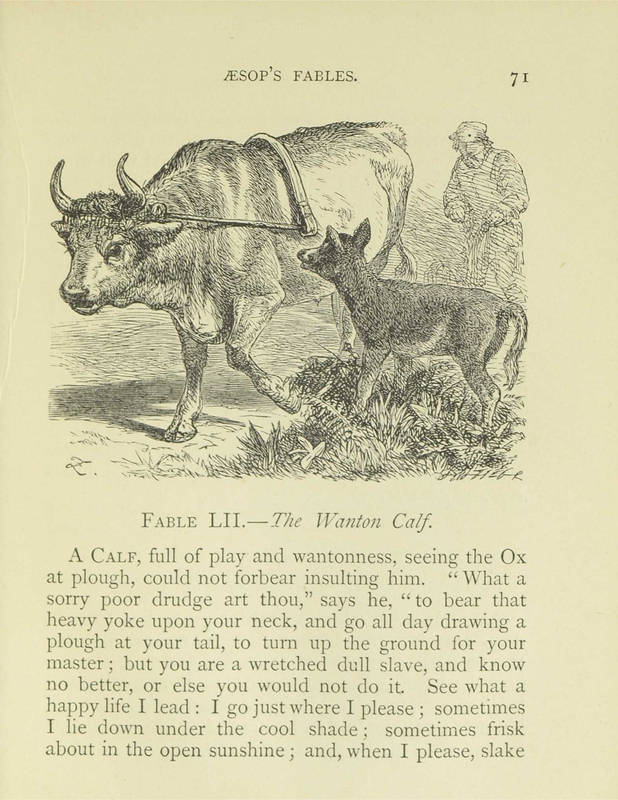
In the right foreground a young calf standing in a thick patch of foliage stares up curiously at an older ox at work. On the left, the older ox mid stride stares ahead as it pushes forward a plow through a field. Behind the plow on the right back corner stands a farmer pushing to keep up with the ox.
Rebecca Crawley sleeping alone in her bed. She has a sleeping cap on and looks peaceful and content, not at all concerned about her husband’s departure to the battlefront.
Circe is sitting in the centre of the image wearing an orange dress and a large headpiece. She was known for her magic and skills with herbs and incantations. The warrior Ulysses is depicted sitting beside Circe, with his companions standing behind him. There are birds illustrated beside Circe. Boccaccio explains that these animals are in fact companions of Ulysses, and that Circe was known to transform those who land on her shores into animals.
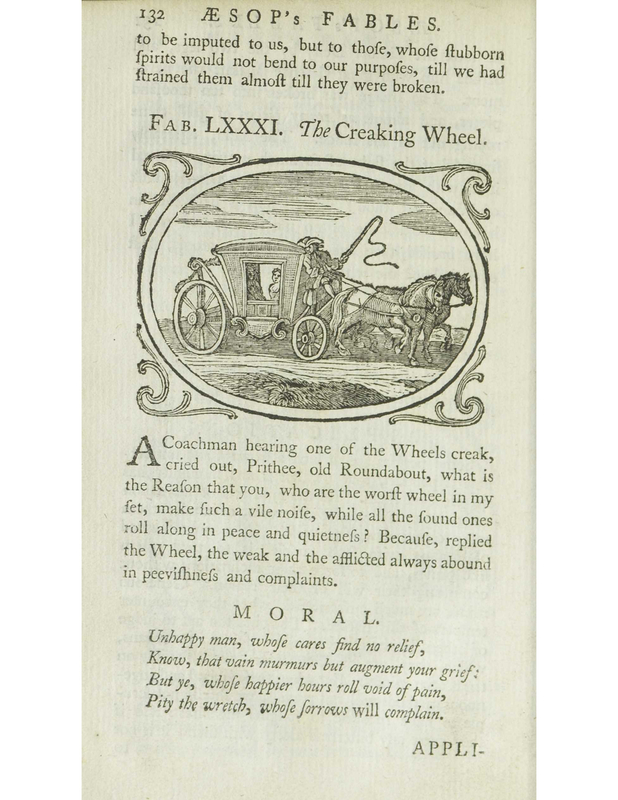
A coachman with a long whip drives a carriage containing a man and a woman. The carriage is being pulled by two horses, one who is dark in colour and the other who is lighter.
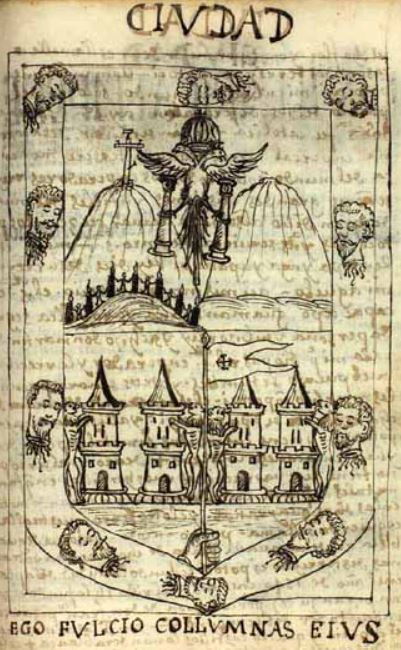
This image depicts the coat of arms for the city of Potosí, Bolivia. There are fortifications at the bottom of the coat of arms that have lions on each side. This is representative of the coat of arms for Castile, Spain, which has both elements. The top of the coat of arms depicts the mountainous landscape of Bolivia and the importance of their silver mines. There is a line of people holding hands in front of the mountainous landscape. Surrounding the coat of arms are decapitated heads, most likely to symbolize the mistreatment of the indigenous peoples in silver mines in Potosí and in other regions of the old Inca Empire. The caption at the top of the image reads “Ciudad” [city], and the caption at the bottom of the image reads “Ego fvlcio collvmnas eivs” [I fortify its columns], which refers to the support the colonized regions of South America gave to its conquerers.
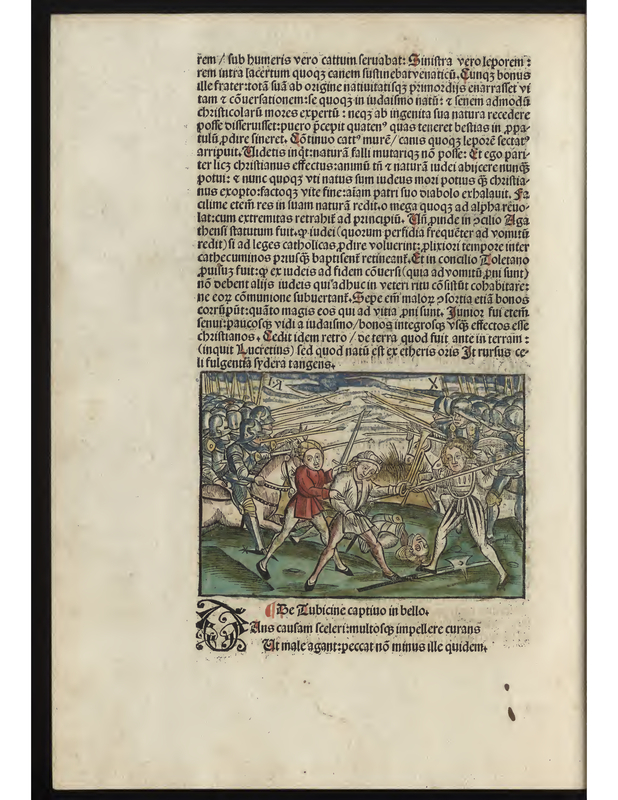
There is an illustration at the top of the page, below this illustration is a body of text. In the illustration, a man is holding two birds of a kind in one hand, and with his other hand he is holding a basket of small birds of the same kind. A smartly dressed man with his arms out is explaining something to this man with the birds. A person is observing this interaction from a house behind the smartly dressed man.
This image depicts Agrippina the Younger, the mother of Emperor Nero and wife of Emperor Claudius. She is riding a chariot in this image because, once she became wife of the emperor and titled Augusta, she rode this chariot to the Capitol, which was a tradition that only priests were able to do. Depicting Agrippina in the chariot demonstrates her power and influence in the empire.
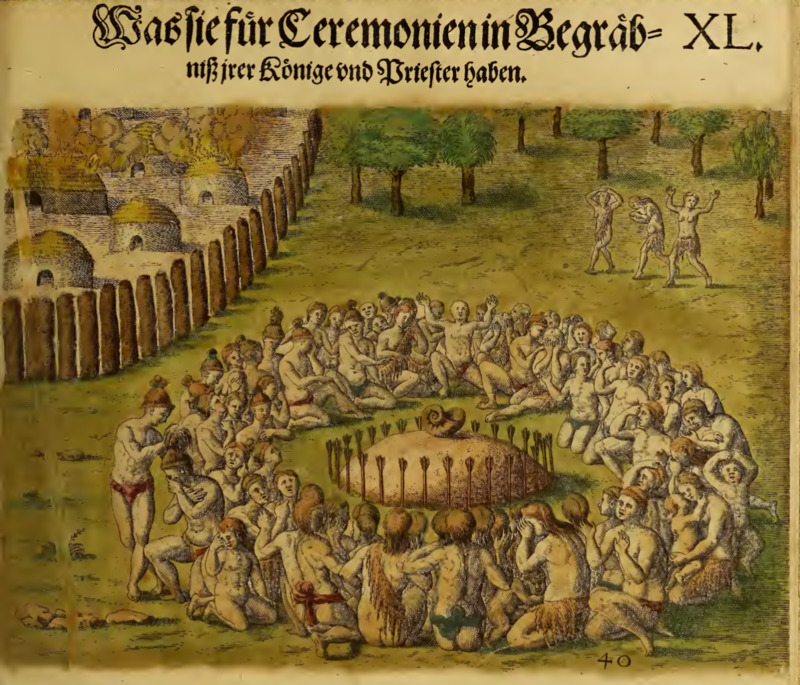
A large group of Indigenous people are shown clustered in a circle, most kneel or sit on the ground. The group appears to be openly mourning together. At the center of the circle there is a mound of earth surrounded by arrows planted tip first into the ground. A large shell sits on top of the ground. The ceremony is taking place outside the village close to the log fence encircling the village. This illustration is identical to the one found on page 127 of Frankfurt 1591, but colored.
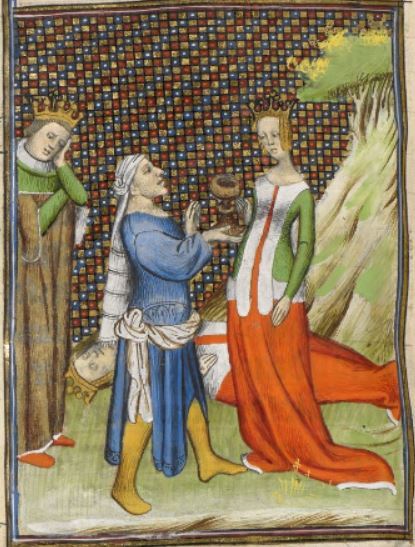
This illumination depicts Sophonisba, the queen of Numidia, about to drink a chalice full of poison. She is illustrated wearing a crown to demonstrate her royal status. Sophonisba is famous for her death, as she willingly drank a poison given to her by her husband to avoid dying at the hands of her enemies: the Romans. Sophonisba’s husband, Masinissa, is illustrated on the left side of the image wearing a brown robe and a crown as he stands beside the servant. He has a saddened look on his face as he does not want his wife to die. Sophonisba is illustrated reaching towards the chalice. There is another depiction of Sophonisba in the background lying dead on the ground after drinking the poison.
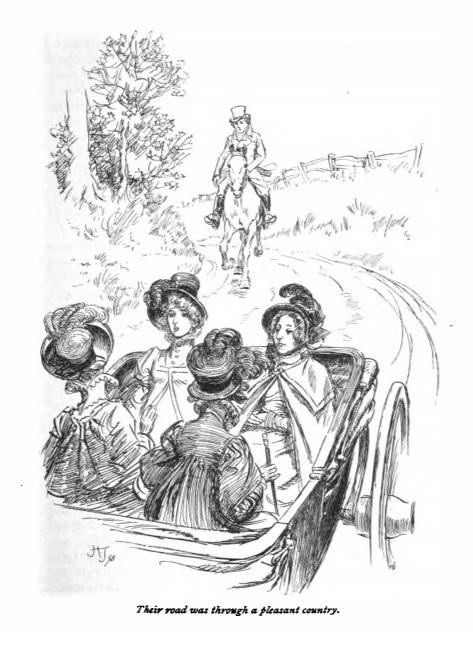
Here we see Fanny, Maria Bertram, Miss Crawford, and Aunt Norris in a carriage on their way to Sotherton, Mr. Rushworth’s estate. Edmund is riding on horseback behind the carriage. The group went to visit Sotherton estate for the day and see the house and the gardens. Maria Bertram was engaged to Mr. Rushworth. This scene occurs in chapter 8. The characters are shown in the traditional regency style. The women are wearing regency style dresses and coats with empire waists, and bonnets. Edmund wears waistcoats and tailcoats, and top hats, with breeches. The regency period dated to the early nineteenth century (1811-1820) when George, Prince of Wales, later George IV (r. 1820-1830), reigned as regent for his mentally ill father, King George III (r. 1760-1820). The regency period is associated with the rise of neoclassicism in art and fashion.
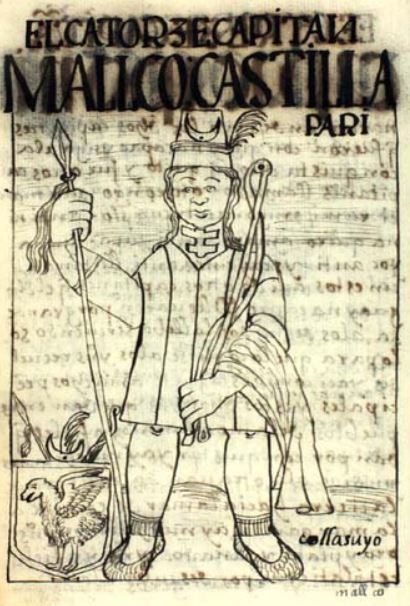
This illustration depicts the fourteenth captain, Mallco Castilla Pari. These captains were a level of Inca authority who helped lead the conquest of the Andes. This captain is depicted standing in the centre of the image holding a spear in his right hand and what appears to be a whip in his left. His shield is resting on the ground by his feet. The word “collasuyo” is written beside his left foot. Collasuyo was a region which made up part of the Inca Empire.
The Fox, passing early one summer's morning near a farm-yard, was caught in a spring, which the farmer had planted there for that end. The Cock, at a distance, saw what happened; and, hardly yet daring to trust himself too near so dangerous a foe, approached l1im cautiously, and peeped at him, not without some horror and dread of mind.
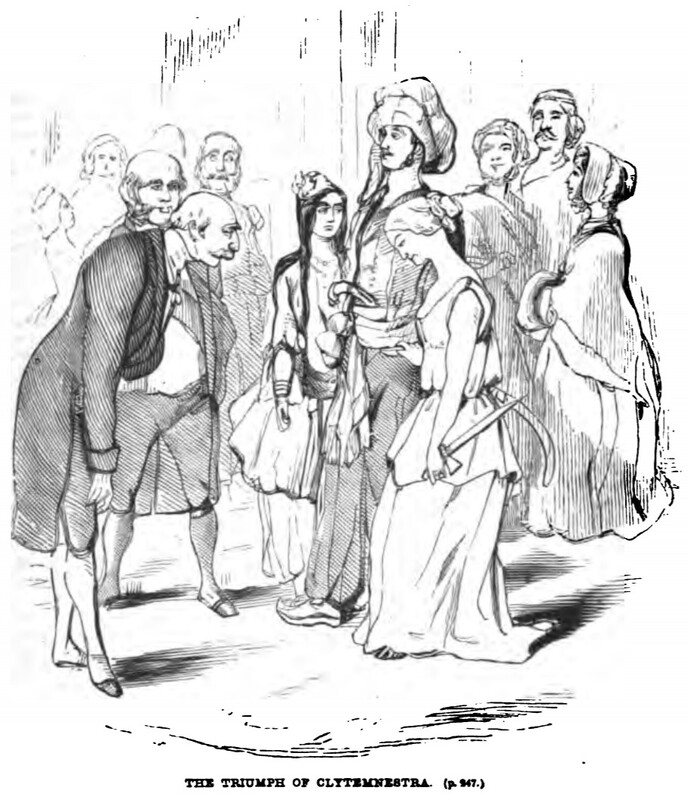
Rebecca Crawley, dressed in a toga and holding a dagger in the character of Clytemnestra, curtseys slightly to his Royal Highness, the prince of Peterwaradin, as he bows and compliments her performance. Next to her is Mr. Bedwin Sands, dressed as a Turkish officer, and behind him Mrs. Winkworth, whose performance as Zuleikah had been the focus of admiration prior to Becky’s appearance. Between Mrs. Winkworth and the prince of Peterwaradin is Lord Steyne, smiling jovially. In the background are several other admiring partygoers. Below the illustration is printed its title and location in the story, “THE TRIUMPH OF CLYTEMNESTRA. (p. 247.)”.



![[The Animals]](https://collections.cemvc.ca/files/large/8dbb1f018000a8ca7adeb7ad5f50f2e028a6ca18.jpg)
![[Act X]](https://collections.cemvc.ca/files/large/5d66333a97caf6ce0c86adbd52ae77ed21f0c21f.jpg)
![Primer Historia de Fiscal, Cantor, Sacristan: Fiscal de la S[an]ta Madre Iglecia](https://collections.cemvc.ca/files/large/85a38336bf6bb48d64619d596db2f518e2a2f361.jpg)
![[Rebecca Sleeping]](https://collections.cemvc.ca/files/large/4ea9936af15244209a4b67320fa1d7e1e20f20b5.jpg)

![Vita et Fabulae [A man talks to another man carrying birds, while another person observes]](https://collections.cemvc.ca/files/large/d6c1a05a4fbd005240ecef2430028a772bfe294d.jpg)
![[Agrippina Riding in a Chariot]](https://collections.cemvc.ca/files/large/020f7534789f4ddacc0da9623294a486415a6344.jpg)