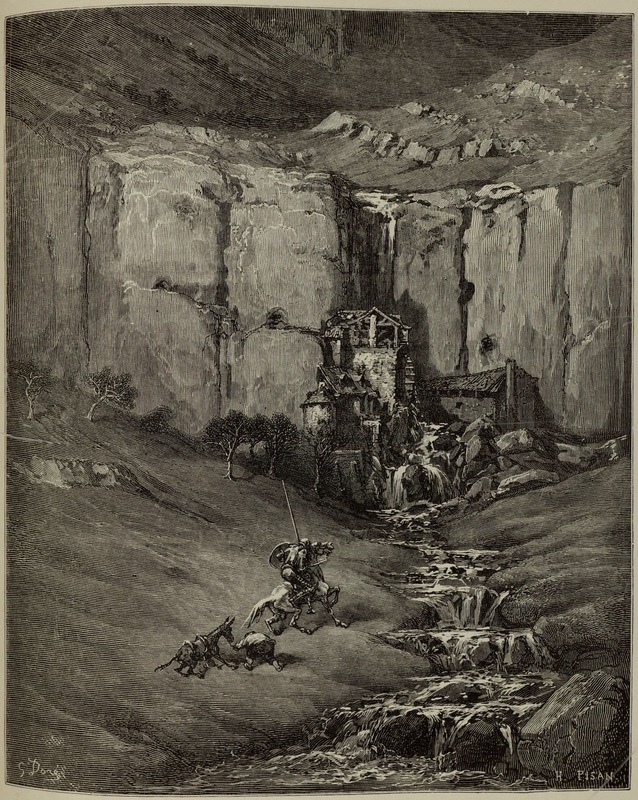
Don Quixote and Sancho Panza approach the fulling mills: some dilapidated hovels at the foot of high crags over which a great rush of water falls. Rocinante becomes agitated by the clamour of the water and the pounding. Sancho crouches and peers between Rocinante’s legs, trying to see what is frightening him. Signed by G. Doré (illustrator) and H.-J. Pisan (engraver). Part 1, ch. 20.
Sancho Panza sleeps in a luxurious bed in the estate of the duke and duchess, his head resting on his arms which themselves rest on some pillows. The lower half of his body is obscured by fabric that hangs from the overhang of the bed.
The wooden horse Clavileño explodes, throwing Don Quixote and Sancho Panza into the air. Signed by D.-N. Chodowiecki (illustrator) and D. Berger (engraver), dated 1779. Plate 13. Part 2, ch. 41.
During master Peter's puppet show, two puppets are depicted sitting at a table gambling. The puppet on the right with a large is moustache is Don Gaiferos gambling with his arms thrust forward rigidly as a puppet's would be, movable joints on his shoulders and thighs. The puppet on the left is the gambler, cup by his hands to roll dice with. On the table, gold is scattered clumsily.
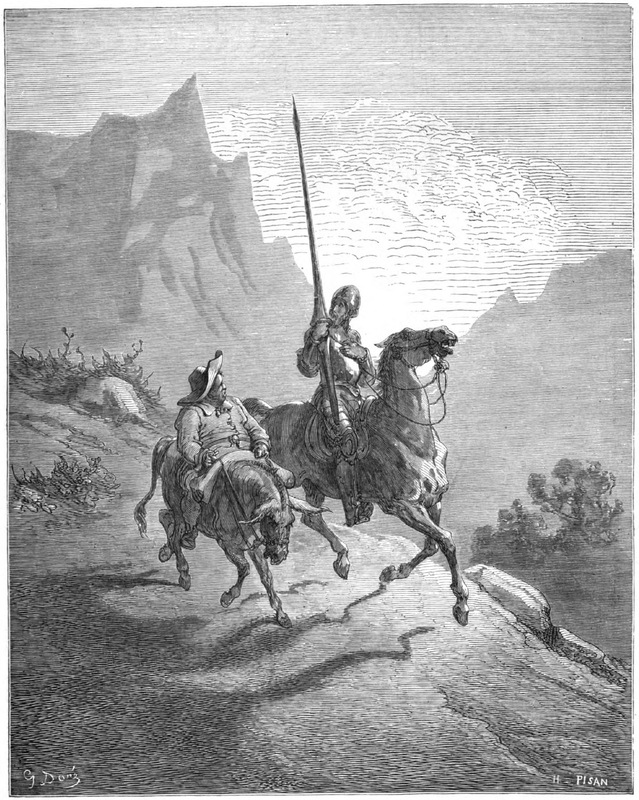
Don Quixote and Sancho Panza set out on their first adventure together. They take the same route as Don Quixote’s first sally, but as it is early in the day, the sun does not tire him as much as the last time. Sancho Panza rides a donkey and carries an alforjas. Don Quixote is once again mounted on Rocinante, with a new lance and restored armor. This scene can be found in Part I, Book 1, Chapter 7.
A rope is let down over Quixote's window, to which five small bells were fastened, and immediately afterwards was emptied a great sackful of cats, which had smaller bells tied totheir tails. These cats all fall before Quixote's window, and Quixote, thinking them devils brandishes his sword (right) and swings his blade wildly about.
A bald blind old man (left) with a long thick beard that falls past his shoulders reaches out to his blind companion (right) with his left hand to grab him by the shoulder so that he will not fall into the gaping hole before them. Both men carry a walking stick in their right hands, and the man on the right holds a hat in his left hand. For clothing the old man has a loose robe whilst the young man wears well-fitted apparel and pants that do not differentiate with the leg. The image is occasioned by the Squire of the Woods saying "if the blind lead the blind, both are in danger of falling into the pit" in referring to the relationship between Quixote and Sancho.
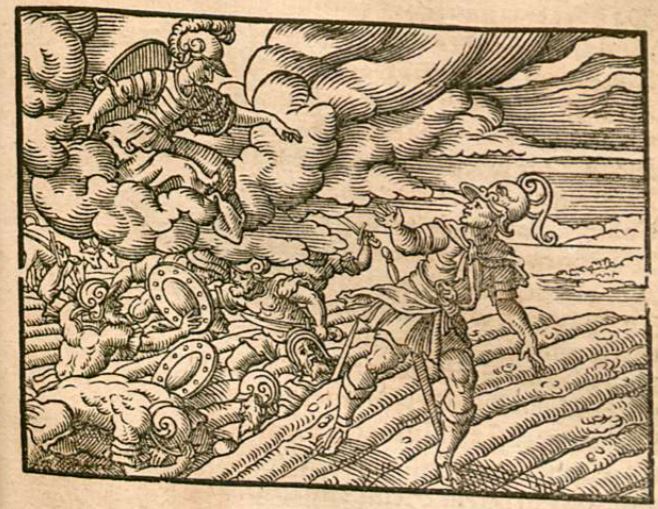
This engraving depicts Cadmus speaking with the goddess Pallas, also known as Minerva. Pallas is depicted flying above Cadmus in the clouds as she tells him to sow the teeth of the serpent that he had just slayed into the ground which will generate people. Cadmus obeys the goddess and proceeds to sow the teeth of the serpent. Subsequently, the sown teeth begin to produce fully armed soldiers as a result, which is illustrated happening behind Cadmus. These cultivated humans now become the newly formed population of Thebes.
A snake (left) coils itself apprehensively, its tongue sticking out and hissing. In the background, another snakes tail is pictured. In the middle, a black toad stands menacingly, eyes plastered to the reader. Another toad is pictured on the background on the right in front of an angry looking lizard behind it. The image is occasioned by Don Quixote saying "thereis a romance which tells us that king Rodrigo was shut up alive in a tomb full of toads, snakes, and lizards, and that, two days after, the king said, from within the tomb".
After having been stoned by the galley slaves (background) they released, Don Quixote tells Sancho Panza that doing good to the lowborn is throwing water into the sea. Signed by G. Doré (illustrator) and H.-J. Pisan (engraver). Part 1, ch. 23.
In the background, Merlin’s cart enters, carrying Dulcinea. The scene is lit by torches carried by the company. In the foreground, silhouetted by this light, are the duke, the duchess, Don Quixote, and Sancho Panza. Unsigned. Part 2, ch. 35.
Having fallen into a hole with his Donkey, Sancho Panza cries out for help. By chance Don Quixote is riding through the forest the following morning, and chanced to approach so near the brink of the hole, that, had he not drawn the reins in suddenly and strongly, he would have fallen in with Sancho. Having escaped the danger, he advanced a little nearer, and, as he was looking down, he heard the voice of his squire from below. Clad in full armor, Don Quixote looks down upon Sancho Panza atop Rocinante with lance in hand.
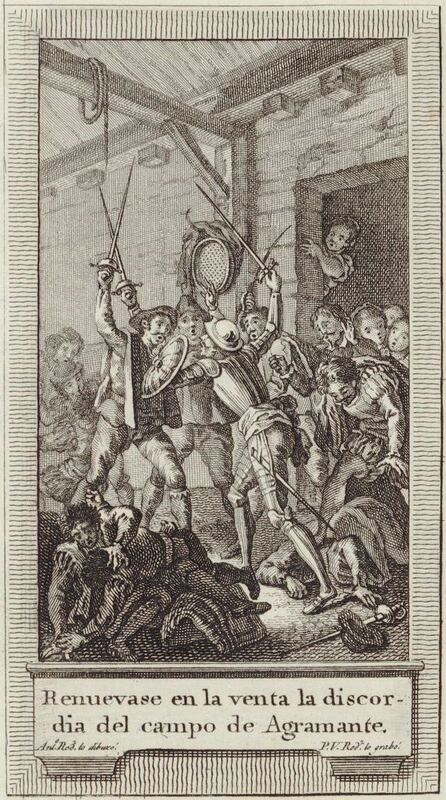
During the dispute about the packsaddle and the barber’s basin, Don Quixote accuses an officer of the Holy Brotherhood of lying and swings at him with his lance. This incites a fight between the officers of the Holy Brotherhood and the innkeeper on one side, and Don Quixote, Don Fernando, Cardenio, and Don Luis’ servants on the other. In the midst of the chaos and confusion, Don Quixote thinks that he has been plunged headlong into the discord at Agramante’s camp, a proverbial dispute described by Ariosto in Orlando furioso. Signed by A. Rodríguez (illustrator) and P. Rodríguez (engraver). Part 1, ch. 45.
In master Peter's puppet show, one of the towers of the Alcazar of Saragossa called Aljaferia is pictured with a long haired woman in North African apparel standing on the balcony in a Moorish habit, this is Melisandra. Now an Algerian man dressed in a turban and white clothes comes behind Melisandra and grabs her to force a kiss full on her lips, his puppet arms extended outwards, while Melisandra, appearing human-like, tries to push him away.
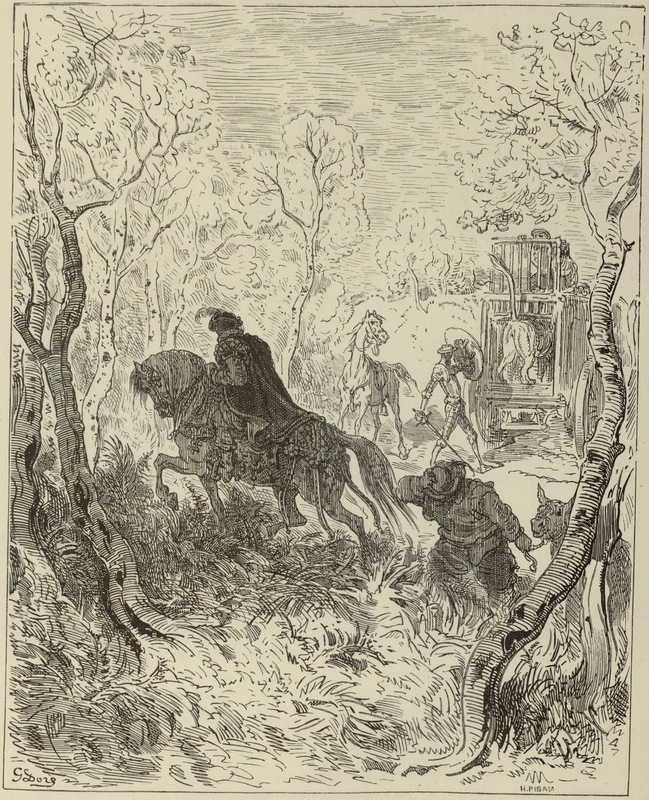
In the foreground, Sancho Panza and Don Diego de Miranda run, while in the background, Don Quixote prepares to fight the lion as the lion keeper opens the gate. However, the lion refuses to leave its cage. Don Quixote holds his sword in one hand and his buckler in the other. Signed by G. Doré (illustrator) and H.-J. Pisan (engraver). Part 2, ch. 17.
The duke and duchess sit behind a clothed table and look off towards the border of the image on the left. The man on the left wears a hat with large plumage, a regal buttoned-up vest and a sprightly moustache. The woman on the right wears a veil which has been pulled back over her head, a large ruff on her neck, and a distaff in her left hand.
Don Quixote tries to give Sancho Panza two thousand lashes to discharge the debt that he had assumed. They struggle and Sancho gains the upper hand. He makes Don Quixote promise not to whip him. In the background, the bodies of outlaws and bandits hang from tree branches. Signed by T. Stothard (illustrator) and Walker (engraver). Plate XVI. Part 2, ch. 60.
Don Quixote (right) and Sancho Panza (left) are seated blindfolded on the wooden horse Clavileño in the yard of the Duke and Duchess. Quixote clad in armor holds his sword in his right hand and his shield aloft in his left. Sancho clings tightly to his master from behind; several onlookers cheer in the foreground. On the right, a man holds a flaming sconce near Quixote's head. Many men behind the horse hold lit torches above their head. on the left a man uses a bellow on Sancho and Quixote to simulate the feeling of flying through the air.
The illustration represents part of Luscinda’s story as told by Cardenio to the priest and the barber: Luscinda asks a man to take a letter to Cardenio, throwing down a knotted handkerchief containing a hundred reales, a gold ring, and the letter. Signed by G. Doré (illustrator) and H.-J. Pisan (engraver). Part 1, ch. 27.
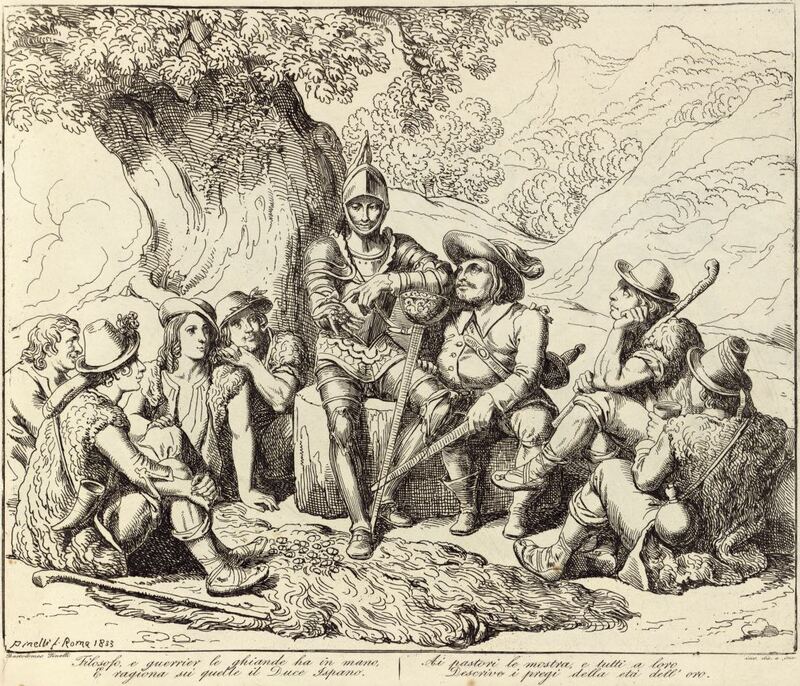
Don Quixote delivers a speech about the Golden Age to a group of goatherds. The goatherds are gathered around Don Quixote, whose figure is at the centre of the composition, under a tree. Sancho Panza sits next to him. Signed by Bartolomeo Pinelli (engraver and illustrator) and dated Rome, 1833. Plate 18. Part 1, ch. 11.
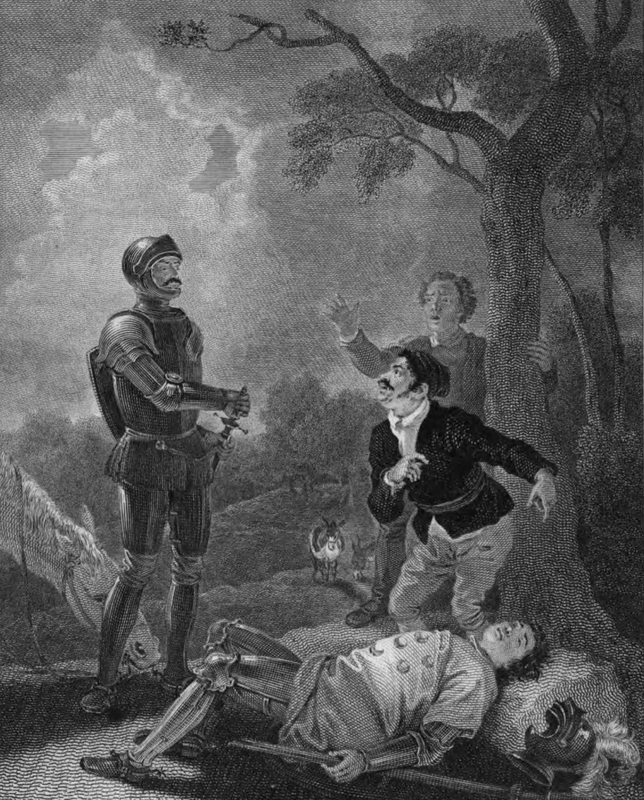
Don Quixote, clad in armor, sheathes his sword having defeated the Knight of the Woods with such force, that he lay on the ground him motionless, and without any signs of life. Sancho unlaced the knight's helmet to see whether he was dead, or if yet alive only to find the face of the bachelor Sampson Carrasco. Surprised, Sancho points to the knight's face and asks his master to kill this enchanted imposter; Standing a cork tree, the Squire of the Wood calls out for Quixote to spare his master. To the left, Don Quixote's horse, Rocinante, licks its master's sabaton's. In the background, the squires' donkey's graze on a grassy hill.
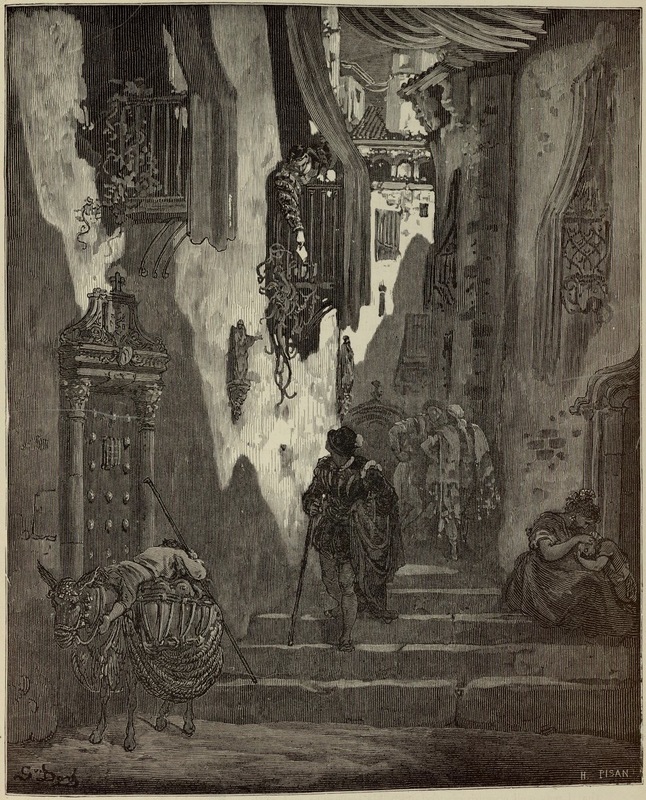
A disheveled man walks about the streets with a large stone in hand, who upon meeting an unsuspecting spaniel, edges slightly towards the dog, with the intention of letting thestone fall upon its body.
In the foreground, Juan Haldudo reprimands and whips Andrés, who is tied to an oak, with a leather strap. Juan’s mare is tied to another. In the background, Don Quixote hears Andrés’ cries and directs Rocinante in their direction. Unsigned. Part 1, ch. 4.
At dawn, Don Quixote and the Knight of the Woods prepare to duel. Their squires both sit beneath a tree to see who of their master's is superior. But the moment Sancho Panza lays his eyes upon the squire of the wood's nose, Sancho recoils in terror. The Squire of the Wood's nose was now so large, that it almost overshadowed his wholeface. The hawk nose is full of warts and carbuncles, of the color of a mulberry, and hanging two fingers breadth below his mouth . Sancho, at the sigh of the nose, began to tremble from head to toe. Unbeknownst to Sancho, the nose is a fake designed to off-put Sancho and Quixote. In the foreground, a sack and bottle lie on the ground, likely to serve as provisions for the two squires in watching the duel. Behind Sancho his Donkey, Dapple, turns its head to see what its owner has become frightened of.

![[Sancho Sleeps in a Luxurious Bed]](https://collections.cemvc.ca/files/large/5a0c05170cff423cdafb28b85f0e2b45f559de1b.jpg)
![[Clavileño explodes]](https://collections.cemvc.ca/files/large/f917ca133955208f7142a243c7986386cdec455b.jpg)
![[Of The Gambling of the Puppet of Don Gaiferos]](https://collections.cemvc.ca/files/large/4f1d4f22e63859f120bb6b8f3c5ebfcc63f4eb7e.jpg)
![[A Rope of Cats Lowered Before Quixote's Window]](https://collections.cemvc.ca/files/large/a197e77e9c0ddcd89c722af4ece232dfe70e9e2d.jpg)
![[The Blind Lead the Blind]](https://collections.cemvc.ca/files/large/73b1441dba0d3dcaa85f69ce69fb198fbeebd7ff.jpg)
![[Master Peter's Monkey]](https://collections.cemvc.ca/files/large/cde923c7bef394c950ba9912df53c3b02024d084.jpg)
![[Toads, Snakes, and Lizards]](https://collections.cemvc.ca/files/large/42404666abe60c35fc89148c327e89aae5944597.jpg)
![[Merlin's cart and Dulcinea]](https://collections.cemvc.ca/files/large/75a3df04fbbf3c71b75b11c79d29a4b03b203f6e.jpg)
![[Don Quixote finds Sancho in a Hole]](https://collections.cemvc.ca/files/large/55729d10feb3e0548ea337d975be2a36d561986e.jpg)
![[A Puppet Moor Forces Himself Upon the Puppet Melisandra]](https://collections.cemvc.ca/files/large/a5af05429b00bc150b49d3607e86e576c77537ed.jpg)
![[The Duke and Duchess Listen to the Baratarian Steward]](https://collections.cemvc.ca/files/large/16f878c8736e6d59f2e065b9d1e5cdb26bad2b91.jpg)
![[Don Quixote tries to whip Sancho Panza]](https://collections.cemvc.ca/files/large/2ffe31961d8e0b1344a4ca02f8f5767095aa1fa8.jpg)
![[Of how Don Quixote and Sancho Panzo Rode the Wooden Horse Clavileño ]](https://collections.cemvc.ca/files/large/462c300b7f522cf8fa7004490ccbb667a4ffd410.jpg)
![[The Madman of Cordova Approaches a Spaniel]](https://collections.cemvc.ca/files/large/bb1b096256154eb393f466dd02c0805e43d0451b.jpg)
![[Juan Haldudo whips Andrés]](https://collections.cemvc.ca/files/large/95ade2bf63a7f4782f48d802f3b69e822e48152c.jpg)
![[Of Sancho's Horror Upon Witnessing the Squire of the Wood's Nose]](https://collections.cemvc.ca/files/large/09d8bde9f92e72af25a7c076b299a50119da428b.jpg)