Here we see Fanny visiting Miss Crawford and Mrs. Grant at the parsonage, discussing the ball. Fanny did not leave Mansfield Park the day after the ball, but the next day she went down to the parsonage to discuss the events of the ball. This scene occurs in chapter 29. The characters are shown in the traditional regency style. Fanny, Miss Crawford, and Mrs. Grant wear regency style dresses with empire waists. The regency period dated to the early nineteenth century (1811-1820) when George, Prince of Wales, later George IV (r. 1820-1830), reigned as regent for his mentally ill father, King George III (r. 1760-1820). The regency period is associated with the rise of neoclassicism in art and fashion.
In this image there are many soldiers all of which we are to assume are males, riding horses. Many of them are white horses. A soldier on the right is waving his weapon in the air. Also, a soldier on the front line is also waving his sword in the air.
Celestina (leftmost figure) arrives at Melibea’s house, where she is greeted by Lucrecia (perhaps the rightmost figure), Melibea’s servant. As an old friend of Melibea’s mother Alisa (perhaps the rightmost figure), Celestina gains entry under the false pretense of paying her a visit and selling yarn. The servant of Alisa’s dying sister arrives and informs Alisa that her sister has requested her presence. Alisa departs, leaving Celestina alone with Melibea (central figure) and Lucrecia. She talks for a while with Melibea and eventually reveals that she is there on behalf of Calisto, which sends Melibea into a fit of rage. Celestina manages to quell her rage with a lie, telling her that Calisto’s cure requires only her girdle and a handwritten charm/spell. Melibea gives Celestina her girdle (as depicted in this illustration), and she asks Celestina to return the following morning to retrieve the spell.
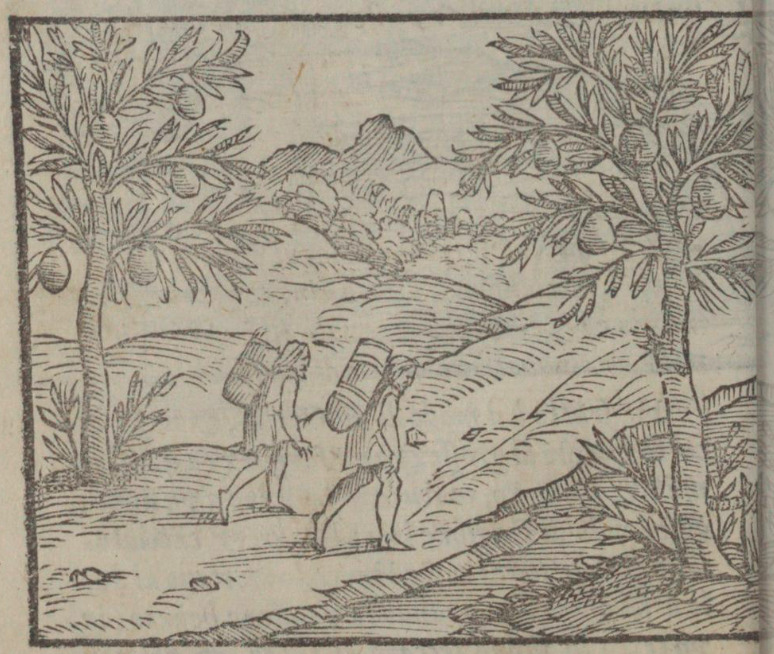
Two Indigenous people walk beneath tall trees that bear oval-shaped fruit (calabash trees). Both individuals have a large basket strapped to their back to gather and carry the fruit, which they will use to make pots and other vessels. This image is identical to one found on page 102 verso of Venice, 1565.
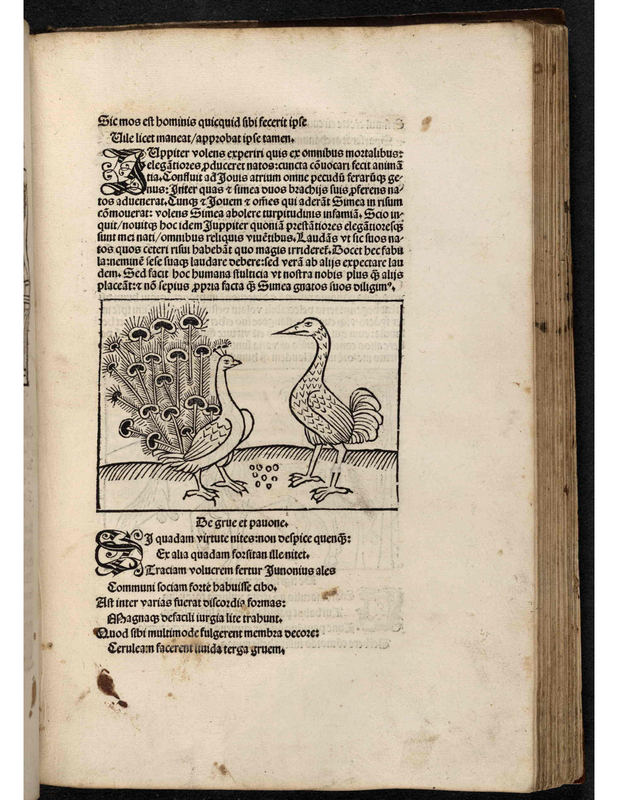
There is a peacock on the left side of the image, and a crane on the right side of the image. They are staring at each other, and there is bird feed in between them.
A group of Indigenous men, women, and children gather around two large pots, one sitting on the ground and one resting on a fire. The group cooks and eats meat and fish. Two individuals sit in a large hammock while the rest sit and stand on the ground around the pots. One structure is visible in the background. This image is identical to one found in Paris, 1557.
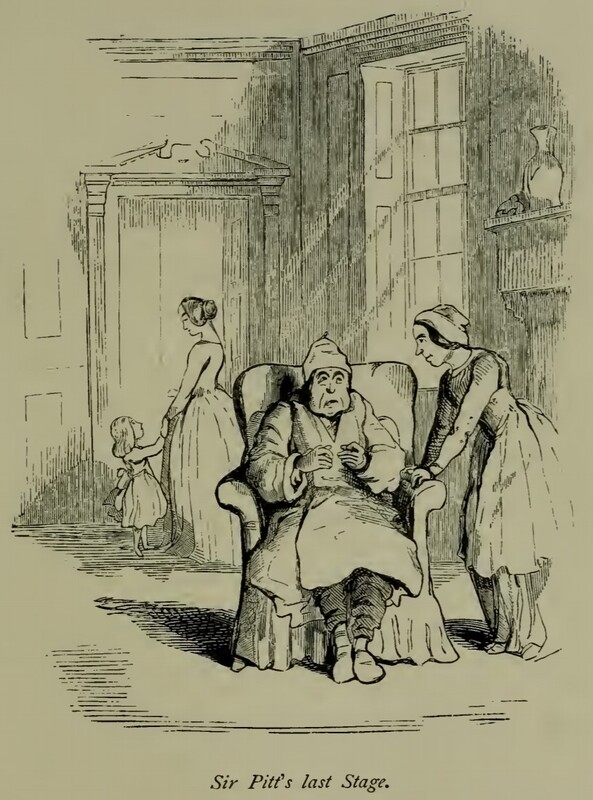
Sir Pitt Crawley, in a nightcap, sits in the chair in front of the fireplace in his apartments. Behind him, Lady Jane Crawley and her daughter, Matilda Crawley, are holding hands as they leave the room. Next to Sir Pitt, Miss Hester, now his nurse, has turned his chair away from the fire with a scowl on her face. Below the illustration is printed in cursive its title, “Sir Pitt’s last Stage.”
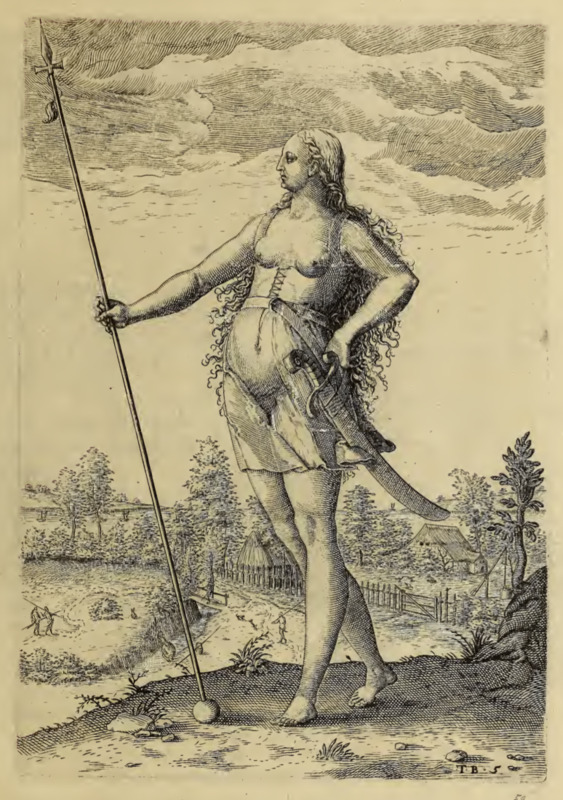
An Indigenous woman is shown from the front. She carries a spear with a ball on the end in her right hand. She wears a belted tunic that is open chested and laces under the breasts. A sword with a curved blade hangs from the belt around her waist. This woman is described as belonging to an Indigenous group that lived near the Picts. The Picts were an Indigenous group who lived in Britain long before the author’s time. Images of Picts were included in this book so that readers could compare their customs to those of the Indigenous people living in Virginia.
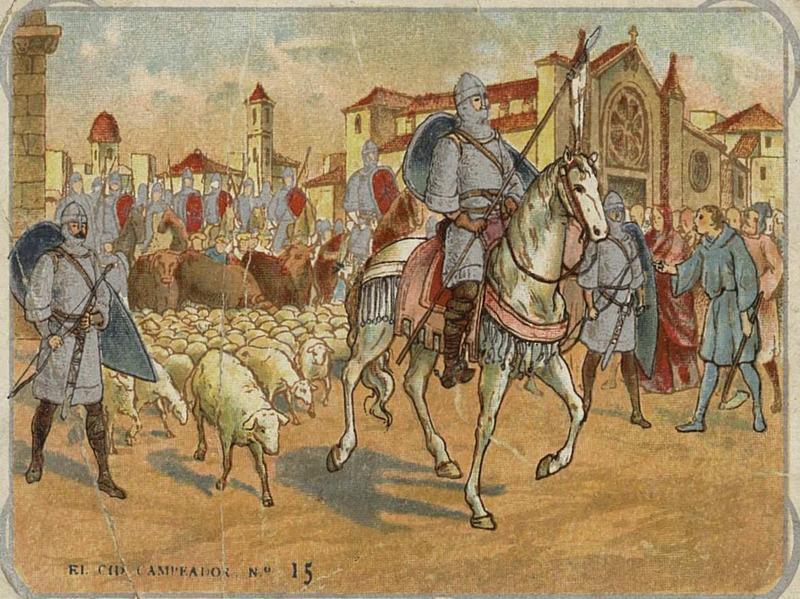
In this photo El Cid is riding his white horse through a town with his soldiers. He is wearing chainmail, a helmet, and a shield strapped to his back. He is holding a spear in one of his hands. In the middle of the image there are many sheep standing in the town. Behind those sheep there are other soldiers riding horses with armour and their spears. On the left of the image near the sheep there is a soldier with chainmail, a helmet, a sword, and a bow in hand. The right side of the image is where there are the townsfolk. Among the crowd the man with the blue tunic and wooden cane is the most detailed. In front of this man is another soldier with chainmail, helmet and sword. The background of the image shows the town’s buildings, towers and roofs are visible; they seem to be all made out of stone with red rooftops. The building right behind the townsfolk is a church wich is distinguishable by its cross.
This image depicts the fictional flying island of Laputa. There are regions of hills in the Southern, and North-West areas of the island. Forests are also shown in the North-East and Central regions. The city of Lagado is in the centre of the island. The town of Maldonado is in the South-East of the island. Above the island are letters, which depict the different ways in which the island moves, hovering over Balnibarbi through magnetic opposition on an adamantine base. The same map appears in other editions of Gulliver’s Travels, including those in other languages.
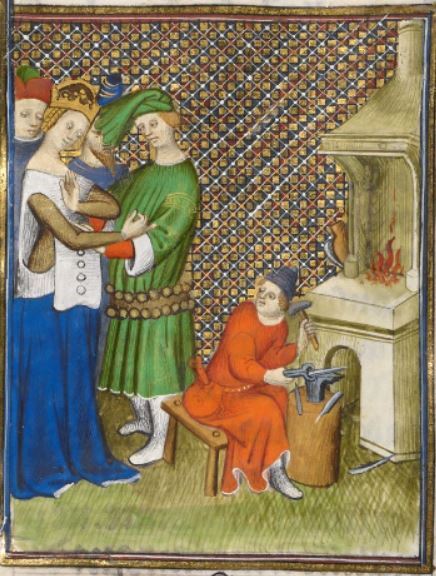
This illumination depicts Faustina Augusta standing on the right side of the image wearing a white, brown, and blue outfit and a crown. She is wearing a crown because she was the wife of Emperor Marcus Aurelius, and was honoured with the title of Augusta, the first woman to have that title. She has three male companions standing with her as she looks at the man sitting at a smithing table. There is a fire beside this man as he forges a weapon on the table in front of him. Faustina was known to be unfaithful to her husband and was in love with a gladiator. The man forging the weapons in the image is presumably the gladiator Faustina fell in love with.
Here we see Gulliver participating in a military procession to boost military morale in preparation for battle with the neighbouring land of Blefuscu. The Emperor asked Gulliver to stand with his legs apart so that the army could walk underneath him, as though he were a triumphal arch, and Gulliver obliged. In the front, we see the military band, complete with drums and horns. Near Gulliver’s right foot, we see three men on horseback. The army is about to pass under Gulliver’s legs, with many men carrying either swords, spears, or bows and arrows. The procession can be seen well into the distance. The royal box with the Emperor and Empress and their page is near Gulliver’s right foot and is decorated with feathers on top of the box. Other spectators watching from stands near Gulliver’s left foot. The image comes at the point when the Lilliputians prepare for war, and Gulliver is asked to join the war effort, which he does, helping the Lilliputians to win the war. The same image appears in the 1839 Krabbe edition.
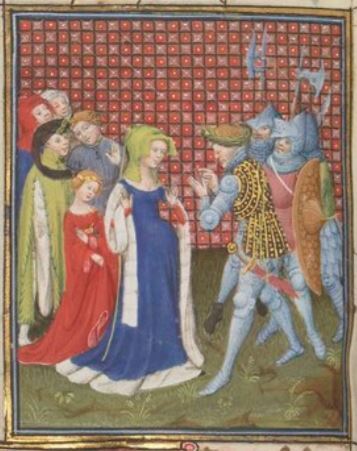
This illumination depicts the noble Roman matron Veturia speaking with her son, Coriolanus. Veturia was a famous for saving Rome from what would have been a violent attack on the city. Her son had been exiled from Rome, and to exact his revenge, he planned an attack on the city with Volscian enemies. Veturia went and spoke to her son and convinced him to call off the attack. Veturia’s daughter-in-law and grandchild are standing behind her, along with other Roman citizens. Coriolanus has his soldiers standing behind him. Women began to gain more respect from men in Rome due to Vetruria’s actions.
While returning home from her meeting with Melibea, Celestina spots Sempronio and Pármeno, who are going to Saint Mary Magdalene’s Church to check on Calisto, and follows them. The two servants enter first and begin talking with Calisto, while Celestina enters afterward and tells them that she has good news. They go to Calisto’s house for privacy, and Celestina reveals that Melibea is passionately in love with Calisto. Calisto is overjoyed when Celestina tells him that Melibea wants to meet him at midnight, but Sempronio and Pármeno are suspicious of Melibea’s sudden change in heart. Calisto tells everyone to leave so that he can rest before night comes, and Celestina returns home. To the right of the image, we see Celestina wearing a robe and a veil. Calisto stands beside her, wearing a coat and a hat, with a sword mounted on his belt (it can be seen protruding from behind his coat in the bottom right corner). His hung head and facial expression convey and air of sadness, which seems an unfitting depiction for this scene. To the left, we see Pármeno and Sempronio, both of whom are wearing hats. A sword is seen protruding from behind the figure on the right, who is pointing toward the figure on the left as he glances toward Celestina and Calisto.The entire image is identical to those found on pages 47 and 93 of the text.
The Inca Emperor Atahualpa (Atabalipa) and his army are attacked by Spaniards outside the city of Cajamarca in Peru. At the center of the melee, a Spanish man grabs Atahualpa (who is still atop his litter) by the ankle and pulls him down, while a monk holds a cross up towards him. Spaniards attack the Indigenous army on horseback from the left and on foot from the right, using muskets, swords, and spears. The Spanish have also lined up several cannons, which they fire at the Indigenous warriors. Despite outnumbering the Spanish, the Inca army is faring poorly, having been caught by surprise and facing more destructive weapons. The Inca warriors are armed with bows and spears, and a few have shields. Many are killed in the attack, while others flee in panic.
An illustration of a lady and officer, attired as they would accurately be at the time of the story. The lady wears a long, thin dress and elongated bonnet, while the officer wears a coat with tails and an oversized, pointed hat, and carries a very thin cane. In the background are many small figures and what appears to be an elaborate bridge or terrace pagoda.
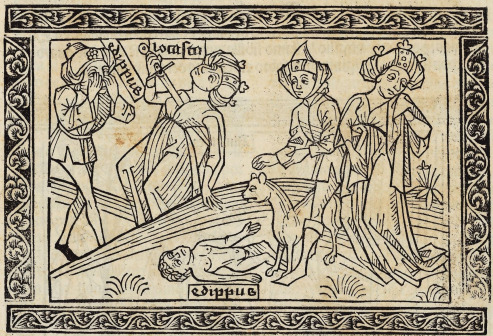
Queen Jocasta of Thebes is depicted on the right side of the engraving rubbing the tears away from her eyes with a shawl. She is crying because her husband exposed their child into the wilderness due to a prophecy which foretold the baby would grow up to kill his father and marry his mother. Her child, Oedipus, is depicted lying on the ground after being exposed. There is a shepherd approaching the baby as he takes him in and raises him as his own. Oedipus’ name is engraved beside his arm. Oedipus ends up fulfilling the prophecy by killing his father later in life, and marrying his mother, Jocasta. When Jocasta and Oedipus find out they are mother and son, Oedipus gouges out his eyes and Jocasta kills herself. This scene is depicted on the left side of the engraving with Jocasta and Oedipus’ names engraved above their heads to identify them.
This image depicts a group of female immortals from Luggnag. Gulliver describes the women as looking more horrifying than did the male immortals. Gulliver says it was easy to pick out the oldest immortal of the group, as they became ghastlier as the years went on. Like their male counterparts, the female immortals act like mortals until about the age of thirty, and then become very melancholy until about eighty years old. At this time, they recon themselves with the reality of never dying. The diplomat also says that the immortals often become opinionative, peevish, morose, vain, covetous, talkative, and incapable of friendship. Furthermore, they lose all ability for affection, even for their descendants. Their primary characteristics become impotent desires and envy. They cannot experience pleasure, and when they attend a funeral, they find themselves envious of others who could die. Their memories also begin to fade. In this image we see a group of these immortal men looking angry and discontent. They are identified by the large spot on their forehead above their left eyebrow. The same image appears in the 1839 Krabbe edition.


![[The Cid in battle with his army]](https://collections.cemvc.ca/files/large/8f8e57326ef7d6296e91b64f893779bcfee57ac8.jpg)

![[Act IV – Celestina Talks to Melibea While Another Female Figure (Either Alisa or Lucrecia) Faces Away]](https://collections.cemvc.ca/files/large/b2e323dcf370742d445055a16a1fede6a839d339.jpg)
![[Indigenous Brazilians cook and eat a meal]](https://collections.cemvc.ca/files/large/69c778d62f93da6761ff38816e760042e4f5bddf.jpg)
![[Map of Balnibarbi and Laputa]](https://collections.cemvc.ca/files/large/a0c3f0c7d77c3858c545173eccbfca287ee56563.jpg)


![[Lilliputian army marches while Gulliver stands as a triumphal arch]](https://collections.cemvc.ca/files/large/4a2ded27a968d4d991226e39738d0c923c128db8.jpg)

![[Act XI – Celestina Delivers Good News to Calisto While Sempronio and Pármeno Voice Their Suspicions of Melibea]](https://collections.cemvc.ca/files/large/8818d82bb5b8f1a652036a208abd3677c558936e.jpg)

![[Fashions of the Time]](https://collections.cemvc.ca/files/large/97819f1f1c3503770e7cc7f6a6c65eb8abb50379.jpg)
![[a group of female immortals from Luggnag]](https://collections.cemvc.ca/files/large/d3faed51f4aa59e91632959f043fa0960d0b8d08.jpg)