There are two men talking and pointing at another man who is holding a long stick. There are two sheep in the back right corner who have their backs turned. There is a wolf biting a sheep at its neck. There is a sheep walking away to the right.
A soldier with a thick moustache stands with one foot out and his sword pointed to the ground. Another soldier is next to him, facing away. In the background, a row of guards can be seen. In the top right corner of the image is the letter T, from “The”.
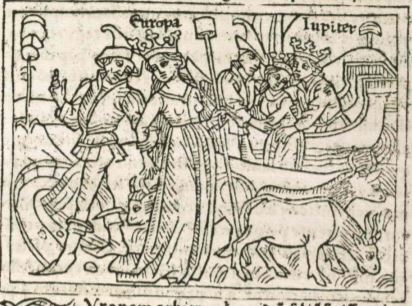
This engraving illustrates the beautiful Europa being kidnapped by Jupiter. Europa is depicted in the foreground of the engraving with a crown on her head and a long staff in her left hand. The creator engraved her name above her head in order to be identified. Boccaccio explains that Europa was following her father's heard of cattle to the shores of Phoenicia because a panderer had convinced her to do so. The panderer is depicted with his arm linked around Europa’s right arm, and him guiding her. The cattle are clustered around Europa’s feet. The background of the engraving depicts the kidnapping. The panderer lead Europa to a ship which carried the god Jupiter. Jupiter’s name is engraved above his head. Jupiter’s arms are depicted around the waist of Europa as he is lifting her onto the ship to take her to Crete.
Christopher Columbus and his companions are shown approaching an island by boat (one of the islands he came across on his first voyage to the West Indies). On the shore stands a group of Indigenous people. Several members of the group hold long staffs, and most appear to be nude except for a belt of leaves around their waists. Two structures stand on the shore, both rectangular in shape and composed of a thatched roof supported by four long poles.
This image depicts Celestina standing outside wearing a robe and a veil, with what appears to be a rosary hanging from her waist. The entire panel is identical to the panels found on pages 70, 114, 146, 208, and 225 of the text.
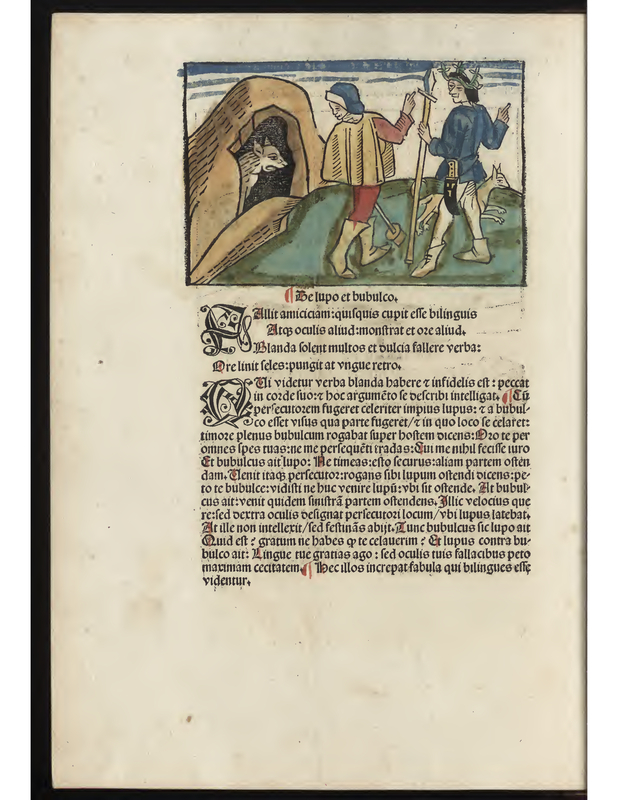
To the left of the image there is a wolf peeking out of a cave. To the right of the image there are two men, one holding a spear. Both men are looking at the wolf in the cave. There is a small ox with the men.
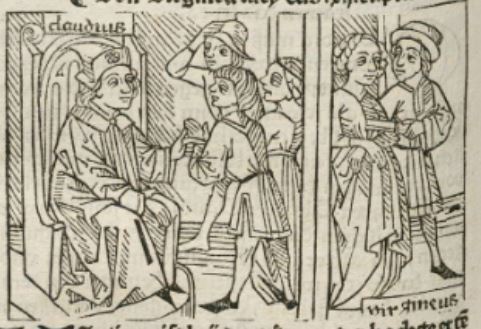
This engraving depicts the tragic fate of a young virgin woman from Rome named Verginia. Boccaccio explains that one of the decemvirs, Appius Claudius, fell madly in love with Verginia. Despite already being betrothed to another man, Claudius devised a plan to have Verginia as his own. Claudius had gotten one of his freedmen (Marcus Claudius) to capture Verginia and claim her as a slave. Verginia’s father, Verginius, went to the trial and protested the sentence of his daughter becoming a slave. Appius Claudius, however, was the judge presiding over the case, and officially decreed Verginia to be a slave. This court trial is depicted on the left side of the engraving, with Claudius sitting on the chair pointing towards Verginia, Verginius, and Verginia’s betrothed, Icilius. Claudius’ name is engraved above his head in order to identify him. After Claudius decrees Verginia to be enslaved, her father takes a knife and stabs her with it as his only way to save her. This is depicted on the right side of the engraving, which illustrates Verginius (his name is engraved below) piercing his daughter’s chest.
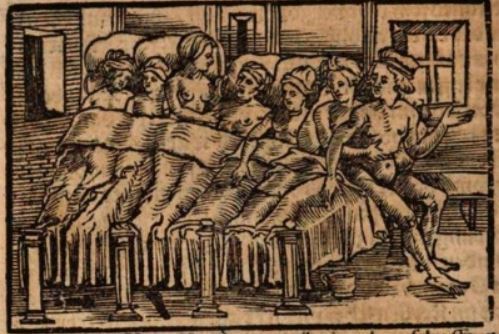
Hypermnestra and her husband, Linus (also known as Lynceus), are illustrated on the edge of the bed on the right side of the engraving. Hypermnestra is depicted with her arm warpped around Linus’ chest. Boccaccio explains that a prophecy told Hypermnestra’s father one of his nephews would kill him. To avoid the prophecy from happening, he married all his daughters to his nephews and instructed them to kill their new grooms. Hypermnestra, however, fell in love with her cousin Linus. Hypermnestra instructs him to leave to avoid her father and sisters from killing him. One of her sisters is depicted lying in the bed behind her, already having killed her husband, along with the other husbands that have been murdered. Boccaccio believes that Hypermnestra is praiseworthy for her devotion to her husband.
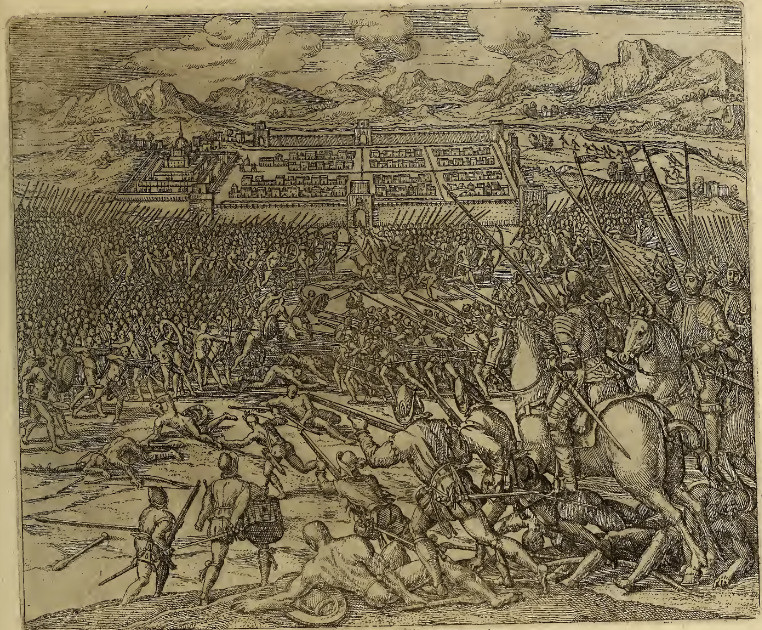
The Incas raised an army to fight the Spanish who occupied Cuzco after the execution of Atahualpa, but they were not successful in retaking the city. Here, the Spanish and the Incan army engage in battle outside the walls of Cuzco. The Incas, massed to the left, fight with bows, spears and shields. The Spaniards, some of whom ride horseback, are armed with muskets, spears and swords, and wear armor. Several Inca men have fallen to the ground as their army is pushed back by the Spanish.
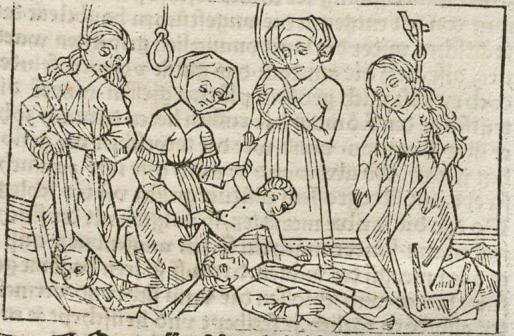
This engraving depicts the wives of the Cimbrians (a northern tribe) killing their children and hanging themselves. After their husbands were defeated in war against the Romans, the wives pleaded to their enemies for mercy and to let them become vestal virgins. When the Romans denied their request, they decided to kill their own children and hang themselves to save their virtue and to not die at the hands of their enemies. Some women in the image are depicted with the nooses around their necks, and one woman is depicted killing her child before killing herself.
Five men gather around a table. Two men seem to be calmy talking while the three others are arguing. Some of the men are holding large sticks. One man is holding onto another, with his stick in the air about to hit him. The third man is trying to keep the two apart with his stick in between them.
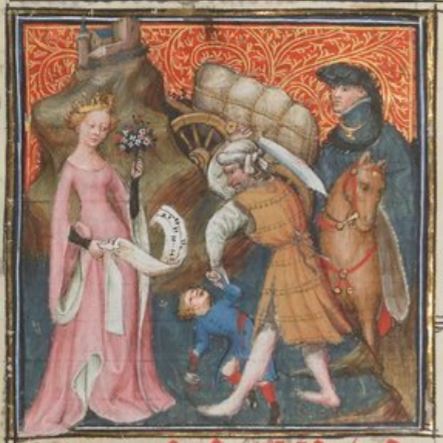
This illumination depicts Medea on the left side of the image wearing a pink dress and holding a bouquet of flowers or herbs. She was renowned for her skills in magic and potion making. She had fallen in love with the Trojan hero Jason, and she betrayed her family to help him achieve his endeavours. She took her father’s treasure and fled with Jason, and to delay her father from going after them, she dismembered her young brother and scattered his remains for her father to find. Medea is illustrated looking down at her young brother while he is being held down by a man with a sword who is about to dismember him. Jason is illustrated sitting on a horse on the right side of the image. The city of Colchis is depicted on a hill in the background of the illustration.
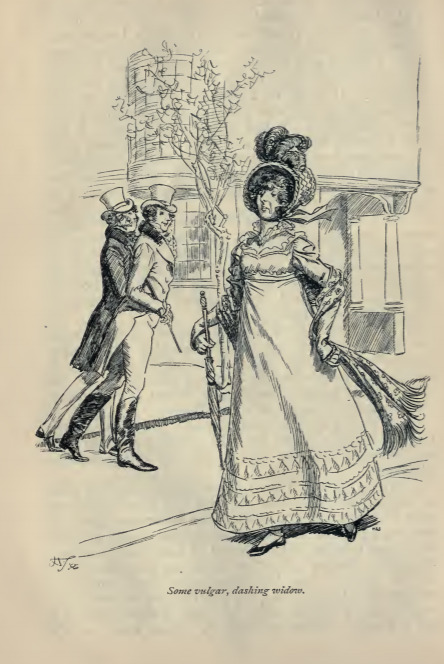
In this image we see a friend of Mrs. Elton walking through the streets of Bath. Mrs. Elton suggested that Emma and Mr. Woodhouse go to Bath on account of Mr. Woodhouse’s ill health. Mrs. Elton said she could introduce Emma to her friends in Bath, whom Emma could only assume were vulgar people. Emma had a poor opinion of Mrs. Elton, believing her to be vulgar and self-important. Emma turned down Mrs. Elton’s offer, not wanting to be associated with her. This scene occurs in chapter 32. The characters are shown in the traditional regency style. Mrs. Elton’s friend wears the regency style dress with an empire waist. She has a bonnet and has a scarf wrapped around her shoulders. The regency period dated to the early nineteenth century (1811-1820) when George, Prince of Wales, later George IV (r. 1820-1830), reigned as regent for his mentally ill father, King George III (r. 1760-1820). The regency period is associated with the rise of neoclassicism in art and fashion.
After Areusa gets information from Sosia about the encounters between Calisto and Melibea, she and Elicia pay Centurio a visit. He acts arrogantly at first, but Areusa pretends that she is still upset with him, causing him to become submissive. She then asks him to avenge the deaths of Pármeno, Sempronio, and Celestina by murdering Calisto. He agrees, but he immediately tries to find some way of escaping his duty. He decides to send Thraso and his companions to fulfill this promise.
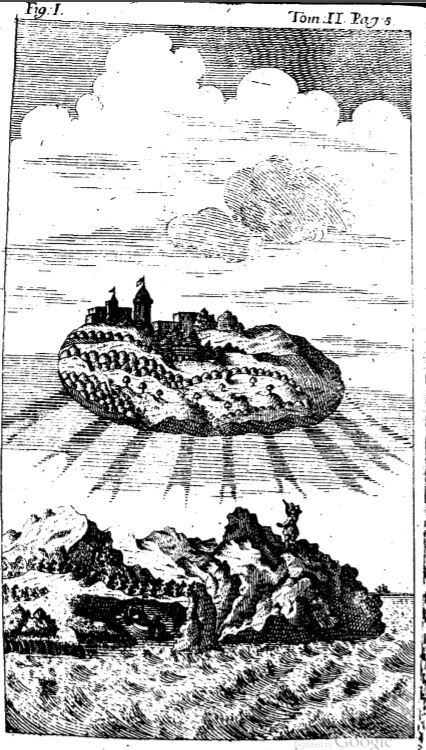
This image depicts the fictional lands of Laputa and Balnibarbi. In the foreground is the water and Balnibarbi on which Gulliver stands, looking through his telescope at the floating island of Laputa. On the island is a castle with rows of trees in front. This image is the same as that in the 1727 German von Wiering edition.
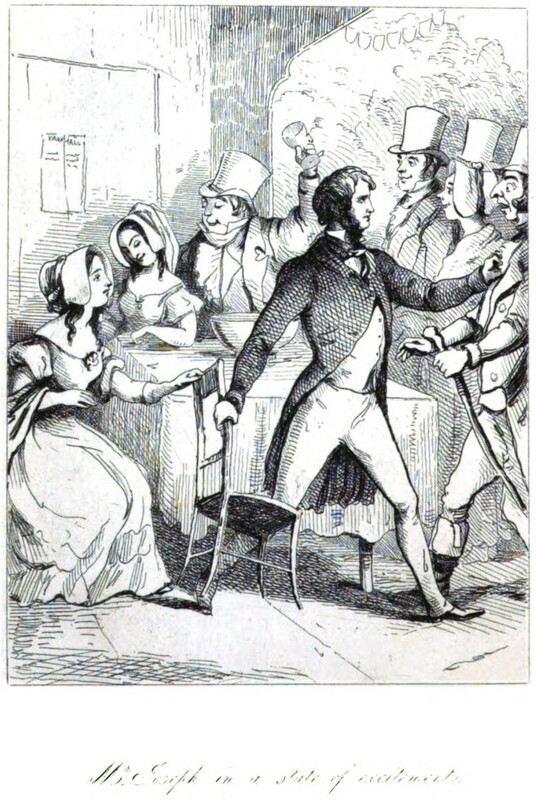
In the center of the image is Joseph Sedley, waving around his cup and singing. On the table before him is a bowl of alcohol which he has drunk all by himself. Amelia Sedley and Rebecca Sharp are seated at the table to the left of the image, with Rebecca gazing down at Amelia, who looks concerned. To the right is George Osborne, holding onto his chair and facing a crowd of onlookers, the nearest of which he is blocking from coming closer. Below the illustration is printed in cursive its title, “Mr. Joseph in a state of excitement”.
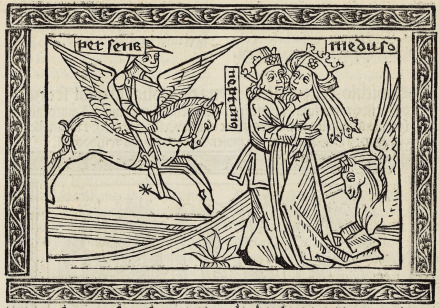
Medusa is illustrated on the right side of the engraving embracing the god Neptune. The creator engraved Medusa and Neptune’s names beside their bodies to identify them. Medusa is depicted in her human form in this engraving before Minerva transformed her into a monster. Boccaccio explains that Minerva transforms Medusa into a monster because she was angry that she had sexual relations with Neptune inside one of her temples. Boccaccio also explains that Medusa ends up giving birth to a Pegasus, which is engraved just behind Medusa on the right-hand side of the engraving. The hero Perseus is depicted riding his Pegasus on the left side of the engraving as he is on his way to conquer Medusa’s kingdom. Perseus’ name is engraved to the right of his helmet.
Here we see the seal of the King of Luggnag. The seal shows the king helping a lame beggar to stand up. The beggar is lying on the ground holding a cane. A dish is on the ground in front of him. The King stands in front of the beggar, extending his arm to help the beggar. Along the bottom of the seal is the phrase “Lugg. Rex.”, meaning King of Luggnag. The seal would be used when sending official letters. The seal appears when Gulliver presents a letter with this seal to a customs official in Japan, asking the Japanese to grant Gulliver passage to Europe. The same image appears in the 1839 Krabbe edition.
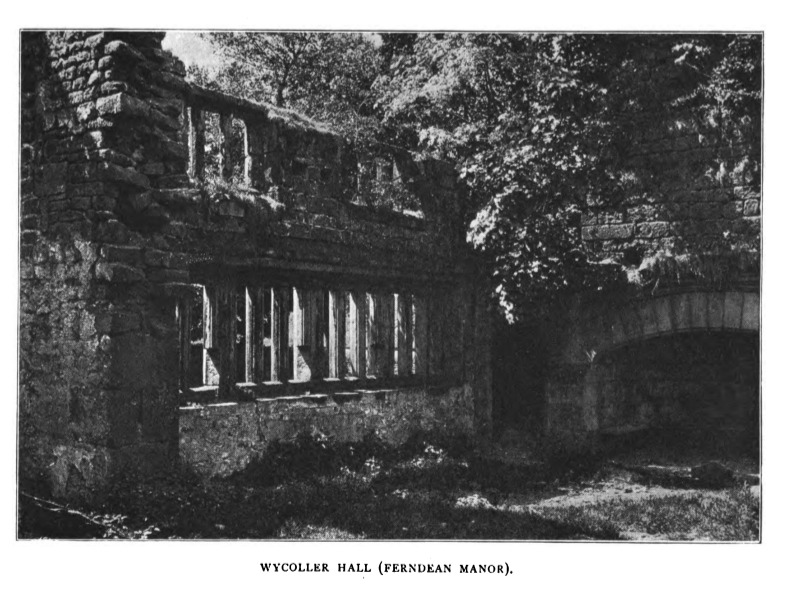
Here we see the Wycoller Hall, a manor house in the village of Wycoller in Lancashire. After hearing Mr. Rochester’s voice calling to her while at Moor House, Jane decided she had to return to Thornfield to see him. When she arrived, she found that Thornfield had been burnt down, and Mr. Rochester had moved to Ferndean Manor. Jane then married Mr. Rochester and moved into Ferndean Manor. The same image appears in the 1899 Harper edition of Jane Eyre.
In this image we see the Lilliputian Secretary standing in Gulliver’s hand. The Secretary came to speak to Gulliver to ask him to participate in the war between Lilliput and Blefuscu. Gulliver lifts the Secretary on his hand so the two can speak more easily. Gulliver then agrees to participate in the war. The same image appears in the 1839 Krabbe edition.
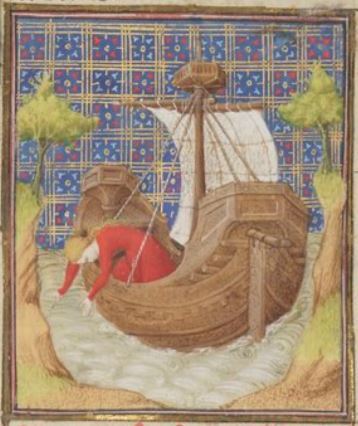
A Greek woman named Hippo is depicted on the ship in the centre of the image as she plunges herself headfirst into the ocean. Hippo had been captured by enemies, and when she heard the men discussing a plan to defile her chastity, she decided that an early death was far better than having her honour destroyed. She drowned and successfully saved her honour.
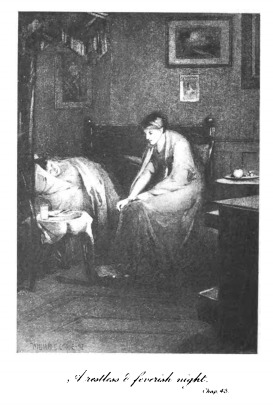
Here we see Marianne lying ill in bed at Cleveland estate as Elinor sits by her bedside. Elinor and Marianne left London with Mrs. Jennings to go to Cleveland, the estate belonging to Mrs. Jennings' daughter and son-in-law, the Palmers. Marianne spent most of her time going for walks, and one day she was caught in a storm and got her feet wet. This resulted in her becoming quite ill, developing an infection. She spent several days sick in bed, culminating in a night where she was overcome with a terrible fever. Elinor was very concerned and sent Colonel Brandon to fetch her mother from the cottage near Barton Park. Marianne was given medicine by the apothecary in town and her fever broke and she recovered quickly. This scene occurs in chapter 42 as noted underneath the title of this image. The characters are shown in the traditional regency style, with Elinor wearing the regency style dress with an empire waist. Her hair is worn tied up, as was tradition for women after their “coming out” before the queen, signaling her entrance into society. The regency period dated to the early nineteenth century (1811-1820) when George, Prince of Wales, later George IV (r. 1820-1830), reigned as regent for his mentally ill father, King George III (r. 1760-1820). The regency period is associated with the rise of neoclassicism in art and fashion. The same image appears as an insert between pages 140 and 141 for the Dent 1893, 1894, 1895, 1896, and 1897 editions of Sense and Sensibility.

![[Wolf Bites Sheep V2]](https://collections.cemvc.ca/files/large/6d7911ec2f014abbda106a94a16afaac12c66c16.jpg)
![[Vanity Fair Vol. II Chapter XXVIII Inhabited Initial]](https://collections.cemvc.ca/files/large/f1a525e474d631fe6c035c5e4a7fa3b4dbd94a11.jpg)
![[Christopher Columbus approaching an island in the West Indies while Indigenous people stand on the shore]](https://collections.cemvc.ca/files/large/fd4ba16ed0e79cf011ad9884189aefd0aa17a22b.jpg)
![[Title Page - Celestina]](https://collections.cemvc.ca/files/large/748f2f6843f182af288934541a90855b5dc13a7b.jpg)

![[Men fight at table]](https://collections.cemvc.ca/files/large/aa38e015b5dfe15ec007d24b77d8bb0efc67d1f9.jpg)
![[Act XVIII – Elicia and Areusa Talking to Centurio]](https://collections.cemvc.ca/files/large/43b51bce802871dd1b6940491e0ed5332cf30a3a.jpg)
![[the royal seal of the King of Luggnag]](https://collections.cemvc.ca/files/large/8eb055bfd37f525d2ea473673b47f47962c28b0f.jpg)
![[A Lilliputian secretary stands on Gulliver’s hand]](https://collections.cemvc.ca/files/large/3c9b78c88d6c4e4167ebb9731f6deae82d79c223.jpg)