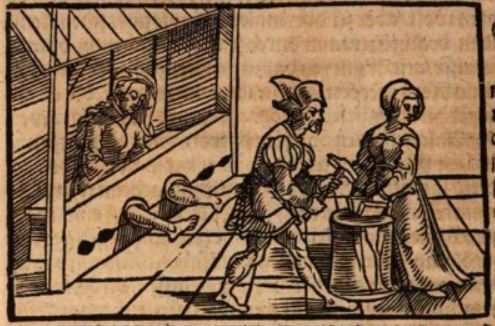
This engraving depicts the freedwoman, Epicharis, being tortured for information regarding a conspiracy to kill Emperor Nero. Epicharis is depicted on the right side of the engraving with her hands inside some form of torturing device while a man with a hammer tortures her. Epicharis is also depicted on the left side of the image with her feet restrained in a stock. Epicharis heard the details of the conspiracy to assassinate Emperor Nero, and when she put her faith in the wrong person, they told Emperor Nero that she was involved in the plan. They tortured her many times; however, she did not reveal the names of anyone involved in the conspiracy. She ended up killing herself to avoid revealing the details to the emperor.
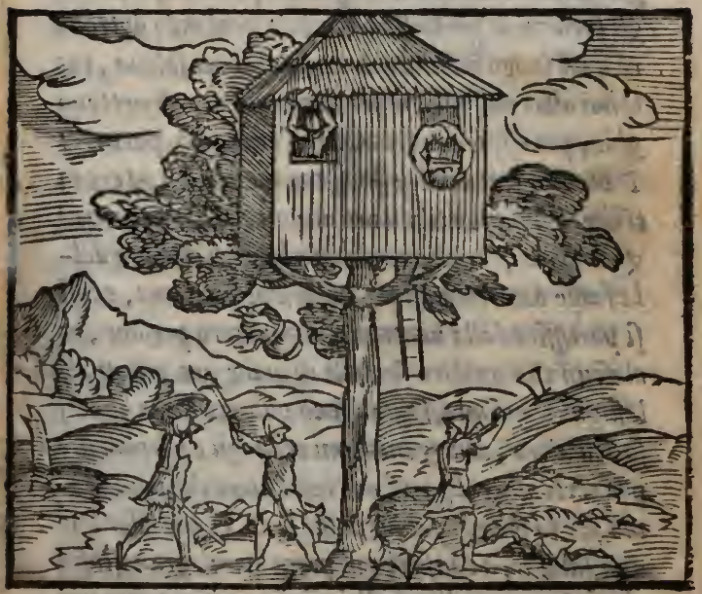
A wooden treehouse with a thatched roof built by Indigenous people sits high in a tree. Two Spanish colonists use axes to chop down the tree while another watches from the side with a shield held over his head. In the treehouse, two Indigenous inhabitants drop rocks and pots of boiling water onto the Spaniards and at least one has found their mark - a Spanish man lays immobile on the ground to the right.
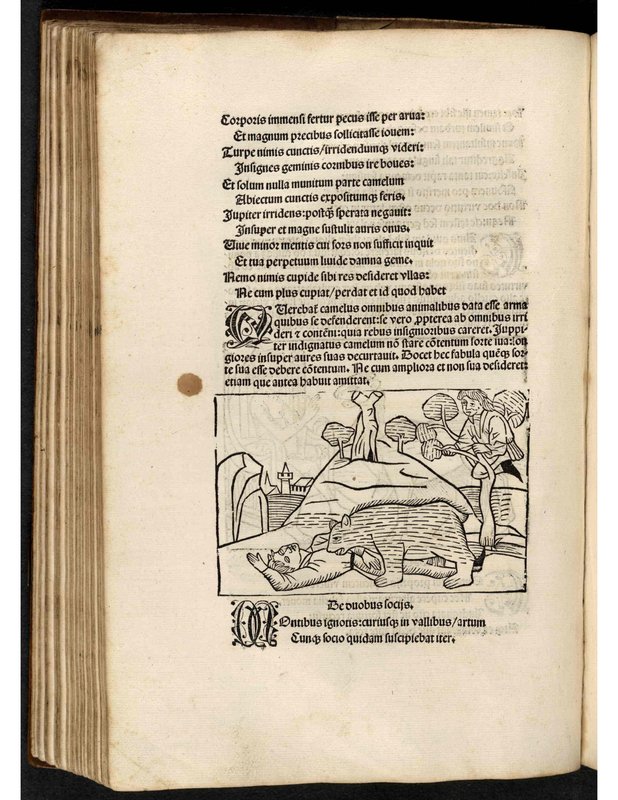
There is a man on a tree watching another man on the ground encountering a bear. There is a castle on the left side of the image, and three trees on a hill, once of which has no leaves or branches.
An Indigenous man is in the process of chopping down a palm tree with a hatchet. Another man sits nearby sharpening a stick for an arrow or spear with a knife. A woman also sits nearby with a child on her lap. There is a single structure in the background. This image is identical to one found in Paris, 1557.
Rebecca Crawley stands at her dressing-table with her hair loose, waving a piece of paper in the air. Next to her, Rawdon Crawley stands looking puzzled, still holding the tray with the pitcher of chocolate and cup that he brought her for breakfast along with the letter. The letter is from his brother, now Sir Pitt Crawley after their father’s death, inviting them to the funeral at the estate.
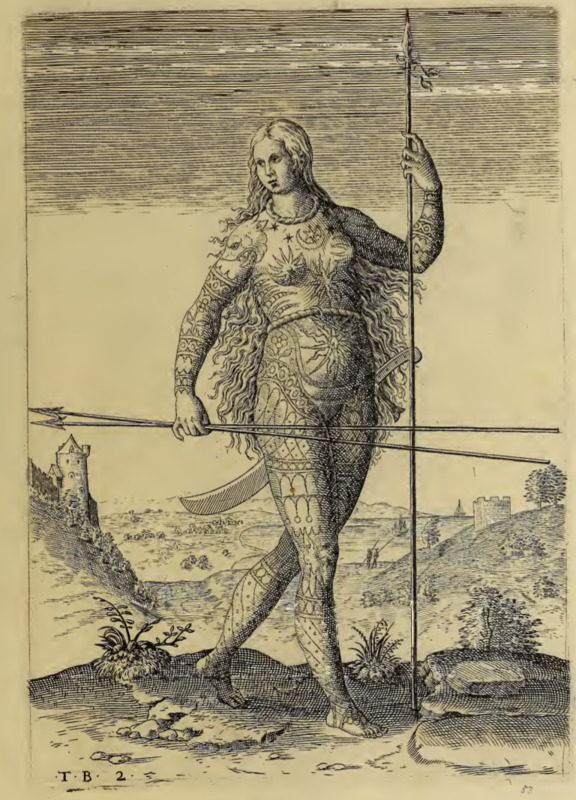
An Indigenous woman is shown from the front. She carries a spear in her left hand and two in her right. Her hair is long, she wears a twisted cord around her neck, and a sword with a curved blade hangs from another cord around her waist. She is nude, and her body is covered in painted designs. The Picts were an Indigenous group who lived in Britain long before the author’s time. Images of Picts were included in this book so that readers could compare their customs to those of the Indigenous people living in Virginia.
In this image there are three women, Jimena and her two younger daughters Elvira and Sol. Jimena is the oldest one sitting at the windowsill with a younger girl on her knees. She is wearing a dress and a bonnet covering her head. Her hair seems to be in braids. The daughter on her knees is wearing a dress and in her hair she has a band of flowers. The older daughter is standing behind her mother wearing a dress. A hairpin holds up her hair. The building they are in is made of stone and the chair Jimena is sitting on has the statue of a dog on it.
While Pármeno accompanies Celestina (central figure) home, Celestina persuades him to help her scam Calisto. In exchange for his loyalty, he asks for Celestina’s prostitute Areusa, whom he loves. Celestina agrees, and they go to Areusa’s house. Celestina tells Pármeno to wait at the bottom of the stairs while she goes to Areusa’s bedroom (we see him waiting in the doorway to the left). Celestina tries to convince Areusa to give Pármeno a chance (foreground), but she eventually calls him to Areusa’s room without agreement from Areusa. Celestina returns home while Pármeno spends the night with Areusa.
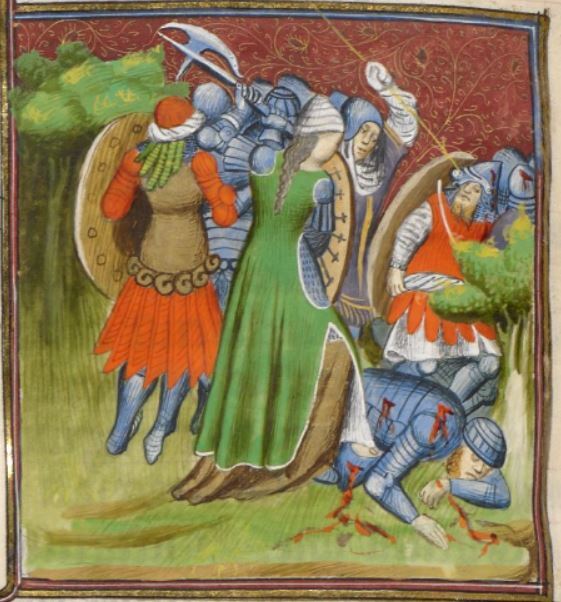
This illumination depicts a woman named Triaria wearing armour and holding an axe above her head. There are other soldiers standing with Triaria as they kill the people lying on the ground. Triaria is renowned for her military skills and devotion to her husband, Lucius Vitellius. She is depicted wearing a helmet and holding an axe in this image to demonstrate her fighting capabilities. Boccaccio explains that Triaria followed her husband into an enemy city and she fought violently and killed many citizens in order to magnify her husband’s glory.
In this image we see the Lilliputian Secretary standing in Gulliver’s hand. The Secretary came to speak to Gulliver to ask him to participate in the war between Lilliput and Blefuscu. Gulliver lifts the Secretary on his hand so the two can speak more easily. Gulliver then agrees to participate in the war. The same image appears in the 1843 Krabbe edition.
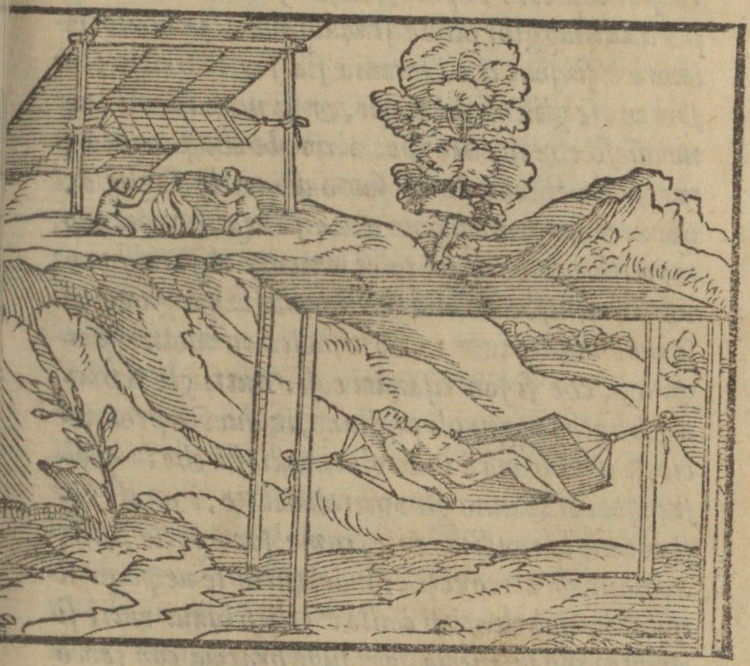
In the foreground, an Indigenous person lays on a hammock that has been strung up under a shelter. The shelter is simple, composed of four poles and a flat roof, with the hammock strung between two of the poles. In the background, two Indigenous people sit beside a fire. There is a second hammock, also strung between the two poles of a shelter, however this shelter is slanted, with on end resting on the ground and the other atop the poles. This image is identical to one found on page 8 of Venice, 1565.
George Osborne is leaning against a table with one hand at his waist and the other at his chin. He is looking at himself in a large standing mirror, and both he and his reflection have a slight smile. In the top right of the image, overlapping the mirror, is the letter I.
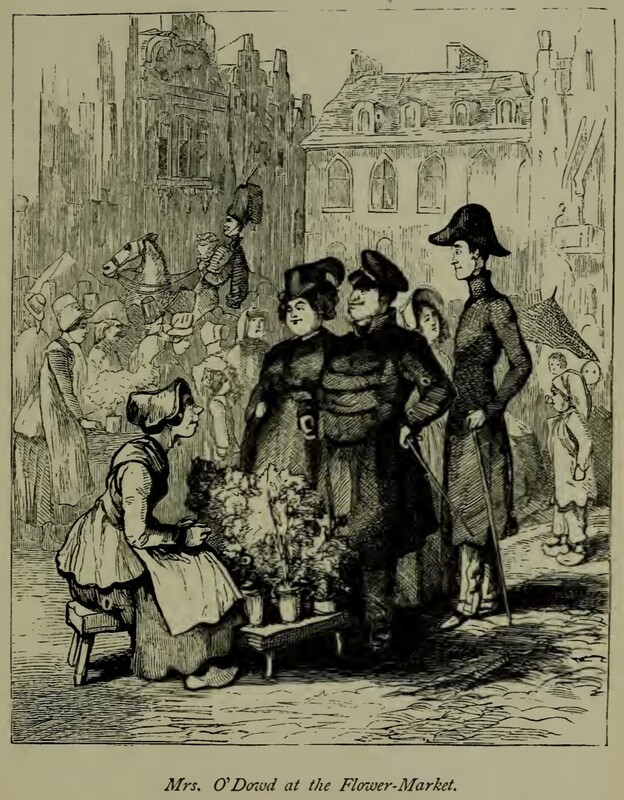
Peggy O’Dowd, in a feathered hat, stands in front of a flower seller at the market in Brussels. She is holding onto the arm of her husband, Major Mick O’Dowd, who has on a cap and is wearing his sword at his hip. Behind the pair are William Dobbin, also with his sword, and Amelia Osborne, who is in a bonnet and looking up at Dobbin. The flower seller is in a bonnet and clogs, seated on a low stool behind the table which holds her rows of potted plants. In the background of the image are the crowds of shoppers, another flower seller standing at her table of plants, a mounted officer holding a bouquet, and the tall, ornate buildings that surround the market square. Below the illustration is printed its title, “Mrs. O’Dowd at the Flower-Market.”
There are two women in this image, Jimena daughter of the count Lozano and Bibiana a servant in the household. The one standing is Jimena and the one sitting down is Bibiana. Jimena is wearing her hair in two braids, she is wearing a dress covered by a cloak. At her waist there is a belt with fabric hanging from it. Bibiana sitting on the stool is wearing a white dress with her head covered. Next to her stool there is a basket of fruits or vegetables. Both of the women are next to a stove with a shelf on top. The shelf has three vases.
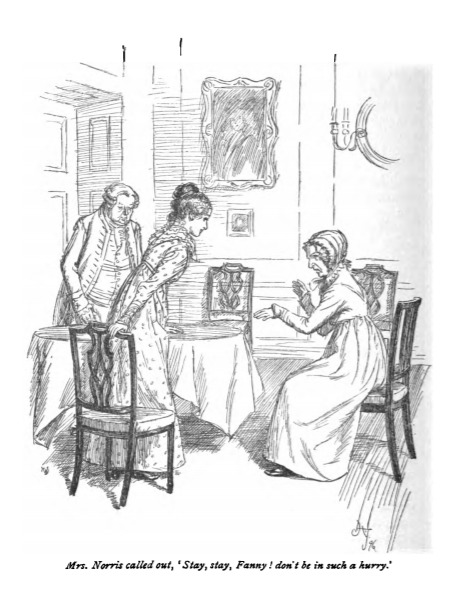
Here we see Fanny and her Aunt Norris in the breakfast room at Mansfield Park. The butler came in saying that Sir Thomas wanted to see her in his office. Mrs. Norris told Fanny to sit down, sure that the butler was mistaken, and that Sir Thomas wanted to see her, not Fanny. The Butler confirmed that Sir Thomas wanted to see Fanny. Mr. Crawford was in Sir Thomas’ office and the two were left alone while Mr. Crawford proposed again, and Fanny once again turned him down. Mr. Crawford said that he would continue to try and convince her of his love, and then left for London. This scene occurs in chapter 32. The characters are shown in the traditional regency style. Fanny and Mrs. Norris wear regency style dresses with empire waists. Mrs. Norris wears a mop cap to cover her head. The butler wears a tailcoat and tailcoat with breeches. The regency period dated to the early nineteenth century (1811-1820) when George, Prince of Wales, later George IV (r. 1820-1830), reigned as regent for his mentally ill father, King George III (r. 1760-1820). The regency period is associated with the rise of neoclassicism in art and fashion.
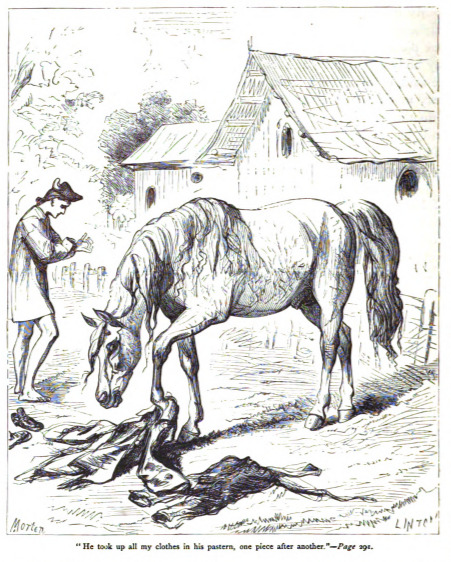
One reason the Houyhnhnms thought Gulliver was different from the Yahoos was because of his clothes. They thought they were a kind of skin. One morning Gulliver’s master discovered that Gulliver did not sleep in his clothes and became suspicious. He examined all of Gulliver’s clothes and ultimately agreed to keep it a secret.
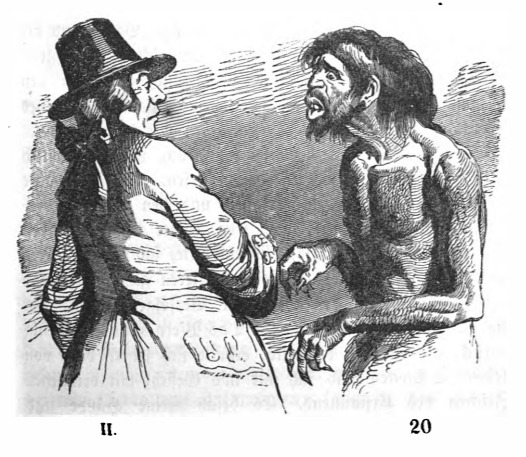
The yahoos are a form of human who live in the Country of the Houyhnhnms. Gulliver looks down on the yahoos, thinking of them as a form of inferior human, which is reflected in this image. The yahoo has long hair and a beard, has long fingernails, and does not wear clothes. The same image appears in the 1839 Krabbe edition.


![[An Indigenous Brazilian man chops down a tree]](https://collections.cemvc.ca/files/large/9e66a77c5739df84dd16d08d1a43a1b328125e70.jpg)
![[A Letter from Queen’s Crawley]](https://collections.cemvc.ca/files/large/ec771f84c4268cd53834d18638b84c6fba9d4149.jpg)
![[Jimena sitting by a window with her two daughters]](https://collections.cemvc.ca/files/large/ee35a3a47a20a56bbddb6fcfd8b44206e5f41dd0.jpg)
![[Act VII – Celestina Talking with Areusa While Pármeno Waits by the Stairs]](https://collections.cemvc.ca/files/large/4001adc571388380472ebebd7b01dcfe1daa3393.jpg)
![[The Lilliputian Secretary of the Emperor’s private affairs stands in Gulliver’s hand]](https://collections.cemvc.ca/files/large/d9e2616ee4ef9e93f21c8f028de7f750b6fe36bb.jpg)
![[Vanity Fair Vol. I Chapter XIII Historiated Initial]](https://collections.cemvc.ca/files/large/171780bc3bd65361c14483eeeba9a4bc1ba77989.jpg)

![[Bibiana talking with Jimena]](https://collections.cemvc.ca/files/large/616b73d8d51162925663dcf8cca7af7fc1e97231.jpg)