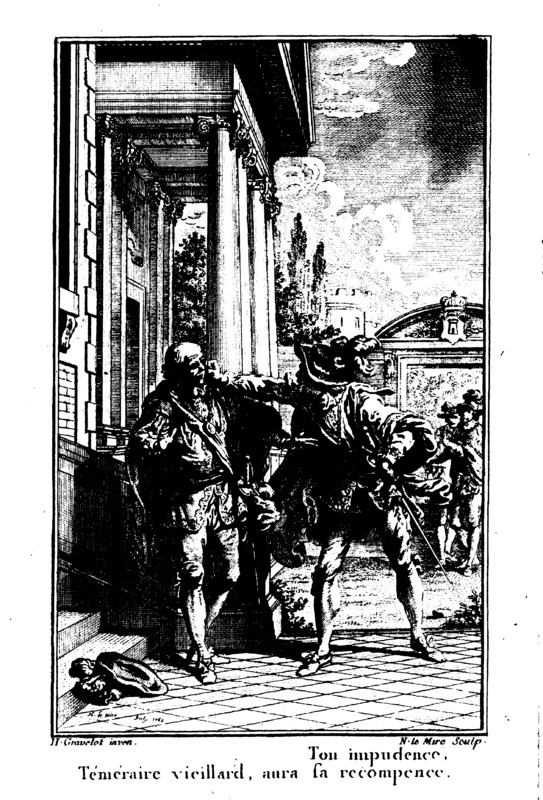
Count Don Gomes confronts Don Diègue (Diego) over a perceived slight. Diègue has been chosen by the king to tutor his son, but Gomes believes that he was more deserving of the job. Diègue initially tries to be friendly with Gomes, as their children wish to marry each other, but after Gomes refuses to back down Diègue tells Gomes that since he did not win the position, he clearly did not deserve it. Gomes responds to this with the quote used as the title of the image and slaps Diègue. This confrontation ultimately leads to Diègue’s son Rodrigue (Rodrigo) taking revenge on Gomes and killing him in a duel.
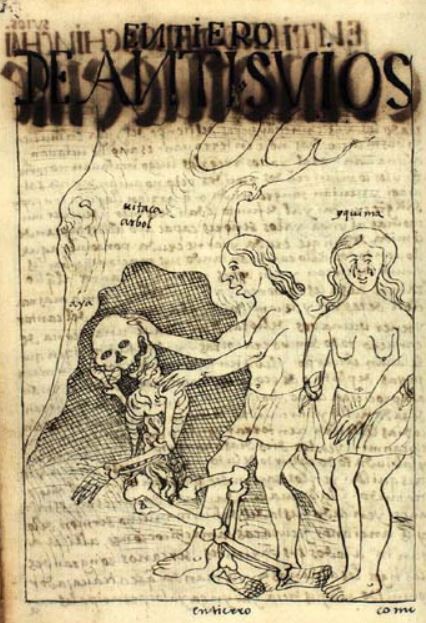
This image depicts the burial traditions of the people in the Antisuyo region of the Inca Empire. The author explains that this group of people were cannibals and when a person died, they ate their flesh to the bone. When the skeleton was exposed, they brought the skeleton to uitaca [tree] and placed the body inside without having any ceremonies to celebrate the dead. The is one figure placing the skeleton inside the tree, and a female figure on the far-right side of the image depicted crying. The skeleton is labeled as aya [deceased], and the female figure is labeled as yquima [widow]. The caption at the bottom of the image reads “enterrio” [burial].
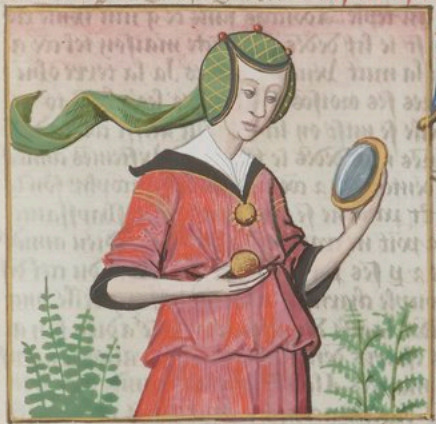
This illumination depicts a portrait of a woman named Agrippina holding a mushroom while looking at herself in what appears to be a mirror. Agrippina is famous for being the mother of Emperor Nero and being a powerful empress. She married Emperor Claudius (who was also her uncle) and is said to have killed him by poisoning mushrooms that he ate in order to make her son the emperor.
Two small children peer into the holes cut in a cabinet. Behind the cabinet stands a man in a long jacket and tall hat. Behind his head, the letter W from “Without” is formed by four sticks.
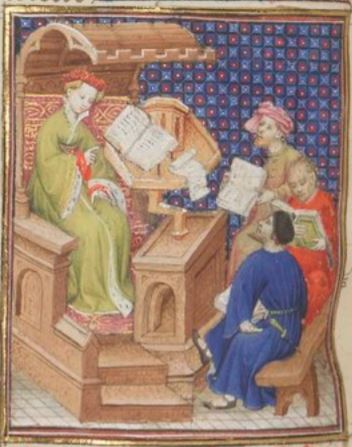
This illumination depicts the famous poetess, Sappho, sitting on the left side of the image looking at her book which is placed on the lectern in front of her. The book in front of her is assumed to be some of her own poetry. There are three men on the right side of the image who are most likely other poets. Boccaccio explains that Sappho was included among the most famous of poets.
When midnight approaches yet again, Calisto visits Melibea while Sosia and Tristan stand guard. As he and Melibea talk, he hears a scuffle in the street. Tristan informs him that it is just Thraso and his companions, and that Sosia has managed to scare them off. Regardless, Calisto climbs the high garden wall and, descending the outside ladder too quickly, falls to his death. To avoid exposing him to dishonour, Sosia and Tristan carry him away (as seen in this illustration). Meanwhile, Melibea laments the tragic loss of her lover.
This image is illustrated in a chapter that discusses the Christian priests in the colonial government in Peru. There are two parish priests depicted standing in the image while dressed in their ecclesiastic clothing. They are illustrated swaping the cards they are holding in their hands. They are swapping parish assignments to abuse and punish their native parishioners. The cards read, “tengo hecho a vuestra merced esta p[er]muta” [I have made this exchange at your mercy] and “Permuta de Uayanay y de Santiago” [the exchange of Uayanay and of Santiago].
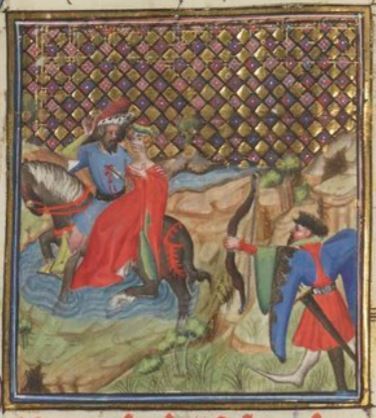
Hercules is illustrated on the right side of the image with his bow in his hand. He shot an arrow at Nessus, who is riding a horse through a river on the left side of the image. Boccaccio explains that Nessus was riding horseback, however, Nessus is known to be a centaur in Greek Mythology. Hercules was with his wife Deianira when they came across a flooded river. Nessus came along and offered to take Deianira safely across the river on his horse. Nessus betrayed Hercules’ trust and began to run away with Deianira after crossing the river. Hercules uses a poison infused arrow to shoot Nessus and rescue his wife. The arrow that Hercules shot is visibly sticking out of Nessus’ chest.
A soldier with a thick moustache stands with one foot out and his sword pointed to the ground. Another soldier is next to him, facing away. In the background, a row of guards can be seen. In the top right corner of the image is the letter T, from “The”.
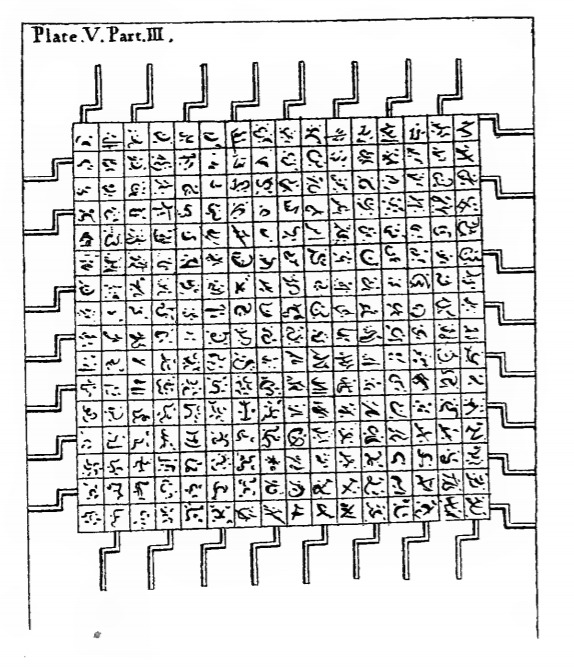
This image depicts an invention created by Laputan Projectors. The invention is to rework the Laputan language. On each of the squares is a symbol representing a phrase in the Laputan language. There are handles which would be turned to create different phrases which would then be analyzed. The same image appears in other editions of Gulliver’s Travels, including those in other languages.
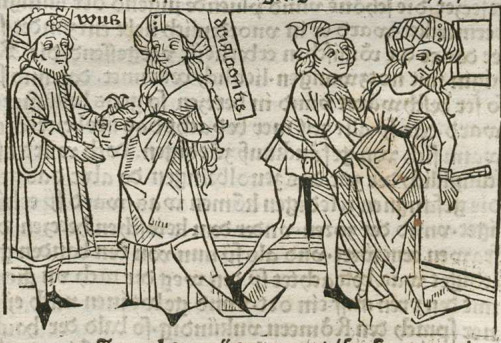
This engraving depicts the queen of the Galatians standing on the left side of the image holding a decapitated head. This woman’s name is unknown; however, she is the wife of King Drigiagon (whose name is engraved beside her head). After being taken as a captive by Roman enemies, the Galatian woman was defiled by a Roman centurion. This is depicted on the right side of the engraving as the queen is bound by a chain on her left hand while the centurion is putting his hand up her dress. She is illustrated looking away and fighting back as he forces himself onto her. To seek her vengeance, once she was freed through ransom, she ordered her servant to decapitate the man who raped her. The Galatian woman is holding the severed head as she presents it to her husband to prove that she was defiled by this man. Boccaccio explains that she wrote on this woman to highlight her daring and courageous nature.
Here we see an overturned boat that Gulliver discovered off the coast of Blefuscu. With the help of the Emperor’s largest vessel, Gulliver retrieved the boat and brought it back to land and spent several days fixing the bottom which was damaged. Gulliver then used this boat to leave Blefuscu and sailed off and was picked up by and English merchant’s ship. In the background is a lighthouse. Above the lighthouse is the letter “T”, because the first word of the chapter is “Theils”. The same image appears in the 1839 Krabbe edition.
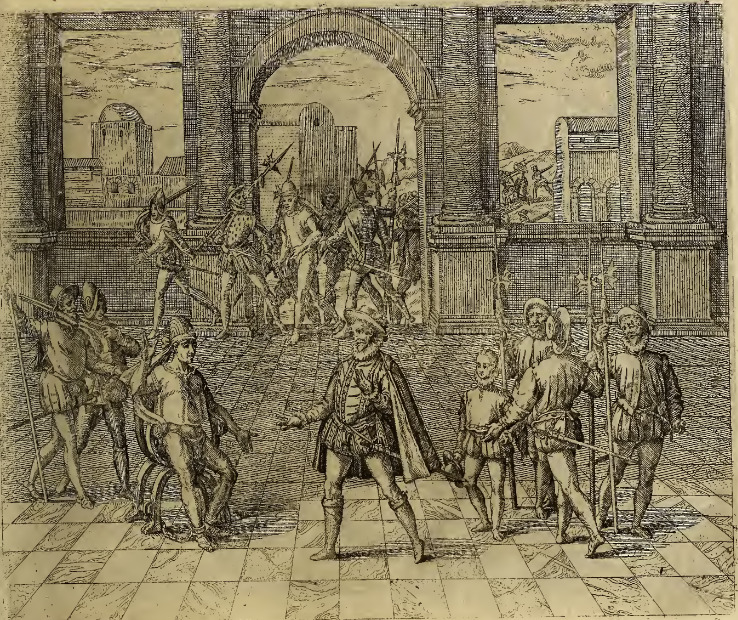
Inca Emperor Atahualpa (Atabalipa) negotiates a ransom amount with Francisco Pizarro, to secure his release from Spanish captivity. Inside a large, open room in the city Cajamarca in Peru, Atahualpa is seated on a chair with his ankles chained to the chair legs. Francisco Pizarro stands in front of him while the two negotiate. Several other Spaniards mill about the room, including a young boy. In the background, an Inca man is escorted into the building by a group of soldiers, led by a chain attached to his ankle.
As the clock approaches midnight, Calisto leaves for Melibea’s house. He is joined by Sempronio and Pármeno, who stand guard while he speaks with Melibea through the door of her house. As he is exchanging passionate words with her, Sempronio and Pármeno overhear a noise in the street and flee, leaving Calisto unguarded. When they realize that the noise is coming from the alguacil’s men (the ‘night watch’) patrolling another street, they return to their post. However, the alguacil’s men eventually enter upon Melibea’s street, forcing Calisto and his servants to flee. To the left of the image we see Calisto, with a sword mounted on his belt, climbing a ladder. Sempronio and Pármeno stand behind him with swords and shields. To the right we see Melibea and Lucrecia looking out from a window. Both of them are wearing a robe and a veil. They seem to be making eye contract with Calisto, though perspective would make this impossible.This illustration is out of place in this act. Calisto does not climb a ladder to enter Melibea’s garden until the following day, after Sempronio and Pármeno have already been executed. I suspect that the use of this illustration (in place of the more relevant 1580 Antwerp edition illustration) may be a consequence of the 1580 woodblock being misplaced or destroyed in the intervening 36 years.The entire image is identical to those found on pages 209 and 255 of the text.
A massive statue on a pedestal, with vertical, pointed ears, wearing a crown and holding a staff. The upper part of the staff forms the letter A from “And” topped with a crown. At the base of the statue there are many seated figures, and in the silhouettes of buildings are in the background.
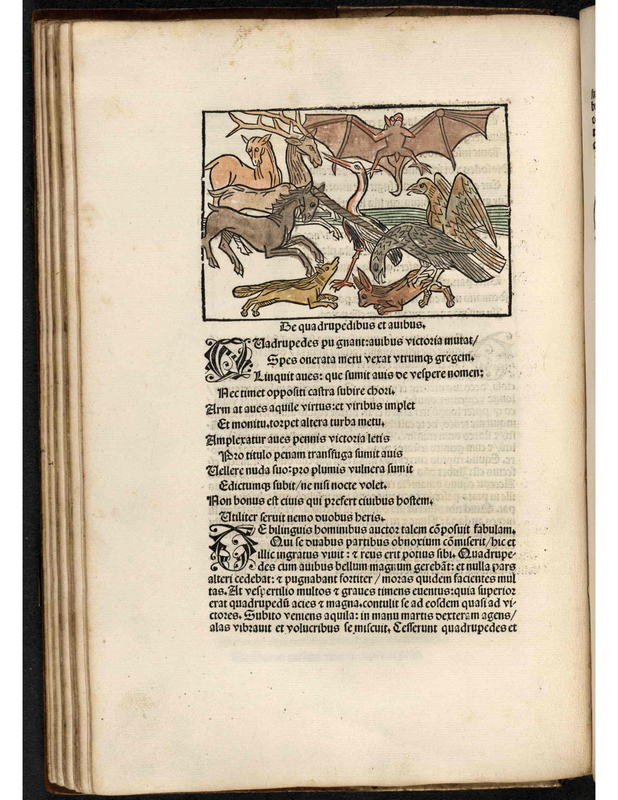
Many animals, 3 birds, 2 horses, 1 deer, a fox and a rabbit are positioned somewhat chaotically in front of a river. One of the birds is sinking its talons into the rabbit, the bat is flying.
In this image Mr. Darcy and Colonel Fitzwilliam accompany their aunt, Lady Catherine de Bourgh at the Parsonage at Hunsford. The two men who were visiting their aunt at Rosings often accompanied her on her outings, including her frequent visits to Mr. Collins, Charlotte, and Elizabeth at the Parsonage. This scene occurs in chapter 32. The characters are shown in the traditional regency style. Lady Catherine wears the regency style dress with an empire waistline. She wears a bonnet and a fur-trimmed coat. Mr. Darcy and Colonel Fitzwilliam wear waistcoats and tailcoats with breeches and top hats. All three carry walking sticks. The regency period dated to the early nineteenth century (1811-1820) when George, Prince of Wales, later George IV (r. 1820-1830), reigned as regent for his mentally ill father, King George III (r. 1760-1820). The regency period is associated with the rise of neoclassicism in art and fashion.
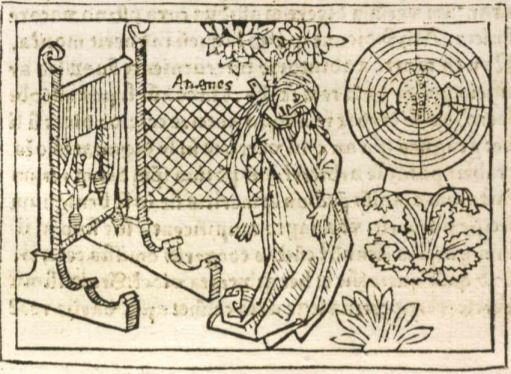
This engraving depicts Arachne killing herself by means of hanging. We know that this is Arachne as her name is engraved in Latin just beside her body. There is a loom on the left-hand side of the engraving and a net just to the right of the loom. Boccaccio explains in his story that Arachne is known by ancient writers as being the one who discovered the uses of woven wool and the first to make nets. Arachne became too confident in her wool work and challenged Minerva to a weaving competition. After the goddess had won, Arachne hung herself, as depicted in the engraving. There is a spider on a spider-web on the right-hand side of the engraving, as Arachne is said to have been transformed into a spider after this event.
The text accompanying this image describes the dog-headed people as inhabiting an island discovered by Christopher Columbus and notes how they are a fearsome people who frequently practice cannibalism and wear no garments except parrot feathers for adornment. The image depicts four dog-headed individuals. The one on the left leads an animal with a human body strapped to it. Two in the middle of the image butcher another body on a large block – limbs have been hung from a wooden frame above their heads. On the right, the fourth individual is consuming an arm.
The left panel depicts Melibea standing outside, wearing a veil and a robe. To the right we see Calisto, also outside, wearing a hat and holding a long item of some sort, perhaps a cane or walking stick.The left panel is identical to those found on pages 208 and 271, and nearly identical to those found on page 84 (where it is labeled ‘Lucrecia’), pages 173, 287, 306, and 317 (where it is labeled ‘Areusa’), and page 350 (where it is labeled ‘Alisa’). The right panel is identical to those found on pages 60, 122, 225, and 235, and nearly identical to the one found on page 317 (where it is labeled ‘Centurio’).
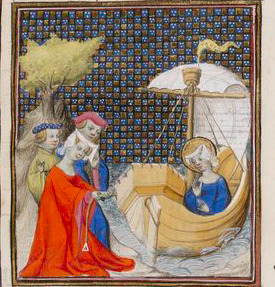
When the boat carrying the statue of Cybele got stuck in the shallow water, Claudia Quinta prayed to the goddess that if she were chaste, she should use her belt to pull the boat to shore. After praying, she ordered the other women to help her, and they successfully pulled the boat to shore. This changed everyone's opinion of Claudia Quinta, since this act displayed her remarkable chastity. Claudia Quinta is represented in the red gown, pulling the boat which is seen carrying the statue of Cybele. Beside her are two women, helping and watching as the boat comes to shore.

![[Vanity Fair Chapter XX Inhabited Initial]](https://collections.cemvc.ca/files/large/666eaea853588f86681beddc6ede3a70c19e02f9.jpg)
![[Act XIX – Sosia and Tristan Lifting Calisto After He Has Fallen to His Death]](https://collections.cemvc.ca/files/large/8ef9284db9fcacd318628c111bd06d8297d93bc5.jpg)
![Permvta de Entre P[adr]es](https://collections.cemvc.ca/files/large/eb437de7951d6dd1719bec6d3913730d9cffca68.jpg)
![[Vanity Fair Vol. I Chapter XXVIII Inhabited Initial]](https://collections.cemvc.ca/files/large/61b566fa120bc7abd068b3cefd27295bcfe3d40a.jpg)
![[Abandoned boat outside of Blefuscu]](https://collections.cemvc.ca/files/large/4fb8cf3f520eed80167afc15a11816fdd6fff920.jpg)
![[Act XII] Calisto spreect.](https://collections.cemvc.ca/files/large/f953e28d01e305e7f1b9b3f43e106db5b83b5e2e.jpg)
![[Vanity Fair Chapter X Inhabited Initial]](https://collections.cemvc.ca/files/large/c9bf3a72e484402b97b576ee407fce2ebce869ba.jpg)

![[Dog-headed cannibals on a Caribbean island]](https://collections.cemvc.ca/files/large/37623d9f11e909ddea22ea7fb757e4d87dd9bac1.jpg)
![[Act I – Melibea and Calisto]](https://collections.cemvc.ca/files/large/cb9922e57997c6d4f439c0f99898e3dd8baaa907.jpg)