This image is illustrated in a chapter that discusses the Christian priests in the colonial government in Peru. This image depicts a parish priest in colonial Peru standing in the centre of the image dressed in fine clothing. The parish priests wished to be rich lords and to be dressed in silks. The author criticizes the parish priests for this as Jesus Christ sought to teach and did not care for silks, and that the parish priests should follow in his example.
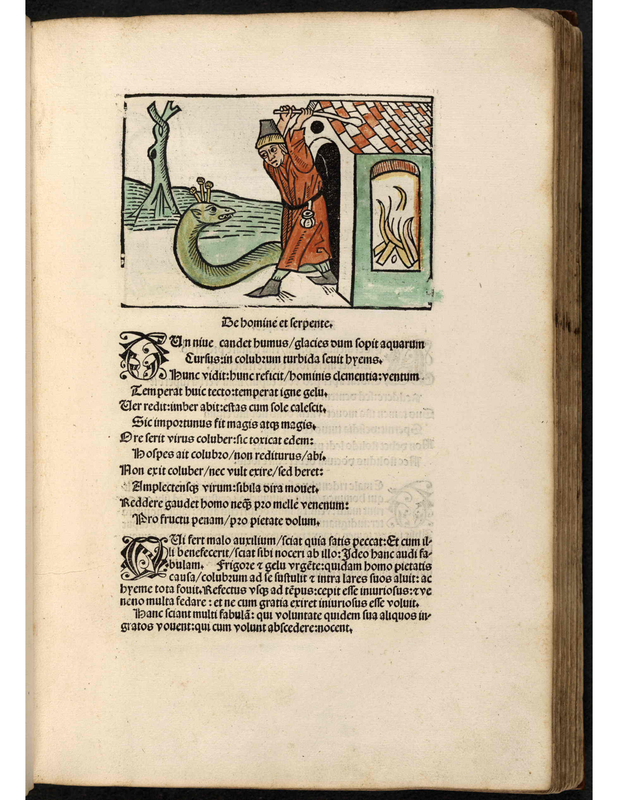
A man is walking out of his house about to strike a large serpent with a spoon. The serpent has three gold antennas on its head. Inside the house we see the man has a fire going.
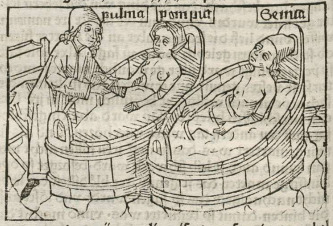
This engraving depicts Seneca and his wife Pompeia Paulina committing suicide in bathtubs. Seneca is depicted on the right side of the image, with his name, written as “Senica”, engraved above his head. Pompeia Paulina is in the tub beside him with her name engraved above her head as well. After emperor Nero found out that his tutor, Seneca, was involved in the conspiracy to assassinate him, he ordered a centurion to command Seneca to commit suicide. Not wanting to live without her husband, Pompeia Paulina got into the tub next to Seneca and slit her arm to die with him. Seneca is depicted dead in the engraving; however, a servant is illustrated saving Paulina by tying a rope around her arm to stop the flow of the blood. Emperor Nero did not want Pompeia Paulina to die as he had nothing against her, which is why the servant saved her life.
Spanish commander Hernando de Soto and Inca Emperor Atahualpa (Atabalipa) meet in Peru. Hernando de Soto is on horseback, as are a few of the Spanish soldiers who accompany him, while most of the group is on foot. The Spaniards are armed with pikes/spears, swords, and muskets. Atahualpa stands in front of de Soto’s horse. He wears a short-sleeved tunic, loincloth, and beaded necklace, and carries a scepter fashioned to look like the sun. A large group of Inca warriors stand behind him, mostly armed with spears and bows, with a few individuals carrying shields. Most of the Inca men wear loincloths, and some wear feathered headdresses.
When Celestina arrives at Melibea’s house with Lucrecia, Melibea explains the pain in her heart and asks Celestina to tell her its cause. Celestina responds that the cause is love, and that she will only be cured if she confesses her passion for Calisto. In denial, Melibea angrily rejects this suggestion, but Celestina eventually persuades her to confess her love. Celestina proposes that the two lovers meet in Melibea’s garden that night at midnight, and Melibea agrees. To the left of the illustration, we see Alisa arriving with her sister’s page/servant. She is shown in a robe and a veil, while he is wearing a hat. The two central figures represent Melibea and Lucrecia, both of whom are wearing robes and veils. The right central figure is wearing a robe that appears a bit more decorative, and she is depicted with an expression of anger, both of which hint at the likelihood that it is meant to represent Melibea. The rightmost figure is Celestina, who is shown wearing a robe and a veil.The entire image is identical to the one found on page 130 of the text, and nearly identical to the one found on page 64. The composition is also entirely distinct from any of the illustrations found in the 1580 Antwerp edition.
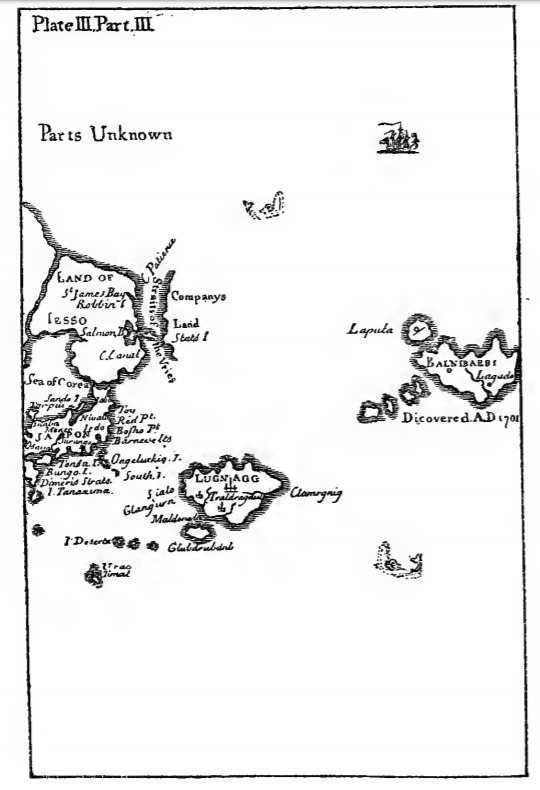
Here we see a map of the countries Gulliver visited in the third part of the book. These include Laputa, Balnibarbi, Luggnagg, Glubbdubdrib, and Japan, among others. Underneath Balnibarbi we see “Discovered AD 1701”. We also see several ships drawn on the water.
This engraving depicts the wives of the Cimbrians (a northern Germanic tribe) killing their children and hanging themselves. After their husbands were defeated in war against the Romans, the wives pleaded to their enemies for mercy and to let them become vestal virgins. When the Romans denied their request, they decided to kill their own children and hang themselves to save their virtue and to not die at the hands of their enemies. The woman on the right side of the image has already hung herself, while the women on the left side of the engraving are depicted killing their children before killing themselves.
A woman in a long gown with loose, wild hair flies through the sky, looking at the reader with bulging eyes and an open mouth. She is holding out in front of her two swords or long daggers. At the bottom right of the image is the letter W from “We”, with bright rays coming out from it as if it were the sun.
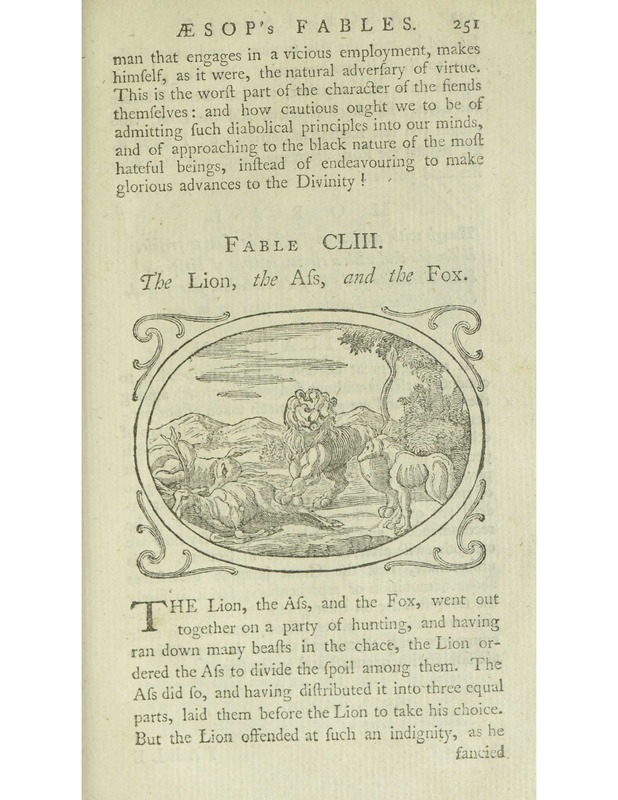
The right of the foreground has two Afs laying on the ground, one with antlers, with concern in their eyes. The fox stands to the right of foreground, observing the Afs. The lion stand in the middle of the image, looking at the fox with their right paw on the flank of the Afs.
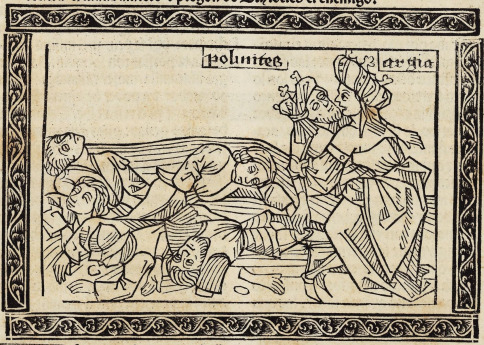
Argia, the daughter of King Adrastus of Argos is depicted on the right side of the engraving holding the body of her husband, king Polynices of Thebes. We know that these figures are Argia and Polynices as the creator engraved their names above their bodies. Boccaccio explains that Polynices had fought in a war against his brother Eteocles and died on the battlefield. Argia snuck herself onto the battlefield after the war to see her husband’s body. She is depicted holding his lifeless body and kissing him on the lips. Behind Polynices and Argia are the other men who had fought and died in this war.
This image shows El Cid trampling his enemies while riding his horse. He is wearing armour and holding a sword in his hand positioned to advance in battle. He is wearing a helmet with plumes on it. In the background a tower of a fortress or castle is visible. His enemies under him or behind him are armed with scimitars and shields; they are also wearing hats. The men whose faces are visible all seem to have beards.
In this image we see the Lilliputians performing for Gulliver. Three are walking on a tightrope, with one doing a handstand, another juggling, and the third walking with a long pole. A fourth man is lying on the ground, as though he fell off the tightrope. A crowd watches the performance from above, with Gulliver sitting in the back. This performance was used for participants to earn their place in high favour at the royal court. Pillows are on the floor to help break the fall of anyone who might slip. This image comes when Gulliver is being accepted into Lilliputian society. The same image appears in the 1843 Krabbe edition.
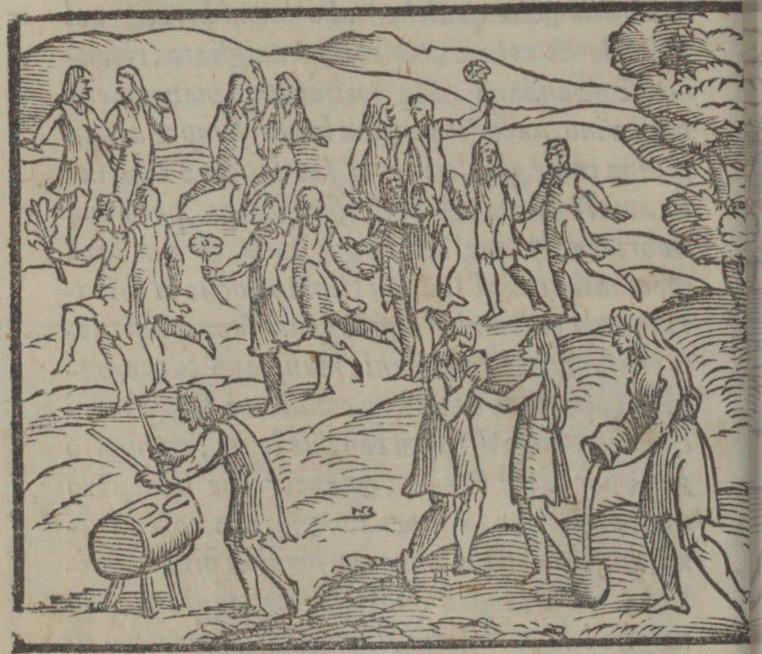
A group of Indigenous people engage in festivities with drinking, dancing and music. One person in the front right pours a beverage from one pot into another, while two people nearby drink. An individual on the left plays a barrel-shaped drum with drumsticks. In the background a group of people dance in pairs in a circle, with some individuals holding leaves or flowers. This image is identical to one found on page 103 verso of Venice, 1565.
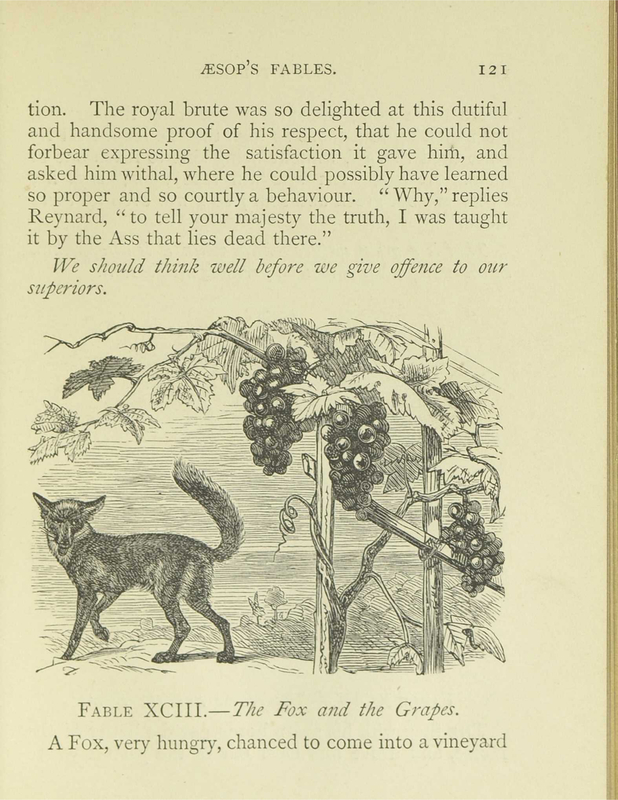
A fox is in the wild, sniffing at a bush that is in front of a tall tree. In that tree is an eagle, or a crow, that is looking down at the fox. Behind that same tree is a stone wall, and in the background are more trees and hills.
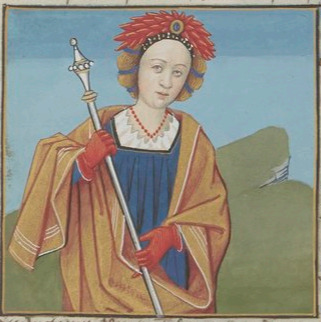
This illumination depicts a portrait of Julia, the daughter of the famous Gaius Julius Caesar. She is illustrated wearing royal clothing and holding a scepter in both of her hands. Julia is renowned for not only being the daughter of Julius Caesar, but for being the wife of Pompey the Great.
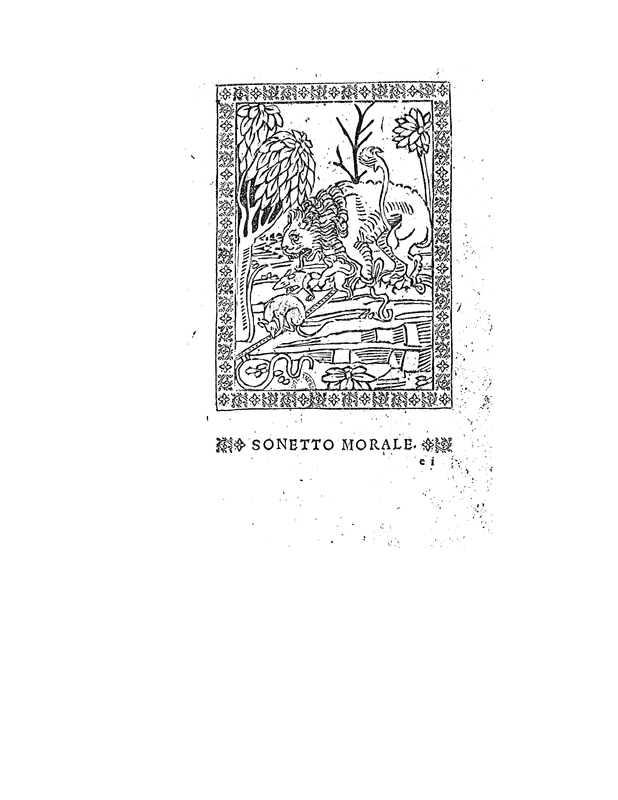
There is a lion with its tail between its legs and seems to have a rope tied to it. The left front paw of the lion is pinning down a mouse. In the forefront of the image there is mouse chewing on the rope that is trapping the lion.
Here we see Gulliver standing next to a yahoo. “Yahoo” is the word the Houyhnhnms use to describe the humans of their country. Gulliver looks disgusted by the yahoo because of the yahoo’s differences from Gulliver. Gulliver’s opinions are a reflection of European prejudice against Native Americans. The same image appears in the 1839 Krabbe edition.
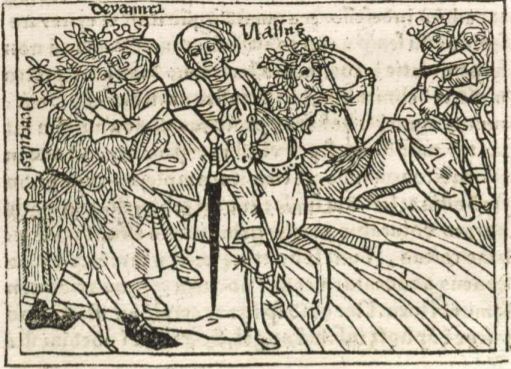
Hercules is depicted on the left-hand side of the engraving holding his new wife Deianira in his arms as they attempt to cross the Evenus river. Hercules is illustrated with a wreath on his head and a bow and arrow by his legs. His name is engraved horizontal to his body in order to be identified. Deianira is illustrated wearing a crown and has her name engraved above her head. A man named Nessus is depicted beside Deianira, holding his arm out to her as he offers to take her across the river. Boccaccio explains that Nessus was riding horseback, however, in Greek mythology, Nessus is known to be a centaur. Nessus’ name is engraved to the right of his head. Nessus betrayed Hercules’ trust, and began to run away with Deianira after crossing the river. Hercules uses a poison infused arrow to shoot Nessus and rescue his wife. This is illustrated in the background on the right-hand side of the engraving. Hercules’ bow is in hand, and his arrow is sticking out of the chest of Nessus.
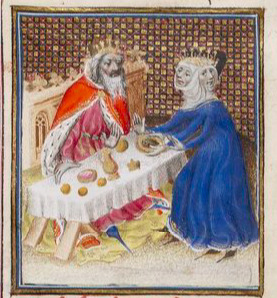
Dripetrua was cursed with having a twin set of teeth, making her very ugly. She proved that this flaw was done by nature and not by parentage, as she followed her father, Mithridates, loyally regardless of circumstances. She is seen serving her father at the dinner table. Her twin set of teeth is represented as a face on the back of her head.
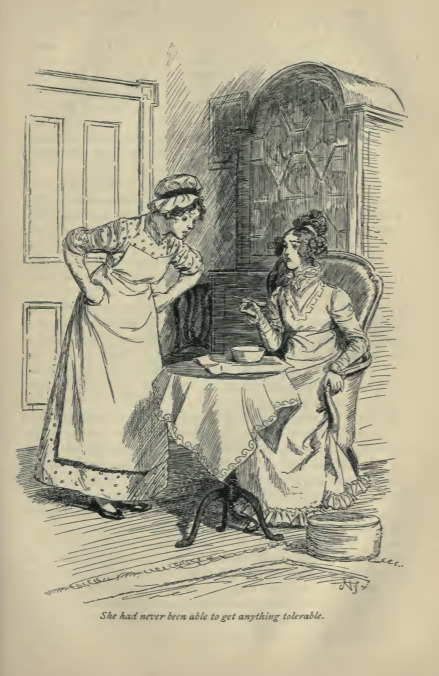
Here we see Emma eating a bowl of gruel while her cook stands by. In this scene, Emma remembers one of her past cooks, thinking how she could not make tolerable gruel. What she made was already too thick or too thin. This scene occurs in chapter 12. The characters are shown in the traditional regency style, with Emma wearing the regency style dress with an empire waist. The cook wears a long apron over her dress and her hair tied up underneath a mop cap. The regency period dated to the early nineteenth century (1811-1820) when George, Prince of Wales, later George IV (r. 1820-1830), reigned as regent for his mentally ill father, King George III (r. 1760-1820). The regency period is associated with the rise of neoclassicism in art and fashion.

![[Vanity Fair Vol. II Chapter XXVII Inhabited Initial]](https://collections.cemvc.ca/files/large/03e00ab7851fdc47918ad916737ec12089038448.jpg)
![Fantacia, S[en]or Apsoluto, Lecinciado Padre. No Ay Quien le Hable, ni Yndios ni Yndias](https://collections.cemvc.ca/files/large/6668ae78a29858251d1dfb05abebd89d0de05597.jpg)

![[Act X] Melibea ontsteken zijnde met de minne van Calisto / spreect aldus](https://collections.cemvc.ca/files/large/e47ede2aa5402451e4e785535c6a6adf7c847ec9.jpg)
![[The Wives of the Cimbrians Killing Themselves and their Children]](https://collections.cemvc.ca/files/large/fff77db3449119018b8a3e4e10b55223c6252a9f.jpg)
![[Vanity Fair Vol. II Chapter XXXII Inhabited Initial]](https://collections.cemvc.ca/files/large/232159042570ccf068e79dd373adecc59cb013f1.jpg)
![[The Cid fighting in battle]](https://collections.cemvc.ca/files/large/23099fa0befb852d01066186177e6752a05a60ee.jpg)
![[Gulliver watches the Lilliputians perform]](https://collections.cemvc.ca/files/large/f2e45676ca37d915defa309b99ec4693dbc1523a.jpg)
![[The Fox and the Eagle]](https://collections.cemvc.ca/files/large/4b6a6a1c07660ce19ac152b1925df7be31c767d1.jpg)
![[Gulliver stands next to a yahoo on the Country of the Houyhnhnms]](https://collections.cemvc.ca/files/large/1b736ecdae6adee44b813bbd8b6791900567a134.jpg)