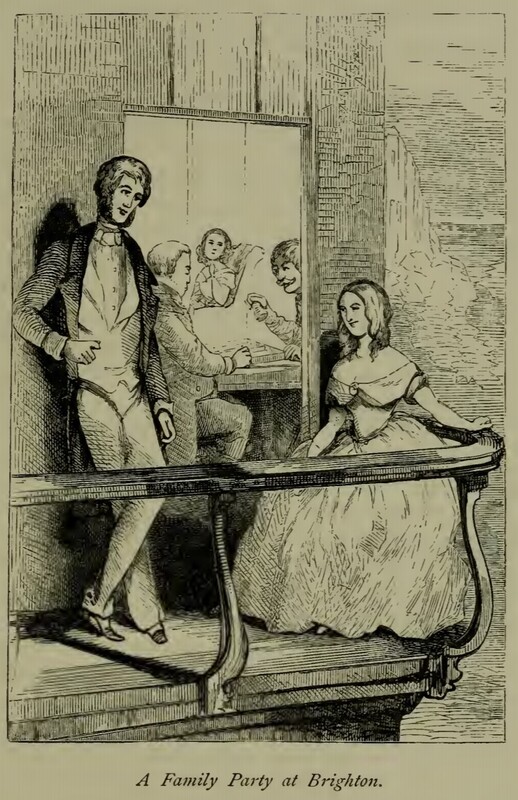
George Osborne and Rebecca Crawley are on the balcony of the inn at Brighton, looking at the ocean. He is leaning against the building, facing out, while she is seated by the railing, facing him. Through the doorway, Joseph Sedley and Rawdon Crawley can be seen inside at the table, playing backgammon. In the far background, Amelia Osborne is sitting alone in an armchair, looking forlornly at the others. Below the illustration is printed its title, “A Family Party at Brighton.”
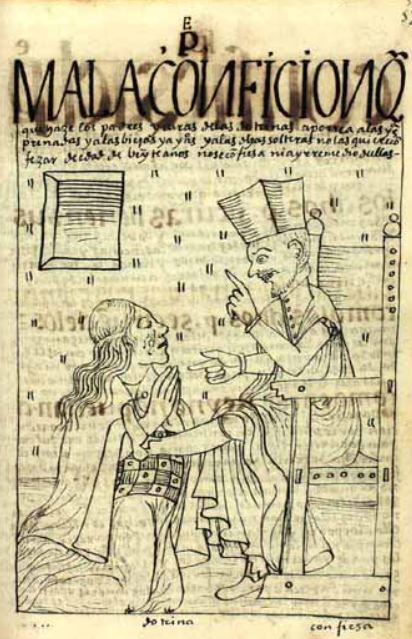
This image is illustrated in a chapter that discusses the Christian priests in the colonial government in Peru. This image depicts a parish priest sitting in a chair on the right side of the image hearing a confession from a pregnant indigenous woman. The parish priest appears to be abusing the pregnant woman by kicking her. She has tears illustrated running down her face. The author and illustrator heavily criticized the parish priests of colonial Peru as they abused and took advantage of indigenous women.
Rebecca Sharp is pictured kneeling on a checkered floor at the base of a statue, crying with her face in her hands. The image is framed in an ornate letter E of “Every”, from behind which a devil leers.
After the death of Calisto, Melibea is overcome with grief. Lucrecia goes to the bedchamber of Pleberio and informs him that Melibea is ill, and Pleberio rushes to her aid. Melibea explains that she has an illness of the heart, which she claims has no cure. Pleberio suggests they go outside to get some fresh air, and she agrees. Once outside, she asks him to fetch some musical instruments to alleviate her ailment. Pleberio departs, and Melibea asks Lucrecia to climb to the top of the house tower with her. At the top, she tells Lucrecia that the height is making her uneasy. When Lucrecia begins descending, Melibea slams the door and locks herself in. Pleberio rushes to the foot of the tower, and Melibea reveals everything. She then takes her own life by jumping.
Here we see Emma and Mr. Knightley walking through the estate outside Hartfield, the Woodhouse estate. She went out alone after the sun came out following a storm. She had been feeling down because Harriet loved Mr. Knightley and she thought he loved her back. Mr. Knightley went to visit his brother and sister-in-law in Brunswick Square in London. Upon hearing of Mr. Frank Churchill's engagement to Miss Jane Fairfax, he returned to Highbury. Mr. Knightley, like many people in town, believed that that Mr. Frank Churchill would propose to Emma, before it became known that he and Miss Fairfax were secretly engaged. Mr. Knightley then returned and declared his love for Emma. When Harriet declared her love for Mr. Knightley, Emma realized that she was in love with him. She was surprised by his proposal and gladly accepted. The only problem was Mr. Woodhouse, who wanted Emma to remain a spinster. Mr. Knightley proposed that he move to Hartfield from his home, Downwell Abbey, living there with Emma and Mr. Woodhouse until his eventual death. In this image, we see Emma and Mr. Knightley walking through the estate, with the house in the background. This scene occurs in chapter 49 as noted underneath the title of this image. The characters are shown in the traditional regency style, with Mr. Knightley wearing waistcoat, tailcoat, and knickers that stopped at the knee. Emma wears the regency style dress with an empire waist. Her hair is worn tied up, as was tradition for women after their “coming out” before the queen, signaling her entrance into society. She wears a bonnet to protect her from the sun while out on a walk. She also carries a parasol, an umbrella used to provide shade from the sun. The regency period dated to the early nineteenth century (1811-1820) when George, Prince of Wales, later George IV (r. 1820-1830), reigned as regent for his mentally ill father, King George III (r. 1760-1820). The Prince of Wales was a fan of Austen’s work, and she dedicates the novel to him. The regency period is associated with the rise of neoclassicism in art and fashion. The same image appears as an insert between pages 192 and 193 for the Dent 1893, 1894, 1895, 1896, and 1897 editions of Emma.
Two men are laying on the ground sleeping. A third man is sitting upright eating. They are in a location with many mountains, and a fire burning behind them. A tree with no leaves is seen behind them.
Here we see Gulliver showing Captain John Biddel who rescued Gulliver and brought him aboard his English Merchant Ship one of the cows he brought from Blefuscu. Captain Biddel allowed Gulliver to board his ship and return to England. As thanks Gulliver offers one of the miniature cows to Biddel. In the image we see the two men in a room on the ship with a table separating the two. Gulliver holds the cow in his hands while Biddel looks in astonishment at it. Biddel is on the right and is wearing a wig as was the fashion of the eighteenth century. The same image appears in the 1839 Krabbe edition.
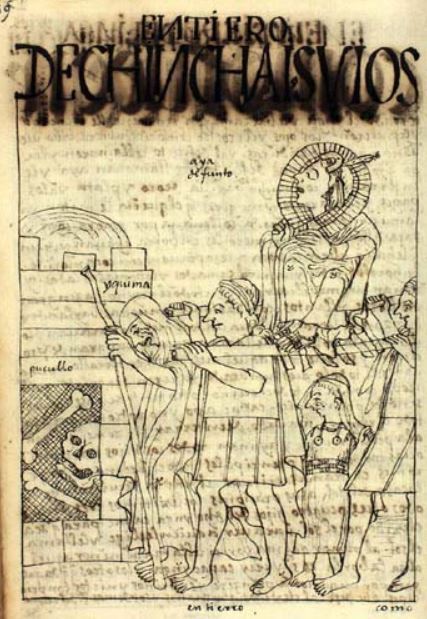
This image depicts the burial traditions of the people in the Chinchaysuyos region of the Inca Empire. The author explains that the burial would take place five days after the death and the citizens would hold a procession where they carry the body adorned in garments. The dead body is depicted being carried on a plank of wood over the shoulders of two men. The dead man’s yquima [widow] is illustrated looking at the ground, holding a stick as she cries for her husband. They are illustrated taking the body to the pucullo [tomb] on the left side of the image. There is a skeleton illustrated on the pucullo to demonstrate that it is a tomb. There is a caption at the top of the image which reads “aya defunto” [deceased] and a caption at the bottom which reads “enterrio” [burial].
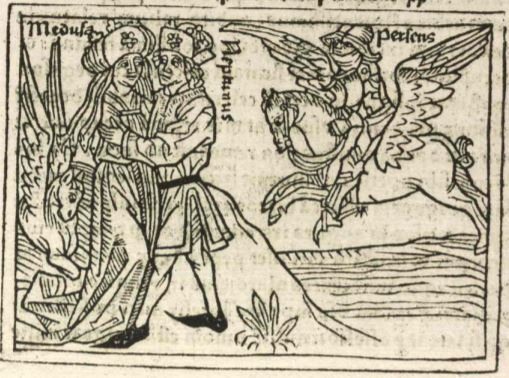
Medusa is illustrated on the left-hand side of the engraving embracing the god Neptune. The creator engraved Medusa and Neptune’s names beside their bodies to identify them. Medusa is depicted in her human form in this engraving before Minerva transformed her into a monster. Boccaccio explains that Minerva transforms Medusa into a monster because she was angry that she had sexual relations with Neptune inside one of her temples. Boccaccio also explains that Medusa ends up giving birth to a Pegasus, which is engraved just behind Medusa on the left-hand side of the engraving. The hero Perseus is depicted riding his Pegasus on the right-hand side of the engraving as he is on his way to conquer Medusa’s kingdom. Perseus’ name is engraved to the right of his helmet.
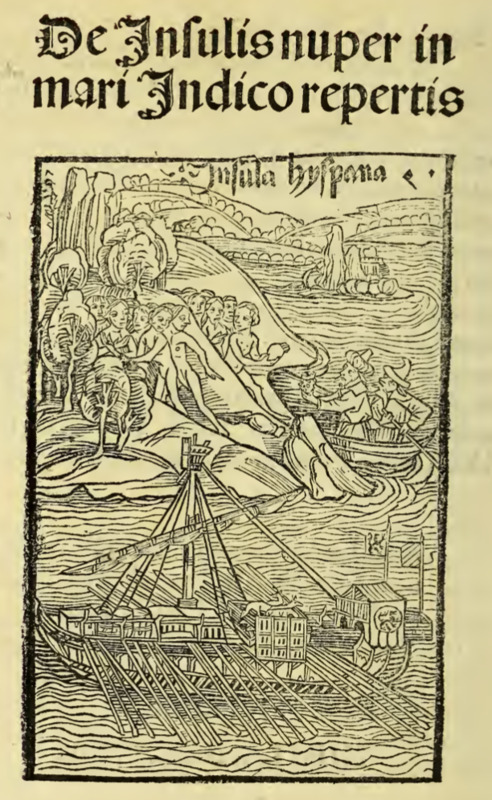
Christopher Columbus is shown arriving at one of the islands he came across on his first voyage to the West Indies. A large multi-oared boat sits in the foreground (not an accurate representation of the type of ship Columbus sailed on to cross the Atlantic) and closer to shore Columbus is shown with another man in a small rowboat. A group of Indigenous people stands on the shore, appearing nervous or timid as they watch Columbus approach. Columbus’s arms are outstretched, offering an object to the Indigenous people.
Two women and a man are fighting off a man entering the room. The man has his sword drawn towards a man by the door. The man entering the room looks surprised at the aggression.
This image depicts Gulliver walking through the streets of Lilliput. Only the lower half of his body is depicted to show the difference in size between him and Lilliput. Gulliver is walking in between buildings as he hides from the invading Blefuscu enemy fleet.
In this image we see Gulliver’s arrival in Blefuscu. Gulliver waded across the water between Lilliput and Blefuscu and here we see him coming out of the water onto the land. He was met by a crowd of people, including members of the Royal Family of Blefuscu. In the image we see the crowd and several carriages. In the distance we also see a tower. Gulliver’s escape to Blefuscu is often linked to Henry Bolingbroke’s escape to France in 1715 after being charged during the Jacobite rebellion. The same image appears in the 1839 Krabbe edition.
Here we see Gulliver and the Governor of Glubbdubdrib, who was a necromancer. After speaking with Alexander the Great, and Hannibal, the Governor brought Caesar and Brutus forward. Caesar told Gulliver that his assassination was far more glorious and better for society than what he did while he was alive. Gulliver then spoke to Brutus, praising his virtue, love of his country, and benevolence. Swift evidently believed Brutus to be a much better man than Caesar, and was a true patriot, as it was better for the country to kill his friend. In talking to Brutus, Gulliver learned that other patriots whom he admired and called the sextumvirate were always together. With Brutus, the other men in the sextumvirate were Lucius Junius Brutus who expelled the last king from Rome in 509 BCE, Socrates (c. 470-399 BCE) who taught Plato and opposed the Athenian government, Epaminodas (c. 420-362 BCE) the Theban general and politician, Cato the Younger (95-46 BCE) who defended the Roman Empire against Julius Caesar, and Sir Thomas More (1478-1535) who opposed King Henry VIII of England’s departure from the Catholic Church. All of these men opposed tyranny, and in some cases were killed for their beliefs. In this image, Brutus is seen on the left holding a dagger. The same image appears in the 1839 Krabbe edition.
A female figure, representing Becky Sharp, is seated in a wooden letter P of “Poor” on the banks of a stream or river. She holds in her left hand a fishing rod, which has attracted the attention of a single large fish, representing Joseph Sedley. In the background are several trees and the shapes of buildings in a city or town in the distance.
Here we see Gulliver lying on the ground speaking with the Emperor. The Emperor is identified by his cape, helmet with three large feathers, and swords. Gulliver explains his experiences to the Emperor. The same image appears in both the 1839 and 1843 Krabbe editions.
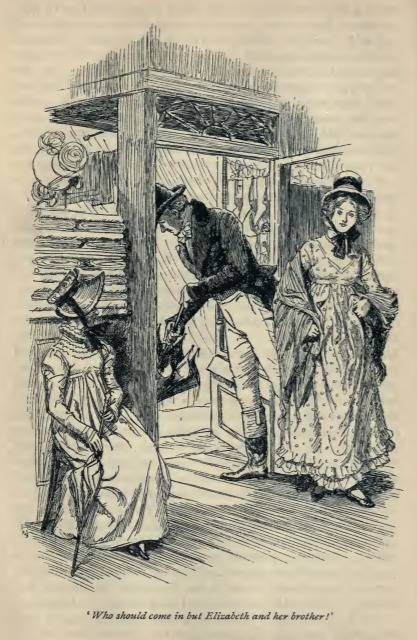
Here we see Harriet sheltering from the rain in a store when Mr. Martin and his sister Elizabeth came in. Harriet felt very awkward because it was the first time she had seen any of the Martins since she turned down Mr. Martin’s proposal. As soon as the rain let up Harriet ran to Harfield to tell Emma about this meeting. This scene occurs in chapter 21. The characters are shown in the traditional regency style. Harriet and Elizabeth Martin wear regency style dresses with empire waistlines. They wear bonnets to protect their faces and Harriet holds an umbrella. Mr. Martin wears a waistcoat and tailcoat with a cravat and a top hat. The regency period dated to the early nineteenth century (1811-1820) when George, Prince of Wales, later George IV (r. 1820-1830), reigned as regent for his mentally ill father, King George III (r. 1760-1820). The regency period is associated with the rise of neoclassicism in art and fashion.

![[Vanity Fair Vol. I Chapter XV Historiated Initial]](https://collections.cemvc.ca/files/large/940de86b866378eb785a97370ffd70972a819e3f.jpg)
![[Act XX – Melibea Falling as Pleberio Watches in Agony]](https://collections.cemvc.ca/files/large/8b04bc82b03787c8bfad8b6fc7f0f032218284bb.jpg)

![[Three men by a fire]](https://collections.cemvc.ca/files/large/f49cf772089e3c28e2279ec8958a597c9c455216.jpg)

![[Vanity Fair Chapter IX Historiated Initial]](https://collections.cemvc.ca/files/large/40a12248bc62b9ea97549404f8481a52250ceea3.jpg)
![[Gulliver shows a cow from Blefuscu to Captain John Biddel]](https://collections.cemvc.ca/files/large/14abb67608f5b4be00e17a5ff14b9f255c6b078f.jpg)
![[Fighting an Intruder]](https://collections.cemvc.ca/files/large/847d6673155b45d08eb73a6d19844384489bf6c1.jpg)
![[Gulliver walking through the streets of Lilliput]](https://collections.cemvc.ca/files/large/115bfe028c9295f5041b2adacfd420fba9788690.jpg)
![[Gulliver's arrival on Blefuscu]](https://collections.cemvc.ca/files/large/911612ccd4b5086cf1d1517a280948bc8384bc5a.jpg)
![[Governor of Glubbdubdrib and Gulliver speak with Caesar and Brutus]](https://collections.cemvc.ca/files/large/b1cace8e73f8ec69b290fe53b4cda77f4537f9cb.jpg)
![[Vanity Fair Vol. I. Chapter IV Historiated Initial, P]](https://collections.cemvc.ca/files/large/92d65cff0f4c17be8e90f37dc681a71a60f66c7b.jpg)
![[Gulliver lies on the ground, speaking with the Emperor]](https://collections.cemvc.ca/files/large/81446800530744ab6299c16512bb037b98902af3.jpg)