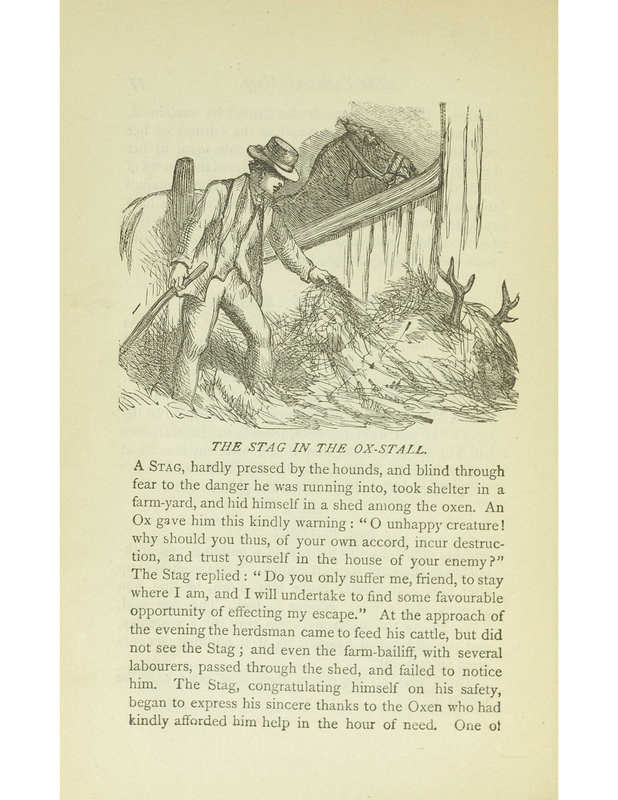
A man wearing a suit and a hat is holding a stick in his right hand, while he is moving hay off the sleeping stag. The body of the stag is not visible, but both its horns are sticking out of the hay as seen in the lower right corner. Behind the man and the stag, a horse is looking at them from its stall in the stables.
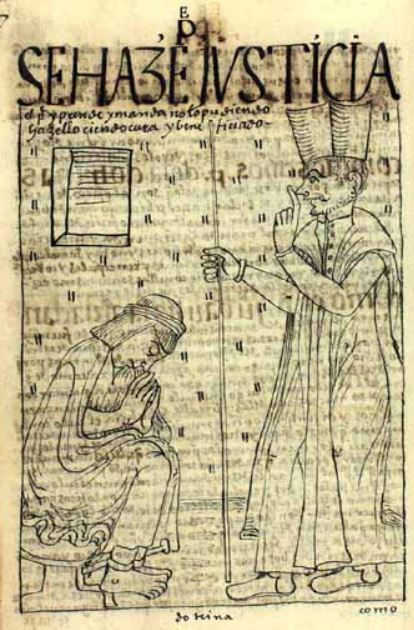
This image is illustrated in a chapter that discusses the Christian priests in the colonial government in Peru. This image depicts a parish priest administering civil justices to an indigenous man. The parish priest is illustration standing on the right side of the image pointing an accusatory finger towards the man on the left. The indigenous man on the left is sitting down as he looks into his praying hands. The author criticizes the parish priests for carrying out decrees and lawsuits when they had no authority to do so.
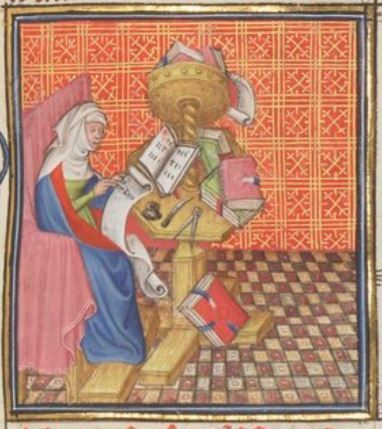
This illuminated image depicts the sibyl, Amalthea (also called Deiphobe), sitting down while looking at a book resting on a lectern as she writes on parchment. Amalthea is famous for having had nine books to give to the Tarquinius Priscus, however, when he denied her payment, she began burning three books at a time until he gave her the money. There were three books left when he paid her. These three books contained all the future events that will happen to the Romans. This is most likely what she is writing in this image.
This image is illustrated in a chapter that discusses the descendants of the Inca and Andean nobles under Spanish colonial rule in Peru and their importance to a revived Andean society. This native official is dressed in an embroidered tunic with a cloak draped over his shoulders while he holds his bag in his left hand and a rosary in his right. These officials were responsible for overseeing a certain number of native tributaries in their pueblos. The administrator in this image was responsible for overseeing ten natives. The caption at the bottom of the image reads, “tributario y cabildo, no tiene don que no le falte dies yndios tributarios” [tributary council, he who lacks ten Indians does not have a title].
A group of Tupinambá people returns to their village by canoe. In the center of the village two people are in the process of dismembering a human body. A torso and leg lay on the ground, one of the individuals holds a head, and another person walks towards a fire holding a leg. There are three fires, all of which have a wooden frame set over them. Human limbs sit on the frames, roasting over the fires. In the background two individuals lounge in hammocks, and two long structures are visible.
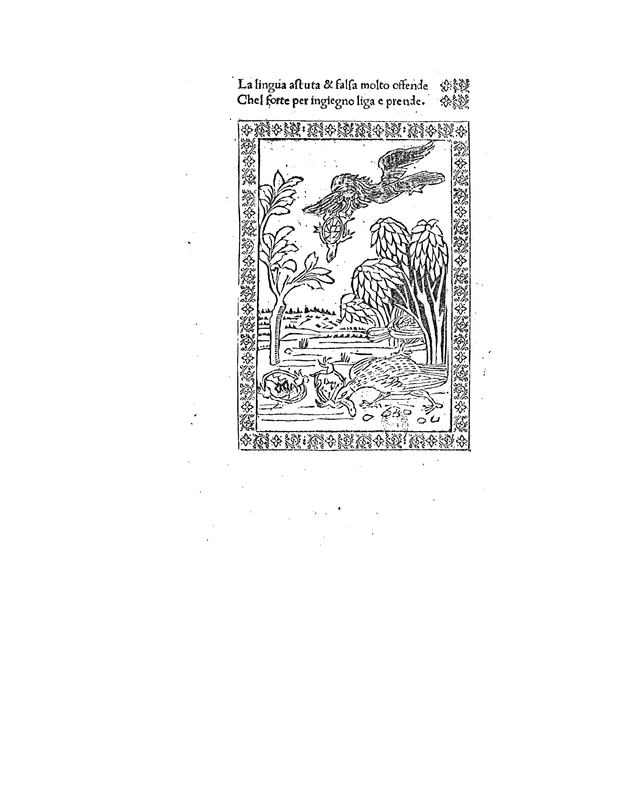
At the top of the image there is an eagle flying while dangling a tortoise. At the bottom of the image we see the tortoise with its shell split being eaten by the eagle on the ground.
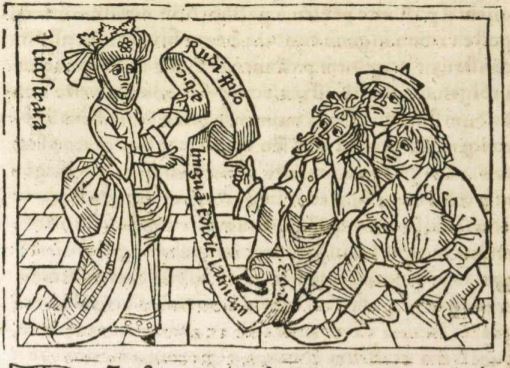
This engraving depicts Nicostrata, a woman who was a famous prophetess during her time, holding a scroll of parchment. We know that this is Nicostrata as the creator engraved her name horizontally adjecent to her body. Nicostrata had gone with her son, Evander, to Italy and he founded the city of Pallantium. Boccaccio explains that once Nicostrata realized that the inhabitants of this city were not well educated or literate, she decided to give them their own language with their own letters and symbols. This was the Latin language. Nicostrata taught the new letters and language to the people of Pallantium, which is what the engraving depicts. There are people sitting on the ground who are listening intently to the prophetess, as she is holding the parchment and pointing at the letters.
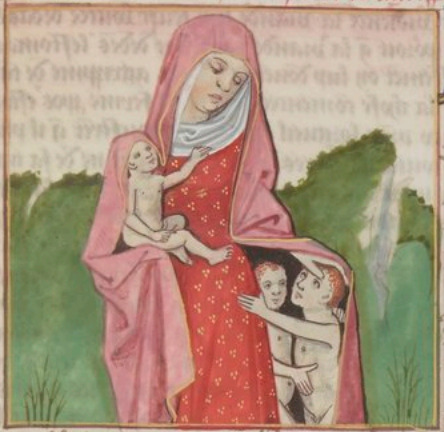
This illumination depicts a woman named Agrippina with her three children. She is illustrated holding one child in her arm and looking at her other two children who are standing by her legs. Agrippina was famous for being the mother of the emperor Caligula. She bore her husband, Germanicus, a total of three sons, all of whom are illustrated in this image.
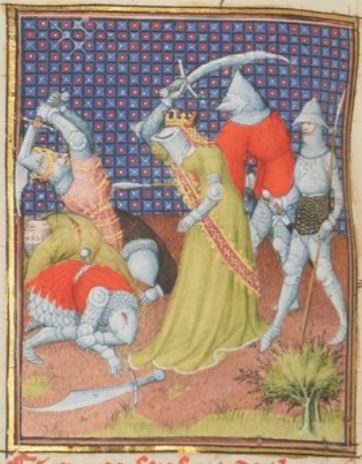
This illumination depicts Queen Thamyris in the centre of the image wearing a helmet and a crown as she swings a sword above her head. She was renowned for her nobility and capabilities of ruling a nomadic tribe. Boccaccio explains that King Cyrus of Asia Minor had invaded Scythia looking for glory, and when he had killed Thamyris’ son, she exacted her revenge by killing his entire army. When Thamyris found Cyrus’ dead body, she took his head for revenge. She is illustrated swinging her sword, about to cut the head off the body of King Cyrus, which is lying on the ground by her feet.
George Osborne and Amelia Sedley sit together on a chaise lounge, talking. Amelia is working on a bit of sewing, while George is leaning against her with his hat placed upside-down on the floor.
In this image we see Gulliver climbing over the walls of the Emperor’s palace, which lies in the centre of Mildendo. The walls were five feet high, so Gulliver built himself two stools out of wood to help him get over the walls – as the gates were too difficult for Gulliver to get through or over. The stools were each three feet tall, and there was one on each side of the wall. Gulliver did this because the Emperor wanted to see the Imperial Palace. The same image appears in the 1843 Krabbe edition.
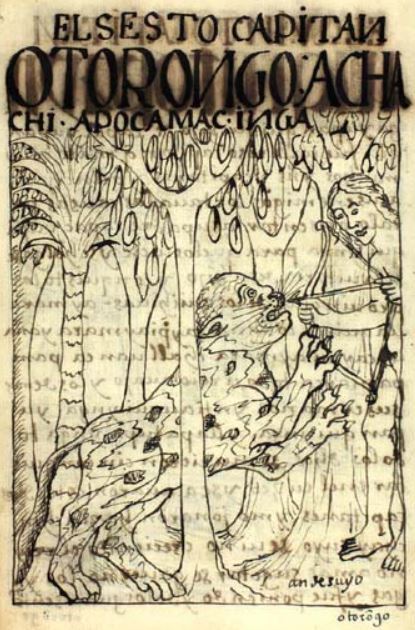
This illustration depicts the sixth captain, Otorongo Achachi who was also known as Apu Camac Inca. These captains were a level of Inca authority who helped lead the conquest of the Andes. This captain was the son of Inca Roca, the sixth king of the Inca Empire. The author explains that a lord had told this captain that in order to successfully conquer he must become an Otorongo [Jaguar]. This is why the author has illustrated a jaguar in this image. There is a person on the right-hand side with an arrow pointed at the jaguar. The words “ande suyo” are written at the bottom of the image which describes the regions that this captain had conquered.
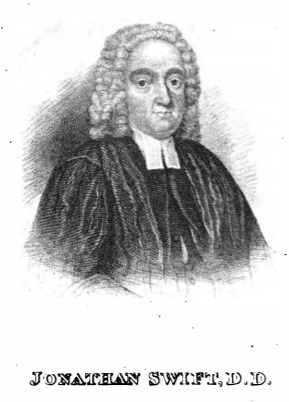
Here we see a bust of Jonathan Swift, appearing before the text of Gulliver’s Travels. Swift was the dean of Saint Patrick’s Cathedral in Dublin and appears wearing the traditional clothing of the dean.
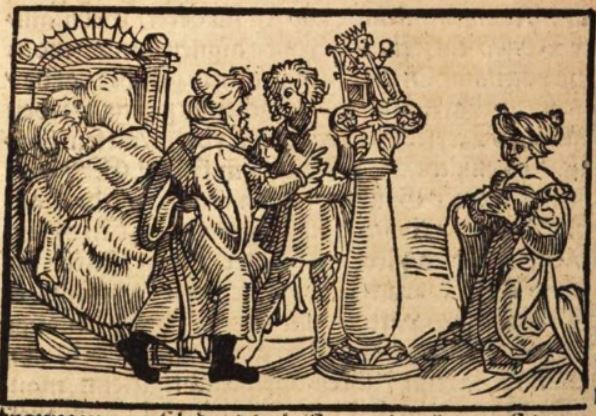
The Roman woman Paulina is depicted on the right side of the engraving as she kneels in prayer. She is looking up at the statue of the Egyptian god Anubis, which is sitting on a tall platform. Paulina was an incredibly devout and chaste woman and was completely faithful to her husband. A man named Mundus had fallen in love with Paulina due to her overwhelming beauty, and when she continuously rejected his advances, he devised a plan to have her as his own. Mundus is depicted in the centre of the engraving handing a bag of money to a priest. Mundus bribed the priest of the temple to convince Paulina that if she spent a night in the temple, she would have an encounter with the god Anubis in her sleep. Paulina naively stayed at the temple expecting to have an experience with Anubis, however, Mundus came to Paulina in her sleep and pretended to be the god and convinced her to have intercourse with him. This is depicted on the left side of the engraving. Paulina and Mundus (disguised as Anubis) are illustrated in bed together after having intercourse. Paulina is famous for having been tricked into losing her virtue and chastity. Mundus ended up being exiled, and the priest was tortured for his involvement in the deception.
Two groups of Indigenous Brazilians engage in conflict. Members of both groups are armed with bows and arrows and clubs, and some carry shields. Several individuals blow into long instruments resembling a type of horn, and at least one person blows into a conch shell. There are two structures visible in the background, one of which is on fire. This image is identical to one found in Paris, 1557.
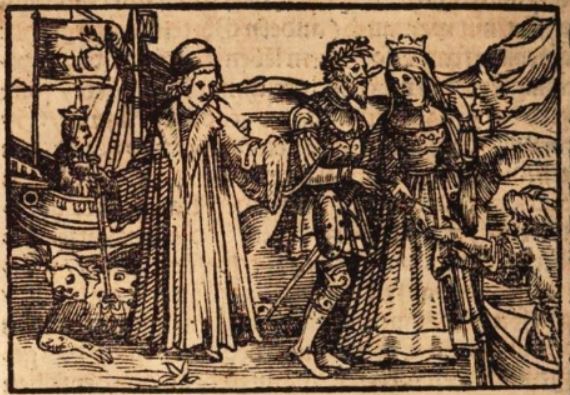
This engraving illustrates the story of Isis and Jupiter. Jupiter is depicted wearing a wreath on his head while he looks lovingly at Isis. Isis is illustrated with a sad expression on her face. Boccaccio explains that Jupiter transformed her into a cow and gave her as a gift to Juno in order to hide his crime of raping her. The god Mercury saved Isis by killing Argus, Isis’ 100 eyed guardian. Mercury is on the left side of the engraving piercing the body of Argus with his sword. Isis is visible in the background of the engraving on the left side sitting on a ship. She sailed to Egypt after being transformed back into her human form. The sail on the ship has a heifer emblem to signify her transformation into a cow.
This is the first image depicted in the author’s chapter where he discusses cities, towns, villages, and provinces in colonial South America. This image depicts the city of Santa Fe in Bogota, Columbia. There are two trees on both sides of the image at the foreground that appear to encapsulate the large city of Sante Fe within them. The caption near the base of both trees reads, “Santa Fe de Bocotá, ciudad tiene gouernador” [Santa Fe in Bogota, the city has a governor]. The large caption at the bottom of the image reads, “[E]n las dichas ciudades, uillas, aldeas que no cirua ningun yndio [ni] yndia ni muchacho que ciruan en las minas a su magestad y que [...] cirua de los negros y negras un millon y sus hijos mes[tizos] y cholos, mestisas, mulatos, zanbahigos y mulatas que ay [m]uchos millones y que se ciruan entre ello como en Castilla” [in those cities, towns, villages that no Indians circulate the mines to their majesty and that a million blacks and their mestizo, cholo, and mulato children and they serve as they do in Castile].

![[Vanity Fair Vol. I Chapter XXVII Inhabited Initial]](https://collections.cemvc.ca/files/large/e422284d627f876202025377a4177c684bd7f968.jpg)
![Mandoncillo de Dies In[di]os, Chvnga Camachicoc, Chiara del Pueblo de Muchuca](https://collections.cemvc.ca/files/large/dd90f1783ea34a6046e476e5fd19192e96b86d6a.jpg)

![[Tupinambá people return to their village]](https://collections.cemvc.ca/files/large/320821790004c28375a8530d0dac201bd5c08d96.jpg)
![[George and Amelia]](https://collections.cemvc.ca/files/large/1a02732595ca17e0bd346ec22fb548281edddd31.jpg)
![[Gulliver climbs the wall of the Emperor’s palace in Mildendo]](https://collections.cemvc.ca/files/large/cc26fe9b07b63c414c6f890a2bfbe01cfc223dfe.jpg)


![[Conflict between two groups of Indigenous Brazilian people]](https://collections.cemvc.ca/files/large/b92c62babc849c6d41e24c88cab90030088db101.jpg)
![Capi[tv]lo Primero de las Civdades I Villas: Civdad de Nobo Neino](https://collections.cemvc.ca/files/large/44fee712ac629935d5c47e7a2a449271876c0ba9.jpg)