In this image we see an old man with a long beard wearing fancy robes. He appears to have tablets in each hand. The image comes when Gulliver discusses the differences in religious beliefs between Lilliput and Blefuscu which led to war. The man represents the former Emperor of Lilliput who outlawed the religious beliefs of Blefuscu. This is a thinly veiled reference to the religious wars of the sixteenth and seventeenth centuries. The same image appears in the 1839 Krabbe edition.
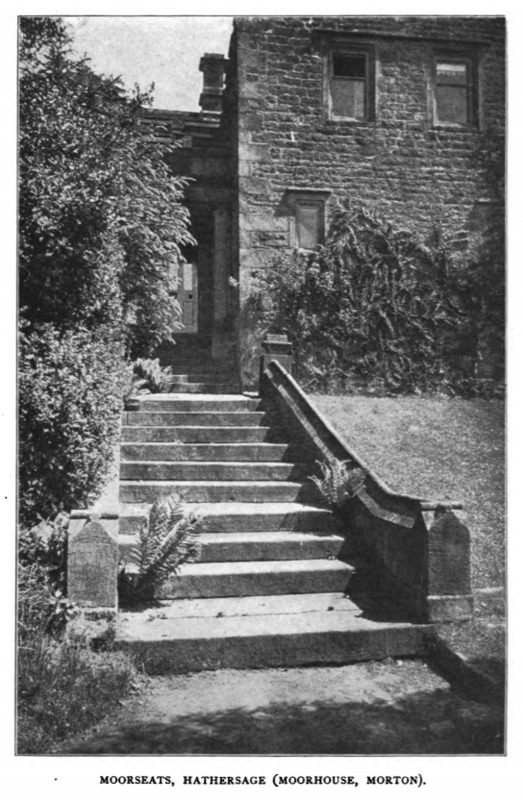
Here we see an image of Moorseats, a house in the village of Hathersage, a village in Derbyshire. After running away from Thornfield after ending her engagement to Mr. Rochester Jane ended up in Morton, which was based on the real village of Hathersage. She arrived at Moor house with Mr. Rivers and his sisters, Diana and Mary. She lived with them for several months and taught at the village school before returning to Mr. Rochester. The same image appears in the 1899 Harper edition of Jane Eyre.
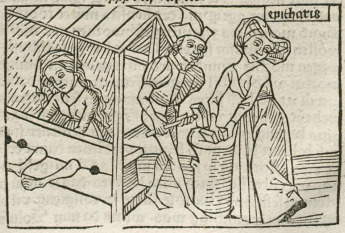
This engraving depicts the freedwoman, Epicharis, being tortured for information regarding a conspiracy to kill emperor Nero. Epicharis is depicted on the right side of the engraving with her hands in some form of torturing device as a man with a hammer tortures her. Her name, written as “Epitharis” is engraved above her head to identify her. Epicharis is also depicted on the left side of the image with her feet restrained in a stock. Epicharis had heard the details of the conspiracy to assassinate emperor Nero, and when she put her faith in the wrong person, they told emperor Nero that she was involved in the plan. They tortured her many times; however, she did not reveal the names of anyone involved in the conspiracy. She ended up killing herself to avoid revealing the details to the emperor.
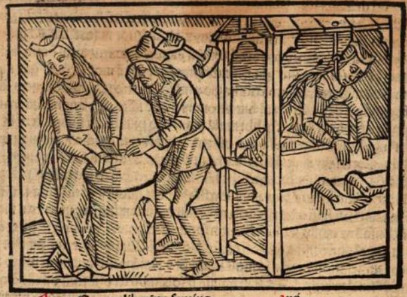
This engraving depicts the freedwoman, Epicharis, being tortured for information regarding a conspiracy to kill Emperor Nero. Epicharis is depicted on the left side of the engraving with her hands in some form of torturing device while a man with a hammer tortures her. Epicharis is also depicted on the right side of the image with her feet restrained in a stock. Epicharis heard the details of the conspiracy to assassinate Emperor Nero, and when she put her faith in the wrong person, they told Emperor Nero that she was involved in the plan. They tortured her many times; however, she did not reveal the names of anyone involved in the conspiracy. She ended up killing herself to avoid revealing the details to the emperor.
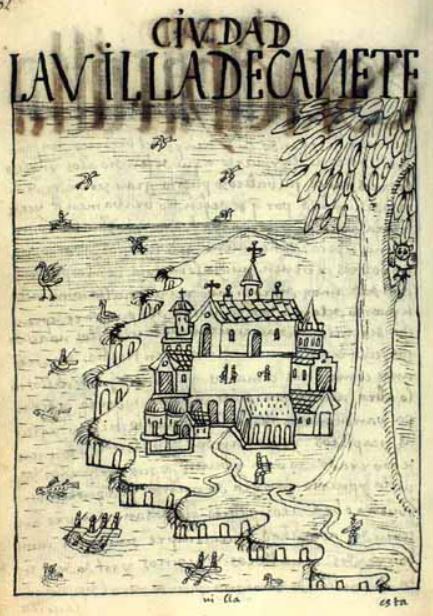
This image is depicted in the author’s chapter where he discusses cities, towns, villages, and provinces in colonial South America. This image depicts the town of Cañete which is south of Lima in Peru. It is a coastal town located next to the water, as illustrated in the image. The town is arranged in a cluster of buildings that form a square in the centre. There are three people walking in the town square, and there are two people walking on the winding path that leads into the city. There are boats, birds, and seals depicted in the water on the left side of the image. The author explains that this town was plentiful in food and had good, charitable Christians living there. The caption at the bottom of the image reads “uilla” [town].
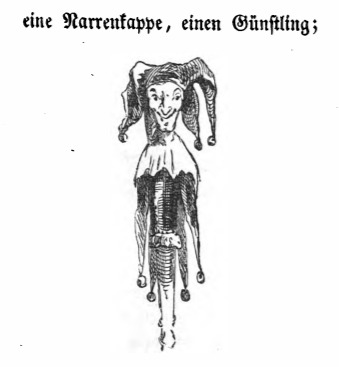
Here we see a court jester, referred to in the eighteenth century as a cap and bell. This is the code word for the King’s favourite. This image comes in a description of a conspiracy found by a professor from the Grand Academy on Balnibarbi. This idea is representing code word for terms in the conspiracy that Swift is satirizing. The professor advises that those named in the conspiracy papers be closely monitored at all times, naming specifically while they were using the bathroom, as this is when men were most thoughtful. This conspiracy is thought to be an allusion to the trial of Francis Atterbury, the bishop of Rochester for allegedly plotting with the Jacobites. Atterbury was charged with treason in 1722 and was exiled to France. The same image appears in the 1839 Krabbe edition.
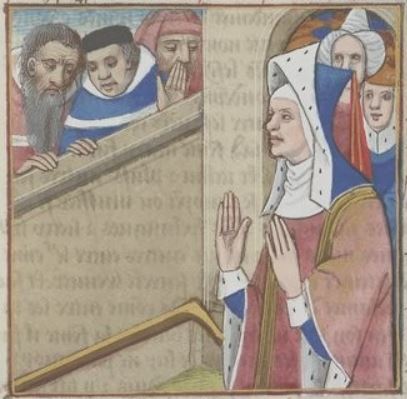
This illumination depicts Hortensia, the daughter of famous orator Quintus Hortensius, speaking in front of the triumvirs. Hortensia inherited the gift of oration from her father, and when the triumvirs raised taxes unbearably high, she spoke so eloquently to them that they revoked the taxes. The triumvirs are depicted on the left side of the image speaking to one another as they listen to Hortensia speak. Hortensia appears to look confident as she speaks to them. There are other women standing behind her in support of her approaching the triumvirs.
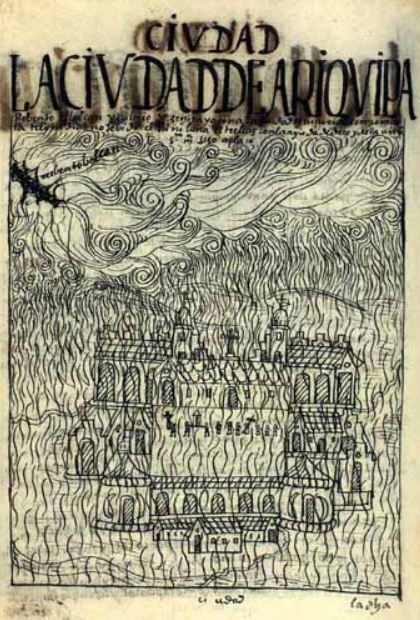
This image is depicted in the author’s chapter where he discusses cities, towns, villages, and provinces in colonial South America. This image depicts the city of Arequipa in Peru, which, according to the author, was founded by conquistador Francisco Pizarro. The city is difficult to see as it is covered in ash from the volcano that erupted. The volcano is depicted in the top left corner and is captioned with “Rebentó bolcán” [erupted volcano]. There are people visible in the town square. The author explains that many people perished in the volanic eruption, and that the city and sky was covered in ash for thirty days. The caption at the bottom of the image reads “ciudad” [city].
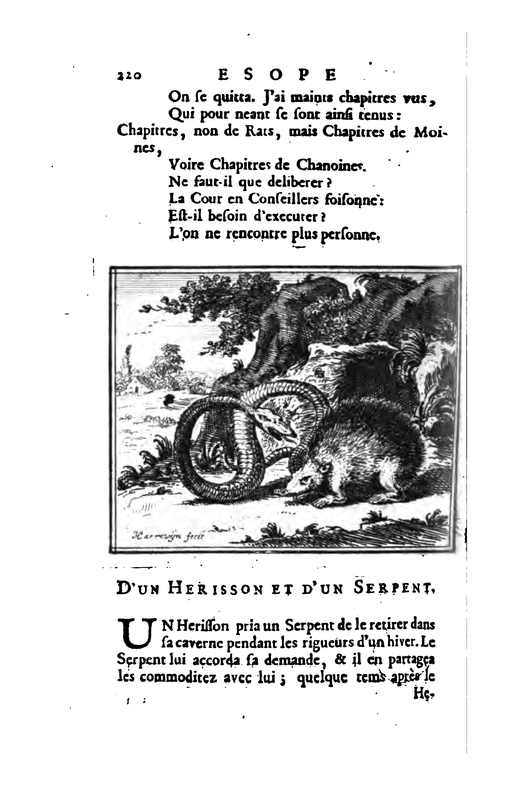
A hedgehog and a snake are close and looking at each other. The snake has its tongue out, and both animals appear to have angry facial expressions. There are rocks, trees, and a building in the background. The illustration has the signature of Harrewijn in the bottom left corner.
This image depicts an indigenous sacristan pulling on two ropes attached to the church's bells in the bell tower to call parishioners to mass. The author explains that the sacristan gets paid twelve pesos, six corns, six potatoes, and a piece of clothing for himself and his wife each year for his services. The priest of the church pays the sacristan as the sacristan assists him with baptisms, mass, and confessions.
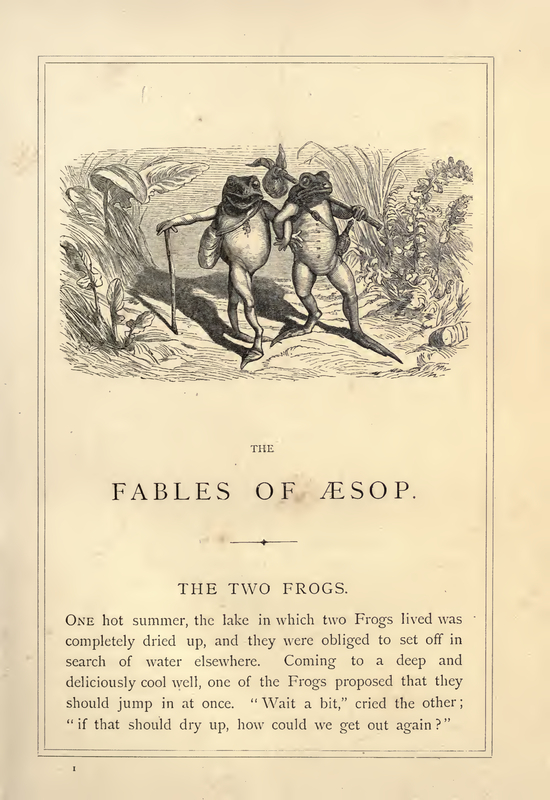
Two frogs are walking down a path. On both sides of the path are tall grass, flowers, and many other plants. The frog to the left has its mouth open. It wears a cross-body satchel across its chest and is walking with a walking stick in its right hand. The frog to the right has its mouth closed and is holding a bundle wrapped in cloth on a stick which he is holding in his left hand. The other frog wears a cross-body satchel as well. Both frogs walk with their free arms intertwined.
On the left side of this illustration, we see a male figure and a female figure off by themselves, the latter of which is wearing a robe. To the right, we see a female figure wearing a robe and a veil. She is interacting with a group of four male figures. In Act IX, there are four female characters and two male characters. As such, we cannot say that this scene is related to the events of Act IX.[This illustration is identical to those found in Acts I (folio 9r), VII (folio 52v), XI (folio 80r), XII (folio 83v), XIV (folio 96v), XVI (folio 106v), and XIX (folio 115v).]
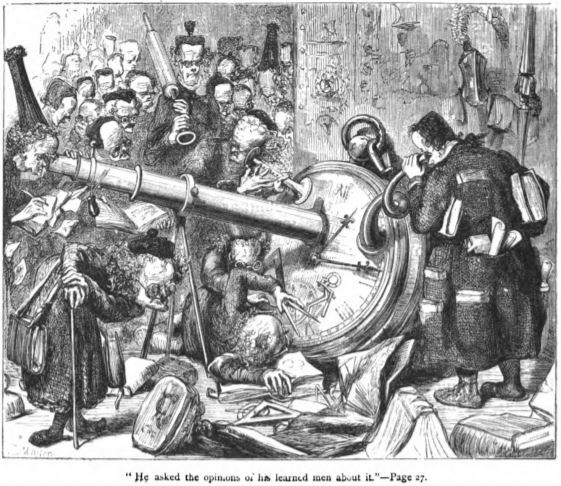
Here we see several Lilliputian scholars examining Gulliver’s effects. Some look at his pocket watch, while others look through his telescope. We also see a ring on the ground. The Lilliputian Emperor called in his scholars to examine all of Gulliver’s effects, and they were particularly interested in Gulliver’s pistol, not pictured here.
Here the Lilliputian Emperor walks through a crowd of kneeling Lilliputians. The Emperor is identified by his elaborate headpiece which has a long train coming out of the top. The Emperor walks towards the gates to the palace, with the crowd lining the walkway towards the gate. The same image appears in the 1843 Krabbe edition.
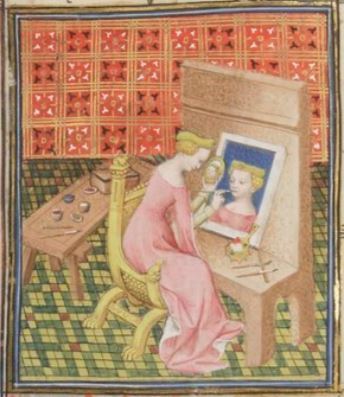
This illumination depicts the young Roman virgin Marcia holding a mirror in her left hand while she paints a self-portrait with her right hand. There is a table with painting and sculpting supplies to the left of Marcia. Boccaccio explains that Marcia is worthy of renown for her chastity and for her sculpting and painting abilities. She is known to have mostly painted and sculpted figures of women, which is why she is painting a self-portrait.
Someone swats at a large flying insect, gripping the bowl that sits atop a set table. Trees bend towards the person in the background, while the insect seems to ponder their swatting. Winged and non-winged insects sit below the table.
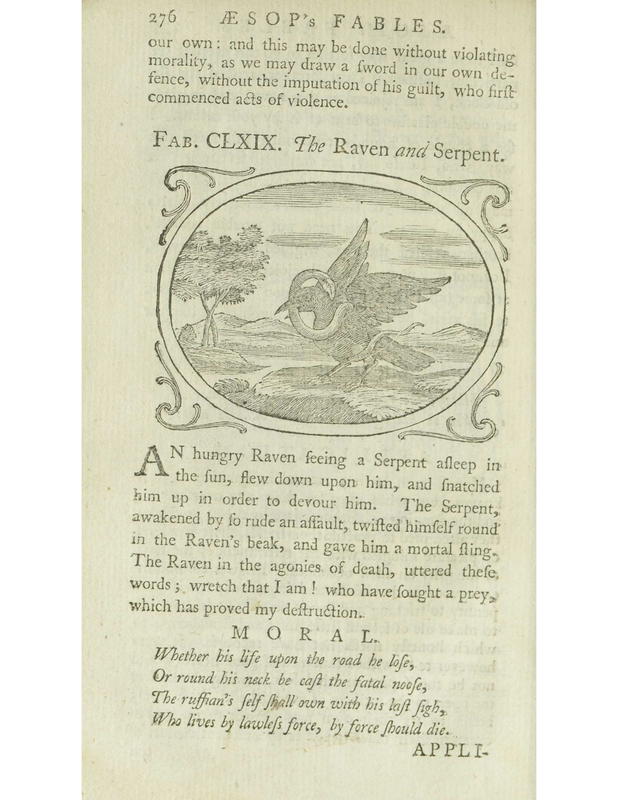
A raven is standing on the ground, with a serpent in their beak. The serpent is coiled around the raven, biting the bird on top of the head. The Raven has their wings up. There is hills and small trees in the background.
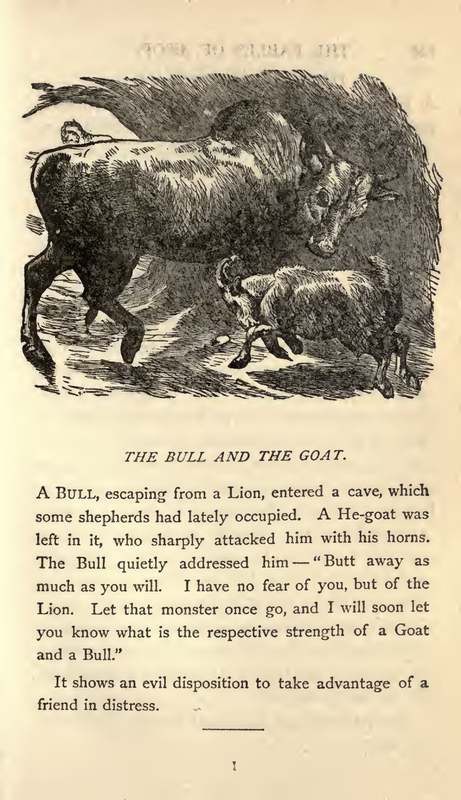
A bull and a goat are in a cave. The goat seems to be aggravated towards the bull. The goat has its head down and is galloping towards the bull in a manner that suggests it is about to headbutt the bull. The bull, who is ten times bigger than the goat, is looking down at the goat and doesn't seem fearful just irritated.
In this image we see the farmer from Brobdingnag picking up Gulliver and examining him, holding Gulliver between his fingers. This image shows the size difference between Gulliver and the Giants of Brobdingnag. A sheathe with a knife hangs from the giant’s waist. The Giant has long straight hair and wears short pants, a loose shirt and a vest over it. He stands amid the field of wheat where he found Gulliver. The same image appears in both the 1839 and 1843 Krabbe editions.
A group of Tupinambá people dance in a circle around a fire. There is a small open shelter with a thatched roof built over the fire. A few of the people dancing hold objects that resemble rattles, and several of the women have babies tied to their backs.
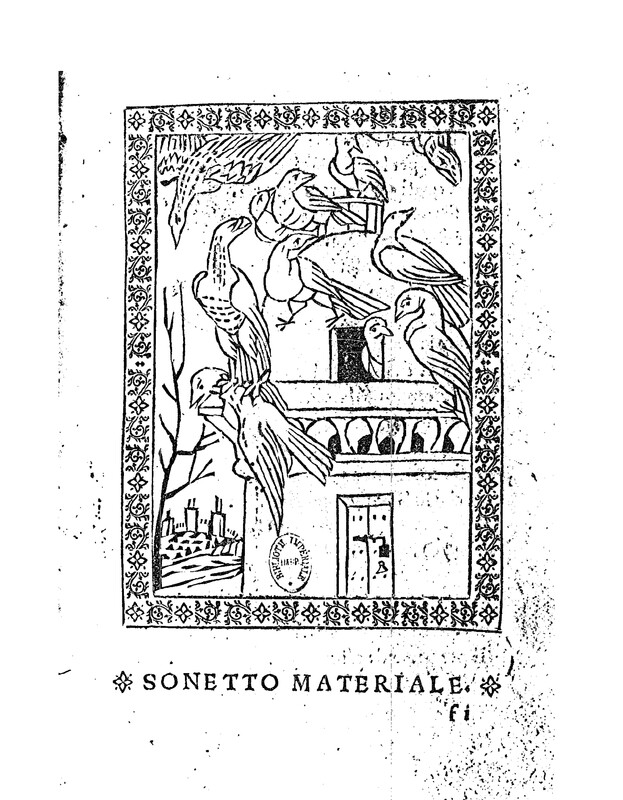
seven birds perched ontop of a building of what seems to be a house, one bird has it's head peaking out of a window. Tree with no leaves to the very left of the image. Image boardered by a pattern of vines. Stamped signature of Liberale de Verona on the bottom of the image
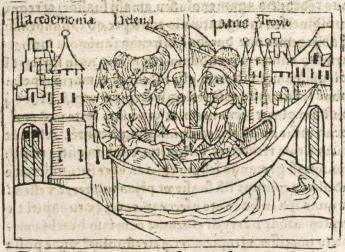
This engraving depicts prince Paris of Troy leaving the shores of Lacedaemon on a ship that contains queen Helen, wife of king Menelaus. Boccaccio explains that Paris had fallen in love with Helen while he was a guest in king Menelaus’ home. It is debated whether Helen’s feelings towards Paris were mutual and she willingly went with him, or if he had taken her by force. This image depicts Paris sitting on the right side of the ship (his name is engraved above his head), and Helen sitting on the left side (her name is also engraved above her head). Lacedaemon is illustrated on the left-side of the engraving, while the city of Troy is on the right side. The ship is pointing towards Troy as that is their destination. Paris and Helen going to Troy is the cause of one of the greatest wars of all time: The Trojan War.
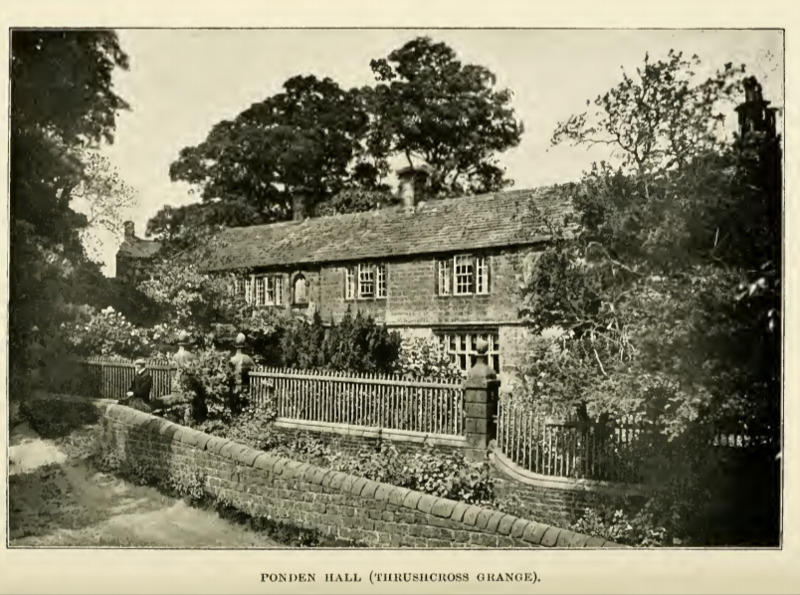
Here we see an image of Ponden Hall, a house on which Emily Bronte based the estate of Thrushcross Grange. In this image we see is taken from the road, looking at the gate leading up to the house. The image is a reproduction of a photograph using a technique called photogravure, where photographs are taken on plates which could then be etched on to create a plate for use in a printing press.
On a field, there is an old wooden shed. Inside the shed there is a small animal, possibly a calf or a kid. A wolf-like animal is standing outside the shed, sniffing out the small animal. Farther behind the shed, a cow is eating grass. And even further behind the cow, a small town is visible behind a row of trees.

![[An elderly man judges the correct interpretation of religion]](https://collections.cemvc.ca/files/large/053b6bb03322c7e1a0544240a9e545dc5e945bca.jpg)
![Sacristan de la S[an]ta Iglecia que Llama a Misa y Tane la Oracion](https://collections.cemvc.ca/files/large/5ba3f00fd6a28f94298d411e9fbe27ddd191b1d6.jpg)
![[Act IX]](https://collections.cemvc.ca/files/large/f0acb25b85daf488f9ad8419566d44c1bfd01f88.jpg)
![[the Lilliputian Emperor walks through a crowd of kneeling Lilliputians]](https://collections.cemvc.ca/files/large/0b355e51085a50e77a95976a9987502bae77f7a4.jpg)

![[Gulliver is picked up by the giant farmer]](https://collections.cemvc.ca/files/large/50911bc88332589ba013753f0cb6287e0f880bb2.jpg)
![[Tupinambá group dances around a fire]](https://collections.cemvc.ca/files/large/004de049a42c36ee0e10067304e5f8d29d2e505d.jpg)
![[The Small Animal in the Shed, the Wolf, and the Cow]](https://collections.cemvc.ca/files/large/e7a2d38b37662d6629d1107c26018f20652575fc.jpg)