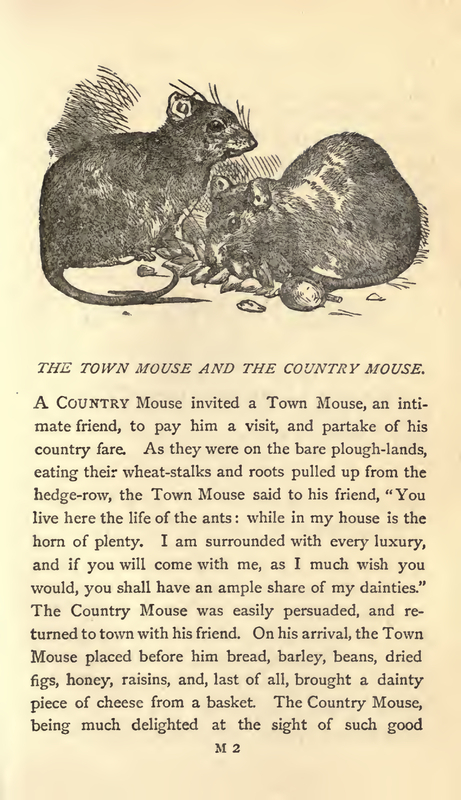
There were two mousses in this picture, one is thin and the other is fat. The fat one was eating the fruit on the ground while the thin one didn’t eat and just looked the fat one ate
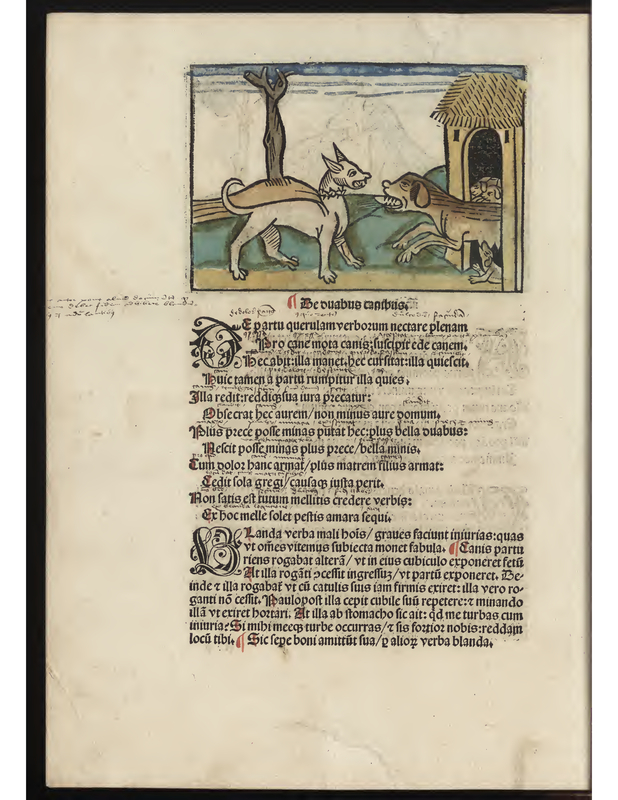
A dog on the right-hand-side of the image is seen lunging out of a hut, towards another dog outdoors. There is a tree atop a hill with no leaves in the background.
Inside the village, two Tupinambá men lower the body of a third man into a grave. The deceased man has been wrapped in cloth. Around the burial site, women crouch with their hands over the faces in mourning, and two women hold each other by the shoulders in comfort. There is a sick man lying in a hammock near the grave site, being tended to by a man who holds a ceremonial/decorative staff.
In this image Gulliver kisses the hand of the Empress, who greets him while standing on the balcony of her apartments. The Empress wears a dark dress and a tall headpiece with a veil down her back, attached to the headpiece. This image comes after Gulliver climbed over the wall of the imperial palace and was able to look around. One of the Empress’ attendants stands behind her. The same image appears in both the 1839 and 1843 Krabbe editions.
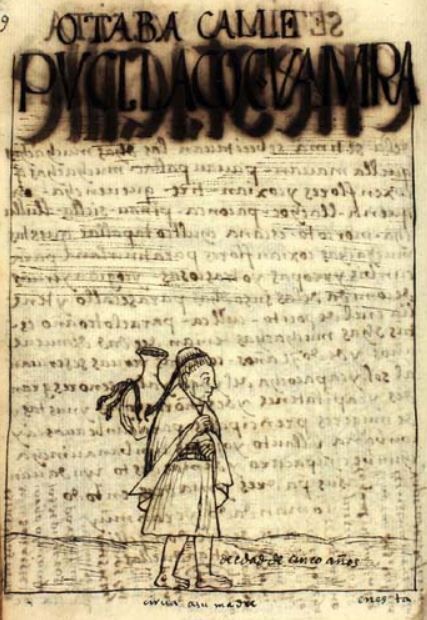
The author explains that there were ten paths for women to follow in the Inca Empire based on age division. This group was called pucllacoc uamra [playful child] and they were aged from five to nine years old. Their duties included serving their parents and nobles, gathering firewood, collecting water, and learning to cook and clean. The author explains that these young girls were often violated by the Spanish colonizers. The young, short-haired girl in the image is depicted walking barefooted as she carries a jug of water on her back. The caption on the image reads “de edad de cinco años, cirua a su madre,” which translates to “five years old, she serves her mother.”
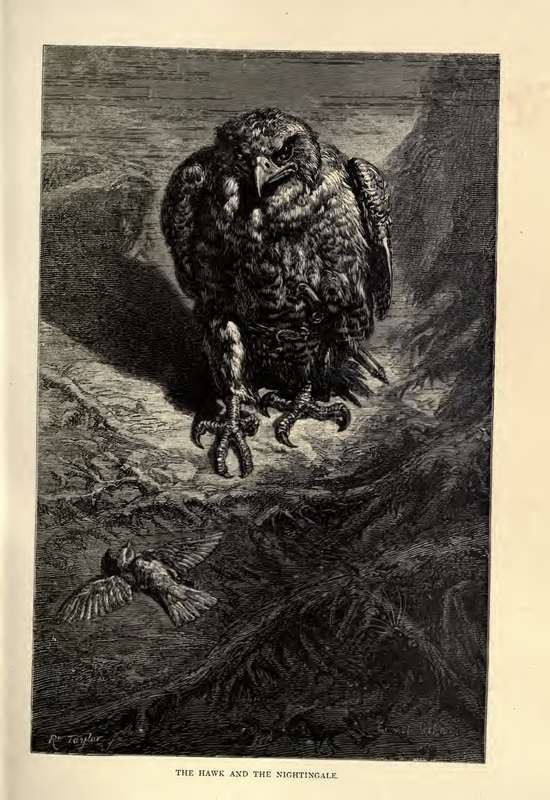
A large hawk is on the ground amongst the tree roots. It is looking down at the ground where a nightingale lies on its back, with both its wings wide open, as though it had fallen off a tree or down from the sky.
There is an illustration at the center of the page; above and below this illustration are bodies of text. In the illustration, three men can be observed. The person left most of the illustration has a long beard and is wearing a crown whilst holding a long object in his right hand. Towards the right of this man is a man conversing with him. Towards the right of the illustration is a man holding a structure of a smaller stature. A flying bug can be seen flying above in the background and another one on the structure.
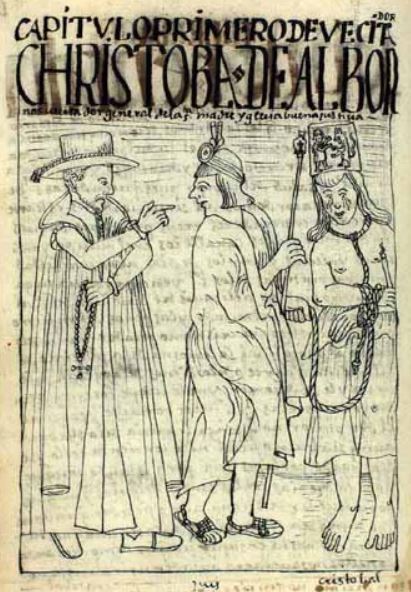
This image depicts Cristobal de Albornoz, a general inspector for the Holy Church, on the left side of the image holding a rosary and pointing to the indigenous man on the right side of the image. Cristobal de Albornoz punished indigenous peoples who practiced witchcraft and who still believed in their old gods. The author praises him for doing everything in the service of God. This image depicts Albornoz punishing an indigenous sorcerer with the help of his indigenous assistant. His assistant is holding a rope that is tied to the sorcerer’s neck and hands. Those convicted of witchcraft would be forced to wear a penitential cap on their heads and, while bound by rope, be taken to a public procession.
Two children, a boy and a girl, stand huddled under a large umbrella, their backs turned to the rain which is coming at them from the right at a steep angle. Behind them, to the right of the image, the letter W from “We” is beneath an arch.
A large European ship is anchored near the coast. Several Tupinambá people in a canoe float alongside the ship, with two European men in the canoe communicating with the men on the ship. There are two other canoes nearby, and two large sea creatures swim in the open water. A group of European men have used a rowboat to go ashore. The rowboat is tied to a stake along the shoreline and the men gather around a large bonfire.
In this image. Gulliver sits reading at a table. This appears during the first chapter where Gulliver introduces himself. The image represents Gulliver studying to become a surgeon, so that he could join a ship. Several busts, a skull, and the skeleton of a small animal are visible on the shelves behind Gulliver, along with various medicine bottles. The same image appears in the 1839 Krabbe edition.
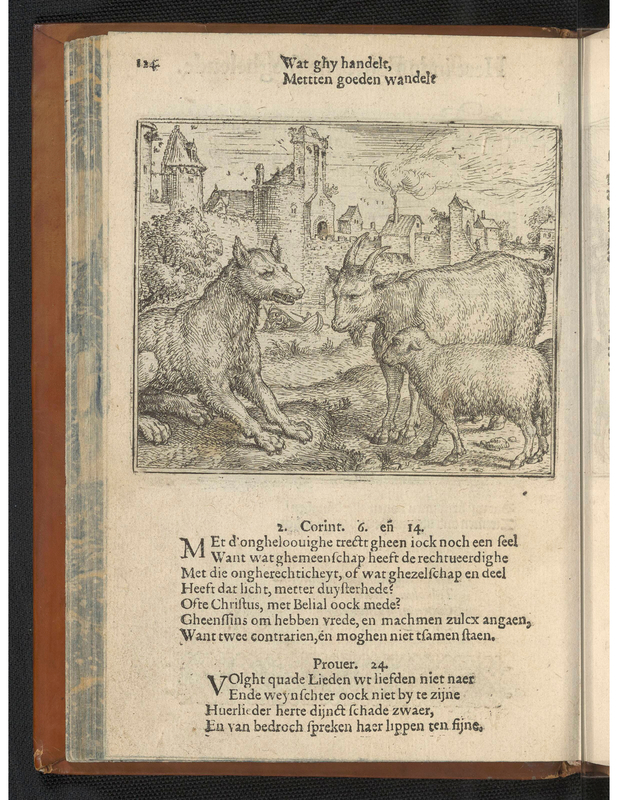
The lamb and the wolf'; a lamb and a ram at right standing before a wolf at left; in the background we see a castle; Dutch letterpress on verso; illustration to Eduwaert de Dene's edition of Aesop's Fables, De Warachtighe Fabulen der Dieren (Pieter de Clerck, Bruges: 1567). c.1567
A man, representing William Dobbin, mounted on a rearing horse points a spear with a pennant at a winged serpent. The serpent, representing Mr. Osborne as Dobbin goes to inform him that his son has married against his wishes, is curved into the letter S from “So”.
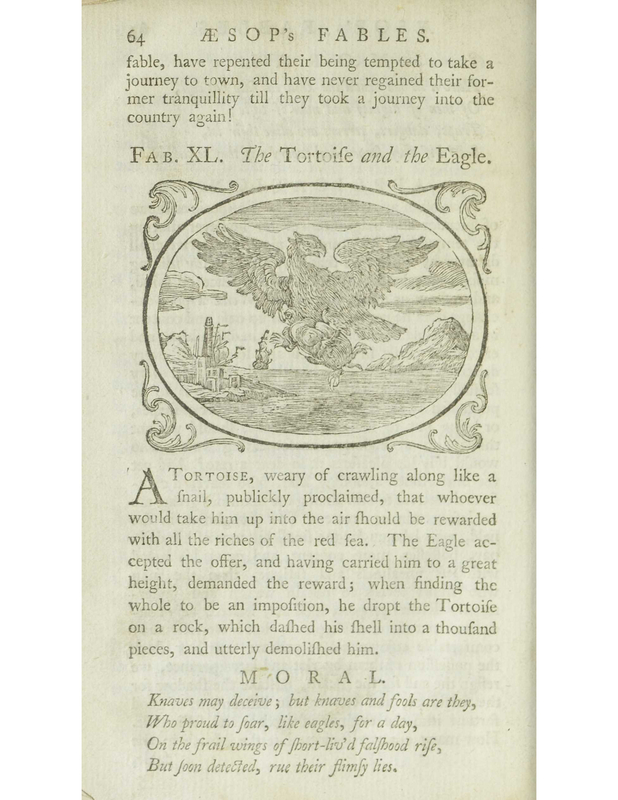
An eagle has its wings spread out, while looking to the right side of the image. It holds a tortoise in its claws while flying above a town which can be seen in the background on the left side of the image.
After Melibea ends her life, Pleberio returns to his bedroom in tears. His wife Alisa inquires as to the cause of his sorrow, and he informs her of Melibea’s death. She faints, and Pleberio pleads with her to awaken, that she may help to console his pain. Pleberio then engages in a lengthy and despondent soliloquy.[1) This illustration is odd, seeing as Act XXI occurs entirely within the bedroom of Pleberio and Alisa. Thus, the illustration does not directly correspond to any of the events in this act. Act XX also does not include the scene in which Melibea falls, only her last words before jumping. Thus, this illustration depicts a scene between Acts XX and XXI. 2) None of the elements in this illustration are found elsewhere in this edition.]
A thin man walks along a raised path. He has his cane and free hand out in front of him, and behind him is a small town in the distance. In the top right of the image is the letter W from “We”.
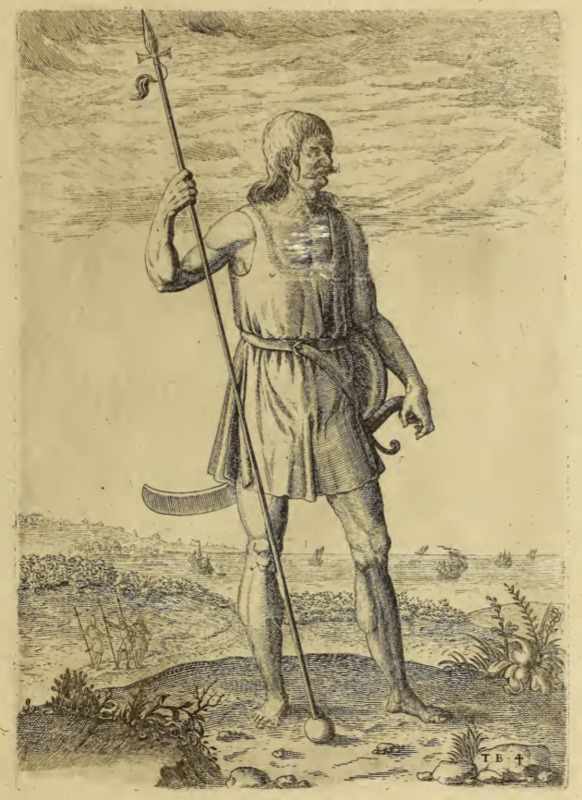
An Indigenous man is shown from the front. He carries a spear with a ball on the end in his right hand. He wears a belted tunic, and both a round shield and a sword with a curved blade hangs from the belt around his waist. This man is described as belonging to an Indigenous group that lived near the Picts. The Picts were an Indigenous group who lived in Britain long before the author’s time. Images of Picts were included in this book so that readers could compare their customs to those of the Indigenous people living in Virginia.
Joseph Sedley sits on the roof of the cabin on the boat from England to Belgium. Beside him on the bench are a cup and bottle of beer. He is dressed in his military coat, holding a long pipe, and looks very comfortable and relaxed.
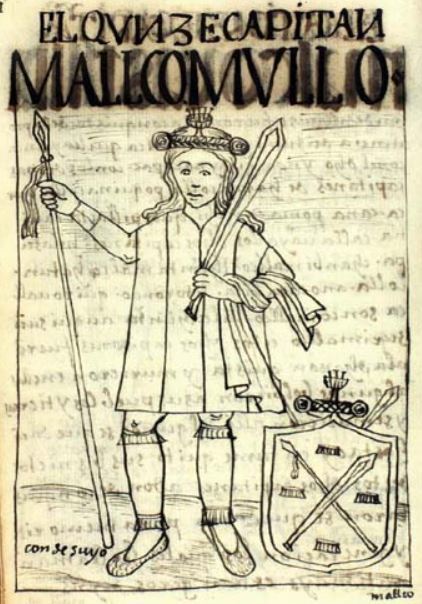
This image depicts the fifteenth captain, Mallco Mullo. These captains were a level of Inca authority who helped lead the conquest of the Andes. The captain is depicted standing in the centre of the image with a long spear in his right hand and a sword in his left hand. His shield is illustrated resting on the ground by his feet. The author explains that this captain helped conquer many regions for the emperor Huayna Capac. The word “condesuyo” is written beside his left foot. Condes was a region within the Inca Empire.
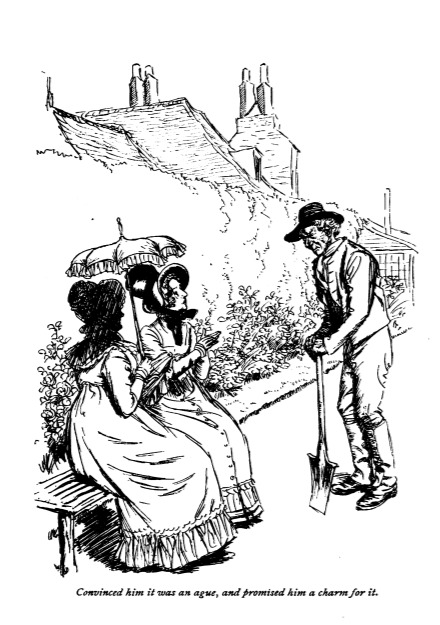
Here we see Mrs. Rushworth and Mrs. Norris speaking with Mrs. Rushworth’s gardener at Sotherton. While visiting Sotherton, Mrs. Norris walked through the gardens with Mrs. Rushworth, the lady of the house. They did not walk through the extensive grounds of the estate, choosing instead to stop and speak with the gardener about his pheasants. He showed the women the gardens, and the dairy, giving Mrs. Norris some of his famous cream cheese and a pheasant to bring home. This scene occurs in chapter 10. The characters are shown in the traditional regency style. The women are wearing regency style dresses and coats with empire waists and bonnets. Mrs. Norris holds a parasol to shade her from the sun. The gardener wears a waistcoat and long pants with a sun hat. The regency period dated to the early nineteenth century (1811-1820) when George, Prince of Wales, later George IV (r. 1820-1830), reigned as regent for his mentally ill father, King George III (r. 1760-1820). The regency period is associated with the rise of neoclassicism in art and fashion.

![[Tupinambá people tend to their sick, bury their dead, and mourn]](https://collections.cemvc.ca/files/large/d3b54d087f3f56db65a1cc5dcfd1623f2785588a.jpg)
![[Gulliver kisses the hand of the Lilliputian Empress]](https://collections.cemvc.ca/files/large/cf63294fef4717c9fbc7dd1bbc7c1adb6c7ecdb2.jpg)
![Vita et Fabulae [A man wearing a crown converses with a man in Holy attire as a third man stands at the back]](https://collections.cemvc.ca/files/large/57ea8222314c2e39d052362e8c75eb2fd3f6eecf.jpg)

![[Vanity Fair Chapter XXXVIII Inhabited Initial]](https://collections.cemvc.ca/files/large/849231c560b3ee7bc8381614f05f3bb34862ce87.jpg)
![[A European ship anchored near the coast with Tupinambá canoes nearby]](https://collections.cemvc.ca/files/large/729b1464ecbac7e5c33a5c7d0378701226538521.jpg)
![[Gulliver studying medicine]](https://collections.cemvc.ca/files/large/4ec351f3de61a8ae9f25955ea31a4f92fd0bb10b.jpg)
![[Vanity Fair Volume I. Chapter XXIV Historiated Initial, S]](https://collections.cemvc.ca/files/large/7b75ebc8d2e5d487acf10d8132f03e91e9de5609.jpg)
![[Act XXI – Death of Melibea]](https://collections.cemvc.ca/files/large/0c0e24972a82a816ba27fefa3ff03b21cb9ac6ab.jpg)
![[Vanity Fair Chapter XXX Inhabited Initial]](https://collections.cemvc.ca/files/large/00613b225147a3b8090cef03b02956d453eaadc8.jpg)
![[Joseph Sedley on the Boat]](https://collections.cemvc.ca/files/large/ede0de313222756bda31f7449dbf6b437d4c8126.jpg)