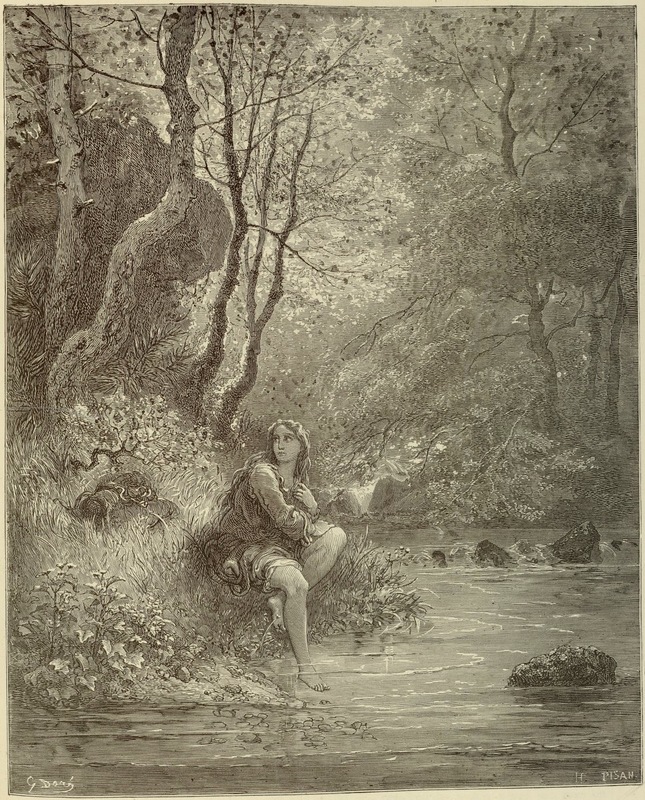
Cardenio, the priest, and the barber encounter a boy dressed as a peasant at the foot of an ash tree, washing his feet in a stream. The boy (Dorotea) wears a short dun-coloured jerkin, breeches and leggings of coarse dun wool, and a dun cloth cap. They are stunned by the whiteness and beauty of the boy’s feet and silently approach him. The illustration depicts the moment Dorotea hears the three men. Signed by G. Doré (illustrator) and H.-J. Pisan (engraver). Part 1, ch. 28.
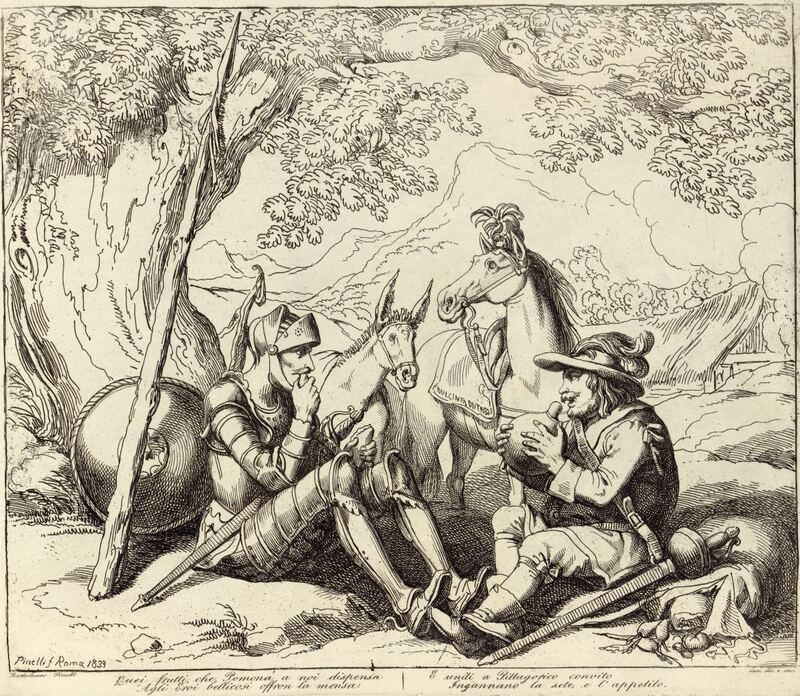
Don Quixote and Sancho Panza discuss the rules of the chivalric profession and what knights errant eat. Signed by Bartolomeo Pinelli (engraver and illustrator) and dated Rome, 1833. Plate 17. Part 1, ch. 10.
Teresa Panza (right), dressed in cap and bodice, plants her face in a cloth and wipes tears from her eyes. Sancho Panza (left) stands next to her with his arms hovering around her in a consoling manner. On the left, a hat rests upside down upon a stool.
Cardenio recounts his story to Don Quixote, Sancho Panza, and the goatherd. He asks them not to interrupt him because he would like to pass quickly through the tale of his misfortunes. Signed by T. Stothard (illustrator) and J. Heath (engraver). Plate XIV. Part 1, ch. 24.
Don Quixote lies on his deathbed adorned in a loose white shirt and cap, his right hand to his chest holds a cross, his left hand raised in the air abiding. Sancho Panza (left) looks on sorrowfully at the bedside with his hat in his hand, the priest stands to the left of Sancho holding his hand to his chest. On the far left a notary sits at a table writing Quixote's will.On the right, Quixote's housekeeper holds a steaming bowl, his niece wies her eyes with a handkerchief and a man stands with his arms crossed by a dresser.
Don Quixote (clad in armor) faces left and grasps the handles of a large straw winnow with purpose to begin winnowing the barley. This he does to oblige the man with many halberds into telling him the tale of how he came into possession of his halberds.
Having grown sedentary within the duchess' castle, Don Quixote (right), clad in full armor, departs for adventure upon his horse. In his left hand Quixote holds a spear while in his right hand he holds a shield, and stopping for a moment he looks up and towards the left. To Quixote's left, Sancho Panza can be seen upon his donkey riding straight ahead. In the top left in a tower of stone women wave handkerchiefs in bidding farewell to the knight and his squire.
A man in expensive clothing walks down a dirt road with a heifer by his left side. He holds the rope with his left hand and a walking stick in the right. In the background a small village can be seen. The image is occasioned by Sancho Panza saying "' When they give you a heifer, make haste with the rope, and when good fortune comes, be sure take her in" (Page 50).
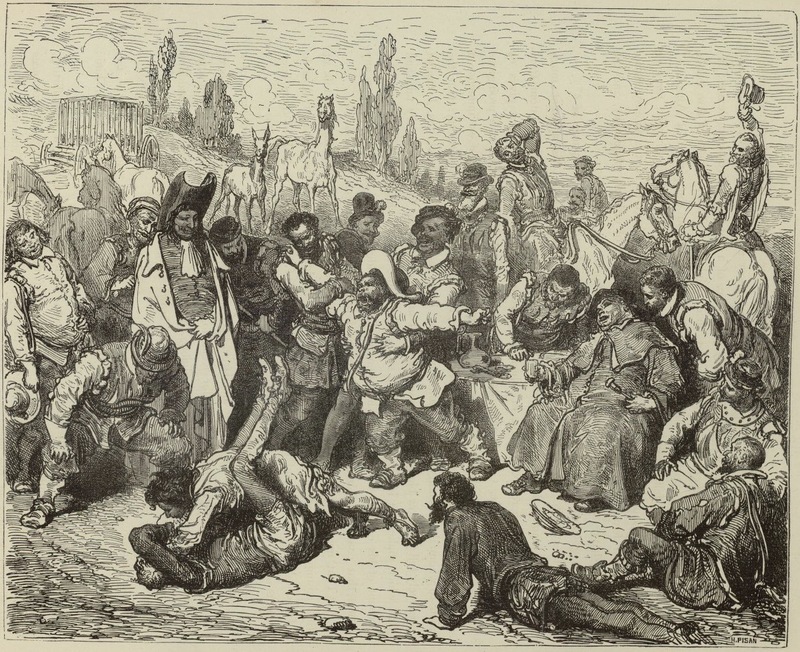
After Eugenio provokes him, Don Quixote seizes a loaf of bread and hits the goatherd with it full in the face. Eugenio leaps on Don Quixote and wraps both hands around his neck. Sancho Panza rushes to help Don Quixote, but is held back by the canon’s servants. The canon, the priest, the barber, and the officers of the Holy Brotherhood look on, some laughing. Signed by G. Doré (illustrator) and H.-J. Pisan (engraver). Part 1, ch. 52.
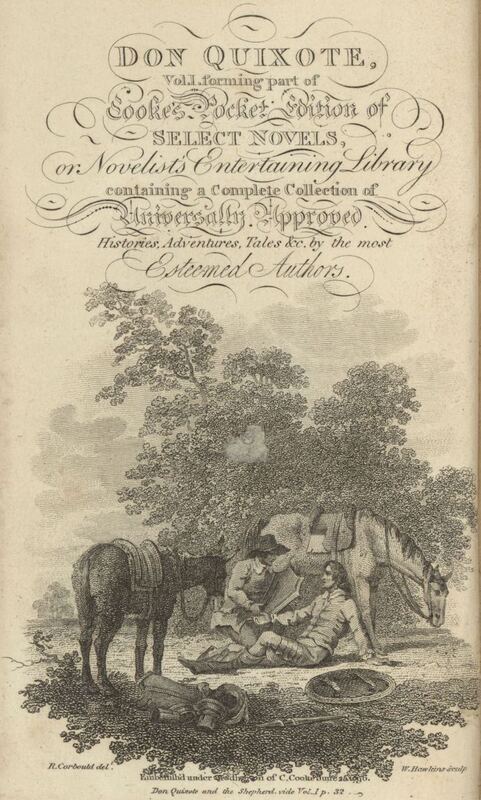
Vignette on title page. As Don Quixote approaches the chasm of Montesinos’ cave, a flock of crows and rooks surprises him, knocking him to the ground. Sancho Panza and the bachelor’s cousin are also pictured. Signed by R. Corbould (illustrator) and W. Hawkins (engraver), dated 1796. Part 2, ch. 22.
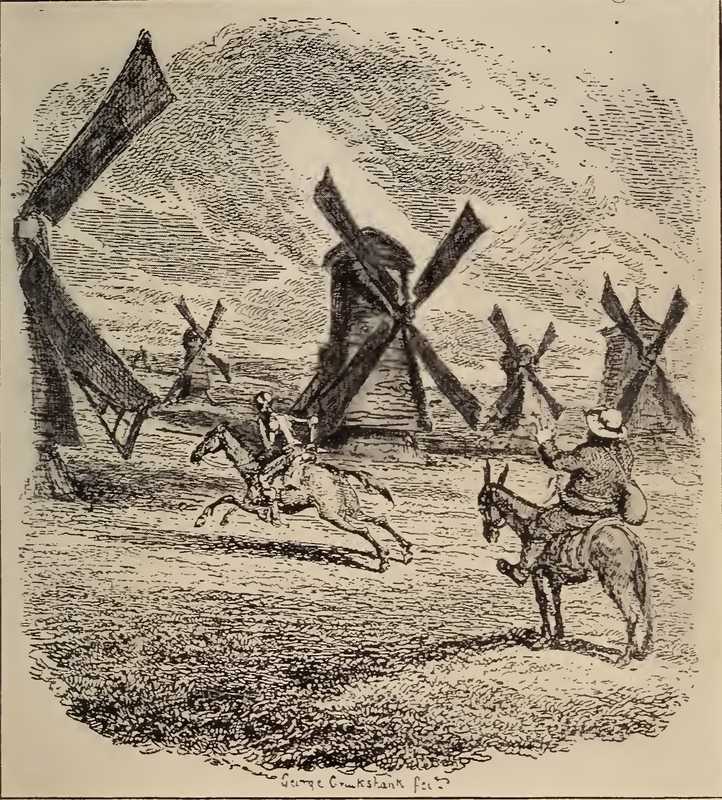
While travelling along the plains of La Mancha, Don Quixote (left), clad in full armor, spots some thirty or forty windmills in the distance and convinces himself that they are in fact monstrous giants. Sancho Panza (right) tries to convince the knight errant that they are windmills, but Quixote does not listen and charges towards the windmills at full speed with the intention of felling them. As Quixote charges at lance-point upon his horse Rocinante, the wind begins to blow and the windmills begin to spin, furthering his conviction that the windmills are giants.
Vignette on title page. After his encounter with the silk merchants of Toledo, Don Quixote recites the ballad of the Marquis of Mantua. Pedro Alonson, a farmer from Don Quixote’s village and a neighbour of his, passes by on his way home after taking wheat to the mill. Recognising his neighbour Alonso Quijana, Pedro gathers his arms and the broken pieces of his lance and ties them to Rocinante. Lifting Don Quixote onto his donkey, he leads it by its halter and Rocinante by its reins toward the village. Signed by R. Corbould (illustrator) and W. Hawkins (engraver), dated 1796. Part 1, ch. 5.
Sancho Panza (right) punches a bearded man (left) whose left arm is raised to strike Sancho with a beating stick. Both men are pictured fighting for possession of a saddle. Don Quixote, clad in full armor raises both fists, prepared to fight alongside his squire. On the left, the bearded man's companion raises his hands, perturbed by the violence. On the left in the background stands a donkey. In the center of the background a woman in a dressed in a gown and a pointed hat watches the brawl. In the background there is also an inn, out of which a man watches the brawl from the window with his arms crossed.
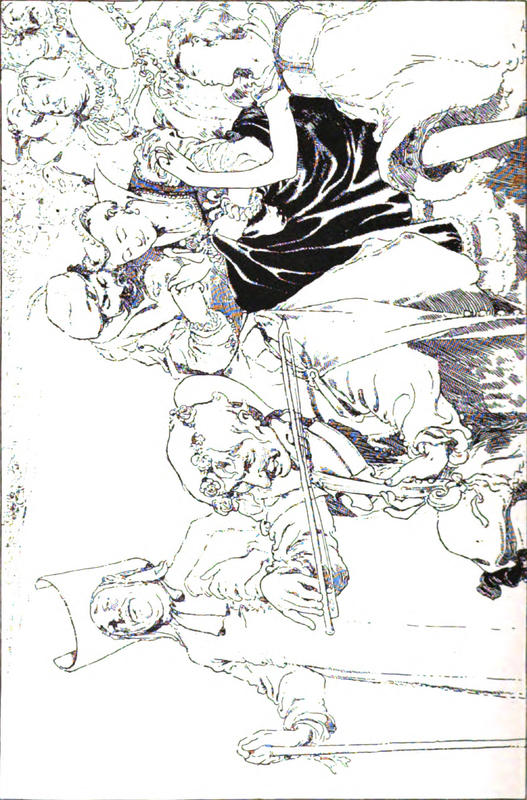
Don Quixote and Sancho Panza arrive at the wedding between Camacho and Quiteria. While traveling to the the wedding they overhear a discussion between peasants and students who are also on their way to the wedding. While Quixote and Panza are engrossed in the discourse they hear a great outcry and the ensuing procession of music. The bride and groom arrive at the meadow, surrounded by multiple kinds of musical instruments, accompanied by the parish priests.
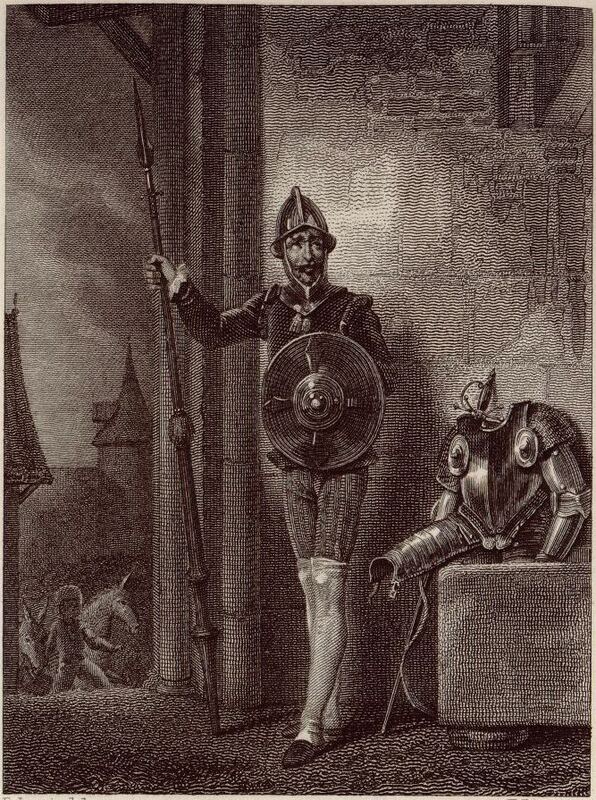
As night falls, Don Quixote gathers his armour and places it on a trough next to a well in a corral near the inn. Taking up his lance, he paces back and forth in front of the trough, standing vigil over his arms. The scene is illuminated by the light of a full moon. The muleteers are depicted in the background. Signed by E. Lami (illustrator) and E. Lignon (engraver). Part 1, ch. 3.
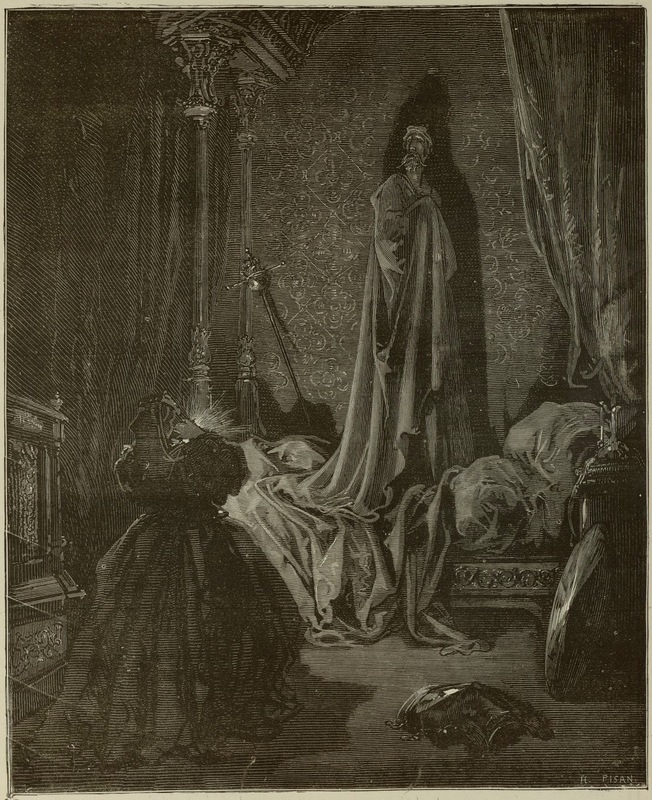
Doña Rodríguez, wearing a pair of spectacles and holding a candle, visits Don Quixote in his room at night. She discovers him standing on his bed, wrapped in his blanket, his face bandaged and marked by the cat’s claws. They scare each other, each believing that the other is a ghost. Signed by G. Doré (illustrator) and H.-J. Pisan (engraver). Part 2, ch. 48.
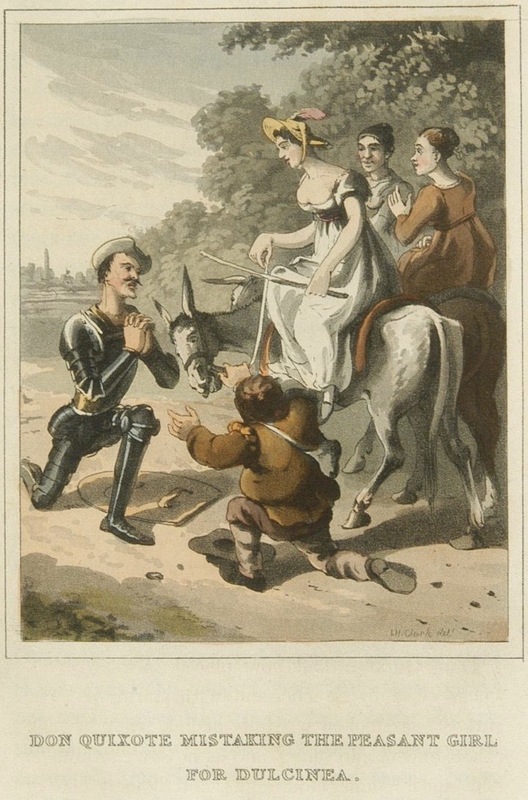
Don Quixote and Sancho Panza kneel before three peasant girls mounted on donkeys. Sancho introduces one of them as the enchanted Dulcinea. El Toboso appears in the background. Unsigned. Part 1, ch. 3.
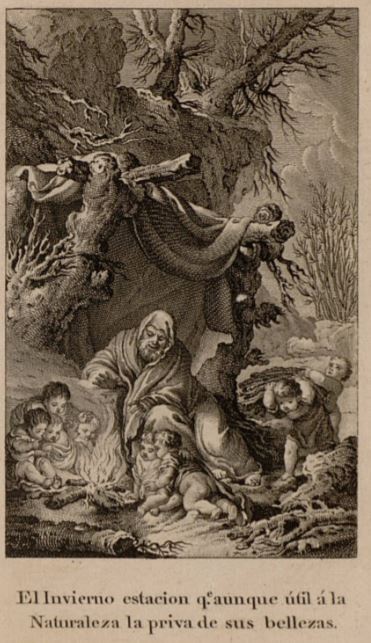
This image represents the season of autumn. The Golden Age of civilization had an eternal spring, but the god Jupiter created four seasons in the Silver Age of civilization. The god Bacchus (also known as Dionysus in Greek mythology) is illustrated sitting against a tree trunk as he sips on a goblet of wine surrounded by cherubs. There are cherubs flying above him as they provide shade with a large piece of fabric. Bacchus is the embodiment of autumn as he is the god of wine and the grape harvest. He is often depicted in iconography in an autumnal setting.
The Duke and the Duchess prepare a wooden horse for Don Quixote so that he may enter into single combat with the giant Malembruno halfway across the country. They explain that the wooden horse which they call Clavileno will transport themthrough the air to the place where Malambruno attends their coming. However, the condition is that they must blindfold their eyes, or else the dazzling and stupendous height of their journey will make them giddy. Instead they must not peek and instead let the neighing of the wooden horse inform them that they have arrived. Once blindfolded, the waiting-women and all the company started shouting their goodbye's pretending that Quixote and Sancho had already taken flight. To make their flight feel all the more realistic, some of the onlooking company took out bellows and blew them in the direction of Quixote and Sancho Panza. This action was followed by two servants taking some flax , with other combustible matter, attaching them the end of a long stick ,and setting them on fire at a small distance from Quixote's nose so the heat and smoke would affect the knight and his squire.
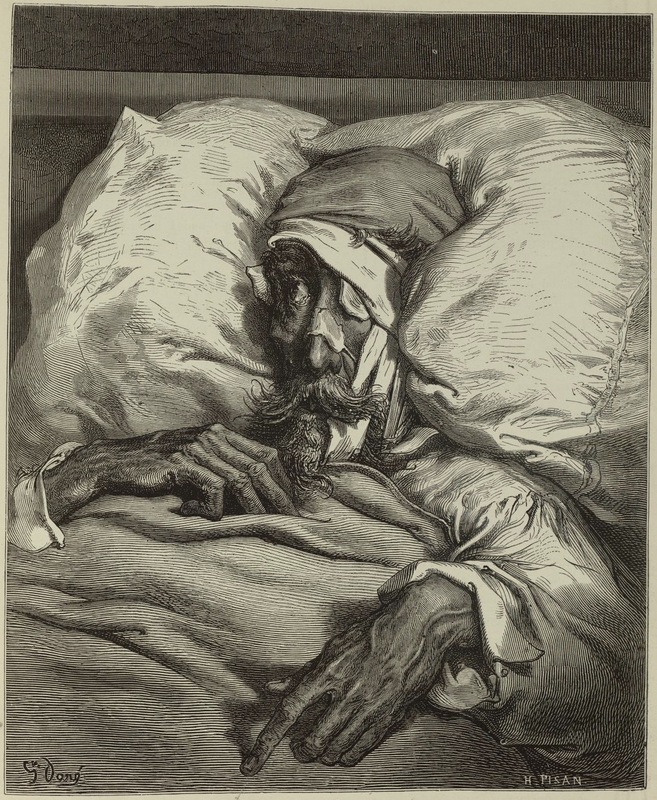
Don Quixote, his face bandaged and marked by the cat’s claws, lies sleepless in bed. Signed by G. Doré (illustrator) and H.-J. Pisan (engraver). Part 2, ch. 48.
As four travellers (left) arrive to the inn, Rocinante moves toward one of their mares, leaving Don Quixote hanging from the window by his hand. Hearing the knight’s cries for help, the innkeeper appears at the entrance of the inn (not pictured). Signed by E. Lami (illustrator) and E. Lignon (engraver). Part 1, ch. 43.
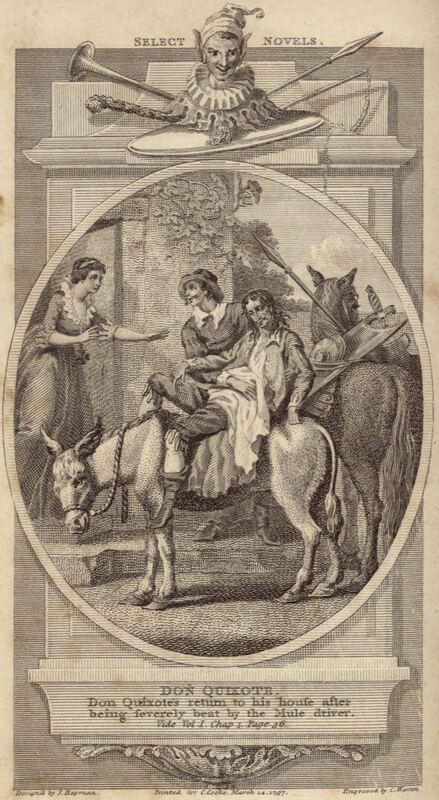
Don Quixote returns home from his first sally, mounted on Pedro Alonso’s mule. Rocinante carries Don Quixote’s shield, lance, and armour. The niece welcomes the travellers. The illustration is set in a decorative and architectural frame, complete with a jester’s head, lance, whip, and trumpet. Signed by F. Hayman (illustrator) and C. Warren (engraver), dated 1797. Part 1, ch. 5.
Having planted himself in the middle of the highway to Saragossa, Don Quixote is confronted by a stampede of bulls. A man with a lance in his left hand rears his horse (left) and tells Don Quixote to get out of the way of the whole herd of fierce bulls. The stampede of bulls is headed by three large bulls with powerful horns. In the background a group of herdsman equipped with lances follows behind the stampede. Don Quixote, clad in armor tries to crawl away from the herd while Sancho covers his head which is no longer covered by his hat for that has flown a little ways further down the road.
Don Quixote (left) pulls a long-sleeved shirt over his head, his ribs and stomach visible and malnourished. Sancho Panza (right) holds Quixote's cap and cloak in his right hand and his sword in his left. On the left stands a box upon which clothes are strewn. On the right there is a bed draped over with clothe, at the center of which a cross is nailed above the pillows. In the background there is a large door.

![[Sancho Tries to Comfort the Weeping Teresa Panza]](https://collections.cemvc.ca/files/large/ab170afd43e2adc2f9988d03e2b6c5cc94ca2abb.jpg)
![[Cardenio tells his story to Don Quixote, Sancho Panza, and the goatherd]](https://collections.cemvc.ca/files/large/e50d3b3e674bb0ab0478959c39bc4194a890fae3.jpg)
![[Don Quixote on his Deathbed]](https://collections.cemvc.ca/files/large/e5b0afe4f4ad239ba616d4b912d5923133389dc6.jpg)
![[Don Quixote Winnowing the Barley]](https://collections.cemvc.ca/files/large/dcd758186d9b8bb7570ada48d5e6dc7d70e41e32.jpg)
![[Quixote and Sancho Depart From The Duchess' Castle]](https://collections.cemvc.ca/files/large/aff32e585fe8f753589c8200bb5bb5ffa967adb0.jpg)
![[A Man and His Heifer]](https://collections.cemvc.ca/files/large/53725d43b7e4db865cc82656fab92ede1d1484ba.jpg)
![[Don Quixote surprised by a flock of birds at Montesinos' cave]](https://collections.cemvc.ca/files/large/1ce996cab915d07b531e54ac446859818633b29f.jpg)
![[Of How Sancho Fought for a Saddle]](https://collections.cemvc.ca/files/large/922818c50b85ab536148ccbf4ea4b46e66565773.jpg)
![[Quixote and Sancho Trampled by Bulls]](https://collections.cemvc.ca/files/large/ce143d46bbd8f2fe8d023da92c4c1ab3e8fd1e9f.jpg)
![[Quixote Dresses and Sancho Holds his Clothes]](https://collections.cemvc.ca/files/large/34d160a1281b5618d5755c46f2478f73aa182157.jpg)