A mother pig and her piglets are climbing up a small hill. One of the piglets is drinking water in a basin at the front of the image. In the lower right corner, a small hare wearing a suit and a hat has both its paws up in front of itself towards the pigs, possibly gesturing for them to stay put.
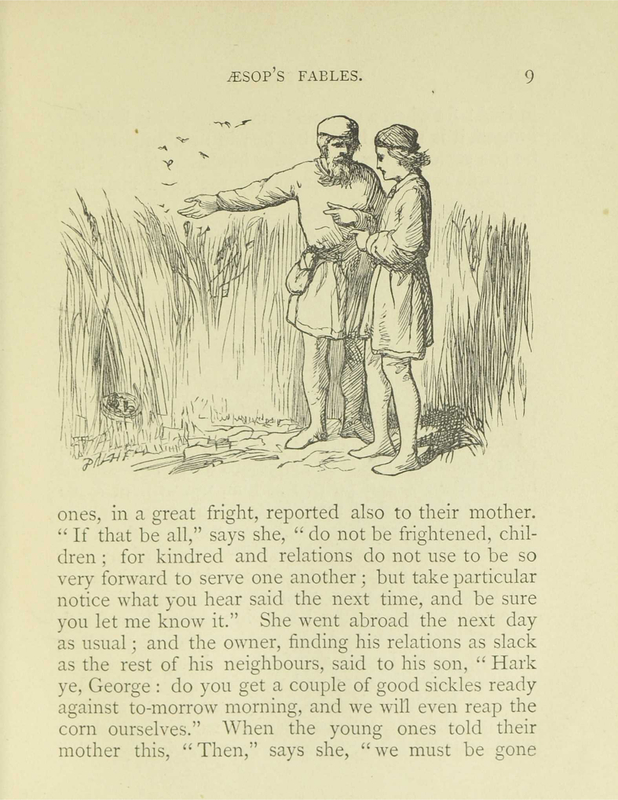
A lark, who had young ones in a field of corn which was almost ripe, was under some fear lest the reapers should come to reap it before her young brood were fledged, and able to remove from the place; wherefore, upon flying abroad to look for food, she left this charge with them-that they should take notice what they heard talked of in her absence, and tell her of it when she came back again
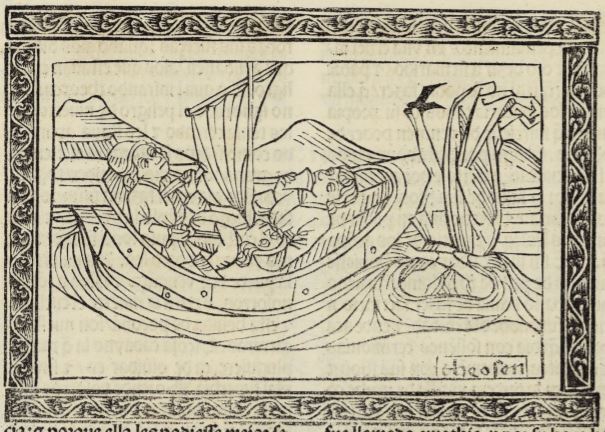
This engraving depicts Theoxena, her husband Poris, and her nephews and child killing themselves. Theoxena and her husband, Poris, are depicted jumping from the ship head-first into the sea to drown themselves. They are illustrated holding each other as they die as a couple. Theoxena’s name, written as “Theosen”, is engraved at the bottom right hand corner of the image to identify her. The figures on the ship are her nephews and her son, who are also killing themselves. Theoxena had given them a choice between stabbing themselves with knives, or to drink poison. There are two boys who had stabbed themselves and one child is depicted drinking the poison from a cup. Boccaccio explains that Theoxena and her family killed themselves to avoid dying at the hands of king Philip of Macedon.
Georgy Osborne in a top hat and suit, holds onto his aunt Jane Osborne’s hand, turned to face the boy who has come up behind him. He is a young sweep, barefoot and with ragged clothes, begging for money. The footman, carrying the church books, is behind the sweep, trying to drive him away with a cane. In the background is Amelia Osborne, who was going for a walk on the cross-street to the one the others are taking to church, watching proudly as her son gives money to the sweep. Below the illustration is printed its title and location in the story, “GEORGY GOES TO CHURCH GENTEELLY (p. 241.)”.
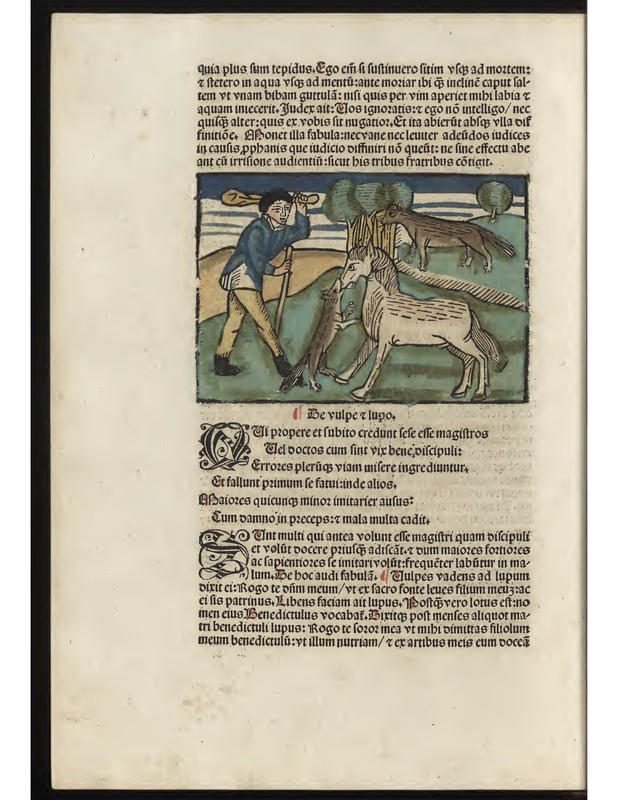
There is an illustration at the center of the page, above and below this illustration are bodies of text. In the illustration, a smartly dressed woman is dining and is wiping her face with a cloth. In front of this dining table, a man wearing a robe is feeding a dog with the contents on the plate, while holding the plate with his left hand and a bone with his right hand.
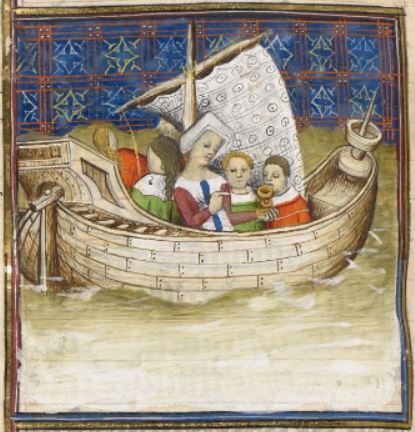
This illumination depicts Theoxena sitting on a ship with her nephews and child as they kill themselves. They are illustrated on a ship as they had attempted to escape King Philip of Macedon by sea, however, their ship was being pulled back to shore by the winds. To avoid dying at the hands of King Philip, Theoxena had given them all a choice between stabbing themselves with knives or to drink poison. Theoxena is depicted holding a chalice full of poison and forcing the children to drink it.
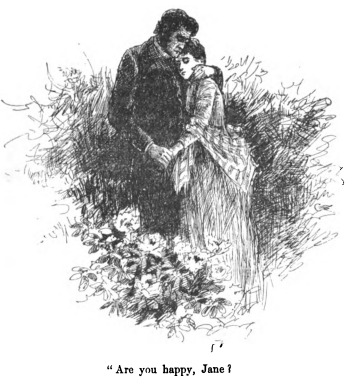
Here we see Jane Eyre and Mr. Rochester embracing. They are standing outside in the orchard at Thornfield. This scene occurs after Mr. Rochester asked Jane to marry him and she agreed. Jane came to Thornfield to be a governess for Adele, a young girl Mr. Rochester oversees.
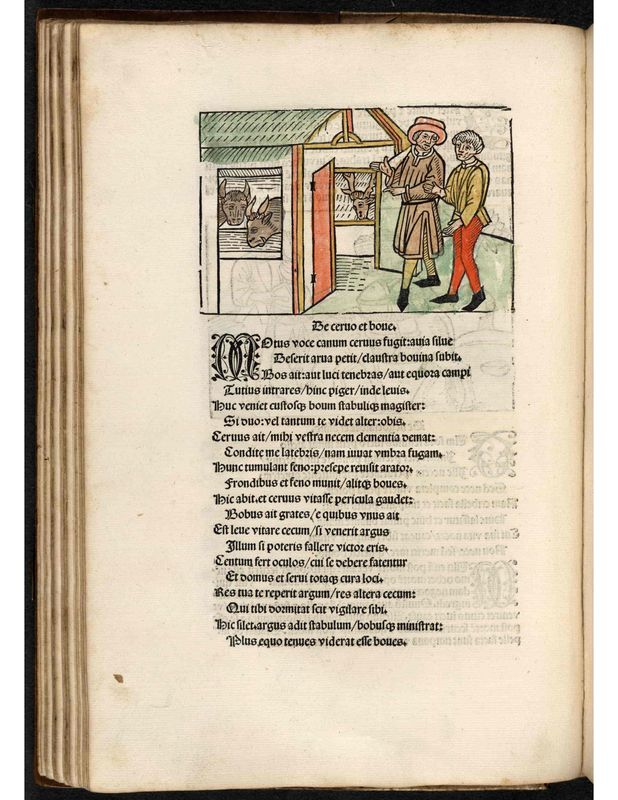
Two men stand in front and gesture towards a barn, inside of which two cows can be seen through a window. Through another window a deer can be seen behind the barn, looking in towards the cows.
An Indigenous man of the Tupinambá group is shown from the chest up, in order to provide an example of facial adornments worn by members of the group. The man’s head is mostly shaved with an area of hair on the crown of his head. His head is spotted with paint or tattoos. He has face stones on his cheeks and chin, and examples of the stones are shown on the right side of the image.
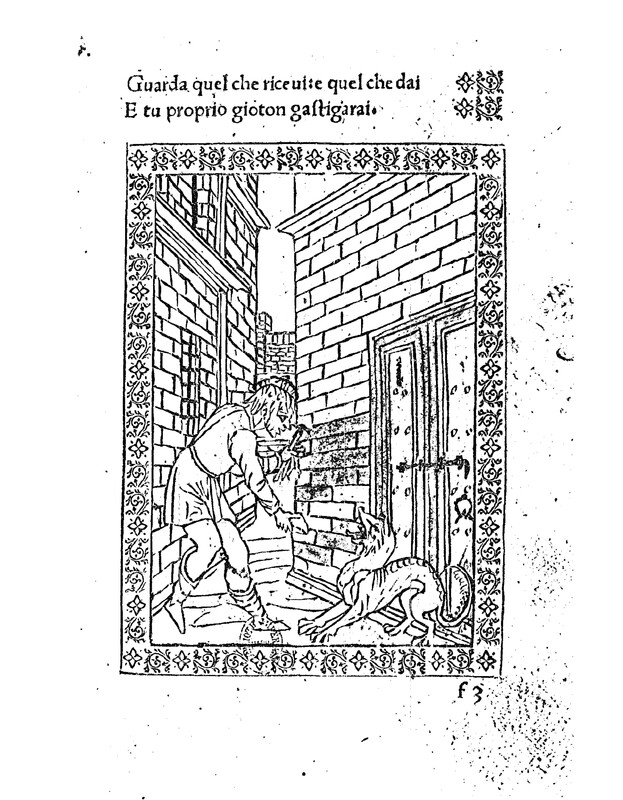
on the left side of the image a man looking frightened is in an alley way and seems to be fending off a mythical creature with what looks like a rock. On the right side There is a double door with a bar lock. All the buildings are made of brick. image is boardered with a design and a Stamped signature of Liberale de Verona is on the bottom middle of image
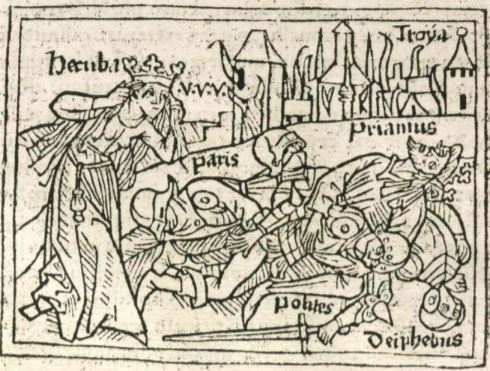
This engraving depicts Hecuba, the queen of Troy, on the left-hand side of the engraving with her hands pulling at her hair in grief as she sees her dead children and husband on the ground. We know that this is Hecuba as her name is engraved beside her head, and because she is wearing a crown. The city of Troy is illustrated in the background of the engraving, burning to the ground as it is engulfed in flames from the Greeks taking the city. The word “Troya” is engraved above the city. Her children Paris, Polites, and Deiphobus are among the figures laying on the ground. Their names are engraved in order to identify them. Priam, Hecuba’s husband, is also among those figures. Deiphobus, who’s body is in the bottom right-hand corner of the engraving, had his ears and nose cut off which is why his face is depicted the way it is in the engraving.
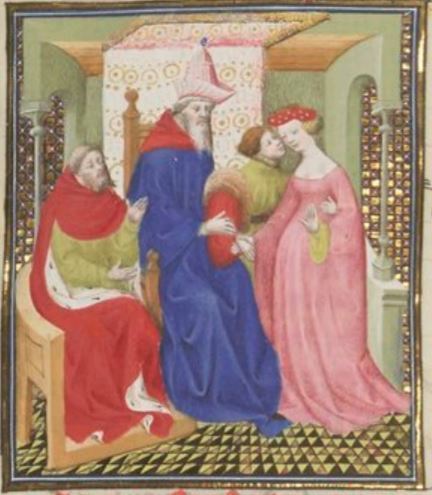
This illumination depicts the Florentine maiden named Engeldruda on the right side of the image wearing a pink dress. Engeldruda is famous for having spoken up against her father to protect her chastity. Boccaccio explains that Emperor Otho IV had gone to Florence for a festival, and when he noticed the beauty of Engeldruda, he asked her father who she was. Engeldruda’s father had offered her up to the emperor as if her chastity meant nothing to him. She rose up and spoke against her father for having done this. The emperor was so impressed with Engeldruda, he offered a nobleman named Guido to be her husband. Emperor Otho IV, Engeldruda’s father, and Guido are all depicted in the image. The emperor is most likely the figure depicted in blue, while her father is the older man on the left side of the image. Guido is assumed to be the one holding Engeldruda’s hand.
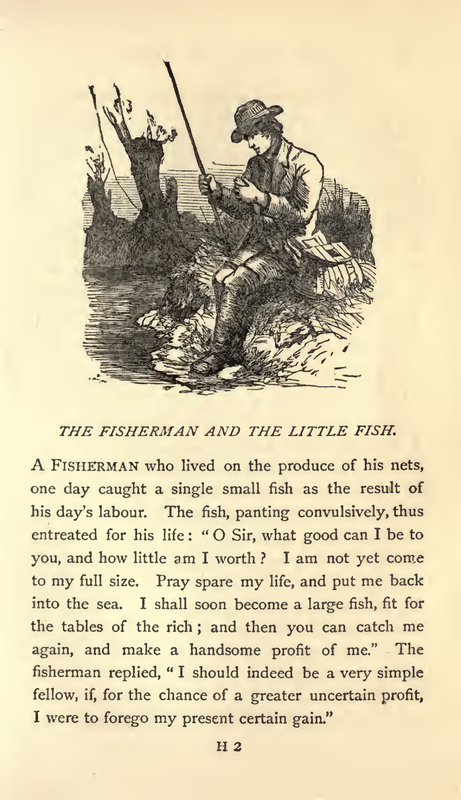
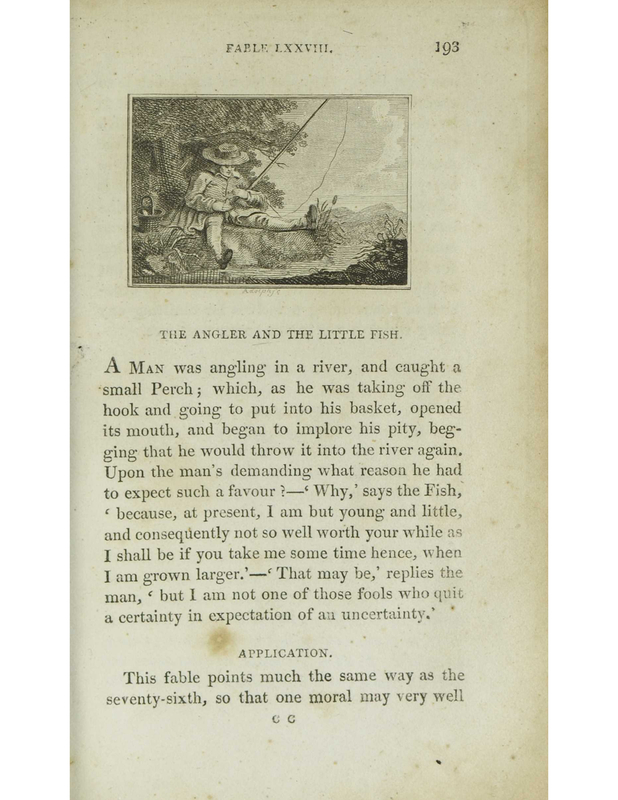
A man is sitting down on a river bank. He is holding a fishing net in his right hand and a fish in his left. He is looking down at the fish and seems to be talking to the fish.
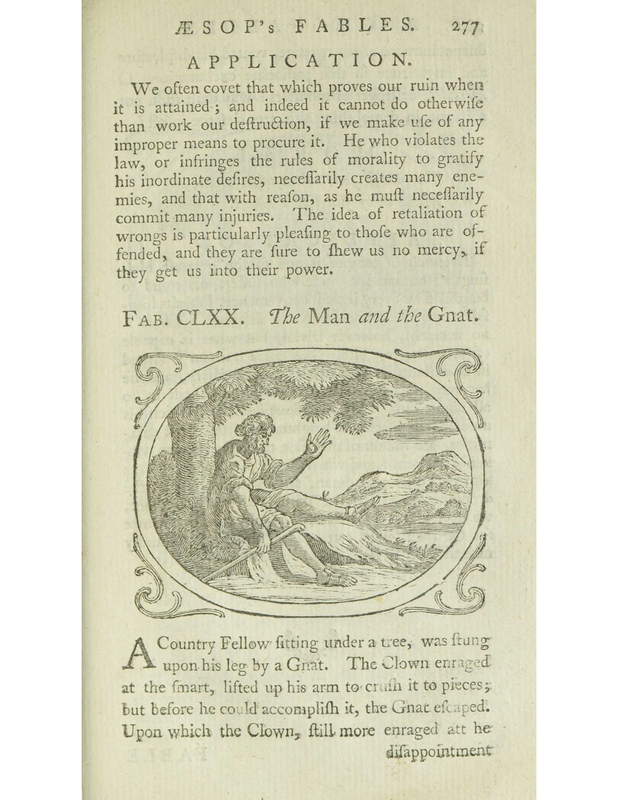
A man sits at the base of a tree. His legs are spread and he is looking down at a small bug. He holds a staff. He is talking and listening to the bug. The bug is represented as a small black dot.
Here we see a crowd of Lilliputians with Gulliver’s feet. Restraints can be seen around Gulliver’s ankles. In the foreground we see a Lilliputian dodging out of the way of Gulliver’s foot. This image appears at the end of Chapter One, and Gulliver is now at the castle in Lilliput, away from the shore.
In this image we see a depiction of the Emperor of Lilliput in front of a window looking out on the city. He holds a sceptre and wears a cape. In the background we see his sedan chair and a curtain blocking out part of the cityscape from view. In front of the Emperor is a crest with a lion and unicorn. This image comes when Gulliver is describing the practices and traditions of the Lilliputians. The same image appears in the 1843 Krabbe edition.
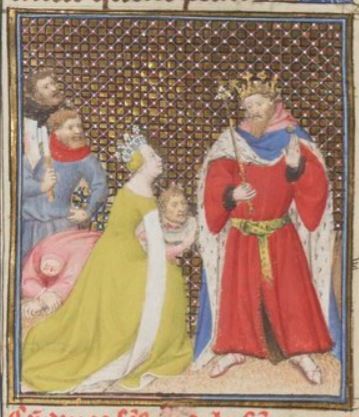
This illumination depicts the queen of the Galatians standing in the centre of the image holding a decapitated head. This woman’s name is unknown; however, she is the wife of King Drigiagon. After being taken as a captive by Roman enemies, the Galatian queen was defiled by a Roman centurion. To seek her vengeance, once she was freed through ransom, she ordered her servant to decapitate the centurion who raped her. The body of the centurion is depicted on the left side of the image with his head severed. The man who cut his head off is illustrated standing above the boxy with a bloody axe. The Galatian queen is holding the severed head as she presents it to her husband to prove that she was defiled by this man. Boccaccio explains that she wrote on this woman to highlight her daring and courageous nature.
Lady Rose Crawley, who looks worn down, enters the dining room on the arm of her stepson, Mr. Pitt Crawley. To the right of the picture, Sir Pitt Crawley stands behind the door, holding a jug in one hand. To the other side, through the open door, Rebecca Sharp can be seen talking to one of the Crawley daughters.
In the centre of the illustration, we see a female figure wearing a robe and a veil. There are two male figures to the left and one to the right. There are three male characters in this act – Calisto, Sempronio, and Pármeno. Areusa is the only female character in this act. Because Pármeno is her sole interlocutor, this illustration does not map onto the narrative of Act VIII.[This illustration is identical to those found in Acts IV (folio 32r), V (folio 42r), VI (folio 45r), X (folio 74r), XIII (folio 93v), XV (folio 102r), and XVII (folio 109r).]
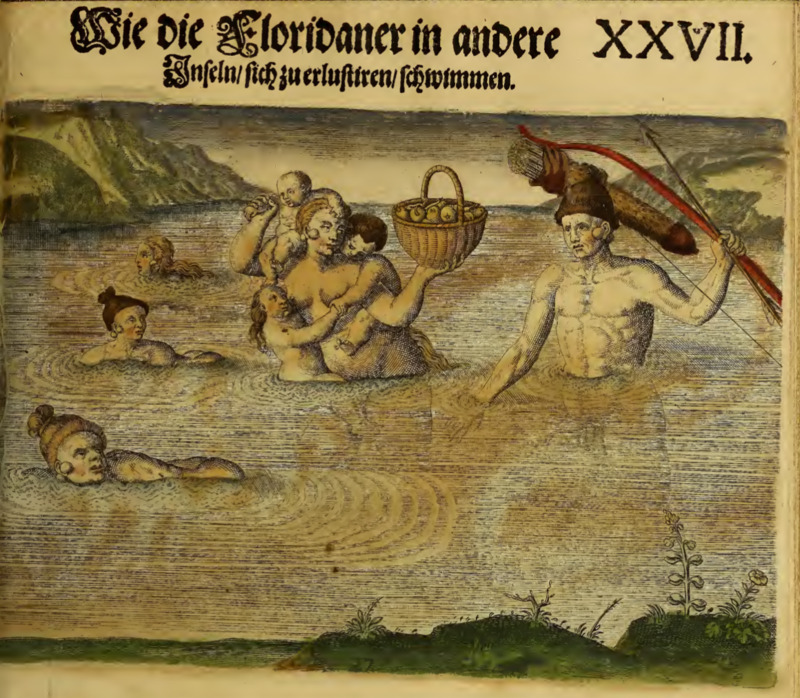
A group of Indigenous women, men, and children crosses a river towards an island. One woman carries a basket of food in one hand raised over her head, and three children cling to her. A man carries a bow and arrow, as well as a quiver of arrows above his head. This illustration is identical to the one found on page 95 of Frankfurt 1591, but colored.

![[The Pigs and the Hare]](https://collections.cemvc.ca/files/large/d1ce79ee536c77b0564c54e366925820db164722.jpg)

![Vita et. Fabulae [A man feeds a dog as a woman sits at a table]](https://collections.cemvc.ca/files/large/b5d06bb6fee6eb7fc121ba7a50f76e97f77efa68.jpg)
![[Facial adornment of a Tupinambá man]](https://collections.cemvc.ca/files/large/277b9a4b08cf6cc53fe24a5ffd4d79f11b73bfc3.jpg)

![[Gulliver’s foot in a crowd of Lilliputians]](https://collections.cemvc.ca/files/large/014706bb7c551af166090b55e79f359ea19a11cd.jpg)
![[Crest with the Lilliputian Emperor]](https://collections.cemvc.ca/files/large/b6e856eead2d750fff1687c18df2c9acc18a0d14.jpg)
![[Lady Rose Crawley]](https://collections.cemvc.ca/files/large/5bd8f891730cf574931979cf4f09a1c66caf0516.jpg)
![[Act VIII – A Female Figure and Three Male Figures Converse]](https://collections.cemvc.ca/files/large/9a6cad08cf15502b069f398afb129bc008abbb8c.jpg)