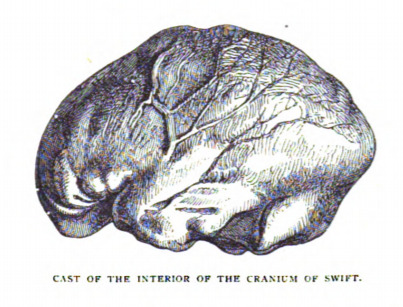
Here we see a cast of Swift’s cranium. After his death, Swift’s head was cut off and a cast was made of his brain. This was done as a way of immortalizing his life and work. This image appears as part of the biography of Jonathan Swift.
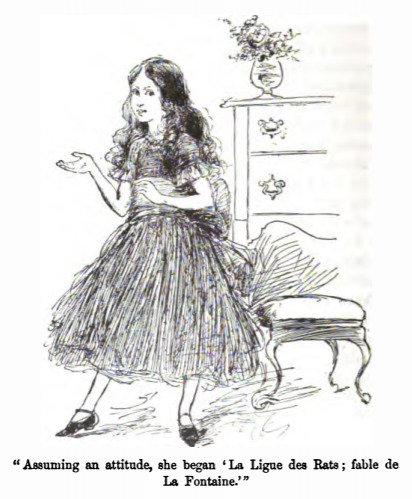
Here we see Adele reciting a French poem for Jane after her arrival at Thornfield. Adele enthusiastically began reciting and performing for Jane in French. When she arrived in England, she did not speak any English and Jane was tasked to teach her English, among other subjects.
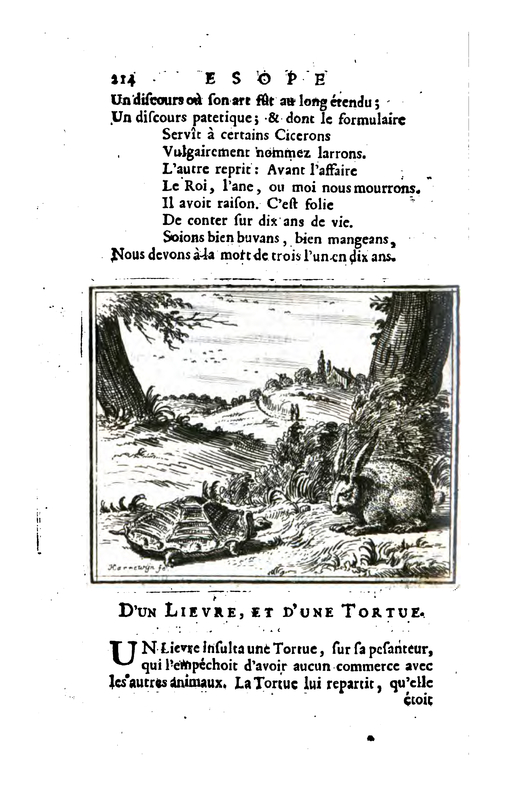
A hare and a turtle are facing each other in the bottom half of the image. The hare appears to be frowning at the turtle. There are two trees nearby, and the background is of grassy hills with a building in the distance. There are birds in the sky. The illustration has the signature of Harrewijn in the bottom left corner.
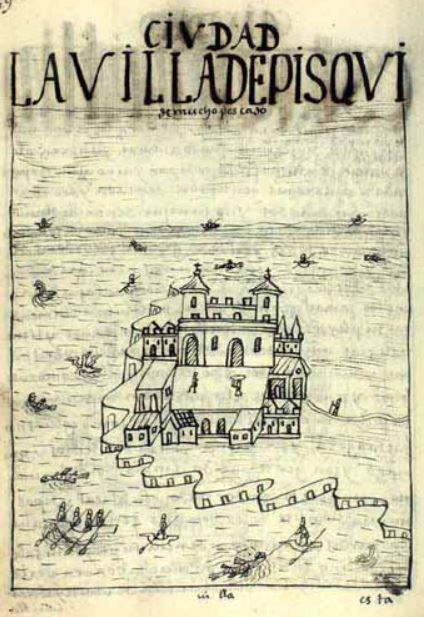
This image is depicted in the author’s chapter where he discusses cities, towns, villages, and provinces in colonial South America. This image depicts the small fishing town of Pisco, Peru. The town is depicted directly next to the water. The town is arranged in a cluster of buildings that forms a square in the centre. There are two people illustrated walking around in the square. There is a path leading into and out of the city on the right side of the image. There are boats, birds, and seals illustrated in the water surrounding the town. The caption at the bottom of the image reads “uilla” [city].
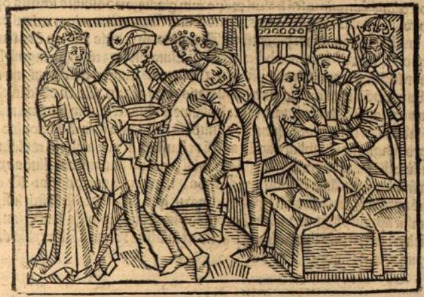
This engraving depicts Faustina Augusta, the wife of Emperor Marcus Aurelius Antoninus, on the right side of the image lying in a bed. There is a doctor hovering over her body while rubbing an ointment over her chest to cure her illness. Her husband, Marcus Aurelius is standing behind the doctor. Faustina Augusta had fallen ill due to being passionately in love with a gladiator. The doctor suggested killing the gladiator and using his blood to cure her of her sickness and overwhelming lust for him. Marcus Aurelius is also depicted on the left side of the engraving wearing a crown and holding a scepter as he watches his men kill the gladiator that his wife was in love with. One of the men is holding a bowl underneath the gladiators wounds so they can use the blood to treat Faustina Augusta.
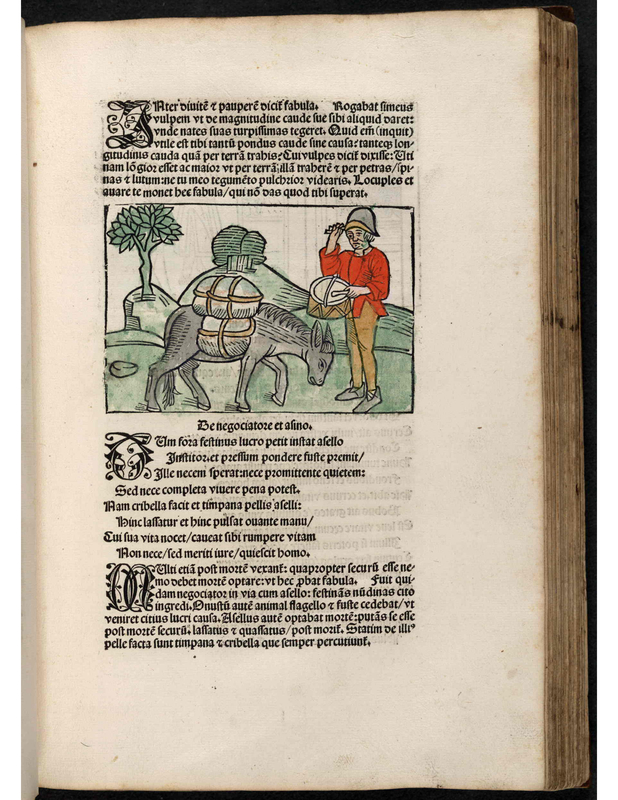
There is an illustration at the top of the page, and below this illustration is a body of text. In the illustration, three men are sitting at a table conversing and the man on the right of illustration is getting his feet washed in a small bowl of water by a person kneeling. The table contains food and utensils.
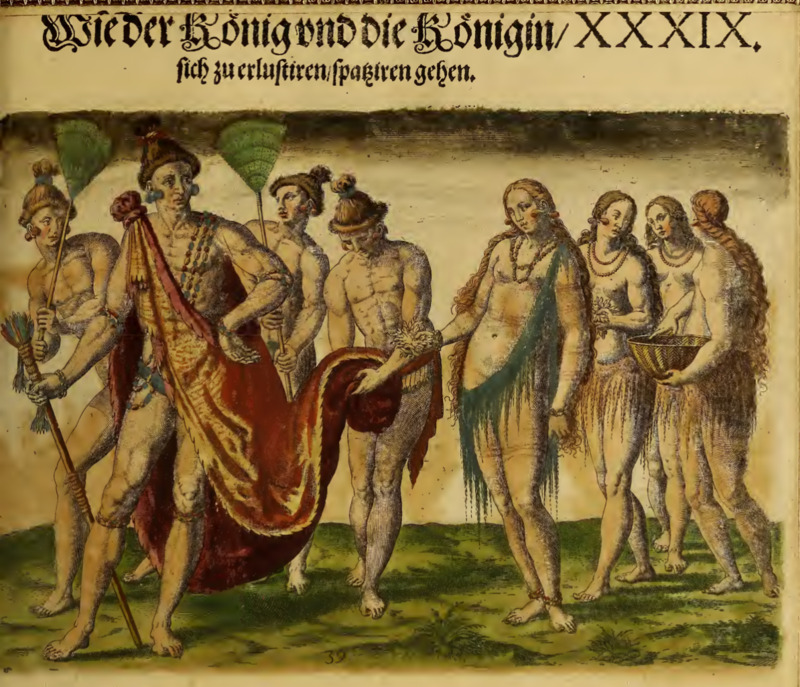
The king wears a robe tied at one shoulder and draping around his body and under his opposite arm. He wears several strands of beads draped from his other shoulder across his body, as well as around his arms and legs. In one hand he holds a staff with feathers at the top end. A man stands behind him and holds the end of the robe. Two other men stand beside the king waving long fans around him. A woman – perhaps the queen – stands slightly behind the king, and wears a garment draped from one shoulder around her body. Several women stand behind the group - one holds a basket and the others hold handfuls of leaves or herbs. This illustration is identical to the one found on page 123 of Frankfurt 1591, but colored.
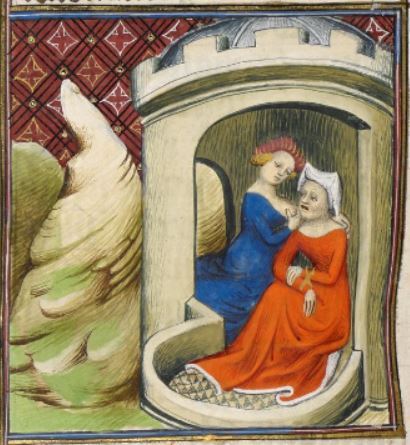
This image depicts the story of a young Roman woman who saved her mother from starving to death. Boccaccio explains that this young woman’s mother had been sentenced to death, and when she was locked away to die of starvation, her daughter saved her with her own breast milk. The young woman is depicted sitting down with her breast exposed as she provides milk to her mother. Boccaccio explains that he wrote on this unknown young woman due to her filial devotion.
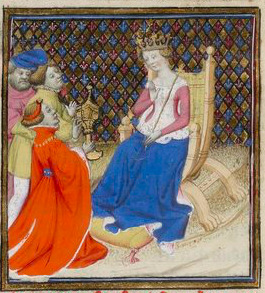
Joanna was known for many good qualities, one being her power. She was respected by many, and ruled vast land that comprised of many towns and cities. The image represents her receiving praise from her people while she sits in a throne. She wears a crown and accepts gifts from the thankful citizens.
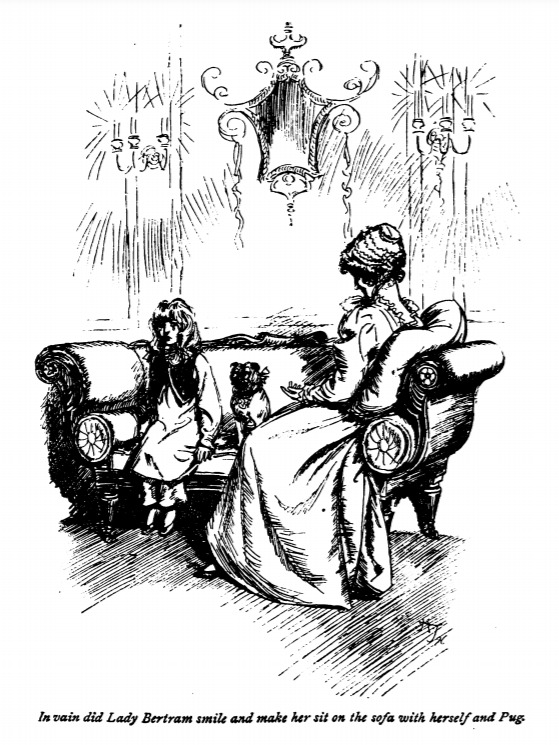
Here we see Fanny sitting on the couch next to Lady Bertram. This scene occurs when Fanny arrived at Mansfield Park. Here she is greeted by Lady Bertram and her pet pug, with whom Lady Bertram spent more time with than her own children. The Bertrams brought Fanny to live with them when she was ten years old to help relieve some of the pressure on her mother, who had several children and very little money. This scene occurs in chapter 2. The characters are shown in the traditional regency style. Fanny and Lady Bertram wear the regency style dress with an empire waist. The regency period dated to the early nineteenth century (1811-1820) when George, Prince of Wales, later George IV (r. 1820-1830), reigned as regent for his mentally ill father, King George III (r. 1760-1820). The regency period is associated with the rise of neoclassicism in art and fashion.
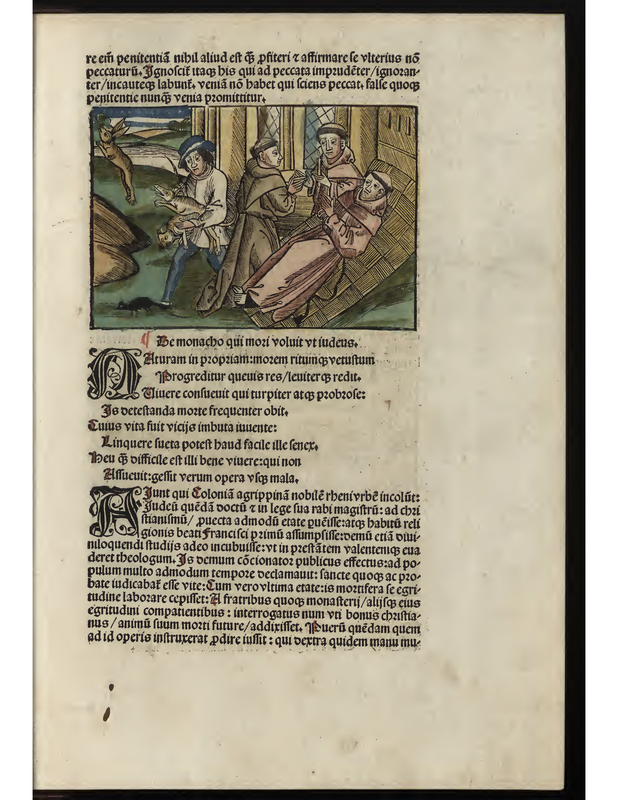
Two monks stand beside a laying third monk, to the right of them a man is seen carrying a dog and cat, with a rat on the ground and a hare leaping in the air
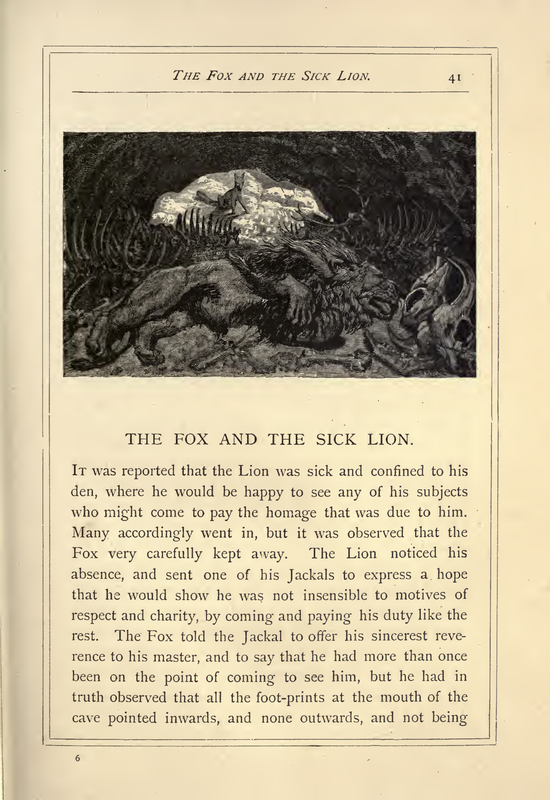
A lion lies on the ground inside of a cave amongst many carcasses. The lion’s tongue is sticking out and he does not look strong. At the opening of the cave, A small fox is sitting down, stretching out to see inside of the cave at the sick lion.
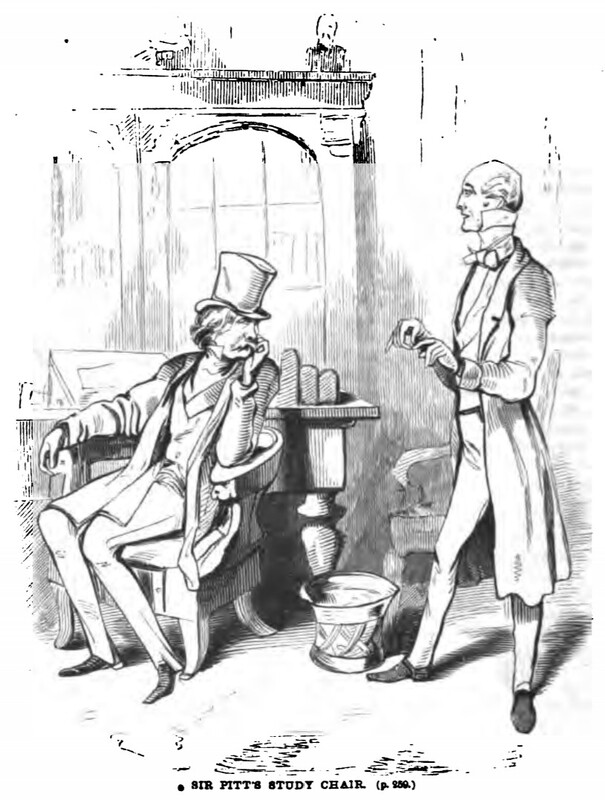
Rawdon Crawley sits in the chair at his brother’s desk with his chin on his hand, looking gloomy. His brother, Sir Pitt Crawley, stands next to him, trimming his nails as they talk. Rawdon wishes for Pitt and Jane to take care of his son once he leaves, as he has just found his wife alone in their home with Lord Steyne and intends to challenge him to a duel. Below the illustration is printed its title and location in the story, “SIR PITT’S STUDY-CHAIR. (p. 259.)”.
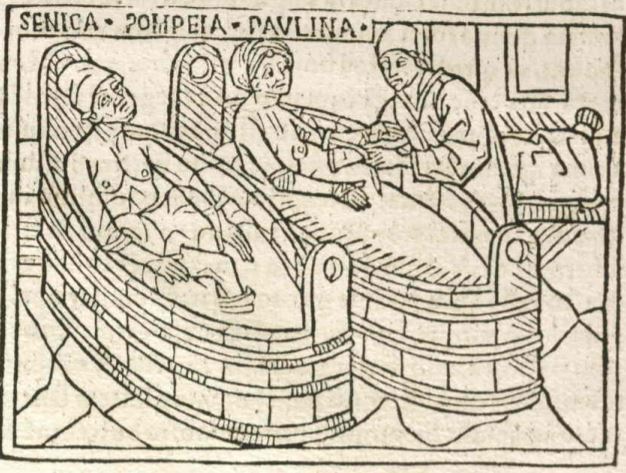
This engraving depicts Seneca and his wife Pompeia Paulina committing suicide in bathtubs. Seneca is depicted on the left side of the image, with his name, written as “Senica”, engraved above his head. Pompeia Paulina is in the tub beside him with her name engraved above her head as well. After emperor Nero found out that his tutor, Seneca, was involved in the conspiracy to assassinate him, he ordered a centurion to command Seneca to commit suicide. Not wanting to live without her husband, Pompeia Paulina got into the tub next to Seneca and slit her arm to die with him. Seneca is depicted dead in the engraving; however, a servant is illustrated saving Paulina by tying a rope around her arm to stop the flow of the blood. Emperor Nero did not want Pompeia Paulina to die as he had nothing against her, which is why the servant saved her life.
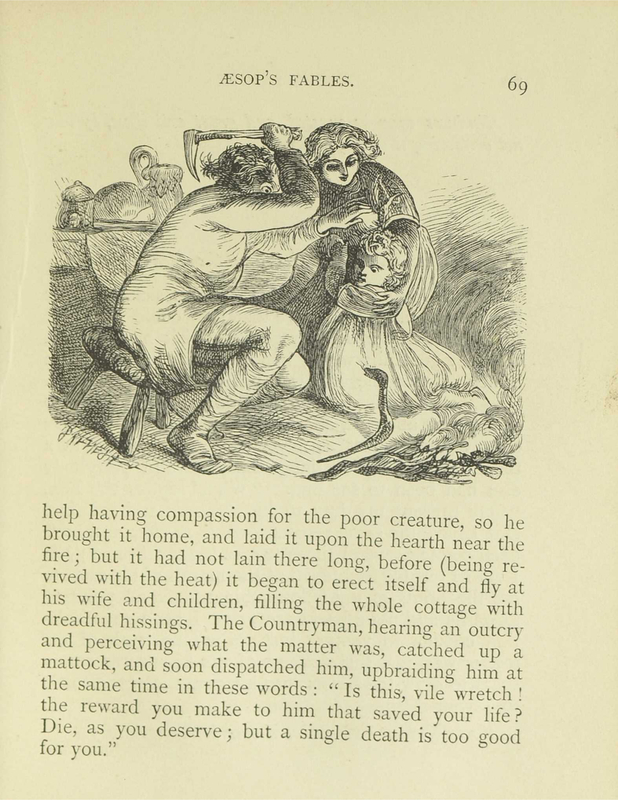
In the foreground of the image a snake on the right side is rearing up as though it is about to strike with its tongue out. On the other side of the snake is a family, a mother and young child on the right, scared of the snake. On the left a man, the father holding an axe in his right hand threatening the snake, about to swing. The scene is set in what appears to be the family’s home with a few pots and dishware can be seen on the left back corner.
A soldier with a thick moustache stands with one foot out and his sword pointed to the ground. Another soldier is next to him, facing away. In the background, a row of guards can be seen . In the top right corner of the image is the letter T, from “The”.
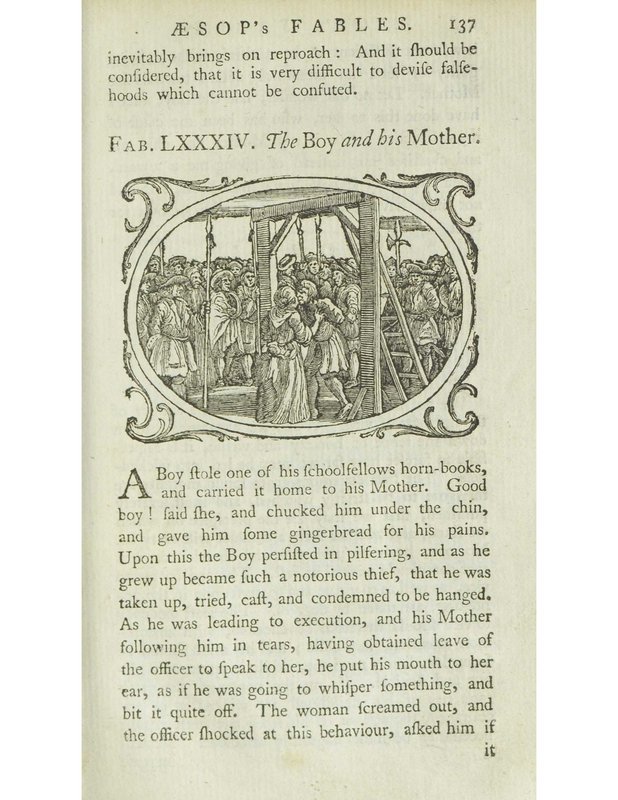
There is a large crowd of people, some whom are carrying spears. They surround a boy and an older woman (presumably his mother). The two of them stand underneath a wooden arch and the boy appears to be very angry with his mother.
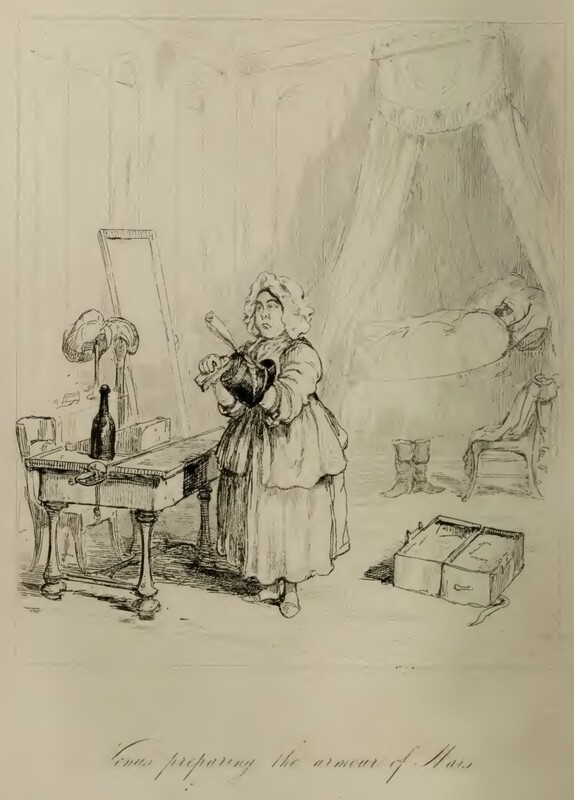
Peggy O’Dowd stands in her bedroom, polishing her husband’s helmet. His sword lies on the table in front of her, along with a bottle and a large mirror. She has already packed his travelling-valise, which lies open on the ground next to her. Major O’Dowd himself is sleeping in the background, with his boots next to the bed and his coat thrown over a chair. Below the illustration is printed in cursive its title, “Venus preparing the armour of Mars”.
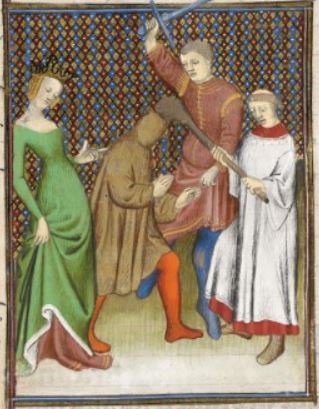
Queen Clytemnestra of Mycenae is depicted on the left side of the illumination wearing a crown and a green dress. The man she has been having an affair with, Aegisthus, is depicted holding a sword above his head. Aegisthus and Clytemnestra conjured a plan to kill Clytemnestra’s husband, King Agamemnon, in order to gain control of Mycenae. Clytemnestra gave Agamemnon a piece of clothing that had no neck hole. He is depicted putting his head into the garment in the centre of the image. As he struggled with the clothing, the adulterer Aegisthus pierced Agamemnon with a sword. An unknown man in a white garment is illustrated hitting Agamemnon above the head with a club.
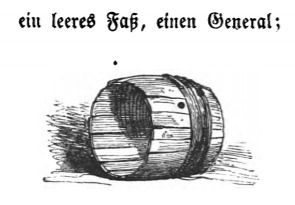
Here we see an empty barrel on its side. This is the code word for a general of the army. This image comes in a description of a conspiracy found by a professor from the Grand Academy on Balnibarbi. This idea is representing code word for terms in the conspiracy that Swift is satirizing. The professor advises that those named in the conspiracy papers be closely monitored at all times, naming specifically while they were using the bathroom, as this is when men were most thoughtful. This conspiracy is thought to be an allusion to the trial of Francis Atterbury, the bishop of Rochester for allegedly plotting with the Jacobites. Atterbury was charged with treason in 1722 and was exiled to France. The same image appears in the 1839 Krabbe edition.
Jocasta, the queen of Thebes, is depicted on the left side of the illustration stabbing herself in the stomach with a sword. Boccaccio explains that when Jocasta when a young girl, she was married off to the King of Thebes. After bearing a child, a prophecy said that the child would grow up to kill the King and marry his mother. Jocasta and King Laius exposed the child after hearing this prophecy. Their child, Oedipus, is depicted in the background of the illustration tied to a tree as he is being helped down by those who go on to raise him. The prophecy ends up being fulfilled as Oedipus kills his father and unknowingly marries his mother. When Jocasta finds out she married her son, she stabs herself, which is depicted in this illustration.
Two assistants of Mr. Moses, the sheriff’s-officer, watching the residence of Rawdon and Rebecca Crawley on Chancery Lane. They are wearing black coats and tall hats, carrying thin sticks, and scowling.


![[Vanity Fair Volume I. Chapter XIV Inhabited Initial, A]](https://collections.cemvc.ca/files/large/91065ac25d396123af464f4fb980e54684e0594d.jpg)
![Vita et. Fabulae [Three men are sitting at the table and the third man is getting his feet washed by a person]](https://collections.cemvc.ca/files/large/967d279324b58cc76721d6fbfa1a435af4c899be.jpg)
![[Vanity Fair Volume I. Chapter XXVIII Inhabited Initial, T]](https://collections.cemvc.ca/files/large/49d4a4b2eb7561ad90169dfd51e023e8a563f419.jpg)
![[Jocasta Stabs Herself to Death]](https://collections.cemvc.ca/files/large/b36959afb05db95372fd85886d2108238ed20045.jpg)
![[Mr. Moses’ Assistants]](https://collections.cemvc.ca/files/large/37f497b2e810615d1ac5e6976c9fdf2f1961f848.jpg)