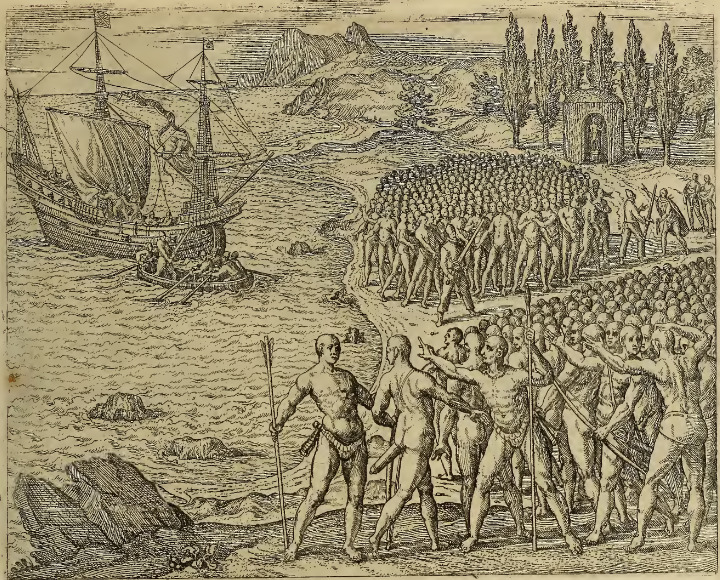
A large group of Indigenous people greets a ship of Spanish explorers in Ecuador. Several Spaniards come ashore in a rowboat. Two Spanish men have already reached land, both wielding swords, and one stands near the shore while the other has pushed through the group of Indigenous people and is confronted by an Indigenous man wearing a cape. Many of the Indigenous people are armed with bows and quivers of arrows or spears. Several Indigenous men at the front of group gesture towards the ship. In the background there is a hut with an Indigenous idol or statue inside. This image is identical to one found on page 2 (113) of Frankfurt, 1596.
Elicia and Areusa go to Centurio’s house to request that he avenge the deaths of Celestina, Sempronio, and Pármeno. When Centurio acts arrogantly toward her, Areusa fakes an unwillingness to cooperate with him, and Elicia tries to calm her down. This causes him to become submissive again. He eventually agrees to kill Calisto, but immediately begins planning ways to avoid fulfilling the task himself. He decides to send some of his men in his place.In this illustration, we see Centurio reaching out toward Areusa, who appears to be pulling away from him. She is wearing a robe and a veil, whereas he is wearing a hat. Further, in his left hand he is holding a sword, the tip of which is resting on the ground. To the right we see Elicia trying to convince Areusa to work with Centurio.The entire image is identical to the one found on page 222 of the text.
A group of Tupinambá women is shown making a traditional alcoholic beverage using cassava (manioc) root. Three women in the bottom right corner sit on the ground and chew the roots. Behind them, there are two large pots on the ground, and three women scoop liquid from them into smaller bowls and pots. To the left, another woman tends a large cauldron set over a fire. In the background, men sit on the ground drinking from bowls and small pots. A woman passes a bowl to one of the men.
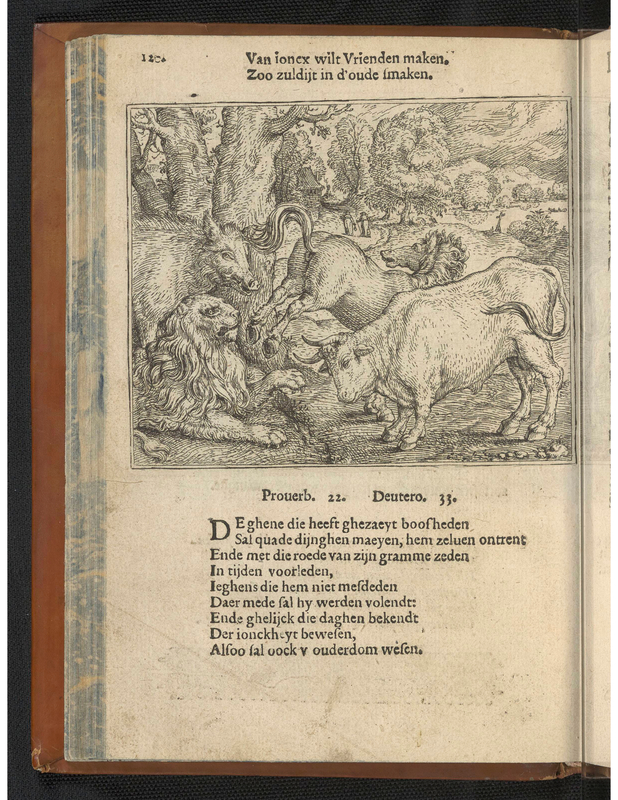
The old lion and other animals'; A lion lying in a landscape at left, surrounded by a staggering horse, a boar and an ox; Dutch letterpress on verso; illustration to Eduwaert de Dene's edition of Aesop's Fables, De Warachtighe Fabulen der Dieren (Pieter de Clerck, Bruges: 1567). c.1567
There is an illustration at the center of the page; above and below this illustration are bodies of text. In the illustration, three men can be observed with the left most people holding a long object in his left hand and wearing a crown on his head. In the center of the illustration is a man of a smaller stature walking towards the right. Towards the right most of the illustration is a holy person pointing towards his right palm with his left index finger while conversing with the other men.
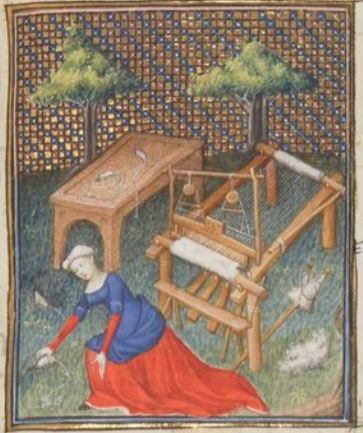
This illumination depicts a Greek woman named Pamphile. She is said to have been the first person to pick cotton from plants, which is why she is illustrated picking cotton in the image. There is a spindle and distaff depicted behind her as she is also renowned for having combed and spun the cotton into thread.
This image depicts Juan Lopez de Quintanilla, a pastoral inspector in colonial Peru. He is illustrated in the centre of the image riding a horse, dressed in a coak and hat. He has an indigenous assistant walking on foot in front of the horse. The author praises Juan Lopez de Quintanilla and his services to God and the kingdom. Because many indigenous peoples would try to complain to inspectors about the abuse they received from parish priests, the parish priests would try to hide them away during inspections. This inspector is praised for having punished the priests for their mistreatment of the indigenous peoples.
In this image we see a cabin boy from Gulliver’s ship first seeing Brobdingnag. He climbs one of two rope ladders up the mast. He waves down to others on the deck to signal his discovery to the others on the ship. The boy is barefoot and wears short pants and a loose shirt. Just below his feet we see the top of one of the sails. The same image appears in the 1843 Krabbe edition.
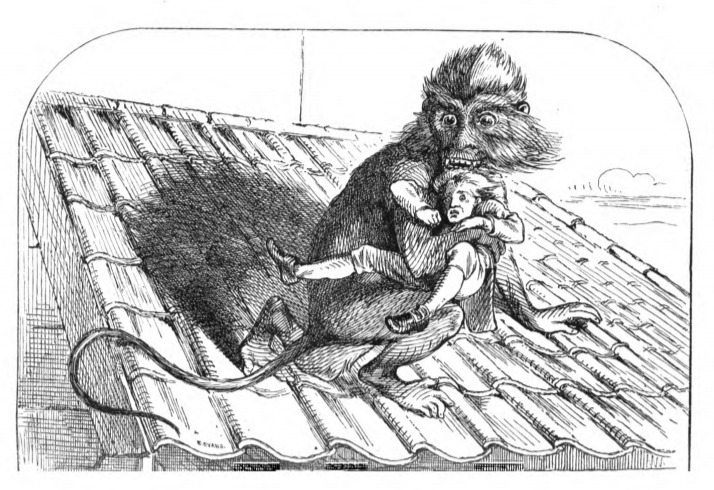
Here we see the scene in which a monkey from Brobdingnag got loose and caught Gulliver. The monkey belonged to a member of the kitchen staff of the King and Queen of Brobdingnag. The monkey found Gulliver’s house and reached in and grabbed Gulliver, carrying Gulliver up to the roof and tried to feed Gulliver.
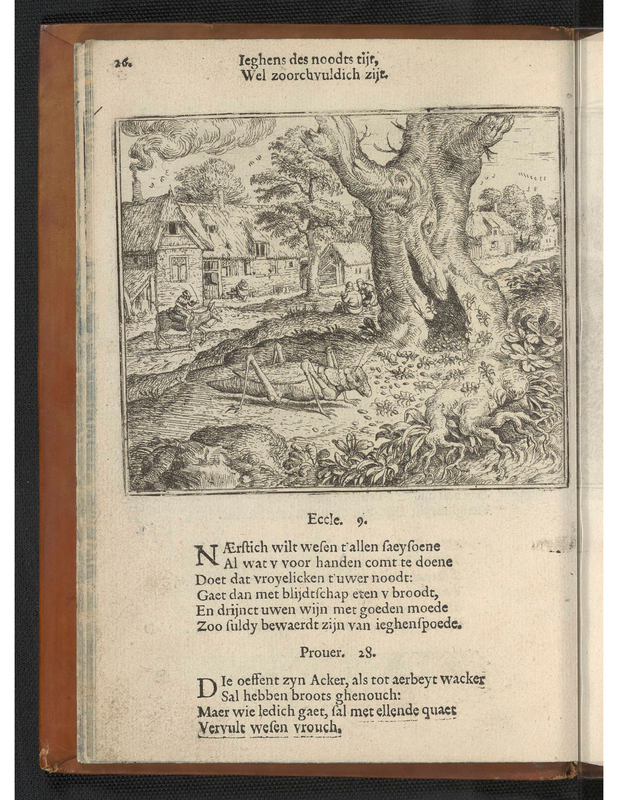
A large locust and many ants gather by a tree in the foreground of the image. A town lies in the background. People converse by the houses of the town. A man on a donkey pass by the town.
A Brazilian Indigenous group attacks the Tupinambá village 'Uwattibi'. The attcking group have arrived in canoes, which are pulled up along the shore on the right. They have surrounded the village and shoot arrows through and over the fence. These men wear feathered headdress and adornments around their waists, most carry bows and have arrows quivers slung around their shoulders, and a few also carry a shield. Several people, both in the attacking group and inside the village, blow into an object, perhaps a wind instrument or blow gun. Inside the village, Tupinambá men stand just inside the fence shooting arrows out towards the attacking group. The women and children in the center of the village run in panic.
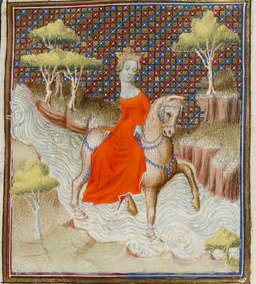
After Cloelia was captured and held hostage with many other maidens and children, she planned and executed their escape. Rather than being reprimanded, she was considered to be very honorable, and was allowed to take with her to be free whichever hostages she chose. She chose the children. During their escape, she found a horse, despite having never ridden a horse before, and used it to help the hostages cross the Tiber river. The image represents this scene, with only Cleolia on the horse in the middle of the river.
This image depicts two wives of the Cimbri (a northern Tribe of Germanic roots) being taken by Roman soldiers acting under the orders of the general Gaius Marius. After a battle between the Cimbri and Romans, the wives of the Cimbrian men requested of the Romans that they be made into vestal virgins to maintain their chastity. The Romans declined their request, and to preserve their chastity, the wives killed themselves and their children.
Here we see a Lilliputian performer doing a flip. This performer does a flip and holds a ribbon. This image appears when Gulliver explains performances on Lilliput.
An old man is holding a stick shaped tool in the air and pointing to a field. Two dogs are chasing a deer on that field. There is a third dog standing next to the man ready to run. A fence is built in the background.
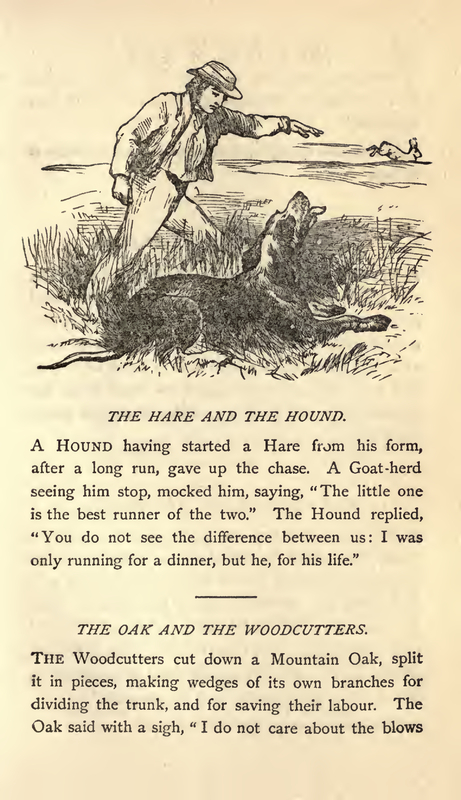
A hound is sitting down in a field, panting and looking up at a man. The man is looking down at the hound and pointing to a hare. The hare is seen in the distance running away.
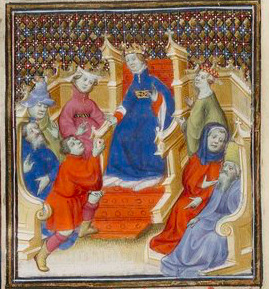
When Soaemias’ son, Elagabalus, avenged the death of his father Caracalla, he obtained posession of the empire. This meant that Soaemias, despite being a prostitute who was known to have slept with many men, was risen to a much higher respect. So much so that she was called Augusta. She was treated like royalty, which is shocking treatment for a woman who was prostitute. In the image she is seated in a throne, with Roman matrons sitting at both sides of her looking up to her.
In this image we see a cabin boy from Gulliver’s ship first seeing Brobdingnag. He climbs one of two rope ladders up the mast. He waves down to others on the deck to signal his discovery to the others on the ship. The boy is barefoot and wears short pants and a loose shirt. Just below his feet we see the top of one of the sails. The same image appears in both the 1839 and 1843 Krabbe editions.
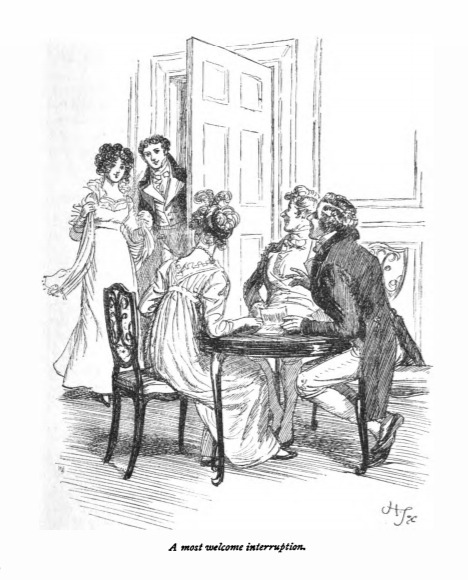
Here we see Tom, Maria, and Mr. Yates sitting in the drawing room at Mansfield Park, when Mr. And Miss Crawford came in. The group discussed the play, “Lover’s Vows” that they decided to put on before Sir Thomas came home. This scene occurs in chapter 15. The characters are shown in the traditional regency style. Maria and Miss Crawford wear the regency style dresses with empire waistlines. Mr. Rushworth, Mr. Yates, and Tom wear waistcoats and tailcoats, with breeches and cravats. The regency period dated to the early nineteenth century (1811-1820) when George, Prince of Wales, later George IV (r. 1820-1830), reigned as regent for his mentally ill father, King George III (r. 1760-1820). The regency period is associated with the rise of neoclassicism in art and fashion.
Here we see Gulliver’s crew chaining him to his bed after they mutinied. Many of his crew died of fever, and Gulliver recruited more men from Barbados. These men then mutinied and chained Gulliver to his bed. They rushed into his room, threatening to throw him overboard if he did not cooperate. Gulliver swore to submit, then they chained him to his bed, and placed a guard at his door. At the first sight of land, the crew dropped Gulliver on land, and left him. In this image we see a man putting a chain around Gulliver’s ankle, while another looks on. The same image appears in the 1843 Krabbe edition.

![[Act XVIII] Elicia spreect eerst.](https://collections.cemvc.ca/files/large/d84f41112c820d0a62b9e63ce6c7a221ead394f5.jpg)
![[Tupinambá women prepare an alcoholic beverage]](https://collections.cemvc.ca/files/large/799bafbd07e19ba35a0f05d9d32b0b3941faf527.jpg)
![Vita et Fabulae [Two people in Holy attire converse while there is another person in the middle]](https://collections.cemvc.ca/files/large/16da73c8061817b863bedaf334dbefad70f1686c.jpg)
![Jv[an] Lopes de Qvintanilla, Becitador de la Santa Yglecia, Este fue muy Cristianicimo, Amigo de los Pobres y Buena Justicia, Umilde](https://collections.cemvc.ca/files/large/f9112c6aff89d80a3c27bab0b82948911a8add6b.jpg)
![[Cabin boy first sees Brobdingnag]](https://collections.cemvc.ca/files/large/76b2a22fa9a138f5f6abece7f748bfabc2b2c935.jpg)
![[A group of Indigenous people attacks the Tupinambá village called 'Uwattibi']](https://collections.cemvc.ca/files/large/6d585bf3a00efd6f9c194b0471223328f6c2f450.jpg)
![[Vanity Fair Chapter XXVII Inhabited Initial]](https://collections.cemvc.ca/files/large/02be82525b3b4f9570b6d29bc45ec61b7fffc93d.jpg)
![[The Wives of the Cimbrian Men]](https://collections.cemvc.ca/files/large/588dec61e9d5a919a53e0cc8a5e63b7486e7e6a9.jpg)
![[A Lilliputian performer]](https://collections.cemvc.ca/files/large/480626a107b853d8c08dbdcfac680265abcb4cbd.jpg)
![[The Old Hound]](https://collections.cemvc.ca/files/large/44fea75f14da37ec8208ad1e93c3bfd5c07f41e0.jpg)
![[a cabin boy first sees Brobdingnag]](https://collections.cemvc.ca/files/large/122938855150e04b71d7834a6566662c5de15367.jpg)
![[Gulliver’s crew mutinied and chained him to his bed]](https://collections.cemvc.ca/files/large/f6c722e3ac69a494600e9d918ddf0e003be67c47.jpg)