This image depicts the coat of arms of the bishops of Peru. The author placed this image before a prologue addressing the priests of Peru on how to act according to their religious duties. The writing inside the coat of arms reads, “en este escudo se a de pintar las armas de los yllustres yn cristos su senoría obispos deste rreyno de cada obispo, y, en muriendo, se borre y se pinte del que biniere de nuebo y su letrero” [This is the coat of arms of the illustrious bishops of Christ in this kingdom of the Earth. And in death, the one who comes again his sign is erased and painted]. The caption at the bottom of the image reads, “que se dexe de negocios y use su oficio de sazerdote, la muger que entrare a la casa del padre sea descomulgada y castigada por todas las justicias de su magestad en este rreyno” [he owes business and uses his office as priest. The woman who enters the priest’s house is disgraced and punished by all the justices of her majesty in the kingdom].
Two men have been captured by the Indigenous Brazilian warrior women, a group which the author calls ‘Amazons’. The men have been hung upside down by one ankle from a tree, and a fire has been lit beneath them. The women shoot arrows at the hanging men. This illustration is a simplified and mirrored version of the one found on page 126 verso of Paris, 1557.
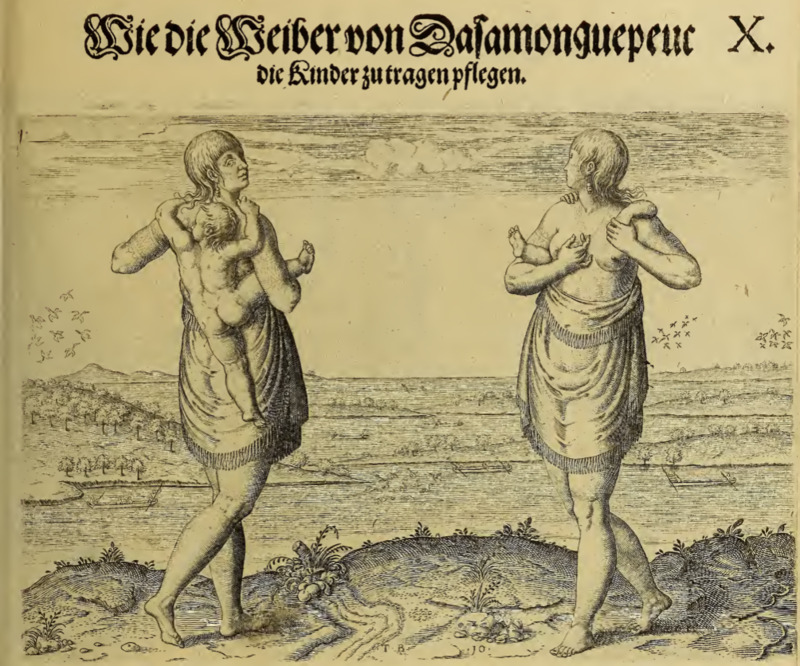
An Indigenous woman is pictured from the front and from behind standing on the bank of a river. She wears a fringed skirt around her waist, her hair is unbound, and she is topless and shoeless. She holds a young child on her back, with the child’s left arm over her shoulder and their left hand in hers, and their right leg tucked under her right arm against her hip. Behind them, other Indigenous people are seen in canoes.
Two figures, a woman holding a stick or thin staff and a man in a curved hat, walk along a path. A sign by the side of the road reads “To London”. Two sets of forked branches in the background form the letter W from “We”.
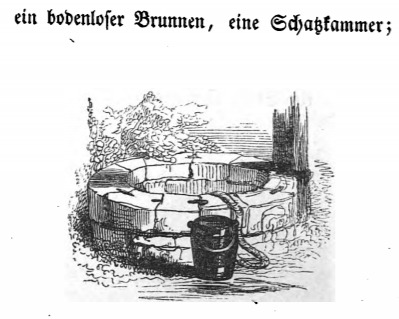
This image shows a bottomless pit, which is the code word for the treasury. This image comes in a description of a conspiracy found by a professor from the Grand Academy on Balnibarbi. This idea is representing code word for terms in the conspiracy that Swift is satirizing. The professor advises that those named in the conspiracy papers be closely monitored at all times, naming specifically while they were using the bathroom, as this is when men were most thoughtful. This conspiracy is thought to be an allusion to the trial of Francis Atterbury, the bishop of Rochester for allegedly plotting with the Jacobites. Atterbury was charged with treason in 1722 and was exiled to France. The same image appears in the 1839 Krabbe edition.
In this image we see Gulliver being brought into the town from the shore on a gurney in Lilliput. This is to remove the arrows stuck in his skin. The gurney is drawn by a large team of horses. Soldiers with spears walk alongside the gurney with their weapons. A crowd lines the streets to see Gulliver. The same image appears in the 1839 Krabbe edition.
A group of women and children sit in a circle with several large dishes at the center. One of the dishes holds a human head and another holds entrails. Some of the women and children sip from bowls while others use their hands to eat. Two of the women have infants strapped to their backs in baskets or slings.
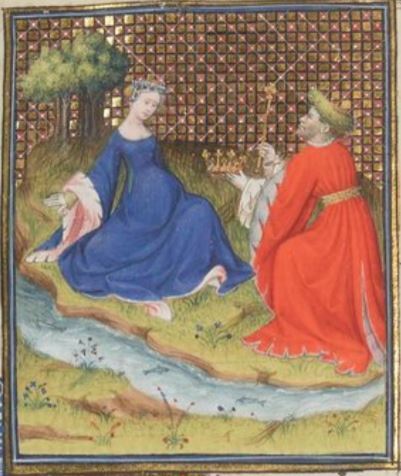
This illumination depicts Lavinia, the wife of Aeneas and queen of Laurentum, hiding in the forest. Boccaccio explains that after her husband Aeneas died, Lavinia fled to the forest as she was afraid that her stepson would kill her and her newborn son, Silvius. Lavinia was wrong, and Ascanius voluntarily gave the kingdom of Laurentum back to her and helped raise Silvius. Ascanius is depicted holding a crown and scepter and presenting them to Lavinia as he offers her kingdom back.
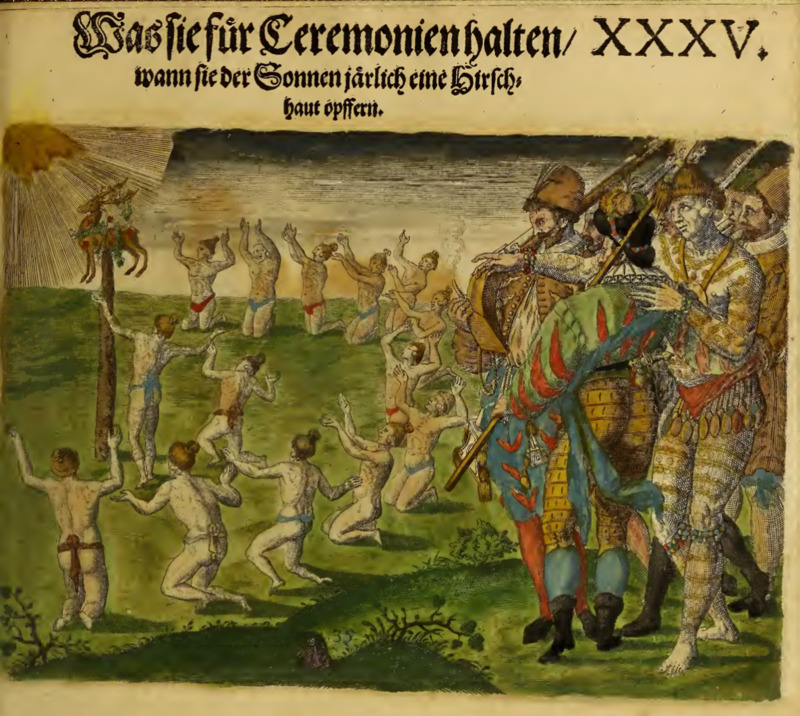
In the foreground, several colonists stand with an Indigenous man. The Indigenous man wears an adorned loincloth and bracelets around his wrists and knees. His skin is covered in tattooed or painted designs. To the left of the men, a group of Indigenous people kneel on the ground in a semi-circle with their arms outstretched or raised above their heads. At the center of the circle there is a log standing on end. Two Indigenous people are beside it, one standing and one kneeling, both with their arms raised. In the upper left corner, the sun is shown, with the remains of a deer in the sun beams. This illustration is identical to the one found on page 113 of Frankfurt 1591, but colored.
Here we see the farmer giant who discovered Gulliver presenting him to his wife. The farmer holds Gulliver on a cloth. Gulliver kneels on the cloth in front of the woman with his arms out towards her. The woman wears a dress with a pocket hanging in front of her. Her hair is covered with a cap. She looks surprised by Gulliver and holds her left arm close to her as though she is alarmed or put off by Gulliver. The same image appears in the 1843 Krabbe edition.
Here we see Gulliver’s house being carried away from Brobdingnag by an eagle. The eagle carrying Gulliver’s house was attacked by another eagle causing it to drop Gulliver’s house the house into the water, seen here.
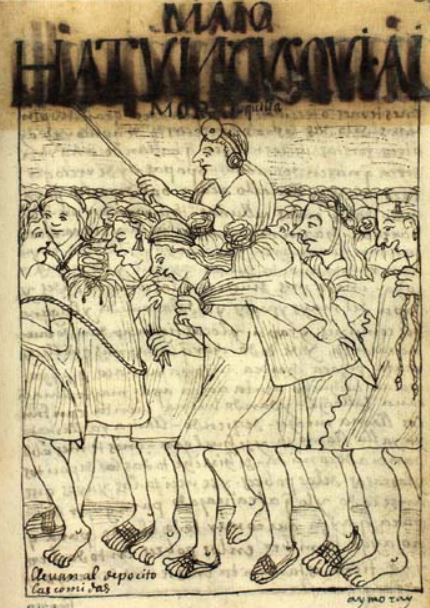
This chapter is dedicated to discussing the traditions and rituals of each month during the Inca Empire. The Incas tracked the months and years through the stars and their months consisted of thirty days. This image depicts the month of May, which was dedicated to harvesting crops. The author explains that the abundance of crops and harvesting provided them with an abundance of food. This image depicts a crowd of people with bags over their shoulders and on their backs as they carry their harvest to storehouses. The author also explains that inspections were done during this month and the people had to give accurate accounts of their crops and food. The person depicted standing above the crowd with a stick in his hand could possibly be the inspector. The caption at the bottom of the image reads “lleuan al depócito las comidas,” which translates to “meals are taken to the storehouses.”
The women of Lemnos, as Boccaccio explains, devised a plan to kill all the men in the city in order to remove themselves from the control of a patriarchy. There are two women in the illustration holding swords, killing the men who are lying on the ground in front of them. The woman depicted without a sword is Hypsipyle, the daughter of king Thaos of Lemnos. She is illustrated wearing a crown to indicate her royal status. She is illustrated without a sword as she does not participate in this plan, and helps her father escape the wrath of the women of Lemnos and becomes queen herself.
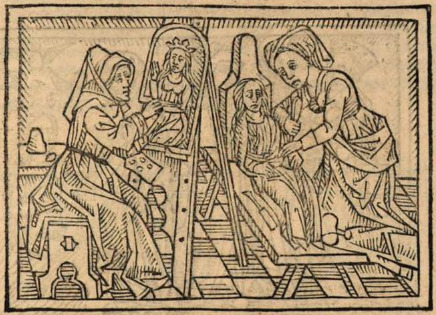
Marcia, a Roman woman who remained a virgin her entire life, is depicted on the left side of the engraving painting a portrait. Boccaccio explains that Marcia is worthy of renown for her chastity and for her painting and sculpting abilities. She is known to have mostly painted and sculpted figures of women, which is why there is a portrait of a woman wearing a crown in her painting. The right side of the engraving depicts Marcia sculpting a figure of a woman. Her sculpting tools are illustrated on the table in front of her.
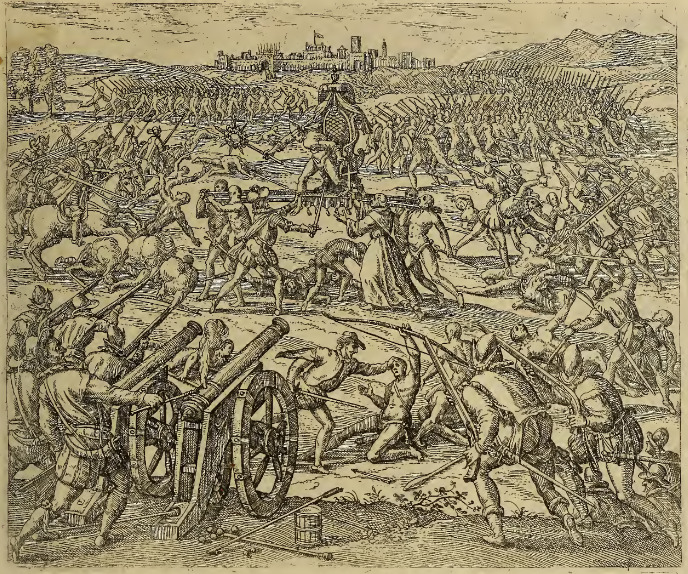
The Inca Emperor Atahualpa (Atabalipa) and his army are attacked by Spaniards outside the city of Cajamarca in Peru. At the center of the melee, a Spanish man grabs Atahualpa (who is still atop his litter) by the ankle and pulls him down, while a monk holds a cross up towards him. Spaniards attack the Inca army on horseback from the left and on foot from the right, using muskets, swords, and spears. The Spanish have also lined up several cannons, which they fire at the Indigenous warriors. Despite outnumbering the Spanish, the Inca army is faring poorly, having been caught by surprise and facing more destructive weapons. The Inca men are armed with bows and spears, and a few have shields. Many are killed in the attack, while others flee in panic. This image is identical to one found on page 7 (123) of Frankfurt, 1596.
John Sedley, slightly stooped, holds a plate out to Trotter, George Osborne’s valet, who brought Amelia to visit her parents. Trotter has just taken the glass of wine which Mr. Sedley offered him and is surprised and slightly pleased by the courtesy.
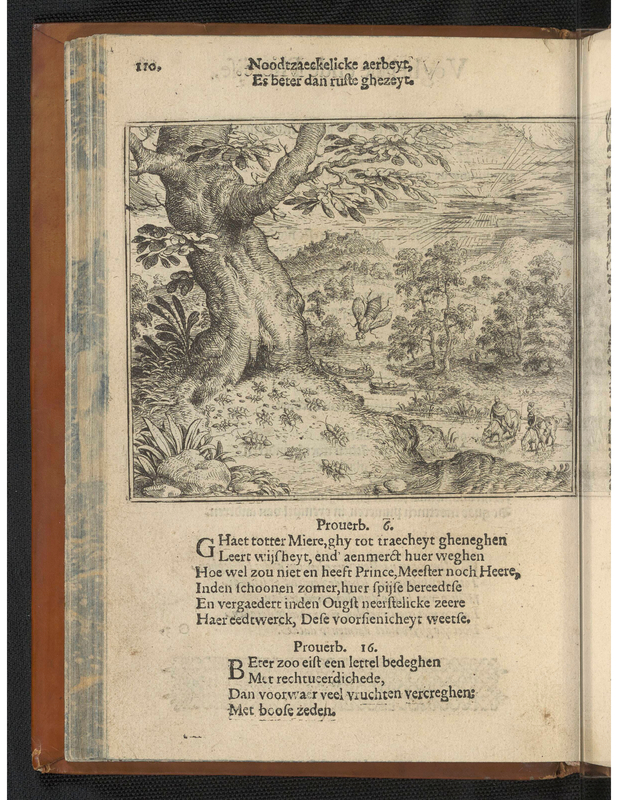
A cricket sits near a tree with ants; in the background there is a farm and a man on a horse; Dutch letterpress on verso; illustration to Eduwaert de Dene's edition of Aesop's Fables, De Warachtighe Fabulen der Dieren (Pieter de Clerck, Bruges: 1567). c.1567Etching
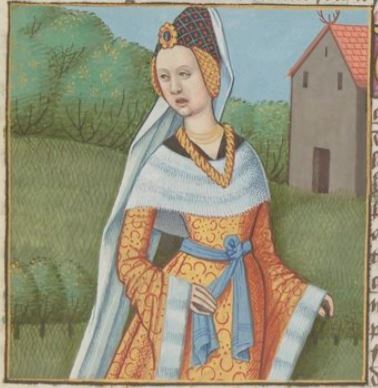
This illumination depicts a portrait of a woman named Verginia. Verginia was a Roman woman and daughter to a name man Verginius. Verginia is famous for having been killed by her father to save her from slavery. A decemvir had fallen in love with Verginia and devised a plan to make her a slave so that he could have her as his own. Her father stabbed her to save her and her chastity from being defiled.
Rebecca Crawley stands at her dressing-table with her hair loose, waving a piece of paper in the air. Next to her, Rawdon Crawley stands looking puzzled, still holding the tray with the pitcher of chocolate and cup that he brought her for breakfast along with the letter. The letter is from his brother, now Sir Pitt Crawley after their father’s death, inviting them to the funeral at the estate.


![Prologo Las Armas de sv S[enori]a](https://collections.cemvc.ca/files/large/e8e424c57bcc423c1d82c9723cc2deaeee72076d.jpg)
![[How the Indigenous Brazilian warrior women treat captives]](https://collections.cemvc.ca/files/large/40f9ef0f9447d550863b35d16665c3f764216a43.jpg)
![[Vanity Fair Volume I. Chapter XII Inhabited Initial, W]](https://collections.cemvc.ca/files/large/0e4170c138e0e505480aabe0b1136800c897ce98.jpg)
![[Gulliver being brought into the town from the shore on a gurney in Lilliput]](https://collections.cemvc.ca/files/large/ca6e7d4afca1d4879bd0a7545e58ff959e13d4cc.jpg)
![[A group of Tupinambá women and children share a cannibalistic meal]](https://collections.cemvc.ca/files/large/3d005ab2d7af3851af1ba6d27978978985eca111.jpg)
![[The giant farmer presents Gulliver to his wife]](https://collections.cemvc.ca/files/large/6dd1bf1de9108e5c1da1498ea1ea8afdb6e7ef87.jpg)


![[The Women of Lemnos Kill all the Men in the City]](https://collections.cemvc.ca/files/large/736fb5709f774e2d73a99d7460e6eef65aa1a360.jpg)
![[Mr. Sedley Greeting Trotter]](https://collections.cemvc.ca/files/large/d2386e6b7f07f77567464d6f29a4e987931fef01.jpg)
![[A Letter from the New Sir Pitt Crawley]](https://collections.cemvc.ca/files/large/1e93fd2783e692e2581a1d5639104da9772fc34d.jpg)