In this image Elizabeth and the Gardiners look out a window at Lambton in Derbyshire. They encountered Mr. Darcy at Pemberley while visiting, and Mr. Gardiner invited him to come dine at Lambton. In this image, Elizabeth and the Gardiners await the carriage bringing Mr. Darcy, his sister, Georgiana, and Mr. Bingley. This scene occurs in chapter 44. The characters are shown in the traditional regency style. Mrs. Gardiner and Elizabeth wear dresses with empire waistlines. Mrs. Gardiner wears a shawl over her dress and a bonnet. Mr. Gardiner wears a waistcoat and tailcoat with a cravat. The regency period dated to the early nineteenth century (1811-1820) when George, Prince of Wales, later George IV (r. 1820-1830), reigned as regent for his mentally ill father, King George III (r. 1760-1820). The regency period is associated with the rise of neoclassicism in art and fashion.
This illustration depicts Semiramis, queen of the Assyrians, throwing a hair comb onto the ground with her other hand touching her face. The comb is on illustrated on the ground by the window. There is a servant bowing to Semiramis in respect, while also presenting a helmet and armour to the queen. Boccaccio explains that she was combing her hair when she was told that Babylon (a kingdom which she ruled) had defected, and instantly threw away her comb to prepare for battle. This illustration depicts this honourable moment.
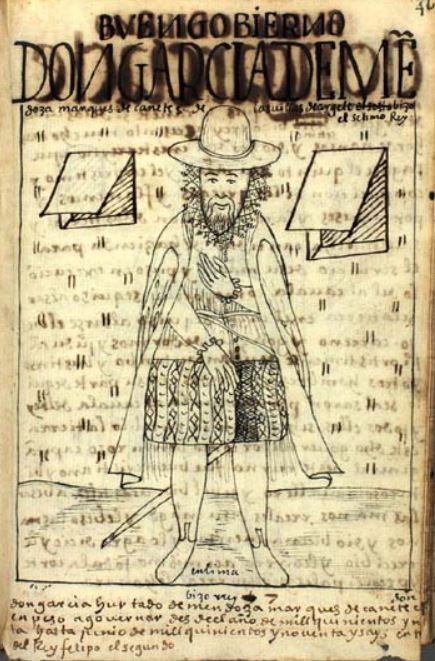
This image depicts a standing portrait of Don García Hurtado de Mendoza, the seventh Spanish viceroy of Peru. He is illustrated wearing traditional European/Castilian clothing and is holding an embroidered bag in his right hand. There is a caption written by Mendoza’s feet that identifies the location as it reads, “en lima” [in Lima]. The caption written at the bottom of the image reads, “don garcia hurtado de mendoza, marques de canete, e[ste] enpeso a gouernar desde el ano de mill quinientos y n[oven]ta hasta junio de mill quinientos y nouenta y says en ti[enpo] del rrey felipo el segundo” [Don García Hurtado de Mendoza, Marquis of Cañete, he began to govern from the year 1590 until June of 1590 in the time of King Philip II].
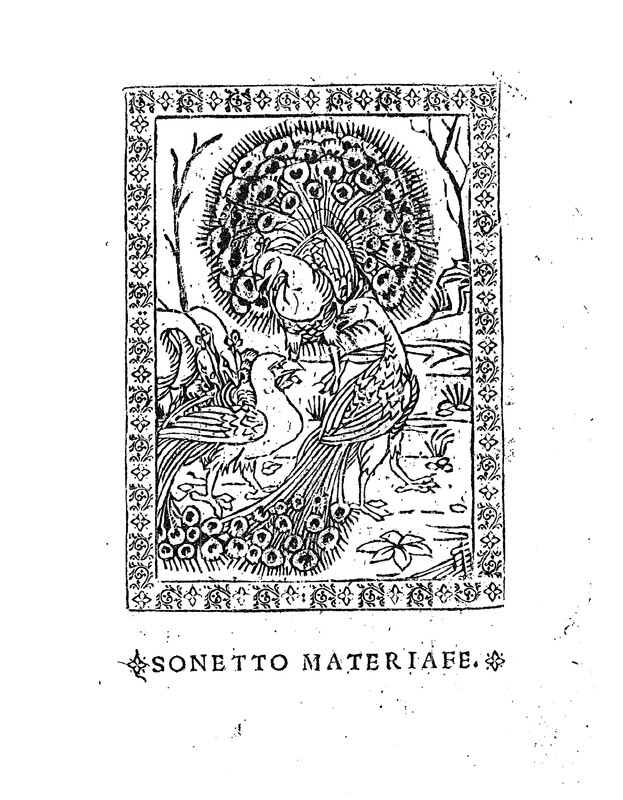
What seems to be a dominant, larger peakcock is standing with its feathers flaired infront of four other peacocks. Two trees in the image which are both dead, with no leaves. The image is bordered by a vine design
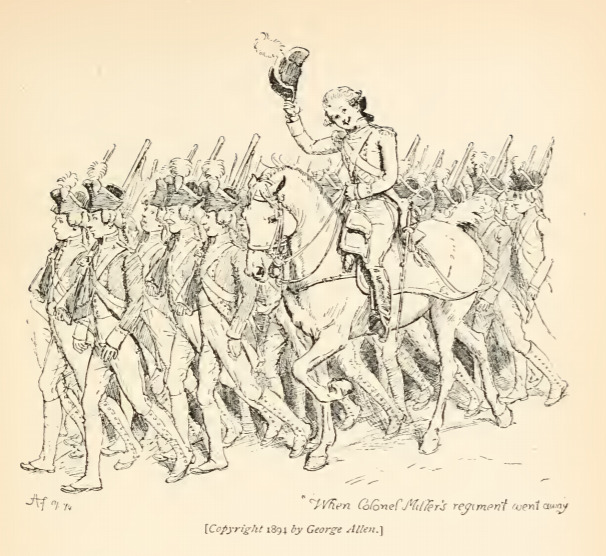
In this image the regiment stationed in Meryton, under the command of Colonel Miller, leaves the town. When the regiment left, Colonel Forester’s wife, invited Lydia to accompany them to Brighton. Elizabeth privately asked Mr. Bennet to prevent Lydia from going, but Lydia begged to be allowed to go, and Mr. Bennet conceded. This scene occurs in chapter 41. The characters are shown in the traditional regency style. The regiment wears the regency military uniform with bicorn hats, leather belts, and double-breasted jackets. Colonel Miller rides on horseback while the lower ranks march, carrying muskets. The regency period dated to the early nineteenth century (1811-1820) when George, Prince of Wales, later George IV (r. 1820-1830), reigned as regent for his mentally ill father, King George III (r. 1760-1820). The regency period is associated with the rise of neoclassicism in art and fashion.
A father flagellates his bare son in front of a brick dwelling. The son, who is welted and injured, is writhing in pain while another man stands overtop looking down at the boy with crossed arms.
Here we see Gulliver speaking to an official from the Lilliputian court. The official sits in a sedan chair, however the chair attendants were dismissed. The official was there to inform Gulliver that he had been charged with treason. Gulliver was charged because he urinated on the Imperial Palace to put out a fire in the Empress’s apartments and for preparing to visit the Emperor of Blefuscu – the enemy of Lilliput. Because of these charges, Gulliver leaves Lilliput and travels to Blefuscu. The same image appears in the 1843 Krabbe edition.
Here we see Gulliver throwing empty barrels of wine which he had just consumed. The Lilliputian named Hekinah Degul told Gulliver to throw the barrels, however the Lilliputians are still scared of the flying barrels. These Lilliputians can be seen at Gulliver’s feet. Gulliver’s head and feet are still tied; however, both of his arms are now free. The same image appears in the 1839 Krabbe edition.
In a Tupinambá village, a large wooden frame has been set up over a bonfire, and several human body parts have been set upon the frame to roast over the fire. A group of men, women and children stand around the fire eating various human body parts, including legs, arms, ribs, and hands. Behind the fire a bearded European man stands with his hands in the air, perhaps in dismay or distress.
A small boy in a uniform and triangular hat with a pair of tiny angel wings holds a packet of sealed correspondence out to a doorway, most likely a letter from Amelia Sedley to George Osborne. The boy has a bag in his other hand and more letters tucked under his arm.
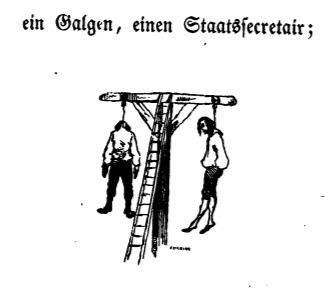
This image depicts a gibbet, which is where the bodies of criminals were hung after their execution. The gibbet was the code for the Secretary of State. This image comes in a description of a conspiracy found by a professor from the Grand Academy on Balnibarbi. This idea is representing code word for terms in the conspiracy that Swift is satirizing. The professor advises that those named in the conspiracy papers be closely monitored at all times, naming specifically while they were using the bathroom, as this is when men were most thoughtful. This conspiracy is thought to be an allusion to the trial of Francis Atterbury, the bishop of Rochester for allegedly plotting with the Jacobites. Atterbury was charged with treason in 1722 and was exiled to France. The same image appears in the 1839 Krabbe edition.
Three Indigenous Brazilian men are in the process of chopping down a tree. One man swings a hatchet at the trunk of the tree, while the other two gather logs or branches. One of the men wears a feathered headdress. This illustration is a simplified and mirrored version of the one found on page 117 of Paris, 1557.
Here we see a procession where the Lilliputian Emperor walks through a crowd of kneeling Lilliputians. The Emperor is identified by his elaborate headpiece which has a long train coming out of the top. The Emperor walks towards the gates to the palace, with the crowd lining the walkway towards the gate. The same image appears in both the 1839 and 1843 Krabbe editions.
There are three standing figures in this image. The figure on the left is identified as “Santiago Mayor,” [St. James the Great] the figure in the centre as “Santa Maria de Pena de Francia,” [Saint Mary] and the figure on the right as “San Bartolome Apostol” [Saint Bartholomew the Apostle]. There is a large cross above Saint Mary that is identified as “Santa crus de Carabuco” [Holy Cross of Carabuco]. Initials reading, “I.N.R.I” [Jesus of Nazareth, King of the Jews] is slightly visible at the top of the cross. There are also two large nails on both sides of the cross to symbolize the crucifixion of Jesus. Saint Bartholomew is pictured holding a knife and his own flayed skin as he was skinned alive. Saint James is pictured holding a staff as this was one of his symbols.
In the centre of the illustration, we see Celestina wearing a robe and a veil. There are two male figures to the left and one to the right. The scene depicted here has no relation to Act IV, since there are no male characters in this act. [This illustration is identical to those found in Acts V (folio 42r), VI (folio 45r), VIII (folio 62r), X (folio 74r), XIII (folio 93v), XV (folio 102r), and XVII (folio 109r).]
When Faustina died of an illness, her husband, Marcus Aurelius Antoninus, asked to have her deified. She became known as the goddess Faustina, and her priestess followers became known as Faustinians. She was the first Roman woman to receive this treatment. In the image, Faustina’s deified form is seen seated in a throne inside of the temple, accepting praise from her followers. Outside of the temple stands her human form before she died, talking to two men.
In this image we see Gulliver sleeping outside the city in Blefuscu. Due to his size, there was nowhere for him to sleep in Blefuscu. Thus, Gulliver was forced to sleep outside, using his overcoat or coverlet as a blanket. In this image we see Gulliver’s size as compared to the buildings surrounding him. Gulliver leans on a large structure with his arms crossed, his head resting in his folded arms. The same image appears in both the 1839 and 1843 Krabbe editions.
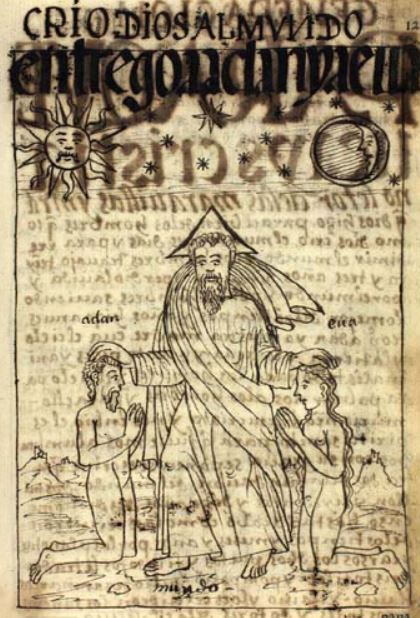
This illustration depicts God in the centre of the image placing his right hand on Adam’s head and his left hand on Eve’s head as he gives them the world. The word “adan” (meaning “Adam”) is written above Adams head, while the name “eua” (meaning “Eve”) is written above Eve’s head. The word “mundo” is written on the ground to demonstrate the world that God is giving to them. God is depicted wearing long robes and wearing a triangular shape on his head to symbolize the Holy Trinity. There is a sun in the top left corner, and a moon at the top right corner.
A cat is on top of a cock and staring at it with an angry expression. There are other cocks around. Behind them, is a farmhouse. A wooden fence surrounds it. Mountains and trees are in the distance.

![[Elizabeth and the Gardiners look out the window at Lambton]](https://collections.cemvc.ca/files/large/36508e0254f844fc4529b88756803809d2881495.jpg)
![[Semiramis Throws Away Her Comb to Prepare for Battle]](https://collections.cemvc.ca/files/large/0643223021b708b00da205fd7c20b819ad19e2e9.jpg)
![[Gulliver speaks with a court official]](https://collections.cemvc.ca/files/large/c1c7e145b4661bfbb4965251b07b062d56a965ce.jpg)
![[Gulliver throws empty barrels]](https://collections.cemvc.ca/files/large/bc509d5e4ef18ab467feab52545f2abc531ee4cc.jpg)

![[The Tupinambá engage in cannibalism while a European man looks on]](https://collections.cemvc.ca/files/large/1c95c473cc55a90a4a449aa35c6bec3f0fb8fbb1.jpg)
![[Letter Carrier]](https://collections.cemvc.ca/files/large/d5063b5fe0915375dfb4167f5f3714447d33661c.jpg)

![[Indigenous Brazilian men chop down a tree]](https://collections.cemvc.ca/files/large/073c6d8f59958c3ba6582b0c6ed8b4a18e4726f5.jpg)
![[A procession of the Lilliputian Emperor]](https://collections.cemvc.ca/files/large/5a8f3dc307f1815b49c66ca15c7e50124c22ffd5.jpg)

![Fiestas Solenes Q[ve] an de Guardar los Yndios en Este Rreyno como pascua por los Milagros que Hizo Dios Para el Bien de los Yndios y de los Cristianos y de su Magestad](https://collections.cemvc.ca/files/large/4cfe05947d745d030cfeede7279580895b8fd345.jpg)
![[Act IV – Celestina and Three Male Figures]](https://collections.cemvc.ca/files/large/68ccb52be0cd54e49507c13bc58c724068584c50.jpg)


![[Gulliver sleeps outside the city on Blefuscu]](https://collections.cemvc.ca/files/large/dde71e05a8e6d975164ad928bb1177947344a28f.jpg)

![[The Cat and the Cock]](https://collections.cemvc.ca/files/large/5b36c796d738ebd2863d90f4949de5a418b61730.jpg)