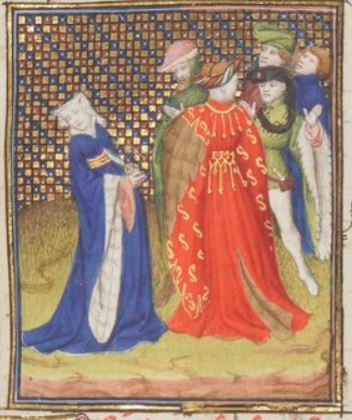
Ain hipsche Tragedia von zwaien liebhabenden mentschen ainem Ritter Calixstus unn ainer Edlen junckfrawen Melibia genannt/ deren anfang müesam was/ das mittel sieß mit dem aller bittersten ir bayder sterben beschlossen.
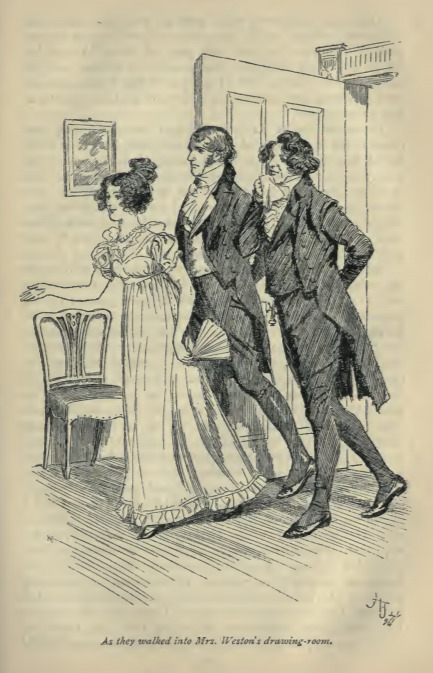
Here we see Emma, Mr. Elton, and Mr. John Knightley walking into Mrs. Weston’s drawing room for her Christmas party on December 24th. Emma leads the way with Mr. Elton looking cheerful, and Mr. John Knightley looking rather discontented, as he often felt. It was after this party that Mr. Elton proposed to Emma, and she turned him down. This scene occurs in chapter 14. The characters are shown in the traditional regency style, with Emma wearing the regency style dress with an empire waist. Her hair is worn up as was the fashion and carries a fan. A fan was often used at evening events by women to communicate with others across the room by moving or holding the fan in a specific manner. Mr. Elton and Mr. John Knightley wear waistcoats and tailcoats with cravats. The regency period dated to the early nineteenth century (1811-1820) when George, Prince of Wales, later George IV (r. 1820-1830), reigned as regent for his mentally ill father, King George III (r. 1760-1820). The regency period is associated with the rise of neoclassicism in art and fashion.
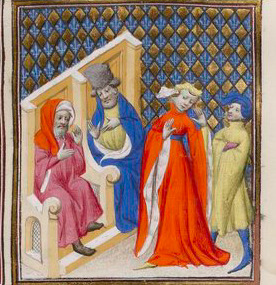
When there were attempts to stain the family name by having Sempronia identify and recognize a third nephew, she refused to do the deed regardless of consequence or command. In the image, Sempronia is seen in a red gown standing with her back to two men who are attempting to have her identify a third nephew. In front of her is the nephew that she refuses to recognize.
Rebecca Crawley learns against the back of George Osborne’s chair, flattering him about his appearance and teasing him about his bad habits. He is turned slightly to look at her, while Rawdon Crawley sits opposite him, smoking. The men are each holding two cards in their game of écarté.
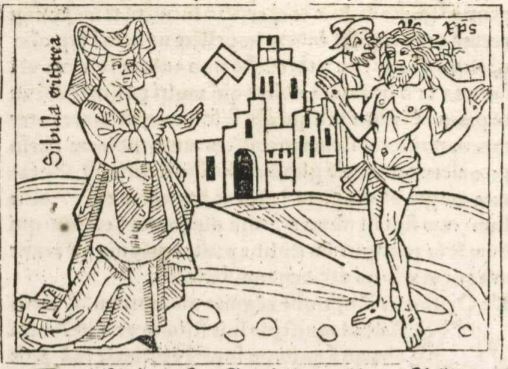
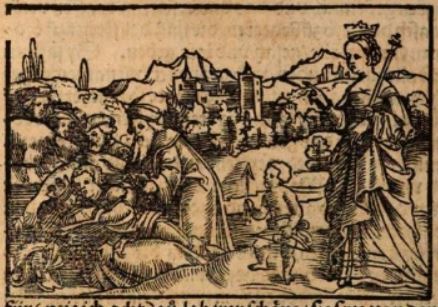
This engraving depicts the sibyl named Erythraea on the left-hand side of the engraving with her left hand facing upwards and her right fingers pointing to the man on the right side of the engraving. We know that this is the sibyl Erythraea as her name is engraved directly beside her body. The man she is pointing to is the son of God, Jesus. His name is engraved beside his head. Boccaccio explains that Erythraea was so intellectual that her prophecies were taken as Gospel rather than fortune-telling. She even prophesized the entire events from the life and death of Jesus, which is why he is depicted in this engraving. Boccaccio explains that Erythraea had also prophesized the fall of Troy, which is assumed to be the city in the background of the engraving. There is an unidentified man’s head engraved beside Jesus.
Two Indigenous men are shown hunting. Both are nude and wear large necklaces. One carries a large bow and a spear, while the other carries a shield and a short blade similar to a scythe. Both men are looking over their shoulders at a pair of unicorns standing among the trees behind them. Only the front half of each unicorn is shown in the image and they both appear to be pawing the ground.
Lady Rose Crawley, who looks worn down, enters the dining room on the arm of her son, Mr. Pitt Crawley. To the right of the picture, Sir Pitt Crawley stands behind the door, holding a jug in one hand. To the other side, through the open door, Rebecca Sharp can be seen talking to one of the Crawley daughters.
Two rich men are giving food to two poor men. The poor men are seen begging, one of them on his knees. The men are distinguished by their attire. The rich men are wearing robes, and what appears to be a crown.
Here we see two mice next to a ram from Blefuscu. The ram is the same size as the mice, showing the difference in size between the animals on Lilliput and Blefuscu and those in the real world. The same image appears in the 1839 Krabbe edition.
An Indigenous man has been taken captive by another Indigenous group and is about to be executed. He is restrained by a rope tied around his waist, with each end of the rope held taut. The captive wears a feathered headdress and a necklace. Another man stands beside him holding a club raised over his head, poised to swing. There is a body lying on the ground behind the man with the club. Groups of people stand on either side of the captive to watch the execution, most of the men hold bows or clubs and at least one woman has a small child in a sling against her chest. Another woman crouches beside the prisoner with her hands over her face in distress. Several structures are visible in the background. This image is identical to one found in Paris, 1557.
Here we see a circle of giants sitting in a field of wheat around Gulliver. The giants are the family of the farmer who discovered Gulliver. Some of the giants hold scythes, representing their work as farmers. The image is surrounded by a decorative frame.
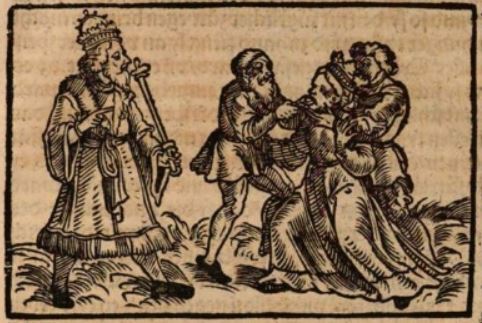
This engraving depicts Agrippina, the wife of Germanicus, being forced to eat food. Agrippina is depicted on the right side of the image with a man holding her head back while the other man is force feeding her with a spoon. The man on the left side of the image is Tiberius, the one who is ordering her to be fed. Tiberius is Germanicus’ father, and after he killed his own son, he sent his daughter-in-law Agrippina to prison. Agrippina decided to starve herself to death to avoid dying at Tiberius’ hands, however, Tiberius force fed her so that she would not die on her own.
Here we see a triptych showing the separation between the Lilliputians and the Blefuscudians. In the first image we see the two emperors as friends, then they have an argument which we seen in the second image with the man further from the viewer crossing his arms and is standing in an aggressive stance. In the third image we are left with only the Lilliputian Emperor. In the first image, there are two shoes in different styles in front of the two men, one with a tall heel, the other with a small heel and a feather detail. In the second image only the shorter heel shoe remains, while in the third image only the higher heeled shoe is shown. The viewer is meant to understand that the argument between the two men was about the correct style of shoes. This is a thinly veiled reference to the religious wars of the sixteenth and seventeenth centuries. The same image appears in the 1839 Krabbe edition.
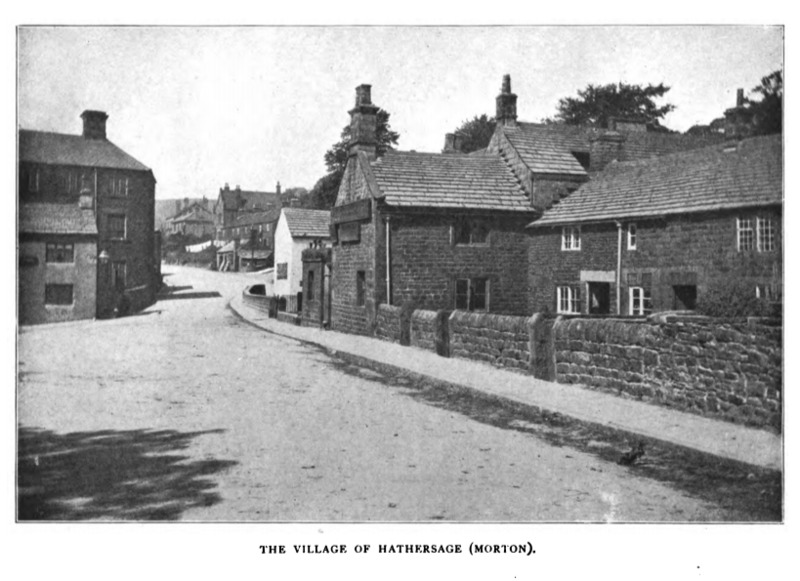
Here we see an image of a street in Hathersage, a village in Derbyshire. After running away from Thornfield after ending her engagement to Mr. Rochester she ended up in Morton, which was based on the real village of Hathersage. The same image appears in the 1899 Harper edition of Jane Eyre.
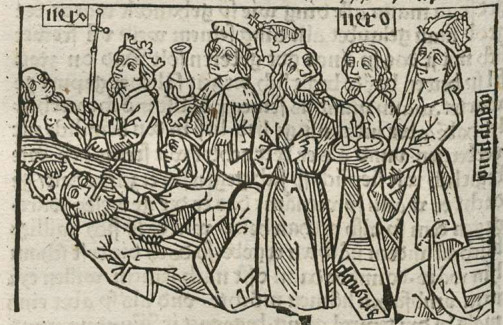
This engraving depicts multiple events. The right side of the engraving depicts Agrippina poisoning her husband Claudius with mushrooms. Agrippina is illustrated wearing a crown and holding a plate of mushrooms as she presents them to Claudius. Agrippina’s name is engraved behind her body, while Claudius’ name is engraved by his feet. Agrippina’s son, Nero, is depicted standing in between Agrippina and Claudius as he watches his step-father being poisoned (his name is engraved above his head). Agrippina poisoned Claudius to obtain power for herself and make her son emperor. The left side of the engraving in the foreground depicts Agrippina further poisoning Claudius. Agrippina is depicted on her knees while she feeds Claudius more poison, as the mushrooms did not complete the task. The background of the engraving depicts Nero as emperor, looking at his mother’s dead, naked body. He began to resent her after becoming emperor, and after having her murdered, he observed her dead body and judged it before cremating it. Nero is depicted wearing a crown and holding a scepter, with a man beside him holding a cremation urn.
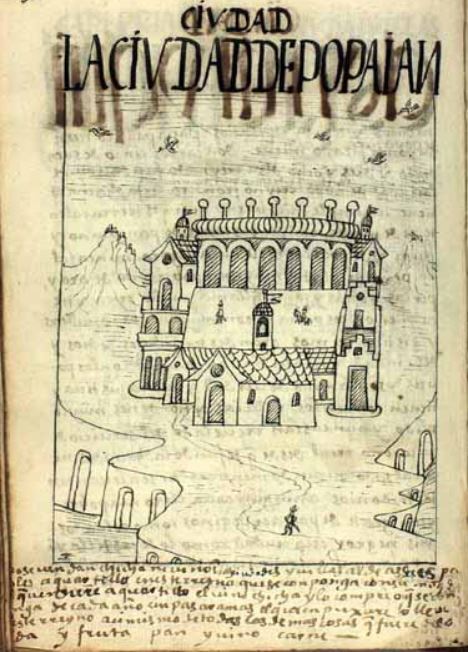
This image is depicted in the author’s chapter where he discusses cities, towns, villages, and provinces in colonial South America. This image depicts the city of Popayan, Colombia. There is a group of buildings arranged in a way that forms a square in the centre. There is a fountain in the centre of the square with two people approaching the fountain. Outside of the buildings, there are mountains in the background and in the foreground, there is a person walking on a path leading towards the buildings. There are birds flying above the city. The large caption at the bottom of the image reads, “[N]o se uendan chicha ni uino en las ciudades y uillas, aldeas se es pa[gal]les a quartillo en este rreyno que se conponga con su Magestad [...] que uendieren a quartillo el uino, chicha y lo compre o que se con[po]nga de cada año cin pasar a más. El quien puxare lo lleue [...] este rreyno, acimismo de todas las demás cosas que fuere de co[mi]da y fruta, pan y uino, carne” [Chicha or wine is not sold in cities or towns, villages are paid by quart in this kingdom and their majesty will sell wine, chicha and buy it each year. Whoever can take this kingdom, as well as all other things that may be food and fruit, bread and wine, meat].
The goddess Venus is depicted on the right side of the engraving wearing a crown and holding a scepter in her left hand. Her son, Cupid, is depicted walking alongside her with his bow and arrows in hand. The left side of the engraving also depicts Venus as she commits adultery with her half-brother, Mars. They are illustrated laying down wrapped in each other’s embrace. Venus’ husband, Vulcan, is depicted walking in on the crime and trying to get Venus away from Mars. The city of Cyprus is illustrated in the background of the engraving. Boccaccio explains that Venus was highly adored in Cyprus as well as Rome, and he chose to write on her for her beauty. He criticizes her highly due to her invention of brothels.
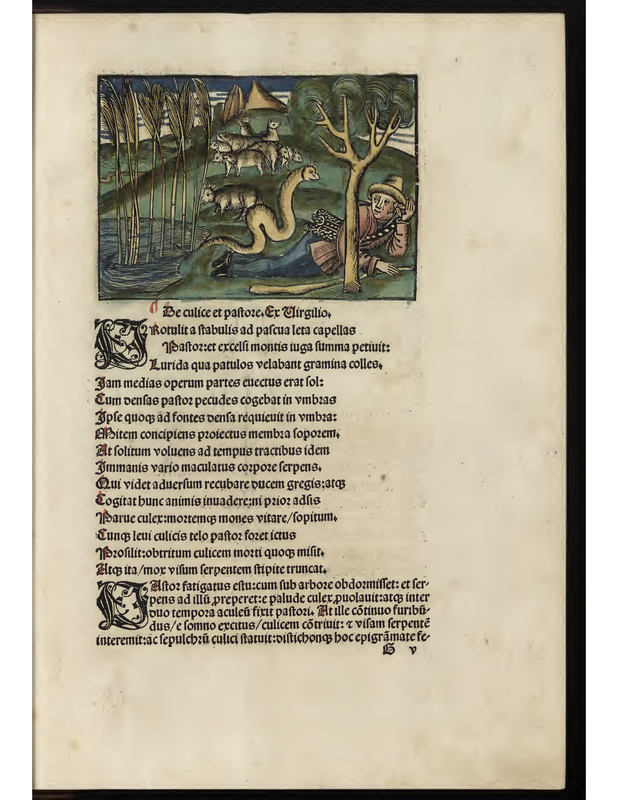
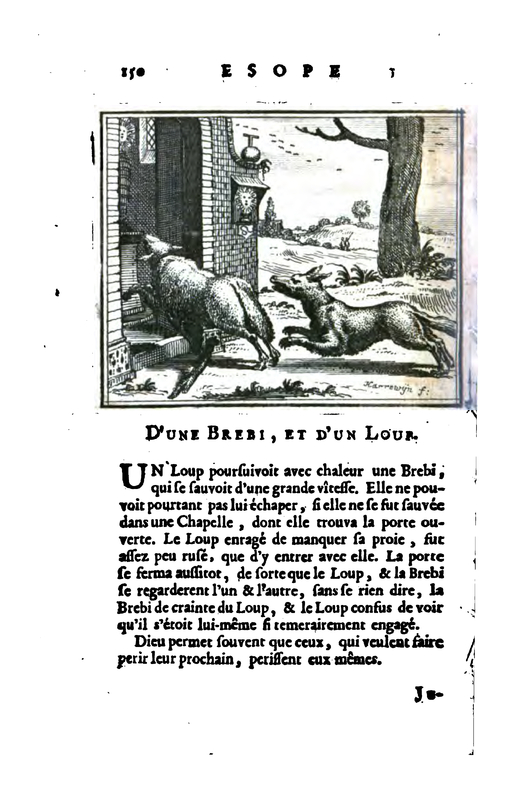
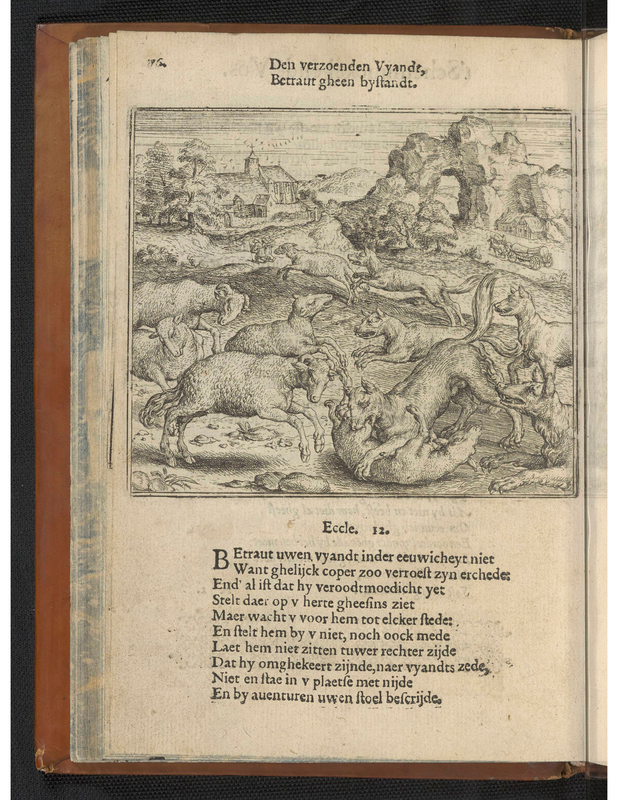
Sheep and wolves run at each other from opposite sides of a field. In the forefront, a wolf bites onto a sheep's leg. In the background, a horse and wagon drive under an arched rock face toward a village.
Amelia Sedley is depicted holding a Black doll with curly hair, possibly representing Miss Rhoda Swartz, at which she gazes lovingly. Next to her, on the right side of the image, is the letter L from “Love”.
This illumination depicts a woman named Lucretia stabbing herself with a knife. There are people depicted on the right side of the image watching Lucretia carry out this act. Boccaccio explains that a relative of Lucretia’s husband (Collatinus) had raped her during the night. This man’s name was Sextus, and he had been welcomed into Lucretia and Collatinus’ home as a guest before he committed this crime. Lucretia told her husband, her father (Tricipitinus) and a relative named Brutus what Sextus had done to her. These are presumably the men illustrated on the right. After she told them what Sextus had done to her, she killed herself in shame of what happened.

![[Act XXI (First Illustration) – Pleberio Telling Alisa About the Death of Melibea while Lucrecia Stands at a Distance]](https://collections.cemvc.ca/files/large/2c789d15283ca3d4d96add51e7e476d6d6c851d8.jpg)
![[Rebecca watches George and Rawdon at Cards]](https://collections.cemvc.ca/files/large/d48d38e2d783a9ec1a93e60163538a1fa244f5ec.jpg)
![[Indigenous people hunting in Brazil]](https://collections.cemvc.ca/files/large/c0bc6466f8fce97f5f0f584f99d8651b037bc47f.jpg)
![[Lady Crawley Entering the Dining Room]](https://collections.cemvc.ca/files/large/b58baebcc7a9f57993843d3a8c33c8899a028088.jpg)
![[Rich give food to poor]](https://collections.cemvc.ca/files/large/659b558e2b49494b0fd286d0b971f8a4bc756333.jpg)
![[Two mice next to a ram from Blefuscu]](https://collections.cemvc.ca/files/large/6f1a51f8e452d2f613bb15184f33588a353cc8d1.jpg)

![[Execution of a prisoner in an Indigenous Brazilian village]](https://collections.cemvc.ca/files/large/ff8b7cb95e4feed6c975c1f72cc49cb6298ec72c.jpg)
![[Gulliver speaks with giants on Brobdingnag]](https://collections.cemvc.ca/files/large/6ae70a7d49fdee5cba16fe1a9b8065c4495c802b.jpg)
![[The rift between Lilliput and Blefuscu]](https://collections.cemvc.ca/files/large/f240c95ccd7b446afb77e5115ea9c274b04d136e.jpg)
![[Vanity Fair Chapter XXI Historiated Initial]](https://collections.cemvc.ca/files/large/6613fdd94cf06bb554876c9f9b833ab0c90ee2dc.jpg)