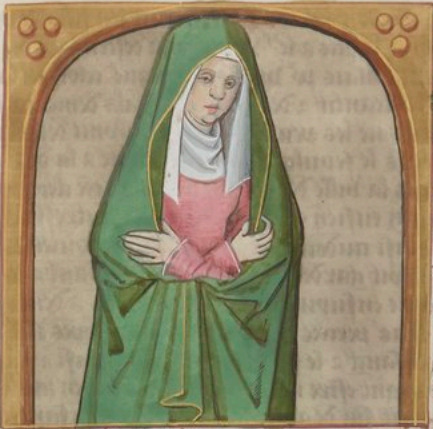
This illumination depicts a portrait of a woman named Antonia, the daughter of the famous Mark Antony and Octavia. Antonia is famous for having remained a widow for the rest of her life following her husband Drusus’ death.
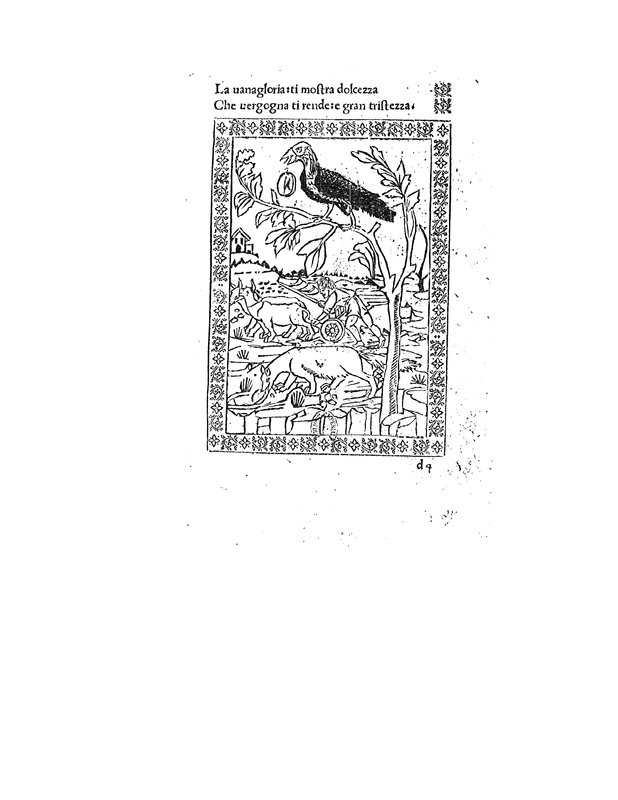
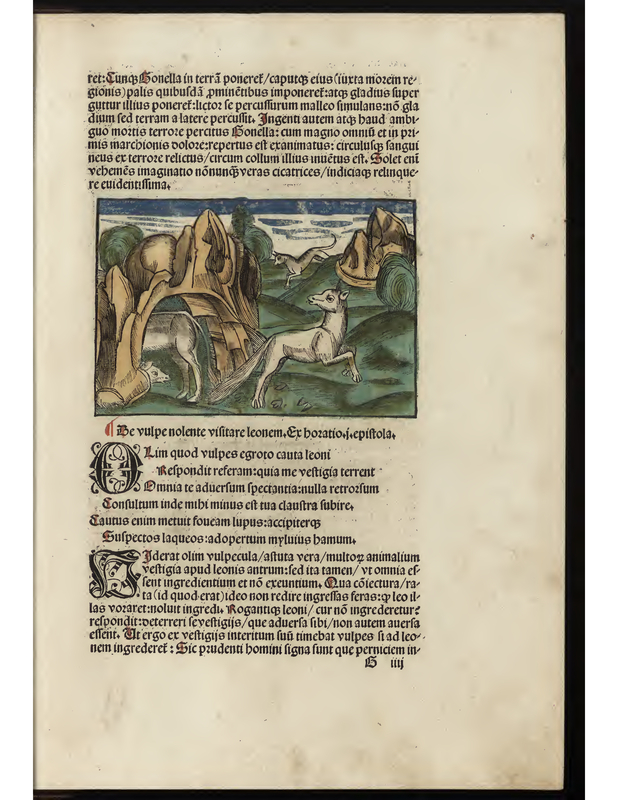
In the centre of the image there is a raven who is sitting on top of a branch of a tree. It has just dropped what seems to a piece of food (cheese). Below the raven on the ground there is a fox with the piece of food (cheese). The fox has a devious demeanor. In the background of the image there is a person working the field with what seems to be a plough and two animals pulling.
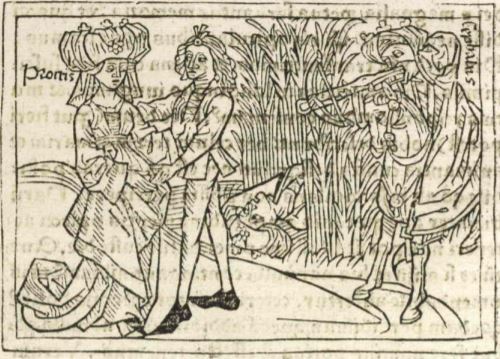
Boccaccio explains that when Cephalus was told that his wife would abandon his love in exchange for money and treasures, Cephalus began testing his wife, Procris. Cephalus disguised himself and offered her gold and treasures in exchange for her love. This scene is depicted on the left-hand side of the engraving. Procris (her name is engraved just beside her head) is clearly putting her hand up to stop the disguised Cephalus as she rejected his first offer. However, Boccaccio explains that she had accepted after Cephalus tempted her a few times. Maddened by her conscious for what she had done, Procris went to live in the woods. Cephalus had been hunting one day and had mistaken his wife for an animal and shot her. Procris is visible behind the grass in the background of the engraving as Cephalus is depicted with a cross bow in his hands after shooting her. Cephalus’ name is engraved beside his arm to identify him.
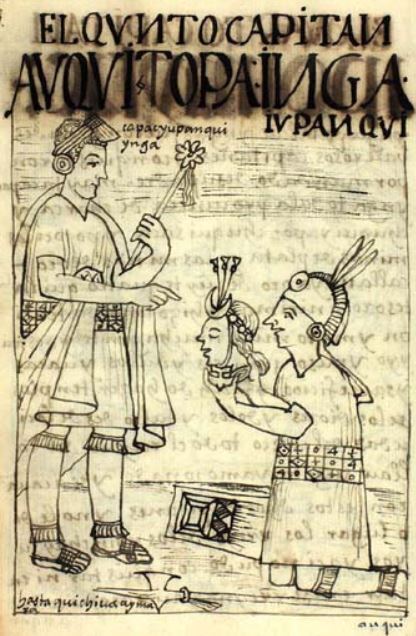
This illustration depicts the fourth captain, Auqui Topa Inca Yupanqui. These captains were a level of Inca authority who helped lead the conquest of the Andes. This captain was the son of Capac Yupanqui, the fifth king of the Inca Empire. This image depicts the captain kneeling on the right side of the image as he presents a decapitated head of an enemy to his father. The king is depicted standing on the left side of the image looking down at his son as he holds a staff in one hand and pointing to the decapitated head with the other. His name is written beside his head to identify him. The words “hasta quichiua aymara” are written below the king’s feet, which translates to “until Quechua Aymara.” This refers to the captain’s conquest of the provinces of the Quechua and Aymara speaking people.
In this image we see Gulliver walking sideways between buildings in the Lilliputian city of Mildendo. The street where Gulliver is walking is likely a residential street, since it is considerably narrower than the main street seen on page 55, meaning Gulliver must walk sideways to fit down the street. Lilliputian residents are leaning out their windows, standing on their balconies, and on the roofs to get a look at Gulliver, who is a giant to them. Some Lilliputians children are still on the street and their mother rushes them inside to get out of Gulliver’s way. The same image appears in the 1843 Krabbe edition.
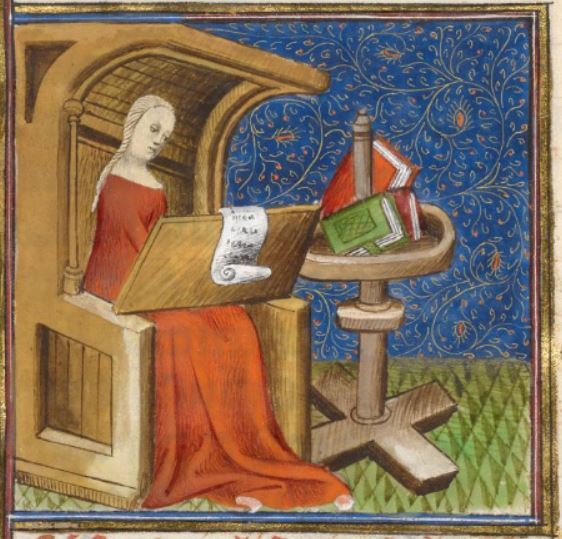
This illumination depicts Proba sitting in a chair as she looks at a book resting on a lectern. The books illustrated in the image are to represent her intellectual life and her teaching history to the world. Proba is renowned for her intellect and extensive knowledge of literature including works from Virgil. Proba had taken lines from the Aeneid, Bucolics, and the Georgics and transformed them into a cento focusing on the Old and New Testaments. Proba was said to have known the Scriptures by memory, which was something not even many men were able to do.
Mrs. Tinker, Sir Pitt Crawley, and Rebecca Sharp stand around a small round table in front of the fireplace in the dining room. Mrs. Tinker has just brought Sir Pitt’s pipe, which she holds, and a paper of tobacco, which is on the table. Sir Pitt has grabbed hold of Miss Sharp’s hand and is leering at her, while she is turned mostly away from the other two and glaring back in their direction.
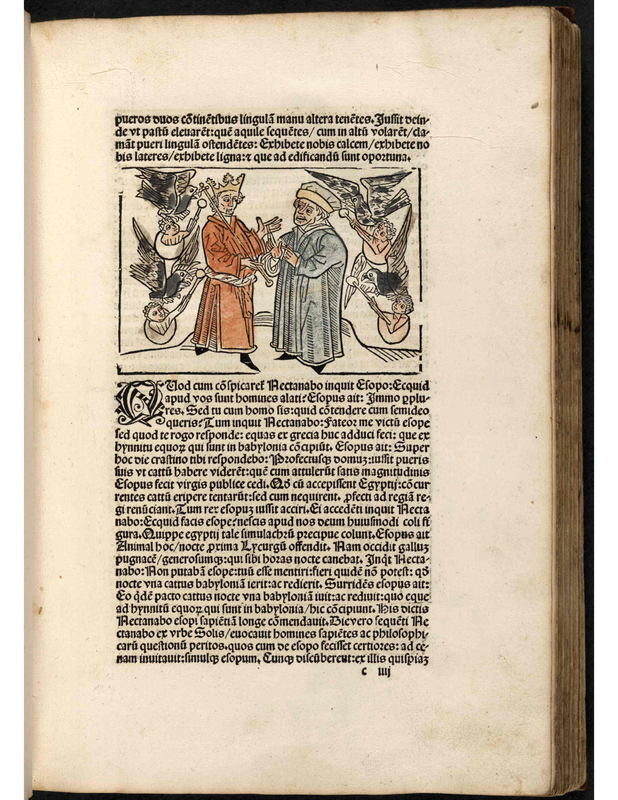
Two men in robes are speaking to each other. One man has a red robe with a crown and amber. The other man is wearing a blue robe and is gesturing to his hand. They are surrounding by four babies being carried in a white cloth by black birds.
Here we see Gulliver saying goodbye to his family as he leaves for another voyage only two months after returning from Lilliput and Blefuscu. Everyone here is crying. Gulliver’s wife is on his left while his daughter and son hug him. In the background we see the docks and the ship that Gulliver was leaving on. The same image appears in the 1839 Krabbe edition.
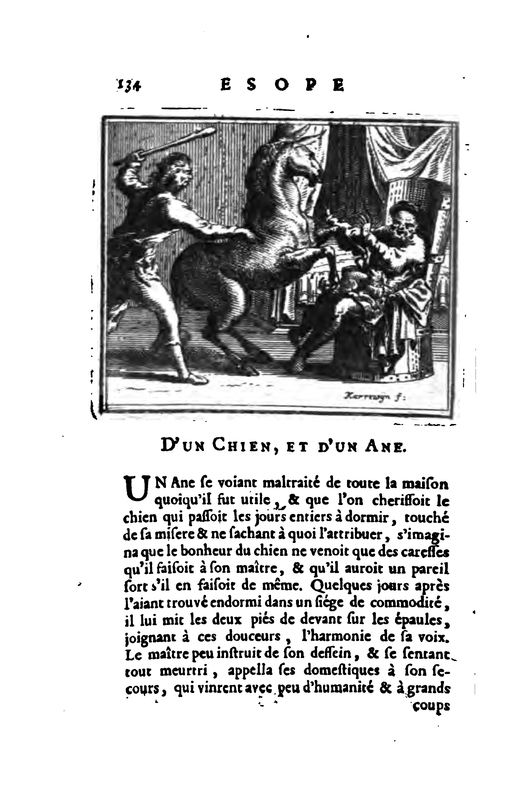
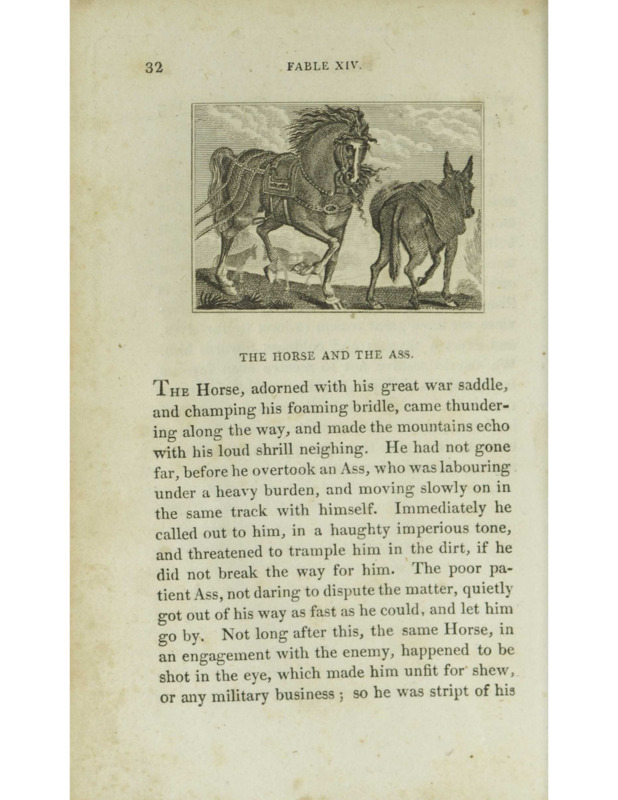
A horse is standing up on its two back legs and appears to be attacking a man sitting down while another man is standing behind the horse with a whip raised above his head.
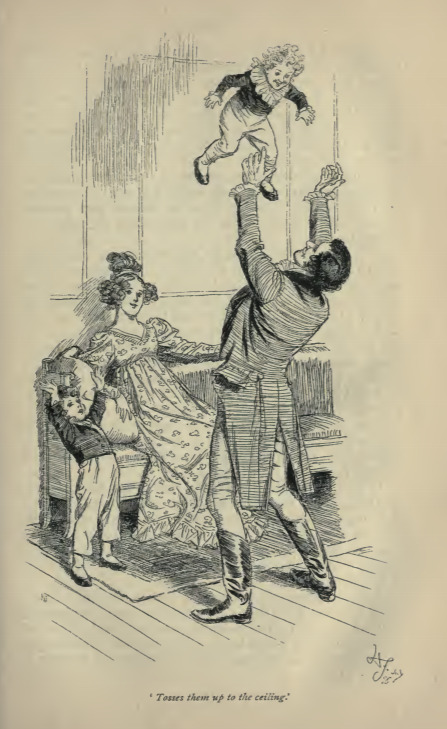
Here we see Mr. Knightley playing with his nephews, tossing one of his nephews into the air. Emma’s sister, Isabella, sits in front of Mr. Knightley. Isabella married Mr. Knightley’s younger brother, Mr. John Knightley. Mr. Woodhouse was always concerned that he played too rough with the boys, but Emma reassured him that they enjoyed it. This scene occurs in chapter 9. The characters are shown in the traditional regency style, with Isabella wearing a regency style dress with an empire waist. Mr. Knightley wears a waistcoat and tailcoat, with a cravat. The young boys wear short coats and breeches. The regency period dated to the early nineteenth century (1811-1820) when George, Prince of Wales, later George IV (r. 1820-1830), reigned as regent for his mentally ill father, King George III (r. 1760-1820). The regency period is associated with the rise of neoclassicism in art and fashion.
When Berenice found out about the murders of her two sons by Mithridates, she was devastated. In her grief, she sought out Mithridates to get revenge. When she found Caeneus, the king’s servant who committed her sons’ murders, she struck him to the ground with a rock and then ran over his body with her chariot. The image depicts Berenice in her chariot, surrounded by soldiers as she looks for the man who killed her sons. She holds a lance in one hand as a weapon, and in the other hand she holds the rock that would strike Caeneus to the ground. Caeneus is depicted in the yellow armor, looking up at Berenice.
Amelia Osborne, wearing a bonnet, is shaking hands with Peggy O’Dowd, who has just entered the sitting room in a riding-habit, eager to meet the newest addition to the officers’s ladies. Through the doorway behind Mrs. O’Dowd are two officers of the regiment.
There is a man sitting on a thrown. He is wearing a crown and holding a bejeweled cane. He has his hand out in front of him. There is a bee flying toward the man on the thrown. To the right, there is a man down on one knee reaching into a dome. This man has fabric wrapped around his head. The fabric covers the man’s mouth.
Rawdon Crawley is at the saddler’s where he, under the pseudonym of Eliza Styles, is receiving letters from Rebecca Sharp. He is seated on the counter, reading his newest letter while twirling his moustache. The boy behind the counter is smiling up at him, and to his side is a saddle displayed over a beam.
This image appears at the end of the book. It depicts man, presumably Giovanni Boccaccio, the author of the book, sitting in his study reading a book which is resting on a lectern. There are other books on a shelf in the background of the image. Giovanni Boccaccio was around forty-eight years old when he compiled the stories of the women in the book, which is why he looks slightly older in age in the image.
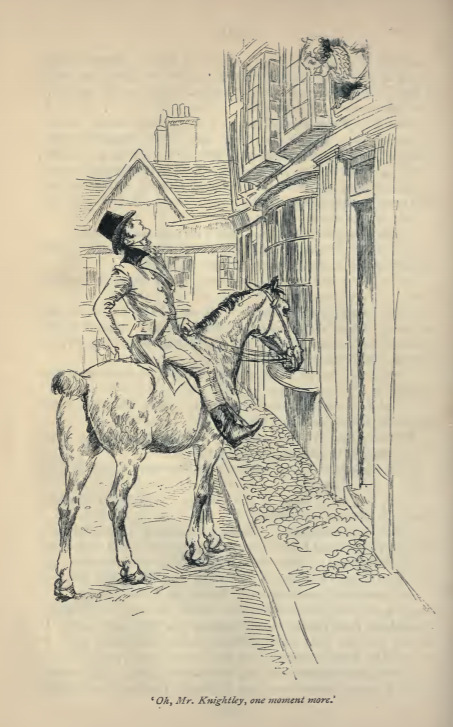
In this image Miss Bates leans out the window speaking to Mr. Knightley who was on horseback. Miss Bates saw him passing the house and, not wanting to cause a chill by opening the window in the drawing room where a group was gathered, went into another room to speak with him through the window. Miss Bates asked him to come in but he said he could not because he was on his way to Kingston. This scene occurs in chapter 27. The characters are shown in the traditional regency style. Miss Bates wears the regency style dress with an empire waist. Mr. Knightley wears a waistcoat and tailcoat, with a cravat and top hat. The regency period dated to the early nineteenth century (1811-1820) when George, Prince of Wales, later George IV (r. 1820-1830), reigned as regent for his mentally ill father, King George III (r. 1760-1820). The regency period is associated with the rise of neoclassicism in art and fashion.


![[Gulliver squeezes through narrow streets of Mildendo]](https://collections.cemvc.ca/files/large/94917bd23a2b950bb28fc14b30684f9501919392.jpg)
![[Mrs. Tinker, Sir Pitt, and Miss Sharp]](https://collections.cemvc.ca/files/large/d4c1bc9d2ff82cb6b85c31f83471406492844b9d.jpg)
![[Gulliver leaves his family shortly after returning from Lilliput]](https://collections.cemvc.ca/files/large/37e254f4036a6f3eaf2453eb9213a56cd68cfeb7.jpg)

![[Amelia’s Introduction to Mrs. O’Dowd]](https://collections.cemvc.ca/files/large/8956c4dd03042c654d7147ffc837800496f14361.jpg)
![[King wants a Bee]](https://collections.cemvc.ca/files/large/e00115e79263ef56f12f616eee67adb0932cdb12.jpg)
![[Captain Crawley Reading a Letter]](https://collections.cemvc.ca/files/large/bea24cc6f4560706d7726e03ffd10f9dbd7c2fc2.jpg)
![[Boccaccio Reading in his Study]](https://collections.cemvc.ca/files/large/9f204f2e4e16093727b8f748339b85c1de2d4ea9.jpg)