Here we see Gulliver’s hand immediately after firing his pistol as a demonstration for the Lilliputians. A cloud of smoke comes from the pistol, while the Lilliputians cower in fear. This image comes at the point in the story where Gulliver demonstrates his weapons to the people of Lilliput, including his rapier and his pistol, which he loaded with gunpowder to demonstrate its use. The same image appears in both the 1839 and 1843 Krabbe editions.
A group of Indigenous Canadians (identified as such by the author) hunt wild boar and deer with spears. They wear tunics, hats, leggings or tall socks with fur, and snowshoes on their feet. One individual in the background drags the body of an animal towards their village. This image is identical to one found in Frankfurt, 1557.
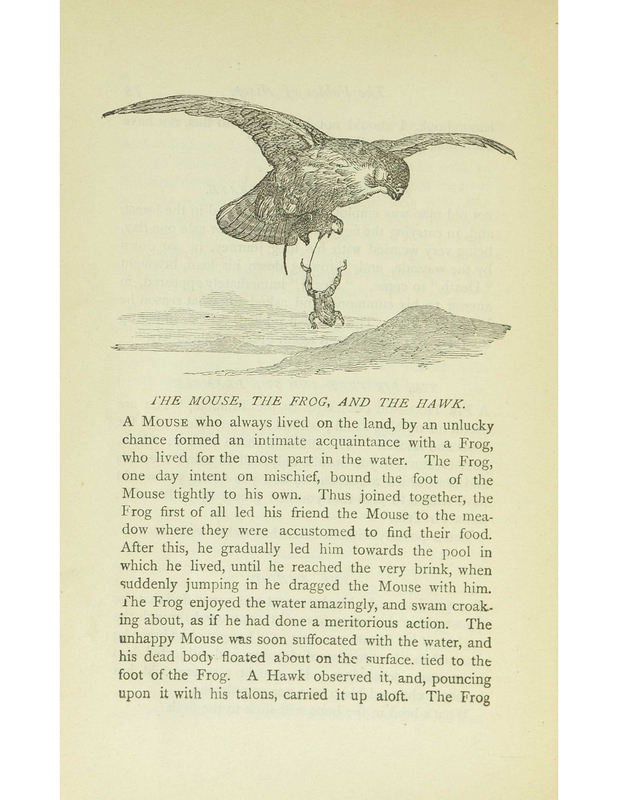
In the sky, a hawk holds a small mouse in its left claw. A frog is falling, but it has a small rope tied around its leg and is being held up by the mouse. The hawk is looking below at the dangling frog, and it seems irritated. In the background, hills and clouds decorate the image.
Rebecca Crawley learns against the back of George Osborne’s chair, flattering him about his appearance and teasing him about his bad habits. He is turned slightly to look at her, while Rawdon Crawley sits opposite him, smoking. The men are each holding two cards in their game of écarté.
This image is illustrated in a chapter that discusses the descendants of the Inca and Andean nobles under Spanish colonial rule in Peru and their importance to a revived Andean society. This image depicts a standing portrait of a noble lord who is dressed in Spanish attire and holding a rosary in his right hand. This lord was responsible for overseeing fifty Indian tributaries. The author explains that if the lord had less than fifty tributaries, they would have no title and no privileges from the king. The caption at the bottom of the image reads, “tributario y cabildo, no tiene don mandón quien le falte cinqüenta yndios tributarios” [tributary and council, he who lacks fifty Indians does not have a title].
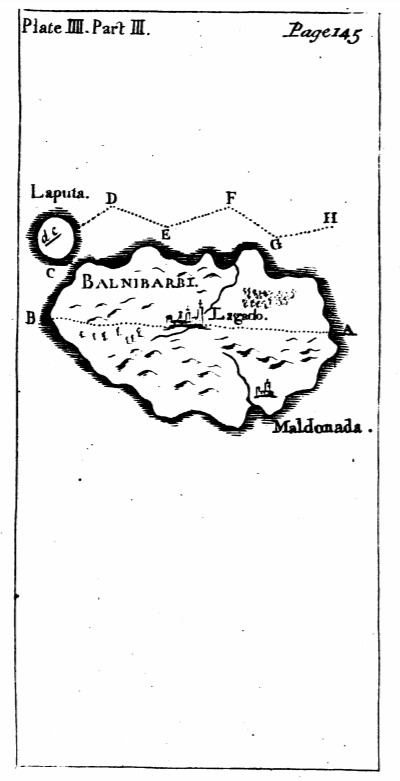
This image depicts the fictional floating island of Laputa. There are regions of hills in the Southern, and North-West areas of the island. Forests are also shown in the North-East and Central regions. The city of Lagado is in the centre of the island. The town of Maldonada is in the Southeast of the island. Above the island are letters, which depict the different ways in which the island moves, hovering over Balnibarbi through magnetic opposition on an adamantine base. The same map appears in other editions of Gulliver’s Travels, including those in other languages.
Two women are holding up a sort of sheet. A third person holding the sheet is standing behind it almost completely covered. A man is walking away from them going through a doorway. This man appears to be carrying something. He has his arms wrapped around the object tightly.
Here we see Gulliver speaking to an official from the Lilliputian court. The official sits in a sedan chair, however the chair attendants were dismissed. The official was there to inform Gulliver that he had been charged with treason. Gulliver was charged because he urinated on the Imperial Palace to put out a fire in the Empress’s apartments and for preparing to visit the Emperor of Blefuscu – the enemy of Lilliput. Because of these charges, Gulliver leaves Lilliput and travels to Blefuscu. The same image appears in the 1839 Krabbe edition.
Here we see Gulliver and the Governor of Glubbdubdrib, who was a necromancer. The two men stand on a balcony and the Governor asked Gulliver what he wanted to see. Gulliver responded that he wished to see Alexander the Great after the battle of Arbela. Alexander appeared in the field under the balcony and called up to Gulliver, speaking Greek. Alexander said that he died of fever from excessive drinking, not by poisoning. Alexander the Great was a Macedonian King from 336-323 BCE. Alexander conquered Greece and Egypt and at the battle of Arbela he defeated Darius III, the King of Persia, in 331 BCE. Rumors at the time of his death said that he had been poisoned, however, Plutarch’s Lives, said that he died of fever, which Alexander corroborates, as this is a more honourable death than dying by poison. The same image appears in the 1839 Krabbe edition.
The footman Sambo, Mrs. Blenkinsop the housekeeper, and the cook stand at the landing-place outside the drawing room to listen to Rebecca Sharp sing. In the background is another figure in uniform, possibly a page boy.
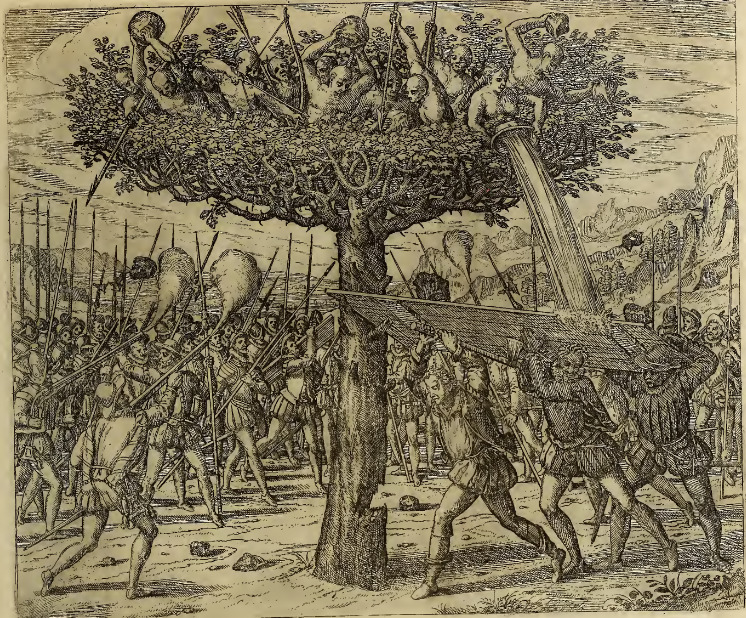
A group of Spaniards attack several Indigenous people in a tree in the Atrato river region of present-day Colombia. The Indigenous people of the region built homes in the treetops because the land around the river was quite swampy. The Indigenous people throw rocks and spears, fire arrows, and pour water onto the attackers on the ground below them, while the Spanish soldiers fire muskets up at them. Two Spaniards hold a large wooden board over the head of a third man, to protect him while he attempts to chop down the tree with a hatchet.
In this image we see the Lilliputian Emperor, Empress, and Prime Minister playing a game to determine the hierarchy of the court. The process involves courtier walking underneath sticks of different height. Depending on the height of the stick – held by the Emperor and Prime Minister – the participants are awarded different coloured uniforms. The uniforms are either blue, red, or green, and these colours indicate their place within the court. This episode was understood as a satire on the process of gaining knighthood in the English Court, where appointment as a Knight appeared to be based not on objective merit of the honour, but rather on the whims and bribes of King George I. The same image appears in the 1843 Krabbe edition.
Joseph Sedley puts on his coat with help from Isidor, his valet. He is intending to go out to discover for himself whether the rumors of Napoleon’s victory are true. Joseph is standing next to a chair over which another coat is draped, and on the wall behind Isidor hangs a large painting.
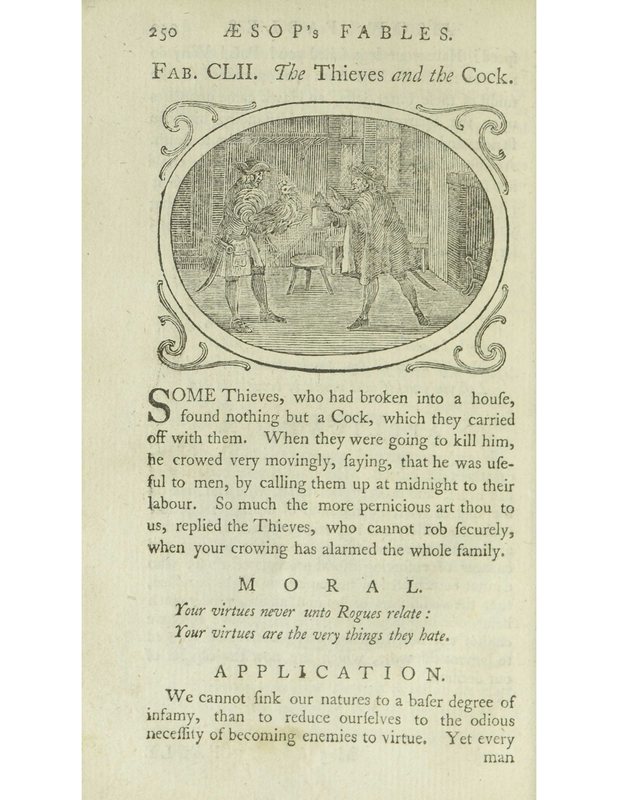
Two men in foreground facing each other. They are in a home. Both wearing triangular hats and cloaks and carrying swords. The man to the left is holding a cock, that is posed aggressively toward the second man. The cock is calling out as he scratches his legs in the air. Man to the right is holding a lantern to aluminate the Cock, and is trying to calm them down.
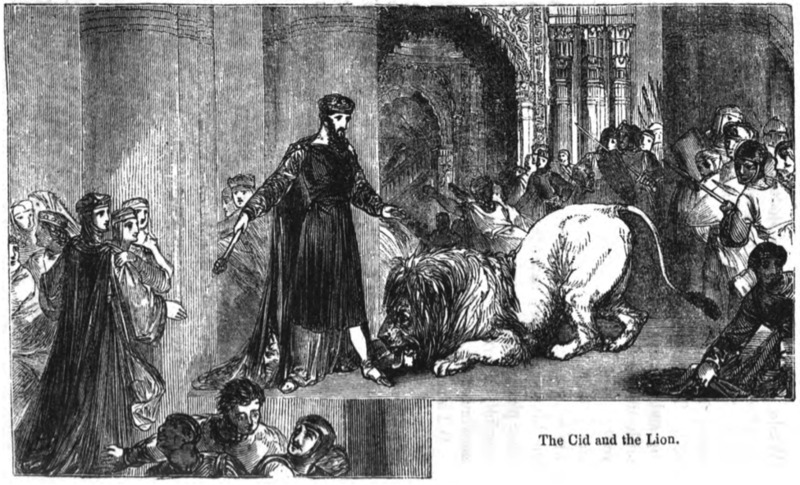
In this image El Cid is facing a lion. He is looking at the lion as the lion looks like he is bowing to him. El Cid is wearing dark robes with a cloak. He has a long beard and is wearing a hat. In his left hand he is holding a sceptre. All around the scene there are people fleeing. They are all in a castle; arched columns are visible in the background making an entrance where most people are fleeing.
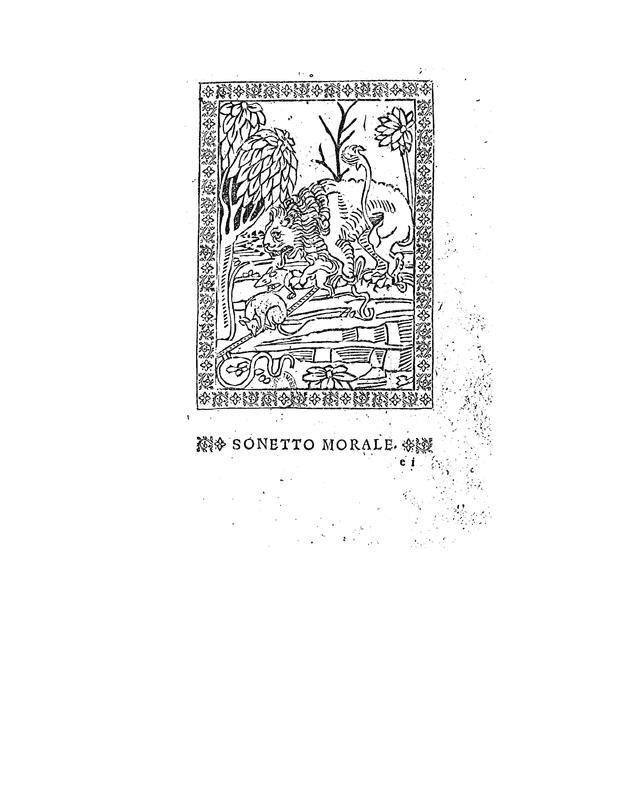
There is a lion with its tail between its legs and seems to have a rope tied to it. The left front paw of the lion is pinning down a mouse. In the forefront of the image there is mouse chewing on the rope that is trapping the lion.
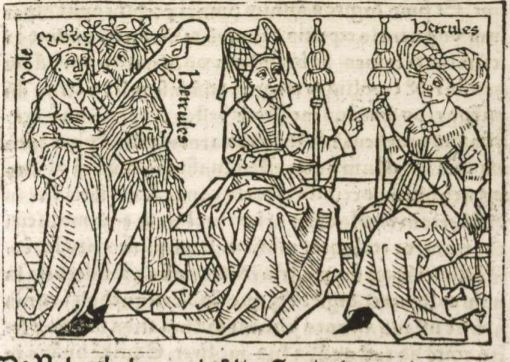
This engraving depicts the marriage between Iole, daughter of King Eurytus of Aetolia, and Hercules. The left-hand side of the engraving illustrates Hercules wrapped around Iole with a look of pure affection on his face. Iole is pictured not reciprocating the embrace. We know that these figures are Iole and Hercules as their names are engraved beside their bodies. Boccaccio explains that Iole is not in love with Hercules because he killed her father after he did not give Hercules permission to marry Iole. In order to seek her revenge on her husband for the murder of her father, Iole allowed Hercules to fall madly in love with her. By doing this, Iole was able to convince Hercules to do whatever she asked. She stripped him of his pride by getting him to dress as a woman and spin wool, which is depicted on the right-hand side of the engraving. As Hercules is unrecognizable in women’s clothing, the creator engraved Hercules’ name above his head to differentiate between him and Iole.
Here we see a vehicle similar to a sleigh drawn by four yahoos. A Houyhnhnm who injured his hoof sits on the sleigh, as it arrives to the house where Gulliver is staying. The sleigh is greeted by another Houyhnhnm, while another takes the yahoos to the stables to be fed. This scene turns the world upside down, as it is now humans who pull the sleighs and the horses riding in it, rather that the reverse. The same image appears in the 1839 Krabbe edition.
An eagle is perched on the back of a turtle. They are both standing on the right side of a small river on a stone ground. On the left side of that small river is a small crow that is looking straight at the eagle. Behind them are a few sparse trees and a stone wall on the right-hand side of the image.
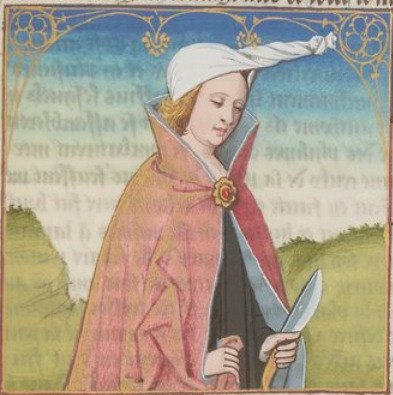
This illumination depicts a portrait of Portia, the daughter of Marcus Cato and wife of Brutus. Brutus was one of the people involved in the conspiracy to assassinate Julius Caesar. When Brutus told Portia of the conspiracy, she takes a barber’s knife and stabs her foot with it. She does this to prepare herself in case she has to kill herself should the conspiracy not work out in Brutus’ favour. Portia is depicted holding the razor in her hand in this image. She eventually kills herself by swallowing hot coals when she finds out that Brutus had died.
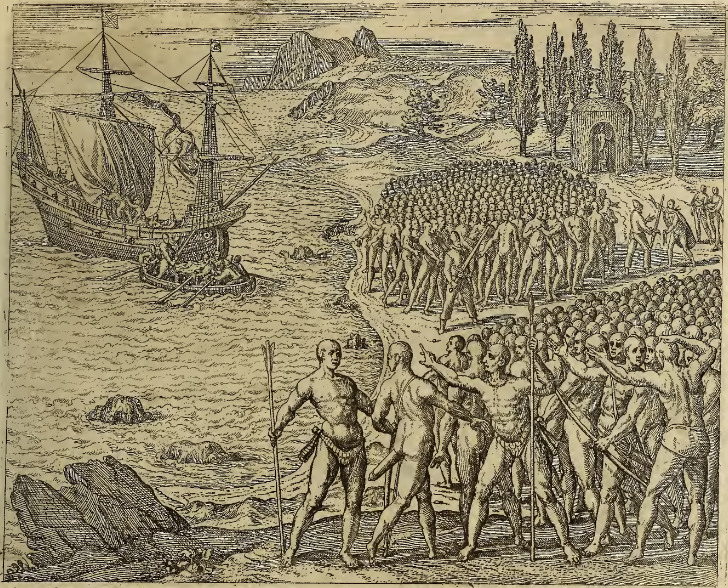
A large group of Indigenous people greets a ship of Spanish explorers in Ecuador. Several Spaniards come ashore in a rowboat. Two Spanish men have already reached land, both wielding swords, and one stands near the shore while the other has pushed through the group of Indigenous people and is confronted by an Indigenous man wearing a cape. Many of the Indigenous people are armed with bows and quivers of arrows or spears. Several Indigenous men at the front of group gesture towards the ship. In the background there is a hut with an Indigenous idol or statue inside.
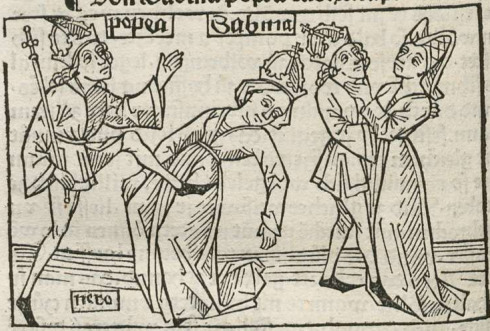
This engraving depicts two separate events. The scene on the right side of the engraving depicts a woman named Sabina Poppaea, a woman of noble birth, seducing emperor Nero. She was incredibly beautiful, as well as cunning. She sought power and found it by marrying emperor Nero, although she did not hold her power for long. The left side of the engraving depicts her tragic fate, as emperor Nero kicks a pregnant Sabina Poppaea, which ends up killing her. Sabina Poppaea’s name, written as “Popea Sabina”, is engraved above her head, and Nero’s name is engraved by his feet.

![[Gulliver demonstrates his pistol]](https://collections.cemvc.ca/files/large/02792b0ab6bb9b1de6ebebcd62830e0ce544f479.jpg)
![[Indigenous Canadians hunt in the winter]](https://collections.cemvc.ca/files/large/7a55f6b665f469ea6ddb7058626e77fd7a6321d8.jpg)
![[Rebecca, George, and Rawdon]](https://collections.cemvc.ca/files/large/6208192d051a3fb4f36f370b863b6b1255cbab2b.jpg)
![Mandoncillo de Cinqv[en]ta In[di]os, Pisca Chvnga Camacchicoc Chuqui Llanqui, Xauxa Guanca](https://collections.cemvc.ca/files/large/dd188ddfbe59fe6cce7b4f097b06acdbb7ee69f9.jpg)
![[Women holding a sheet]](https://collections.cemvc.ca/files/large/543f4efaed65fe40b95c99c9cf0b0ac72e61c743.jpg)
![[Gulliver talks to a Lilliputian official]](https://collections.cemvc.ca/files/large/c2225213fd15691fcf1d460b73cfdbb0500736b4.jpg)
![[The Governor of Glubbdubdrib shows Gulliver a scene of the victory of Alexander the Great]](https://collections.cemvc.ca/files/large/fc593290c884fedcc36252f45a035eba4eb421f3.jpg)
![[The Workers at the Parlour Door]](https://collections.cemvc.ca/files/large/838c04914c60e97192326ea39c71e698b4bbe1b2.jpg)

![[Gulliver observes the Lilliputian Royals playing a game]](https://collections.cemvc.ca/files/large/71385f36fb957de8998844ae33c52964de2d0e73.jpg)
![[Joseph Puts on his Coat]](https://collections.cemvc.ca/files/large/93bb1330e78dc356739fe82e5960d2c58d8791cd.jpg)
![[yahoos pull a vehicle for the Houyhnhnms]](https://collections.cemvc.ca/files/large/171f514f6d05795ceae6d615c73f0c6a35c37eaf.jpg)
![[The Eagle, the Turtle, and the Crow]](https://collections.cemvc.ca/files/large/68c249a4520efe88c04353b9f76cd1f3d37a55f9.jpg)