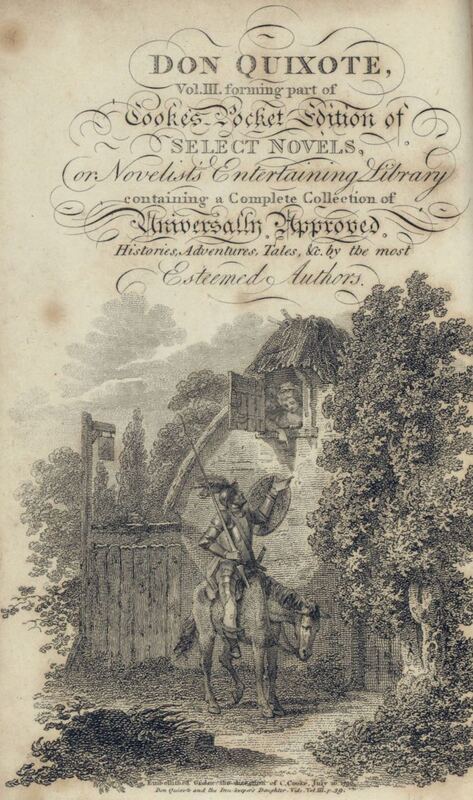
Vignette on title page. Maritornes and the innkeeper’s daughter, playing a prank on Don Quixote, ask him for his hand. Mounted on Rocinante, the errant knight holds his hand up to the window of the inn. Unsigned, dated 1796. Part 1, ch. 43.
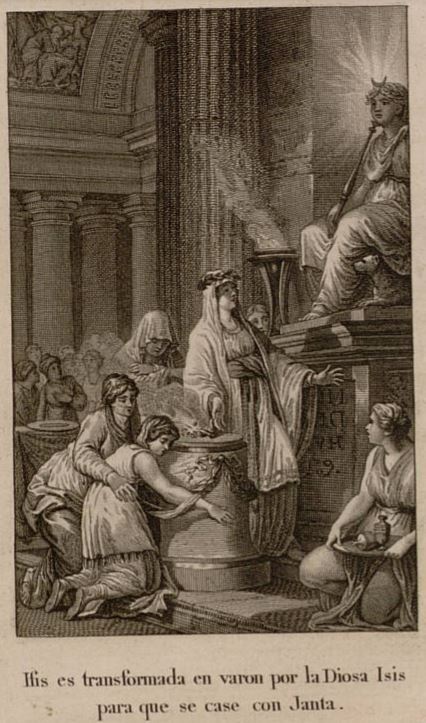
This engraving illustrates Telethusa and her daughter Iphis praying to a statue of the Egyptian deity Isis. There are also other women depicted in the temple praying to the goddess. Before Iphis was born, her father vowed to kill the child if she were to be born a girl. Isis had appeared to Telethusa in a dream and told her to keep the child no matter what. With the help of Isis, Iphis was disguised as a boy after being born to evade death. This engraving takes place when Iphis is set to marry a woman who is unaware that Iphis is a female. Telethusa and her daughter are praying to the goddess Isis once again for her help. Isis answers the prayers of the mother and daughter and she transforms Iphis into a man so that she may marry her betrothed.
Marcela appears on a crag overlooking Grisóstomo’s burial (centre of the composition). Ambrosio, Grisóstomo’s friend, stands near his body. He accuses Marcela of causing the death. The scene is observed by Don Quixote, Sancho Panza, the gravediggers, and several goatherds. Signed by D.-N. Chodowiecki (illustrator) and D. Berger (engraver), dated 1779. Plate 3. Part 1, ch. 14.
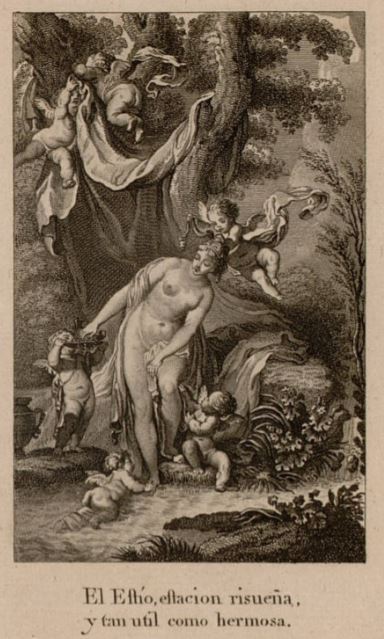
This image represents the season of summer. In the Golden Age of civilization, Spring was eternal. During the Silver Age, however, the god Jupiter shortened spring and created the four seasons. There is a woman standing to the left of the center of the image in the forest with a piece of clothing draped around her arm and in front of her pelvic region. There are small, winged cherubs surrounding the woman and flying above her in the large tree.
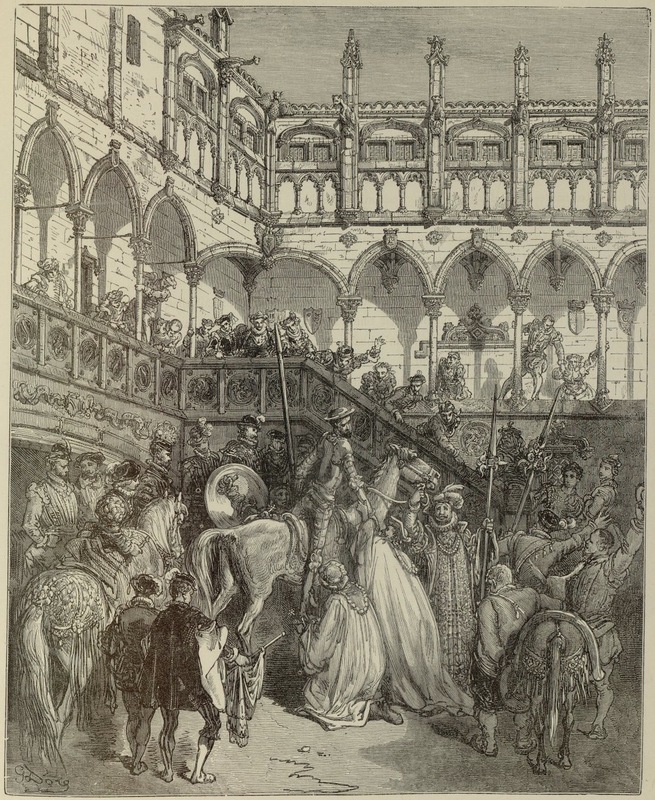
In the palace courtyard, two well-dressed lackeys help Don Quixote to dismount, followed by Sancho Panza and the duchess. Signed by G. Doré (illustrator) and H.-J. Pisan (engraver). Part 2, ch. 31.
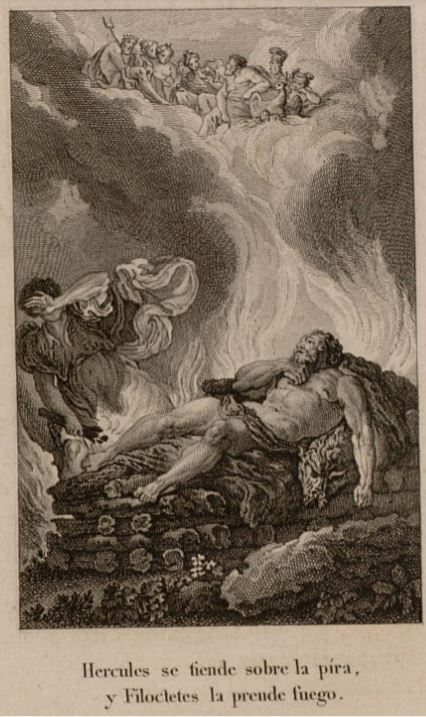
This image depicts the death of the demi-god Hercules. Hercules had been tricked into putting on a shirt that would poison him and cook him alive. Unable to withstand the pain, Hercules creates a funeral pyre for himself. He is depicted laying on the pyre in the image. He commands Philoctetes to light the pyre. Philoctetes is illustrated on the left side of the image as he lights the pyre and covers his eyes to protect himself from the flames. The gods of Olympia, who are depicted at the top of the image watching the scene unfold, agree that Hercules should be deified.
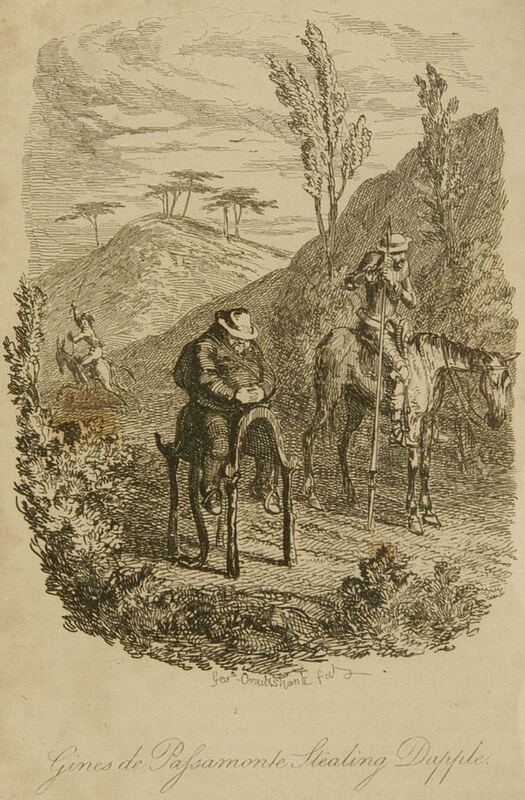
During the night in Sierra Morena, Ginés de Pasamonte (background) makes away with Sancho Panza’s donkey. In the foreground, Sancho Panza is pictured sleeping on the packsaddle mounted on stakes, and Don Quixote on Rocinante. Signed by G. Cruikshank (illustrator and engraver). Part 2, ch. 4.
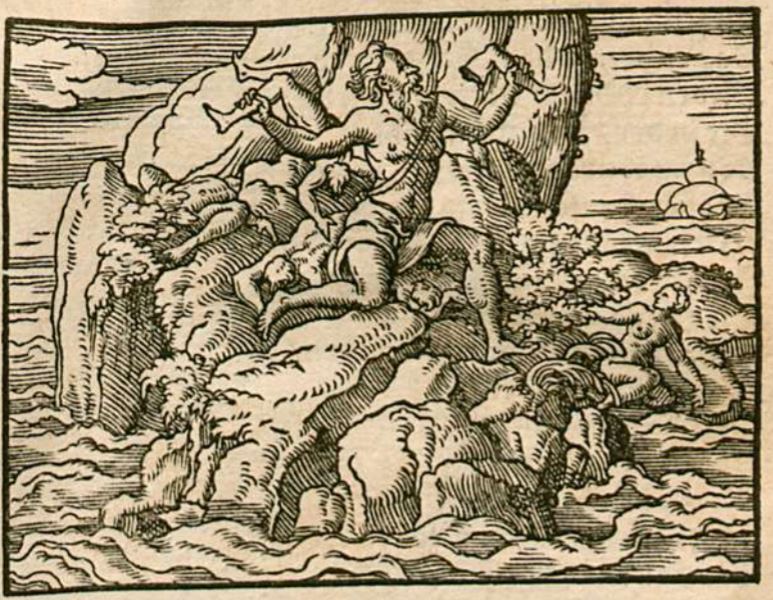
This engraving illustrates the cyclops, Polyphemus, eating the companions and comrades of Ulysses after he had sailed away from the rocks of Aetna. This story is being told by Achaemenides, who had been accidentally left behind on the rocks after Ulysses had sailed away. Polyphemus was in a rage due to Ulysses sailing away before he could kill him. Polyphemus is depicted with limbs in his hands as he devours them. There are dead bodies surrounding him on the rocks.
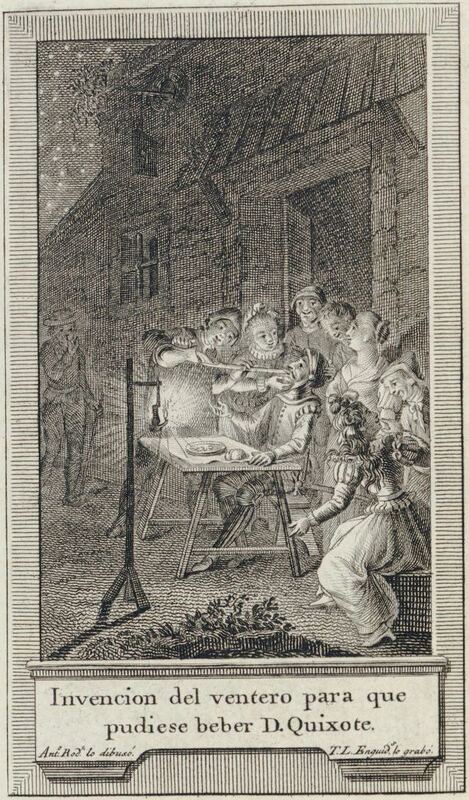
Don Quixote dines at the inn with the innkeeper, Doña Molinera, and Doña Tolosa (pictured with some other guests). They are seated at a table at the door of the inn to take advantage of the cooler air. The innkeeper helps Don Quixote drink wine with a hollow reed through his helmet. In the background, a sowgelder arrives at the inn and plays his reed pipe. Don Quixote mistakes this sound for music played for his entertainment. Signed by A. Rodríguez (illustrator) and T. Enguídados (engraver). Part 1, ch. 2.
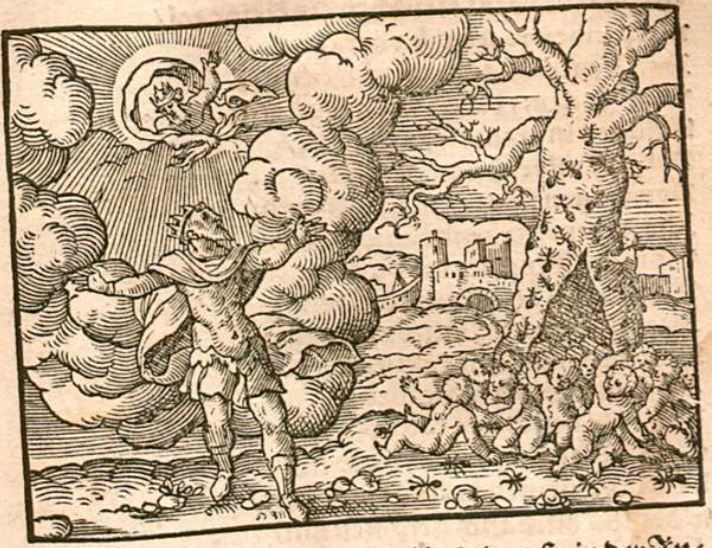
This engraving illustrates the god Jupiter appearing from the clouds, gesturing to his son on Earth, Aeacus of Aegina. Aeacus had survived through a plague which wiped out his population, and he had asked Jupiter for help to rebuild his city. Jupiter lead him to an oak-tree which had food-gathering ants all over it. Suddenly, the ants began to transform into humans, as illustrated in the engraving at the foot of the tree. The humans that transformed from the ants go on to create the new population of Aegina and are thenceforth known as the Myrmidons.
Fearing for Don Quixote's Mental State, the priest (middle) proposes that they burn the detrimental chivalrous books. On the left the housekeeper throws two books out of the window, at her feet Quixote's niece sifts through a pile of books on the ground to decide whether they should be burned. In the middle, the priest holds aloft an open book in his left hand and talks to the barber on the right who holds a book in his left hand and another beneath his arm. Many books are strewn across the ground. In the background, there's a bookshelf on the right, a picture of a horse hanging by the door and a horn on the left.
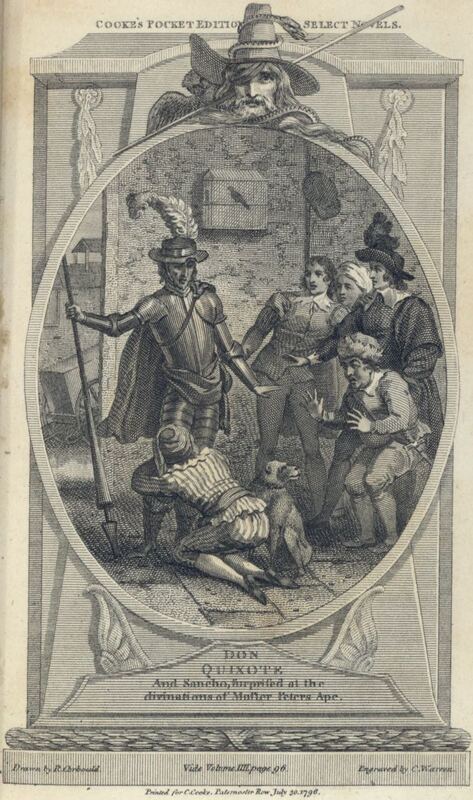
When Maese Pedro meets Don Quixote, he kneels and embraces his legs, praising him. Sancho Panza, three other guests at the inn, and Maese’s monkey are also pictured. The illustration is set in a decorative and architectural frame, complete with Maese Pedro’s head and a snake. Signed by R. Corbould (illustrator) and C. Warren (engraver), dated 1796. Part 2, ch. 25.
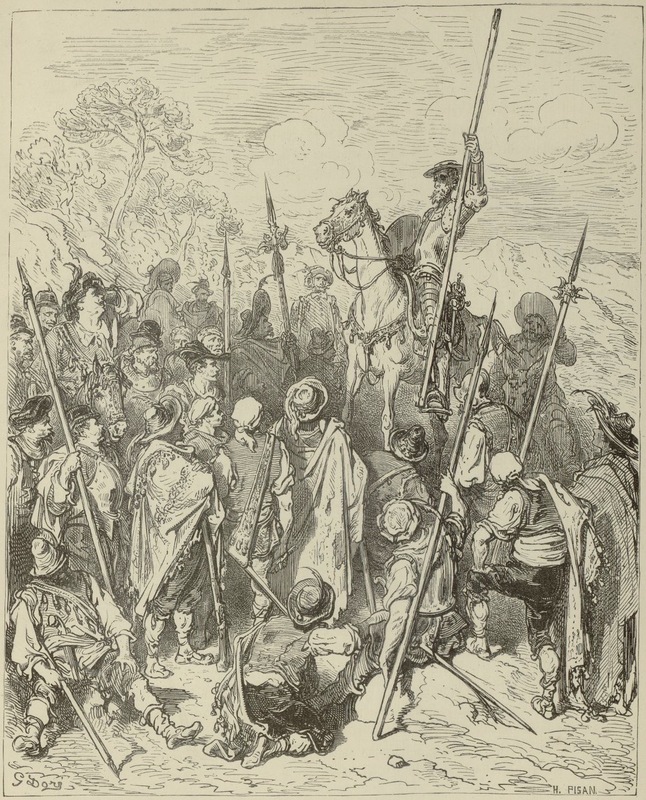
Don Quixote introduces himself before the members of the braying mayors’ squadron. Signed by G. Doré (illustrator) and H.-J. Pisan (engraver). Part 2, ch. 27.
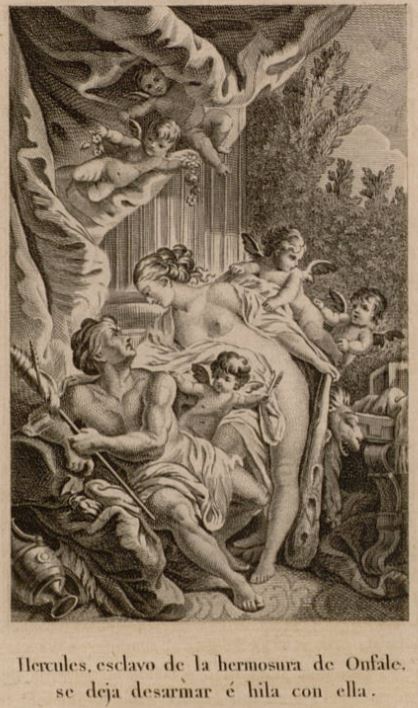
This image depicts the story of Hercules and Omphale. The story of Hercules and Omphale is not actually described in Ovid’s Metamorphoses, but his twelve labours are mentioned and this story relates to his twelve labours. Hercules, in a fit of rage, had killed a man named Iphitus, and was advised by the Oracle of Delphi to serve a certain period of time in slavery as punishment. Hercules was a servant to the Lydian queen Omphale. During his servitude, he was forced to do women’s tasks such as spin, wear women’s clothing, and hold woven baskets while other women spun. This image depicts the queen Omphale holding Hercules’ club in her left hand as she leans over Hercules who is holding a spindle. Omphale is leaning over Hercules to show her power over him.
At the inn, Don Quixote is greeted by Doña Molinera and Doña Tolosa, who try to remove his armour. In the background, the innkeeper enters the room. Signed by D.-N. Chodowiecki (illustrator) and D. Berger (engraver), dated 1779. Plate 1. Part 1, ch. 2.
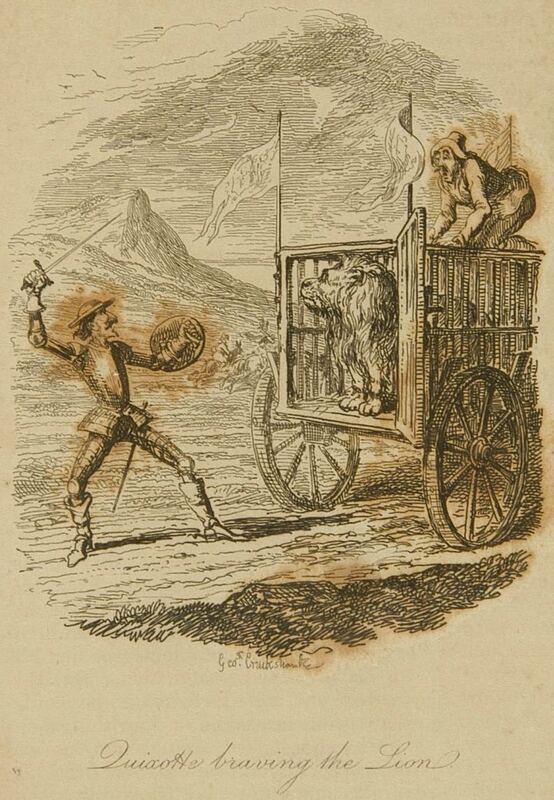
In the background, Sancho Panza and Don Diego de Miranda run away, while in the foreground, Don Quixote prepares to fight the lion as the the lion keeper opens the gate. However, the lion refuses to leave its cage. Don Quixote holds his sword in one hand and his buckler in the other. Signed by G. Cruikshank (illustrator and engraver). Part 2, ch. 17.
Don Quixote (right), clad in armor with a rope tied around his waist pulls back some bushes to enter the cave of Montesinos, but is surprised by the emergence of birds and bats from the cave. Seeking to fight back against these animals, Quixote brandishes his sword and swings wildly around. The scholar (middle) shields his face from the winged animals with his left hand and grasps on Quixote's rope with his right. Sancho Panza (left) is struck by the scholar's flailing right hand, but retains his hold on the rope with both hands. In the foreground, a rope is coiled at Sancho's feet so that Quixote may descend a great distance.
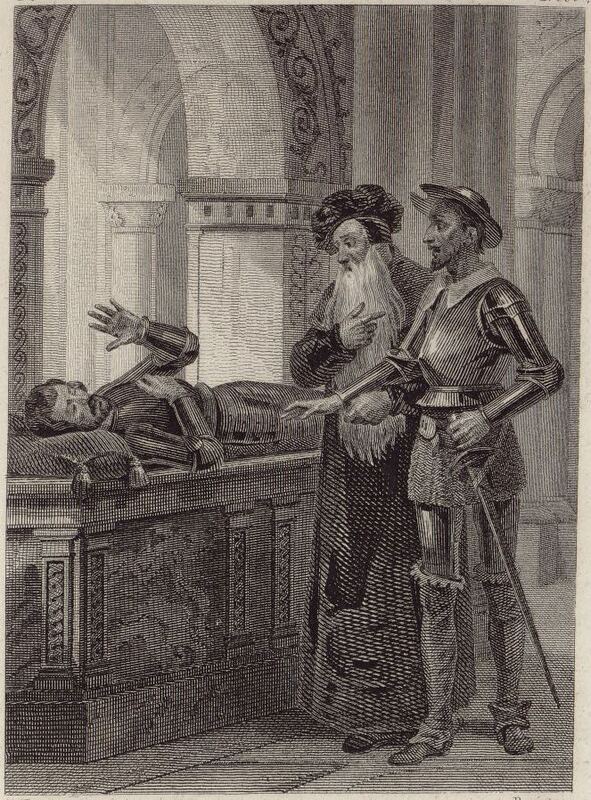
The illustration depicts one of Don Quixote’s visions in Montesinos’ cave: Don Quixote watches Montesinos talking to Durandarte, who lies on his tomb. Montesinos confirms to Durandarte that, according to his will, he has taken his heart to Belerma (represented as a flying ghost holding Durandarte’s heart). Signed by E. Vernet (illustrator) and Prevost (engraver). Part 2, ch. 23.
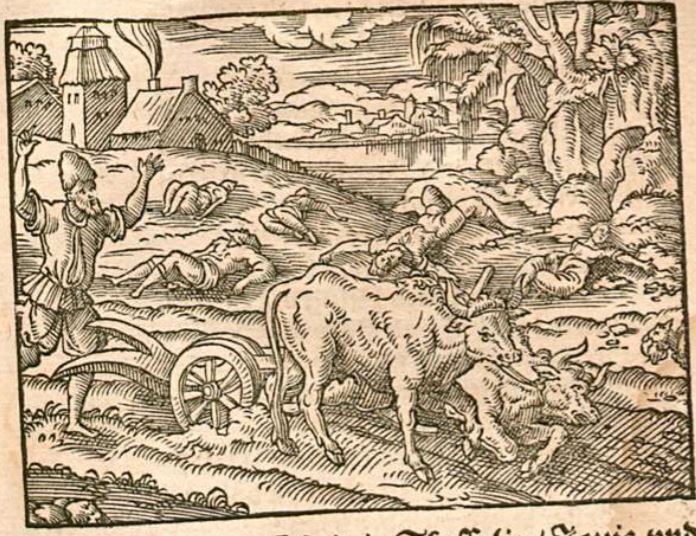
This engraving illustrates the plague that ravaged in Aegina. King Aeacus of Aegina recalls this story to Cephalus and explains that the plague hit Aegina due to Juno being jealous that the island was named after Aeacus’ mother. There are people depicted throughout the engraving that have fallen and died due to the epidemic. Humans were not the only ones affected by the plague, as most of the animals had perished as well. The man illustrated with his arms in the air is the farmer of the oxen that have collapsed. He is showing his dismay at the tragedy that surrounds him.
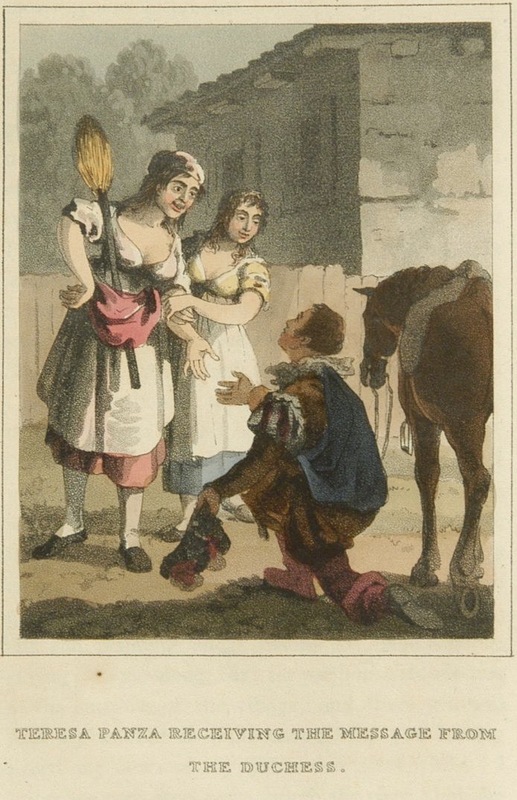
The duchess’ page kneels before Teresa Panza and her daughter Sanchica. He presents them with letters and gifts from the duchess and Sancho Panza. Teresa holds a bunch of flax (accurate to the text). Unsigned. Part 1, ch. 3.
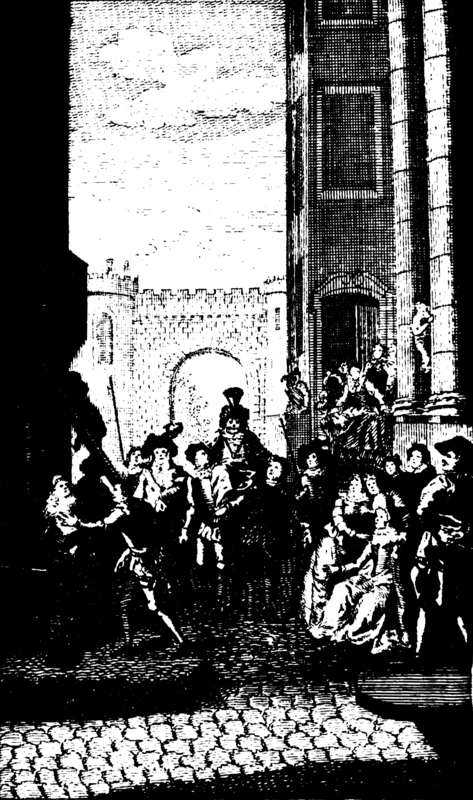
Sancho, with all of his attendants, arrived in the walled town of Barataria which inhabited about a thousand citizens. Officers and officials of the city came to greet their new governor while the people gave demonstrations of their joy. Sancho proceeded through the cobbled stone road towards the church where many ceremonies were set to take place. In the meantime, many citizens could not withhold their surprise and amusement for the garb, the port, the huge beard, and the short and thick shape of the new governor.
Three men hang by their neck to a branch of a tree. They are wearing long white shirts, their eyes closed and heads tilted having asphyxiated. They have been hung in the forest ass punishment for their crimes. The man in the middle and left have long beards while the man on the right is clean shaven.
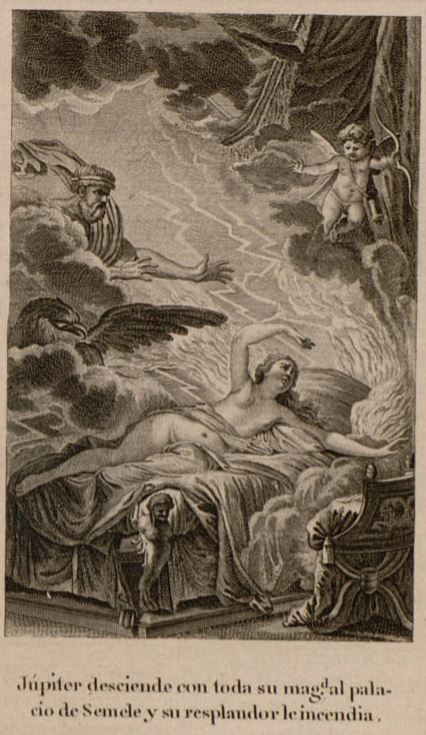
This image depicts Semele, the daughter of Cadmus (the founder of Thebes), being destroyed by Jupiter’s power. She was unknowingly tricked by Juno into asking Jupiter to show his true godly form to her. Juno did this out of jealously, as she had found out that Semele was pregnant with Jupiter's baby. Semele followed the advice and requested Jupiter to show her his true form. Jupiter reluctantly did this, knowing it would incinerate her. The image shows what Jupiter’s full form unleashes unto Semele. Jupiter is depicted on the left side of the image with his hands reaching out towards Semele who is laying down and trying to cover herself from the lightning bolts and flames. There is a winged cherub in the top right corner of the image and an eagle below Jupiter. Eagles are common iconography linked with Jupiter as he often transformed into an eagle.
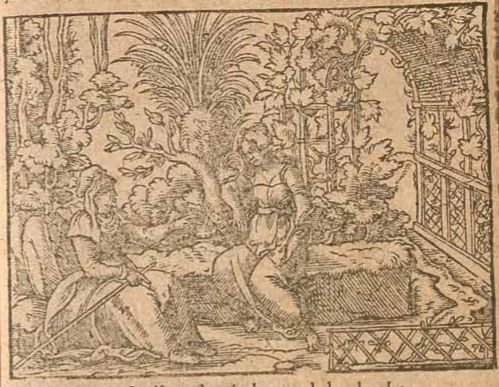
This engraving illustrates the nymph Pomona engaging in a conversation with what seems to be an elderly woman. The elderly woman is in fact the god of seasons, Vertumnus, in disguise. Pomona is a nymph who has a passion for gardening. Ovid explains that she allows no men to enter her garden, which is why Vertumnus disguises himself as an old woman. Taken by her beauty, Vertumnus does whatever it takes to spend time with Pomona, even putting on disguises. The disguised old woman is depicted pointing at an elm tree, while Pomona sits and listens. Pomona is depicted holding a curved pruning knife in her left hand, which is what she uses to maintain her garden.

![[Grisóstomo's burial and Marcela's appearance]](https://collections.cemvc.ca/files/large/e16986841218d36a91d8d64afbdae58387579778.jpg)
![[Of How Don Quixote's Books of Chivalry were Discarded to be Burned]](https://collections.cemvc.ca/files/large/f512be5da1d2000c2469138ce2b791c4ac22fcd2.jpg)
![[Don Quixote arrives at the inn]](https://collections.cemvc.ca/files/large/24abcf470781d4012a346804eda89ab345eb73b7.jpg)
![[Of How Don Quixote and Company Were Frightened by Bats Emerging from the Cave of Montesinos]](https://collections.cemvc.ca/files/large/e10fdcd864878e1cc82812ce733bcff031ec651b.jpg)
![[Thieves hung in a Forest]](https://collections.cemvc.ca/files/large/8f56ffbe78292f803d330ad7b53ea1b09abc661e.jpg)
![[Basilio's Blade and Brooch lie in Herbs]](https://collections.cemvc.ca/files/large/e54c78b1e9cf2d02fba880939f1bdd7e7175bc93.jpg)