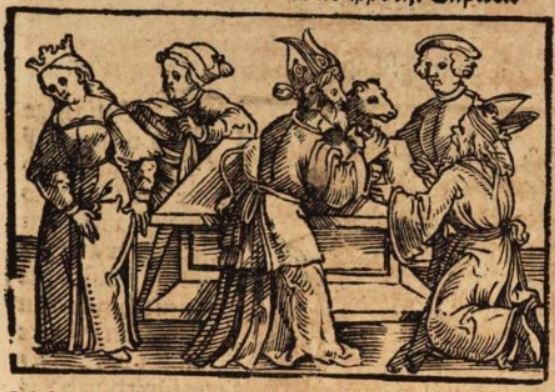
This engraving depicts two separate events. The right side of the engraving depicts Pompey the Great participating in a sacrifice of an animal. The man to the left of Pompey is depicted cutting the neck of the animal that he is holding. Boccaccio explains that after Pompey’s garments became stained with the animal’s blood, a servant carried his stained clothes back home to get new ones. Julia, Pompey’s wife and the daughter of Julius Caesar, saw the blood-stained clothing of her husband and immediately thought that he had been murdered. Julia is depicted on the left side of the engraving after having just seen the clothing of her husband. She looks distraught and is depicted mid-fall to the ground. There is a servant beside her who is holding the blood-stained garments of her husband.
Here we see Gulliver standing in the courtyard of the Imperial castle outside the city. Gulliver stands as tall as the castle. Lilliputian guards surround Gulliver, while a crowd gathers to see Gulliver. Gulliver is chained at the ankles to the castle, as he was a prisoner of the Emperor at this point in the story. The same image appears in both the 1839 and 1843 Krabbe editions.
The picture shows Peggy O’Dowd in a feathered turban, holding a closed fan with both hands, with her elbows on the edge of an opera box. In the top right of the image is the letter M from “Mr.”
The man in this image is the king Fernando and he is sitting on his throne. He is wearing his crown and holding a sceptre in his right hand. He is wearing a white robe. On the right side of his robes there is a darker piece of clothing covering his right side. He has a beard. On his throne there is a cushion and a carpet at his feet. The carpet has patterns on it. Under his cushion on the throne, there seems to be another carpet similar to the one on the ground flowing down the throne.
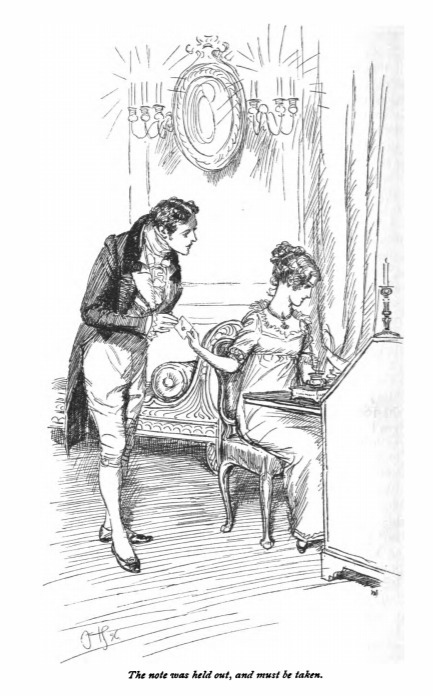
Here we see Fanny writing a note to Miss Crawford, hand handing it to Mr. Crawford. Miss Crawford wrote a note to Fanny expressing her excitement at Mr. Crawford’s proposal, assuming she would accept. Mr. Crawford wanted Fanny to respond, so she quickly wrote to Miss Crawford, saying that she had not accepted his proposal, and handed the note to Mr. Crawford so he could deliver the note. This scene occurs in chapter 31. The characters are shown in the traditional regency style. Fanny wears a regency style dress with an empire waist. Mr. Crawford wears a tailcoat and tailcoat with breeches. The regency period dated to the early nineteenth century (1811-1820) when George, Prince of Wales, later George IV (r. 1820-1830), reigned as regent for his mentally ill father, King George III (r. 1760-1820). The regency period is associated with the rise of neoclassicism in art and fashion.
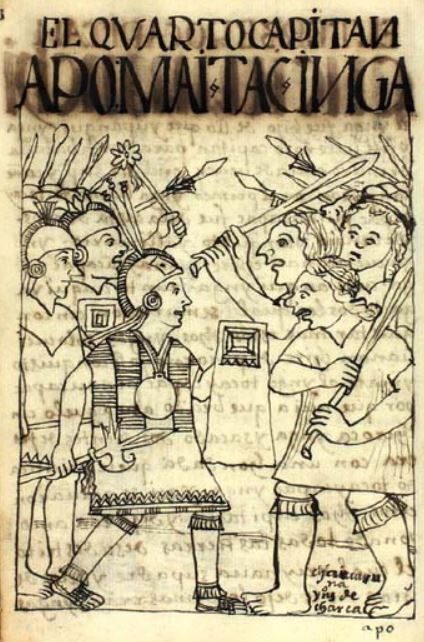
This illustration depicts the fourth captain, Apu Mayta. These captains were a level of Inca authority who helped lead the conquest of the Andes. Apu Mayta was the son of the fourth Inca king Mayta Capac. Apu Mayta is depicted on the left side of the image holding a shield in his left hand and an ax in his right as he leads an army behind him. He is facing an army on the right side of the image. The army that he is fighting are people indigenous to Charcas, Bolivia. The words “charcacuna yndios de charca” are written at the bottom right corner of the image. This is to identify the army on the right side of the image as it translates to “charcacuna, Indians from Charca.”
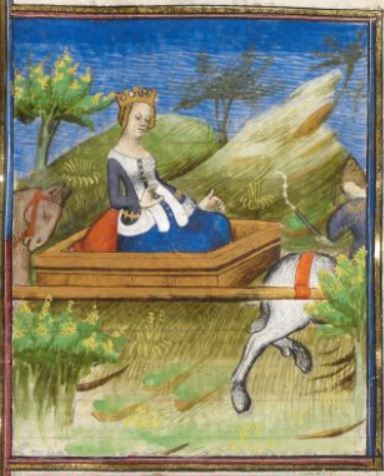
This illumination depicts Sabina Poppaea, the wife of Emperor Nero, sitting in a chariot visibly pregnant. She is depicted wearing a crown and a blue and white dress. Boccaccio explains that Emperor Nero had gotten angry and kicked Sabina in the stomach while she was pregnant, which was the cause of her untimely death. Despite Roman traditions of cremation, Emperor Nero had a public burial for his wife and had her body placed in a sepulcher.
In this image Gulliver kisses the hand of the Empress, who greets him while standing on the balcony of her apartments. The Empress wears a dark dress and a tall headpiece with a veil down her back, attached to the headpiece. This image comes after Gulliver climbed over the wall of the imperial palace and was able to look around. One of the Empress’ attendants stands behind her. The same image appears in the 1843 Krabbe edition.
When Celestina (second figure from the right) and Sempronio (one of the figures in the background to the left) arrive at Calisto’s house, Celestina tells Calisto (rightmost figure) about her meeting with Melibea. Calisto experiences impassioned mood swings with every sentence that Celestina speaks, and Pármeno starts chiding both him and Celestina. Sempronio (also one of the figures to the left) grows impatient with Pármeno and tells him that his words are harming the happiness of all. Celestina eventually shows Calisto the girdle (presumably the scene depicted here), and he is overjoyed. When the time comes for Celestina to depart, Calisto asks Pármeno to accompany her and ensure that she arrives home safely.
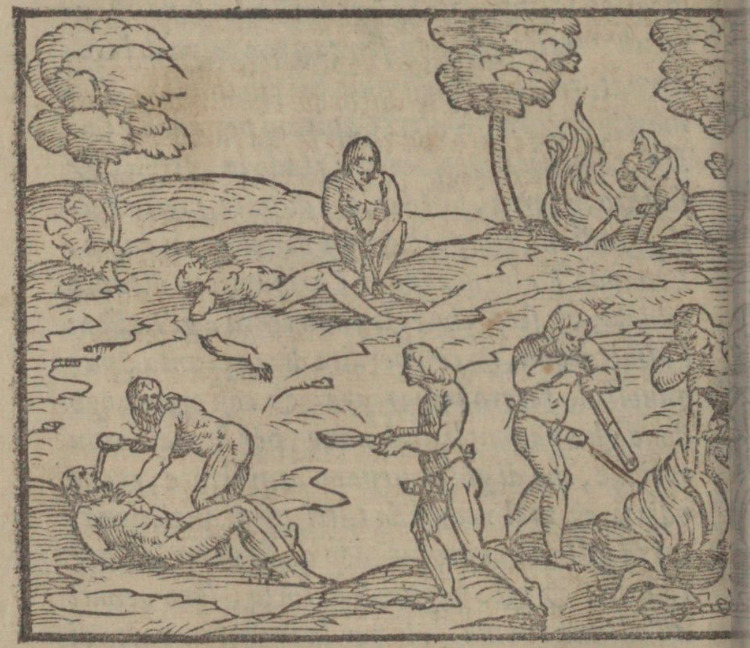
A group of Indigenous people melt gold over a fire and then pour the molten gold into the mouth of a Spaniard who lays tied up on the ground. In the background, the body of a second Spaniard is being dismembered for cannibalism. One individual kneels beside a second fire that has been built to roast the limbs. The men in this group wear a garment tied around their waists that covers their genitals. This image is identical to one found on page 49 of Venice, 1565.
Amelia Sedley is seated in a one-armed chair in the corner of a room. The curtains on the window have been drawn back and she is gazing out while thinking about George Osborne.
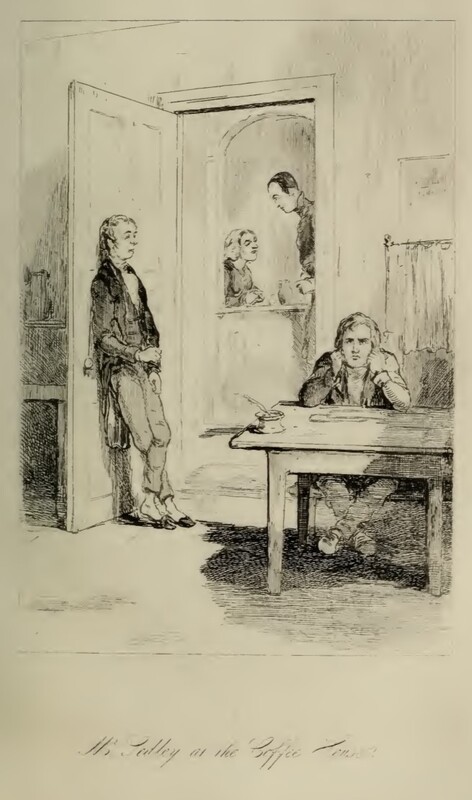
John Sedley is seated at a table at the Tapioca Coffee-house, slouching over with his elbows resting on the table and his scowling face between his fists. On the table in front of him are several pieces of paper and an inkwell with a quill. The door to the room is held open by a bored-looking man who leans against it. Through the doorway, William Dobbin can be seen talking to the woman at the desk. Below the illustration is printed in cursive its title, “Mr. Sedley at the Coffee-House.
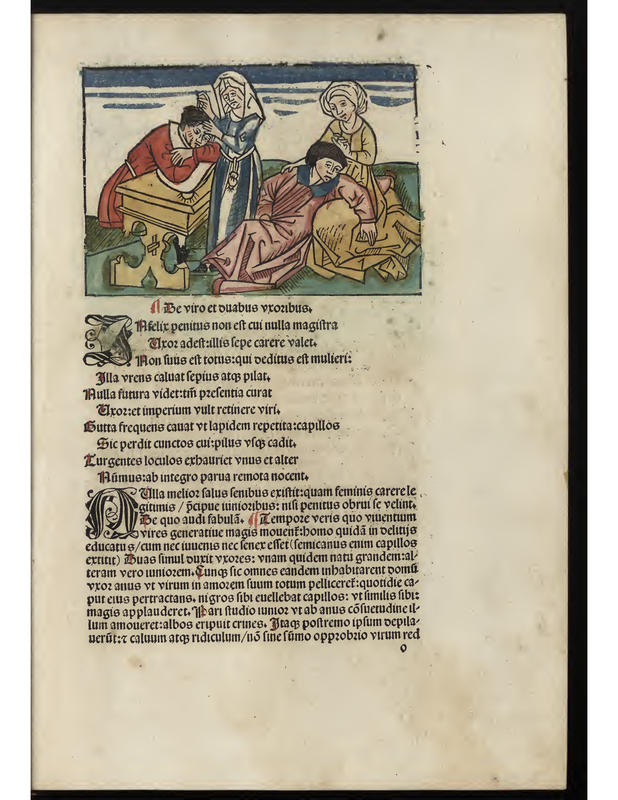
This illumination depicts a Roman woman named Paulina cutting a garment with scissors. Paulina was a chaste and devout woman and is renowned for her naivety by being tricked into losing her virtue. A man named Mundus had tricked Paulina into thinking that he was the Egyptian god Anubis and tricked her into having sexual relations with him. When Paulina realized she was deceived, her husband went to the emperor and had Mundus exiled.
Here we see a broom, bucket, and sieve. These items were things in Gulliver’s hut, which was used as storage before he arrived. This image appears at the beginning of chapter four. The letter “D” appears in the top corner, as the word “during” is the first word of the chapter.
A group of Tupinambá Indigenous people stand on the shore near their village. Part of the group forms a circle, with some of the individuals holding objects resembling rattles. Three people stand in the center of the circle. Several canoes have been pulled up along the shore. In the background there are two long structures, and two individuals lounge in hammocks. There is a large fire with a wooden frame over it, upon which several human limbs have been set to roast.
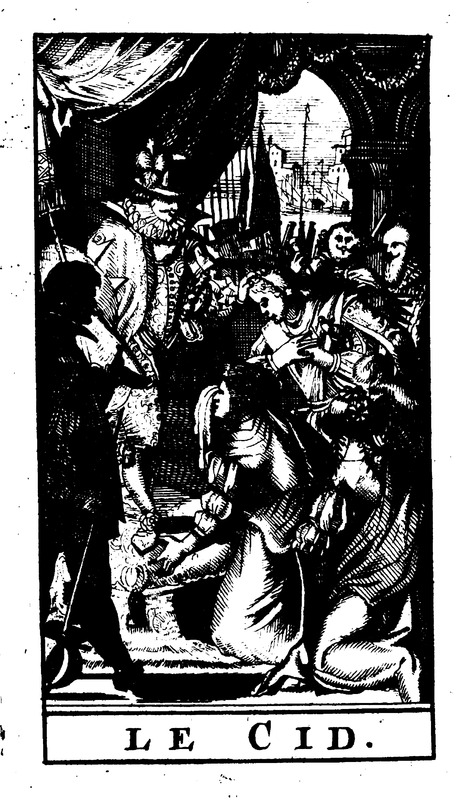
Chimène (Jimena/Ximena) and Don Diègue (Diego) cast themselves at the feet of Don Fernand (Ferdinand), king of Castile, each pleading their case to him. Don Rodrigue (Rodrigo), son of Don Diègue, has just killed Chimène’s father Don Gomes in a duel, and Chimène is demanding justice for his death. Diègue tries to convince the king that the murder was just, as Rodrigue was avenging the harm that Gomes had previously done to Diègue.
The yahoos are a form of human who live in the Country of the Houyhnhnms. Gulliver looks down on the yahoos, thinking of them as a form of inferior human, which is reflected in this image. In this image we see Gulliver in the background, with a group of yahoos in the front. A female yahoo nurses her child, while another climbs a tree. The same image appears in the 1839 Krabbe edition.
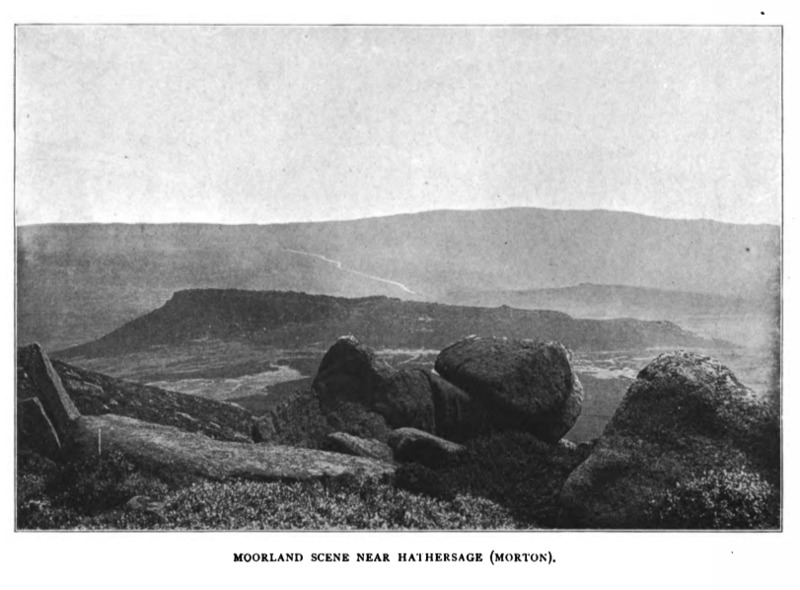
Here we see the moorlands near the village of Hathersage, a village in Derbyshire. After running away from Thornfield after ending her engagement to Mr. Rochester Jane ended up in Morton, which was based on the real village of Hathersage. She arrived at Moor house with Mr. Rivers and his sisters, Diana and Mary. She lived with them for several months and taught at the village school before returning to Mr. Rochester. Before arriving at Moorhouse Jane spent two days and nights walking around the moorlands. The same image appears in the 1899 Harper edition of Jane Eyre.
In this image Gulliver kisses the hand of the Empress, who greets him while standing on the balcony of her apartments. The Empress wears a dark dress and a tall headpiece with a veil down her back, attached to the headpiece. This image comes after Gulliver climbed over the wall of the imperial palace and was able to look around. One of the Empress’ attendants stands behind her. The same image appears in the 1839 Krabbe edition.
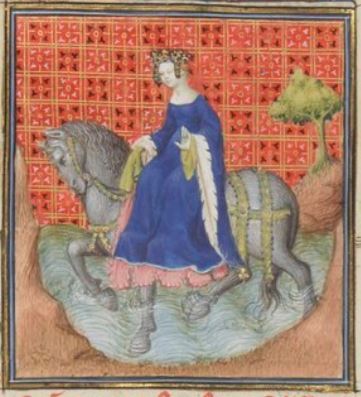
This illumination depicts Cloelia, a young Roman woman, riding a horse through a deep river. Boccaccio explains that Cloelia was given to a foreign king as a hostage, and when she escaped, she took many other hostages with her back to Rome. While escaping, she came across a river that was too treacherous to pass. She found a horse, and despite never having ridden one, she got herself and the other women across safely by means of this horse.



![[Gulliver standing in the courtyard at the Emperor’s castle]](https://collections.cemvc.ca/files/large/96903a7455cf8856b1fee4b8a8f47d195f77e1ec.jpg)
![[Vanity Fair Vol. II Chapter XXIX Historiated Initial]](https://collections.cemvc.ca/files/large/22bc4b06fd3f6cdf1d215ef1279d7721c185379a.jpg)

![[King Fernando sitting on his throne]](https://collections.cemvc.ca/files/large/c20998bc52b773945dcc74e402a347a2c7a988d1.jpg)

![[Gulliver kisses the Empress’ hand]](https://collections.cemvc.ca/files/large/bbbeb0dda59fe61b82129984202fd68d0a269c4b.jpg)
![[Act VI – Celestina Talks with Calisto While Sempronio Chastises Pármeno for His Snide Remarks]](https://collections.cemvc.ca/files/large/76d268e0a74929532062bd816f7e57edc56a490e.jpg)
![[Amelia Thinking]](https://collections.cemvc.ca/files/large/d2e536fc2be4dc19b78afba35748200ad4e3403b.jpg)

![[Cleaning supplies in the Country of the Houyhnhnms]](https://collections.cemvc.ca/files/large/442029575c11605e58816adebd8871852b6cda50.jpg)
![[A Tupinambá ceremony]](https://collections.cemvc.ca/files/large/1b397bd75eed9febdc5df55654bfa2882b44c3e0.jpg)
![[Gulliver meets the yahoos for the first time]](https://collections.cemvc.ca/files/large/7fb6a5fa7e2c0e94cf276435469d9787541b6064.jpg)
![[Gulliver kisses the Empress of Lilliput’s hand]](https://collections.cemvc.ca/files/large/c31ed4b523b1ec49b64d482d942669e5bdc12796.jpg)