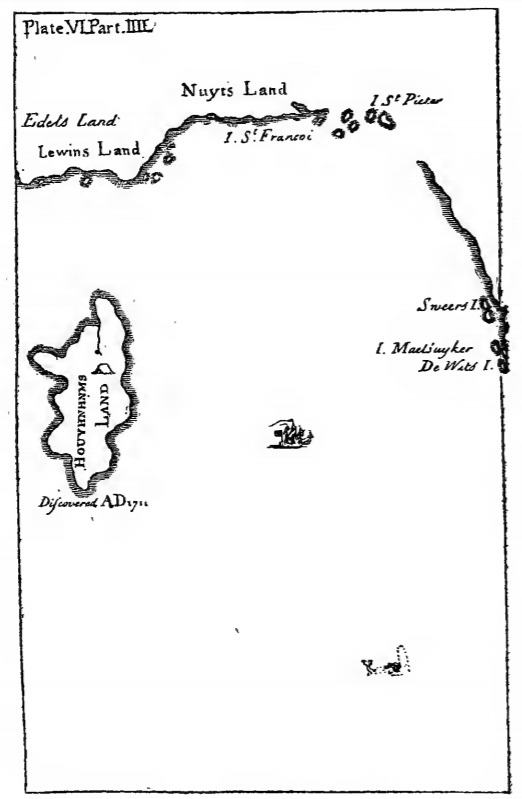
Here we see a map of the Country of the Houyhnhnms. Written under the land is “Discovered AD. 1711. The Houyhnhnms’ Land is shown near Nuyts Land and Eidels Land. A man-of-war style ship is shown in the water.
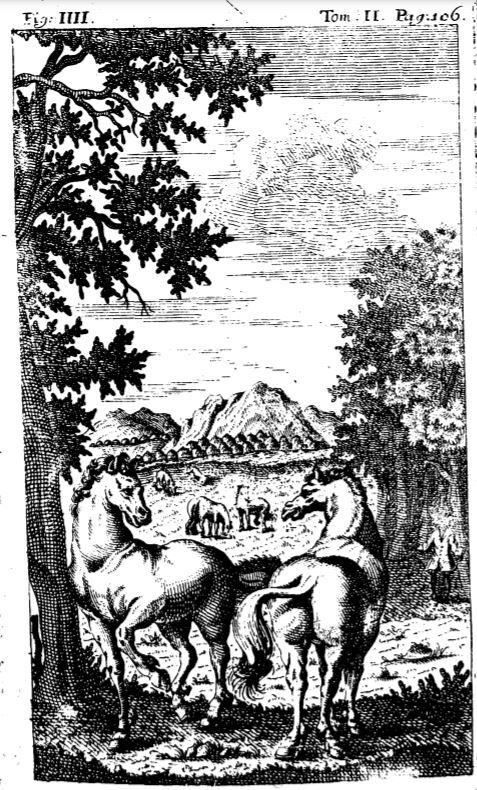
This image shows some of the horses in Houyhnhnms. In the foreground are two horses, with Gulliver in the background on the righthand side. There are several other horses in the background. The landscape is made up of trees and hills. This image is the same as that in the 1727 German von Wiering edition
This illustration was intended to be the final illustration in the book [Act XXI (Second Illustration)], as evinced by its placement in the original 1520 Augsburg edition. It is difficult to pinpoint exactly why the printer would place the illustration of Melibea lying dead in the street before the illustration where she is in the process of falling. Perhaps it is intended to represent the scene at the very end of act XIX, continuing between acts XIX and XX – where Melibea faints upon realizing that Calisto is dead, after which Lucrecia rouses her and walks her to her bedroom before going to inform Pleberio of her illness. If this is the case, then the inclusion of Pleberio and Alisa in the illustration is rather odd.
Because this illustration is included at the end of this act, we can infer that it is meant to represent the scene in which Sempronio and Pármeno murder Celestina, after which they jump from the third storey of her house to escape the alguacil’s men. We see a male figure (either Sempronio or Pármeno) reaching out toward Celestina, who appears to be pulling away from him. She is shown wearing a robe and a veil, while he is wearing a hat. In his left hand he is holding a sword, the tip of which is resting on the ground. To the right we see Elicia watching this encounter. She is wearing a robe and a veil, while her face displays an air of sadness.This illustration is somewhat odd for two reasons: there is only one male figure in this illustration, and it does not depict violence like most other illustrations of this scene. I suspect that the use of this illustration (in place of the more relevant 1580 Antwerp edition illustration) may be a consequence of the 1580 woodblock being misplaced or destroyed in the intervening 36 years.The entire image is identical to those found on pages 222 and 246 of the text.
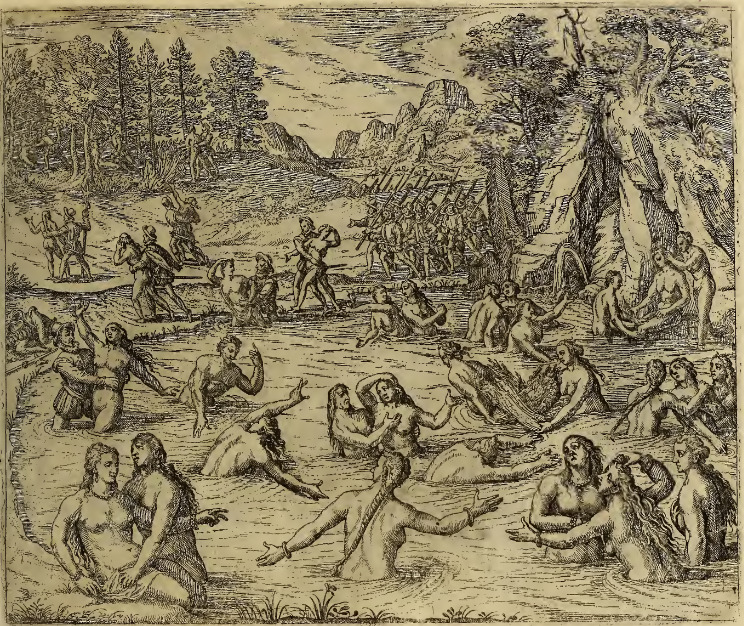
After the Inca Emperor Atahualpa was captured by Francisco Pizarro and his men, Spanish soldiers rampaged through the area around Cajamarca in Peru. Here, a group of soldiers have come across a pond where several Inca women bathe. Some of the Spaniards approach the pond from the far side, and others wade into the water and seize women. Several of the women have been pulled from the water and are dragged by the soldiers towards a stand of trees nearby. Women amongst the trees are pushed to the ground by soldiers, and sexually assaulted.
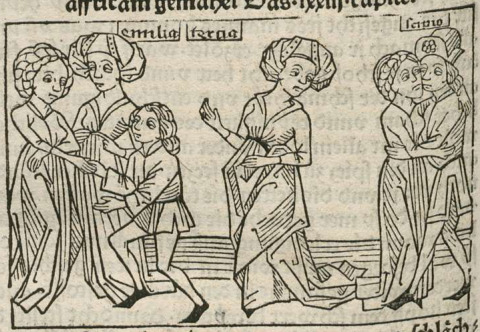
This engraving depicts Scipio Africanus, a Roman general, committing adultery with a young servant girl on the right side of the image. The name Scipio is engraved at the top to identify him. The woman in the centre of the engraving is his wife, Tertia Aemilia. She is depicted looking at her husband and his mistress as they commit adultery. Instead of confronting her husband about the affair, she devises a plan to get rid of the mistress. The left side of the engraving depicts Tertia Aemilia marrying the young servant girl off to a freedman. She does this so that no one finds out about the affair so that it does not ruin her reputation. Her name, written as “Emilia Tertia”, is engraved above her head to identify her. Boccaccio explains that he chose to write on Tertia Aemilia because the way she handled the affair and how she used her cunning was admirable.
Here we see Gulliver bringing the small boat he found overturned onto shore in Blefuscu. Gulliver saw the boat offshore and with the help of the Blefuscudians he brought it to shore where he intended to refurbish it so then he could use it to get home. In this image we see Gulliver pulling the boat up onto the dock. Gulliver stands in the water, with his pants rolled up to his knees and is barefoot. He is aided by the Blefuscudians who pull on several ropes tied to the boat. These ropes were used to drag the boat behind a warship while Gulliver pushed it from behind to get it to shore. There is a large crowd of Blefuscudians – some of whom help get the boat on shore, while other simply watch the scene. The city is visible in the background. The same image appears in the 1839 Krabbe edition.
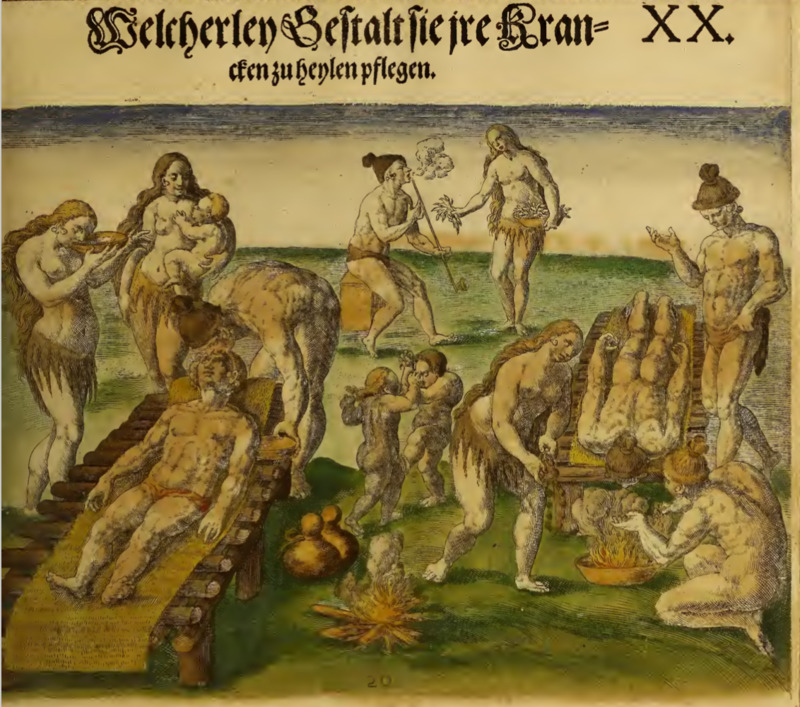
The sick lie on elevated beds made of wooden slats with woven mats laid on top. One lies on their stomach with their head hanging over the side of the bed and their face close to steam coming out of a pan on the ground. The other lies on their back being tended to by other individuals. There is a fire between the beds and two jugs on the ground. Children play between the beds, and a woman breastfeeds nearby. In the background, a man smokes from a long pipe. This illustration is identical to the one found on page 75 of Frankfurt 1591, but colored.
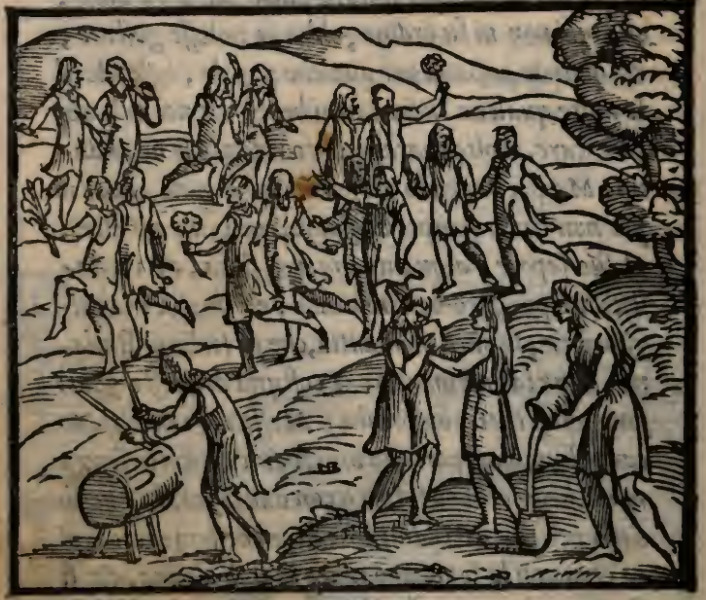
A group of Indigenous people engage in festivities with drinking, dancing and music. One person in the front right pours a beverage from one pot into another, while two people nearby drink. An individual on the left plays a barrel-shaped drum with drumsticks. In the background a group of people dance in pairs in a circle, with some individuals holding leaves or flowers.
Four Indigenous women crouch around large pots on the ground. They chew roots (manioc/cassava) and then spit them into the vats, after which the concoction is boiled and strained. A woman holding a small child stands nearby watching. A man holding a bow and arrow also peers over the shoulders of the women. In the background two people tend to a large pot set over a fire, while another individual passes by carrying a large basket on their back. Several structures are also visible on the left and right. This image is identical to one found in Paris, 1557.
Three figures in sashes and pointed hats, holding poles, stand in formation before buildings with curved roofs. In the top right corner of the image is the letter T from “The”.
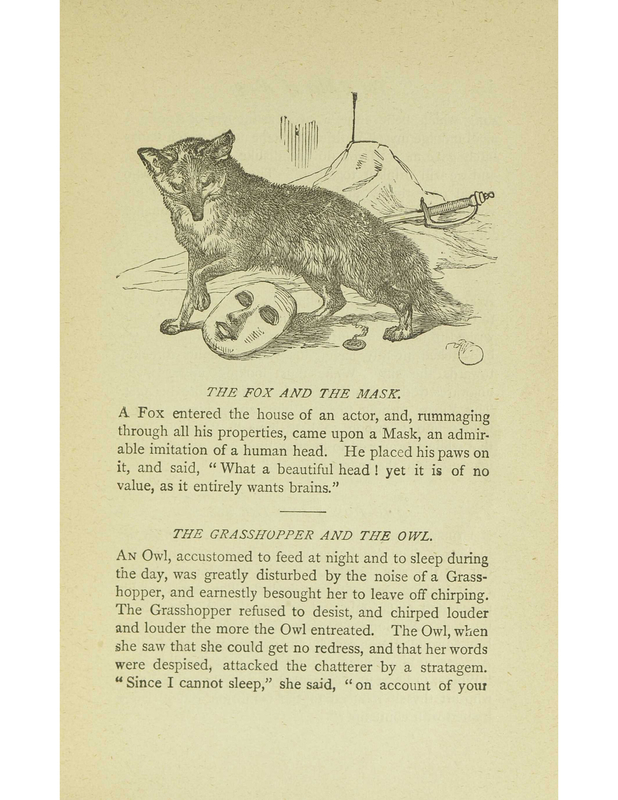
A fox is in the center of the image; it is walking by a strange mask that lies on the ground. The fox looks at it as though it is an enemy, it is cautious. Underneath the fox, near its hind legs, a necklace-looking object lies on the ground. It is a chain with a circular object strung to it. Behind the fox is a sword lying
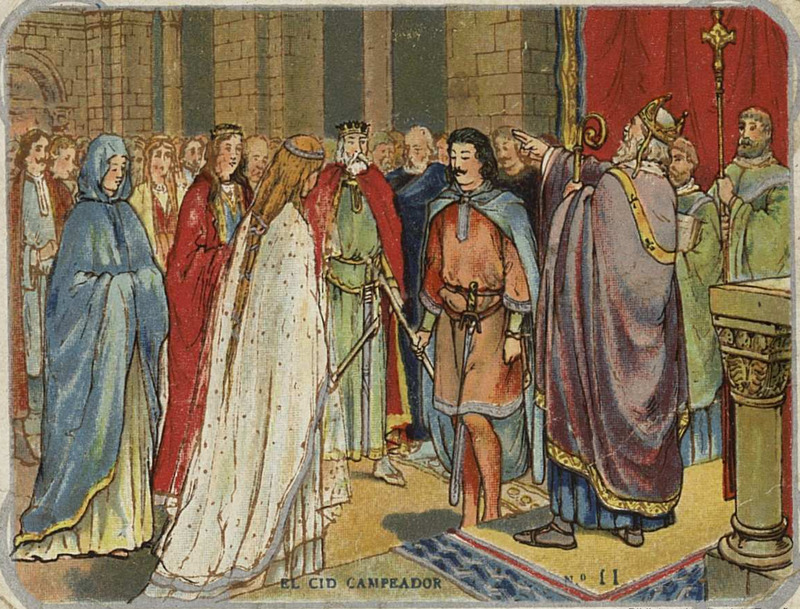
This image represents the wedding of El Cid and Jimena. The two are in the center of the image facing each other with candles. Jimena’s face is not visible but she has long blond hair and is wearing a white dress. El Cid standing right in front of her is wearing a brown tunic with a blue cloak. He has a moustache and brown hair. At his wais the hilt of a sword is visible. In front of them is the bishop with his hand raised in the air. He is wearing a purple robe with a streak of gold on it. He has grey hair and beard. On top of his head he is wearing a hat and he is holding a golden staff. The two priests on his right are dressed in green robes. Then one of the far right is holding a golden staff with a symbol of the cross on top. The king and queen are right behind the couple. The king has a white beard and is wearing his golden crown. He has green robes on and is wearing a red cloak. He like El Cid is carrying a sword at his waist. The queen standing next to the king is wearing a diadem over her blond hair. She is wearing a dress with a red cloak covering it. There is a woman standing right behind Jimena and she is all covered in her blue cloak and with her eyes closed. The two men behind the king are both older men, one with a blue robe and white beard and the other with a brown robe with a moustache. The rest of the people in the image appear to be guests. They seem to all be in a church made of stone. At the right of the picture a red tapestry is on the wall.
Sambo, standing on the right, presents a platter on which rests a letter for Miss Amelia Sedley from her brother. Amelia, who is reaching for the letter, sits on the sofa next to Rebecca Sharp. Amelia looks concerned, while Becky looks irritated. On the wall behind them is a portrait of the man in question atop an elephant, and on the table to the left of the illustration lies an open book and inkwell with a pen and quill.
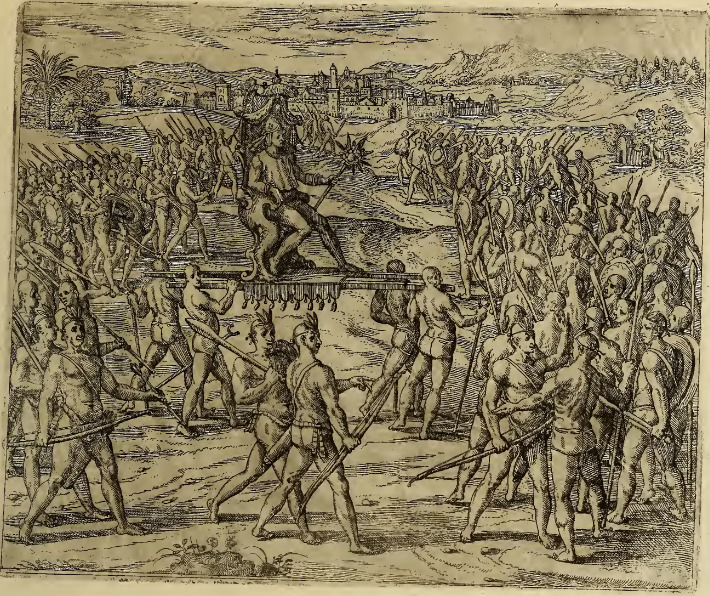
The Inca Emperor Atahualpa (Atabalipa) arrives at the city Caxamalca (Cajamarca) in Peru to meet Francisco Pizarro. Atahualpa is carried towards the city on an ornate litter born by four soldiers. He wears a headdress, short-sleeved tunic, and beaded necklace, and carries a scepter fashioned to resemble the sun. He is accompanied by many warriors, who are armed with a combination of spears, clubs, bows and shields. Some of the men wear feathered headdresses and loincloths. The fortified city Caxamalca (Cajamarca) is visible in the background.
Hercules is depicted on the right side of the engraving holding his new wife Deianira in his arms as they attempt to cross the Evenus river. Hercules is illustrated with a wreath on his head and a bow and arrow by his legs. His name is engraved horizontal to his body in order to be identified. Deianira is illustrated wearing a crown and has her name engraved above her head. A man named Nessus is depicted beside Deianira, holding his arm out to her as he offers to take her across the river. Boccaccio explains that Nessus was riding horseback, however, in Greek mythology, Nessus is known to be a centaur. Nessus betrayed Hercules’ trust, and began to run away with Deianira after crossing the river. Hercules uses a poison infused arrow to shoot Nessus and rescue his wife. This is illustrated in the background on the left side of the engraving. Hercules’ bow is in hand, and his arrow is sticking out of the chest of Nessus.
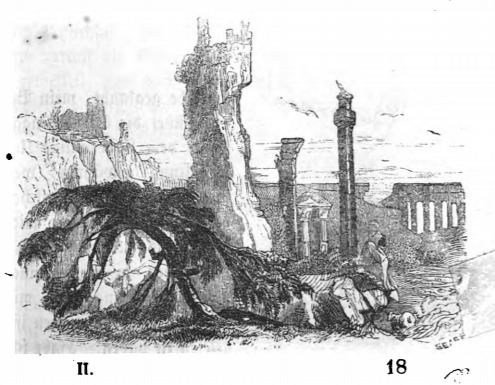
Here we see the ruins of an ancient city. There are partial columns and sections of porticoes. The architecture suggests that this was a Roman city, possibly Pompeii. There is a large tower in the centre of the image, with a tree that is curving back towards the ground creating an archway in the foreground. Archaeology and the excavations of Pompeii and Herculaneum were well underway when this edition of Gulliver’s Travels was published in 1839, and images of the ruins were being sent all over the world. This image comes at the end of the tenth chapter, in which Gulliver learns about the immortals of Luggnag. The same image appears in the 1839 Krabbe edition.
In this image we see Gulliver kneeling and saluting the Lilliputian Emperor. Gulliver was recruited to fight in the war between Lilliput and Blefuscu. In this image, the Emperor reads Gulliver’s duties to him, while pages attend the Emperor. Gulliver salutes the Emperor, signaling his acceptance of his duties. The same image appears in the 1839 Krabbe edition.
This illumination depicts a young woman named Thamyris sitting in front of an easel as she holds a brush with her right hand and a pallet in her left as she paints a portrait of woman and a child. Boccaccio explains that Thamyris was renowned for her exceptional painting skills and was the daughter of a famous painter (Micon). There is a person on the right side of the image who is assumed to be Micon. There is a table in the foreground of the image that has painting tools on it such as a box of paint brushes.
Here we see Gulliver sitting on the ground in front of one of the Houyhnhnms. He holds a scroll, learning the language of the Houyhnhnms. Gulliver was taught by everyone in the house, including his master, his master’s children, and the servants.

![[Act XX – Lucrecia Mourning the Loss of Melibea]](https://collections.cemvc.ca/files/large/464545fa3c63853fefd22e4e0769f591007fe73f.jpg)
![[Act XII – Celestina Recoils from (Sempronio or Pármeno) While Elicia Watches from Behind]](https://collections.cemvc.ca/files/large/ef6c10c0e71ca0dc7d9b8c2ba7cb658f4b075c59.jpg)
![[Gulliver brings an abandoned boat onto Blefuscu]](https://collections.cemvc.ca/files/large/f055d0ff9ca5f27b2c5015f2eb224e38b88b2d0b.jpg)

![[Indigenous Brazilians prepare an alcoholic beverage]](https://collections.cemvc.ca/files/large/c20649fcb7e937aab1199ca04de5ebc9807e7086.jpg)
![[Vanity Fair Vol. II Chapter XL Inhabited Initial]](https://collections.cemvc.ca/files/large/51731b1a7e0a318435edda9c010fe4db1a899919.jpg)

![[Sambo Delivers a Letter to Amelia]](https://collections.cemvc.ca/files/large/2c79437628cd72d9ab584d42d541b97ad6429204.jpg)

![[Gulliver kneeling and saluting the Lilliputian Emperor]](https://collections.cemvc.ca/files/large/e7ecb25cf7108544b6fbb1a8abc7b96e703b917a.jpg)
![[Thamyris Painting a Portrait]](https://collections.cemvc.ca/files/large/e402d8eb7298ab6e5331649f09670addc0255c0f.jpg)

![[Gulliver learns the language of the Houyhnhnms]](https://collections.cemvc.ca/files/large/4b335103d7611c756f7a21c73b892fe4744eb22e.jpg)