Don Quixote, holding the basin, tries to convince the barber of the nature of the basin (Mambrino’s helmet. Don Fernando, the priest, and Sancho Panza observe them. Next to Sancho lies the packsaddle that he disputed with the barber. Plate no. 25, signed by J. Vanderbank (illustrator) and G. van der Gucht (engraver). Vol. 1, book 4, ch. 17.
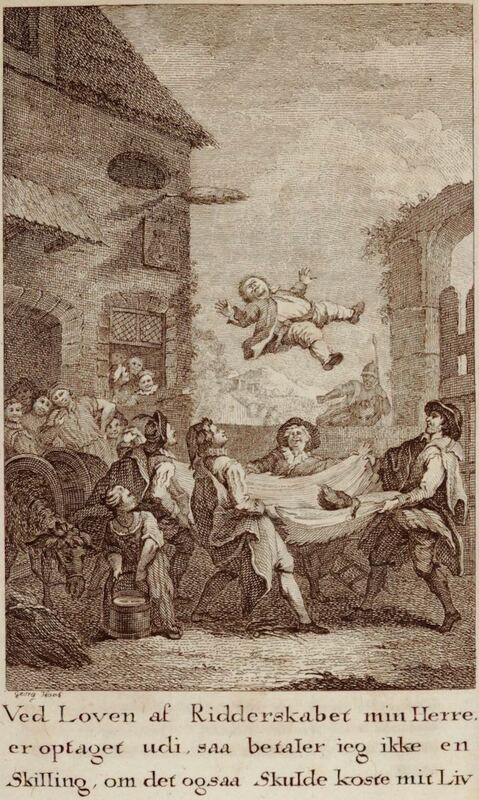
When Sancho Panza refuses to pay the innkeeper, guests at the inn toss him in a blanket in the courtyard and make merry with him. Among the guests are four wool carders from Segovia, three needlemakers from El Potro in Córdoba, and two residents of La Feria in Sevilla. In the background, Don Quixote looks on from behind the inn wall. Signed by J.-J.-G. Haas (engraver). Part 1, ch. 17.
This engraving illustrates Polyphemus, a cyclops, hurling a massive boulder at Acis. Polyphemus was in love with Galatea, a nereid who did not mutually share this feeling. Galatea was in love with Acis and rejected Polyphemus’ affections. One day, Polyphemus found the two lovers embracing and chased Acis until he threw a massive rock at him. The boulder crushed Acis as illustrated in the engraving. Galatea is depicted in the background of the engraving running away from Polyphemus. Acis' blood transforms into a river.
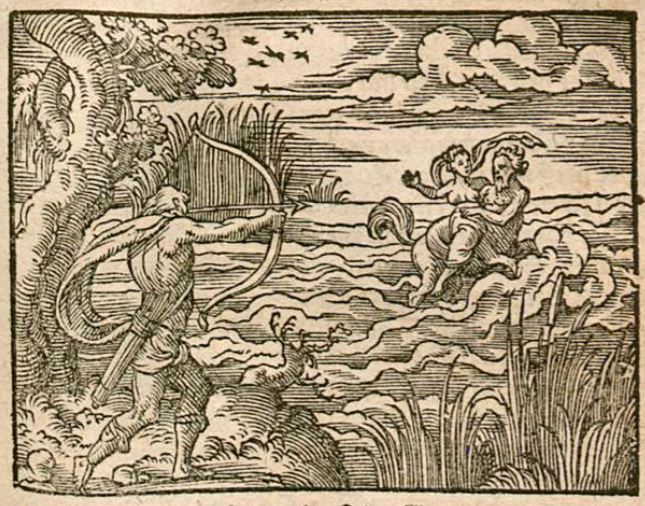
Hercules and his new bride Deianira came across the Evenus River while on their way back to Hercules’ native land. The river was higher than normal and dangerous to cross. A centaur named Nessus appeared and offered to carry Deianira safely across the river. Hercules misplaced his trust, as after he crossed the river, he turned back to realize that Nessus was stealing his new bride. Deianira is illustrated in the arms of Nessus, with her hand reaching to Hercules on the shore imploring him to save her. Hercules is depicted with his bow and arrow as he uses his archery skills to strike Nessus down and save his wife.
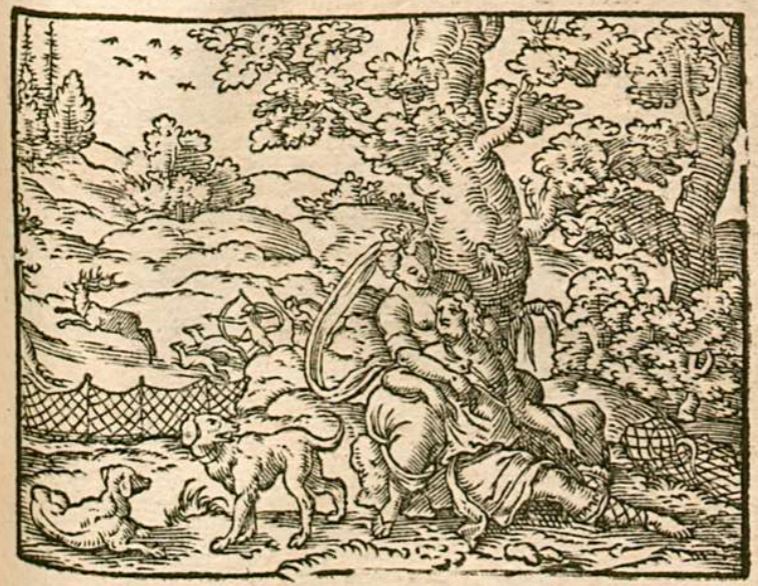
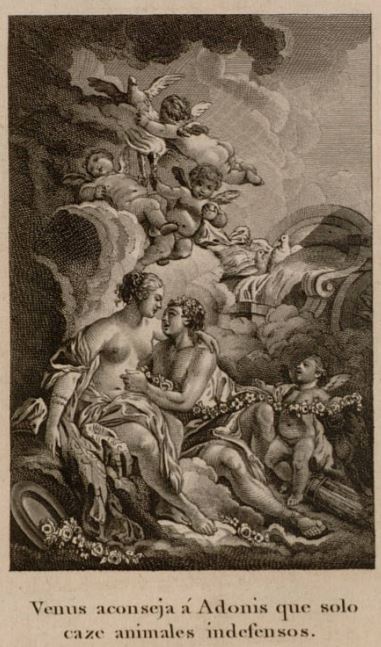
This engraving illustrates the goddess Venus sitting on the ground as she holds her new lover, Adonis. They are illustrated looking lovingly at one another as Adonis’ hounds rest beside them. Venus had been admiring Adonis from afar when her son Cupid had accidentally scratched her with one of his arrows. The arrow caused her to fall in love with Adonis. She decides to abandon her love of watching over her cities and she forgets the heavens all to focus on Adonis. They roam the forest and hunt together, which is depicted in the background of the engraving.
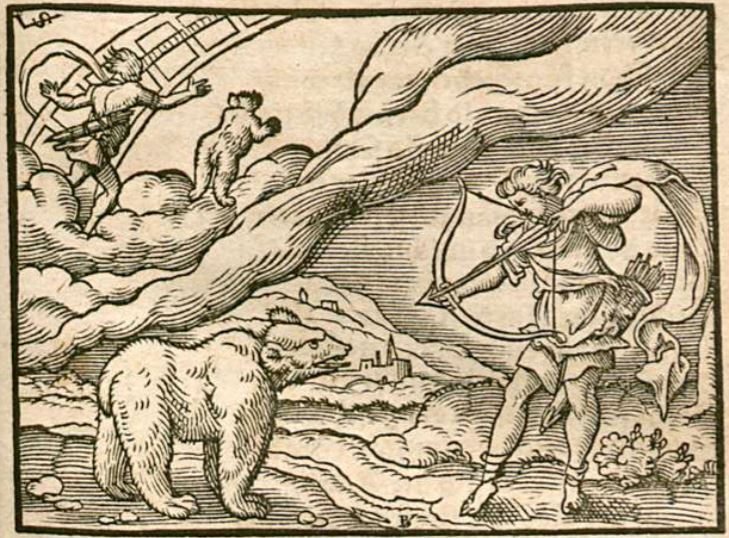
This image depicts a fifteen-year-old Arcas, the son of Callisto and Jupiter, pointing his bow and arrow towards a bear. This bear is actually Callisto, Arcas’ mother. Callisto was transformed into a bear by the goddess Juno as punishment for being raped by Jupiter and having his son. While hunting in the woods one day, Arcas spots his mother in the form of a bear, and just before he shoots her, Jupiter stops him. Jupiter takes Arcas and Callisto and puts them into the sky to form the constellations of the Little Bear and Great Bear for them to be together again. Arcas and his mother are illustrated in the top left corner of the image going into the sky to become constellations.
Don Quixote (middle), clad in armor, makes a show of alighting and throsw his body off Rocinante with a swing, carrying with him Rocinante's saddle, which was ill girthed, causing both him and the saddle to come falling to the ground. On the left, Sancho dismounts from Dapple, but his foot gets stuck one of the rope stirrups, and he hangs by it, with his face and arms on the ground. On the right, the duchess and her men are seen watching in the background.
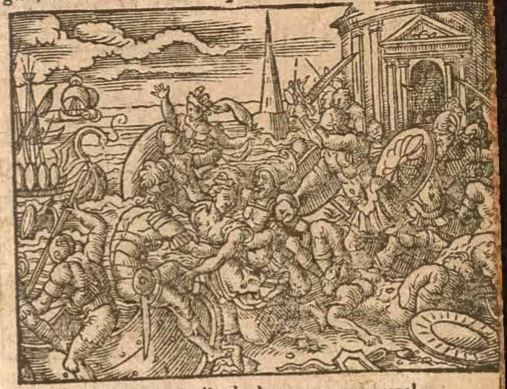
This image depicts the fall of Troy at the end of the Trojan War. After a ten-year war, the city of Troy is destroyed by the Greeks. There are Greek ships illustrated on the water to signify the sailing towards home once the sacking of the city is complete. The main focus of the engraving is the chaos of the Greeks destroying the city before they leave. There are women being taken, one of them being Cassandra, the daughter of King Priam and the head priestess of the temple of Apollo (which is illustrated in the background of the engraving). The other woman being taken is Hecuba, the wife of King Priam and mother to Cassandra.
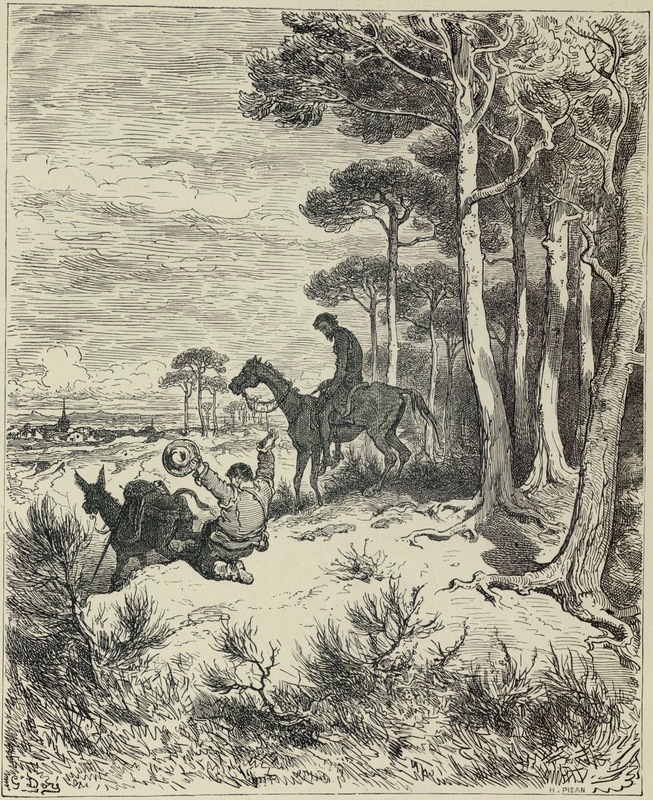
In the foreground, Sancho Panza kneels before his village (background). Don Quixote, mounted on Rocinante, observes him. Sancho Panza’s donkey carries the knight’s armour. Signed by G. Doré (illustrator) and H.-J. Pisan (engraver). Part 2, ch. 72.
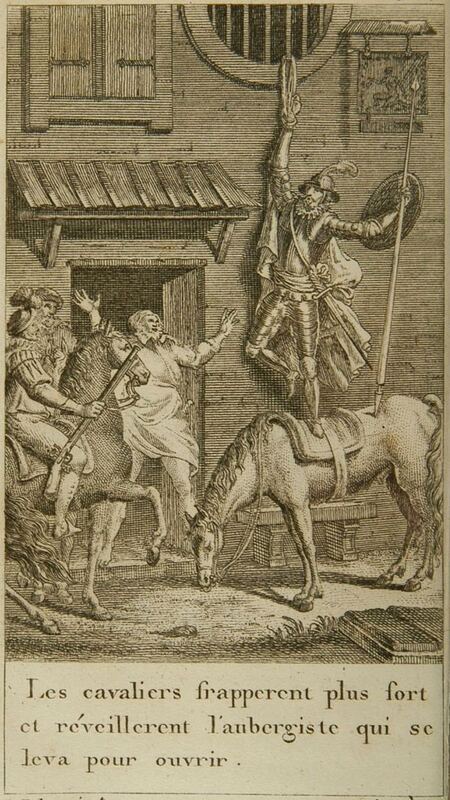
As four travellers (left) arrive to the inn, Rocinante moves toward one of their mares, leaving Don Quixote hanging from the window by his hand. Hearing the knight’s cries for help, the innkeeper appears at the entrance of the inn. Signed by C. Lefebvre (illustrator) and F. Godefroy (engraver). Part 1, ch. 43.
Don Quixote pulls the arm of the Innkeeper's maid, Maritornes, as the Carrier approaches from the right with a candle in his right hand. Behind Quixote, Sancho Panza lies on a bed.
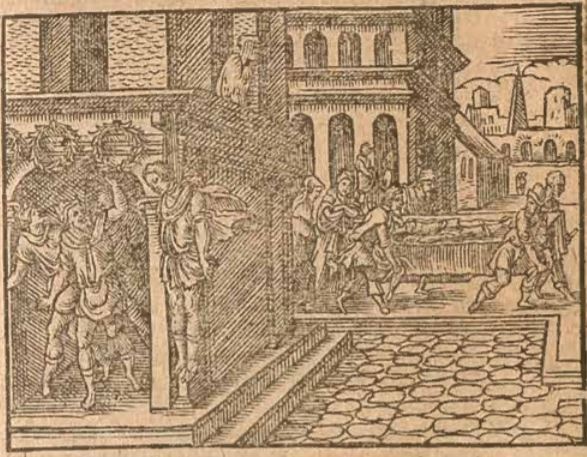
This engraving depicts the story of Iphis and Anaxarete. A young man named Iphis had fallen in love with a young noble woman named Anaxarete. Unfortunately for Iphis, Anaxarete’s feelings were not mutual. Iphis hung himself outside of Anaxarete’s room out of grief for the unrequited love. This is depicted on the left side of the engraving. There are servants emerging out of the doorway with shocked expressions as they see Iphis hanging. The background of the engraving illustrates the funeral ceremony for Iphis, as he is carried away on a funeral bier with his mother walking directly behind the bier. Anaxarete is depicted looking out of her window as she watches the funeral processions.
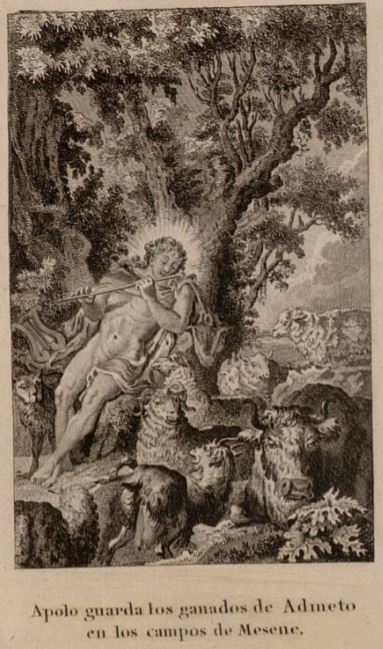
This image depicts the god Apollo (also known as Phoebus) dressed as a shepherd as he tends to his cattle and sheep. As he is the god of music, he is also depicted playing a fluted instrument. Apollo was exiled to earth for nine years by Jupiter and during that time he became a shepherd to Admetus, the king of Thessaly. This image represents his time as a shepherd on earth.
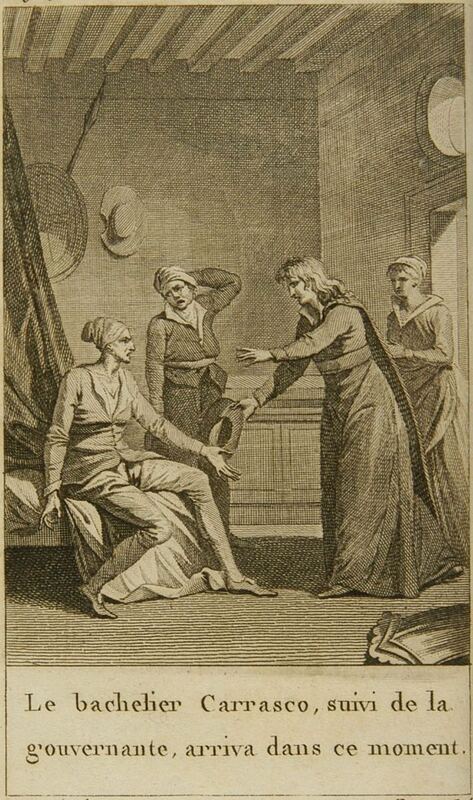
Sansón Carrasco offers to serve as squire to Don Quixote, making Sancho Panza distressed and sad. The actions of the characters are well represented in the illustration with gestures. Instead of convincing Don Quixote to stay home as promised to the housekeeper, Sansón Carrasco encourages him to set out on his third sally. Signed by J.-J.-F. Le Barbier (illustrator) and L.-M. Halbou (engraver). Part 2, ch. 7.
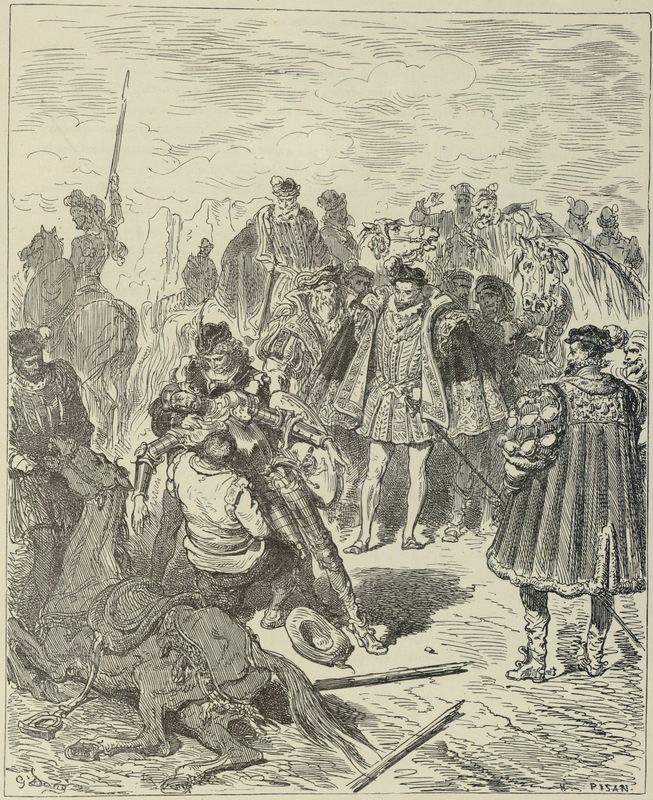
Sancho Panza and the viceroy’s servants help Don Quixote to his feet after having been defeated by the Knight of the White Moon (Sansón Carrasco). The viceroy and Don Antonio Moreno look on. Signed by G. Doré (illustrator) and H.-J. Pisan (engraver). Part 2, ch. 64.
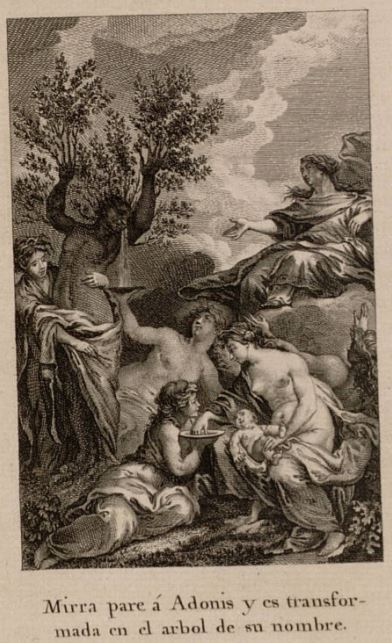
This image depicts the birth of Adonis and the transformation of his mother Myrrha. Myrrha asked the gods to punish her for having incestuous relations with her father. They abided, and transformed her into a Myrrh tree. Before she is fully transformed, her son is born. Myrrha, almost fully transformed into a tree, is depicted on the left side of the image crying. The goddess of childbirth, Lucina, is depicted holding the newborn as she washes him. Numerous nymphs are surrounding Lucina as they help care for the baby and for Myrrha.
When Quixote, clad in armor, arrives at the castle gate mounted on Rocinante, there immediately issued out two lacqueys or grooms, clad in morning-gowns of fine crimson satin down to their heels, who, taking Don Quixote in their arms, lifted him from his saddle and onto the ground.
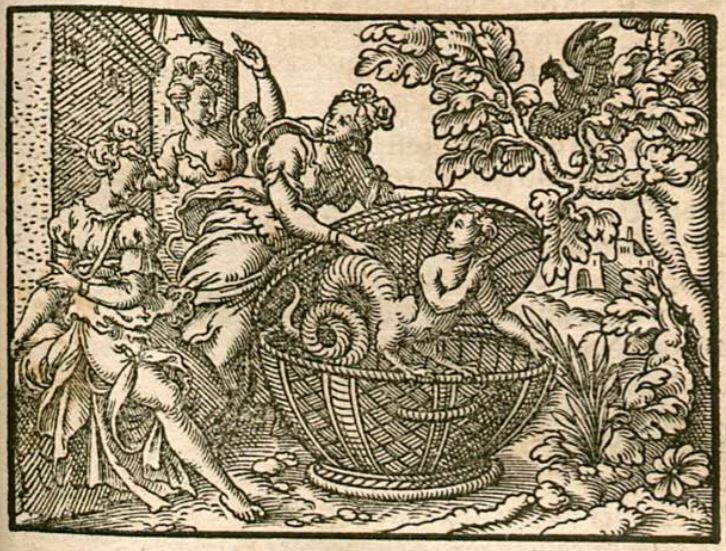
This image depicts the three daughters of Cecrops (a king of Ancient Athens) standing on the left side of the image. The daughter that is holding onto the woven basket in the illustration is named Aglauros, while behind her are her sisters Pandrosus and Herse. This basket contains a child that was born from the seed of the god Vulcan. The goddess Minerva had entrusted these three sisters to watch over the basket, swearing not to look at the contents inside. Aglauros, however, disobeyed the goddess and is illustrated holding the basket open, exposing the child named Erichthonius. Erichthonius is depicted as half human half serpent in this illustration which is why the women appear to be shocked. There is a crow that is overlooking the scene who is the one telling this story to a raven.
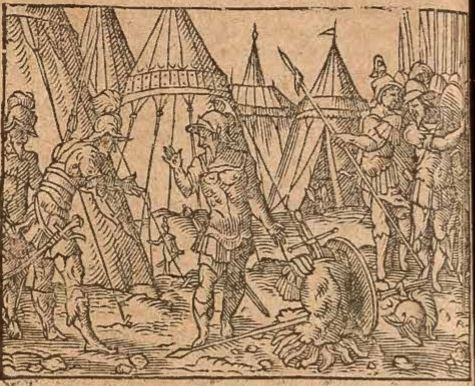
This engraving illustrates the Greek leaders of the Trojan war listening to a debate between Ajax and Ulysses. There is a contest between these two men to see who should be awarded the armor and weapons of the great Achilles. Achilles’ belongings are placed on the ground with a sword and a spear going through the chest plate and the helmet to the right of the shield. Ajax and Ulysses are illustrated speaking to each other as they debate who is more worthy of receiving Achilles’ weapons. Ajax believes he should be the one to inherit Achilles’ things as he is related to him. Ulysses believes he should be the one to receive Achilles’ things as he is the one who got Achilles to participate in the Trojan war in the first place. The Greek leaders are depicted on the right-hand side of the engraving engaging in whispered conversations as they decide who should be the recipient of the armor. It goes to Ulysses.
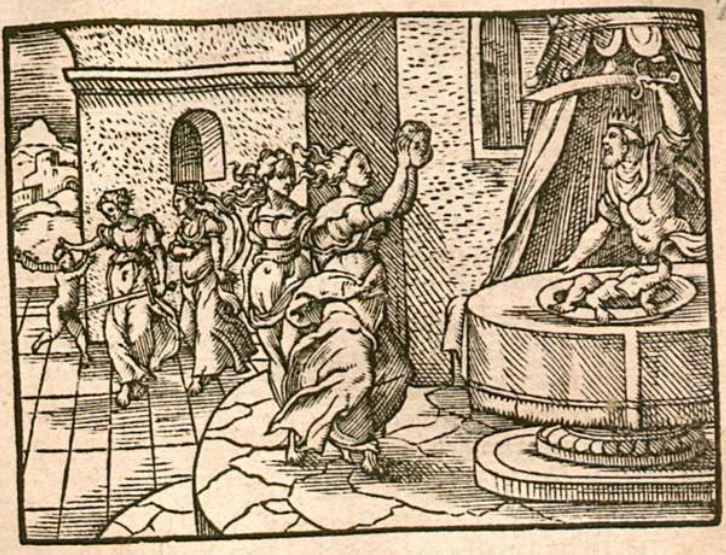
This engraving illustrates Philomela presenting the head of her nephew to her brother-in-law, Tereus. After being rescued by her sister Procne, Philomela and her sister conjured up a plan to seek revenge on Tereus for keeping Philomela captive and mutilating her. Procne decided to kill her own son and feed him to her husband, Tereus, to avenge her sister. Tereus is illustrated with his arm in the air in outrage as he just learned that he had eaten his son. Philomela is depicted holding the head of her nephew, Itys, to spite Tereus for what he had done to her. Procne and Philomela are also depicted in the background of the engraving killing Itys with a sword.
This engraving depicts the goddess Venus sitting on the ground as she holds her new lover Adonis. Venus had been admiring Adonis from afar when her son Cupid had accidentally scratched her with one of his arrows which then caused her to fall in love with him. She decides to abandon her love of watching over her cities and she forgets the heavens all to focus on Adonis. She even decides to start dressing up like her sister, Diana, a huntress. There are cherubs and doves surrounding the two lovers as those are two symbols of the goddess.
Travelling along a road, Don Quixote see's a man riding along with with something that shined like gold on his head and thinks this the helmet of Mambrino, when in fact it is only a a barber's brass basin worn ontop of his head to protect him from the rain. Nonetheless, thinking the basin a helmet of gold, and the barber a knight of high standard, Don Quixote put Rocinante at full speed, couched his lance and intended to run the poor barber through. Seeing Quixote charge at him, the barber fell from his donkey in fright and ran away with his steed, leaving his basin behind. Satisfied, Quixote picked up the basin and admired its shiny exterior still thinking it a helmet, while Sancho laughs at his master for thinking a brass basin to be a legendary gold helmet.
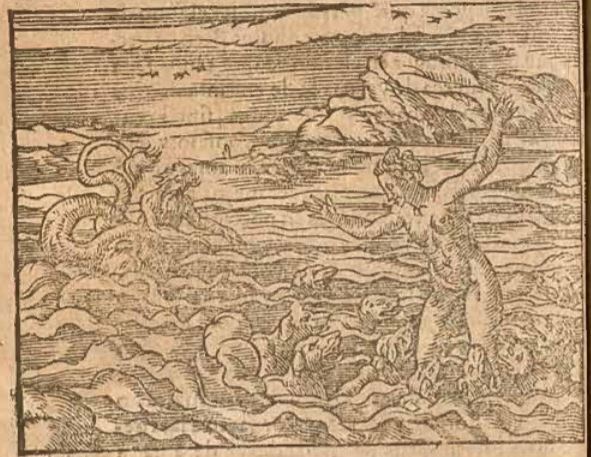
This image illustrates Scylla being transformed into a sea monster. Scylla was a beautiful young woman who had been sought out by many men. A sea-god by the name of Glaucus had been especially taken by her beauty. He had sought the help of Circe, a goddess skilled in herbs and potions, to help Scylla fall in love with him. Circe had become infatuated with Glaucus, and when he rejected her due to his affection for Scylla, Circe had become jealous, as Glaucus preferred Scylla over her. To exact revenge, Circe concocted juices and herbs to transform Scylla into a monster. The engraving illustrates many hounds surrounding Scylla, who are now a part of her body. Glaucus is visible in the background of the engraving, shocked at the transformation of Scylla.
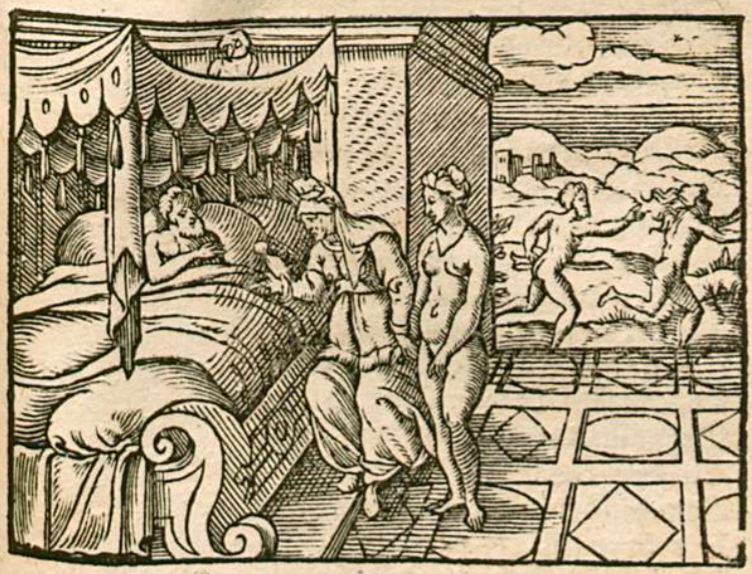
This engraving illustrates a young girl named Myrrha being led by her nurse to a bed with a man lying in it. The man is Myrrha’s father, Cinyras, who Myrrha is incestuously in love with. Myrrha’s nurse told Cinyras that she could provide him with a young girl who lusted over him, and Cinyras fully obliged. Without telling Cinyras that the girl is in fact his own daughter, the nurse leads Myrrha to him in the night so that he cannot see his daughter’s face. There is a screech owl depicted sitting above the bed. The owl represents an omen which warns Myrrha that she should not go through with the act. Myrrha ignores the omens and the father and daughter continue to have an affair, until one night when Cinyras desired to see his lovers face, he lit a candle and held up the light to see that it was his daughter. Cinyras is illustrated in the background of the engraving angrily chasing after Myrrha for what she had done.
Zoraida, in the company of the captive and surprised by her father Agimorato, pretends to faint. Plate no. 23, signed by J. Vanderbank (illustrator) and G. van der Gucht (engraver). Vol. 1, book 4, ch. 14.

![[Don Quixote insists the barber's basin is Mambrino’s helmet]](https://collections.cemvc.ca/files/large/dee313974cd679375d92b8637fdf91a091882191.jpg)
![[Acis is Murdered by Polyphemus]](https://collections.cemvc.ca/files/large/0b623cfd6d02c8d6edbbfc6269696e8ea525093f.jpg)
![[Of How Sancho and Quixote Fell From Their Horses in the Presence of the Duchess]](https://collections.cemvc.ca/files/large/5c833c493f6636d89f3722e80ed33657acd8950e.jpg)
![[Don Quixot and the Carrier fighting for the Innkeepers Maid]](https://collections.cemvc.ca/files/large/c6ed04d55ee70090947a8d76689d8eae65be10d8.jpg)
![[Two Servants of the Duchess Help Quixote Off His Saddle]](https://collections.cemvc.ca/files/large/f7c2fdda40031e6f9cfabe640337d5d60fe2a854.jpg)
![[Of the Acquisition of Mambrino's Helmet]](https://collections.cemvc.ca/files/large/1d0ca7d0b07a8ab892390894c3d2d9ba37f2b226.jpg)
![[Zoraida's father discovers his daughter and the captive]](https://collections.cemvc.ca/files/large/6357d388a115889a2e2ee64f49b5a187276c63c5.jpg)