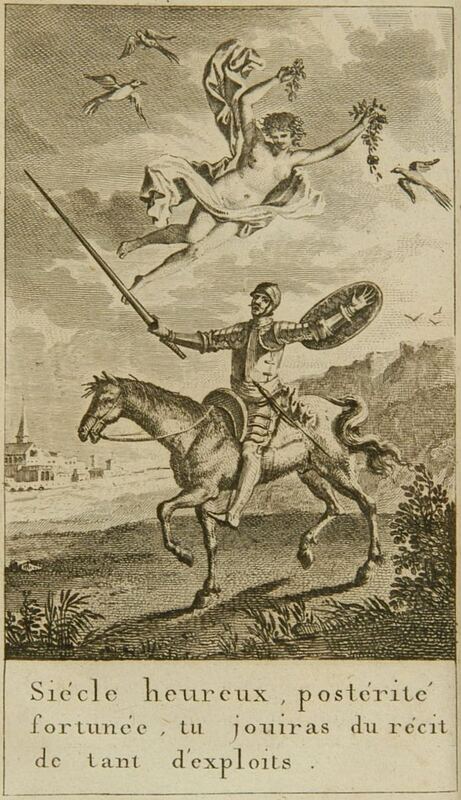
Don Quixote sets out on his first sally, accompanied by the allegorical figure of Apollo, who spreads strands of his golden hair over the face of the earth. Cervantes takes this allegory from Homer. Don Quixote’s village is pictured in the left background. Unsigned. Part 1, ch. 2.
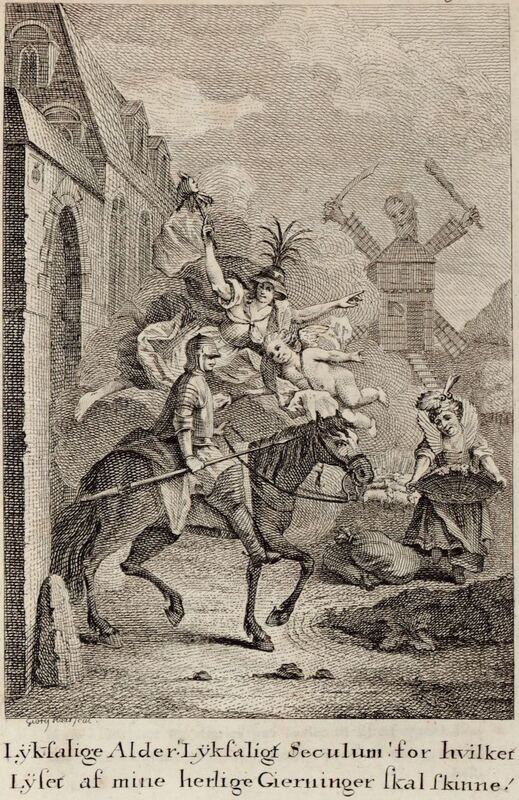
The illustration is an allegorical representation of Don Quixote’s first sally. Don Quixote, mounted on Rocinante and wearing his armour, leaves his village while Folly (with the basin) and Love (Cupid holding a torch touching Don Quixote’s heart) watch over him. Dulcinea is also depicted. In the background, a flock of sheep and a windmill transforming into a giant are pictured. Signed by J.-J.-G. Haas (engraver). Part 1, ch. 2.
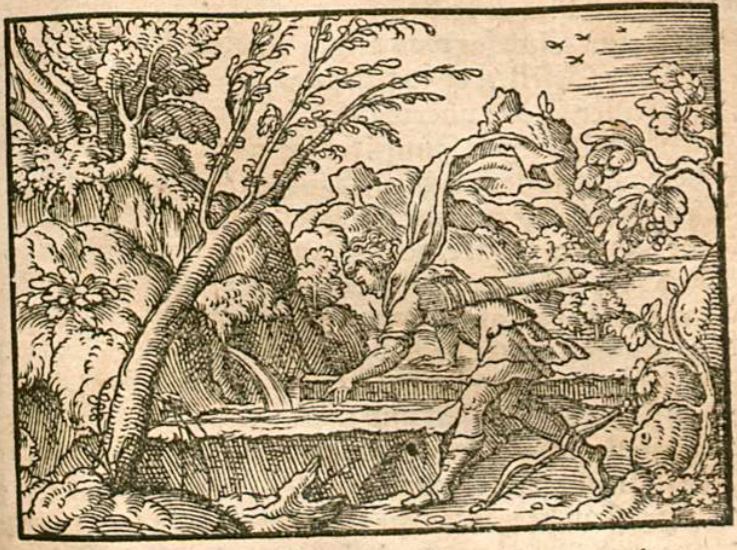
This engraving illustrates Narcissus, the son of a beautiful nymph, who has discovered his own reflection in a fountain of water and fallen in love with himself. Narcissus was blessed with beautiful physical appearances; however, he had rejected the advances of anyone that showed interest in being his lover. After breaking the heart of yet another admirer, Narcissus was cursed by the goddess Nemesis after she heard a request from one of the people Narcissus had hurtfully rejected. Nemesis cursed Narcissus to feel the pain that his admirers had felt: the feeling of unrequited love. While wandering through the forest, as illustrated in the engraving, Narcissus spots himself in a fountain of water and painfully desires himself. Narcissus ends up melting from his burning passion and transforms into a flower.
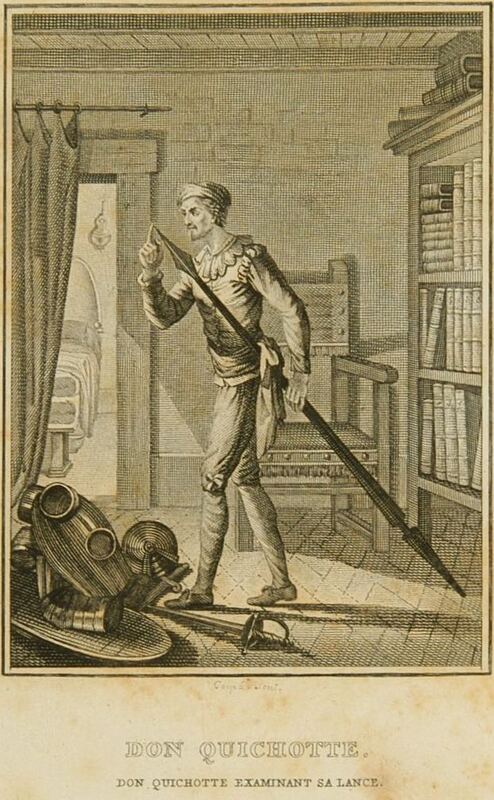
Don Quixote examines his lance, testing the blade with his finger. His sword and armour lay on the floor of the library. In this illustration the room is uncluttered and tidy, while in others the library is symbolic of Don Quixote losing his mind, and is depicted as messy and chaotic. In the background is a doorway, beyond which is the bedroom. Signed by A.-J.-B. Coupé (engraver). Part 1, ch. 1.
Sancho Panza, mounted atop his donkey Dapple, leans to the right, a wooden bowl in his right hand with which he hopes to scoop out the curds from Quixote's helmet which he holds in his left hand. Sancho looks out of frame to the left where Don Quixote has demanded him to return his helmet.
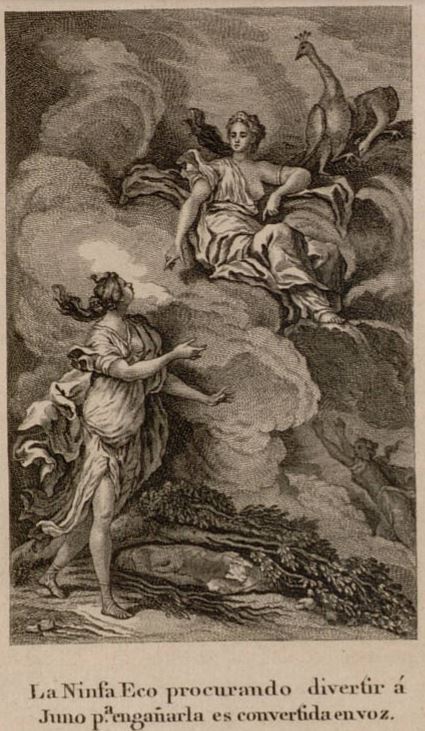
This image depicts the nymph Echo standing on the ground as she speaks to the goddess Juno who is sitting on a bed of clouds in the sky with her peacock beside her. Echo would often converse with Juno to distract her from finding out that Jupiter was having affairs with nymphs. When Juno find out about this deception, she punishes Echo by making her only able to speak if she repeats the last word of what anyone says to her. Echo is depicted in the background of the image in the bottom right corner lunging into the forest to hide in shame.
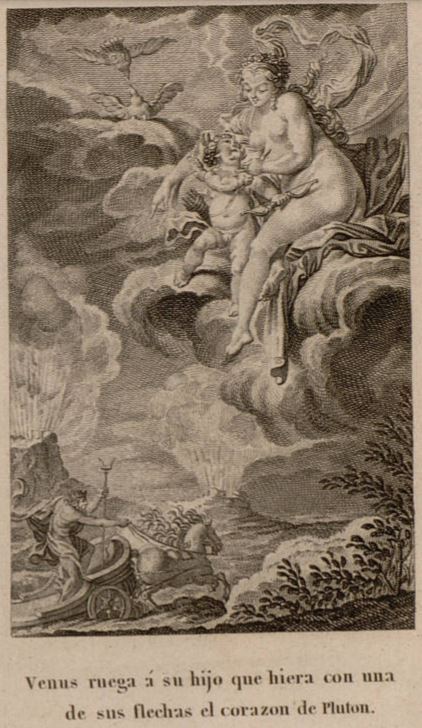
The goddess Venus and her winged son Cupid are illustrated looking at each other as they float on a bed of clouds. Venus instructs her son to shoot one of his arrows into the heart of Pluto, the god of the Underworld, to make him fall in love with the first woman he sees. Cupid is depicted holding his bow and arrows in his hands. Pluto is illustrated at the bottom of the image riding a horse-drawn chariot. He ends up falling in love with Proserpina, the daughter of the goddess Ceres. There are two doves illustrated touching beaks beside Venus and Cupid. Doves are a symbol of love and are often linked with Venus in iconography.
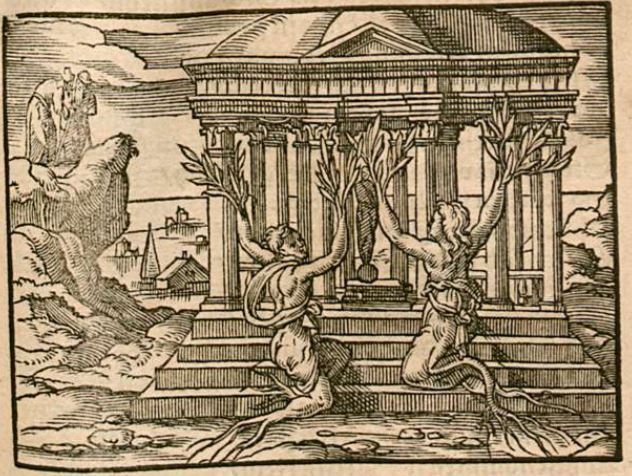
When Jupiter and Mercury unleashed a flood upon a small town to punish the citizens for denying them hospitality, they decided to save an old couple by the name of Baucis and Philemon. They saved them as they were the only people who welcomed the gods into their home. Along with sparing their lives, Jupiter and Mercury saved their home by transforming it into a temple, which is the building illustrated in the engraving. Baucis and Philemon had also requested from the gods to become priests of the temple, and to die within the same hour of each other. The gods granted their request, and when their time came to die, they transformed Baucis and Philemon into trees so that they would be together forever. The couple are illustrated mid-transformation on the steps of the temple.
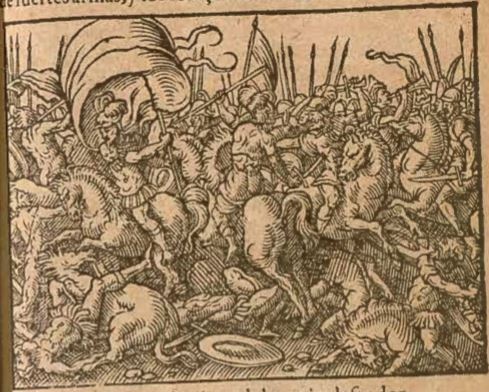
This engraving illustrates the pure chaos of the first battle between the Greeks and the Trojans. This battle signifies the beginning of the Trojan war, as it is the first encounter the two armies have with one another. Protesilaus is the first Greek to step onto the shores of Troy, as well as the first to die. He is most likely one of the men in the forefront of the engraving who are depicted to have been slain.
Sancho Panza, wearing a wide hat, sits at a table at where he places his elbows. In his right hand he holds a pair of scissors which he plans on using to cut off the top of his fingernail so that it does not grow too long. This image is occasioned by Don Quixote saying "Sancho, in the first place I enjoin you to be cleanly, and to pare your nails, instead of letting them grow, as some do, whose ignorance makes them believe that long nails beautify the hands ; as if that excrescence which they preserve so carefully were a nail, whereas it is rather the talon of a lizard-hunting kestrel: a monstrous and revolting abuse!" (Page 453).
Don Quixote (middle) dressed with scarlet mantle over his shoulders and a satin montera marched out into the great saloon with his sword by his met. He is met by many damsels drawn up in two ranks, as many on one side as the other, and all of them provided him with flagons of perfumed water for washing his hands, which he accepts by offering his hands to one of the damsels who begins to pour her flagon. On the right Sancho Panza watches in the background.
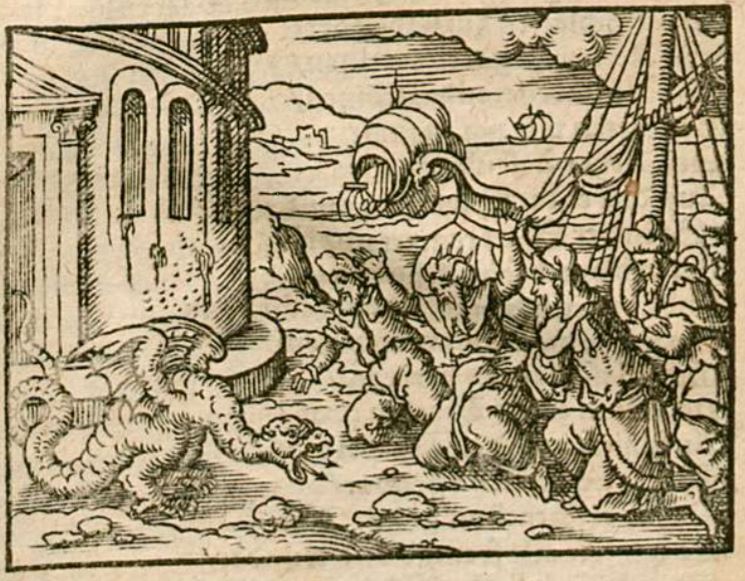
This engraving depicts the god of healing, Aesculapius, transformed in the form of a winged snake. He is illustrated outside of his own temple on the left side of the image. There are men standing in front of Aesculapius who appear to be extremely afraid of the snake. These men are Romans who sought the help of Aesculapius because their city was ravaged by the plague. Aesculapius had appeared to one of these Roman delegates in his dream to inform him that he would help their city and accompany them back to Rome on their ships in the form of a serpent.
Don Quixote, clad in a full suit of armour, prays on his knees. In front of him, a small child carries a minuscule torch in his his left hand, his right hand points towards Don Quixote. On Don Quixote's right, the innkeeper stands with a book in his right hand and a sword held aloft in his left. To Quixote's left and back two of the inn's guests kneel, and in the doorway to the inn two more guests ridicule Quixote.
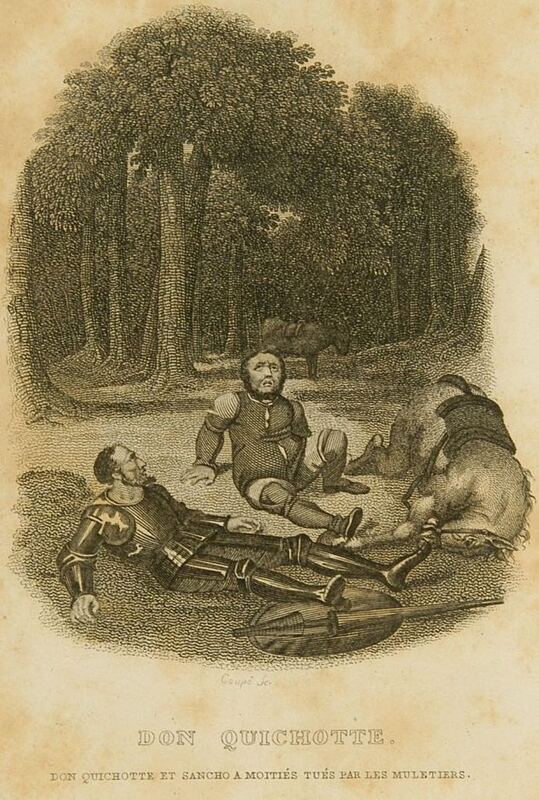
Don Quixote, Sancho Panza, and Rocinante lay defeated by the shepherds recovering from their wounds. In the background, Sancho’s donkey is pictured. Signed by A.-J.-B. Coupé (engraver). Part 1, ch. 15.
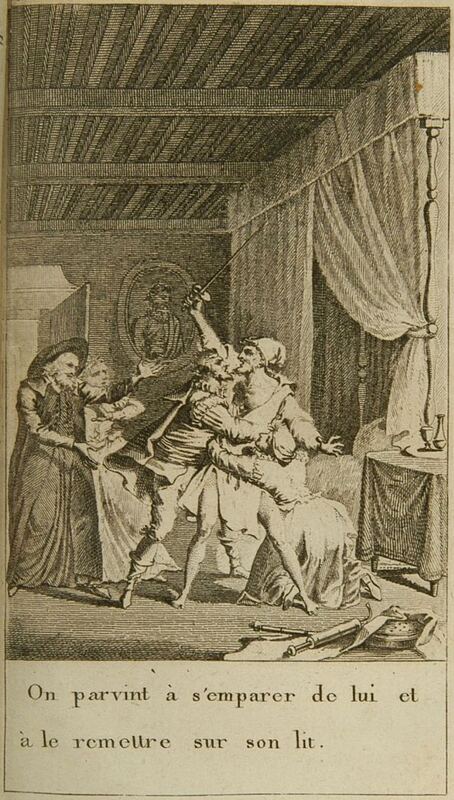
After returning from his first sally, Don Quixote wakes up shouting in his home. The priest, the barber, the housekeeper, and the niece attempt to calm him. Unsigned. Part 1, ch. 7.
The priest, the barber, and Cardenio encounter Dorotea, washing her feet in a stream. The trees and shrubbery pictured in the illustration are well detailed. Plate no. 18, signed by J. Vanderbank (illustrator) and G. van der Gucht (engraver). Vol. 1, book 4, ch. 1.
Don Quixote, clad in armor, stands triumphantly between Sancho Panza (left) and a barber (right), with a brass basin that he has mistaken for Mambrino's helmet held aloft in his right hand, with his left hand Quixote holds back the barber. Sancho stares at the barber and clenches his fists, having just been separated from the brawl by his master. The barber looks at the brass basin which Don Quixote has previously stolen from him in the forest. A donkey's pannel lies at the feet of Sancho Panza. In the background, a crowd of onlookers has gathered to watch the brawl and see the conclusion of the barber's hostility.
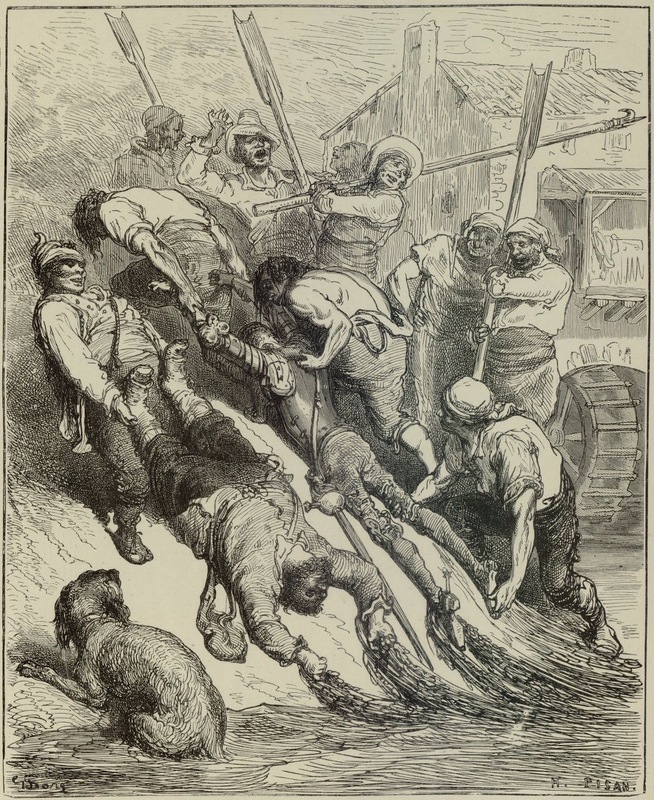
Don Quixote and Sancho Panza are pulled to land by the millers, rescuing them from the millrace rapids of the Ebro. Signed by G. Doré (illustrator) and H.-J. Pisan (engraver). Part 2, ch. 29.
Portrait (bust) of Miguel de Cervantes Saavedra in an circular frame. Below the frame are a number of symbolic objects: a sword, a shield, a lance, spurs, a laurel wreath, and a lyre. Signed by D.-N. Chodowiecki (illustrator) and D. Berger (engraver), dated 1780. Title page.
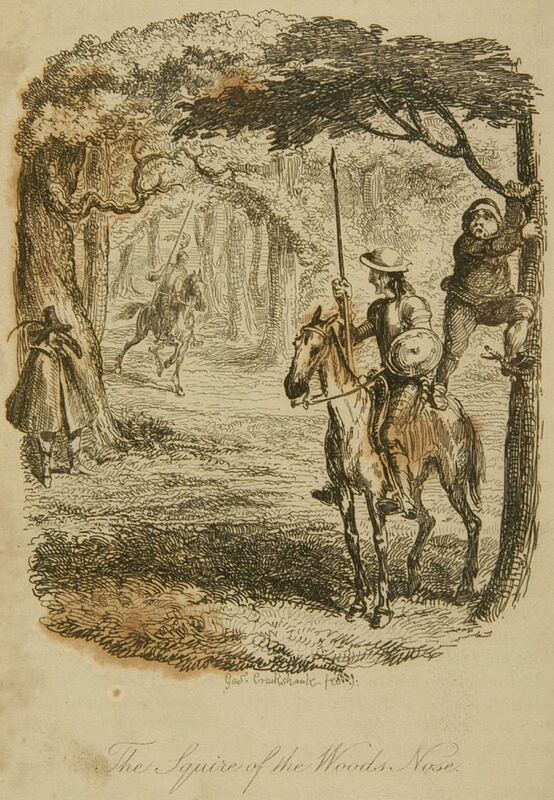
Sancho Panza, startled by the big nose of the Knight of the Mirrors’ squire (Tomé Cecial), climbs into a tree. Don Quixote and the Knight of the Mirrors (Sansón Carrasco) prepare to duel. Signed by G. Cruikshank (illustrator and engraver). Part 2, ch. 14.
After Vivaldo (pictured riding a horse in the background) reads Chrysostom's song of despair as he is set to be buried, Ambrosio gives a eulogy for his shepherd friend, accusing Marcella of causing Chrysostum's death. Vivaldo sets about to read another of Chrysostom's songs but is interrupted by the sight of the shepherdess Marcela (pictured looking down at the burial from a rock), who appeared so beautiful it surpassed all report. Don Quixote (pictured clad in full armour with a lance by his side) was as shocked by her beauty as all other attendees.
Having been trampled by a stampede of bulls, Don Quixote, dressed in his armor, raises his right hand in the direction of the exiting stampede and their herdsmen. In the middle of the foreground, Quixote's helmet lays battered upon the ground. On the right, Sancho Panza lays upon his knees and clutches his back in pain.
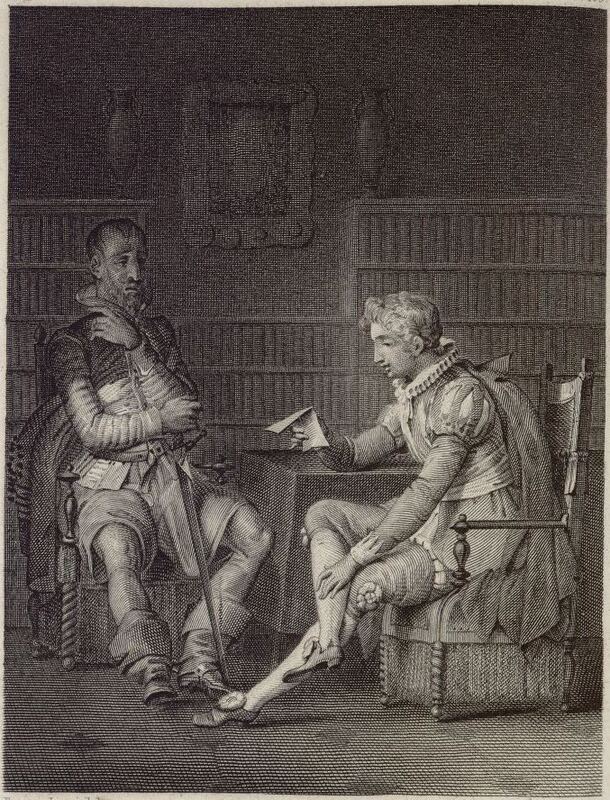
At Don Diego de Miranda’s house, his son Don Lorenzo reads some poems to Don Quixote. He recites the gloss that he has written for a literary competition, after which Don Quixote praises him and hails him as the best poet on earth. Signed by E. Lami (illustrator) and E. Lignon (engraver). Part 2, ch. 18.
Don Quixote (left), clad in armor, and Sancho Panza (far left) come across a cart without awnings, strapped to two donkeys led by a man dressed as the devil. Sitting in the cart are a man dressed as death with scythe in hand, an angel with large painted wings, a man with a crown, and a man dressed as cupid with a bow slung over his shoulder. Quixote, mounted on Rocinante, holds his lance in his right hand and with his left points at their cart and asks what their business is.
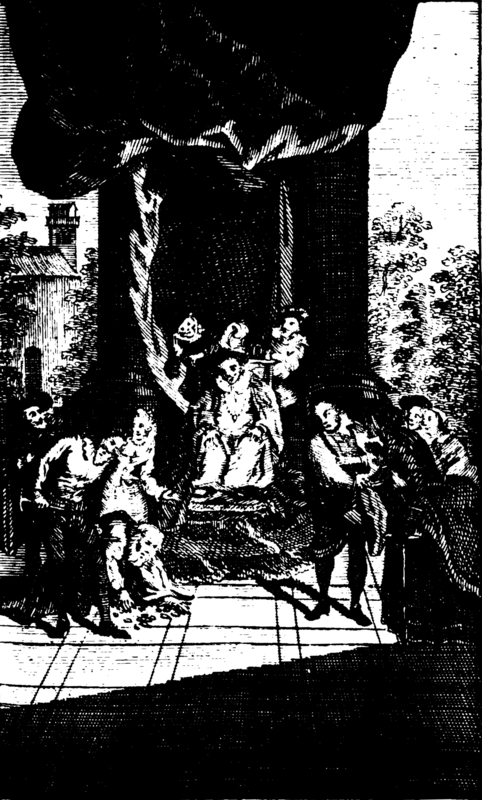
Having been carried to the court of justice, Sancho Panza is placed on a regal seat and told that it is custom for the governor of the islant to answer difficult and intricate questions asked of him by the citizens. The answers Sancho gives will make the people feel the extent of his wisdom, and estimate his abilities, so they can judge whether they ought to rejoice, or to be worry for his coming. The first to seek an audience with Sancho Panza are two old men (pictured to the left), one with a staff and the other without. The old man without a staff explains that he'd lent ten crowns but had not been repaid. The old man with the staff claimed he had never been lent the ten crowns to begin with. The old man without the staff said he would be satisfied if the other man would swear upon god that he has paid me back. The old man with the staff agreed and handed his staff to the plaintiff before swearing to Sancho and all present that he had repaid the sum in full. Satisfied, the plaintiff gave the staff back and was about to leave but Sancho stopped him and told his attendants to break the staff. The staff was then broken and ten crowns fell out from within.

![[Of How Sancho Was Forced to Give Quixote's Helmet While Curds Remained]](https://collections.cemvc.ca/files/large/c0fccaf092007a9bd98357b6d3bfe2266853b6ab.jpg)
![[Sancho Panza Pares His Nails]](https://collections.cemvc.ca/files/large/55c066299101b319d5fa3ce528f30ac3bfcb045a.jpg)
![[Of How Don Quixote Washed His Hands]](https://collections.cemvc.ca/files/large/33d835f80e752da5d71fa5f1c85499c2675bf5e5.jpg)
![[Don Quixot Dubb'd a Knight Errant by the Innkeeper]](https://collections.cemvc.ca/files/large/03a84651823ea5464975c12f9b8985cfba1c3e86.jpg)
![[The priest, the barber, and Cardenio encounter Dorotea]](https://collections.cemvc.ca/files/large/59d4e6b1d92a4862056ced24fe3c1e9a7e937669.jpg)
![[Don Quixote Separates his Squire from the Barber the Rightful Owner of the Basin]](https://collections.cemvc.ca/files/large/49850907c96aa8274d403968341f2dfaf2cc37a5.jpg)
![[Portrait of Cervantes]](https://collections.cemvc.ca/files/large/3896ff04886d7c4dfffa3dcf7aec049868ed0141.jpg)
![[Marcella Interrupts Chrysostom's Burial]](https://collections.cemvc.ca/files/large/b9cd4d67e56a1be4debef92e5ad5e47837a4c3d1.jpg)
![[Don Quixote and Sancho Trampled and Rolling on the Ground]](https://collections.cemvc.ca/files/large/495678d26a72b6164ea169fa0c4b2f585003f061.jpg)
![[Of How Don Quixote Met the Cart of Players]](https://collections.cemvc.ca/files/large/e33d8225cb644d31d3b86f9f5d9339125ea4fc5c.jpg)