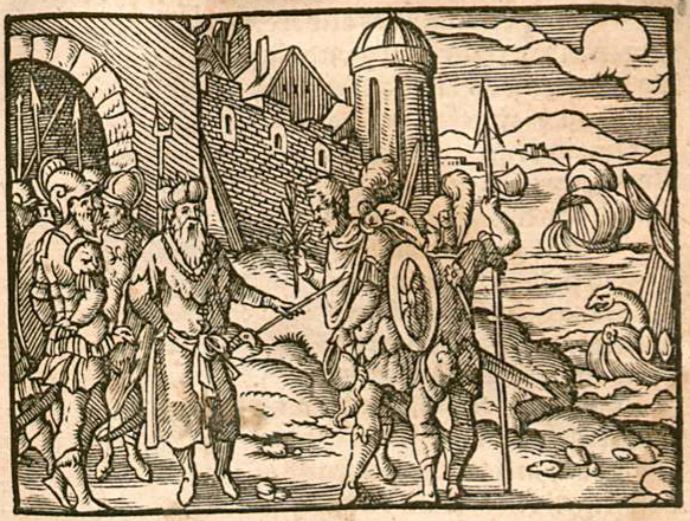
This engraving illustrates Cephalus, an ambassador of Athens and ally to Aegina, having just arrived on the shores of Aegina. Him and his companions are greeted by King Aeacus of Aegina and his sons Telamon, Peleus, and Phocus on the left side of the image. Cephalus arrived in Aegina to request their aid as King Minos of Crete was out of control and trying to wage war on Athens. In the background of the engraving, there is a ship that is sailing away from Aegina. This ship contains King Minos, as he had left Aegina only moments prior to Cephalus arriving, attempting to recruit King Aeacus into joining his forces. King Aeacus declined, as he was allied with Athens.
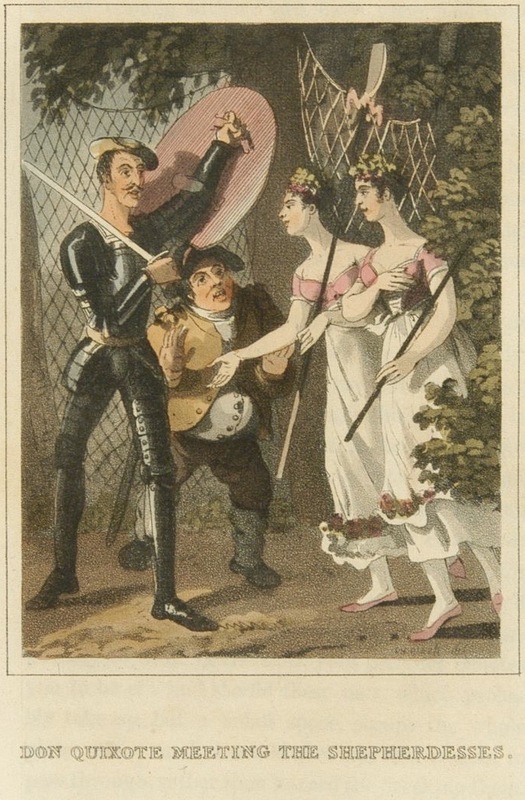
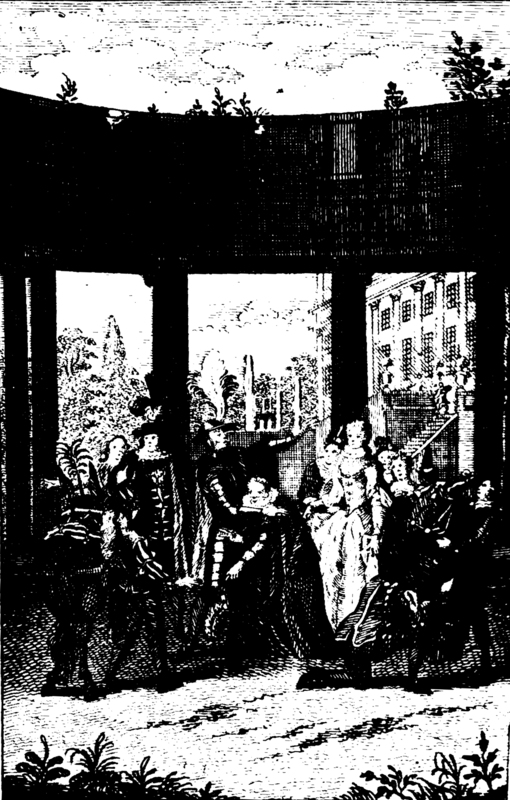
Don Quixote finds himself caught in nets of green string that are stretched between trees. Imagining that enchanters want to entangle him, he tries to break the nests when two shepherdesses appear before him and Sancho Panza. They are dressed in jackets and skirts made of fine brocade and rich moiré shot with gold. Unsigned. Part 1, ch. 3.
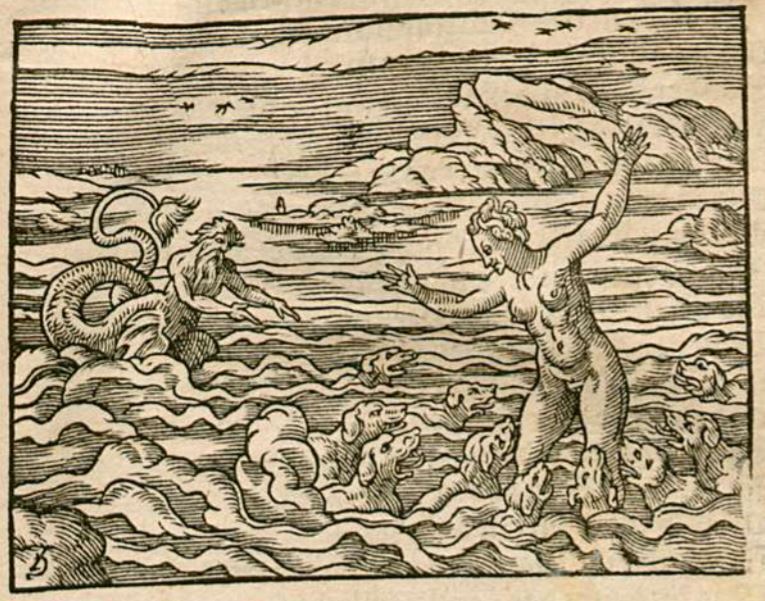
This image illustrates Scylla being transformed into a sea monster. Scylla was a beautiful young woman who had been sought out by many men. After being rejected by Scylla, the sea-god Glaucus was enraged. He had sought the help of Circe, a goddess skilled in herbs and potions, to help Scylla fall in love with him. Circe had become infatuated with Glaucus, and when he rejected her due to his affection for Scylla, Circe had become jealous as Glaucus preferred Scylla over her. To exact revenge, Circe concocted juices and herbs to transform Scylla into a monster. The engraving illustrates many hounds surrounding Scylla, who are now a part of her body. Glaucus is visible in the background of the engraving shocked at Scylla’s transformation.
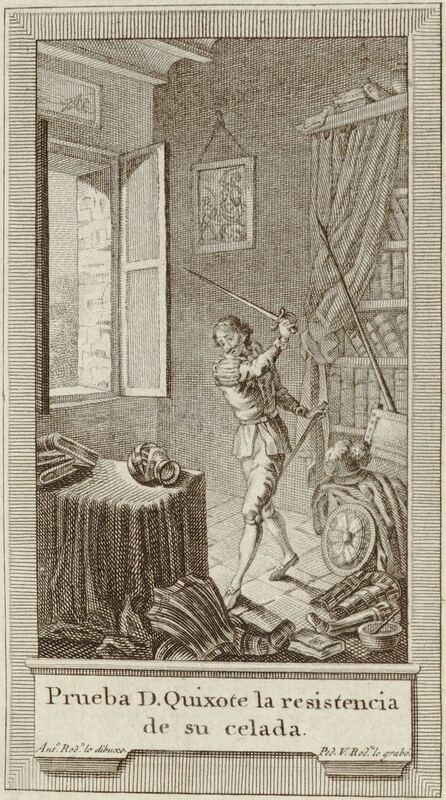
Don Quixote, having cleaned and restored some of his great-grandfather’s armour (pictured strewn about him on the floor), finds a defect in the helmet. Instead of a full sallet helmet with a neckguard, there is only a simple headpiece. The errant knight compensates for this by fashioning a half-helmet out of pasteboard. To test its strength and whether it can withstand a blow, he takes his sword and strikes it twice. Unfortunately, with his first blow he immediately undoes what had taken him a week to create. Signed by A. Rodríguez (illustrator) and P. Rodríguez (engraver). Part 1, ch. 1.
Sancho Panza (right) tells Don Quixote (middle) that Dulcinea is approaching with two maids on horseback and grabs a peasant girl riding on the back of a donkey in hopes that Quixote will be fooled. Don Quixote, clad in armor, believes that she is Dulcinea and falls to his knees, convinced that an evil enchanter has changed her into a peasant. In the background two of the peasant girl's companions follow on donkeys of their own, the closest one raising a stick to hit Sancho and Quixote.
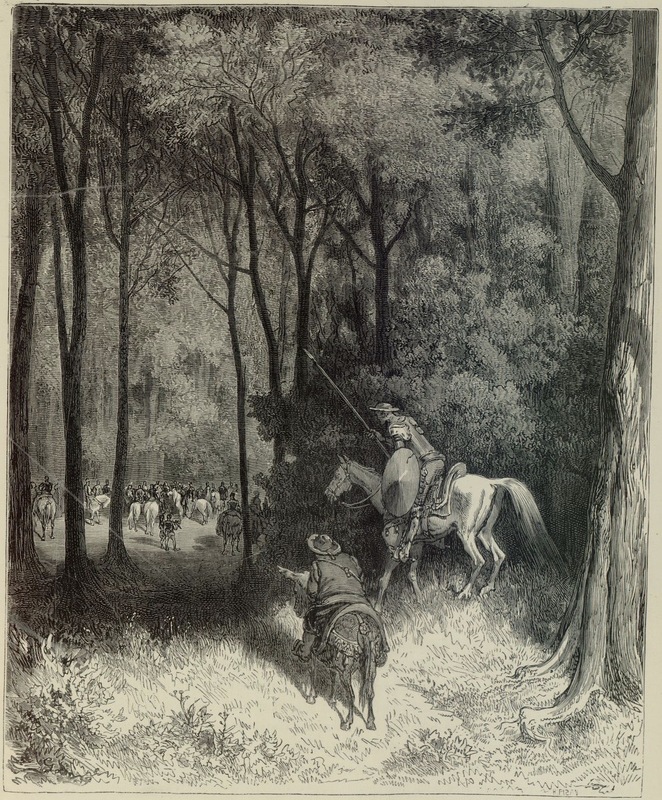
In a green meadow, Don Quixote and Sancho Panza encounter a party of falconers, among them a graceful lady on a snow white palfrey with a green harness and a silver sidesaddle (the duchess). In her left hand she carries a goshawk, which indicates to Don Quixote that she is a great lady and probably the mistress of the other hunters in the party. Signed by G. Doré (illustrator) and H.-J. Pisan (engraver). Part 2, ch. 30.
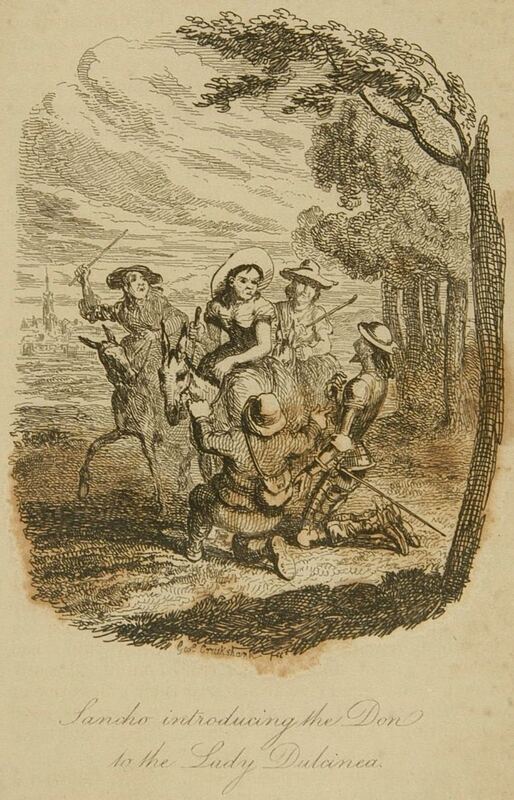
Don Quixote and Sancho Panza kneel before three peasant girls mounted on donkeys. Sancho introduces one of them as the enchanted Dulcinea. El Toboso appears in the background. Signed by G. Cruikshank (illustrator and engraver). Part 2, ch. 10.
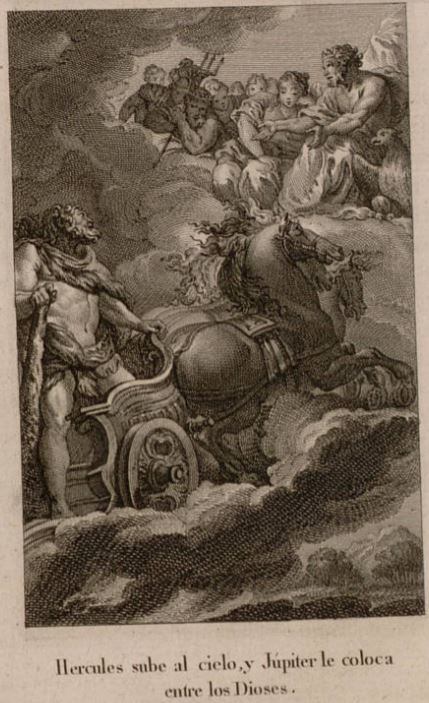
The event in this image takes place after Hercules was burned in a funeral pyre and died. The mortal piece of him was burned to death, however, as he is the son of Jupiter, the immortal being within Hercules survived. This illustration depicts Jupiter and the rest of the Olympian gods in the clouds, welcoming Hercules into the heavens as he rides on the horse-drawn chariot. Once Hercules rejoins his father and the other gods, he is made into a constellation.
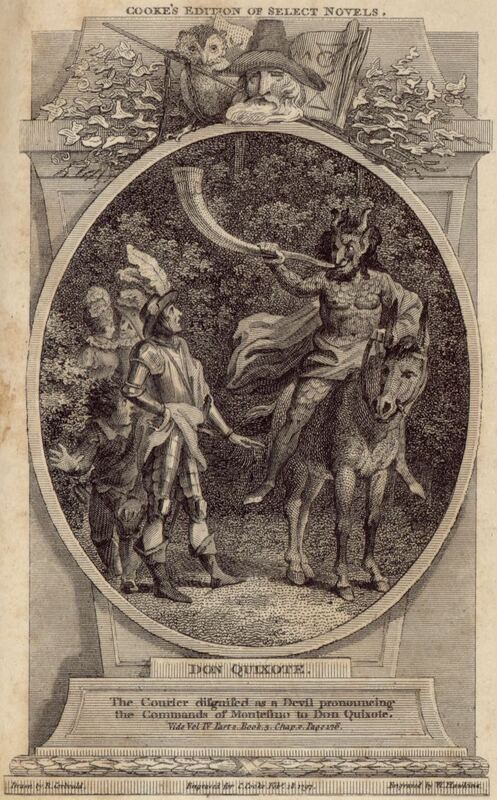
A postillion dressed as a demon approaches the hunting party, playing a huge, hollow animal horn that emits a harsh and terrifying sound. The devil announces the arrival of the enchanted Dulcinea and the gallant Montesinos. Don Quixote and Sancho Panza are depicted with astonished expressions. The illustration is set in a decorative and architectural frame, complete with Merlin’s head, a book of enchantments, a wand, and an owl. Signed by R. Corbould (illustrator) and W. Hawkins (engraver), dated 1797. Part 2, ch. 34.
This engraving illustrates the encounter that Cephalus has with Aurora, the Goddess of Dawn. While out hunting and setting traps for deer, Aurora came upon Cephalus and decided to take him against his will as her prisoner. Cephalus denied the advances of goddess and told her that he only had eyes for his wife, and so she eventually set him free. Before setting him free, she planted the idea in Cephalus’ head that his wife might be unfaithful to him.
This engraving illustrates a wolf on the banks of a shore emerging from the waters, attacking a herd of cattle. The wolf is thought by Peleus to have been sent by the Nereid, Psamathe, in punishment for killing his brother (and Psamathe’s son), Phocus. Peleus prays to the Nereid in attempt to stop the wolf from ravaging the cattle and the herdsmen. This is illustrated in the background of the engraving, as the sea-goddess is emerged out of the water and Peleus is depicted standing on land facing her. Psamathe does not listen to Peleus’ prayers, and allows the wolf to continue ravaging the cattle. Peleus’ wife, Thetis, convinced Psamathe to forgive Peleus and to stop the wolf by turning it into stone.
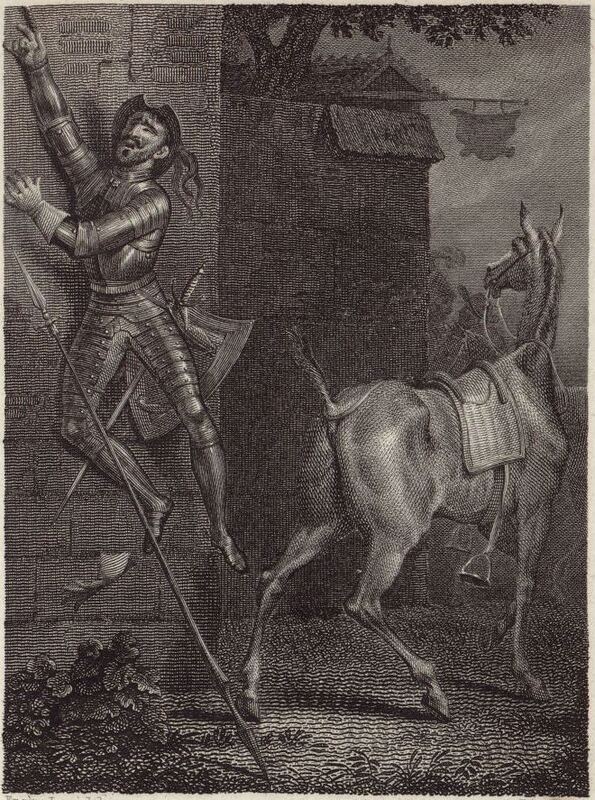
Don Quixote lifted with his horse by the wing of a windmill; flails wildly, broken lance in his right hand and his shield in his left hand. Sancho Panza (right) raises his hands in fear for his master, riding on his donkey. Two workers are shocked as they look up to see Quixote suspended by the wing of the windmill. In the bottom left, a donkey leads a cart of cargo. In the background, two more windmills are turning as per usual.
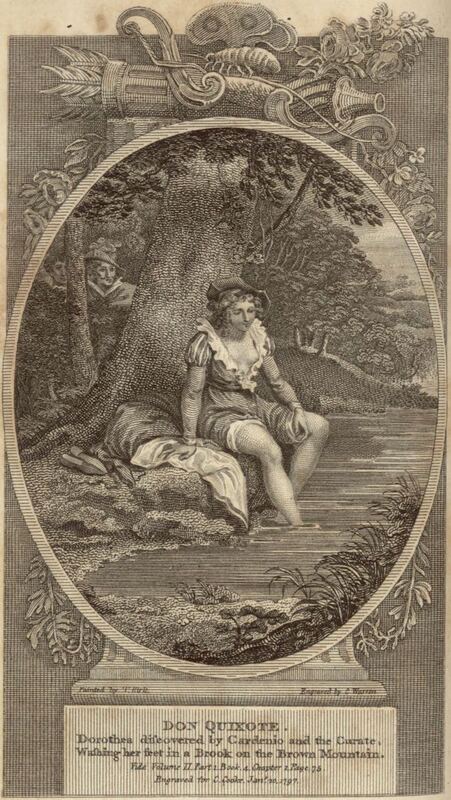
In Sierra Morena, the priest and Cardenio (the barber should appear too), hidden in a bush, watch Dorotea washing her feet in a stream. The illustration is set in a decorative and architectural frame, complete with a bow and quiver with arrows, a butterfly, and flowers. Signed by R. Corbould (illustrator) and C. Warren (engraver), dated 1797. Part 1, ch. 28.
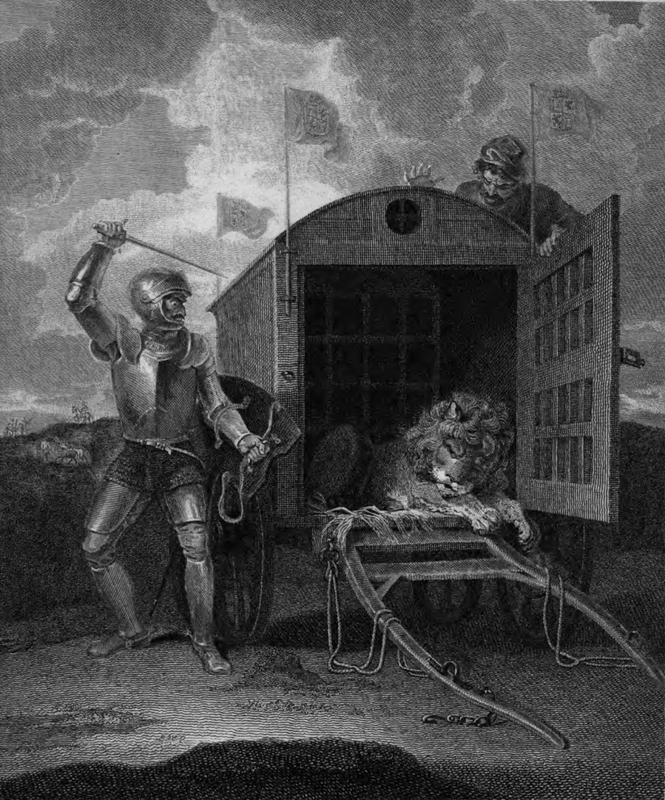
Don Quixote pulls aside a cart flying the flags of the king, and the cart driver explains they are carrying Lions to the King. Quixote, wishing to fight the lion, threatens the Keeper's life. The keeper, seeing Don Quixote fixed in his posture , knew he could not avoid letting loose the lion, without incurring the resentment Quixote's wrath, and opened the door of the cage, where the lion was lying. This lion was both very large and had on it a frightful and illustrious mane. Don Quixote, clad in full armor, observes the lion with fixed attention, his sword high in the air and his shield by his side, impatient to might grapple the lion defeat it. The lion takes no notice of Quixote's challenge and merely lies in the cage lazily.
Having given Sancho Panza governorship of the distant village of Basataria, Sancho says farewell to Don Quixote, the Duke, and the Duchess. In preparation for the journey, Sancho is dressed in a long robe, and wore over his other clothes a white coat or gown of watered camlet, and a cap of the same stuff. Behind him was led his Dapple, bridled and saddled in extravagant silk. Don and Sancho wept and sobbed at their separation despite their otherwise good tidings.
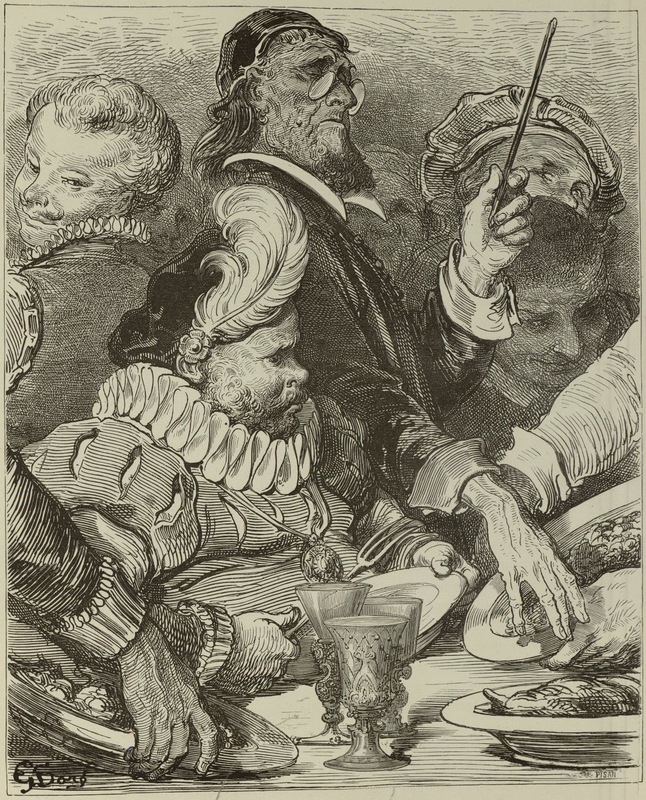
Sancho Panza is taken from the courtroom to a sumptuous palace, where, in a large hall, a royal table is set. Plates of food are placed before Sancho, but at the request of the physician Pedro Recio (background, holding a rod), they are taken away. Signed by G. Doré (illustrator) and H.-J. Pisan (engraver). Part 2, ch. 47.
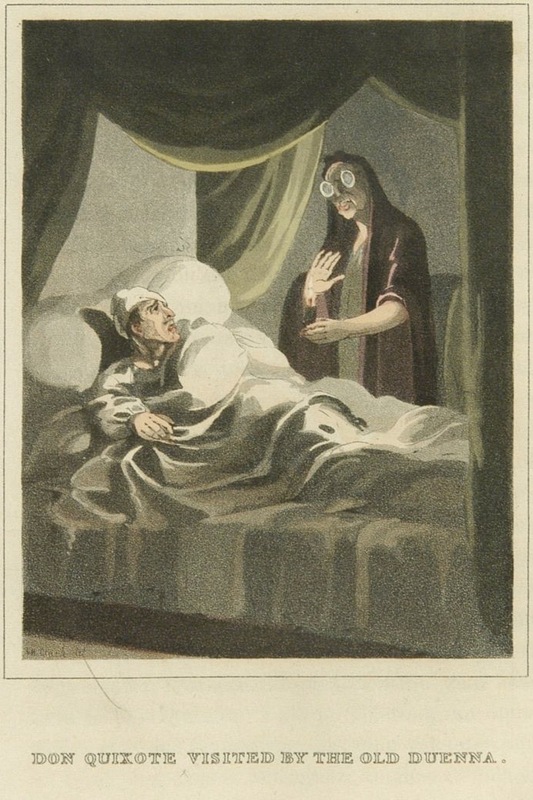
Doña Rodríguez, wearing a pair of spectacles, visits Don Quixote in his room at night. She discovers him in bed, wrapped in his blanket, his face bandaged and marked by the cat’s claws. They scare each other, each believing that the other is a ghost. Unsigned. Part 1, ch. 3.
Two beautiful woman dressed in the attire of shepherdesses present themselves from among the trees. They are wearing corsets of fine brocade, and habits of rich gold lutestring. Their hair hangs loose about their shoulders, and their heads are crowned with garlands of laurel and amaranths. Their age seems to be around seventeen. The image is occasioned by Don Quixote getting caught in hunting nets set for birds.
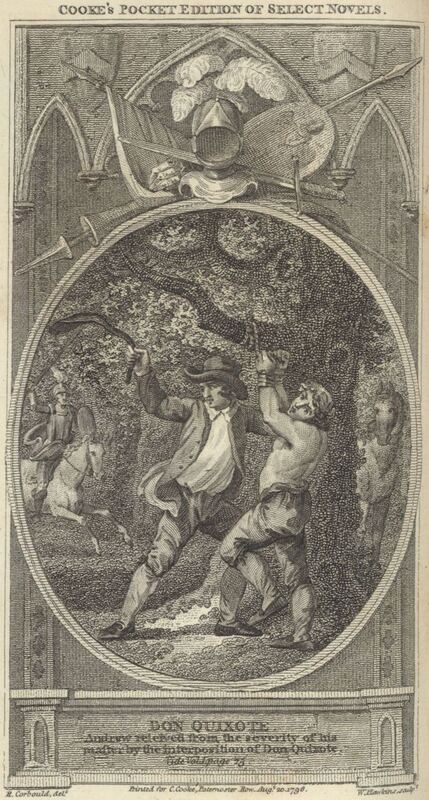
Don Quixote (background), mounted on Rocinante, discovers Juan Haldudo reprimanding and whipping Andrés with a leather strap (foreground). Andrés is pictured tied to an oak tree. Don Quixote aims his lance at Juan and orders him to release Andrés. The illustration is set in a decorative and architectural frame, complete with the errant knight’s arms: lance, sword, helmet, and buckler. Signed by R. Corbould (illustrator) and W. Hawkins (engraver), dated 1796. Part 1, ch. 4.
In the backyard of an inn, the innkeeper (left) raises a sword above his head with both hands to perform the initiation rites of knighthood for Don Quixote (middle), who has mistaken the innkeeper for a king and his inn for a castle. On the left, a boy wearing a cap holds a candle in his left hand and the inn's ledger in his right which they have tricked Quixote into thinking is a holy book of knighthood. Don Quixote, clad in his armor, takes to one knee and prays. On the right two women appear bemused by Quixote's rites of initiation into knighthood.
At their house, Sancho Panza explains to his wife Teresa why he has decided to undertake another sally with Don Quixote. The illustration is detailed and accurate: the hen with chicks, Sanchica in the window, the cat, and the garlic hanging from the rafters. Signed by R. Smirke (illustrator) and J. Mitan (engraver). Part 2, ch. 5.
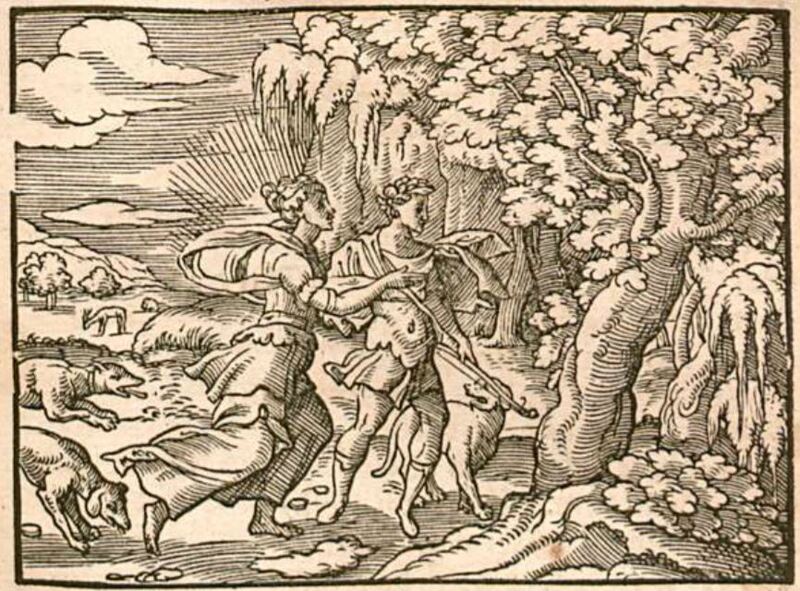
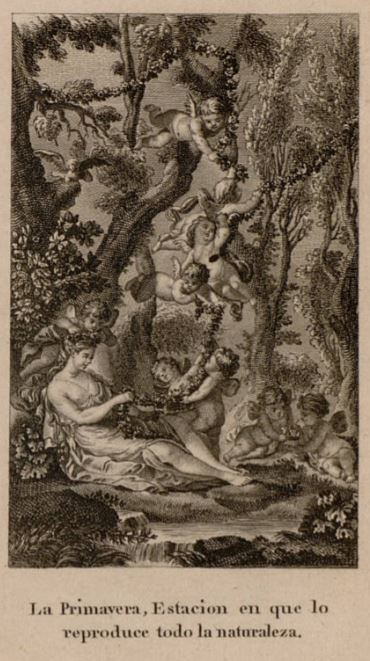
This image represents the eternal spring that was present during the Golden Age of civilization. It represents the earth providing everything that was needed for humans to survive and thrive. Spring was eternal until the Silver Age, when the four seasons were created and Spring was shortened. The image depicts a woman resting against a tree holding a string of foliage that is also being held by many small, winged cherubs. There is a stream flowing in front of where the woman is sitting.
In the foreground, Sancho Panza comes to help Don Quixote and Rocinante, who were thrown by the windmill (background). Signed by D.-N. Chodowiecki (illustrator) and D. Berger (engraver), dated 1779. Plate 2. Part 1, ch. 8.
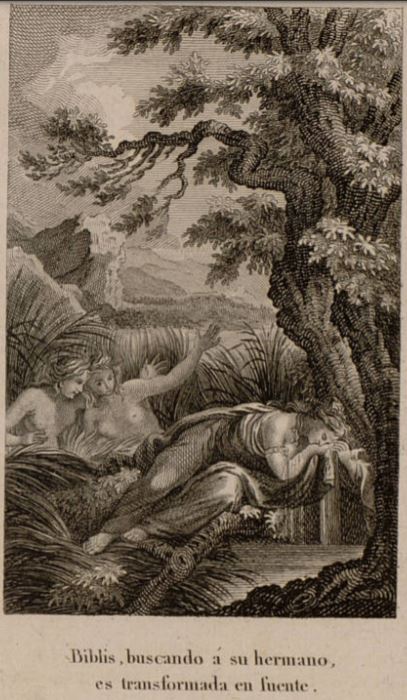
After Byblis confessed her incestuous love for her twin brother Caunus, he fled the country to escape her advances on him. She became so upset by his rejection that she traveled distant lands looking for him. As illustrated in the engraving, there were Lelegeian nymphs who had attempted to comfort Byblis and heal her broken heart. Overcome by grief, there was no end to Byblis’ tears. Her tears were so plentiful that they created a spring. The nymphs ended up transforming Byblis into a fountain to keep the spring flowing, and to help heal the broken-hearted Byblis.
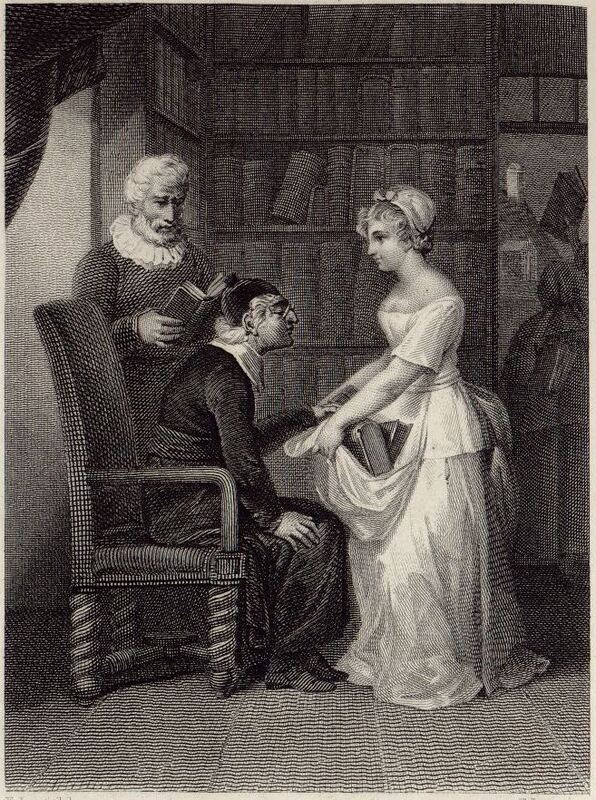
The housekeeper, the priest, the barber, and the niece scrutinise the books in Don Quixote’s library, later deciding to burn them for their responsibility in Don Quixote’s madness. The niece holds a stack of chivalric books while the priest and the barber select the ones that are to be saved. The housekeeper (right) throws books out the window into the courtyard. Signed by E. Lami (illustrator) and E. Lignon (engraver). Part 1, ch. 6.

![[Don Quixote Praises a Peasant Girl as Dulcinea Del Toboso]](https://collections.cemvc.ca/files/large/b0fa567a23a140ca3b6cce233c66eb86c73c8c0e.jpg)
![[A Wolf Ravages a Herd of Cattle]](https://collections.cemvc.ca/files/large/139119adee8a9537073d3589758f47eeb583a84b.jpg)
![[Of How Don Quixote was Lifted by the Windmill Having Mistaken it for a Terrible Giant]](https://collections.cemvc.ca/files/large/f94a71adbcaa857eac0c4db467255efdd10a2fc7.jpg)
![[Two Shepherdesses Emerge from the Forest]]](https://collections.cemvc.ca/files/large/131e131576ba418b791cb0149c9e264824f140b8.jpg)
![[Of How Quixote was Knighted in the Backyard of an Inn that he Mistook for a Castle]](https://collections.cemvc.ca/files/large/4b1caf35ddc26e397d55ee333dd16dc23a2e8cf8.jpg)
![[Adventure of the windmills]](https://collections.cemvc.ca/files/large/78f6da57393ec97d8c777a2d19d97b076fc52ad3.jpg)