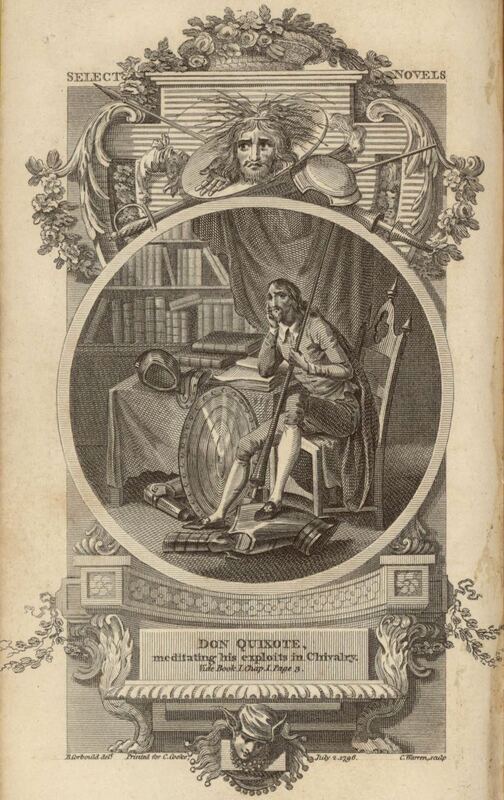
Don Quixote reads chivalric books in his library, slowly descending into madness. His arms and armour are strewn about him. The illustration is set in a decorative and architectural frame, complete with Don Quixote’s head, his lance, his sword, a torch, and the barber’s basin. Signed by R. Corbould (illustrator) and C. Warren (engraver), dated 1796. Part 1, ch. 1.
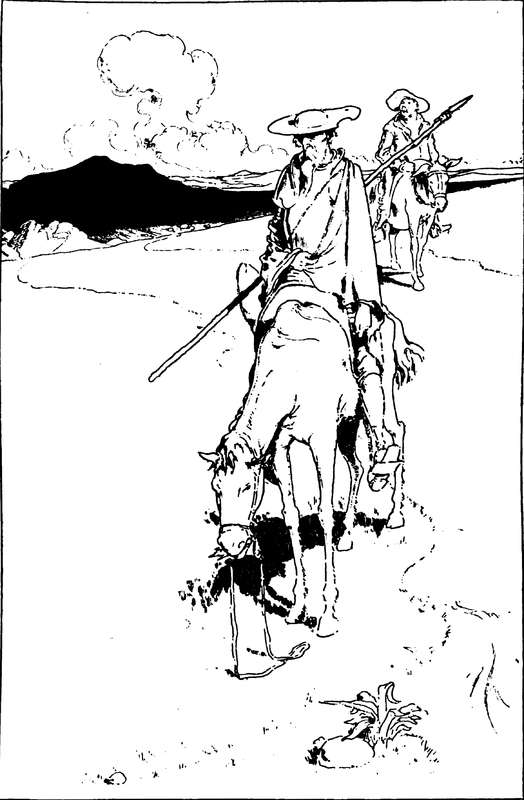
Having visited his lady Dulcinea of Toboso, Don Quixote and Sancho Panza mount their beasts and follow the road to Saragosa to partake in a solemn festival. As they travel Quixote (left) sits pensively on Rocinante, thinking about the trick which he thinks enchanters have played on him, fooling him into thinking a commoner was instead his lady Dulcinea, and how to reverse the ill enchantment. He becomes so engrossed in his thoughts that he lets go of Rocinante's bridle, allowing the horse to leave the path and follow its own whim.
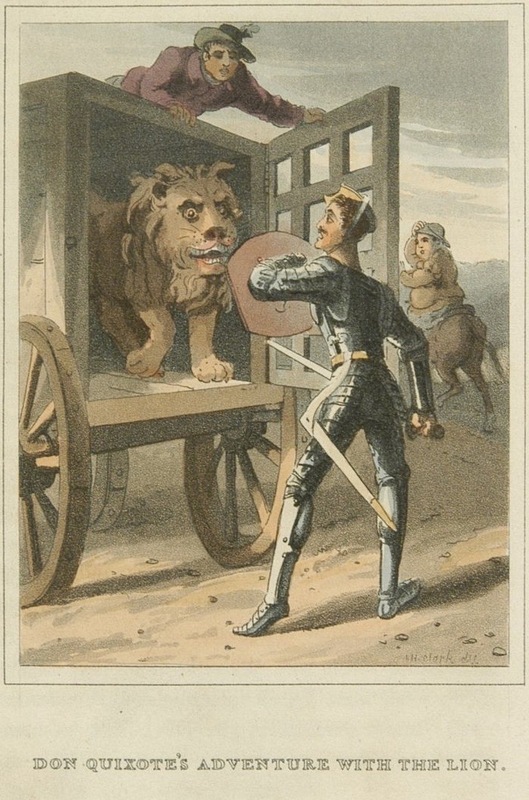
In the background, Sancho Panza runs away (Don Diego de Miranda is not pictured), while in the foreground, Don Quixote prepares to fight the lion as the the lion keeper opens the gate. However, the lion refuses to leave its cage. Don Quixote holds his sword in one hand and his buckler in the other. Unsigned. Part 1, ch. 3.
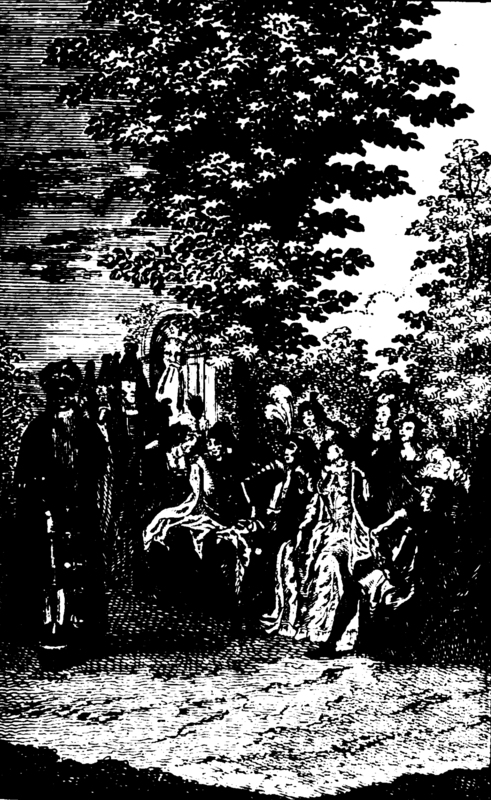
Twelve elderly women enter the garden of the Duke and Duchess, ranked in pairs, clad in large mourning habits over which they wore veils of white calicoe. They are the procession of Trifaldi, the countess of three skirts. Don Quixote (pictured to the right of the Duchess), the Duke (pictured to the left of the Duchess), and the Duchess (pictured in a white dress between Quixote and the Duke) all stood up in response to this procession. Then the twelve women ordered themselves into two rows and made a lane for the countess (pictured walking towards the Duke wearing to crown) to march between them.
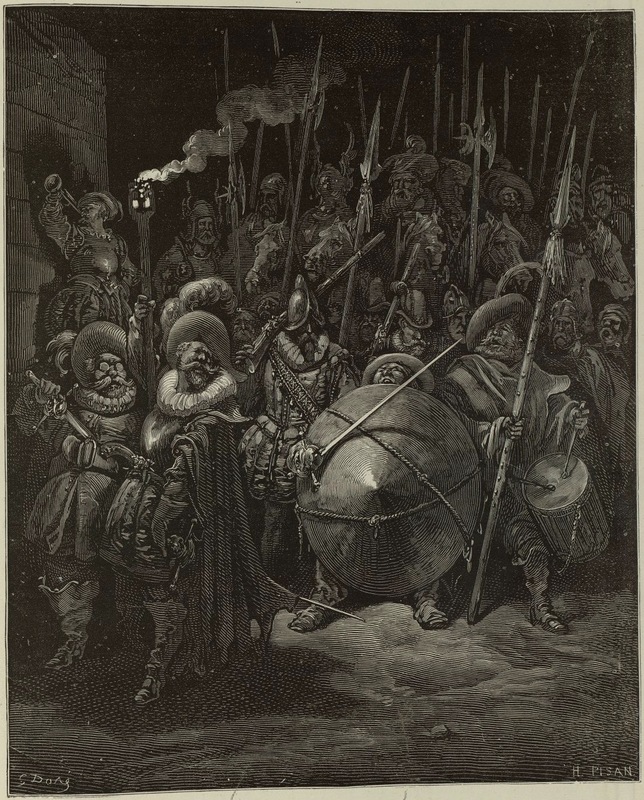
During the invasion of Barataria Island, governor Sancho Panza, is tied between two shields. He is armed and surrounded by soldiers, some of which are on horseback. Signed by G. Doré (illustrator) and H.-J. Pisan (engraver). Part 2, ch. 53.
Sancho Panza (middle) sits on a low stool, his arms resting on his knees, he looks up at the duchess to speak. Five of the duchess's damsels and duennas gatherround about him, in silence, to hear what he will say. The duchess herself sits on a high chair and looks down upon Sancho in a white dress, a feather duster in her right hand which she rests upon her lap. She wears a golden medallion upon her neck.
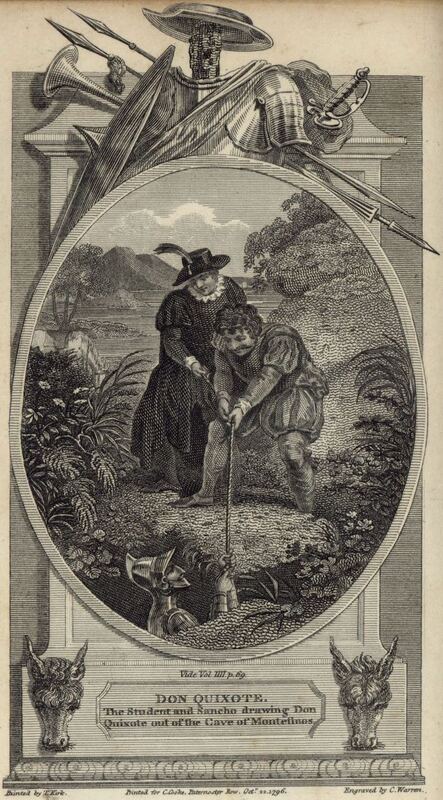
Sancho Panza and the bachelor’s cousin pull Don Quixote out of Montesinos’ cave. His eyes are closed as if he is sleeping. The illustration is set in a decorative and architectural frame, complete with the errant knight’s arms (lance, sword, helmet, and buckler) and donkey heads. Signed by T. Kirk (illustrator) and C. Warren (engraver), dated 1796. Part 2, ch. 22.
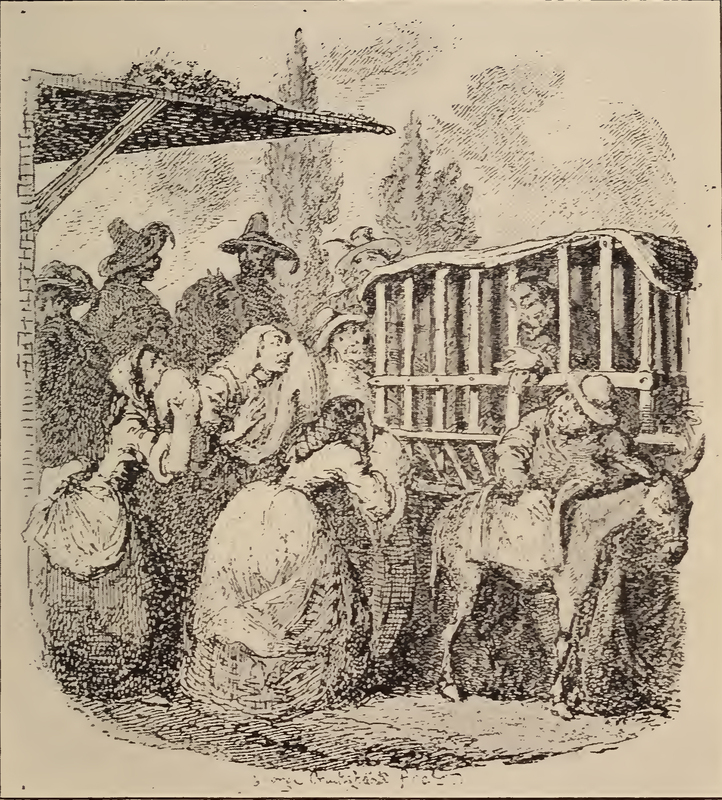
The barber and the priest contrive a plot to bring Don Quixote back to his home in La Mancha by putting him in a cage and bringing him back to his home under the pretense of putting him under an enchantment and reuniting with Dulcinea. Quixote accepts the enchantment and enters the cage willingly. Sancho Panza, skeptical of the reality of the enchantment mounts his donkey and warns his master that he is not enchanted, but Quixote does not listen. As the cart sets in motion the Landlady, her daughter and other guests of the inn rush out to bid Don Quixote farewell, pretending to weep at his departure.
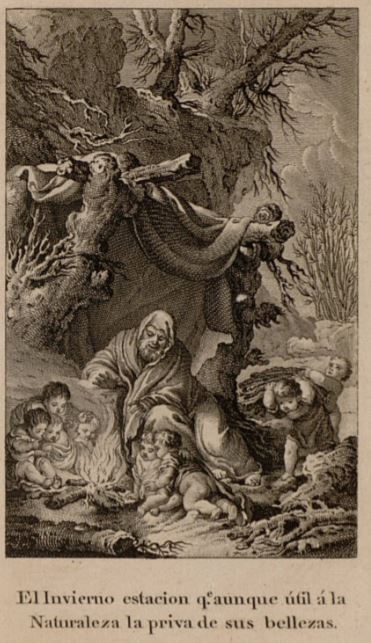
This image represents the season of winter. The Golden Age of civilization had an eternal spring, but the god Jupiter created four seasons in the Silver Age of civilization. This image depicts an old man wrapped in clothing surrounded by many winged cherubs as he holds his hands out towards a fire. They are all sitting close together in front of the fire and sitting under a shelter made of wood and fabric to keep warm from the winter’s cold air. There are two cherubs on the right side of the image carrying firewood.
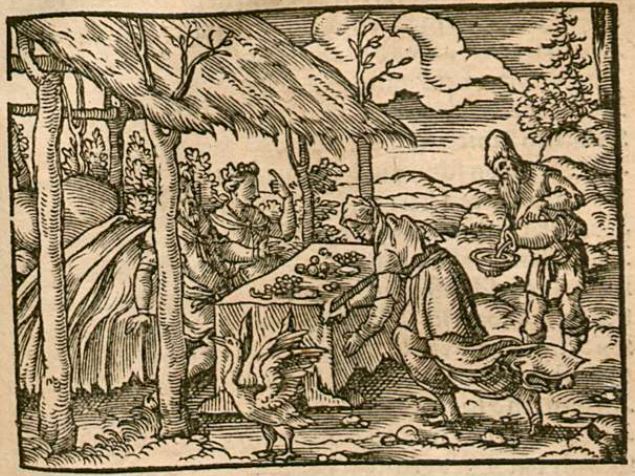
The gods Jupiter and Mercury had disguised themselves as weary travelers and sought hospitality from citizens in a town called Phrygia. Every house that they came upon denied their entry and failed to provide the gods with hospitality, until. an old, humble couple welcomed them graciously into their home. Their names were Baucis and Philemon, and they gave exceptional hospitality to the disguised gods, despite their lack of provisions. The gods are depicted sitting at their table in the engraving while Baucis and Philemon are illustrated pouring wine and setting the table for their guests. There is a goose illustrated in the engraving as well, as Baucis and Philemon were willing to sacrifice it in order to feed their guests. Before they could sacrifice the goose, Jupiter and Mercury revealed their true identities.
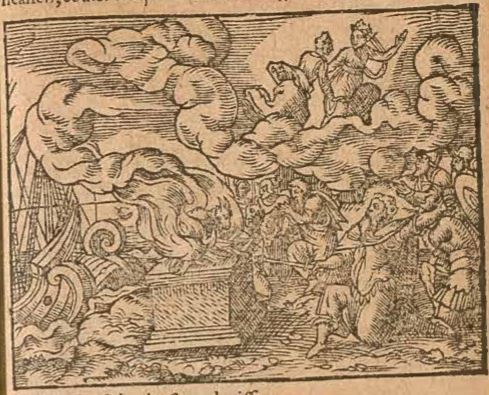
This image illustrates Agamemnon, the king of Mycenae, sacrificing his daughter Iphigenia to the goddess Diana. The Greeks, on their way to Troy, had to stop in the port of Aulis due to a storm. Agamemnon used his daughter as the ultimate sacrifice in the hopes that Diana would subside the storm and offer safe passage to Troy. The storm is illustrated on the left-hand side of the engraving, as there are waves crashing up against the shore and on the ships. Before burning Iphigenia alive, Diana saves her and replaces her with a female deer. The female deer is visible in the center of the engraving, laying on the stone table with the flames engulfing her. The Greeks are depicted surrounding and watching the sacrifice as smoke fills the air. Diana and Iphigenia are illustrated at the top of the engraving, with Diana looking towards Iphigenia as she points her towards safety.
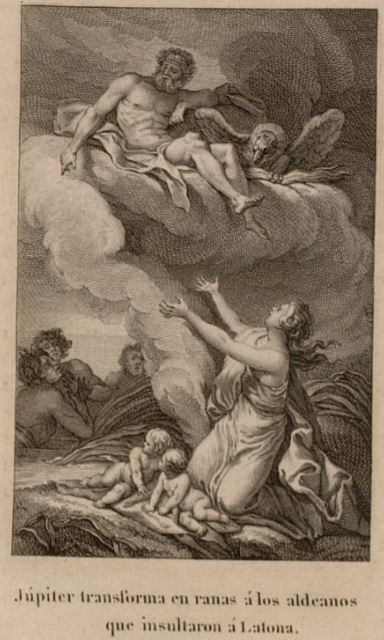
The goddess Latona had fled to escape the jealous wrath of Juno for having given birth to children born of Jupiter. Along her journey, she came upon a river in Lycia and attempted to quench her and her children’s thirst with the river’s water. Villagers from Lycia, however, denied Latona access to the water. Angered by their actions, Latona transformed the villagers into frogs. This image depicts the god Jupiter in a bed of clouds above the scene and he appears to be the one transforming them into frogs. The story that Ovid describes, however, suggests it is in fact Latona who transforms them. Latona’s children, Apollo and Diana, are depicted as babies resting by Latona’s legs.
Don Quixote (left), clad in armor, sits at a table with Sancho Panza (right) and discuss the way to govern properly. Quixote stretches his legs and rests his left elbow on the table to make a point with a pointed finger, his right hand on his waist. Meanwhile, Sancho rests his head on his right hand and listens to Quixote's advice.
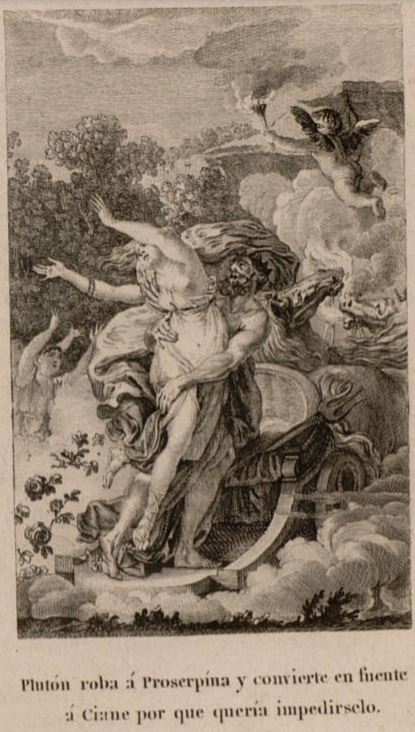
This image depicts the abduction of Proserpina. Pluto, the god of the Underworld, had been shot by one of Cupid’s arrows which made him fall in love with the first woman he saw. The first woman he saw was Proserpina, the daughter of the goddess Ceres. Pluto is depicted stealing Proserpina in this image and taking her back to the Underworld with him on his chariot. The figure on the right side of the image is the fountain nymph named Cyane. Cyane tried to stop Pluto from abducting Proserpina, which is illustrated in this engraving as she is reaching out towards Proserpina. Pluto uses Cyane’s fountain to create a passageway to escape down to the Underworld.
Don Quixote performs mad acts of penance while Sancho Panza, mounted on Rocinante, observes him. Sancho Panza leaves for El Toboso to deliver Don Quixote’s letter to Dulcinea. In the foreground, Don Quixote’s arms and the barber’s basin (Mambrino’s helmet) are pictured. Plate no. 17, signed by J. Vanderbank (illustrator) and G. van der Gucht (engraver). Vol. 1, book 3, ch. 11.
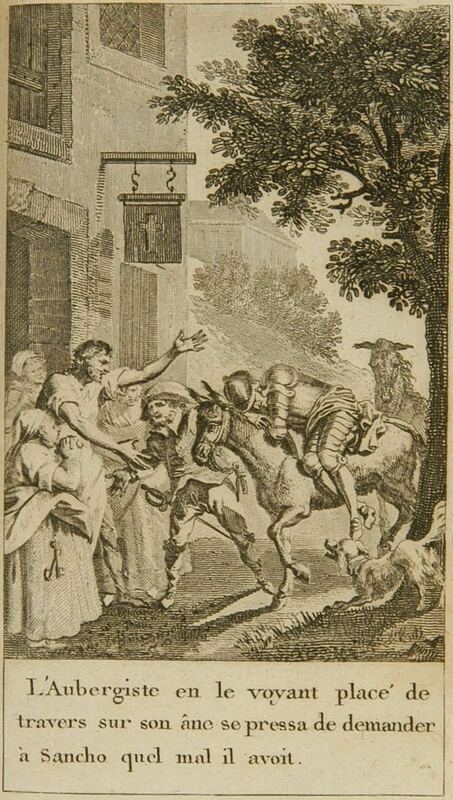
After their encounter with the Yanguesans, Sancho Panza settles Don Quixote on his donkey and leads it and Rocinante by their halters to a nearby inn. The innkeeper, his wife, his daughter, and Maritornes are pictured greeting them. Unsigned. Part 1, ch. 16.
Don Quixote sits at the head of an extravagant table full of morsels and drink with his arms crossed and his legs splayed to his right displaying his patterned leggings. The ecclesiastic seated against him, dressed in religious robes, extends his left hand parallel to the ground in argumentation. The the duke and duchess are also seated on the other side of the table in very tall chairs. In the background on the right, a servant delivers a tray of food.
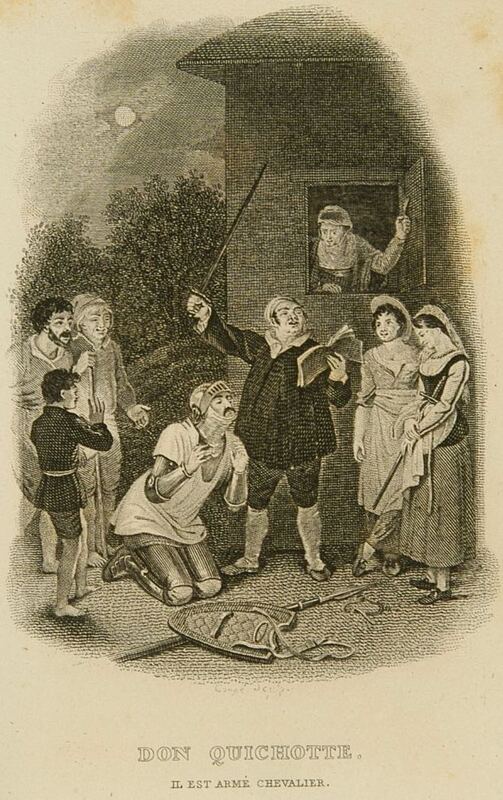
Don Quixote, kneeling and wearing his helmet, is knighted by the innkeeper, who holds a sword and a book. Doña Tolosa, holding Don Quixote’s sword, and Doña Molinera stand to the right. A crowd gathers to watch the spectacle, including a boy holding a candle to light the scene. Signed by A.-J.-B. Coupé (engraver). Part 1, ch. 3.
A four-wheeled cage is drawn by two mules, on top of the cage, two royal banners fly on the back two corners and one large flag flies front and center. Two men steer the cage, the one on the left carries a whip while the one on the right sits idly. Although not pictured, this is the cage that carries the lion that Quixote seeks to slay.
A dozen beautiful damsels between the ages fourteen and eighteen years old dance. They were all clad in light green cloth, with their hair blonde, plaited and loose; and in their hair they wore garlands of jessamine, roses and woodbine that they swung in dance. In the middle, a venerable old man in dark robes and an ancient matron in an ostentatious gown. A clarinet of Zamora was played on the right by a nimble young man dressed as a nymph.
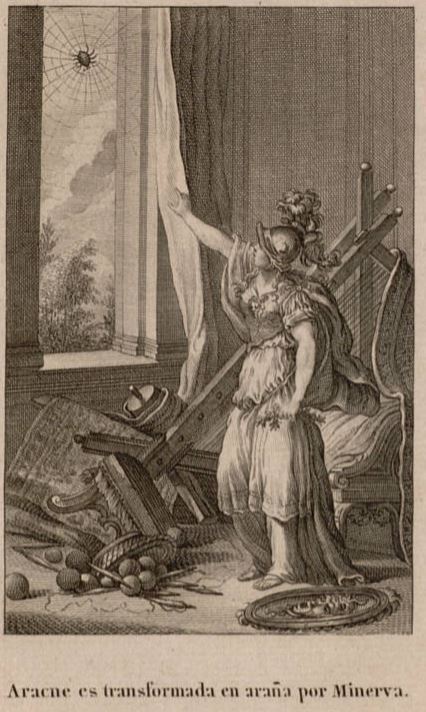
This image depicts the goddess Minerva transforming Arachne, a skilled weaver, into a spider. Arachne is depicted in the top left corner in her transformed state as a spider sitting in a web. There is a loom knocked over behind Minerva. Arachne had claimed she was a better weaver and spinner than the goddess Minerva. Minerva, angered by this hubris, challenged Arachne to a weaving contest. After Minerva had won the contest, she transformed Arachne into the spider as a punishment.
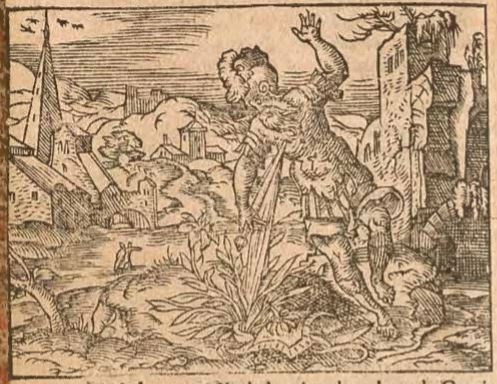
This engraving illustrates Ajax killing himself after finding out that he lost a debate to Ulysses. The prize of the debate was the armor and weapons of the great Achilles. Ajax, despite being Achilles cousin, lost the debate and therefore lost the right to take the armor. After hearing that Ulysses won, Ajax took his sword and stabbed himself with it. The blood that is illustrated pouring out of Ajax sprouts a flower as it hits the ground. The blood transforms into a hyacinth flower, as depicted in the engraving.
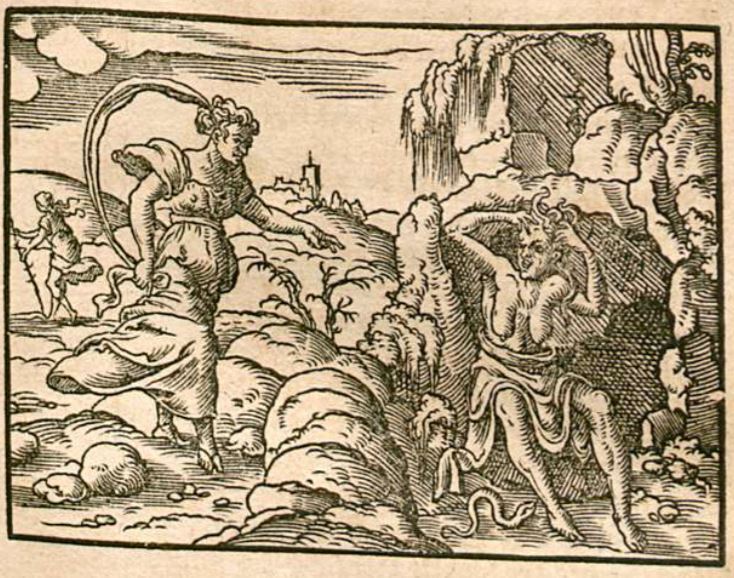
This engraving illustrates the goddess Minerva on the left side of the image with the personified character of Envy on the right. Minerva has come to the cave of Envy to seek her help in poisoning Aglauros. Aglauros was a woman from Athens who had betrayed Minverva in the past and made a pact with the god Mercury in order to receive riches from him. The greed and betrayal of Aglauros angers Minerva enough to want to poison her.
Don Quixote dines at the inn with the innkeeper, Doña Molinera, and Doña Tolosa. They are seated at a table at the door of the inn to take advantage of the cooler air. The innkeeper helps Don Quixote drink wine with a hollow reed through his helmet. Signed by A.-J.-B. Coupé (engraver). Part 1, ch. 2.
Don Quixote's helmet lies on the ground, it is filled with curds. The image is occasioned by Quixote asking for Sancho to bring him his helmet while the squire is in the midst of buying some curds. Knowing not what to do with the curds now that they were paid for, he decided to pour them into his master's helmet.

![[Sancho Sits Before the Duchess]](https://collections.cemvc.ca/files/large/639d675cee5205330231600088fd84a044639d50.jpg)
![[Don Quixote Explains How Sancho Must Govern]](https://collections.cemvc.ca/files/large/7d6588ae9985a89786ddf1f55f6f01e10f5884b3.jpg)
![[Don Quixote performs mad acts of penance]](https://collections.cemvc.ca/files/large/6ac297b4118a2fff581c3dad9d023336fc8eb23a.jpg)
![[Of How Don Quixote Argued With the Ecclesiastic]](https://collections.cemvc.ca/files/large/aa9c2448d7c3685a1a933f445b10d3ec3ef42d69.jpg)
![[The Cart of the Lions]](https://collections.cemvc.ca/files/large/c819c6bb1432641e8dfb00a17c5d7c96d1a0c643.jpg)
![[Of the Maiden's Dance at Quiteria's Wedding]](https://collections.cemvc.ca/files/large/e105867f51363c9d862ee2bfdcd09d0756b03b3d.jpg)

![[Quixote's Helmet Filled With Curds]](https://collections.cemvc.ca/files/large/5b2a056f4934d40045158f05225c801d8ebb66cc.jpg)