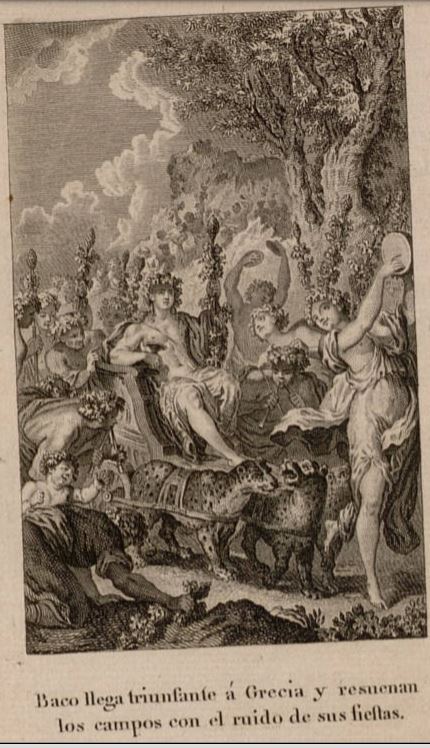
This image depicts the worship of the god of wine, Bacchus. Bacchus is depicted sitting in a chariot that is being pulled by leopards. He is holding a goblet of wine as he watches the festivities surrounding him. There are people playing musical instruments and dancing and some people are depicted bowing to the god as they worship him.
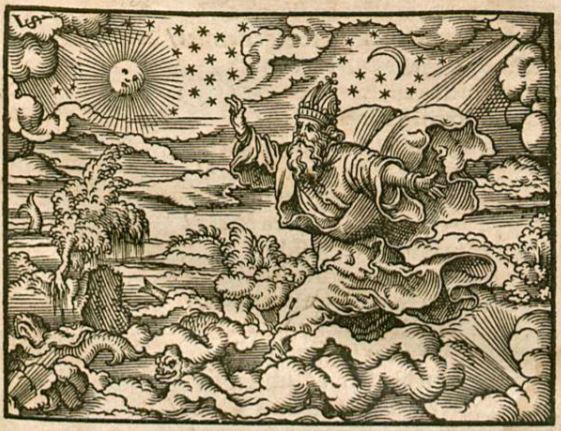
This illustration depicts a god of an unknown name, surrounded by disorder. Ovid describes that the origins of the world were chaotic, unorganized, and all things were unstable. The image shows a god fixing the chaos and separating all the elements into stability. His right hand appears to be creating separation between day and night, where the sun is on the left top side of the image, and the moon on the right, with clouds in between them. The rest of the image is difficult to interpret which symbolizes the chaos in which Ovid describes.
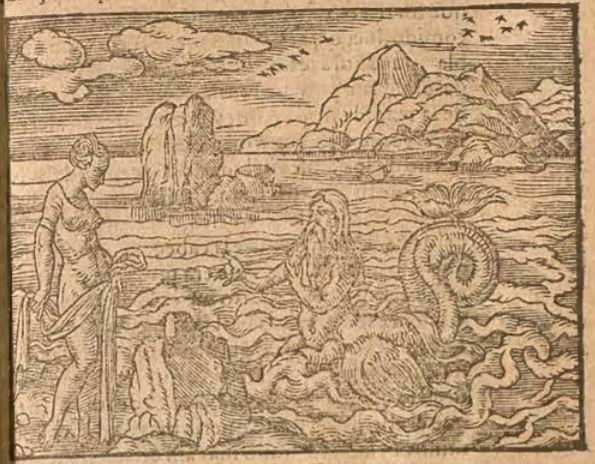
After getting murdered by the cyclops Polyphemus, Acis had been transformed into a river-god by his lover, a Nereid named Galatea. Polyphemus had killed Acis in a jealous rage and crushed him with a boulder. The blood that poured out from Acis’ body had been turned into a river, and Acis became the god of that river. Galatea is illustrated on the bank of the river looking at Acis in his newly transformed state as a river-god. Acis is depicted with his arms reaching toward Galatea in an appreciative and longing manner.
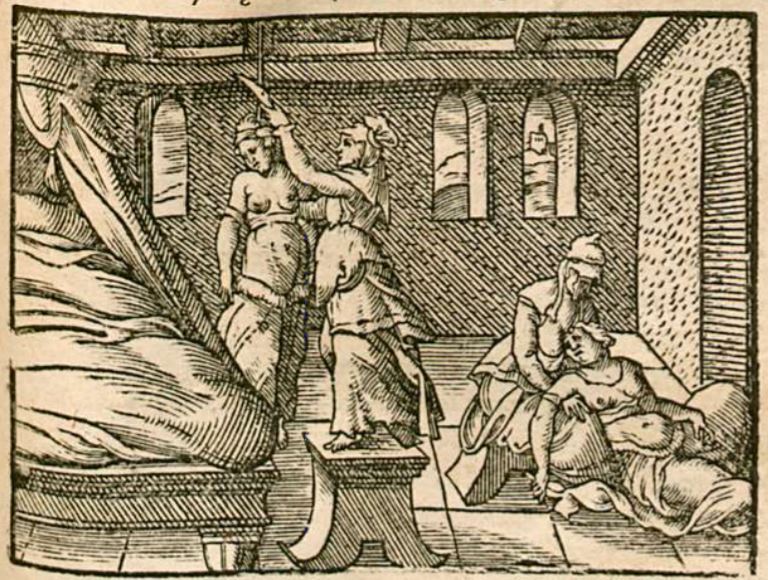
This engraving illustrates a young girl named Myrrha attempting to kill herself by hanging. She does this due to her sinful thoughts of lusting over her father. Myrrha understood that her thoughts were wrong, so she decided to kill herself to evade her incestuous feelings. Myrrha’s nurse came into the room as she heard moaning, and she cut her from the constricting rope when she saw Myrrha hanging. The nurse is also illustrated holding Myrrha on the ground after she cuts her free. The nurse comforts Myrrha and inquires as to why she tried to kill herself. Reluctantly, Myrrha eventually shares her incestuous thoughts with her loyal nurse, who had promised to help her.
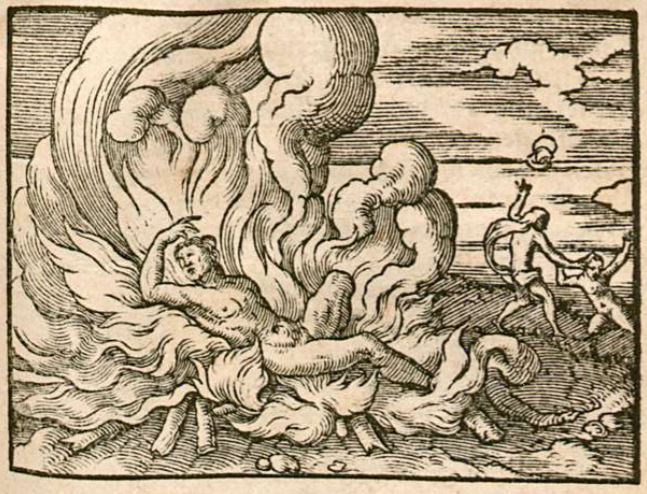
When Hercules had shot the centaur Nessus with a poisoned arrow, Nessus gave his blood-stained shirt to Hercules’ wife, Deianira. Nessus told Deianira that the shirt would act as an aphrodisiac if Hercules were to ever become unfaithful to her. The time came when Deianira was questioning Hercules’ fidelity to her, so she gifted him the shirt of Nessus. The shirt, however, was not an aphrodisiac. The shirt burst into flames when Hercules put the shirt on, and there was nothing he could do to stop it. In the background of the engraving, Hercules is illustrated throwing a man named Lichas into the water out of anger and pain he was feeling. Hercules decided to accept his fate and he made himself a funeral pyre. He is illustrated in the forefront of the engraving laying on the pyre accepting his death.
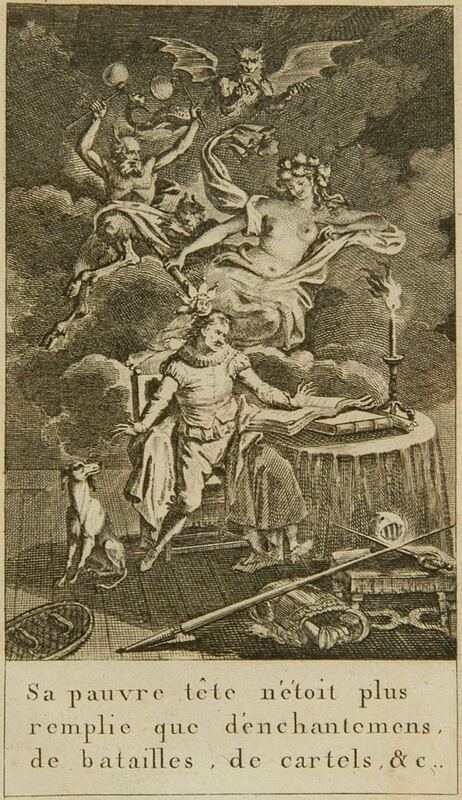
While Don Quixote reads chivalric novels, his library fills with devils, monsters and allegorical figures. The illustration masterfully combines reality (Don Quixote reading in his library), fantasy (adventures, monsters, and all other figments of his imagination), and allegory. Anecdotal detail from Cervantes’ text: skinny greyhound at Don Quixote’s feet and the errant knight’s arms, strewn about on the floor in the foreground. Unsigned. Part 1, ch. 1.
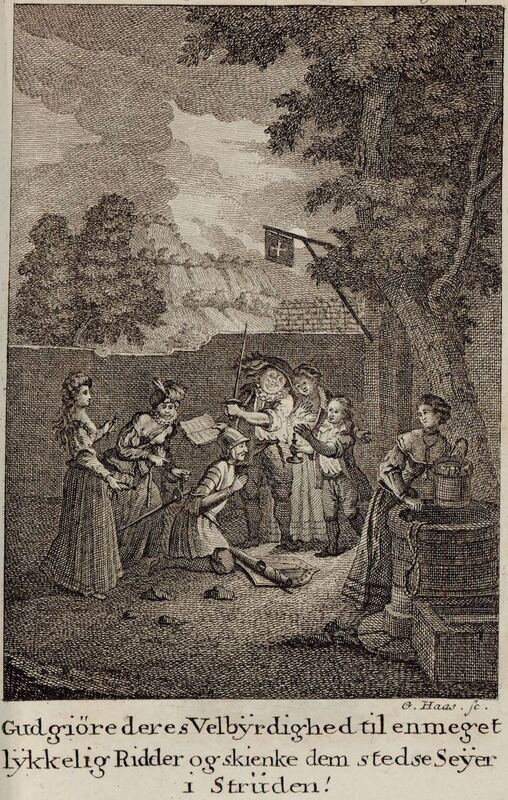
In the centre of the composition, the innkeeper knights Don Quixote, who kneels before him. The knight wears his armour and his helmet. Doña Molinera holds his sword and Doña Tolosa holds his spurs (left). A boy holding a candle (right) is also pictured. Two other women, who do not appear in Cervantes’ text, watch the proceedings. The scene is accurately depicted at night: the characters are illuminated by the light of the boy’s candle and that of the moon, partially obscured by clouds. Signed by J.-J.-G. Haas (engraver). Part 1, ch. 3.
Don Quixote, hung by his hand tied to the window of the inn, stands on Rocinante while Maritornes and the innkeeper’s daughter observe him from the courtyard. The illustration is not an accurate representation: in the text, Maritornes and the innkeeper’s daughter watch from the window before leaving him. Plate no. 24, signed by J. Vanderbank (illustrator) and G. van der Gucht (engraver). Vol. 1, book 4, ch. 16.
Having been invited to Don Diego's house, Don Quixote, clad in full armor, enters and see's four earthen wine-jars of a Toboso variety. Seeing these Tobosan jars renews Quixote's memory of his enchanted and metamorphosed Dulcinea causing him to extend his hands to the jars and cry aloud that the jars remind him of Dulcinea. In the background on the left a donkey, horse can be seen in the background, with Sancho behind them all.
Don Quixote, mounted upon a horse, charges at a windmill with the intention of felling it with a lance. In his left hand he carries a shield and is clad in full armour with a helmet covering his face. There are three windmills in total and Quixote is charging the one closest to the foreground. In the mid-ground, Sancho Panza can be seen praying alongside his donkey. In the background a horse drawn carriage proceeds down a path.
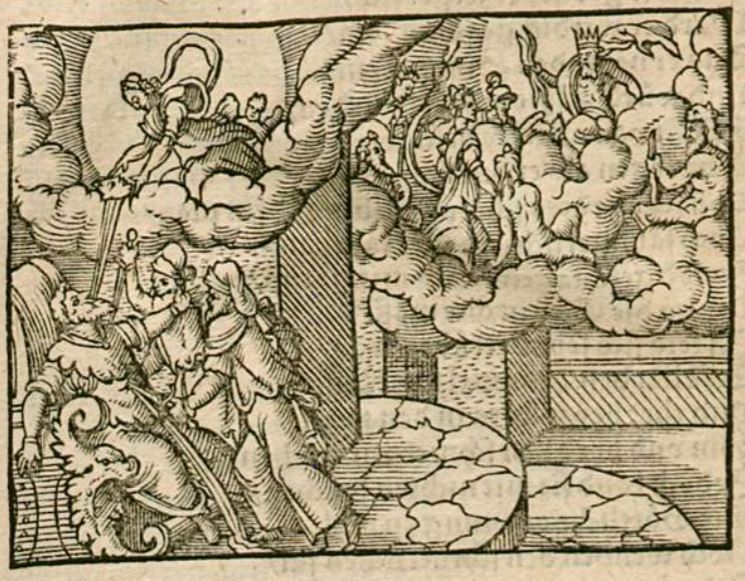
The top right corner of the engraving illustrates many gods sitting on a cloud looking at Jupiter who is wearing a crown and holding thunder bolts. Venus begs Jupiter to stop the assassination of Julius Caesar before it happens. Jupiter, however, explains that there is nothing Venus can do to stop the fates from ending Caesar’s life. The left side of the engraving depicts the assassination of Julius Caesar. Venus is illustrated in a cloud above Caesar with her hands reaching towards him as she transforms him into a star and deifies him once he is dead. Cupid, Venus’ winged son, is depicted directly behind her on the cloud.
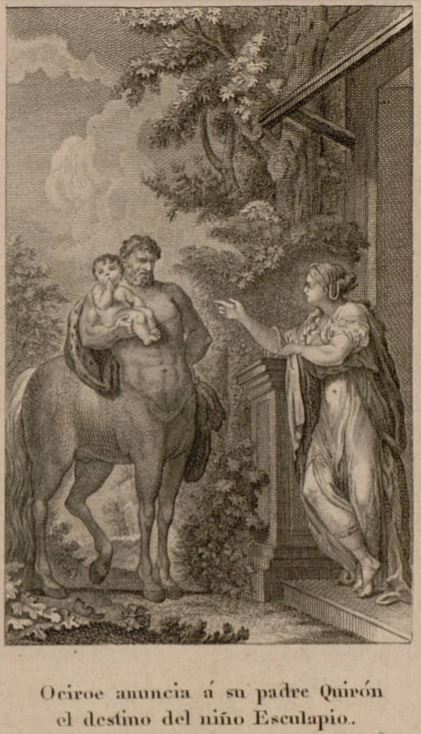
The centaur named Chiron is illustrated on the left side of the image holding a young child named Aesculapius in his arm. Chiron had agreed to look after Aesculapius after his mother had gotten shot by the boy’s father, the god Apollo. Chiron is depicted standing in front of his daughter Ocyrhoë. Ocyrhoë makes a prophecy and she is explaining to her father that Aesculapius will grow up to have great healing powers.
Hersilia, the wife of Romulus, is depicted on the left-hand side of the engraving with a crown on her head, running towards the goddess illustrated in the sky. Hersilia, as described by Ovid, had been upset as Romulus had been deified and had to leave her behind. The goddess Juno had pitied Hersilia, and sent her messenger, Iris, to send word to Hersilia that she may join her husband and become a goddess herself. Iris is illustrated on the cloud with her hand reaching down towards Hersilia.
This engraving illustrates Polyxena, the daughter of King Priam of Troy, seconds away from being sacrificed. King Agamemnon, illustrated on the right-hand side of the engraving with a crown on his head, was confronted by the ghost of Achilles who demanded a sacrifice in his honour. Agamemnon chose Polyxena as the sacrifice. Polyxena is illustrated on a table with her hands in front of her, in a bodily position that looks as though she is accepting her fate. She accepts her fate as a noble woman, rather than being forcefully sacrificed as a slave. She asks the soldiers to give her body back to her mother so she can grieve for her. The soldiers who are onlookers to the sacrifice are depicted with their heads facing down, as Polyxena’s words had moved them and they feel pity for her. The man who holds the sword is Neoptolemus, who also pities the young girl and regretfully sacrifices her.
Having recovered from their embarrassing tumbles, Sancho (middle) and Quixote (right) have adjusted and mounted their saddles, Sancho upon his donkey and Quixote, clad in armor and equipped with a spear upon his spindly horse Rocinante. On the left the duke rides by Sancho's side upon a very fine horse, and the duchess rides between Sancho and Quixote with her legs draped over the left flank of the horse. Sancho makes forth in conversation with the duchess from his low vantage, to the great satisfaction of the duke and duchess, who looked upon it as an entertainment.
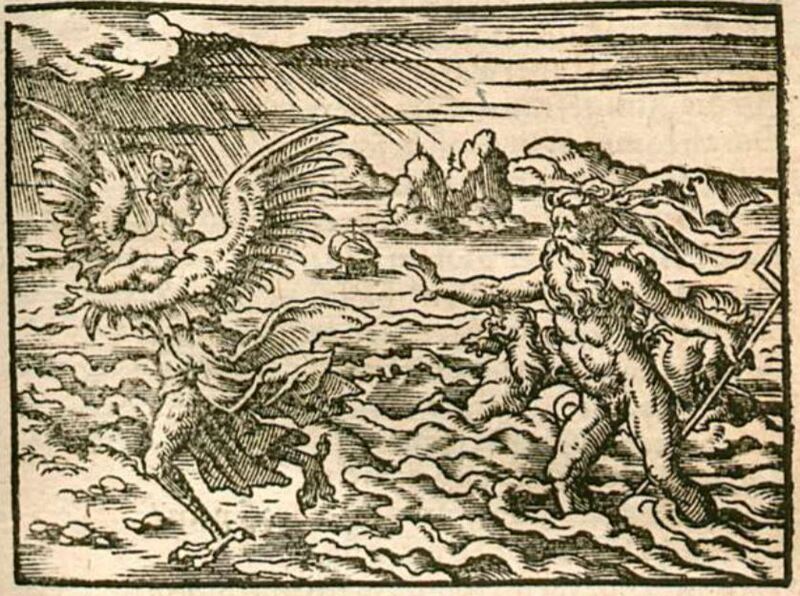
This engraving illustrates the god of the Sea, Neptune, chasing a woman on the seashore. The woman is a princess from Phocis named Coronis. The god spotted Coronis and instantly became infatuated with her, and she resisted. As the God chased Coronis, she prayed to the virgin goddess Minerva for help to save her from her pursuer. Minerva aided Coronis by transforming her into a crow. This is illustrated in the engraving as Coronis’ skin is turning to feathers, her arms to wings and her feet into claws. After Coronis fully transforms into the crow, she becomes a servant to the goddess Minerva. Neptune is depicted emerging from the water with his hand stretched out towards Coronis. He has a shocked expression as he watches her transform into the crow.
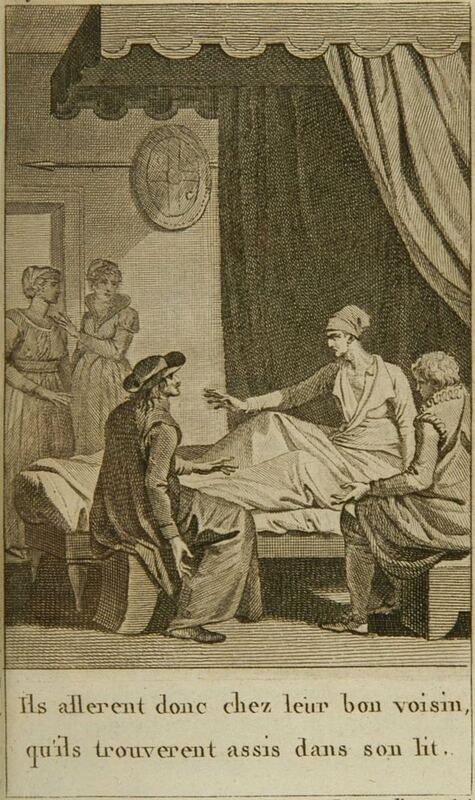
The priest and the barber visit Don Quixote to see his improvement, having heard from the niece and the housekeeper that he is giving signs of being in his right mind. Signed by J.-J.-F. Le Barbier (illustrator) and L.-M. Halbou (engraver). Part 2, ch. 1.
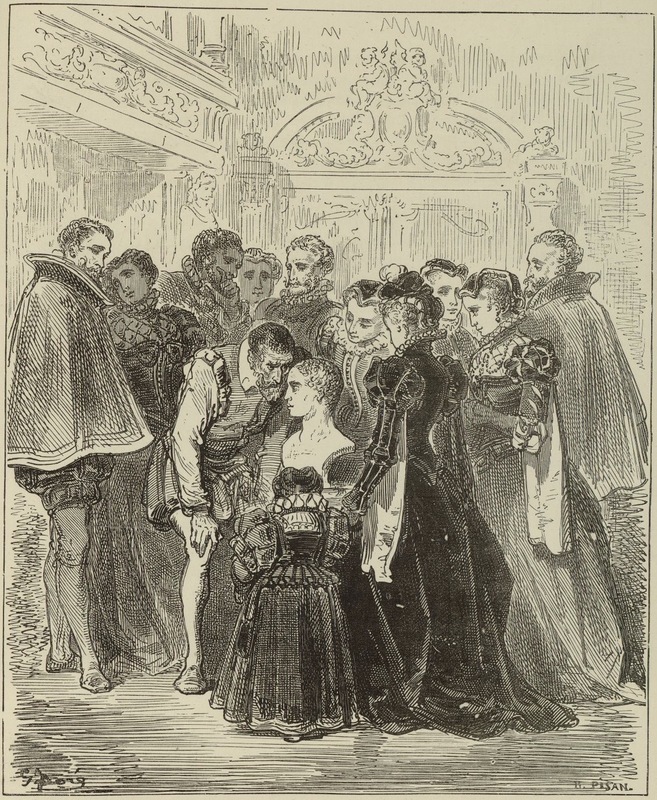
Don Antonio Moreno leads Don Quixote to a side room, where there is a table of jasper on a base of the same material. On it is a bronze bust made in the fashion of Roman emperors. While his friends and Sancho Panza gather in the room, Don Antonio tells Don Quixote that the enchanted head has the property and virtue of responding to any question spoken in its ear. Signed by G. Doré (illustrator) and H.-J. Pisan (engraver). Part 2, ch. 62.
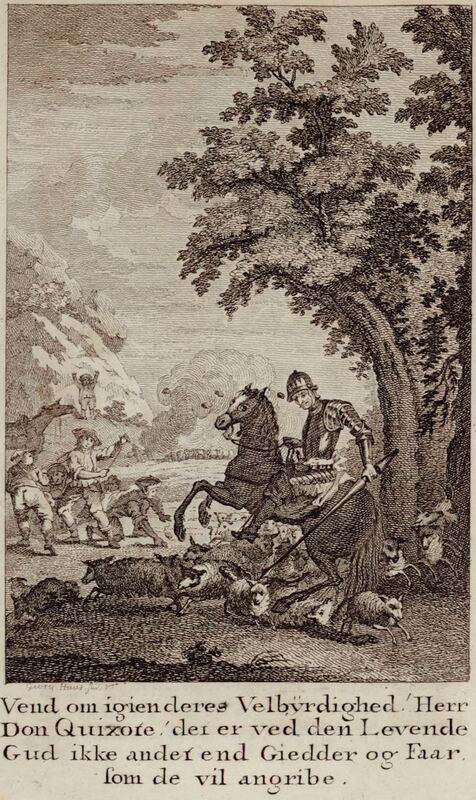
Despite Sancho Panza’s warning (he is pictured gesticulating in the background), Don Quixote charges a flock of sheep. He is mounted on Rocinante and holds his lance. In the background, the shepherds are depicted preparing their slings to throw stones at the knight. Signed by J.-J.-G. Haas (engraver). Part 1, ch. 18.
While Don Quixote speaks, one of the officers of the holy brotherhood (right) consults a description of Don Quixote to identify him. The judge, Juan Pérez de Viedma, and the priest stand between them. Plate no. 26, signed by J. Vanderbank (illustrator) and G. van der Gucht (engraver). Vol. 1, book 4, ch. 18.
This engraving depicts Scylla, surrounded by her nymph friends, combing the hair of Galatea. As Scylla combs Galatea’s hair, she discusses her love life and how she is always sought out by men. Galatea is depicted kneeling by the water with her hand to her face, as she is crying due to her own unfortunate love life. Galatea explains that she was once in love with a man named Acis, however, he was killed by a cyclops named Polyphemus.
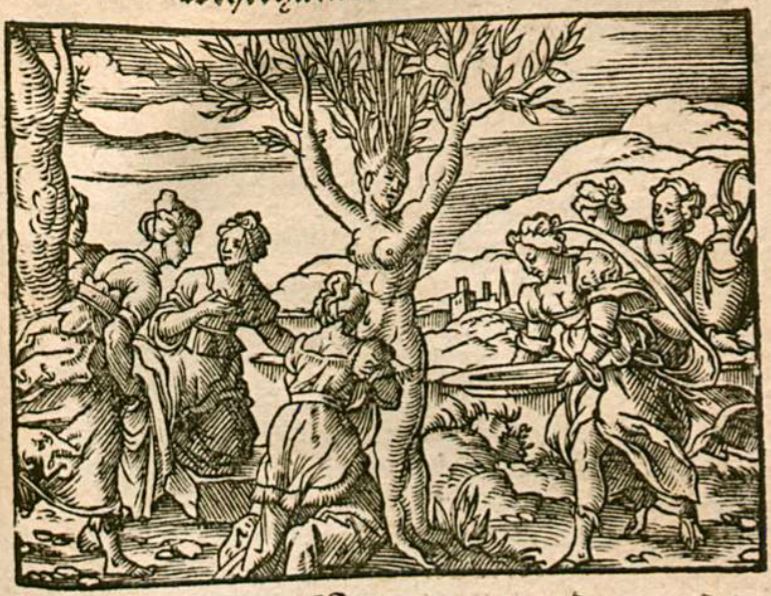
This engraving illustrates Myrrha transforming into a tree. She had asked the gods for a punishment for her actions of engaging in incestuous affairs with her father and getting pregnant. Her wish was granted, and she transformed into a tree. Her tears turned to sap, and that is how the word myrrh came about. The baby that was in her womb continued to grow even after she turned into a tree. One day, Myrrha’s bark split open and the goddess Lucina and Naiads came to the child’s aid and pulled him from the tree. They are depicted in the engraving surrounding Myrrha in her transformed state.
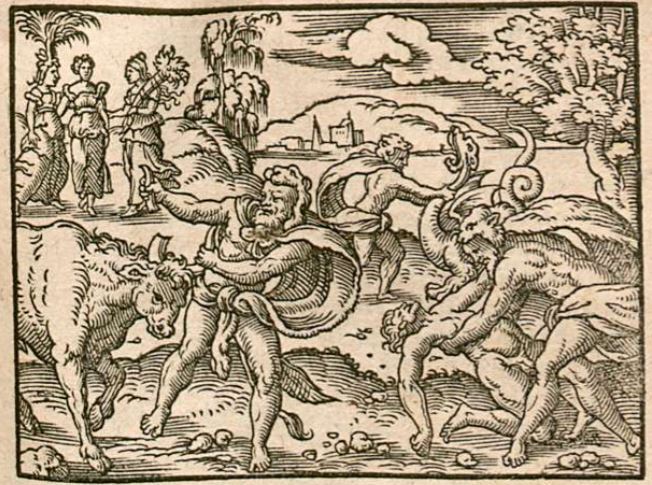
This engraving illustrates the wrestling match between Hercules and the river god, Achelous. Hercules and Achelous were both interested in marrying a woman named Deianira, and this caused a rivalry between the two. Hercules believed he should marry her because he is the son of Zeus. Achelous believed he should marry her because he was a native to that land and not a foreigner, like Hercules. Hercules and Achelous began to physically fight for the right to marry Deianira. There are three fighting scenes in the engraving, one where Achelous is in his human form, one where he transforms into a serpent, and one where is in the form of a bull. When Achelous transforms into a bull, Hercules rips off one of his horns and wins the battle. There are three women illustrated in the background of the engraving, one of them is assumed to be Deianira.
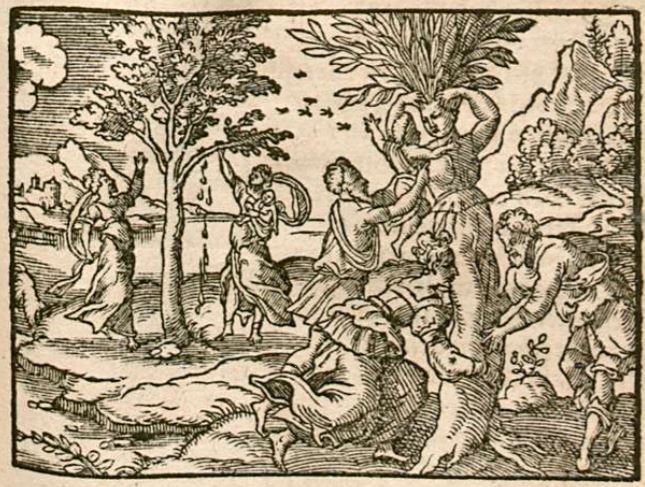
This image illustrates the tragic fate of Dryope being transformed into a tree. The background of the illustration depicts Dryope and her half-sister, Iole, picking flowers from a tree. Dryope is the figure that is holding a child in her arms. Dryope was the first to pick a flower, when suddenly, blood began pouring out of the tree. The tree was in fact a nymph in the form of a tree, and to punish Dryope for picking flowers off her body, she transforms Dryope into a tree as well. Dryope is depicted in the forefront of the illustration with her body in mid-transformation, with her arms and legs already changed. Iole is illustrated clinging onto her sister’s legs to try preventing the transformation. Her husband, Andraemon, and her father, Eurytus, are illustrated in the engraving as well. Her husband is holding up their child to kiss her lips one last time.
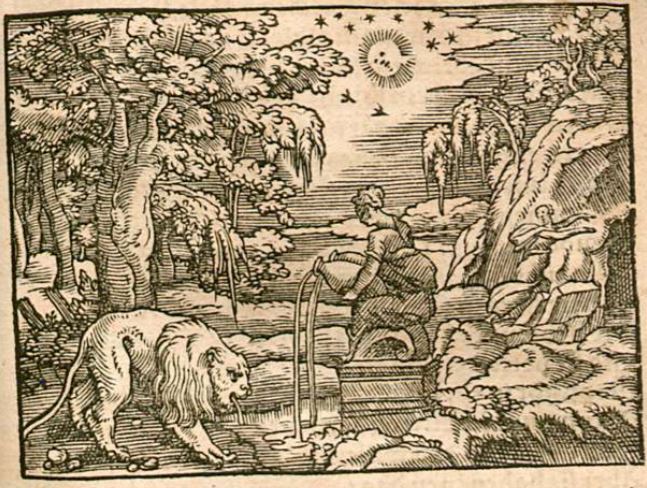
This engraving illustrates a story that is being told by one of the daughters of King Minyas in order to pass the time during a festival. The story being told is that of Pyramus and Thisbe, two lovers that share a tragic fate. Pyramus and Thisbe were star crossed lovers who tried to run away from their homes in order to be with each other. The pair had arranged to meet in the forest and while Thisbe was on her way to meet Pyramus, she had a close encounter with a lion. The lion stopped to drink at a fountain, as depicted in the engraving. To escape, Thisbe runs as fast as she can into a cave to seek safety. She is visible on the right-hand side of the illustration running away from the lion.

![[Don Quixote hangs by his hand]](https://collections.cemvc.ca/files/large/326fbc1a8660f056e40b05ab99f7d87944bdf2e5.jpg)
![[Of How Don Quixote Cried Aloud at the Earthen Jars]](https://collections.cemvc.ca/files/large/07dac537c8e8a75d2ba5bd632c8a7bb5621d0178.jpg)
![[Don Quixot's Encounter with the Wind-mills]](https://collections.cemvc.ca/files/large/0e12b84ed86b2bcd67f2413b89bb2264b8af9b18.jpg)
![[Hersilia is Approached by the Goddess Isis on Behalf of Juno]](https://collections.cemvc.ca/files/large/af355f38dad8da6ebdeafcd235e4f223c7412a0f.jpg)
![[Polyxena is Sacrificed by the Greeks]](https://collections.cemvc.ca/files/large/104aaee4daab85ceb838229864e219924bb22aca.jpg)
![[Of How Sancho and Quixote Rode To the Estate of the Duke and Duchess in Their Presence]](https://collections.cemvc.ca/files/large/1136f6859e4d157a520f89177a62b4aad392ae74.jpg)
![[The holy brotherhood arrests Don Quixote]](https://collections.cemvc.ca/files/large/4ab208ea5a5f0783f6c08112d5c4b17814b9e589.jpg)
![[Scylla Brushes the Hair of Galatea]](https://collections.cemvc.ca/files/large/45bc77538b9381e2f7843215f832356b73ea45ff.jpg)