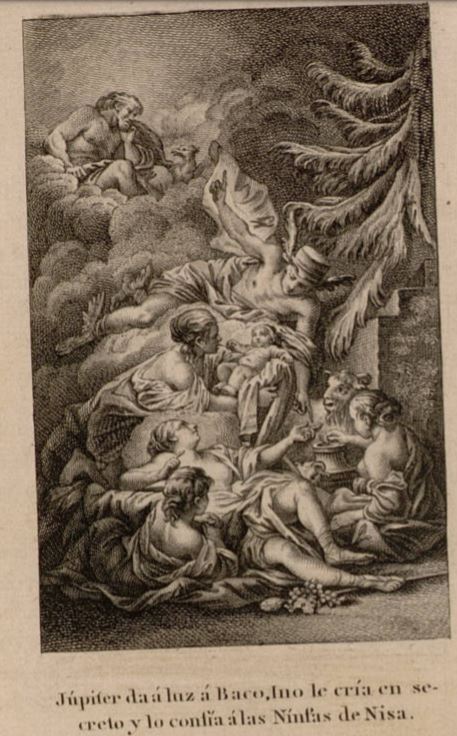
After giving birth to his son, Bacchus, Jupiter entrusted him to Ino, the sister of Bacchus’ mother. Bacchus’ mother was destroyed by Jupiter after she had requested that he show her his full godly power. Jupiter is illustrated in the top left corner of the image floating on a bed of clouds as he looks down on Bacchus. There is an eagle beside Jupiter as Jupiter often transforms into eagles. The messenger god Mercury, depicted with wings on his ankles and back, is illustrated giving the baby to Ino and other nymphs who will raise him as their own.
During Quiteria's wedding, Sancho Panza lifts a feathered chicken from a pot with a seperate plucked chicken left inside. Sancho's left hand holds the pot semi-aloft, his mouth agape and his eyes wide.
The duchess’ page kneels before Teresa Panza and her daughter Sanchica. He presents them with letters and gifts from the duchess and Sancho Panza. Teresa holds a bunch of flax (accurate to the text). Teresa’s thatched-roof house and well are depicted. Signed by F. Hayman (illustrator) and S. F. Ravenet (engraver). Part 2, ch. 50.
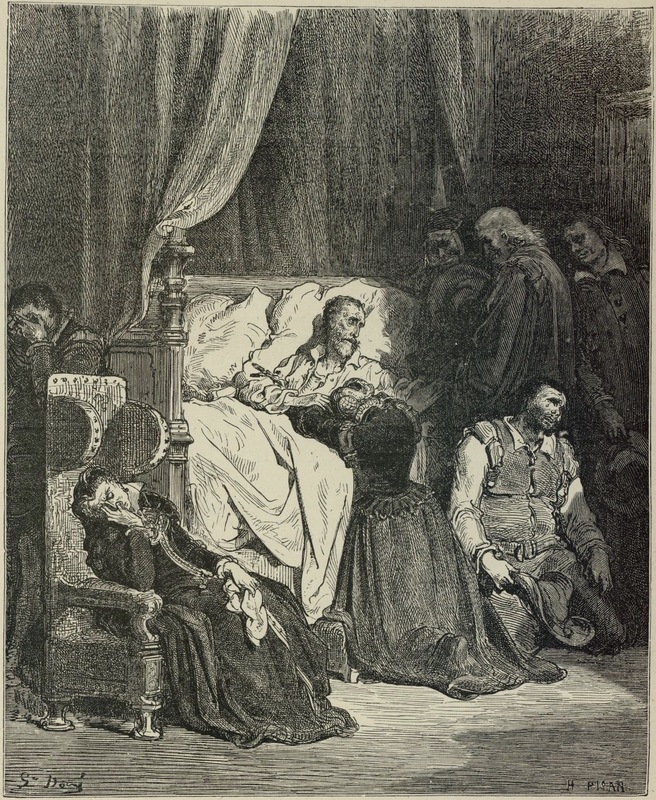
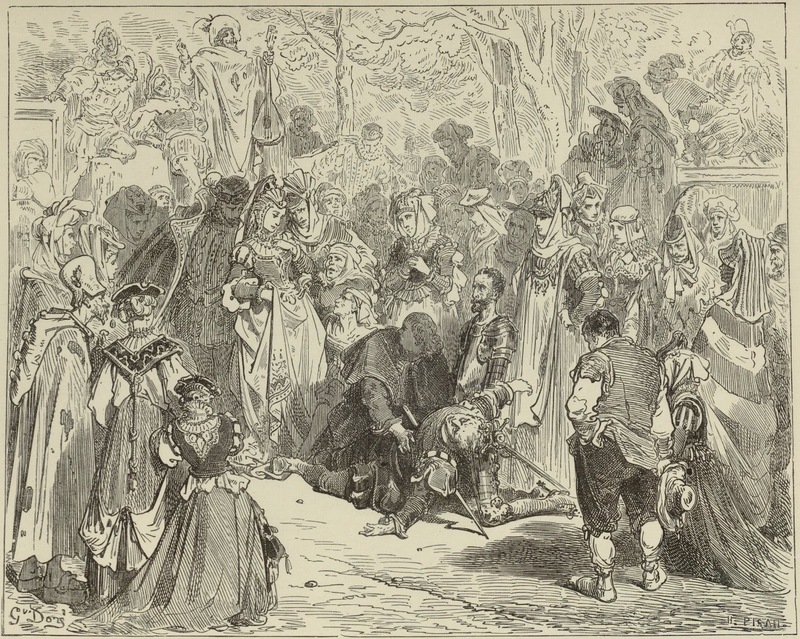
From his bed, Don Quixote dictates his last will to a notary. Also pictured are Sancho Panza (kneeling and weeping), Sansón Carrasco, the notary, the housekeeper, the priest, and the niece. Signed by G. Doré (illustrator) and H.-J. Pisan (engraver). Part 2, ch. 74.
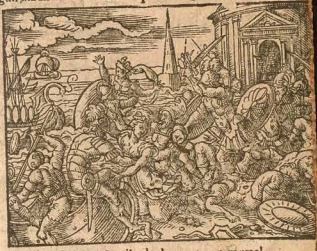
This engraving illustrates multiple events. In the background, Polymestor, the King of Phrygia, is illustrated atop a tower, throwing someone off the edge. The person he is throwing off the edge is Polydorus, the son of King Priam of Troy. King Priam had sent Polydorus to live with Polymestor during the Trojan War to avoid being killed. King Priam’s mistake was to send treasure and wealth along with Polydorus. The King of Phrygia was greedy and killed his foster son in order to take the wealth that King Priam had sent with him. The foreground of the engraving illustrates King Agamemnon and his soldiers on a beach in Thrace. There is a ghost that is emerging from the ground in front of Agamemnon. The ghost is that of Achilles, who has his sword in hand, ready to attack Agamemnon for his injustice of not offering him a sacrifice after he died. King Agamemnon then takes Polyxena, a daughter of King Priam of Troy, as a sacrifice to Achilles. She is depicted on the right-hand side of the engraving being detained by Greek soldiers.
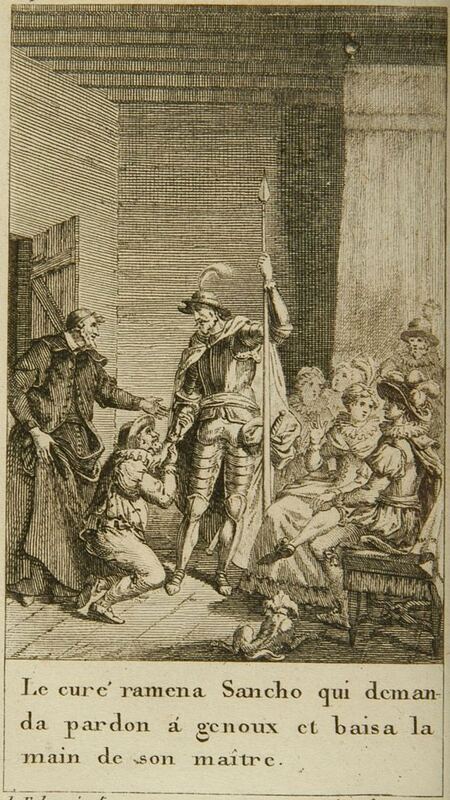
At the inn, Sancho Panza suggests that Mimicona (Dorotea) is not a genuine princess, provoking Don Quixote. The knight is infuriated and tries to punish him. Following the priest’s advice, Sancho kneels before Don Quixote and asks for his master’s pardon. Dorotea, who understands Don Quixote’s madness, tries to pacify him by claiming that Sancho Panza saw illusions that offended her good name. Signed by C. Lefebvre (illustrator) and F. Godefroy (engraver). Part 1, ch. 46.
An ox stands in the midst of a small stream and looks towards the shore in the foreground where a single frog stands by a patch of reeds. The image is occasioned by the duke telling Sancho Panza "Secondly, Bear constantly in mind who you were, and endeavour to know yourself, which is the most difficult point of knowledge imaginable. The knowledge of yourself will keep you from puffing yourself up, like the frog who strove to equal the ox in size" (Page 447).
In the backyard of the inn, Sancha Panza is tossed up into the air with a blanket by six gamesome young fellows dressed in well fitted cloth garments and well-to-do hats. In the background, Don Quixote notices the cries of Sancha Panzo and gallops towards the commotion, but is obstructed by a fence.
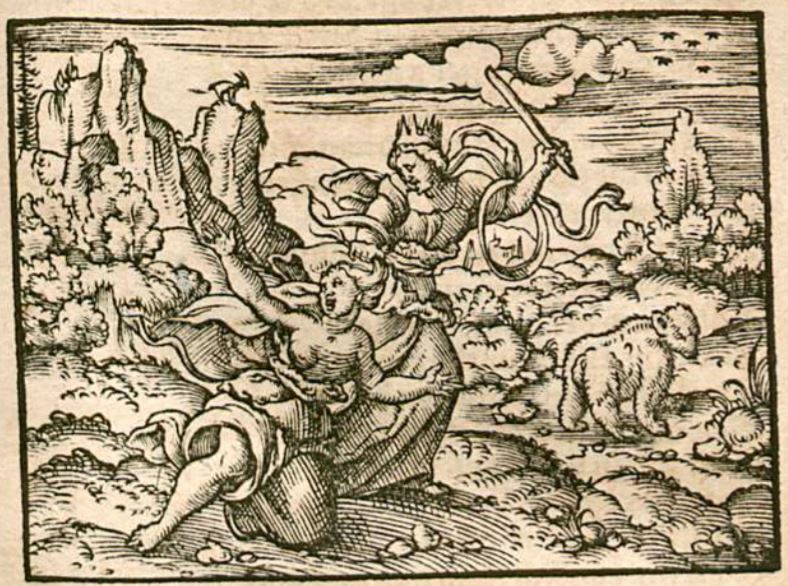
This image depicts Juno, the wife of Jupiter, pulling on the hair of the nymph Callisto. Juno is depicted with a crown to signify her status as a goddess as well as the wife of the king of the gods. Juno is angry with Callisto because Jupiter had raped her and then she gave birth to a son. This was an embarrassment to Juno, so she decided to punish her. Juno physically transformed her into a bear with her human consciousness remaining. Callisto, in the form of a bear, is illustrated on the right side of the image.
Don Quixote (left) lies in bed in a loose white shirt and a small greasy cap with his left hand extended parallel to the bedding. He is visited by Sancho Panza (left), who holds his hat in his hands respectfully and looks towards his master, and Carrasco clad in the garb of St. Peter, who falls to one knee and kisses Quixote's hand. On the left, Quixote's armor hangs on the wall next to his bed.
Sancho Panza stands at the doorstep of Don Quixote's house, addressing Quixote's niece (right) and housekeeper (left) who lean through the window to speak to him. At Sancho's feet, two dogs investigate the alleged intruder.
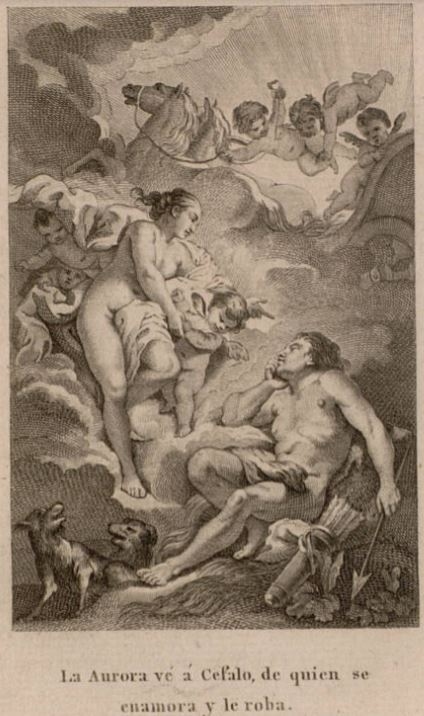
Aurora, the goddess of the dawn, is depicted on the left side of the image floating on a bed of clouds and surrounded by winged cherubs. One of her symbols is a chariot which she uses to fly across the sky to announce the arrival of day light, and that chariot led by horses is illustrated in the background of the image. Aurora is depicted looking at a man named Cephalus, with whom she falls deeply in love with. Cephalus, depicted with his bows, arrows, and hunting dogs, is not interested in the goddess and only has eyes for his wife. Aurora abducts him against his will.
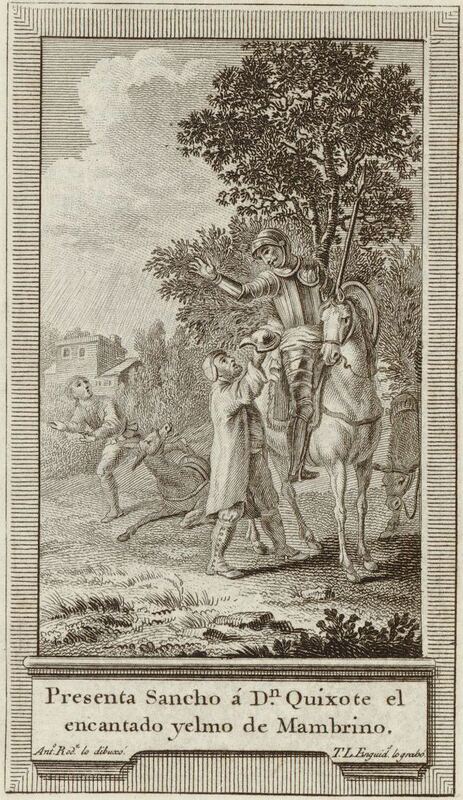
In the foreground, Sancho Panza presents the barber’s basin to Don Quixote, who believes it to be the fabled helmet of Mambrino. In the background, the barber runs away, leaving his mule. Signed by A. Rodríguez (illustrator) and T. Enguídados (engraver). Part 1, ch. 21.
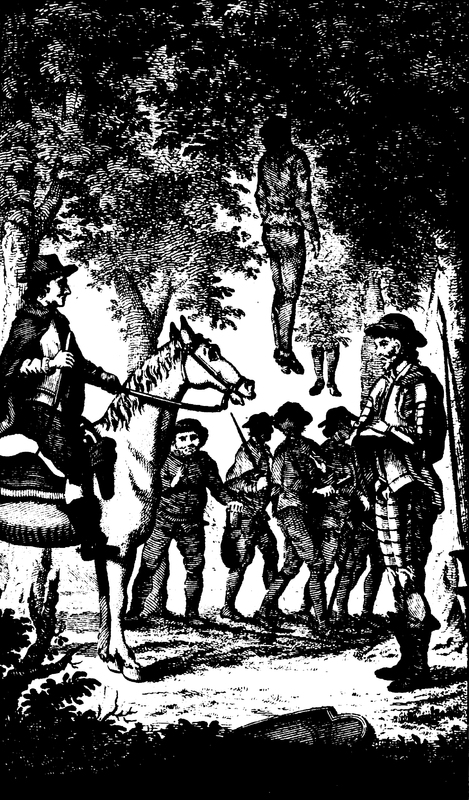
On the road to Barcelona, Sancho Panza (pictured in the background to the left) and Don Quixote pass through a forest of hanged robbers. To their surprise they are suddenly surrounded by forty live robbers who hold them at knife-point, rummage through their belongings for valuable, and in the Catalonian tongue ordered them not to move till their captain arrives. Their captain arrived soon thereafter (pictured to the left upon a horse), his name was Roque Guinart, and seemed to be about thirty four years old, of a robust make, middling size, reserved, and brown in complexion. He was mounted upon a horse, was clad in a coat of mail, and armed with multiple pistols. Upon arriving, Roque was most surprised by the amusingly melancholic figure of Don Quixote clad in full armor (pictured to the right discussing his mission to Roque), and sought to understand the full extent of his madness which he was so famous for. Beneath the image is inscribed the message "On foot and deep in thought, behold our knight surprised by robbers - unprepared for fight, who plunder Dapple, but the things restored pleased much Sancho - and his master more".
Basilio, pretending to have stabbed himself, is married to Quiteria. Don Quixote, Sancho Panza, Camacho (standing behind Quiteria), and the priest (holding Basilio’s body) are also pictured. Signed by G. Doré (illustrator) and H.-J. Pisan (engraver). Part 2, ch. 21.
Having intimidated the keeper into opening the lion's cage, Don Quixote (left) clad in armor raises his sword in his right hand and his shield in his left in preparation to face the lion and prove his courage. The lion's keeper (right), having opened the cage stands with his mouth agape, terrified of what will become of himself after Quixote has been eaten. The lion (center) stares at Quixote casually, uninterested in the knight-errant. The lion's cage is held aloft by four wooden wheels and has 4 flags on each corner. In the background two people on horseback ride past.
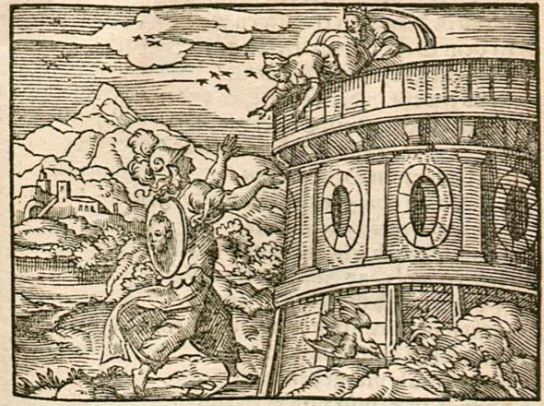
This engraving illustrates Daedalus on top of a tower, with his sister Perdix standing beside him, leaning over the ledge with her arm outstretched to her son who had just been pushed from the tower. Perdix had sent her twelve-year-old son, Talos, to live with Daedalus. Talos was incredibly bright and invented many things which caused Daedalus to become jealous. His jealously drove him to push Talos off the tower to kill him. Minerva, who favours intelligence, interferes and saves Talos before he hits the ground by transforming him into a partridge. Minerva is depicted standing on the ground at the bottom of the tower with her arms stretched out to signify that she had just transformed Talos into a bird. Talos then changes his name to Perdix to honour his mother and his new form.
During the night in Sierra Morena, Ginés de Pasamonte (background) makes away with Sancho Panza’s donkey. In the foreground, Sancho Panza is pictured sleeping on the packsaddle propped up with stakes, and Don Quixote on Rocinante. Signed by T. Stothard (illustrator) and J. Heath (engraver). Plate XI. Part 1, ch. 23.
This image appears at the beginning of the eighth book in this volume. There are many elements in this image and they appear to depict some of the fables and characters in the eighth book. For example, the goddess of the hunt, Diana, is visible with her two dogs on the left side of the image. The goddess Minerva, dressed in her armour is visible also on the left side of the image. The minotaur of Crete (who is depicted more in the shape of a centaur in this image) is depicted in the centre.
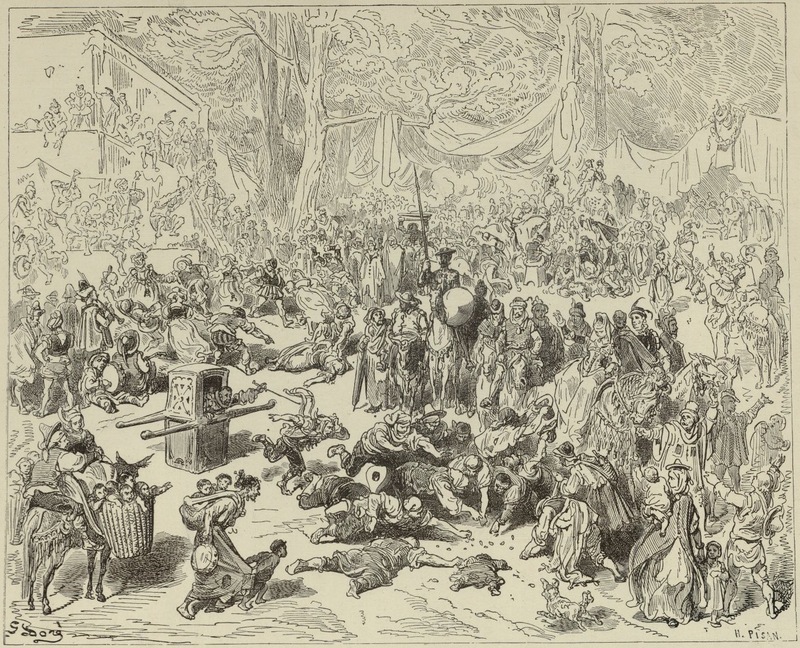
Basilio and Quiteria leave the wedding. Camacho, to show that he did not resent Basilio’s trick or consider it of any importance, decides that the celebrations should go on as if he really had been married. Signed by G. Doré (illustrator) and H.-J. Pisan (engraver). Part 2, ch. 21.
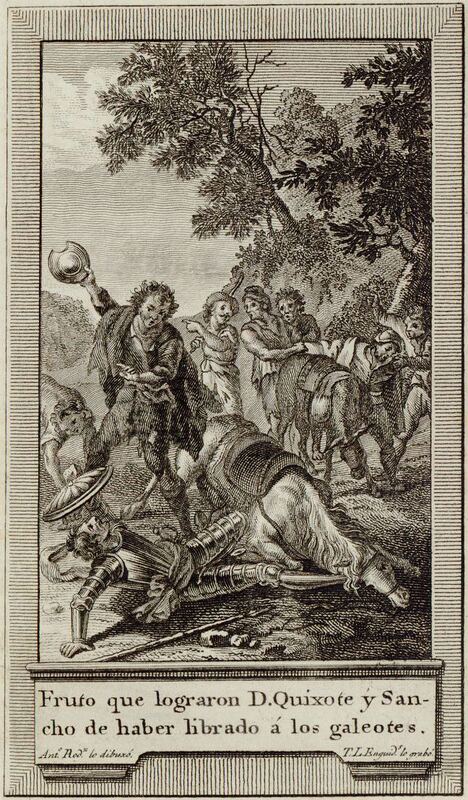
After their release, the galley slaves stone Don Quixote and Sancho Panza. They are led by Ginés de Pasamonte, who refuses to travel to Toboso to present himself to Dulcinea as requested by Don Quixote. Signed by A. Rodríguez (illustrator) and T. Enguídados (engraver). Part 1, ch. 22.
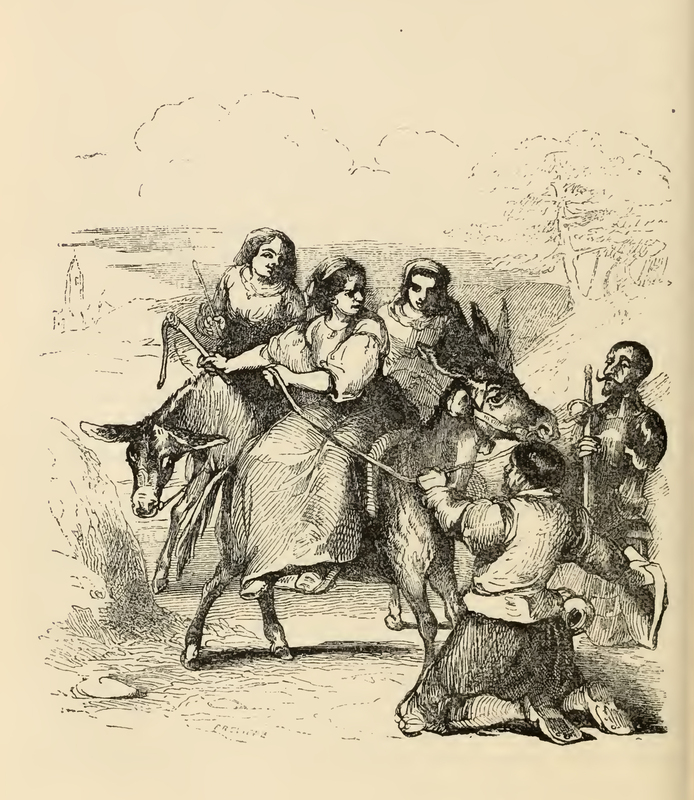
Sancho Panza meets the country girls and lays hold of one of them by the halter of their donkey, and bending to both of his knees introduces himself and his master to the girl who he calls Dulcinea Del Toboso. Seeing Sancho act thusly, Don Quixote (right) clad in armor, also places himself on his knees looking wistfully at the girl who Sancho Panza claims is Dulcinea Del Toboso. The two girls in the background laugh at the notion of being called ladies, and the girl in the front pulls back her halter angrily trying to distance herself from Sancho and Quixote. Toboso can be seen in the background on the left.
While prancing along the seaside of Barcelona upon Rocinante, Don Quixote spots another knight-errant, armed like himself, with a full moon painted on his shield, who is in fact Samson Carrasco in disguise. This knight introduces himself as the knight of the full moon and challenges Don Quixote to a duel with the condition that if Quixote loses he must lay aside his weapons, totally renounce the exercise of chivalry, and retire to his home in La Mancha. The two fierce knights, Don Quixote de la Mancha and the knight of the white moon, prepare their horse's and charge at one another. The knight of the white moon (pictured mounted atop Don Quixote) met Quixote with such violence that, without touching him with his lance, down fell the knight, and down fell Rocinante with him. The conqueror then instantly sprang upon Don Quixote, and put his lance to his vizor, ending the duel. Below the image is inscribed the message "Don Quixote's friend, Carrasco as a knight disguised attacks him, and subdues in fight through kindness bent in search of him to roam, to cure his follies and allure him home".
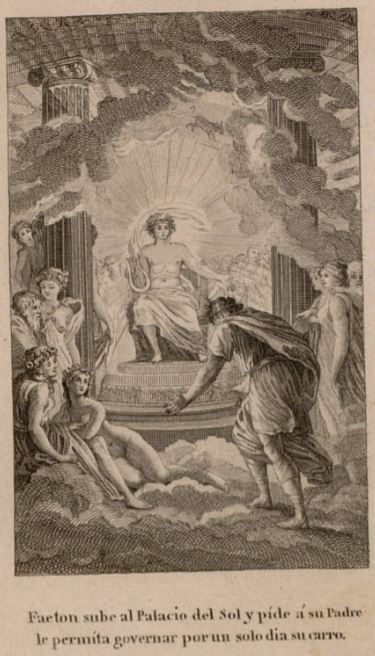
This image depicts Phaethon kneeling before his father, the Sun (Helios), who sits at his temple on his throne with the sunshine beaming brightly behind him and with other gods surrounding him. Phaethon had questioned whether the sun god was his legitimate father, so his mother Clymene told him to go to the sun god himself for proof. Once Phaethon reaches the god, as depicted in the engraving, the god confirms his parentage to Phaethon. Phaethon requests to govern his father’s golden chariot for a day as further proof of his parental legitimacy.
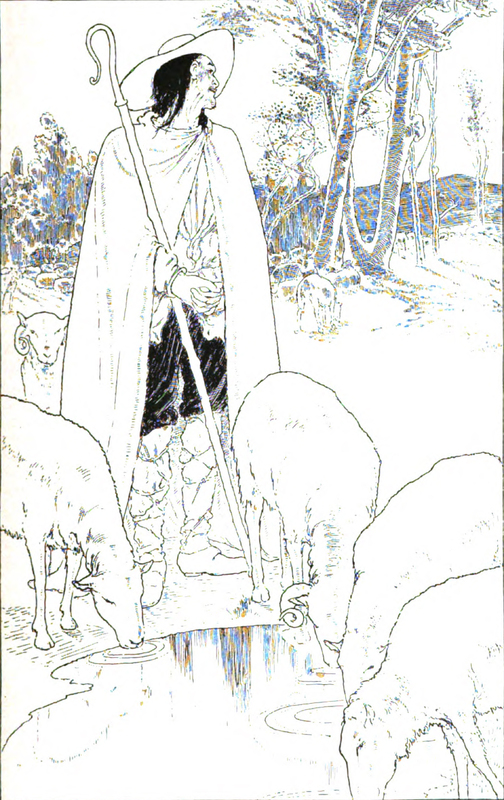
The shepherd depicted in the illustration is Chrysostom a love-sick shepherd's student who dies from his love for Marcela (who he likely looking towards out of frame), a wealthy, beautiful orphan who has abandoned her wealth for a shepherdess’s life and refuses to marry. Don Quixote (not pictured in the illustration) is relayed this story by a group of goatherds who invite him to accompany them to Chrysostom's burial.

![[Sancho Assaults a Kettle's Morsel]](https://collections.cemvc.ca/files/large/65fd100e9a7cdf456ab7f4a801cc040aa8b51921.jpg)
![[The page kneels before Teresa Panza]](https://collections.cemvc.ca/files/large/948f6dbb74428187dc54d22ba41e896424b9c197.jpg)
![[The Frog Who Strove to Equal the Ox In Size]](https://collections.cemvc.ca/files/large/4531bd116f5fde5a0e2019478b80fa45ca3bfbcb.jpg)
![[Sancho Pancha toƒsd in a Blanket]](https://collections.cemvc.ca/files/large/ebc832d771611714bf031b8c3e94fd03af3e4c5a.jpg)
![[Of How the Bachelor Sampson Carrasco Kissed Don Quixote's Hand]](https://collections.cemvc.ca/files/large/dc9ec04f46c6e84a9c332b134b43eb6f97f771c6.jpg)
![[Sancho Panza Expostulating with the Niece and the Housekeeper]](https://collections.cemvc.ca/files/large/6e8e92bbfcdfb2c5dcb1754cc1d87448aa507afd.jpg)
![[Don Quixote Faces off Against the Lion]](https://collections.cemvc.ca/files/large/d3006f88def0698d6c223a080649d6499113947a.jpg)
![[Ginés de Pasamonte steals Sancho Panza's donkey]](https://collections.cemvc.ca/files/large/93497a2257668bcad947e765aba2b3846dbd8408.jpg)
![[Many Fables of the Eighth Book]](https://collections.cemvc.ca/files/large/4703c81ea0c69688c3b004b35c89708e9a3765fa.jpg)