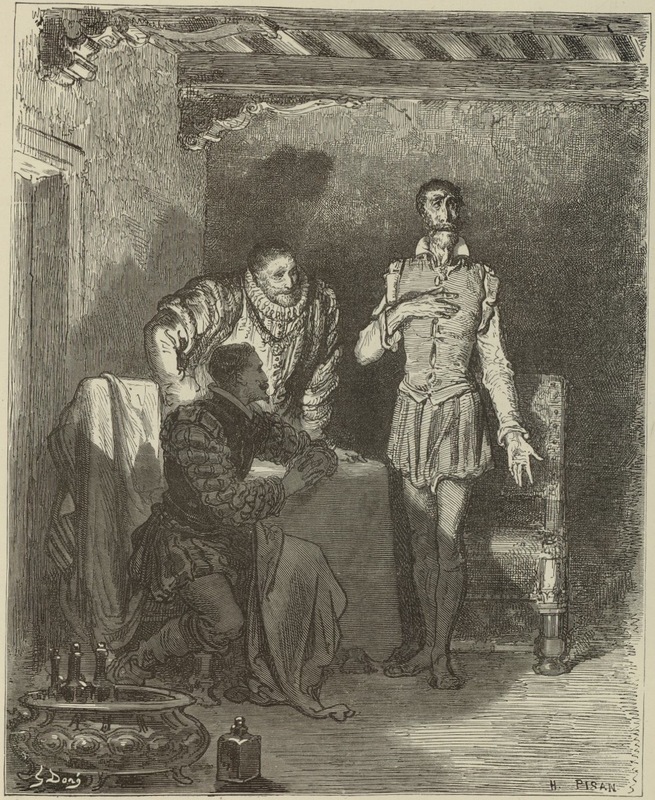
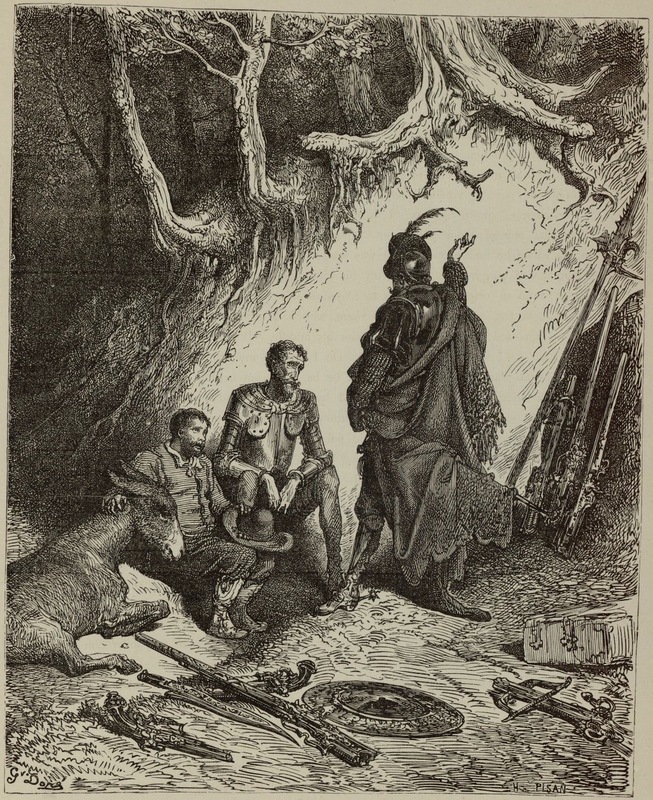
At the inn, Don Quixote meets Don Jerónimo and Don Juan, who tell him about Avellaneda’s novel (the publication of the false second part of the story of Don Quixote) and ask him about Dulcinea. Signed by G. Doré (illustrator) and H.-J. Pisan (engraver). Part 2, ch. 59.
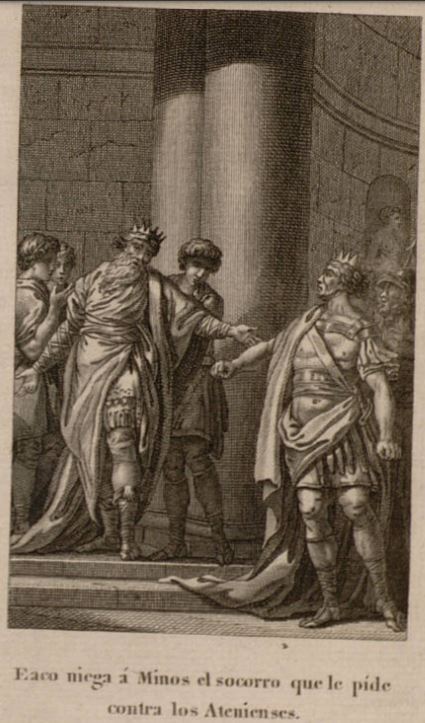
This image depicts King Minos of Crete meeting with King Aeacus of Aegina. King Minos is looking to recruit allies in a battle against Athens to avenge his son’s death. King Aeacus, however, declines Mino’s request for help as he is already allied with the city of Athens. King Aeacus is illustrated on the left side of the image with companions surrounding him and King Minos is illustrated two steps below him as he asks for his help. They are both wearing crowns to signify their status as kings.
In the estate of the duke and duchess, Sancho Panza dines at a clothed table with fork and knife upon chicken and grapes, with a bottle of wine by his side and a goblet to accompany him. Over his neck he has slung a cloth napkin to act the part of a bib.
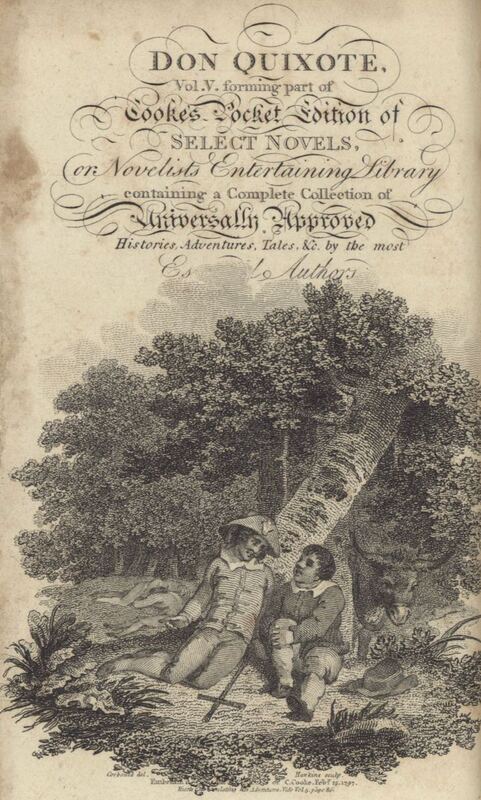
Vignette on title page. After leaving Barataria Island, Sancho Panza encounters Ricote, a shopkeeper from his village. While his fellow pilgrims sleep in a grove of poplars (background), Ricote tells Sancho about what happened to him after he left his village. Signed by R. Corbould (illustrator) and W. Hawkins (engraver), dated 1797. Part 2, ch. 54.
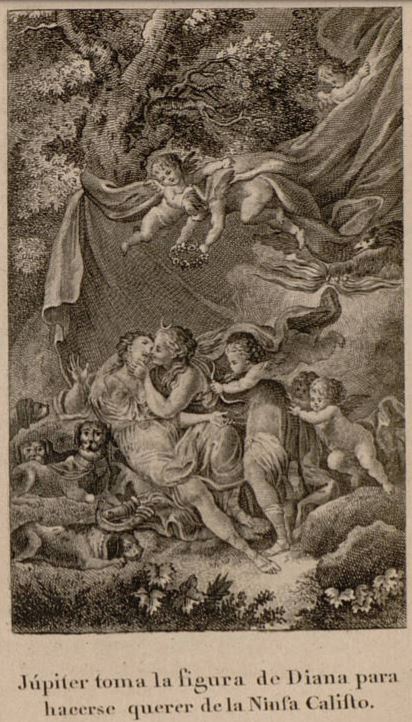
This image depicts Callisto, a virgin nymph loyal to the goddess Diana, sitting in the woods being seduced by what appears to be the goddess Diana herself. The goddess, however, is Jupiter in disguise. Jupiter was one day wandering through the forest when he spotted Callisto hunting and developed a burning passion for her. In order to seduce Callisto, Jupiter disguises himself as Diana knowing Callisto would not be able to resist her most beloved goddess. Disguised as Diana, Jupiter then rapes Callisto. Callisto and Jupiter are surrounded by winged cherubs and dogs. Dogs are included in the image as dogs were often used as help for hunting in antiquity.
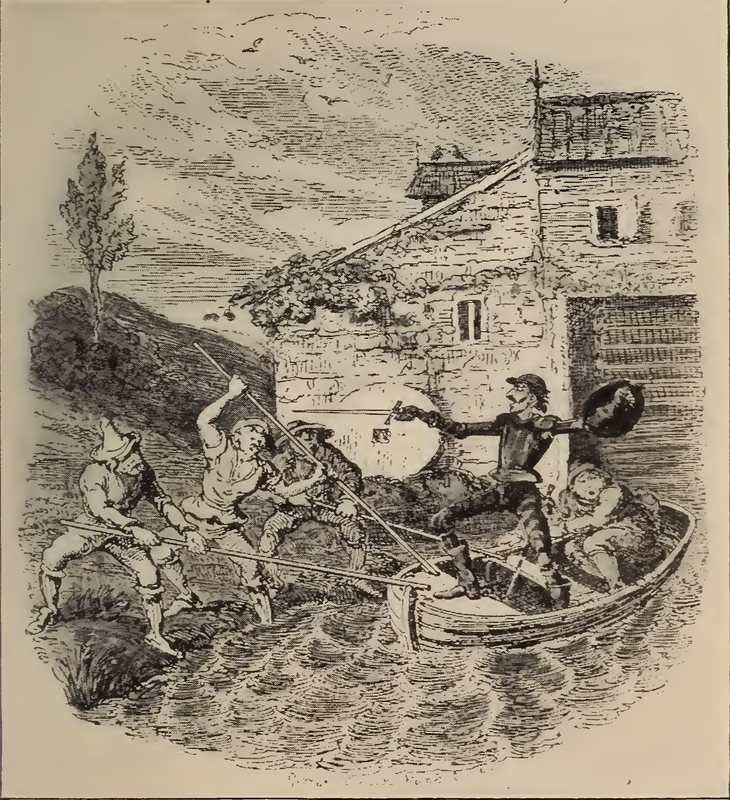
Having boarded an empty boat up-river, Don Quixote and Sancho Panza ride this 'enchanted bark' downstream. Eventually they reach a mill, which Quixote confuses for a fortress, and its millers as evil enchanters. Worried that the boat could break their mill, the millers brought out long poles in order to stop the boat and those in it from experiencing an unsavory demise. As the millers stop the boat Don Quixote tries in vain to fend off the millers with his sword, while Sancho Panza tries in vain to hold on to the violently shaking vessel.
Don Quixote undertakes his second sally, now accompanied by his squire Sancho Panza. Don Quixote rides Rocinante, wearing his armour and holding his buckler and lance. Sancho is mounted on his donkey. Signed by T. Stothard (illustrator) and J. Heath (engraver). Plate III. Part 1, ch. 8.
Don Quixote and Roque Guinart discuss their ways of life. Don Quixote is amazed to hear Roque speak so well and so reasonably because he had thought that among outlaws there could be no one who was well spoken. Various arms—flintlock rifles, a pistol, a crossbow, and swords—are pictured in the foreground. Signed by G. Doré (illustrator) and H.-J. Pisan (engraver). Part 2, ch. 60.
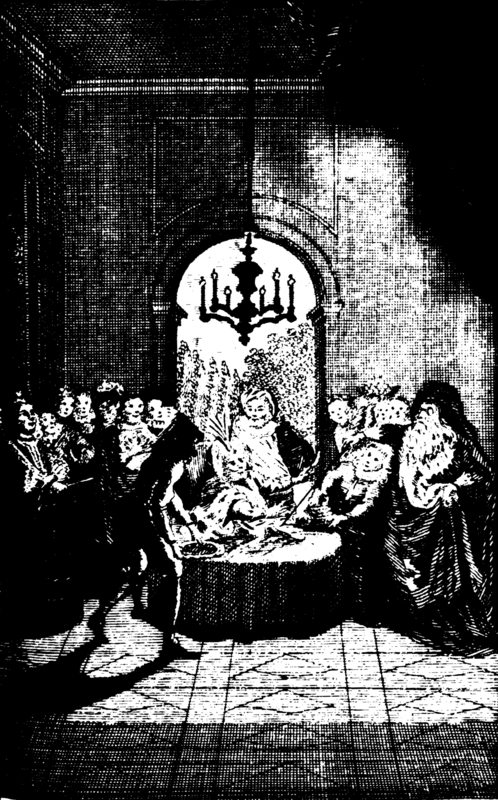
After answering questions in the court of justice, Sancho Panza is led to a palace, where, in a spacious room, music is played for him and four pages wait to help him wash his hands. Sancho is placed at the head of a table with a white cloth laid out for one. Then a physician with a very long white beard and black robe came and stood to the right of the table with a whalebone wand in his hand. Sancho's attendants brought dishes forth, and Sancho discovered fruit, meat and other delicious dishes. A student (pictured behind Quixote), said grace ; a page (pictured to the left of the student) put a bib under Sancho's chin ; and another set a dish of fruit before him. But Sancho had hardly putone bit into his mouth, before the physician touched the dish with his wand, and then it was taken away by a page in an instant much to the distress of Sancho Panza.
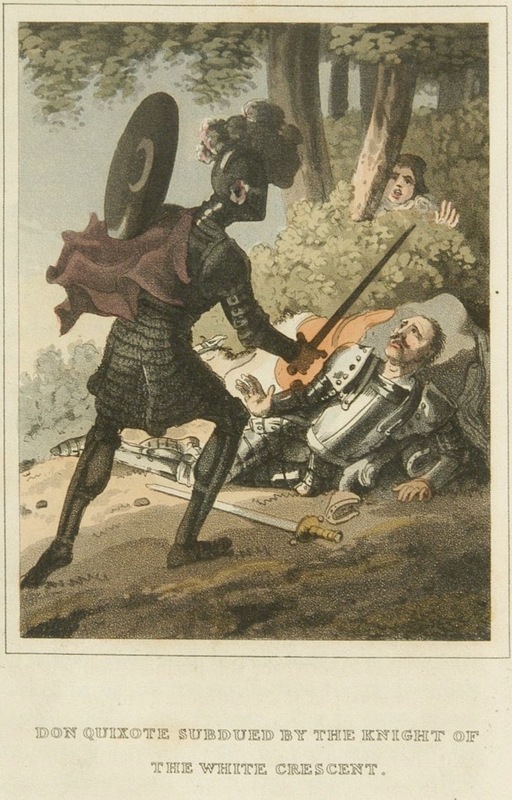
The Knight of the White Moon (Sansón Carrasco) defeats Don Quixote. The illustration is not accurate to the text: they are depicted in a forest, while Cervantes writes that the battle takes place on the beach at Barcelona. Sancho Panza is pictured in the background, hiding behind a bush. Unsigned. Part 1, ch. 3.
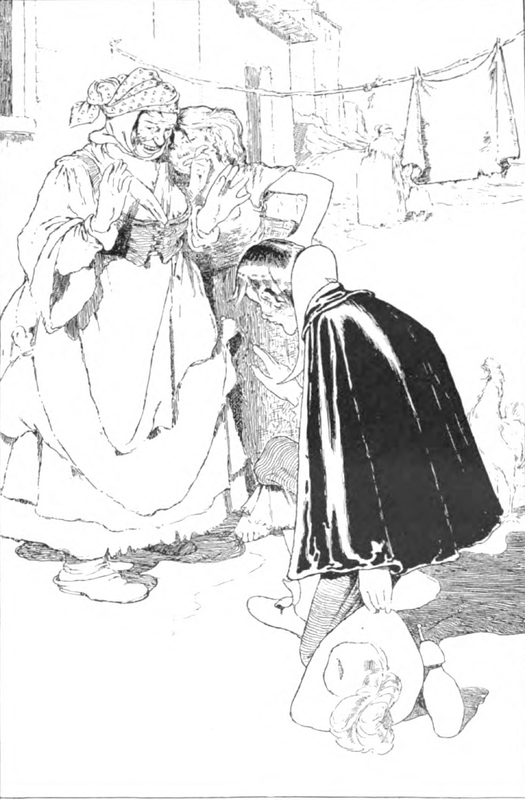
A page is sent by the Duke and Duchess, who are playing another trick on Sancho Panza and Don Quixote, to convince Sancho Panza's wife that he has succeeded in becoming someone of great importance. Arriving at the village where the Panza's abide, he meets Sancho Panza's daughter (middle) who brings him to meet her mother. Sancho Panza's wife, Teresa Panza (left), is surprised to see that a page (right) has arrived at her house on behalf of her husband Sancho Panza, who she is told is now a governor. Teresa does not believe the page, but is convinced when she is given a letter and a necklace of gold coral beads.
Sancho Panza, kneeling before the duchess, her squire, and the duke, introduces her to Don Quixote, who waits in the background. The duchess is pictured on horseback and holds a goshawk. Signed by E. Lami (illustrator) and Leroux (engraver). Part 2, ch. 30.
Having drawn a short sword that was concealed in a scabbard; Basilius threw himself upon it. With the bloody blade at his back, the poor wretch lay his length along the ground, weltering in his blood. Sancho Panza (left) ran presently to his assistance, grieved at his misery and deplorable disaster. Don Quixote, clad in armor on the right behind Sancho also rushed to the scene. On the left Quiteria holds her head in her hands, grieved by Basilius' perceived suicide, Camacho at her side, his hand lowered in fright and caution.
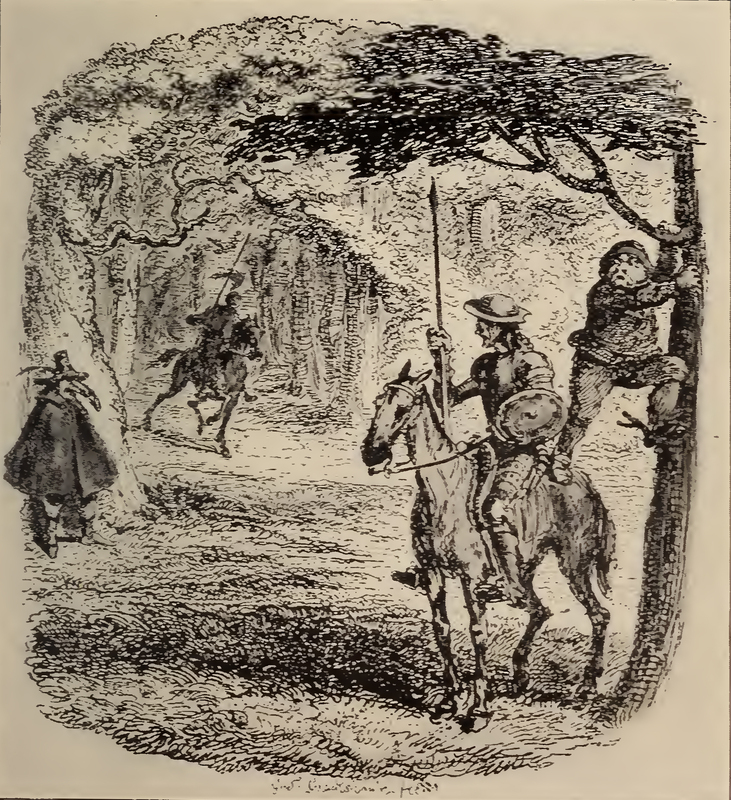
The knight of mirrors charges at Don Quixote from a nearby forested path. Quixote's squire Sancho Panza flees up nearby cork tree in fear whilst Quixote turns to face his foe. To the left of the knight of mirrors, stands his squire clad in a long black poncho, sporting a tall feathered cap. He has an exceptionally long nose which is soon revealed to be fake.
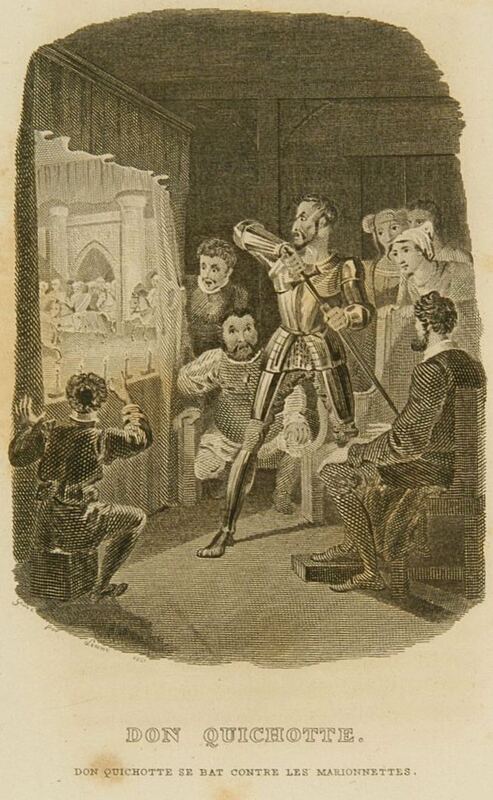
Don Quixote draws his sword before attacking the puppets of Maese Pedro’s theatre. The people in the crowd watch him, alarmed. Excellent rendition of light and shadows, and of Don Quixote’s armour. Signed by Leroux (engraver), no given name, and dated 1821. Part 2, ch. 26.
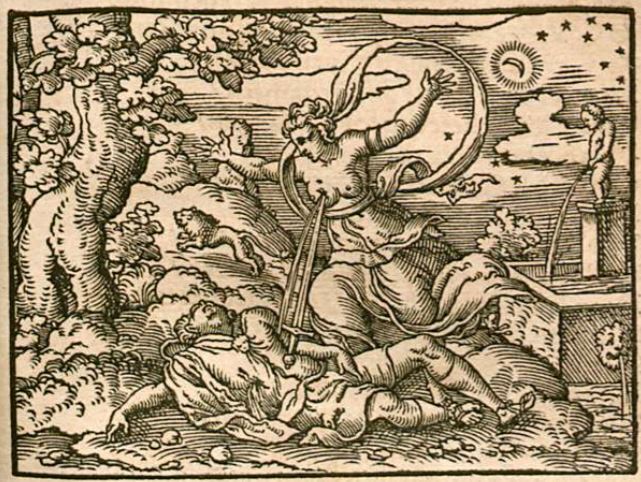
This engraving illustrates the story of Pyramus and Thisbe, two star-crossed lovers who share a tragic fate. Pyramus is illustrated lying dead on the ground of the forest, as he had just stabbed himself to death. He had done this because he saw a lioness in the location where he was meant to meet with Thisbe (the lioness is illustrated in the background of the engraving). He thought the lioness must have killed her. Grieved at the thought of Thisbe’s death, Pyramus kills himself. Thisbe, however, was not dead. She had hidden from the lioness in a cave, and when the lioness had run off, Thisbe emerges to see the body of her beloved Pyramus. Pained by the death of Pyramus, she takes his sword and impales herself, as illustrated in the image. The blood from their wounds spilled onto the berries on the tree behind them, which from that point on are known as blackberries.
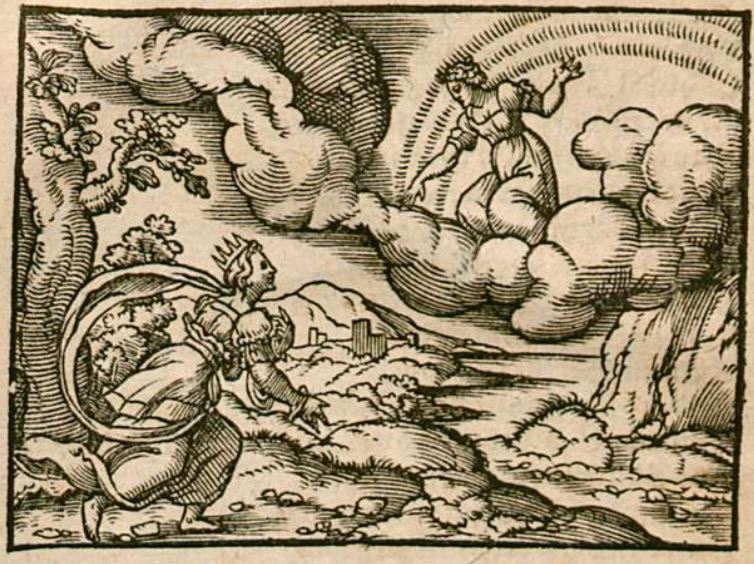
Hersilia, the wife of Romulus, is depicted on the left side of the engraving with a crown on her head running towards the goddess illustrated in the sky. Hersilia had been upset because Romulus had been deified and had to leave her behind. The goddess Juno had pitied Hersilia and sent her messenger, Iris, to send word to Hersilia that she may join her husband and become a goddess herself. Iris is illustrated on the cloud with her hand reaching down towards Hersilia. Hersilia becomes the goddess named Hora.
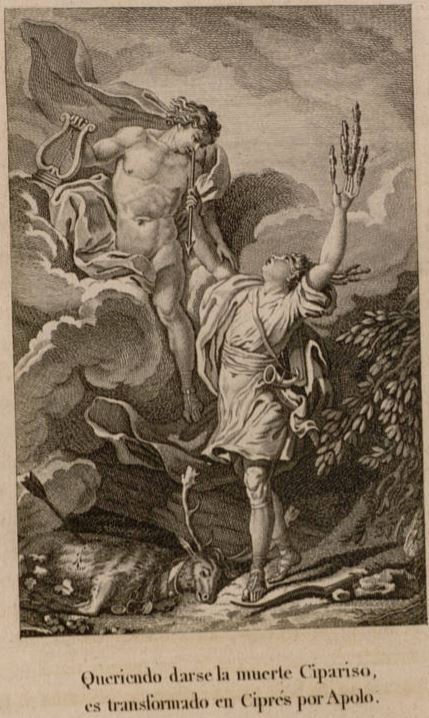
This engraving depicts the origin story of the cypress tree. There was a named Cyparissus who was incredibly fond of a giant stag that had bejeweled antlers and was friendly to all. Cyparissus and the stag were walking in the woods, when the stag decided to lay down in the grass and enjoy the breeze. By mistake, Cyparissus shot one of his arrows which had fatally wounded the stag. Grieved by his actions, Cyparissus begged the god Apollo to allow him to mourn for the stag forever. Apollo granted the request and transformed him into a cypress tree. Cyparissus is depicted mid-transformation with his left arm turning into a branch. His right hand is holding the arrow which killed the stag. The stag is illustrated lying dead on the ground by Cyparissus’ feet. Apollo is floating on a bed of clouds as he transforms Cyparissus. Apollo is holding a lyre as he is the god of music.
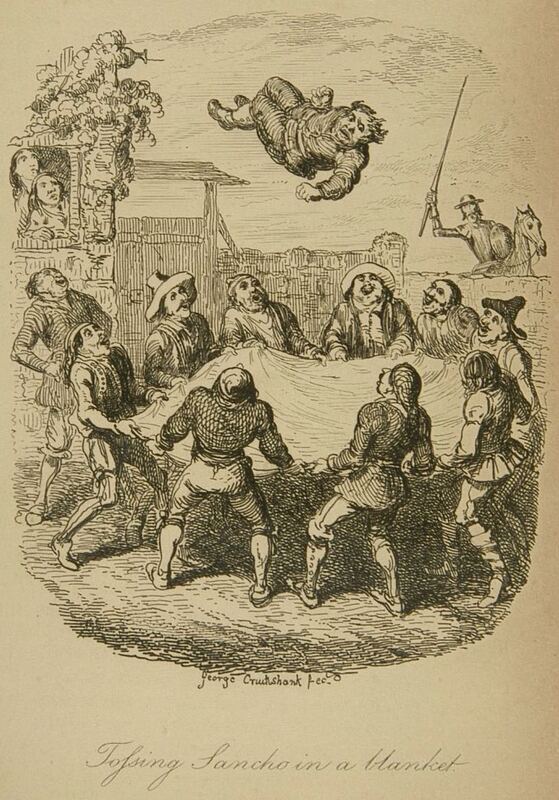
When Sancho Panza refuses to pay the innkeeper, guests at the inn toss him in a blanket in the courtyard and make merry with him. Among the guests are four wool carders from Segovia, three needlemakers from El Potro in Córdoba, and two residents of La Feria in Sevilla. In the background, Don Quixote looks on from behind the inn wall. Signed by G. Cruikshank (illustrator and engraver). Part 1, ch. 17.
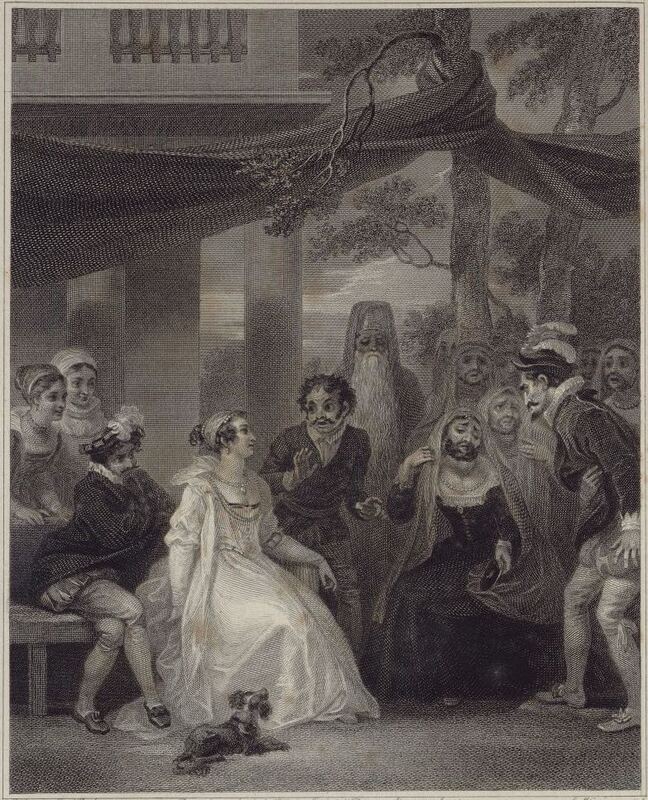
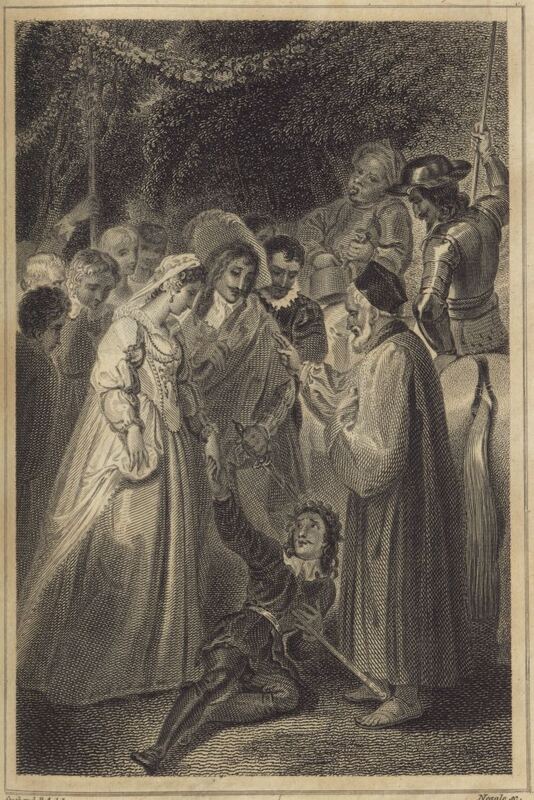
Basilio, pretending to have stabbed himself, is married to Quiteria. Don Quixote, Sancho Panza, Camacho (standing behind Quiteria), and the priest (standing, right) are also pictured. Signed by T. Stothard (illustrator) and J. Neagle (engraver). Part 2, ch. 21.
Having listened to Don Lorenzo's (lleft) poem, Don Quixote rises to his feet and grabs lorenzo's left hand with his own, raising his right hand into the air as if to praise the work. Sitting on a stool on the left, Lorenzo looks up at Quixote with concerned eyes, the poem he has just read from in his left hand. Pictured with his back turned, Sancho is also present on the right, as is Don Diego (middle right) and Donna Cristina (middle left) in the background.
In front of a large water mill standing in the midst of a river, Don Quixote and Sancho Panza drift in a wooden boat. The boat, being caught in a current rushes towards the water mill. The millers, pictured in the top left) see the boat drifting towards their mill and ran in hast with long wooden poles to stop the boat. Mistaking the mill for a castle of evil enchanters, Quixote, clad in armor, stands up and threatens the millers, raising his sword in the air with his right hand, and holding his shield with his left. The boat shakes and water begins to enter, making Sancho Panza lean against the far side of the boat to keep it upright.
Don Quixote asks Sancho Panza to be his squire, promising to make him governor of an island or kingdom. Sancho listens to Don Quixote attentively. Attention is drawn to the expression on Sancho’s face and Don Quixote’s gestures. Plate no. 6, signed by J. Vanderbank (illustrator) and G. van der Gucht (engraver). Vol. 1, book 1, ch. 7.
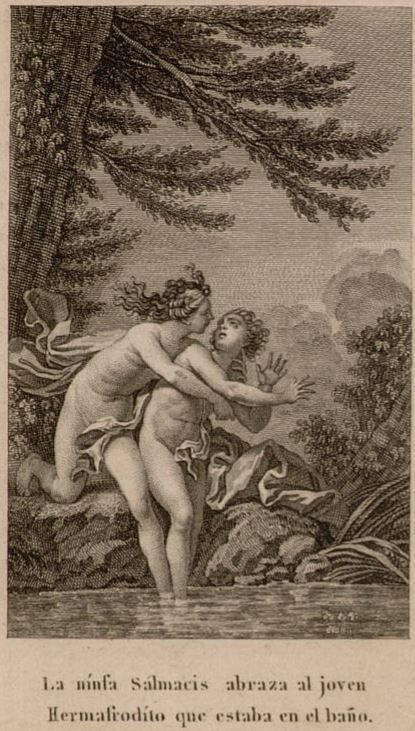
This image depicts the story of Hermaphroditus and Salmacis. Salmacis is a water nymph that occupies a pool of fresh water and falls in love with Hermaphroditus when he finds her pool. Hermaphroditus is the son of Mercury and Venus, and the beauty of his appearance captivates the Naiad. She is overcome with passion and cannot restrain herself from pursuing Hermaphroditus, despite his rejections. Salmacis, with her arms thrown around Hermaphroditus, asks the gods to never be separated from him. The gods oblige, and merge their two bodies together, creating the first hermaphrodite.
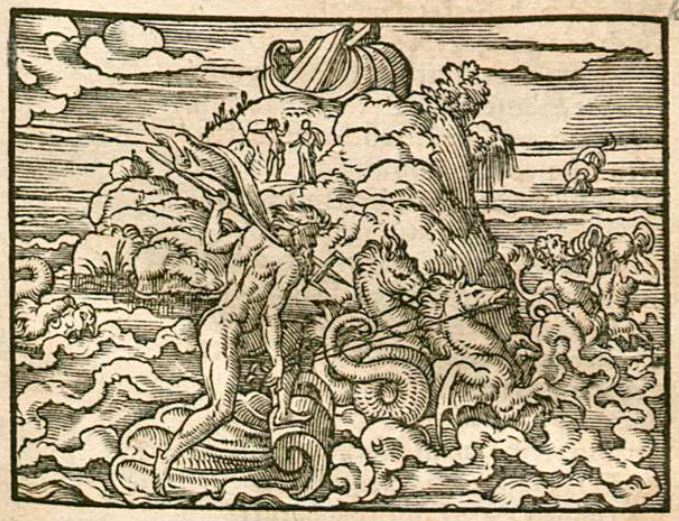
This image depicts the sea god Triton in the foreground riding his chariot and holding his trident in his left hand with a conch shell in his right. Triton was sent by Jupiter to calm the waters of the great flood that Jupiter had created in order to destroy humankind. The two people illustrated on the rock directly behind Neptune is Deucalion and Pyrrha, a husband and wife who had been spared by Jupiter for their religious devotion to the gods.

![[Sancho Panza Dines]](https://collections.cemvc.ca/files/large/f5d404caeb3f99162707a0ecc1a42eb1da90ef1f.jpg)
![[The second sally]](https://collections.cemvc.ca/files/large/e5c74a3dc3dac1cb11b0eb61ab4207dfcea8bbf1.jpg)
![[Of How Basilius Fakes his Own Death]](https://collections.cemvc.ca/files/large/e21ea2ad9fec75c3f0dda19be31118d9c4dccfc0.jpg)
![[Don Quixote Holds Don Lorenzo by the Hand]](https://collections.cemvc.ca/files/large/6f116df7b375e5f76ad79e82afca90f8ceec3223.jpg)
![[Of How Don Quixote Tried to Defend his Boat from the Millers]](https://collections.cemvc.ca/files/large/d995a1e954732530804e7b9d9134a05af0ea19c1.jpg)
![[Don Quixote asks Sancho Panza to be his squire]](https://collections.cemvc.ca/files/large/9feb43fb011f0d6c1bff58e32f2a1db35e410711.jpg)