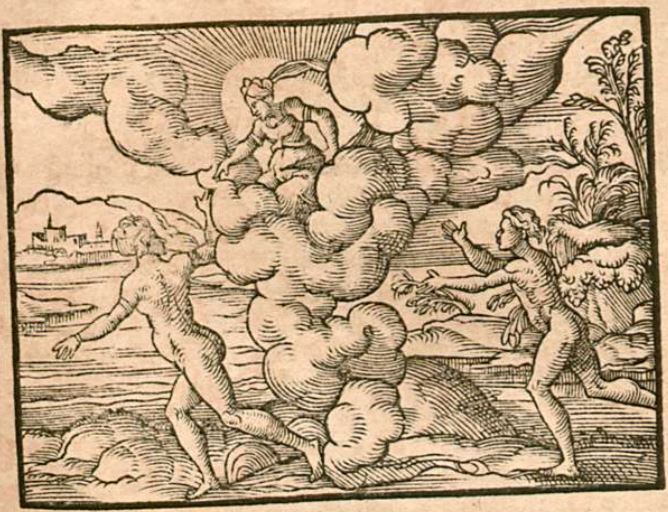
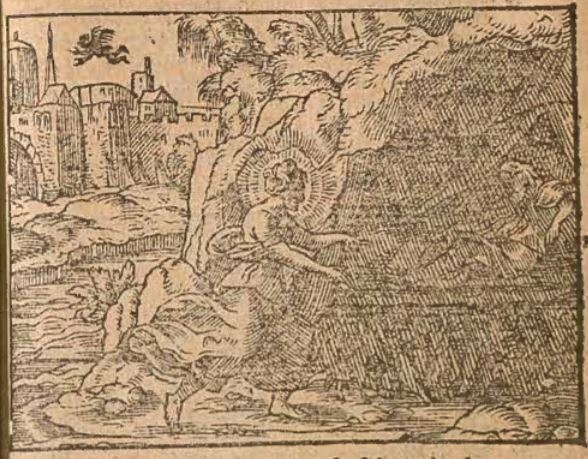
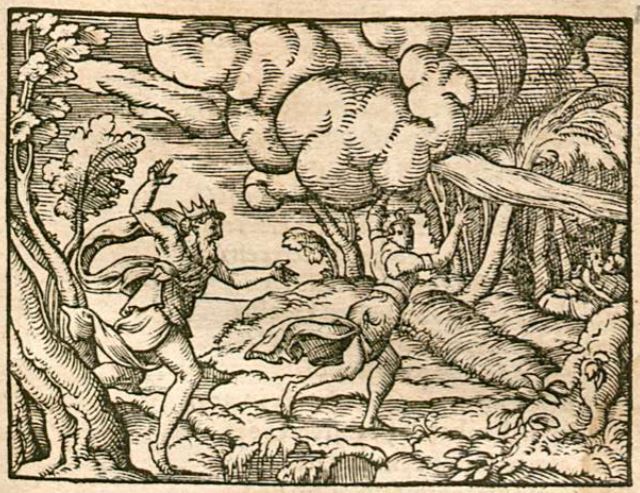
This engraving illustrates the nymph Arethusa running away from her pursuer, Alpheus. Arethusa was bathing naked in a river when the river god Alpheus had called out and declared his love for her. Arethusa panicked and ran away as fast as she could with Alpheus chasing after her. They ran over vast distances, and Arethusa was beginning to slow down due to fatigue. She called out to the goddess Diana for protection. Diana was moved by Arethusa and granted her safety by producing a cloud of mist which made Arethusa invisible to Alpheus. Arethusa is depicted within a large cloud in the centre of the image. Alpheus is depicted chasing the cloud on the right side of the image and Diana is illustrated on the left side holding her hand up to Arethusa.
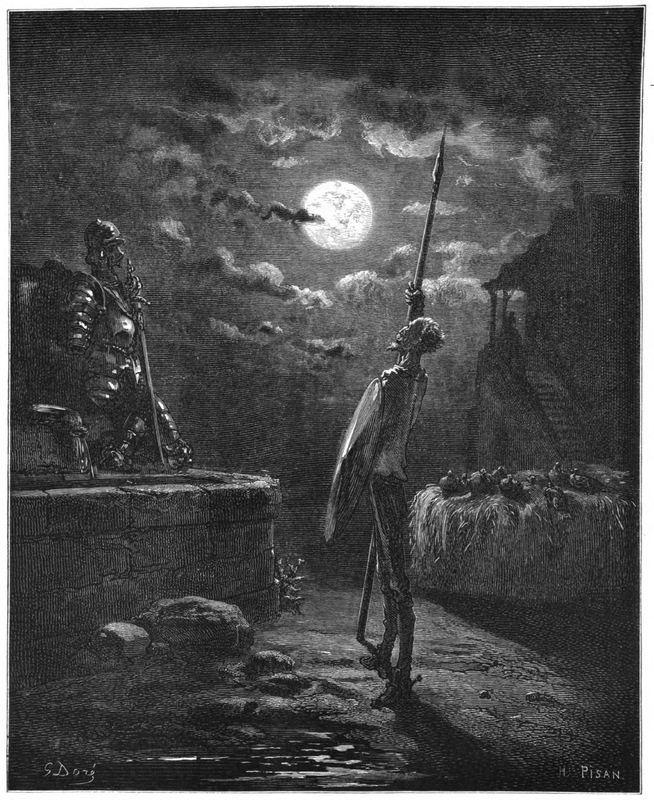
Don Quixote stands guard in front of his armor in the courtyard of the inn. He is waiting to be knighted in the morning by the innkeeper who is humouring his delusions of knighthood. Don Quixote’s armor is placed on the water trough, a full moon illuminates the scene and birds roost in the hay bale to the right. The inn is just visible on the right. This scene is found in Part I, Book 1, Chapter 3.
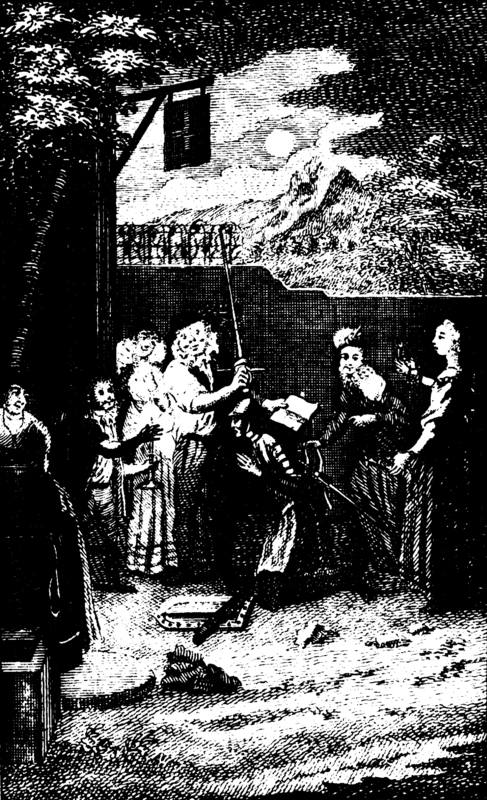
In the backyard of an inn in the plains of la Mancha, an innkeeper proceeds to bestow knighthood upon Don Quixote. Don Quixote has asked the innkeeper to give him this honour, as he mistaken the inn for a castle and the innkeeper for a king. Doubting the mental fluency of Don Quixote, the innkeeper goes along with Quixote's ruse so that the knight will leave without need of the law. For the knighthood ceremony, the innkeeper brought a sword to knight Quixote with and an accounts ledger to play the part of a script. In addition, the innkeeper gave a candle to a young boy to add ambience, and had to his left two women whom Don Quixote had mistaken for the queen and the princess. As the ceremony progressed the guests of the inn watched on in amusement.
Sancho Panza is taken from the courtroom to a sumptuous palace, where, in a large hall, a royal table is set. Plates of food are placed before Sancho, but at the request of the physician Pedro Recio (right, holding a rod), they are taken away. Signed by F. Hayman (illustrator) and C. Grignion I (engraver). Part 2, ch. 47.
Don Quixote (left) stands upright on his bed, wrapped from head to toe in a quilt, a woolen cap on his head, and his face and moustache bandaged up. Donna Rodriguez (right), wearing glasses and dressed in a long white veil holds aloft a lighted candle in her right hand and is surprised to see Quixote standing on his bed in the image of a ghost.
Sancho Panza is frightened by a noise in the night (misrepresented in the illustration). To prevent Don Quixote from abandoning him, he ties Rocinante’s hind legs. Plate no. 13, signed by J. Vanderbank (illustrator) and G. van der Gucht (engraver). Vol. 1, book 3, ch. 6.
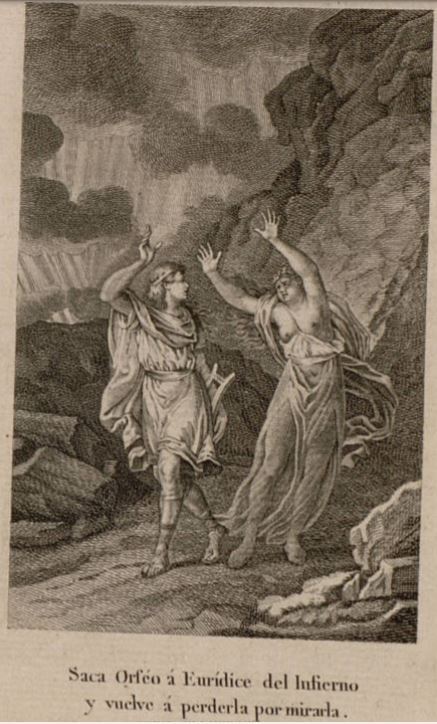
This image depicts Orpheus trying to save his wife Eurydice from the Underworld. Eurydice had died from a venomous snake bite, and Orpheus was so pained by her death that he traveled to the Underworld to try to rescue her. He played his lyre for the lord and lady of the Underworld, and they were impressed with him and allowed him to take Eurydice back to the surface with him on the condition that he does not look at her. Orpheus, however, did not listen. He looked back to Eurydice to make sure she was following him, and she instantly vanished. This image depicts Orpheus standing in front of Eurydice as he looks back to her. Eurydice’s hands are in the air as she is about to go back to the Underworld due to him looking at her.
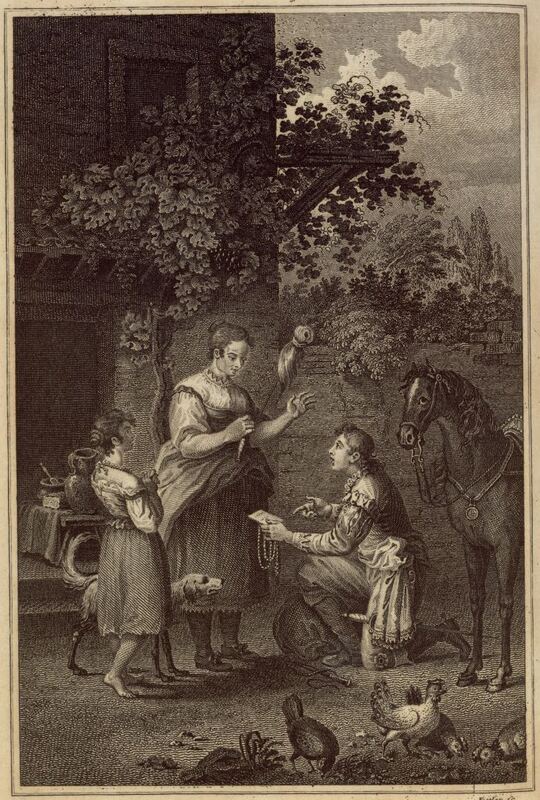
The duchess’ page kneels before Teresa Panza and her daughter Sanchica. He presents them with letters and gifts from the duchess and Sancho Panza. Signed by J. Fittler (engraver). Part 2, ch. 50.
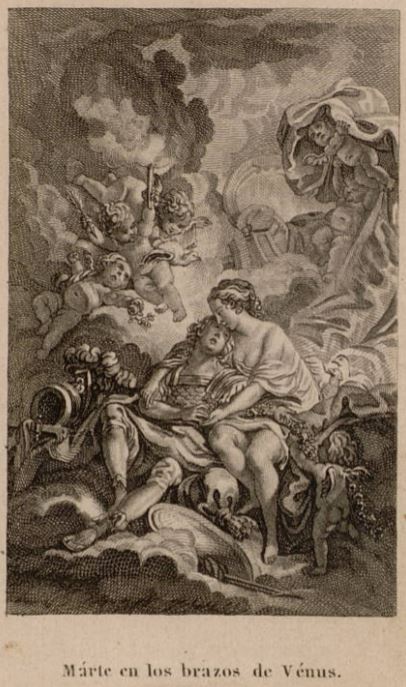
This image depicts the god Mars and Venus having an affair. They are depicted wrapped in each other's embrace as they are surrounded by winged cherubs. The sun god, who sees everything on Earth had seen Venus and Mars in bed together and told Venus’ husband Vulcan. In a jealous rage, Vulcan, the god of craftsmanship and fire, had created thin wires made from gold to fashion a net in order to trap the adulterers. It appears that two of the cherubs in the top right corner of the image are carrying the net that will catch Venus and Mars.
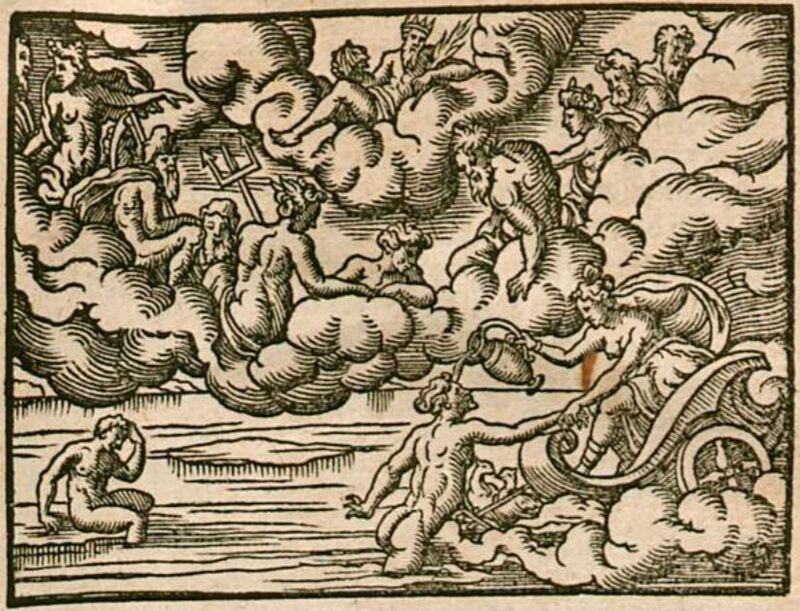
This engraving illustrates the deification of Aeneas. Aeneas’ mother, Venus, had begged her father, Jupiter, to grant Aeneas some form of divinity so that he will be able live freely with her as a god. Venus believes that Aeneas’ accomplishments make him worthy of divinity. Jupiter grants Venus this request. Jupiter is illustrated at the top of the engraving sitting in the clouds watching over the ceremony. There are other gods illustrated in the engraving as well, one of them being Neptune, as his trident is illustrated amongst the gods. Venus is in the bottom right corner sitting in her chariot as she pours a divine perfume over Aeneas’ body after he had been cleansed of his mortality in the river Numicius. Aeneas is depicted reaching out to his mother, holding her hand as he accepts the deification. Aeneas then becomes the god named Indiges.
A lit torch of flax lies in the background next to a bellow on the left and a wooden horse's head on the right (the head of Clavileno). In the foreground there is a stick lying to the left of a crown. These are all objects which played a role in Don Quixote's adventure with the 'flying' wooden horse Clavileno at the behest of the duke and duchess.
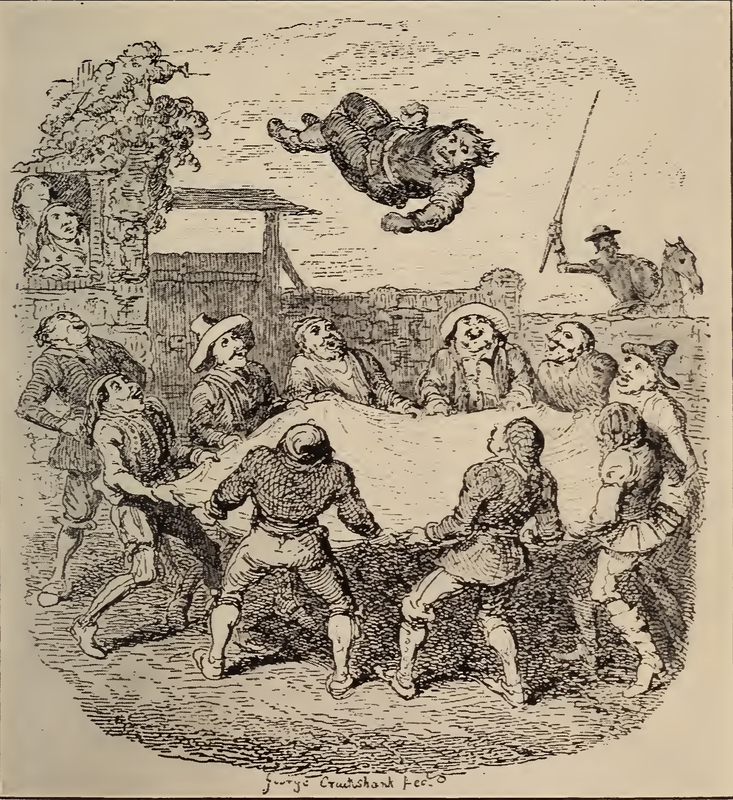
The ill-fortuned Sancho Panzo gets taken off his mount and carried to the yard of an inn by a company of lively fellows. This company is composed of four wool-carders from Segovia, three needle-makers from Cordova, and two lodgers from the Fair of Seville. This company fetches a blanket and places Sancho Panza into the middle, subsequently flinging him into the air. Sancho Panza cries wretchedly as he flies, reaching the ears of his master Quixote who can not help because his path is obstructed by a fence.
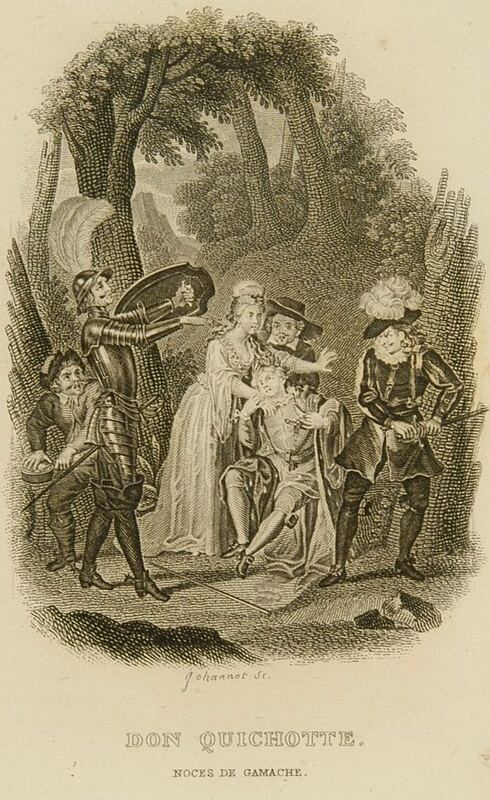
At the marriage of Basilio and Quiteria, and former pretends to stab himself. To the left, Don Quixote moves to stop him. To the right, Camacho makes ready to draw his sword. Sancho Panza and the priest are also pictured. Signed by Johannot (engraver), no given name. Part 2, ch. 21.
This engraving depicts Iris, the messenger of the Gods, entering the cave of the god of sleep. The god of sleep is illustrated laying on a bed of ebony, which is veiled by a dark-grey sheet. Iris was sent to seek out the god of sleep by Juno. Juno wishes for the god to appear to Alcyone in a dream to reveal that her husband, King Ceyx of Thessaly, has died in a shipwreck.
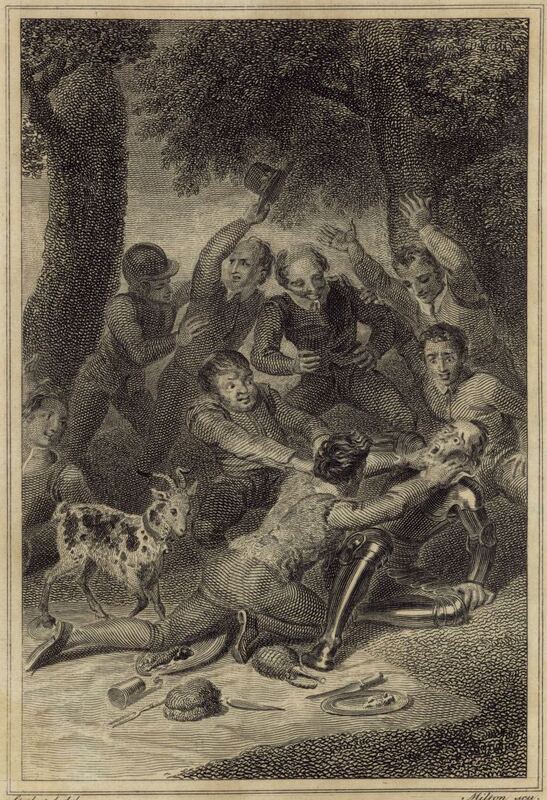
After Eugenio provokes him, Don Quixote seizes a loaf of bread and hits the goatherd with it full in the face. Eugenio leaps on Don Quixote and wraps both hands around his neck. Sancho Panza rushes to help Don Quixote, but is held back by the canon’s servants. The canon, the priest, the barber, and the officers of the Holy Brotherhood look on, some laughing. Signed by T. Stothard (illustrator) and T. Milton (engraver). Part 1, ch. 52.
Having fallen from his horse, Don Quixote (left), clad in full armor, begins to get up off the ground. His sword is wedged beneath his legs from the fall, but has not injured him. His horse, Rocinante (right), looks to the right and also begins to rise. In the background, the outline of some trees can be seen.
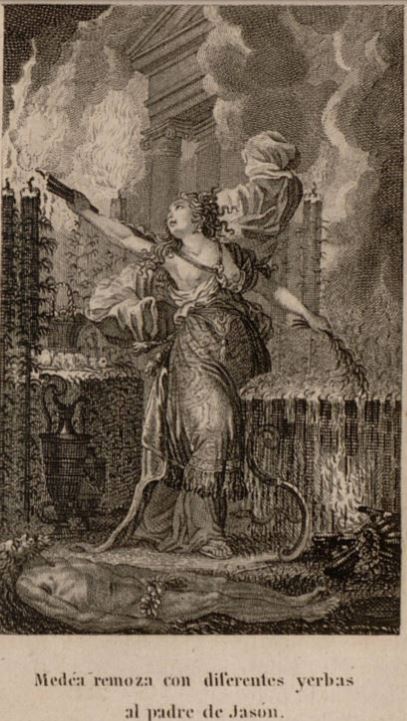
This image depicts Medea performing magic with various herbs in order to rejuvenate her father-in-law Aeson. Aeson’s body is lying on the ground as Medea lights candles and holds an olive branch. Medea must slit the throat of Aeson and drain his blood so that she can replace it with her potion. Once this is done, Aeson is rejuvenated by forty years.
Jupiter is illustrated on the left side of this engraving. He is depicted wearing a crown to signify that he is the king of the gods. The woman that he is chasing is Io, daughter of the river god Inachus. Io was walking through the woods trying to find her way home when Jupiter approached her. When Io declined Jupiter’s approaches, Jupiter created a foggy mist to veil her vision, which is illustrated above Io in the engraving. When Jupiter finally caught up to Io, he raped her.
Don Quixote arrives at the inn, which he perceives to be a castle, mounted on Rocinante. He carries a lance and a sword. The innkeeper (who appears to Don Quixote as the lord of the castle) holds Rocinante’s reins while Don Quixote attempts to calm two ladies frightened by the sight of him. In the background, a swineherd blows a horn, who Don Quixote confuses with a dwarf welcoming the knight to the castle. The buildings featured in the illustration are not representative of Manchegan architecture. Plate no. 3, unsigned. Vol. 1, book 1, ch. 2.
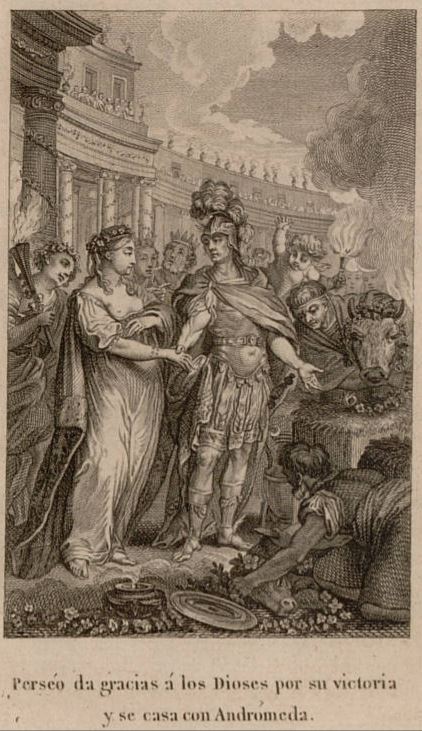
In exchange for rescuing her from a close encounter with a serpent, Andromeda’s parents allowed Perseus to marry Andromeda. This image depicts the wedding ceremony of the two. Perseus is depicted wearing his armour and Andromeda is depicted wearing a long dress that exposes her breasts. Perseus is looking at Andromeda as he holds her hand. There is a crowd of people witnessing the ceremony, and one man on the right side of the image appears to be sacrificing a cow to the gods for the event.
Don Quixote (background) and Sancho Panza (foreground) return to their village, and are welcomed by the priest, the barber, the housekeeper, Don Quixote’s niece, and Sancho’s family. Sancho leads his donkey. A church is pictured on a hill in the background. Signed by F. Hayman (illustrator) and S. F. Ravenet (engraver). Part 2, ch. 73.
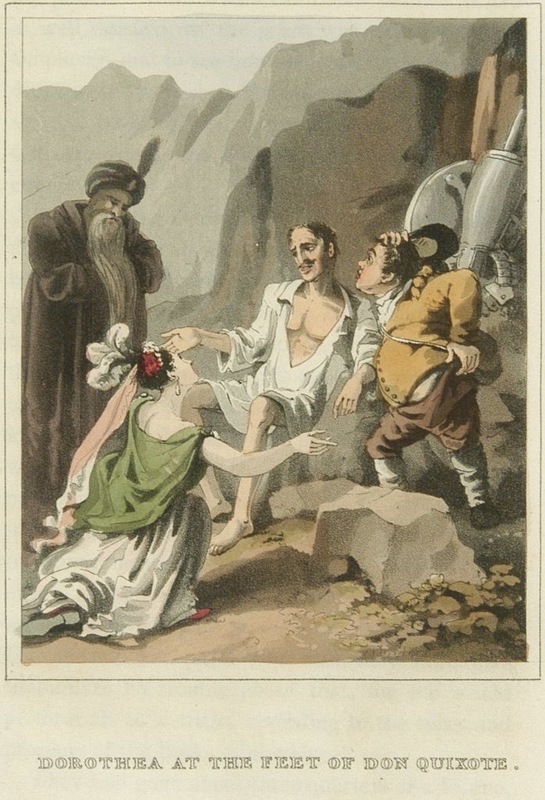
In Sierra Morena, princess Mimicona (Dorotea) kneels before Don Quixote and begs for his help. The barber is disguised as Dorotea’s page with a fake beard (an oxtail). Also pictured is Sancho Panza (right). The landscape is poorly detailed. Unsigned. Part 1, ch. 3.
Altisidora (left) enters Don Quixote's chambers in a long white taffeta robe, in her left hand she supports herself with a black staff of polished ebony, her right hand reaching out to the knight, she is wearing a garland on her head. Quixote see's Altisidora, but is so confounded by her presence he grasps violently at his pillow. On the right there is a wooden chair. In the background Sancho Panza watches from behind a curtain.
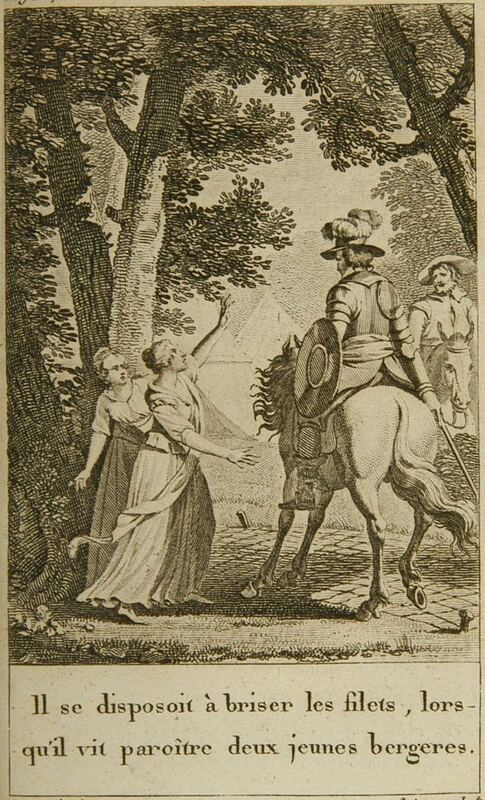
Don Quixote finds himself caught in nets of green string that are stretched between trees. Imagining that enchanters want to entangle him, he tries to break the nests when two shepherdesses appear before him and Sancho Panza. They are dressed in jackets and skirts made of fine brocade and rich moiré shot with gold. They invite the errant knight and his squire to dine with them and their friends in field tents (background) that they have put up along the banks of a stream. Signed by J.-J.-F. Le Barbier (illustrator) and J.-J. Coiny (engraver). Part 2, ch. 58.
Having been beaten in a duel by Don Quixote, Sampson Carracso arrives in a village where they meet an algebrist (middle), pictured with a full white beard. The algebrist cures the unfortunate Sampson (left) by pouring ointment onto his wounds. Sampson, lying in bed in a large white shirt raises his left arm to be treated and speaks to Tom Cecial (right) about how he will enact revenge on Quixote. Tom Cecial (known otherwise as the Squire of the Woods), wearing his signature brimmed hat, listens to his master. In front of the bed, a trunk rests with bedding laid atop of it.

![[Dinner at Barataria Island]](https://collections.cemvc.ca/files/large/8b87c6ab06bd4a50e332c8e512749d5e450f65f0.jpg)
![[Of Don Quixote's Surprise Encounter with Donna Rodriguez]](https://collections.cemvc.ca/files/large/c3e45d204fea7e6bffa1fef7c9de2eff80c93e1b.jpg)
![[Sancho Panza ties Rocinante's hind legs]](https://collections.cemvc.ca/files/large/37848910d49ebc5456de881210f636e6eb21986a.jpg)
![[The Objects Involved in the Adventure of Clavilenos]](https://collections.cemvc.ca/files/large/e585bd60059597502c146e9d0a4dd0ee48178d66.jpg)
![[Don Quixote lies next to his Horse Having Fallen]](https://collections.cemvc.ca/files/large/83ea08029e5339554e7fd76a83554affe0bda22a.jpg)
![[Arrival at the inn]](https://collections.cemvc.ca/files/large/ca5d154fd87292920bcceab735d7642af55c1731.jpg)
![[Don Quixote and Sancho Panza return to their village]](https://collections.cemvc.ca/files/large/db7d7c28f4f5464343a0df00425f4008093fc426.jpg)
![[Altisidora Visits Don Quixote in his Chamber]](https://collections.cemvc.ca/files/large/142af9c09eaa204b689732e08e3a56471d80c9d3.jpg)
![[Of How Sampson Carrasco Was Healed After Defeat]](https://collections.cemvc.ca/files/large/2a2833456c8883c8aa3bf59e9493529f076741b6.jpg)